


Likes
Comments
Share


@Naturalist
Follow
Started LST on day 64, trimmed & added 2nd light panel on day 68.


Likes
2
Share


@Mr_nugs_lover_David
Follow
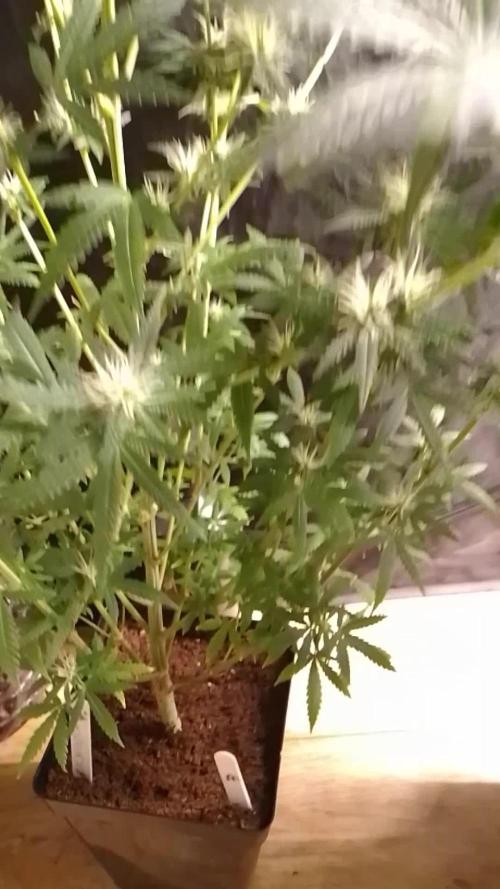
Her aroma it's just super cheesy,I love the autoflowers from this seedbank they have amazing and original aromas and flavors,she's not gonna ve very productive however I love how she smell it's gonna be a pleasure to taste.



Likes
6
Share


@Virginia_Nugz_540
Follow
Okay so I’ve been slacking a bit on the grow-diaries, only because I’ve had a lot going on and also because I don’t feel obligated to do so because this isn’t a sponsored grow. It’s been nice to have a little break but I think I’m ready to come back at it full force again.
These girls are living their best lives, they are all the same age and they are all thriving. Floraflex nutrients, as well as some Silica, Regina-root, and a trichome enhancer called “Grease”!! Seems like the real deal. Watering every other day and let me tell you these girls are very thirsty. Defol as needed!
My new HLG Blackbird lamp fixture is out of this world. My 3 autos that you can also find in my profile absolutely blew up. I typically fit 4 autos in my 3x3 but now it’s essentially one Purple punch from Fastbuds and I had to cram 2 more inside basically because they are going crazy. Unfortunately I had to move them from under the blackbird and put them under a HLG350R and they are still going crazy. Basically what I’m saying is HLG Lamps=Crazy growth and amazing lamps!! HLG has a lifetime customer!
That’s it for now but check in next week to see the progress!
Thanks for tuning in. Until next time and as always, Stay Smokey my Friends!!! 💨💨💨
Instagram: Virginia_nugz_540
Sponsors:
Horticulture Lighting Group
HLG-Blackbird
HLG-600RSpec
HLG-350R Diablo (X2)
Discount code: Virginia_Nugz
Petra Tools
LTPRO 2.0 Backpack Sprayer
Trimbag
Standard Trimbag
Discount Code: Virginia_nugz
Fastbuds
Fastbuds Genetics
Goat and Monkey
Hydrokulture Store
4x4 Gorilla Tent
Likes
4
Share


@FrecheOma60
Follow
They all look very healthy, i always water the full amount fertilizer like in the plan from hesi in combination with rain water (ec 0).I always water the ground of my tent, so the plant can get enough but dont get overwatered every plant takes what it needs. I wasnt sure if I should have defoliated the plants but now its too late , hopefully every topbud gets big and we dont get any mold issues.
Likes
1
Share

@Ninjabuds
Follow
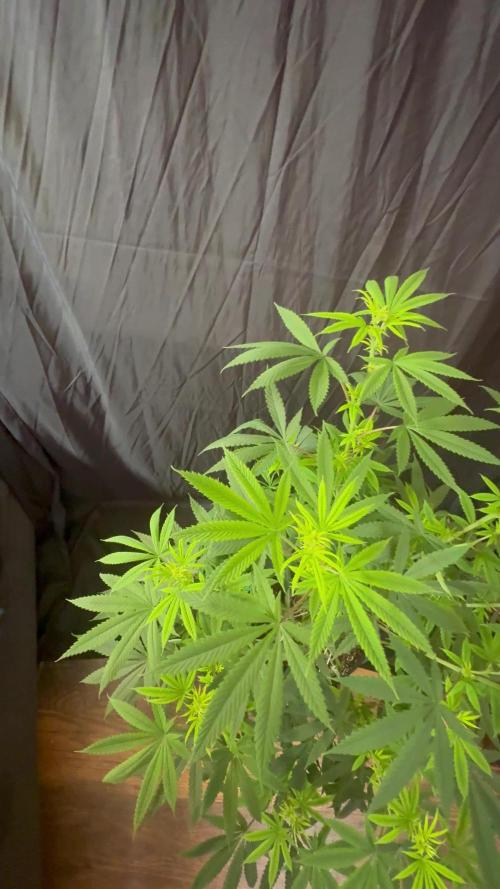
I like this plant it’s not to big and not to small. I’m still trying to give it enough nutrients it is a super heavy feeder. It keeps wanting more and more nutrients I’m excited to see how this one turns out

Likes
31
Share


@The_Bearded_Grower
Follow
Day 39 11/06/20 ok so she is doing very good and the color is amazing. i cant wait till she gets bigger and boy she is thirsty i have to 5 from 1 gal to 5 L. i have lots of info in the vids for your viewing. happy growing and keep your stick on the ice

Likes
1
Share

@hinterhofgrower
Follow
.
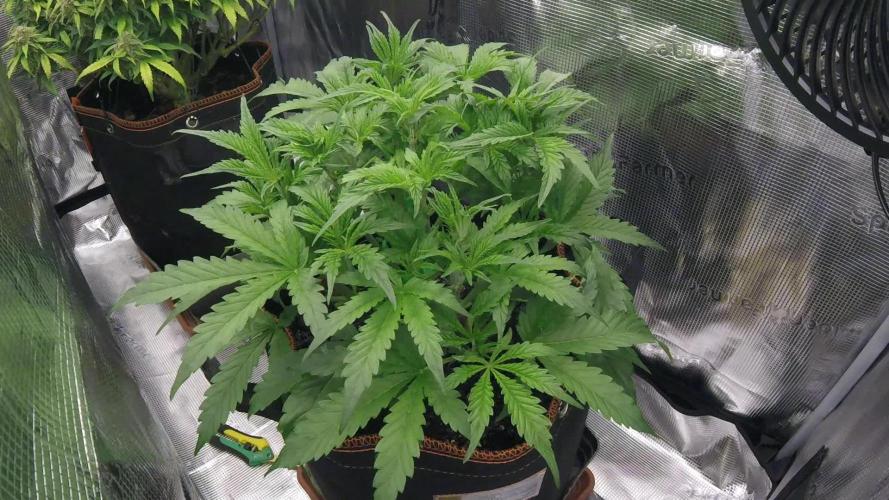
🌱 :
💧 : 4l day 35, 4l day 39, 4l day 41
💡 : Dli: 40 mol/m²/d
🤔 :

Likes
8
Share


@HydroBudz91
Follow
Week 4 of flower Mann I think she’s looking pretty good!!! She’s really starting to swell up. I was running my ppms at 800 the last week but I upped it to 950 this week. She’s responding great and no leafs have burnt. And Mann is she popping trichomes like crazy already and she smells nice light but you smell her. I’m loving DWC more and more. She is drinking a lot so I am constantly watching water level. Week 5 lets get it!!!!

Likes
1
Share

@Grow_bob
Follow
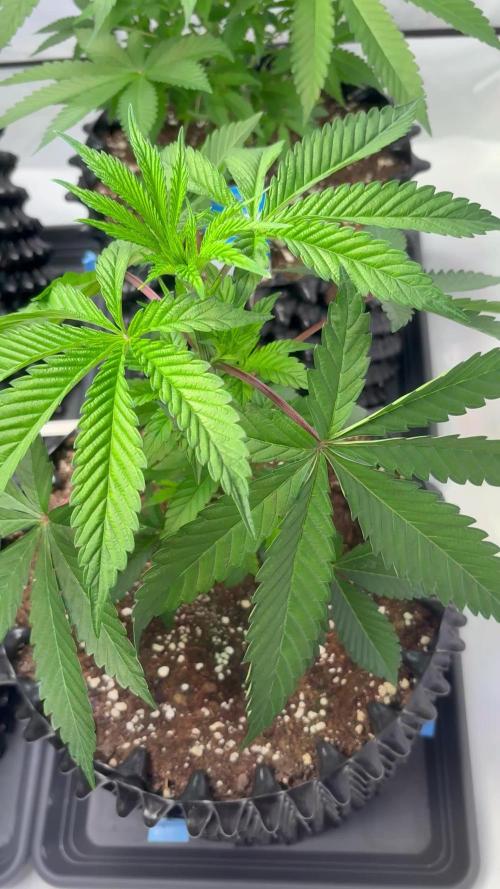
Sie wird immer größer xD ma gucken ob nach 5 Automatik Versuche auch die fem drauf hab 😅
Wurden vor 2 Wochen von 1L AirPods zu 12,5L umgetopft … mfg


Likes
120
Share


@DogDoctorOfficial
Follow
The Harvest Prelude:
After a patient wait and 48 hours of darkness, the moment arrived. The Tropical Tangie Lego Ninja, standing proudly like a silent guardian, was ready for the grand harvest. The sound of each cut echoed through the grow space, reminiscent of felling a mighty tree. The compact structure of the buds was awe-inspiring, a testament to the ninja's disciplined growth.
The Lego Ninja, like a stoic warrior, was then hung upside down, beginning a two-week drying ritual. Maintaining an ambient temperature of around 21°C and a relative humidity of 60%, this slow-drying process allowed the buds to retain their essence, preserving the symphony of terpenes and cannabinoids.
The trimming phase unfolded like a fragrant masterpiece. Each bud, adorned with a glistening layer of resin, transformed the trimming process into a sensory delight. The zesty aroma of oranges enveloped the room, a tangible expression of the tropical lineage. The compact buds made every snip a careful dance, revealing an abundance of frosty trichomes.
The moment of reckoning arrived with the scale's unveiling. The Tropical Tangie Lego Ninja, from a single plant, bestowed upon me 309 grams of dried medicine. Each gram was a treasure trove of cannabinoids, a promise of euphoria and relief. The sheer compactness of the buds translated into a concentrated potency that left me in awe.
In parallel, the clones, nurtured with equal care, showcased a fascinating divergence. A twist in the tale unfolded as the intense oranges of the mother transitioned into vibrant tangerines. This unique expression, I believe, was a testament to the clones weathering a summer heatwave differently, bringing forth a distinct personality.
The clones, resilient and generous, gifted me a bountiful 549 grams of pure joy. This now my keeper of the garden, an embodiment of the Lego Ninja's legacy. The harvest dance, though familiar, carried the nuances of tangerine zest, a refreshing twist that left me eager to explore its intricacies.
Both harvests shared a common thread—their resinous abundance. The trim bin, akin to a treasure chest, gleamed with golden trichomes and fragrant joy. Sticky fingers became a badge of honor, a tangible connection to the resinous richness that filled the room.
Shout Outs:
No harvest report is complete without expressions of gratitude. A special nod to @DutchPassion_Official for crafting the genetic marvel that is the Tropical Tangie Lego Ninja. Their expertise paved the way for this epic journey, and I tip my hat in acknowledgment.
In conclusion:
As the dust settles on this epic harvest saga, my heart brims with happiness and excitement. The Tropical Tangie Lego Ninja has proven itself not just as a plant but as a living masterpiece. Stay tuned for the smoke report, where we delve into the true essence of this botanical ninja's legacy. Until then, fellow cultivators, may your gardens flourish, and your harvests be as bountiful as the joy they bring.
As always thank you all for stopping by, for the love and for it all , this journey of mine wold just not be the same without you guys, the love and support is very much appreciated and i fell honored and blessed with you all in my life<3 <3 <3
#aptus #aptusplanttech #aptusgang #aptusfamily #aptustrueplantscience #inbalancewithnature #trueplantscience
With true love comes happiness <3 <3 <3 Always believe in your self and always do things expecting nothing and with an open heart , be a giver and the universe will give back to you in ways you could not even imagine so <3 <3 <3
Friendly reminder all you see here is pure research and for educational purposes only
<3 <3 <3 Growers Love To you All <3 <3 <3
P.S- I must extend my sincerest apologies for the missing video reports. Regrettably, Grow Diaries is still facing some technical issues that are preventing me from uploading them. Rest assured, as soon as the situation is resolved, I'll share those videos to give you an even closer look at this fascinating journey. or in my case apparently GD dont let me do uploads over 100mb with is super small file if you working and editing videos , doing my best here to upload them all but GD is not making my life easy on this <3 <3 <3


Likes
8
Share


@Ctbest2023
Follow
Week went good girls are drinking like crazy and growing broke a cola on one week and half ago she hasnt grown much since but its about healed now but she should catch up now

Likes
2
Share


@Thanas_Garden
Follow
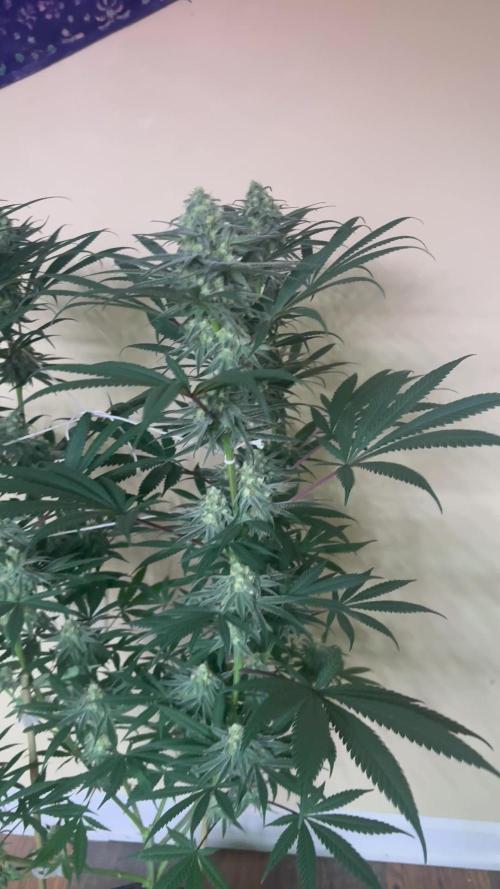
Week 7.
I adjusted the watering system so that instead of 3 minutes twice a day, it now turns on at 5 hour intervals during the lights on period. So the first watering occurs at 8 am when the lights come on, then again at 1pm, 6pm and 11pm.*
This turned out to produce too much runoff after the first day. So I adjusted it down to 1 minute for each fertigation, still at the 5 hour intervals 4 times a day.
I started seeing trichomes on some of the buds. They are still very early in their development, but I can see some sugar leaves starting to get frosty. The smell, which is sweet and green, has become more prominent when the tent is open, but not overwhelming by any means.

Likes
1
Share

Likes
4
Share


@AestheticGenetix
Follow
11/13/24
Fed today with 15 ml bloom and 15 ml bloom booster as top
11/17/24
the buds seem healthy. just watering as needed. the environment is easy to deal with again since the weather has changed to cold, so now i can run my heater and that drops the humidity to a manageable level without having the dehumidifiers running.
Likes
9
Share


@Buddyhighs
Follow
Another good week doubling size, loads of starts of buds blossoming. Both seem to to have grown more of an appetite water a feed every day this week.
Stage 5: budding/flower
Day36: water and tied down and defoliate
Day 37: feed
Day38: last spray
Day39:water
Day40: water
Day 41:feed more defoliation
Day 42: water
Likes
18
Share


@Ultraviolet
Follow
Chemical reactions in which, a single substance splits up into two or more simpler substances are called decomposition reactions. These reactions are carried out by energy, supplied by different sources. The required energy can be supplied by heat (thermolysis), electricity (electrolysis), or light (photolysis).
Let’s talk about photolysis reactions (not photosynthesis): Photolysis (also called photodissociation and photodecomposition) is a chemical reaction, in which a chemical (an inorganic or an organic) is broken down by photons and is the interaction of one or more photons with one target molecule. The photolysis reaction is not limited to the effects of visible light, but any photon with sufficient energy (higher than the dissociation energy of the targeted bond) can cause the chemical transformation of the said (inorganic or organic) bond(s) of a chemical. Since the energy of a photon is inversely proportional to the wavelength, electromagnetic waves with the energy of visible light or higher, such as ultraviolet light, X-rays, and γ -rays, can also initiate photolysis reactions.
Like all other peroxides, hydrogen peroxide (H2O2) also consists of a relatively weaker O−O bond, which is susceptible to light or heat.
The net equation for the reaction is:
2H2O2⟶2H2O+O2
The step-wise reaction mechanism is suggested as follows (Ref.1):
H2O2+hν⟶2HO∙
HO∙+H2O2⟶HO−O∙+H2O
HO−O∙+H2O2⟶2HO∙+H2O+O2
Using isotope studies it was confirmed that the O2 formed is cleanly derived from H2O2 (Ref.2).
Notes: The rate increases rapidly in the presence of catalysts such as MnO2 and KI (Ref.2). The rate of decomposition is slow at room temperature, but it increases with temperature. It is believed to be due to thermal decomposition of H2O2, which seemingly accelerates the photolysis (Ref.3).
References:
1.J. P. Hunt, H. Taube, “The Photochemical Decomposition of Hydrogen Peroxide. Quantum Yields, Tracer and Fractionation Effects,” J. Am. Chem. Soc. 1952, 74(23), 5999–6002 (https://doi.org/10.1021/ja01143a052).
2.A. E. Cahill, H. Taube, “The Use of Heavy Oxygen in the Study of Reactions of Hydrogen Peroxide,” J. Am. Chem. Soc. 1952, 74(9), 2312–2318 (https://doi.org/10.1021/ja01129a042).
3.F. O. Rice, M. L. Kilpatrick, “The Photochemical Decomposition of Hydrogen Peroxide Solutions,” J. Phys. Chem. 1927, 31(10), 1507–1510 (https://doi.org/10.1021/j150280a004).
Interestingly, as early as 1934 Haber and Weiss (Ref. 1) proposed that HO2∙ is formed in the decomposition of hydrogen peroxide.
The subsequent reaction of the transient superoxide radical anion with hydrogen peroxide has been determined to also form the hydroxyl radical (Ref. 2). The higher pH version of the last reaction is, therefore, best represented as:
O2∙−+H2O2⟶2HO∙+OH−+O2
And as H++OH−=H2O, the net product formation is not altered. However, alkaline H2O2 is well known to be less stable than acidic hydrogen peroxide (Ref.3) even in absence of light exposure, which accelerates its decomposition (which can involve radical pathways) liberating oxygen!
References:
1.Haber Fritz and Weiss Joseph, 1934, The catalytic decomposition of hydrogen peroxide by iron salts. Proc. R. Soc. Lond. A 147: 332–351 http://doi.org/10.1098/rspa.1934.0221
2.TOSHIHIKO OZAWA, AKIRA HANAKI, Reactions of Superoxide with Water and with Hydrogen Peroxide, Chemical and Pharmaceutical Bulletin, 1981, Volume 29, Issue 4, Pages 926-928. https://doi.org/10.1248/cpb.29.926
3.https://www.researchgate.net/figure/Effect-of-pH-on-the-decomposition-of-hydrogen-peroxide-H-2-O-2-0-800-mg-l_fig1_234110563, from Yazıcı, Ersin & Deveci, Haci. (2010). Factors Affecting Decomposition of Hydrogen Peroxide. https://doi.org/10.13140/RG.2.1.1530.0648.
Processing
Likes
22
Share


@DankBudz
Follow
Well day 63 in flower and still maybe only 25% red hairs.
022320 - day 68 flower, still 50% white hairs, almost time to start watching trichs 😁.

Likes
4
Share

@eldruida_lamota
Follow
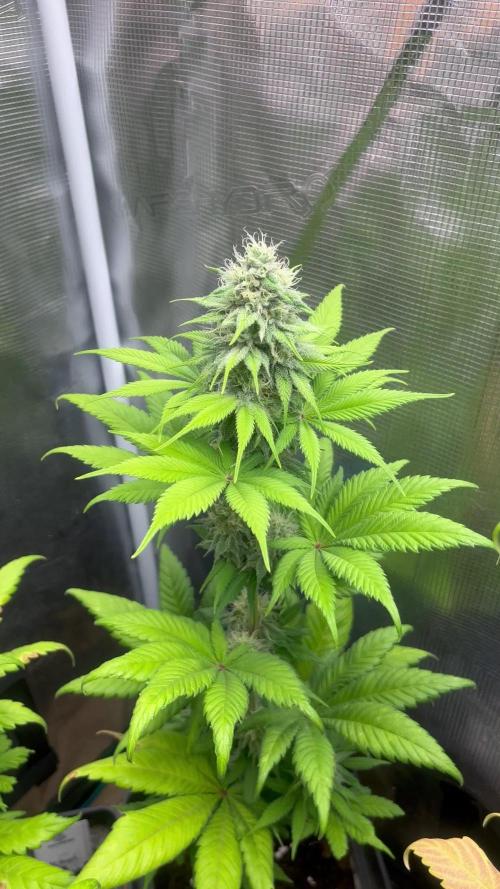
Que pasa familia, vamos con la quinta semana de floración de estas Kiwi x Papaya feminizadas de Mavericks .
Vamos al lío ,se trasplantaron en macetas de 7 litros definitivamente.
El ph se controla en 6.0 , la temperatura la tenemos entre 24/20 grados y la humedad ronda el 50%.
El ciclo de crecimiento puse 12h de luz, el foco está al 100% de potencia.
De momento van creciendo a buen ritmo y tienen un buen color.
La flor está cogiendo forma y ya empezó a tricomar.
Gracias a Agrobeta de nuevo por el kit para esta temporada, unos grandes 🙌.
- os dejo por aquí un CÓDIGO: Eldruida
Descuento para la tienda de MARS HYDRO.
https://www.mars-hydro.com
Hasta aquí todo, Buenos humos 💨💨💨
