Likes
Comments
Share
@Mrg7667
Follow
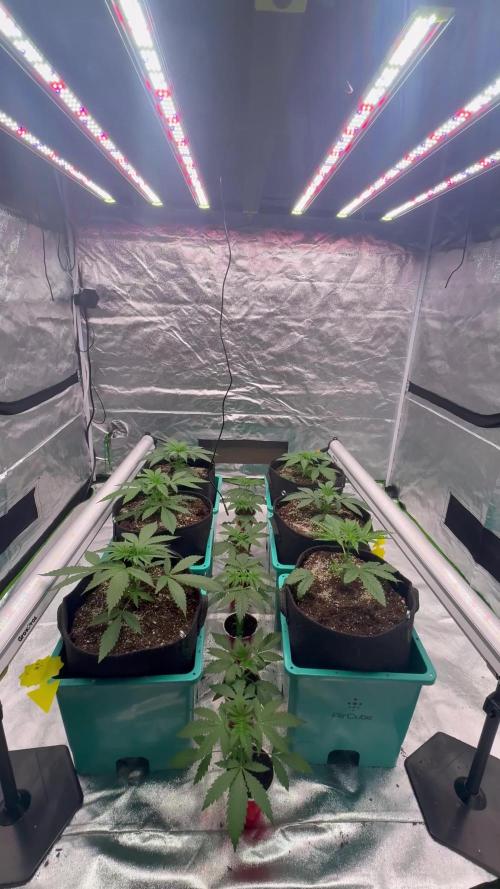
Lowered the lights a good 8-10inches just because i realized i could get them closer without burning! Going for around 6-7 inches above canopy getting the temp in the high 70s low 80s om top canopy. All pheno are getting very unique and super resinous! I have a slight lnat problem going to spray this week when i get paid
Likes
3
Share
Tito's Living Soil Blueprint: Why You Can’t Treat Organics Like a Synthetic Hydro System. When transitioning from synthetic hydroponics to true organic cultivation, many growers bring their old habits with them. It is a common pitfall: pulling out pH pens, measuring runoff, and liquid-feeding heavy doses of organic nutrients as if the medium were sterile coco or rockwool. But living soil operates on an entirely different set of rules. To achieve the true potential of an organic garden, we must stop treating the soil as a mere holding tank for liquid chemicals and start viewing it as a self-sustaining biological engine. This will be a breakdown of why treating organic soil like a synthetic system fails, and how to shift ones methodology to unlock the true power of the soil food web. Pouring massive amounts of raw elements into a living system all at once is the biological equivalent of force-feeding a newborn a massive takeout meal and expecting them to digest it instantly. In an optimal system, soil should never be breaking down more than roughly 5% of its total composition as organic matter at any given time. The math is simple: more intense chemical and biological reactions equal more physical heat. If the root zone temperature creeps even remotely over 72°F, oxygen hypoxia sets in, drastically reducing plant growth. Organic rhizospheres and biological nutrient delivery require significantly more oxygen to maintain efficient parameters for growth—a reality that is drastically different from a pure synthetic approach where a complex rhizosphere is virtually non-existent. The fundamental blueprint of organic growing relies on Cation Exchange Capacity (CEC). The goal is to build a medium with so much CEC that it can store massive amounts of excess nutrients safely. This provides the necessary buffering capacity to handle large biological reactions, a process typically managed in the time period between grows. Once the soil is fully loaded and stabilized, the rhizosphere maintains its own pH balance, allowing the plant to dynamically feed itself directly from its massive, built-in storage of CEC. Treating Living Soil Like Coco creates a runoff-runaway trap. Applying a massive overdose of raw organic materials releases too many nutrients at once, leading to completely uncontrolled pH skewing. Running a synthetic-style management setup while simultaneously dumping organic inputs into the container does not make it an "organic" grow. Trying to judge a metric like pH after letting it run completely out of control with multiple simultaneous amendments is an uphill battle. Each input possesses unique chemical properties that drastically alter atomic decay chains and, consequently, pH. Without an adequate structural buffer, the medium experiences unpredictable swings. Put simply, the sheer volume of inputs rapidly outpaces the soil's built-in buffering capacity. Constantly reading the pH and Electrical Conductivity (EC) of input and output water in an organic soil is not true organic cultivation; it is just a synthetic indoor environment layout utilizing organic ingredients. This presents a distinct misunderstanding of how these two opposing approaches need to be separated. One cannot simply measure EC and pH to heavy runoff in a soil designed to store cations and expect to keep accurate tabs. Even when using 100% organic certified ingredients, liquid feeds, and compost teas, the underlying methodology matters most. Measuring runoff pH and EC treats an organic soil system like a synthetic coco or rockwool grow. In a high-CEC organic soil, a runoff reading is highly inaccurate. A soaring runoff reading of 8.0 is often just the water physically washing past raw amendments on its way out of the pot. It does not mean the actual root interface is locked out; it simply indicates that the soil ran out of immediate storage capacity for those heavy inputs. Synthetic growing relies entirely on direct nutrient delivery. Chemical salts are poured over the root system, the plant absorbs what it needs through basic osmotic pressure, and the excess is flushed away. True organic growing, however, relies on biological cycling. An organic soil should never be watered to heavy runoff, because doing so actively washes away the beneficial microbes, soluble humic acids, and organic buffers that the soil life works so hard to create to protect the root zone. Applying inputs as an immediate, massive overload of raw elements causes chaotic chemical spikes. Dumping heavy amendments directly into a big pot mid-grow triggers unpredictable reactions. In a true living soil system, amendments are added in tiny, balanced amounts long before the plant ever meets the dirt. This deliberate timeline allows the soil’s Cation Exchange Capacity to naturally "park" and buffer those nutrients. When inputs outpace the soil's ability to buffer them, the system breaks down, and the runoff pH screams. When faced with a fluctuating pH meter, a common reactive impulse is to throw agricultural sulfur at the problem. This is a classic example of trying to react mechanically to a digital number rather than letting the soil chemistry work. Elemental sulfur does not lower pH on contact. Soil microbes must first digest it and convert it into sulfuric acid. Because this biological process takes weeks or even months, adding it mid-problem yields no immediate change. This leads to the temptation to add even more. Weeks down the line, the cumulative sulfur will finally convert, causing the pH to crash violently and fry the root system. As a general rule, avoid using sulfur as a corrective knee-jerk reaction. If it is used at all, it should be applied strictly 2 to 3 weeks prior to flower as a precise, one-off addition to assist with Isopentenyl pyrophosphate synthesis. If a soil matrix is truly experiencing a severe alkaline lockout at a pH of 8.0, the new leaves at the very top of the plant will tell you directly by turning bright yellow while the veins stay dark green—the classic signature of alkaline drift and iron chlorosis. The solution is simple: put the pH meter away. Stop watering to heavy runoff. Only apply enough water to evenly moisten the soil matrix, and let natural inputs do their job to feed the microbes and naturally buffer the root zone. Electrical Conductivity (EC) dictates plant water and nutrient availability by altering the soil solution's osmotic potential. This potential controls whether a plant can efficiently pull water into its roots or if it will actually lose water to the surrounding soil. If a grower cannot control the rate of what is going in (the rate of nutrient release) and cannot control the rate of what is going out (the plant's dynamic growth), the immediate medium's EC deviates. When EC deviates, osmotic potential goes with it, disrupting bulk flow and the entire vascular transport system of the plant. Synthetic nutrient delivery relies on precise input measurements and an incredibly tight management of the wet-dry cycle to prevent the constant, violent spiking of EC caused by excess moisture loss. Reducing EC to a mere measurement of "food in and food out" oversimplifies its true function. It acts as a balance of electrical conductance that must be maintained to regulate the flow of water. Failing to acknowledge this is a severe disservice to the beauty and potential of a true rhizophagy cycle in all its respiratory glory. True organic cultivation does not actually begin until biological cycling is actively linked to hydrogen exudation from the roots. The vast majority of modern cultivation advice leaves growers completely in the dark regarding these biological mechanics. This is a product of market capitalism rather than basic chemistry. There are significantly lower profit margins for hydroponic companies when a grower uses ten times fewer mass consumables and relies on little more than water from seed to harvest. By shifting focus away from "feeding the straw" and moving it toward nurturing the near-infinite soil food web, the plant regains absolute autonomy over its own rhizophagy cycle. It begins regulating its own nutrient intake dynamically, without a single digital EC pen in sight. This allows the grower to focus entirely on optimizing the macro-environment rather than micromanaging the root zone. The cultivation medium can be reused indefinitely so long as you can prevent a buildup of carbon and nitrogen in the soil; cover that in a later week. To achieve a truly organic system that unlocks this rhizophagy cycle, the cultivation approach must shift entirely from feeding the plant directly to feeding the soil microbiome. Because the modern gardening community is heavily guided by synthetic methodologies, the subtle nuances and variations of this biological process are rarely highlighted. The hydroponic industry is fundamentally built on a recurring revenue model of bottled minerals, flush agents, and sterile mediums. Conversely, a self-sustaining living soil system requires minimal external inputs after its initial build. This shifts the grower's role from a rigid chemical manager to a biological custodian. Because managing biology requires observing subtle environmental factors—like consistent soil moisture, oxygenation, and temperature—rather than reading a digital screen, commercial entities scaled for automated, synthetic delivery often dismiss it as unpredictable. When the soil food web is fully unlocked, the plant takes the driver's seat, operating with a level of systemic efficiency that synthetic nutrient lines simply cannot replicate. In the commercial cultivation landscape, corporate structures are legally bound to protect shareholder interests and recurring profit margins, which often prioritize the sale of bottled consumables over the promotion of self-sustaining agricultural practices. Under modern industrial cultivation models, biology is too often treated as secondary to business. By stepping away from the meters, understanding Cation Exchange Capacity, and feeding the microbiome instead of the roots, you break free from the chemical cycle—allowing nature to do what it has perfected over millions of years.
Likes
72
Share
Hola hermanos de cultivo! 🤜💐🤛 Novena semana para las Green Crack F1 Automatic. Simplificando muchísimo el trabajo con la increíble controladora TrolMaster TentX 🤜💐🤛 🌄El clima se establece como una simulación de día real, con salida y puesta de sol más el pico de mediodía, el clima se siente bastante natural aquí adentro. Hice un nuevo artefacto para distribuir la humedad de manera homogénea en toda la carpa.🌅 _ FLORES GORDAS Y PEGAJOSAS _ Plantas verdaderamente rápidas y con un aroma dulce afrutado y diésel, con un pequeño fondo de incienso. Xpert nutrients en el orden adecuado hace todo a la perfección. Ahora ellas beben cantidades increíbles, 1 litro al día para las dos plantas, intercalando dos riegos con nutrientes y uno de enzimas para no generar sobrecargas. Ph: 6.4 - 6.6 EC: 1000 100+/100- HR: 55% 10+10-. C⁰: 20 - 28 . !! 20 hs 2 x TS600 + 20 hs TS 1000 led max dim !! . Los soportes laterales se encienden antes y se apagan más tarde que la iluminación central en el ciclo lumínico diario, con el control sunset de Trolmaster puedo usar mi TS1000 de MarsHydro para mejorar la entrada de luz y no estresar las pequeñas 🤜🤛 🌅🌄🌌 Un abrazo grande y mucho ánimo para todos, un gusto siempre!
Likes
5
Share
@Deli_Weed
Follow
Esta fue su última semana con nutrientes, no engordo mucho, creo que mi error fue excederme con los nutrientes a lo largo de su ciclo, yo aproximo que me dará unos 50 gramos masomenos, no es mucho pero es trabajo honesto jaja 😆 la próxima semana será de puro flush ya para darle corte
Likes
100
Share
Hi people :-) This week everyone has developed very nicely and is slowly coming to an end 🤗🌱🍀. The Orange Sherbert was placed in the darkroom yesterday and will be harvested tomorrow :-). Everyone else will continue to be flushed. Blue Gelato # 41, Her Majesty F1 and Sour Diesel will be harvested next week. The next week is the gelato letzt. Then I will gradually add all the harvest pictures 😍👍 I wish you all a good start into the week, let it grow 🌱🍀 and stay healthy 🙏🏻
Likes
37
Share
Last lap ! This is the biggest plant a grew, def
Likes
2
Share
Some problems have appeared with my beloved plants. From my research, I have poor air circulation inside my grow tent, which wasn't surprising. When I set everything up somewhat haphazardly, I knew I would need to fix it. I confess I'm dissatisfied with this week; some plants are stressed, nothing too serious, but I noticed a slowdown in 3 Baker's phenotypes, some gnats have returned, another insect I've never seen before has appeared, and I'm somewhat short on resources to deal with it. I also had a serious problem with the electricity, forcing me to completely improvise the electrical system and exhaust fan to work without a ventilator. Anyway, enough bad news. I'm still in my first run, but I'm learning from my mistakes!
Likes
3
Share
@RBK2023
Follow
I'm happy with how these OG's are growing after I topped them last week. I've just turnt to 12/12 and super cropped the main heads that were getting abit tall. I'm working against height on this grow so I need to keep them low to allow for the stretch!
Likes
32
Share
@UGrowGuy
Follow
Day 70! They are showing signs of foxtailing due to the light intensity. Time to go!!! Temps, humidity, and CO2 are prime. I pulled the Super Skunk, the Maui Waui’s, and the Gorilla Glue #4 into their light deprivation area for the next 60 hours or so. It gets dark when i drop the Cloth curtain. I also have a Durban Poison already hanging. Got tired of looking at her about a week ago. I will post some close up pics with those HIDs off and some normal light right before i cut them. There are a few more ripening up in the flower room. They will all be done over the next 2 weeks.
Likes
14
Share
@squalino
Follow
​🌿 Journal de Culture : Mac 1 Autoflower – Début Semaine 4 ​On attaque la quatrième semaine et le moins que l'on puisse dire, c'est que la puissance de la Mac 1 est au rendez-vous. On entre dans une phase charnière : la préfloraison. 💗​Un Grand Merci💗 ​Avant d'attaquer le vif du sujet, je tenais à remercier chaleureusement 💞@mia_biotabs et Mrs_Larimar 💞 pour leurs précieux conseils qui m'aident énormément à optimiser cette session. Un grand merci aussi à vous tous qui me suivez et qui m'encourage depuis le début ! ​Paramètres de Culture & État de la Plante ​Âge : 27 jours Passage officiel en préfloraison à 3 semaines et 3 jours (23 jours). ​Taille : Elle mesure actuellement 40 cm. ​LST (Low Stress Training) : Elle a subi un entraînement drastique hier. Sans ce LST, elle culminerait déjà à plus de 60 cm ! J'ai dû réduire sa hauteur pour garder une canopée homogène et gérer l'espace. ​Lumière : la lampe se trouve désormais à 65 cm de la canopée pour accompagner son début de stretch. ​Climat : Toujours stable (24°C jour / 21°C nuit) avec 50% d'humidité. ​Manipulations & Observations ​Côté technique, il y a eu du mouvement hier (04/05) : ​Retour aux sources : J'ai retiré les clips de palissage. Pour être honnête, je n'en suis pas fan. Je suis revenu à mes bons vieux bouts de ficelle pour guider les branches, je trouve ça plus précis et moins risqué pour les troncs. ​Entretien : J'ai procédé à un léger défeuillage pour libérer les sites de floraison naissants. Les feuilles de la Mac 1 sont tellement massives qu'elles bloquaient la lumière pour les branches inférieures. ​Nutrition : rien donné. Toujours sur la lancée Biotabs, le sol est vivant et la plante ne montre aucun signe de faim, bien au contraire, elle est d'un vert éclatant. ​Analyse de la structure ​La plante est devenue une véritable athlète. Le tronc principal, malgré la micro-fissure de la semaine dernière, a cicatrisé de façon spectaculaire et affiche une épaisseur impressionnante. Les branches secondaires ont explosé et rattrapent la tête principale, créant une belle structure. ​On commence à voir les premiers pistils apparaître nettement au sommet des apex, confirmant que le "stretch" est bien lancé. La structure est exactement ce que je recherchais : une plante basse, large et prête à supporter le poids des futures fleurs. ​Merci encore à tous et à toutes qui suit ce journal ! La préfloraison est lancée, c'est là que tout se joue. On se retrouve très vite pour voir comment elle s'étire !
Likes
10
Share
Buenas a tod@s!!, bueno pasamos la segunda semana de floración de las lemon cookies kush, de momento no tengo problema excepto algunas hojas amarillas, le baje la dosis de los productos e intento mantener una temperatura y humedad y pH adecuado, hay días y días, de momento respondieron muy bien y están creciendo rápido y muy bien.. ya vamos viendo q tal desarrolla más adelante.... Buen finde para tod@s y buenos humos... 🇦🇷🤝🏻🇪🇦👍🏻💨💨💨
Likes
27
Share
The end is in sight, the trichomes are getting milky. Gave them a good shot of Cannazym and Canna boost last watering to help the ripening process. Kind of a first flush to help enzyms digest the build up in the soil. Next 2 Waterings gonna be just RO water followed by a flush with Canna flush:)
Likes
29
Share
Day 63 - Thunderhaze Auto I think I got a little lightburn but things are looking really frosty, this girl drinks a gallon plus a day so I've stopped using RO water because I was bringing it in 5 gallon bottles which is getting too much of a hassle and cost so she is going to get tap water from now on but I'll use RO water again later when I flush. I was feeding the full grow/bloom/micro line up just about every other day but im going to cut back to only 2 times a week and ill feed with Recharge 2 times a week and all other waterings inbetween with just a little Terpinator.
Likes
12
Share
Likes
8
Share
@pzwags420
Follow
On day 1 I did another light defoliation. The plants are progressing as expected. The only issue I'm dealing with is fungus gnats... ugh. I will keep applying BTI weekly until the population is under control. On day 3 the plants are putting out more pistils and seem to have stopped or slowed down their "stretch" phase. On day 4 I'm starting to see some trichomes forming on the sugar leaves, no smell that I can discern yet. I also changed out my reservoir and applied a BTI soil drench. On day 5 I adjusted the PH of my reservoir down to 6.1. I also purged my blumat system to make sure there are no clogs as my reservoir has fertilizer particles due to my water heater causing separation. I must keep the water heater on as I am growing in the northeast coming into the cold time of the year and can't have my reservoir freeze on me. On day 6 I adjusted the PH of my reservoir down to 6.1. On day 7 I adjusted PH in reservoir to 6.1.
Processing
Likes
41
Share
12/15: Some plants are taking too long to transition and stretching beyond my space constraints, so I dialed the photoperiod back to 12/12. 12/16: Fed today and rotated edge plants. Added another 150w of 3000k below the canopy. 12/17: Worked on ventilation...no A/C necessary now, as I'm using another AC Infinity 6" fan to intake outdoor air into the closet whenever temps reach 75f..and it's been cold as hell outside.👍 The final trick will be to replace the 6" exhaust fan with an 8" so as to be able to fully exchange the closet air faster ...but that's gonna have to wait til next season.
Likes
Comments
Share
After 14 days vacation my tent Went crazy. The Stretch is absolute shocking and so many new leaves in this short time. I really have to defo. And HST some Main-Colas or they will get burned
Likes
30
Share
@Dunk_Junk
Follow
Very good growth this week! She is just entering flowering.
Likes
23
Share
@Kakui
Follow
Primera ves cultivando una cepa de esta calidad, algo ansioso por obtener los mejores resultados posibles con estás genéticas. Básicamente elegí la Grandpa's Stach R2 y la Grandpa's Cookies #6 S1 solo por sus tiempos de floración, espero que sean buenas tanto de sabor y resina, cómo también de producción. G1, brotaron las semillas, solo 1 semilla brotó chueca, por lo que tuve que ayudarla con un alambre y va un poco atrasada en comparación del resto. G3, primer riego con pH 6.1 y EC 0.6, y micorrizas Great White. G5, creciendo bien. G11, riegos cada 2 o 3 días, a punto de pasar a etapa vegetativa.
Likes
31
Share
December 29 day 15, growth is fine, I will likely top the plant later in the week. Roots are developed enough to remove humidity dome, although I am still running a humidifier. December 30, day 16, topped the Malasana cookies and removed growth at the first node. I am not mainlining as I don't think it would give me an even canopy across the 8sqft growing area this plant will take up. The topping won't give the same symmetry, but with a bit of training I will end up with an even, wide canopy. I removed the branches from the first node as I would have to end up removing a lot of that growth. In my experience those first branches never fill in as much anyways. December 31 day 17, recovery from topping going well. Put the humidity dome back on to keep the VPD at around .8kPa. January 2 day 19, despite the large pot causing a bit of overwatering leaf droop the Malasana cookies continues to recover well. I am done with the humidity dome after waffling back and forth quite a bit. I posted an image in more natural light to so that the leaves are a healthy green. Just that edge curling that will work itself out when the plant grows into its big container. January 4 day 21, growth is taking off as it should at this age. Its still going to be a long veg to get an 8sqft flowering size. Recovery from the topping is good, and new leaves are healthier with less clawing. I applied LST with plant ties to get growth to head toward my plant training frame (atlas plant trainer).