




Likes
60
Share


@SooSan
Follow
J'ai divisée la 90x60x140 en 3 parties (et donc 3 Diaries) :
1️⃣
🏠 60x60x140
☀️ FC-E 4800 => puissance a 20%
🍁
1x Black Bomb / Philosopher Seed
2x Amnesia Lemon / PEV Seeds
1x Blueberry / PEV Seeds
1x Blueberry / 00 Seeds
1x Wappa / Paradise Seed
1x Dark Phoenix / Green House Seed
1x Quick Sherbet / Exotic Seeds
1x Mango Cream / Exotic Seeds
1x Banana Frosting / Sensi Seed
1x Hindu Kush / Sensi Seed
1x Fast Mix / Sweet Seed
📎 https://growdiaries.com/diaries/122084-grow-journal-by-soosan
2️⃣
🏠 30x60x90
☀️ TS1000 => puissance a 50%
🍁 4x Fast Mix - Sweet Seed
📎https://growdiaries.com/diaries/124052-grow-journal-by-soosan
3️⃣
🏠 30x60x50
☀️TS1000 => puissance a 50%
🍁 4x Quick Sherbet - Exotic Seed
📎 https://growdiaries.com/diaries/122080-grow-journal-by-soosan


Likes
16
Share


@valiotoro
Follow
Hello everyone 😎
Week 9 of flower for the strawberry banana auto from Fast Buds 🍓🍌
One was ready !
She grew fast with beautiful color,for the nutrient 4ml/L terra bloom & 1ml/L power buds next week i will introduce Green sensation at very low doses from Plagron ✔️
Now only plain water💧
Amazing smell 🤤super fruity 🍓🍌
The buds are super sticky ✂️
Mars hydro SP-6500 100%
Have a nice day 😋

Likes
Comments
Share
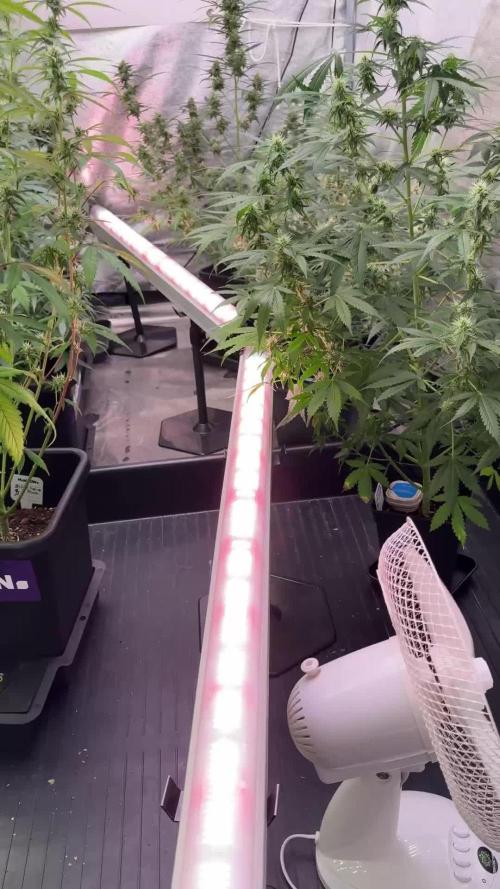

@DogDoctorOfficial
Follow
👑 Godfather OG – Pheno B
Week 9 | Just Let Me Grow
Welcome back to another chapter of the 8×8 Adventure! 💚🌱
Some plants ask for attention.
Some plants demand it.
And then there are plants that simply look at you and say:
“I'm good. Just let me grow.” 😂
Godfather OG Pheno B is definitely one of those girls.
This week, she's happy.
She's growing.
She's adapting.
She's building flowers.
She's beautifully green.
And she's asking for absolutely nothing.
So what am I doing?
Exactly what she wants.
I'm letting her grow. 🌱
🌿 The Happy Girl in the Room
There is something incredibly satisfying about walking into a room full of more than twenty plants and finding one that simply looks completely comfortable in her surroundings.
Godfather OG Pheno B is giving me exactly that feeling.
She's not complaining.
She's not demanding anything.
She's not asking for a special intervention.
She's just continuing to do what she has been doing from the beginning:
growing beautifully.
And honestly, I love it.
At around 160 cm, she's among the taller plants in the room.
But I want to make something clear.
This run isn't about producing gigantic plants.
We haven't been chasing enormous heights.
And that's something I'm actually very happy about.
The plants are growing into what I would consider a beautiful, manageable size, while still creating strong structures and plenty of flowering sites.
For me, that's a win.
👑 A Different Queen From Her Sister
And once again, her relationship with Godfather OG Pheno A makes the phenotype hunt even more interesting.
Same genetics.
Same room.
Same lighting.
Same irrigation.
Same reservoir.
Same general treatment.
Yet two very different personalities.
Her sister has been one of the demanding girls in the room.
Pheno B?
She's basically:
“Don't touch me. I've got this.” 😂
And I respect that.
That's exactly why I don't want to force every plant into the same behaviour.
The whole point of this experiment is to give the genetics the opportunity to express themselves.
And Godfather OG Pheno B is expressing herself beautifully.
🍃 That Lush Green
One of the first things I notice about her is the colour.
She's lush.
That beautiful, healthy green is still running throughout the plant, and it gives her a very strong visual presence.
The foliage looks happy.
The structure looks balanced.
The plant is carrying herself confidently.
And when I compare her to some of the more demanding phenotypes in the room, the contrast is fascinating.
She's not screaming for anything.
She's simply using what we're providing and turning it into growth.
That's the kind of response every grower loves to see.
🌸 The Buds Are Coming From Everywhere
And this week, the flowers are really beginning to take over the story.
The bud development is becoming much more obvious, and the structure is starting to show exactly where this plant is heading.
What I particularly love is the consistency of the flower formation from bottom to top.
We're not just seeing beautiful development at the highest points.
We're seeing flowering sites developing throughout the plant.
And this is where the lighting strategy becomes especially interesting.
The combination of the overhead lighting with the inner-canopy and under-canopy lighting is doing an outstanding job.
Light is reaching much deeper into the structure.
And we're getting flower development throughout that vertical space.
That makes me very curious about how these lower flowers will continue to develop as we move deeper into flowering.
💡 Above, Inside & Below
This is something I've been particularly happy with during this run.
The Future of Grow LED Black Series provides the main overhead light.
But we're not asking the top light to do absolutely everything.
The inner-canopy lighting and the LumiFlora under-canopy lighting are helping bring photons into areas that traditionally receive much less direct light.
And when you look at Godfather OG Pheno B...
you can see why that matters.
She's tall.
She's open.
She's got flowering sites distributed throughout her structure.
And now we're seeing that flower development progressing from the upper canopy down toward the lower areas.
That's exactly the kind of structure I wanted to see.
Not one giant flower-covered ceiling with forgotten branches underneath.
Instead:
light → leaves → flowers
from top to bottom.
And so far, it's looking beautiful.
🌱 No Need to Interfere
This week there was no reason for me to make major changes.
No dramatic training.
No unnecessary defoliation.
No attempt to reshape her.
No trying to make her behave differently.
She's already giving us exactly what we want.
So I'm following one of my favourite cultivation rules:
If it isn't broken, don't fix it.
Sometimes growers feel like they need to be doing something constantly.
But plants don't need our hands on them every day.
Sometimes the best thing you can do is observe.
Look.
Listen.
And leave the plant alone.
Godfather OG Pheno B is making that lesson very easy this week.
Twelve Genetics. One Ecosystem.
This is where the 8×8 Adventure continues to become more interesting every week.
We're running twelve different genetics and more than twenty plants in the same overall ecosystem.
They all have access to the same environmental conditions.
They share the same feeding strategy.
They share the same lighting philosophy.
And yet every plant finds its own way.
Some demand more.
Some demand less.
Some stay darker.
Some become lighter.
Some stretch aggressively.
Some stay compact.
Some become extremely aromatic.
And some...
just quietly get on with the job.
Godfather OG Pheno B belongs to that last group.
She's adapting.
She's comfortable.
And she's building.
🍽️ Feeding
The room continues with the shared flowering nutrition strategy:
🌱 Plagron Terra Bloom – 2.2 ml/L
🌱 Power Buds – 1 ml/L
🌱 Green Sensation – 1 ml/L
🌱 Sugar Royal – 1 ml/L
⚗️ Lemon Kick / pH Plus as required
The important part isn't simply the recipe.
It's the response.
And her response has been very clear:
She's happy.
She's growing.
She's flowering.
She's maintaining that beautiful green.
She's not asking us to change anything.
So we're not going to create changes just to feel like we're doing something.
Consistency remains the strategy.
🌡️ The Environment
The room continues running under stable conditions:
🌡️ Day temperature: 29°C
🌙 Night temperature: 25°C
💧 Relative humidity: 60%
⚗️ pH: 6.0
⚡ EC/TDS: approximately 2.0 mS/cm
💦 Solution temperature: 25°C
🌱 Substrate temperature: 26°C
💨 CO₂: 639 ppm
💡 Light schedule: 12/12
? Pot size: 15 L
💧 Watering: approximately 1.3 L/plant/24h
Again, the environment stays consistent.
And Pheno B is showing us that she likes it.
📸 Behind the Lens
This girl is becoming a photographer's pleasure.
The full-plant photographs show that elegant vertical structure.
The closer shots reveal the flowers developing throughout the plant.
And the foliage...
That green.
That beautiful, healthy green.
It's one of those plants where the longer you look, the more you notice.
First you see the overall structure.
Then the flowering sites.
Then the individual flowers.
Then the pistils.
Then the early resin development.
And suddenly you're standing there staring at one little flower for five minutes. 😂
That's the danger of growing.
You start with:
"I'll just check the plants."
And twenty minutes later you're photographing a single flower from seventeen different angles.
We've all been there. 😂📸
🌸 The Structure Is Speaking
One thing I really like about this phenotype is the overall structure.
She's tall without feeling awkward.
She's open without looking sparse.
She's producing flowering sites throughout the plant.
And she's maintaining enough foliage to support that development.
This is one of those plants where I don't feel the need to impose my own vision on her.
Her structure already makes sense.
She's doing her thing.
And she's doing it well.
That's what I mean when I say that the plants are telling us their own stories.
We just have to be patient enough to listen.
🔍 What I'm Watching Now
At this stage, my curiosity is shifting.
The question isn't really:
"Will she flower?"
We already know the answer.
She is.
The question now becomes:
How much will these flowers build?
How much density will they develop?
How much resin will accumulate?
How will those lower flowering sites respond as we move deeper into the cycle?
And what will this beautiful green plant look like when the flowering structure really starts to mature?
Those are the questions I'm interested in now.
And fortunately...
I don't need to do anything to answer them.
I just need to wait.
👑 Let Her Shine
There's something particularly satisfying about this phenotype.
She's not trying to be the biggest.
She's not trying to be the loudest.
She's not asking for special treatment.
She's simply doing her job.
Growing.
Adapting.
Flowering.
And looking beautiful while doing it.
She's around 160 cm, making her one of the taller ladies in the room, but that's exactly what I like about this run.
We haven't created a jungle of enormous plants.
We've created plants with beautiful proportions and beautiful structures.
And Godfather OG Pheno B fits into that picture perfectly.
💚 The Beauty of Doing Nothing
Sometimes cultivation is about knowing when to act.
And sometimes...
it's about knowing when not to.
This week, Godfather OG Pheno B doesn't need intervention.
She doesn't need correcting.
She doesn't need reshaping.
She doesn't need me trying to improve what is already working.
She needs time.
And I'm more than happy to give it to her.
Because every week, she's showing a little more of what she's capable of.
A little more flower.
A little more structure.
A little more resin.
A little more personality.
And now we're reaching the point where those little changes are starting to become very obvious.
🔮 Looking Ahead
Next week, I expect the flowers to continue building and becoming more defined.
The stretch should gradually become less important as the plant shifts more of her energy toward flower development.
I'm particularly interested in watching those lower and inner-canopy flowers.
With the combination of the overhead, inner-canopy and under-canopy lighting, we're giving those areas a much better opportunity to develop.
And so far...
they're responding beautifully.
So the plan?
Keep the environment stable.
Keep the reservoir consistent.
Keep observing.
Keep photographing.
And most importantly...
don't get in her way. 😂🌱
👑 Godfather OG Pheno B — Week 9
So here we are.
Another week.
Another chapter.
Another little piece of the phenotype story revealed.
She's around 160 cm.
She's among the taller plants in the room.
She's lush.
She's green.
She's healthy-looking.
Her flowers are developing beautifully.
Her structure is exactly the kind of structure I enjoy seeing.
And she's asking for nothing.
She's simply growing.
And perhaps that's the most beautiful thing about her right now.
She's comfortable enough in her environment that she doesn't need us constantly trying to intervene.
She's found her rhythm.
And now we're watching that rhythm turn into flowers.
🙏 Thank You
A huge thank you to everyone following the 8×8 Adventure.
This project keeps reminding me why growing multiple phenotypes together is so fascinating.
We can give them the same room.
The same light.
The same irrigation.
The same nutrition.
The same environmental conditions.
And they still find completely different ways to express themselves.
Godfather OG Pheno B is showing us the peaceful version of that story.
Her sister is asking questions.
This girl is answering them with flowers. 😂👑🌸
Thank you to GrowDiaries for providing the space where we can document, compare, learn and share these journeys.
Thank you to Zamnesia for the Godfather OG genetics.
Thank you to Plagron for the nutrition supporting the garden.
Thank you to Future of Grow LED for the powerful overhead lighting.
Thank you to LumiFlora for helping bring light into the lower canopy.
Thank you to TrolMaster for helping maintain environmental stability.
And finally...
thank you to everyone following along.
Every comment.
Every question.
Every observation.
Every person who stops by simply to watch these plants develop.
It means a lot.
This isn't just about reaching the finish line.
It's about seeing what happens along the way.
And Godfather OG Pheno B is giving us one of the most enjoyable stories in the room right now.
She's happy.
She's adapting.
She's beautiful.
She's building flowers from top to bottom.
She's getting more interesting every week.
And she has only one thing to say:
“Don't worry about me. I've got this.” 😂🌱👑
And you know what?
I believe her.
Growers Love, my friends, and I'll see you next week! 💚👑🌱
Processing
Likes
62
Share


@Herbz_Unkraut
Follow
Defoiled, bend them down(LST) and lollipopped them at the end of the week...
Will do another week of veg now
The triple cheese will be handled next week


Likes
18
Share


@ZouzouCanna
Follow
J’ai investi dans un système d’arrosage automatique Blumat avec 8 detecteurs Tropf. Fini l’arrosage, petite défoliation et c’est roue libre complète pendant un mois ! :)
I invested in a Blumat watering system with 8 Tropf sensor. No more watering for me, one more defoliation and we’re set to go for the next month !
Likes
38
Share


@Aedaone
Follow
The first part of this week has been great. It's cool but dry. There's was no dew on day 2. It's sunny with low humidity during the day. The plants are feeding on the built up nutes in the soil. I did not feed the listed formula although that is what I use prior to the flush week and thought I'd include it. We missed two projected rains and received one very light rain in the early a.m. hours of day 6 of this week. This was a great week for the girls. The rain didn't materialize like the forecast. We still had p.m. hours humidity in the 90s and cool nights, but these girls handled it. Only one has shown susceptibility to powdery mildew. Overall this is a beast outdoor strain for the Midwest USA. We have had a lot of leaf eating caterpillars attacking the plants because the trees are losing their green leaves. Just some natural defoliation no biggie.
Likes
3
Share


@stolen_cheese
Follow
Leicht den Überblick verloren. Wurde krank, dann viel Arbeit und keine Zeit gehabt. Die Pflanze hatte zwischendurch mal Probleme, weil ich ihr viel zu viel Wasser gegeben habe und das hat sie locker eine Woche gekostet. Egal, jetzt sieht sie fit aus und geht in die Blüte.
Sie hat 1x 100 ml FertiPlus 5-1-5+ bekommen und eine hohe Dosis Pflanzengeflüster, das hat sie wieder auf Kurs gebracht.
Trainiert wurde nur durch gezieltes Entlauben einzelner Sonnensegel und mit LST Clips
Tag 34: Insgesamt sieht die Pflanze wieder super aus, vielleicht etwas klein fürs Alter. Heute wurde auch stark trainiert.
Likes
30
Share


@Canadian
Follow
This plant have a very strong smell and there are very high THC with a good balance that allows you to still be productive on my day . All popcorn and small buds were chopped into pieces and put in a pot for edibles.
The buds that grow from the plant that did very well are very dense and heavy the main cola waited 15.56 grams dry

Likes
Comments
Share


@CentralCoastGenetic
Follow
Around 4 weeks since sprouting nice and slow for now.. Two more weeks then I’ll do the flipping to 12/12 and weave out the males and go from there .. gave them a light dose of floraflex nutrients V1 and V2… 🤙🏽 Tinos Genetics
Likes
87
Share


@Roberts
Follow
Banana kush auto is growing. I messed her up with ph fluctuations and improper feed amounts. She was way hungrier then I had expected. She smells nice just looks rough. She did okay under the Medic grow mini Sun-2. The next update will be a harvest. Thank you Medic Grow, Athena, and Weed Seeds Express. 🤜🏻🤛🏻🌱🌱🌱
Thank you grow diaries community for the 👇likes👇, follows, comments, and subscriptions on my YouTube channel👇. ❄️🌱🍻
Happy Growing 🌱🌱🌱
https://youtube.com/channel/UCAhN7yRzWLpcaRHhMIQ7X4g

Likes
11
Share


@Grizzly
Follow
The smell when wet trimming the fans off is of sweet berrys, a little bit citrus and musky dank smell is the only way I can describe it.
The drying is coming to an end, at the end of day 13 I broke a bud off that weighed a gram and had a smoke test, the flavours are there and it smooth smoke surprisingly but I think a cure will really bring the terps out.
Likes
13
Share


@smokeycropping
Follow
segunda semana de cultivo las luces son muy muy brillantes
la primera semana usando diodos samsung 120w dimmer a 50%
segunda semana aumentamos a 75% dimmer del panel
se rego 1 vez ala semana humedad del suelo duraba y se retenía muy bien,
300cc agua reposada midiendo
plantas sanas todo marcha ok


Likes
141
Share


@Ganja4Show
Follow
Update 11/04/2022 (Day 57)
Hello All! the start of yet another week!!
it's been 2 weeks ago since I Flipped to flower but I have a feeling they are really slow in this process.
it's only today I really start to see some pistols forming! Since these are my very first Photoperiods i am yet again on unknown territories.
Might be that at this stage my TSW2000 just isn't juicy enough. lucky enough I've got a new FC-4800 coming in from Mars hydro. this will have a much better coverage and and some more wattage
I might have to do another Lollipopping session once I really see pistols all over the place.
The stretch on these girls is crazy at almost an 78CM as of today. I only have +- 80 CM left in my tent and that also means I gotta figure out a way to get my lights up tight against the ceiling and rearrange my extraction fan.
1 plant is kinda on the slow side I accidently topped that one in the early stages and it feels like it never really recovered from that.
Having a look at my clones well 4 out of 8 survived and are now starting to develop some nice roots.
Thats it for today. hope too see some nice buds forming this week.
Update 14/04/2022 (Day 60)
Yesterday the new light arrived so I got busy. in order for the new light to be hang as high as possible I had to move the extraction fan outside the tent it now sits on top of the tent.
the driver from the light is also placed on top of the tent. I must say this new FC4800 is a very welcoming upgrade it really has a much better coverage in my 4x4 and more wattage :D
after the switch I got busy with some scissors to apply a final lollipop session.
also transplanted the clones in some bigger pots gotta keep them under the Secret Jardin Tneon 2x55watt lights 6500K till beginning of may than they will be moved to some friends garden.
Likes
12
Share


@GirlGoneWeed
Follow
So last summer a friend of mine grow a Dark Angel Fem seed from Crop King outdoors and turned out the harvest was full of seeds...so I saved 9 of these seeds and germinated to do an outdoor grow this season.
I know chances are I will get hermies just like my friend did but since I have these seeds laying around why not?
Germination: 13h on water cup and 24h later tap roots were screaming to be put on soil... impressive.
Once put n soil seedlings popped out the morning after, seedlings are under a 25w Sunblaster for now, I have been using tap water on a spray bottle to water them.
Thats all for now, stay lit folks!
Follow me on Instagram @GirlGoneWeed

Likes
236
Share

@yan420
Follow
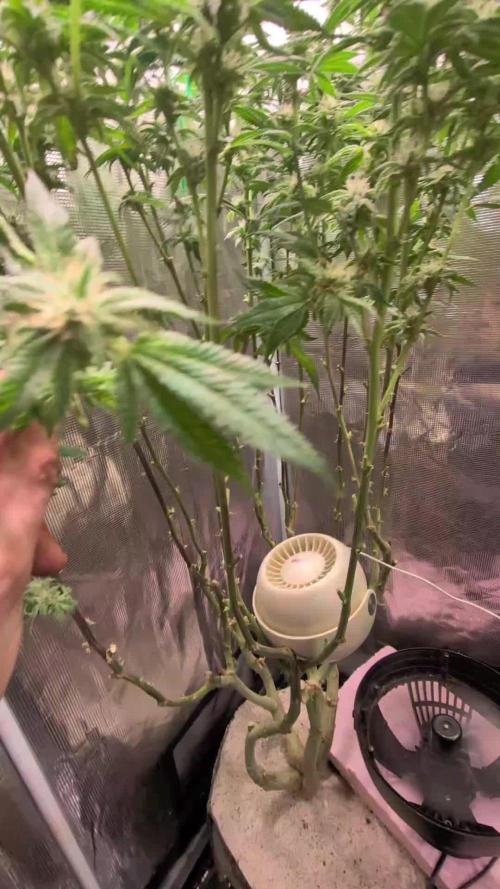
This two were part of another diary and got moved out due to space reasons at VW8 and moved back indoors at VW20
https://growdiaries.com/diaries/218151-auto-god-s-glue-grow-journal-by-yan402
13.09.25 VW21 Both are looking good and are developing tighter nodes than when they were outside, I'm going to have to keep cutting them back every once and a while I also applied nematodes against thrips and fungus gnats.
20.09.25 VW22 some spots and some yellow leafs, I think it's a root problem, probably root bound, but both seem healthy and are getting thicker so maybe just top up with Coco coir and give a slight different nutrient schedule less Tri Part Bloom could do the trick MAYBE lol.
27.09.25 VW23 Topped up the pots with extra coco coir and trimmed the side roots a bit, both plants were root bound 📹
03.10.25 VW23 did a HST/LST session 📹
12.10.25 VW25 Done a major HST session to try and keep them in line with the Sunset Sherbet GF I have going in the same tent, rest in the video 📹
17.10.25 VW25 ffj/fpj/fish 30 → 60 ml
19.10.25 VW26 it just became a one plant diary, keeping #5, #6 gets it's own diary for testing nutrients.
20.10.25 VW26(?) Feed tweak: added 3 g Calcium Nitrate/ 30 L (≈ 15 ppm N + 10 ppm Ca)
24.10.25 VW26 did a defoliation and trimming session 📹
25.10.25 VW26 I'll be repoting tomorrow, 26.10.25 VW27 rest in the video📹
27.10.25 VW27 Epsom Salt 0 → 2.5, Calcium Nitrate 3 → 9 g
01.11.25 VW28 CalMag 60 → 30ml, TriPartBloom 20 → 30ml, Magnesium 2.5 → 3.5g
04.11.25 VW28 no more yellowing between the veins and no new spots, the changes to the schedule worked, rest in the video 📸
09.11.25 VW29 Did what I'm hoping is a last cleanup 🎥
12.11.25 VW13 Did another cleanup in the tent 🎥, also switched to the FERMAKOR PK Micro schedule, (10.11.25) added Phosphoric acid as a pH down in preparation for flowering
14.11.25 FW1 FERMAKOR PK Micros 40 → 50 ml
22.11.25 FW2 Calcium Nitrate 40 g → 35 g
05.12.25 FW3 about 2 weeks ago Calcium Nitrate 35 g → 25 g, FERMAKOR PK Micros 50 ml → 60 ml
08.12.25 FW4 powdery mildew, rest in video 📸
🌱💦🌱💦🌱💦🌱💦🌱💦🌱
Day to day tasks & actions 🌿
🌱💦🌱💦🌱💦🌱💦🌱💦🌱
06.12.25 FW3 – Fed 5l of #1 → 2l runoff
(*RUNOFF reused for indoor house plants)
💧💦💧💦💧💦💧💦
🌱 Nutrients in 30 L #1 Veg – FERMAKOR
💧💦💧💦💧💦💧💦
Calcium Nitrate (Calcinit / Nitcal): 45 → 40 g → 35 g → 25 g
= 1.50 g/L → 1.33 g/L → 1.17 g/L → 0.83 g/L
= 207 ppm N / 253 ppm Ca → 184 / 225 → 161 / 197 → 115 / 141
PK Concentrate (FERMAKOR Base): 30 → 40 ml → 50 ml → 60 ml
= 1.00 → 1.33 ml/L → 1.67 ml/L → 2.00 ml/L
→ balanced 1:1 P:K + light micros (from extract)
Home-made FFJ/FPJ (Fish + Veg): 30 ml
= 1.00 ml/L
Epsom Salt (MgSO₄·7H₂O): 8 g
= 0.27 g/L → ~26 ppm Mg + ~35 ppm S
Fetrilon Combi 1 (Micros): 0.5 g
= 0.017 g/L
→ Fe 0.7 ppm · Mn 0.7 ppm · Zn 0.3 ppm · Cu 0.3 ppm · B 0.1 ppm · Mo 0.02 ppm
Phosphoric Acid (pH down) + Citric Acid (chelation): as needed
→ First set pH with phosphoric acid, then add a little citric only if you want extra chelation
Target pH: 5.8 – 6.0 (drop test yellow-green)
📦 TOTAL:
Liquids: 60 → 70 → 80 → 90 ml per 30 L
= 2.00 → 2.33 → 2.67 → 3.00 ml/L
Solids (CaNO₃ + Epsom + Fetrilon):
53.5 → 48.5 → 43.5 → 33.5 g per 30 L
= 1.78 → 1.62 → 1.45 → 1.12 g/L
💧💦💧💦💧💦💧💦
⚙️✂️⚙️✂️⚙️✂️⚙️✂️⚙️
✂️ Tools & equipment ✂️
⚙️✂️⚙️✂️⚙️✂️⚙️✂️⚙️
✂️ 2× MarsHydro SP3000
⚙️ MarsHydro 150mm ACF Ventilator
✂️ Trotec dehumidifier (big unit)
⚙️ Mini no-name dehumidifier
✂️ Kebab skewers (LST – stainless)
⚙️ Wire + roast skewers (LST assist)
✂️ Scissors (HST)
⚙️ Vacuum (for spills & cleanup)
✂️⚙️✂️⚙️✂️⚙️⚙️✂️⚙️✂️⚙️✂️⚙️
🍒🍭🍬🌈🍒🍭🍬🌈🍒🍭🍬🌈🍒
🦄Fantasy Feast ( Seeds)🦄
🌈🍒🍭🍬🌈🍒🍭🍬🌈🍒🍭🍬🌈🍒
Species: Hybrid (Regular)
Genetics: The mother is Unicorn Whip by Dirty Bird Genetics. The father is Charcuterie by Cannarado Genetics.
Effect: Unknown Mixed effect body and head high
Flavor: Some phenos are Skunky gassy fruity, some are fruity sour citrus with a chemical touch and a touch of skunk
Flowering: Estimated 8–10 weeks
Resistance: Strong — Testing phase done
YouTube Link: https://youtube.com/-m8h?si=A7x4Zlr2kj-_ga31


Likes
1
Share


@Sleestacker
Follow
Oh man, she’s begun the stretch…
And I scared! Thankfully I just got a new 1 foot taller tent, gonna need to get that up soon as this AVT is trying to take over the world! She’s badass though, accidentally gave her a couple ounces of the flowering tea I made for the forum stomper, she’ll be ok though, got a little nitrogen toxicity I need to address first… but thanks 👽!

Likes
29
Share


@Ultraviolet
Follow
Hope you are well. Thanks for taking the time.
Little main line defoliation to focus growth.
ATP (adenosine triphosphate) is the primary energy carrier in cells, including plant cells. It powers various cellular activities like nutrient uptake, protein synthesis, and cell division. Without ATP, the plant's metabolic machinery would grind to a halt, regardless of the presence of nutrients, oxygen, or carbon. Nutrients, like nitrogen, phosphorus, and potassium, are essential for building plant tissues and various molecules. They are incorporated into proteins, nucleic acids, and other vital compounds. While crucial, their uptake and utilization rely on ATP-driven processes. Oxygen is vital for cellular respiration, a process that generates ATP. While plants can produce ATP through photosynthesis, oxygen is essential for maximizing ATP production in mitochondria through oxidative phosphorylation. Carbon is the backbone of all organic molecules, including carbohydrates synthesized during photosynthesis. It's the fundamental building block of plant structures and fuels. However, its incorporation into organic molecules is also ATP-dependent.
We don't grow we facilitate energy conversion.