


Likes
Comments
Share


@TheHighNews
Follow
Day 30 toady, i switched to 12/12 3 days ago e the babies are already stretching hard and some are showing preflowers i'm pretty happy i'm watering with no nutrients as i'm using Canna Pro Plus soil and it should have enough nutrients for the first 3/4 weeks of flower. I cleaned the bottom of the plants from lowers branches and leaves and i will continua till day 14 of flower and i fixed it with a bamboo stick i got gifted from @AlpineGoat i will fix the other branches in the next weeks i'm pretty stocked with this grow this genetics are really solid growing strong and fast! Good job @Exotic_Seed!!🙌👍


Likes
19
Share


@Ketamine
Follow
Big stretch this week , things are looking good all in all.
Just added another second layer of trellis today. A small bit of defoliating also. Was hard to find co2 today , but got it done.
Will start to lower temps a bit here in next week to about 78f .
Getting dry backs of about 20-25% during the night. Keeping media about 60% saturated during day via multiple small shots of nutrients.
Could do much better but I will need better media censors to do that , so it is what it is for now.
Likes
13
Share


@smoking_hills9
Follow
Almost ready, want to give 1 more week for some brown trichomes. Otherwise it's ready. 2 trees are quite small, but all 6 have super smelly hard buds. Other 4 big trees.
. Last few times watering with raw cane molasses or just water.

Likes
52
Share


@GuerrillaNo_4
Follow
OVERALL:
~ Very happy with the grow, I really dialled everything in well this run.
~ She grew super fast, I put it down to the constant oxygenation of the rootzone along with consistent and constantly optimized light DLI and leaf to air temp variance. The extra Co2 helped push the plant to its limit in terms of heat, allowing it to push its hardest.
~ The lack of HST and Defoliation I feel let it finish faster due to lack of stress and stunting. The faster finishing time along with the big yield and efficient MarsHydro light, it hugely reduced my electricity costs per gram and freed up space much sooner for the next plant.
~ Turned into a very dense bush of buds, there is even smokable dense buds at the base of the plant due to the under canopy lighting (Not as dense as top canopy buds but still decent)
~ Ran a thin line between stressing the plant and letting it flourish. The buds came out big and very dense, also it's hard to see on camera but they're very frosty too (Prob from UVB)
YIELD:
~ 145g (dry) in just 9 weeks from seed.
~ 753g (Wet)
~ 0.91g/watt
GENETICS:
~ MSNL - Gorilla Glue Auto ~ my favorite strain, as you can tell by my username!
STRAIN REVIEW:
~ Heavy hitter, like an indica but has some of that "feel it in your face" sensation of a strong sativa. Not as heavy or as strong as other GG#4's I have smoked, which would make me question the genetics used to produce the auto version. I will wait till after a cure and judge it again.
TRAINING:
~ No defoliation or HST (Bar last week for pics)
~ A little LST and leaf tucking but largely just left the plant alone to do its thing. I felt chopping healthy parts off the plant would slow the plant down and leave it with less chlorophyll to photosynthesize the light.
~ I did prune by lightly plucking dead leaves away, when the plant was ready to let them go easily.
DRYING
~ 20/21'C 50% RH with air circulation.
~ Homemade Drybox made using: 2 x Bankers Boxes ~ 2 x USB Desk Fans ~ 1 x Carbon Filter ~ 6 x Clothes Hangers
UPDATE: Day 5 after Harvest:
~ Fast dried some small batches, as we couldn't wait to sample.
~ Chopped off branches as some are down to 12% moisture whilst bigger buds are up at 18%. Moving to paper bag for couple of days to even moisture out then transferring to jars
CURING:
~Curing in jars 3/4 full.
~ Dark closet/18'C/50% RH
~ Jars burped once Hygro passes 65% and sealed when it drops to 58%.
~ Stabilised it at 62% and after 2 weeks I'll drop it some more and stabilise it at 58% to bring out more of the flavour.
~Sitting in jars with Boveda 62% at this stage.
~ Already tastes and feels great.
WATER:
~ Condensed (Starting at 40ppm)
~ Disinfected prior to adding nutrients etc. (Using COOSPIDER UVC - 253nm & 187nm bulb)
CLIMATE:
~ Ambient Air Temp = 29'C ~ 28'C LST ~ Leaf to air temp variance of between 1'C
~ Night Temp = 22/23'C ~ Day/Night temp differential 6-7'C
~ Under Canopy Temp: 26'C (Day) ~ 21'C (Night)
~ Relative Humidity = 50-60%RH (Avg. 55%RH)
~ VPD = 1.45kPa (Avg.)
~ Co2 ranges from 900ppm to 1500ppm (Avg. 1200ppm)
AIR PRESSURE:
~ Ambient Air Pressure (outside tent) = Mean Avg. 1010 mbars (101 Kilopascals)
~ Actual Air Pressure (inside tent) = Mean Avg. 1005 mbars (100.5 Kilopascals)
~ Air Pressure Differential = up to 0.5 kPa range between inside & outside
LIGHT:
~ UVB (High intensity @ 45cm) ~ 2 hours daily mid light cycle.
~ Warm White 3000K/White 5000k/Far Red (660nm)
~ At plant canopy = PPFD 900-1000umols/s/m2 ~ Lux 45,000-55,000 ~ Daily Light Integral 55-65
~ Under canopy lighting ~ Blue (460nm)/ Red (630nm)
NUTRIENTS:
~ Mostly Advanced Nutrients (For base nutrients and most additives, as only company I could find scientific data on)
~ Canna (For Calmag Agent and Cannazym)
~ Plant Success (Great White Mycorrhizae)
ADDITIONAL GROW TECHNIQUES:
INFECTION PREVENTION & CONTROL:
Infection control practices i.e
~ PPE, Alcohol Hand wash
~ Gray room outside tent,
~ Carbon filter
~ HEPA filter
~ Plasma Ionizer
~ Inline UV-C germicidal bulb
~ Also using an additional higher powered COOSPIDER (UVC) 253nm & 187nm bulb, to disinfect the gray room outside of the tent once a week for 30 mins.
~ Ozone (o3) gas that is produced using the COOSPIDER, is then directed into the tent to further control any unwanted pathogens.
~ Ed Rosenthal (Zero Tolerance organic pesticide), sprayed once a week as preventative measure. On hand for heavier use (Once every 3 days before lights out for 15 days) in the case of an outbreak
(No outbreaks yet, due to aforementioned preventative measures)

Likes
31
Share


@MxGrow
Follow
Feliz por como van mis gorilas, todos los días hay cambios y cada semana tengo que aumentar el riego, esta semana utilice en total 18 litros, 4.5 litros para cada planta aproximadamente.
En los primeros 6 litros uso:
▪️︎4ml de Connoisseur A y B por litro de agua.
▪️︎2ml de Rhino por litro de agua.
▪️︎2ml de Bud Candy por litro de agua.
▪️︎2ml de Carboload por litro de agua.
▪️︎2ml de B-52 por litro de agua.
Espero 30 minutos y despues aplico otros 6 litros con los siguientes nutrientes:
▪️︎4ml de Connoisseur A y B por litro de agua.
▪️︎2ml de Nirvana por litro de agua.
▪️︎2ml de Big Bud por litro de agua.
▪️︎2ml de Overdrive por litro de agua.
▪️︎2ml de Voodo Juice por litro de agua.
No tengo medidor de EC, por lo tanto trato de que las mediciones en ml sean exactos con una jeringa.
☆ 1 día a la semana riego las plantas con 6 litros de agua sin nutrientes y con un PH en 6.0, hasta el momento no han presentado carencias pero tengo la duda si tienen exceso de nitrógeno por el color verde intenso de las hojas.

Likes
20
Share


@eldruida_lamota
Follow
Que pasa familia, vamos a añadir la primera semana de floración de estas Apple Fritter de RoyalQueenSeeds, empezamos con la temperatura que la tenemos entre los 21/25 grados, la humedad está entorno al 50%, el ph está en 6.2 , el foco actualmente lo tengo encendido 12 horas y la potencia es al 75% de lo que da el foco.
También añado la gama de nutrientes de Agrobeta, que no falla, sin duda de la mejor alimentación que hay para tus plantas.
Trasplantamos a macetas definitivas, 7 litros en este caso, también se ven bien verdes ya recuperaron la carencia de nitrógeno.
Veremos estas próximas semanas como avanzan y se comportan en la floración.
Mars hydro:
Code discount: EL420
https://www.mars-hydro.com/
Agrobeta:
https://www.agrobeta.com/agrobetatiendaonline/36-abonos-canamo
Hasta aquí todo, Buenos humos 💨💨💨

Likes
24
Share


@Seedler
Follow
no problems at all, as usual if things are dialed in but just as long as it is.
i did not change water yet, i fill it up every morning until water reaches the plastic pot.
The water is ph corrected 5.5-6.5 somewhere around that with the same nutes but in lower concentration so it adds up to 1000ppm

Likes
13
Share


@Krautbauern
Follow
Flowers are growing great. All the plants have been given 2 small shovels of compost. The compost was mixed into the soil on top.
Likes
35
Share


@bmvape
Follow
The Northern Light produced almost twice as much as White Widow. As they were in the same basin, I attribute the better performance to three factors. 1. Roots made it to basin faster. The WW's pellet dried out before her roots were in the water as the airstone shifted right under the NL.
2. The second and more powerful light was placed directly over the NL, however, the space is so small that they both should have benfited.
3. I did a better LST job on the NL.
Overall, happy with the harvest. The buds are airy, my fault. The smell is very lemony with a bit of an earthy smell during the cure. Currently, the taste is minty and refreshing, but still a bit heavy. Effects are nice. Noticeable but not overwhelming or tiring. I think potency will come with age,
But both plants tolerated my inexperience and have produced enough fruit to get me by. What else could you ask for out of a first grow?!
Thanks to everyone that helped! Wish I found this community from the start.


Likes
21
Share


@JuicyFruit
Follow
Week 9 - Day 63 - 26/11/19
Im so grateful to be a part of this community and to be at this milestone so to speak :) had an amazing time growing this plant, thanks to everyone who had a look or contributed to my diary!
Harvest was fun but that little 16cm tall plant stunk my whole house out of cheese when i started trimming her :)
Added a few photos and videos of the harvesting, i got a little ball of hash off the scissors which i smoked in a bong and it was nice! very hashy!
its taken about 2 hours to finish trimming but ive stored all the trim in the freezer along with the dwarf trim from my last diary :) im making cannabutter and edibles this week. really excited for that.
So i hung my drying rack outside the tent beside the passive intake. temps are between 20-22c in the room so it should dry fine and im hoping the passive intake will drag the smell in and keep it sort of fresh in the room :)
This diary has got me excited for my Quick One plant as its much taller and has colas like arms :D.
Il update in 3-7 days when buds are dried and then il be updating a lot throughout curing :)
Day 65 - 28/11/19
Still drying these buds :) they look much smaller now, i smoked a small bud and although its much drier than harvest its still spongy/sticky and stretchy when breaking apart so 2-3 more days drying i think.
Smell is wonderful especially if you get it on your hands, its like tropical fruit cheese and the effects of thc are not as pronounced with this strain but i felt very relaxed, no muscle pain etc and no paranoia or anxiety. i havent had a clear relaxed headspace before bed in a very long time. Any 1:1 THC/CBD is a must grow, give it a try if you havent already, i couldnt have picked a better starter medical plant as i love a good old cheese strain :)
And i made some cannabutter out of the 59g of sugar leaves i got from this diary and my first diary. il have to upload a few pictures of the process later and let you all know if the cannabutter worked in my brownies :)
Day 66 - 29/11/19
Started curing and added a photo to show :) buds were at 59-60% when left in the jar alone for a few hours so i threw in my boveda 58% pack and started burping 5-6 times per day :) i could have cured for a week before adding the boveda pack but i had barely any bud in the huge jar so i thought it would be wise to add the boveda to prevent mold and to keep it curing perfectly!
Day 67 - 30/11/19
Posted a picture of a handful of buds :) i smoked a few in a bong and had a joint and it left me nice and medicated! no anxiety no paranoia nicely locked to the couch and sleepy. perfect nightime smoke as it wont trip you out or mess with your head, just a nice happy little mellow buzz!
Flavour hasnt really came through yet, not sure what to expect as im a newbie but its slightly like cheese/flowery/herbs.
Curing is definitely helping every day! the smell is getting better, buds are getting really smooth and they look amazing also! really excited for the next few weeks curing :)
Final Update - Day 69 - 02/12/19
Finally here at the end of this diary and i have to say i loved growing this plant. it was a dark green colour throughout growing and took whatever i threw at it.
Buds are nice and dry and curing well. i saved the best buds until last and added a couple of photos of them and a video also! they are covered in trichomes and feel great.
Not much of a smell from the buds and it tastes like a sweet floral cheese mixture.
Im pretty couchlocked from a bong of this strain so im gonna end this diary here and go relax but many thanks for following along folks and take a look at my other diaries if you get a chance :)
Peace!
Likes
7
Share
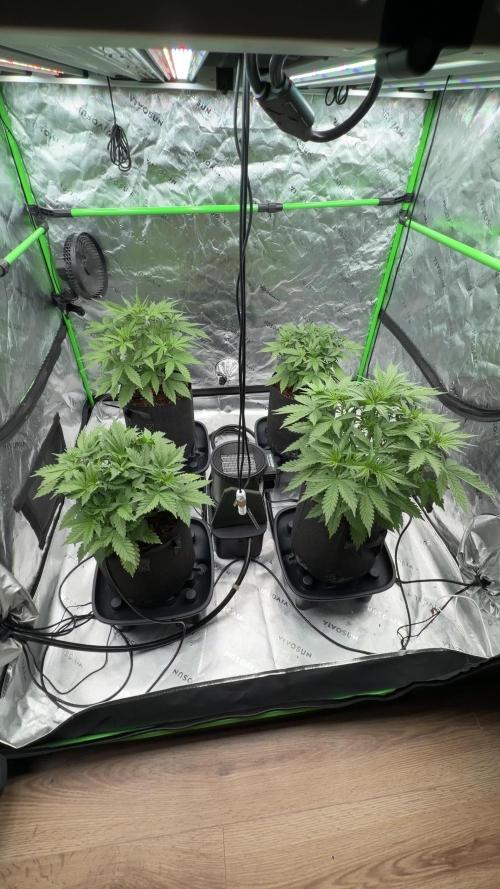

@Stoney_Stark
Follow
Sticky Broccoli Auto — Week 3 Update
Grower: Stoney Stark / Little Lilly Farms
Event: Eternity Cup
Stage: Late Veg (Pre-Flower Transition Approaching)
⸻
Growth Overview
Week 3 showed aggressive vegetative expansion. Plants are stacking nodes quickly with strong lateral branching and tight internodal spacing. No visible pistils yet, but structure suggests pre-flower is approaching soon.
Feeding frequency has increased to near-daily, which aligns with rapid coco dry-back under elevated PPFD and warmer temps. Plants are handling higher EC without tip burn or clawing, indicating strong uptake and healthy root function.
⸻
Light Settings
2/5 — Spectrum Adjustment
• 60% Cool
• 40% Warm
• 0% IR
• 0% UV
• 430 PPFD
This spectrum favors vegetative growth by emphasizing blue light for tighter structure while maintaining enough red for balanced development.
⸻
Environment
2/6
• Temp: 84°F
• RH: 69%
VPD is on the higher transpiration side at that temperature. This explains the heavier feeding demand and strong nutrient pull. Plants are metabolically active and drinking accordingly.
⸻
Watering & Nutrient Log
All nutrient amounts listed per gallon.
⸻
2/6
• 1 gallon mixed
• ¼ gallon per plant via auto system
• 1050 PPM
• 5.8 pH
.5 ml Silicium
2 ml Mag-Cal
10 ml Cocos A
6 ml Cocos B
1 ml Royal Rush
4 ml Pure Zym
4 ml Photo +
2 ml Fish Sh!t
5 ml Ruby Fulvic
Notes: Elevated PPM largely from Scientetics Mag-Cal addition. No signs of toxicity; plants appear to be responding positively.
⸻
2/7
• Light defoliation
• Cleaned lower growth to prevent sprayer interference
• Removed 2 larger fan leaves per plant for penetration
• 5-gallon batch mixed
• Auto system ran 2 minutes
• 5.8 pH
• No runoff
Nutrient mix remained identical.
⸻
2/8
• Auto system ran 3 minutes
• Small runoff achieved
• 1250 PPM
• 5.8 pH
Same nutrient ratios maintained.
Observation: 1250 PPM in week 3 is aggressive for autos, but structure and leaf posture suggest they’re metabolizing efficiently.
⸻
2/10
• Removed 2 large top leaves per plant to open side branching
• 2 gallons mixed
• Auto ran 3 minutes
• ½ gallon per plant
• Small runoff achieved
• 900 PPM
• 5.8 pH
Adjusted mix:
.5 ml Silicium
2 ml Mag-Cal
10 ml Cocos A
6 ml Cocos B
1 ml Royal Rush
4 ml Pure Zym
2 ml Fish Sh!t
5 ml Ruby Fulvic
Photo + removed this feed cycle.
Lowered PPM to 900 — a smart reset to prevent salt stacking while maintaining daily feeding cadence.
⸻
Nutrient Function Breakdown
Silicium
• Strengthens cell walls
• Improves stress tolerance
• Supports upright leaf posture
Mag-Cal
• Provides calcium for cell structure
• Magnesium for chlorophyll production
• Essential under high LED intensity
Cocos A & B
• Primary macro base (NPK + micros)
• Drives vegetative expansion
Royal Rush
• Early metabolic stimulator
• Supports nitrogen utilization
Pure Zym
• Enzyme product
• Breaks down dead root matter
• Prevents medium compaction in coco
Fish Sh!t
• Microbial inoculant
• Enhances nutrient conversion
Ruby Fulvic
• Chelation support
• Improves micronutrient uptake
• Increases efficiency at higher EC
Photo + (earlier feeds)
• Carbohydrate support
• Microbial fuel
• Supplemental metabolic enhancer
⸻
Technical Observations
• Feeding frequency is appropriate for 84°F + 430 PPFD
• Achieving slight runoff on 3-minute cycle is ideal
• Dropping from 1250 to 900 PPM was a strong preventative move
• No pistils yet — expect pre-flower within 5–10 days
At this pace, they are setting up for a strong stretch phase. Structurally, they look primed for a controlled but productive transition into flower.

Likes
10
Share


@DogDoctorOfficial
Follow
💙 Project Blue Tent – Week 13 💙
🥒 Pickle Lemon Haze F1 – Pheno B
🌸 OH MY GOD, SHE'S BEAUTIFUL! Frost, White Pistils, and Another Girl Approaching the Finish! ❄️😂
Hello everyone, and welcome back to another chapter of Project Blue Tent! 💙🌱
My friends, seriously...
IS SHE BEAUTIFUL, OR IS SHE BEAUTIFUL?! 😂❄️
Every week, I walk into this room thinking I already know what to expect. Four girls, two cultivars, the same environment, the same equipment, and the same general approach.
And then I look at the flowers again.
And there I go, grabbing the camera and spending another ridiculous amount of time admiring these girls!
😂📸💙
This week, we're giving Pickle Lemon Haze F1 – Pheno B her own spotlight.
And what a beautiful girl she is!
She's dense, compact, seriously frosty, and carrying plenty of those beautiful white pistils. Her colours are developing towards lighter shades, and much like her Pickle Lemon Haze sister, she's showing a different finishing progression from our Blue Waffle F1 girls.
The flowers are looking fantastic, the aroma is amazing, and I'm genuinely curious to see how everything develops from here.
Will the Pickle Lemon Haze girls need more time than the Blue Waffles?
Will we end up harvesting some plants before the others?
Or will the entire room surprise us and finish closer together than we're expecting?
Let's see, my friends!
We're not going to decide the ending before the plants show us what's happening.
For now, we're keeping the ecosystem running, making our latest environmental adjustments, reducing the nutrient concentration, and observing each plant individually.
Same room. Same equipment. Same passion.
But every girl has her own story.
And today, Pickle Lemon Haze F1 Pheno B is the star of the show!
💙🥒🌸
🌿 SAME TENT, SAME ECOSYSTEM – FOUR PLANTS, TWO CULTIVARS
Let's begin with the bigger picture.
Project Blue Tent brings together four plants sharing the same growing environment.
We have two Blue Waffle F1 plants and two Pickle Lemon Haze F1 plants.
They're sharing the tent, the irrigation system, the reservoir, the overhead lighting, the supplemental under-canopy lighting, and the general environmental conditions.
We're maintaining a consistent approach across the room while documenting each plant separately.
And this is where things get interesting.
Even when plants share the same environment, their individual development doesn't have to be identical.
Different cultivars can express different characteristics, and individual plants can show their own variations as flowering progresses.
That's exactly why we're keeping separate diaries.
We want to document what we actually observe rather than treating all four girls as one identical group.
And Pickle Lemon Haze F1 Pheno B has plenty of individual characteristics worth documenting.
She's compact and dense, with beautiful flowers, impressive frost, lighter colours, and plenty of white pistils still showing.
She's looking fantastic, but her progression appears a little different from the Blue Waffle girls.
We're not going to assume that means we know her exact harvest date.
Instead, we'll continue observing her development alongside her sisters and see where the journey takes us.
That's what makes this project so enjoyable.
Four plants. Two cultivars. One ecosystem.
And four individual stories unfolding side by side!
💙🌱
🌸 PICKLE LEMON HAZE F1 PHENO B – DENSE, COMPACT, AND ABSOLUTELY FROSTY!
Let's talk about this beautiful girl!
One of the first things that catches my attention is her flower development.
The flowers are looking dense and compact, with an impressive amount of visible frost across the developing buds and surrounding sugar leaves.
The structure is established, the flowering sites are developing throughout the plant, and we're now concentrating on observing how everything progresses towards the finish.
This is the stage where I love comparing the photographs from different weeks.
Earlier in the project, our attention was focused on building the structure.
We were topping, training, managing the canopy, performing defoliation, and supporting the branches through the flowering stretch.
Now, we can appreciate the results of that earlier work while giving the flowers the attention they deserve.
And Pheno B certainly deserves it!
She's beautiful from a distance, but the close-up photographs reveal another level of detail.
The trichomes, the pistils, the flower structure, and all those little details that make macro photography so rewarding.
Honestly, my friends, I could spend hours looking at these photographs.
And knowing me, I probably will!
😂📸❄️
? WHITE PISTILS – SHE'S STILL WRITING HER STORY
One of the most noticeable things about Pheno B this week is the number of white pistils still visible across her flowers.
They're giving the buds a beautiful appearance, and they're one of the characteristics that stand out when we compare her with the Blue Waffle girls.
The Pickle Lemon Haze plants are showing lighter colours and still have plenty of white pistils, while the Blue Waffles appear to be progressing towards the finish a little faster.
At least, that's what we're observing at the moment.
And I find that fascinating!
We're keeping the same general environment and nutritional approach across the room, yet the plants are showing differences in their development.
Of course, white pistils alone don't determine whether a plant is ready for harvest. Their appearance can vary throughout flowering, and different parts of the same plant can mature at different rates.
So we're looking at the complete picture.
The flowers, the trichomes, the pistils, and the overall development of each individual plant all matter when we're assessing maturity.
For now, Pheno B is still showing plenty of white pistils, and we're going to keep watching her closely.
There's no need to rush.
She'll tell us more as the weeks progress, and we'll document what we see.
💙🌸
🎨 LIGHTER COLOURS – ANOTHER INTERESTING DIFFERENCE
Something else I'm enjoying observing is the colour development.
Pickle Lemon Haze F1 Pheno B is showing lighter colours as she progresses through flowering.
Compared with the Blue Waffle girls, her appearance is taking a different direction.
And that's one of the things that makes growing different cultivars in the same environment so interesting.
The same room doesn't mean every plant will express the same colours or follow precisely the same visual progression.
Genetics, plant development, and environmental conditions can all influence what we see.
We're not going to attribute every difference to one particular cause without enough evidence.
Instead, we're recording the observations and comparing the plants as the project continues.
Right now, Pheno B is looking beautiful with her lighter colours, dense flowers, and impressive frost.
And if she continues developing in the direction we're seeing now, I'm very curious to see how her appearance changes over the coming weeks.
The Blue Waffles are showing their own characteristics, while the Pickle Lemon Haze girls are giving us another expression to appreciate.
Same ecosystem, different expressions.
That's the beauty of documenting the individual plants!
💙🥒🌿
❄️ THE FROST – AN ABSOLUTE PLEASURE TO PHOTOGRAPH
I know, I know.
I keep talking about the frost.
But look at her!
😂❄️
The close-up photographs reveal beautiful details across the flowers and sugar leaves, giving us another opportunity to appreciate the plant beyond what we can see from a normal viewing distance.
This is why I enjoy macro photography so much.
When you're looking at an entire plant, your attention naturally goes towards the overall structure, the canopy, and the distribution of the flowering sites.
But when you get closer, the details become the main attraction.
The trichomes.
The pistils.
The textures of the flowers.
The small features that make every close-up worth examining.
And Pheno B is giving us plenty to work with!
The visible frost is impressive, and I'm genuinely happy with the photographs we've managed to capture.
We're not simply taking pictures to fill the diary.
We're creating a visual record of the plant's development, allowing everyone following Project Blue Tent to see more of what we're observing inside the tent.
And honestly, I think that's one of the best parts of documenting a grow.
We can share the experience with the community, even when everyone can't be standing beside us looking at the flowers.
So, my friends, enjoy the photographs!
Because this girl deserves every bit of attention she's getting.
💙📸❄️
📸 THREE PHOTO STACKS – 664 PHOTOGRAPHS COMBINED!
And now, let's talk about the photography!
For Pickle Lemon Haze F1 Pheno B, we created three separate photo stacks.
Here's the breakdown:
Photo stack 1 – 204 photographs.
Photo stack 2 – 213 photographs.
Photo stack 3 – 247 photographs.
That's a combined total of 664 individual photographs across the three stacks!
😂📸
Now, that's a considerable amount of work for a few final images.
But that's part of the fun.
Focus stacking allows us to combine photographs taken at different focus distances to create a final image with greater depth of field.
When we're photographing small details, the area in focus can be extremely narrow.
One part of a flower might be perfectly sharp, while another section just a little further away falls outside the focus plane.
By combining multiple frames, we can bring more of those details into focus in the finished image.
Of course, the quality of the result depends on the original photographs, the shooting conditions, and how well the stacking process handles the images.
But when everything comes together, the results can be beautiful.
And that's what we're trying to achieve with these stacks.
We created three different views of Pheno B, each giving us another opportunity to appreciate the flower structure and visible frost.
Some of the other girls have more stacks this week, while Pheno B has three.
That's simply how the photography worked out.
Every plant presents different opportunities, and we're working with the time and conditions available to us.
The goal isn't to produce the same number of photographs for every diary.
It's to document every plant as well as we can.
Three stacks. Hundreds of frames. One beautiful Pickle Lemon Haze F1 Pheno B!
And I'm delighted to have them included in her diary.
💙📸🌸
💡 OVERHEAD LEDS – GRADUALLY REDUCING THE OUTPUT
Now, let's move back to the shared room setup.
We're continuing to adjust the overhead lighting as the plants approach the final stage.
The current approach is to run the main LEDs at approximately 90% and gradually reduce the output by around one or two percentage points per day.
We're taking a measured approach rather than making sudden changes.
The objective is to manage the lighting while observing the plants and maintaining a balanced environment.
More light doesn't automatically guarantee a better result, and maximum output isn't necessarily the goal at this stage.
We've already established the canopy and completed the major structural work.
Now we're concentrating on the final stage of development, making deliberate adjustments and observing the plants' responses.
The lighting is one part of the system, but it doesn't work in isolation.
Temperature, humidity, airflow, irrigation, and the condition of the plants all matter too.
So we're continuing to look at the complete environment rather than focusing on one setting alone.
And, as always, we're documenting what happens rather than promising a particular outcome.
💡🌿
💡 TWO LUMIFLORA 150W FIXTURES – UNDER-CANOPY LIGHTING
The two LumiFlora 150W full-spectrum under-canopy fixtures remain part of our setup.
They're arranged in an X-cross configuration beneath the canopy, supplementing the primary lighting from above.
For now, we're keeping their output around 90–95%, with the possibility of reducing it closer to the end.
The purpose of this experiment is to explore supplemental lighting beneath the canopy and observe how the lower flowering sites develop.
With a substantial plant structure, the amount of light reaching different parts of the canopy naturally varies.
That's why we're interested in seeing how the lower portions of the plants develop under this arrangement.
We're not assuming that the additional lighting automatically produces a particular result.
Instead, we're documenting the setup, keeping the other conditions as consistent as possible, and observing the plants as they progress.
This is one of the interesting aspects of Project Blue Tent.
We have the equipment, we have the plants, and we have the opportunity to follow the development over time.
And now we're watching the results unfold.
💙💡🌿
🌡️ TEMPERATURE AND HUMIDITY – PREPARING FOR THE FINISH
The temperature adjustments apply to the entire room, so Pheno B is sharing the same general environmental conditions as her sisters.
Our current approach is to maintain a daytime air temperature around 25°C and bring nighttime temperatures down to approximately 19–20°C.
The solution and substrate temperatures are being kept around 21°C.
We're also maintaining our normal relative humidity target of approximately 55%.
These adjustments form part of our approach as the plants move towards the final stage.
We're looking at the relationship between temperature, humidity, lighting, and plant development rather than treating each parameter separately.
We want to maintain a balanced environment and observe how the different cultivars respond.
One interesting detail is that the Pickle Lemon Haze girls are showing a different visual progression from the Blue Waffles.
However, we're not assuming that the temperature adjustments alone explain those differences.
We're recording what we see and allowing the individual plants to show us how they develop.
If the room conditions remain stable while the plants continue progressing, we'll have a clearer record of what happened throughout this stage.
And that's exactly what we want from this project.
Consistent records, individual observations, and no unnecessary assumptions.
💧 IRRIGATION AND DRAINAGE – THE SAME SYSTEM FOR ALL FOUR GIRLS
The automatic irrigation and drainage system continues supporting the four plants.
All four girls share the reservoir, which allows us to maintain the same general nutritional approach across the tent.
The recorded watering volume is approximately 1.6 litres per plant over 24 hours.
That's the reference value in the diary, although actual demand can still vary between individual plants.
We continue monitoring the system and observing the plants rather than assuming that every plant will behave identically.
The irrigation setup is an important part of the overall ecosystem, but when everything is running as intended, we don't need to make unnecessary changes.
The goal is to maintain consistency while allowing us to concentrate on the plants themselves.
And that's what we're continuing to do this week.
The system remains established, the plants are progressing, and our attention is increasingly focused on the flowers and the approaching finish.
💧🌱
⚗️ NUTRITION UPDATE – LOWER EC, GREEN SENSATION DISCONTINUED
Now, let's document the current nutrient program correctly.
As explained in the previous Project Blue Tent reports, we've stopped using PLAGRON Green Sensation.
We've also reduced both Hydro A and Hydro B, while keeping Power Buds in the recipe for the moment.
This is an important change because it explains why the EC has come down.
We're not simply reducing the A and B components while leaving the entire previous recipe untouched.
Green Sensation has been removed from the current mixture as well.
At this late stage, I've decided that I don't need to continue adding the PK product to the reservoir.
The current recorded recipe is:
PLAGRON Hydro A – 1.8 ml/L
PLAGRON Hydro B – 1.8 ml/L
PLAGRON Power Buds – 1 ml/L
PLAGRON Green Sensation – discontinued
PLAGRON pH Plus and pH Minus – used as required for pH adjustment
The current diary readings show a pH of approximately 6.0 and an EC of 1.86 mS/cm.
We're continuing with the lower nutrient concentration and monitoring the plants as they progress.
The pH target remains close to 6, with small variations being acceptable within our intended range.
We don't need to chase an absolutely fixed number throughout the day if the reading is already where we want it.
We monitor, adjust when necessary, and keep the records accurate.
Because all four plants share the same reservoir, this nutritional adjustment applies to the entire tent.
That consistency is an important part of our approach.
And just as importantly, the written diary needs to reflect what we're actually using.
From this week onward, we're recording Green Sensation as discontinued, Hydro A and B at the reduced rates, and Power Buds as remaining in the recipe for now.
That's the current situation, and that's what we'll continue documenting.
💙🌱
🥒 PICKLE LEMON HAZE VS. BLUE WAFFLE – WHO WILL FINISH FIRST?
This is the question I'm really looking forward to answering!
We have two different cultivars growing side by side in the same tent.
The Blue Waffle girls appear to be progressing towards the finish faster, while the Pickle Lemon Haze girls are still showing plenty of white pistils and lighter colours.
Both Pickle Lemon Haze plants are looking beautiful, dense, compact, and frosty.
But their visual progression appears to be a little slower than that of the Blue Waffles.
And now I'm curious to see what happens next.
Will the Blue Waffles be ready first?
Will the Pickle Lemon Haze girls need additional time?
Will we have a staggered harvest, or will the plants come closer together as flowering progresses?
I genuinely don't know.
And I don't want to pretend that I do!
The appearance of the pistils and the colours of the flowers are useful observations, but they don't tell us everything about maturity.
We'll continue checking the trichomes, observing the flowers, and looking at the overall condition of each individual plant.
The decision will be based on the plants themselves, not simply on the fact that they're sharing the same room.
If some girls are ready before the others, we'll have to decide how to manage that.
If they all finish together, fantastic!
Either way, I'm looking forward to seeing how the four individual stories come together.
This is exactly why keeping separate diaries is worthwhile.
We can follow each plant individually and compare their progress without assuming that they'll all follow the same timeline.
Let's see what the next chapter brings!
😂💙🌸
🔭 WHAT I'M WATCHING NEXT
As we move closer to the finish, my attention is on the details.
I'm watching the flower development and the changing appearance of the pistils.
I'm monitoring the trichomes and the overall maturity of Pheno B.
I'm observing how the lighter colours develop and whether her appearance continues changing over the coming weeks.
I'm also watching the effects of our gradually reduced overhead lighting output, the supplemental under-canopy lighting, and the lower nutrient concentration.
And, of course, I'm comparing her progress with that of her Pickle Lemon Haze sister and the two Blue Waffle girls.
Will the differences in their development become more noticeable?
Will the Pickle Lemon Haze plants continue taking their time?
Will the Blue Waffles be ready first?
We'll keep documenting the journey and let the plants answer those questions.
No rushing.
No assumptions.
Just observation, patience, and plenty of photographs!
💙📸🌿
💙 FINAL THOUGHTS – OH MY GOD, SHE'S BEAUTIFUL!
My friends, what a pleasure it is to document this girl!
Pickle Lemon Haze F1 Pheno B is looking absolutely fantastic.
She's dense, compact, seriously frosty, and carrying plenty of beautiful white pistils.
Her colours are moving towards lighter shades, and her overall progression appears a little slower than that of the Blue Waffle girls.
But that's exactly what makes this stage so interesting.
We have four plants sharing the same room and the same general conditions, yet we're seeing differences in their development.
The lighting setup remains established, the under-canopy fixtures continue supplementing the main LEDs, and the irrigation system keeps supporting the plants.
We've reduced the nutrient concentration, stopped using Green Sensation, and kept Power Buds in the recipe for now.
We're also gradually lowering the overhead LED output and maintaining the cooler environmental conditions we've established for this stage.
And through all of this, Pheno B is continuing to give us plenty to admire.
The photographs are beautiful.
The frost is impressive.
The aroma is amazing.
And I'm genuinely curious to see how she develops from here.
Will she finish after the Blue Waffles?
Will the Pickle Lemon Haze girls need a little more time?
Will we harvest the room in stages?
Let's see!
For now, I'm happy to keep observing, keep documenting, and give every girl the time she needs.
Because that's what this project has always been about.
Learning, experimenting, appreciating the individual plants, and sharing the journey with the community.
Same tent.
Same ecosystem.
Same passion.
Same love.
But every plant deserves her own moment in the spotlight.
And today, that moment belongs to Pickle Lemon Haze F1 Pheno B.
She's beautiful, my friends.
Simply beautiful!
😂💙🥒🌸❄️
💬 COME JOIN THE DOGDOCTOROFFICIAL DISCORD COMMUNITY!
And before we finish, the invitation remains open to everyone!
If you're already part of our Discord family, you know how much fun we have together.
And if you haven't joined yet, come and say hello!
We welcome growers of all experience levels who want to share their gardens, exchange ideas, discuss equipment, share photographs, and learn from one another.
It's a place to meet people who enjoy the same hobby, ask questions, and become part of the community.
We also organize giveaways and photo championships, with prizes for the winners!
So don't be shy.
Come introduce yourself, share what you're working on, and join the conversation.
💙 DogDoctorOfficial Discord:
https://discord.gg/dogdoctorofficial
Everybody is welcome!
🙏 A HUGE THANK YOU
A huge thank you to Zamnesia for making Project Blue Tent possible and giving us the opportunity to document these beautiful Blue Waffle F1 and Pickle Lemon Haze F1 plants individually.
Thank you to PLAGRON for the Hydro nutrient line supporting this project and helping us document the nutritional changes throughout the journey.
A massive thank you to Zamnesia for the Phytonaut LED lighting, curved scissors, and clip fans that have become important parts of this ecosystem.
Thank you to Mars Hydro for the irrigation and drainage equipment helping us maintain consistency throughout the tent.
And a special thank you to LumiFlora for the 150W full-spectrum under-canopy fixtures that we're using to explore supplemental lighting beneath the canopy.
Thank you to GrowDiaries for giving us a platform where we can document the plants, share our photographs, record our observations, and learn from the entire process.
And, of course, thank you to everyone following Project Blue Tent!
Your support makes sharing every individual chapter even more enjoyable.
Four plants. Two cultivars. One beautiful ecosystem.
We're getting closer to the finish, but there's still plenty to observe, photograph, and appreciate.
Until next week, my friends...
Keep growing.
Keep learning.
Keep taking photographs.
And keep enjoying the journey!
Growers Love, happy growing, and take care everyone! 🌱💙🥒🌸❄️

Likes
22
Share


@DogDoctorOfficial
Follow
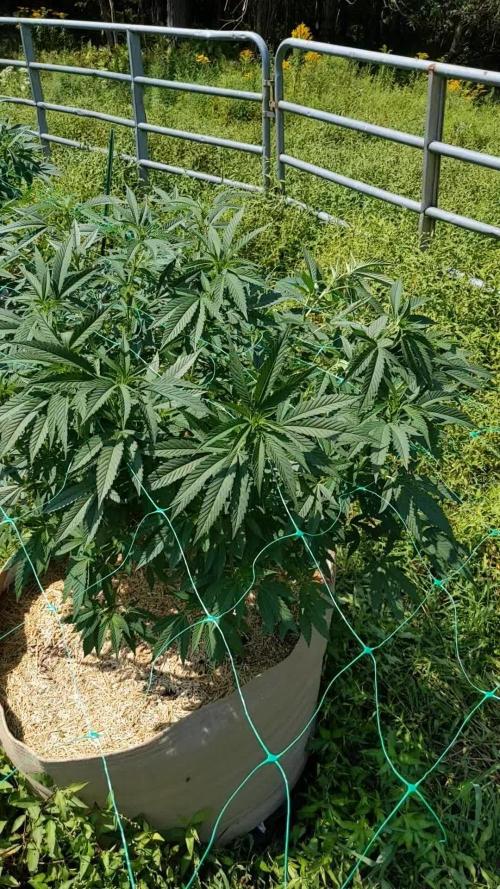
Week 10 Veg – The Art of Clipping & Training
We’ve officially hit Week 10 Veg with our White OG from Seedsman Seeds, and this week has been all about training and sculpting her into the beast she is meant to be! 💪🌿
🌱 Training & Clipping – The Path to Perfection
This week, I went full hands-on with her structure, bending, clipping, and securing her branches into the exact shape I want. Each branch was carefully attached and adjusted, allowing her to spread out and open up beautifully. This method encourages even light distribution and maximizes bud sites for the upcoming flowering phase.
She’s been responding amazingly to the training, showing strong recovery and explosive growth in return. It’s taking longer than usual in veg, but patience is key. I believe this will pay off in the end, rewarding us with a massive, structured mama ready to produce some stunning flowers.
📸 The Photoshoot – Showing Off Her Beauty
By the end of the week, after letting her settle and stretch from all the training, I decided to do a proper photo shoot to capture all her beautiful details. There’s something about seeing her structure under the perfect lighting that makes all the work worthwhile.
Feeding & Conditions
Still rocking the Aptus Clean Line, keeping things simple yet powerful with:
✅ Regulator
✅ RO Water Conditioner
✅ All-in-One Liquid
💦 pH – 6.02
⚡ EC – 1.12
Lights are still FOG LED, controlled by TrolMaster, ensuring she gets the perfect spectrum and intensity for this crucial phase. The climate remains stable, allowing her to keep thriving and adapting to the ongoing training.
🙏 Shoutouts & Gratitude
Big thanks to the sponsors, the community, the platform, and everyone supporting this journey! Special appreciation to:
🔥 Seedsman Seeds
🔥 Aptus Holland
🔥 TrolMaster
🔥 Future of Grow LED
🔥 Pro-Mix Soil
🔥 CannaCan
Much love to all growers, followers, haters, supporters, and everyone in this amazing journey! 🚀🌱
🎥 Join the Journey!
Don’t forget to catch more action on Instagram & YouTube, where I’ll be sharing exclusive content, updates, and insights. Let’s keep learning, growing, and having fun together!
Stay tuned – flowering is just around the corner! 🌸🔥
#GrowDiaries #WhiteOG #ToppingMadness #AptusHolland #Mainlining #PlantTraining #GrowersLove #SeedsmanSeeds
As always, this is shared for educational purposes, aiming to spread understanding and appreciation for this plant.Let’s celebrate it responsibly and continue to learn and grow together!
💚Growers Love 💚 🌿
DISCOUNT CODE - SeedsmanSeeds - DOGDOCTOR 10% off
As always thank you all for stopping by, for the love and for it all , this journey of mine wold just not be the same without you guys, the love and support is very much appreciated and i fell honored and so joyful with you all in my life 🙏
With true love comes happiness 💚🙏 Always believe in your self and always do things expecting nothing and with an open heart , be a giver and the universe will give back to you in ways you could not even imagine so 💚
Friendly reminder all you see here is pure research and for educational purposes only
💚Growers Love To you All and remember to keep that smile big and alive 💚





Likes
27
Share


@I_Identify_As_A_Dan
Follow
Week 12 for Kalini Asia by Zamnesia
Also going to be giving her a little dose of BioGrow before giving her a full dose of BioBloom before flipping her to flower this weekend.
Shes about the same height as the white widow.
Likes
13
Share


@Limelight
Follow
This week kicks off 6w of flower for unknown and she’s going!!! Super excited to see the trichomes increase because I’ve had two days where, it was very unexpectedly hot and could do little to nothing about it even with fans. So she definitely suffered from heat stress but, the super low temperatures (constantly 😍) after that has made up for it. I believe the best is yet to come with this lady but, I’ll continue to play it cool and safe with her! She’s also very resistant to low temps compared to wwa.
This week also kicks off w11 for wwa and she’s also living up to her name (so I’ve read 😏) with, the increase of trichomes over the last week! She also suffered from heat stress but, has bounced back amazingly and is fattening up. She’s also looking to be very purple (due to low temps) I believe I’m a few weeks out but, continuing to slow roll things!
Thanks for stopping by this week 👋… Have a great day reader ✌️😎😎.
Likes
8
Share


@Salokin
Follow
The week went uneventful the plant is doing what it's supposed to be doing. The wifey is doing a great job in taking care of the plant while im travelling. Introduced Hess's PK 13/14 from the last feeding. PPM remained flat at 900 and will now gradually increase the PK 13/14 over the next weeks. Looks pretty good from what I can tell by the pictures I received. Still a bit of tip burn so, will decrease the base nutrients a little as well over the next few weeks.

Likes
5
Share


@Brasson
Follow
She's still alive! I don't know what I could be doing better. But buds aren't swelling up much but she still has some time to grow.
Likes
1
Share


@HighlandWolf
Follow
Around 11-12 weeks seed to harvest,, only had a few plants the largest yielded 72 grams the smallest around an ounce,,,
just a few plants for personal medicinal use grown 100% naturally in the great british outdoors 😎
