The Grow Awards 2026 🏆 






Processing
Likes
Comments
Share
@SalocinSpecial
Follow
D33 (24/12/2020): First week of flowering. Both officially went into flower 4-5 days ago but I decided to finish the week before starting first flower week. I fed around 3L of water today, they were thirsty. I mixed full recommended dose of nutrients for last week of veg in 1,75 gal. of water. I want to go slow in reintroducing nutrients after 2 flush last week.
- temp: 25C
- water: approx. 3L per plant, PH6.4. 600 PPM
- run off: 900 PPM for Banana Kush and 800 PPM for Glue Gelato
- RH: 54%
D34 (25/12/2020): Nothing special today except that it's Christmas, everything is going well. RH is higher today since higher temperature where I live but nothing crazy.
- temp: 25C
- no water
- RH: 58%
D35 (26/12/2020): I removed leaves under canopy today and fed with a gallon of water + minerals each plant.
- temp: 25C
- water: approx. 3,75L per plant, PH6.8, 350 PPM
- run off: 750 PPM for Banana Kush and 600 PPM for Glue Gelato
- RH: 55%
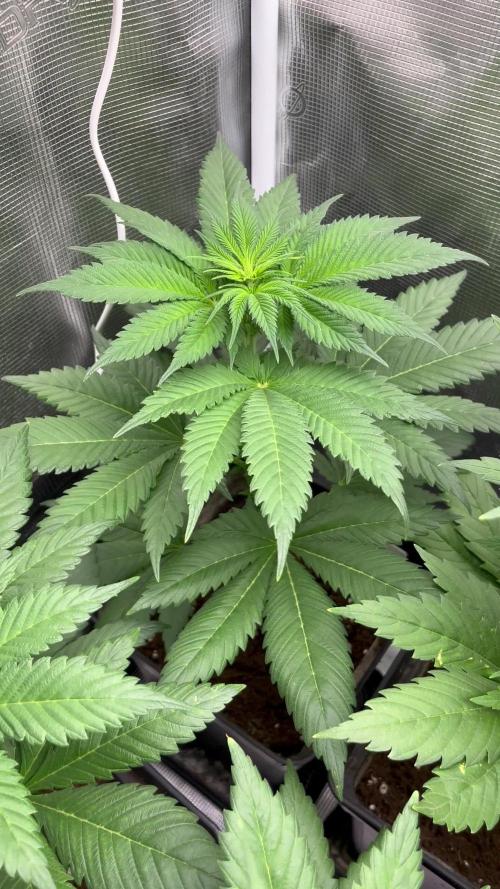
D36 (27/12/2020): I readjusted some ties because they are stretching like crazy! The buds are forming and more pistils are showing.
- temp: 25C
- no water
- RH: 53%
D37 (28/12/2020): Still readjusting the ties and removed leaves today. The lights are now at 24 inch and plants receive around 495-525 PPFD (38 0000 to 40 000 lux). I'm aiming to go above 600 PPFD in the next week. I will check how they react with more light.
- temp: 24C
- no water
- RH: 54%
D38 (29/12/2020): I gave approx. 3.5 L of water per plant. I used 3/4 of the recommended dose for transition week.
- temp: 25C
- water: approx. 3.5L per plant, PH 6.4, 720 PPM
- run off: 900 PPM and PH6.8 for Glue Gelato; 800 PPM and 6.8PH for Banana Kush
- RH: 54%
D39 (30/12/2020): Removed more leaves under canopy.
- temp: 25C
- no water
- RH: 54%


Likes
7
Share
@Cthoff
Follow
Well am happy with the outcome and the way I grew it. I might do things slightly different next time. Be more proactive instead of reactive.
4.65 oz was the total weight (dried + trimmed)
Smoked a little already before curing and was such a smooth and clean hit. No harshness in my throat and it was a clean high but more of a head high. That should change after a few weeks of curing in jars but nonetheless a comfortable high!

Likes
13
Share
@Kayotic
Follow
Starting to get frosty and sticky. Snell is more intense, like berries and gas. Very thirsty and hungry. Watering every day, feeding every other.

Likes
Comments
Share
@eldruida_lamota
Follow
Que pasa familia, vamos con la primera semana de floración de estas Kiwi x Papaya feminizadas de Mavericks .
Vamos al lío ,se trasplantaron en macetas de 7 litros definitivamente.
El ph se controla en 6.0 , la temperatura la tenemos entre 24/20 grados y la humedad ronda el 50%.
El ciclo de crecimiento puse 12h de luz, el foco está al 50% de potencia.
De momento van creciendo a buen ritmo y tienen un buen color.
Gracias a Agrobeta de nuevo por el kit para esta temporada, unos grandes 🙌.
- os dejo por aquí un CÓDIGO: Eldruida
Descuento para la tienda de MARS HYDRO.
https://www.mars-hydro.com
Hasta aquí todo, Buenos humos 💨💨💨

Likes
19
Share
@A_Rolling_Stoner
Follow
The one in the middle is struggling a little, but I'll just keep it and see how it turns


Likes
72
Share
@Fatnastyz
Follow
1-17
Seems silly to start a week, but she is alive. For now 😱
Locked her up at sleep time today. I'll check on her Sunday.
She is figuring out whats going on. 😂
Since last night was her last light night,( say that one 5 times fast 😂) I let Guy and Luna say their farewells. August just wanted to play.
Made for some fun pictures. 😁🤘


Likes
14
Share
@Lazuli
Follow
plants look healthy and ready to start making weight
juli 26 (day 30 since flip)
huge defoliation (see pics)

Likes
24
Share
@Grey_Wolf
Follow
CALIFORNIAN GOLD DWC
19th April 2024
8 Weeks of flowering finished and I have emptied the rez and refilled with plain rainwater .
I don't know how important ph'ing the water is for the flushing week but just to be sure , I dropped it to 5.7 👌
She sure smells good and the harvest window is fast approaching .
I'll give her as many days as she needs to finish up and I'll cut her down .
See ya's next week and Thanks again for stopping by 👍

Likes
8
Share
@Living_Organic
Follow
Hello, the plants are already second week flowering. Now begins the most iterous part :)
The garden is organic and for flowering I put a top dressing of guano.

Likes
13
Share
@masonandjayden
Follow
Defoliation and lst of the four super sour s1 and the 2 peanut butter soufflés as well they are growing great. Flipping to flowering in the next 3-4 weeks

Likes
18
Share
@eldruida_lamota
Follow
Esa familia, actualizamos las northern light xL, hay una de las 3 que destaca del resto por tamaño y flores, pintan muy bien, se ve buen color y bastante vigorosas, tutelamos 1.
Bajamos humedad y temperatura, a estas alturas estamos pensando en el siguiente proyecto con varias geneticas de zambezaseeds.

Likes
52
Share
@Ultraviolet
Follow
You don't become confident by shouting affirmations in the mirror, but by having a stack of undeniable proof that you are who you say you are, outwork your self-doubt.
Nitrogen fixation is a chemical process by which molecular nitrogen (N2), which has a strong triple covalent bond, is converted into ammonia (NH3) or related nitrogenous compounds, typically in soil or aquatic systems but also in industry. The nitrogen in air is molecular dinitrogen, a relatively nonreactive molecule that is metabolically useless to all but a few microorganisms. Biological nitrogen fixation or diazotrophy is an important microbe-mediated process that converts dinitrogen (N2) gas to ammonia (NH3) using the nitrogenase protein complex (Nif).[2][3]
Nitrogen fixation is essential to life because fixed inorganic nitrogen compounds are required for the biosynthesis of all nitrogen-containing organic compounds, such as amino acids and proteins, nucleoside triphosphates and nucleic acids. As part of the nitrogen cycle, it is essential for agriculture and the manufacture of fertilizer. It is also, indirectly, relevant to the manufacture of all nitrogen chemical compounds, which include some explosives, pharmaceuticals, and dyes.
Nitrogen fixation is carried out naturally in soil by microorganisms termed diazotrophs that include bacteria, such as Azotobacter, and archaea. Some nitrogen-fixing bacteria have symbiotic relationships with plant groups, especially legumes.[4] Looser non-symbiotic relationships between diazotrophs and plants are often referred to as associative, as seen in nitrogen fixation on rice roots. Nitrogen fixation occurs between some termites and fungi.[5] It occurs naturally in the air by means of NOx production by lightning.[6][7]
All biological reactions involving the process of nitrogen fixation are catalyzed by enzymes called nitrogenases.[8] These enzymes contain iron, often with a second metal, usually molybdenum but sometimes vanadium.
Green clover (Fixation)
White clover (Fixation)
Red Clover. (Fixation)
Yellow Clover. (Fixation, deeper roots)
Sweet Thai Basil. (Terpenes)
Italian Basil. (Terpenes)
Chamomile.(Oil production)
Borage.(Pest attraction taste)
Lavender.(Pest attraction smell)
Marigold(Pest attraction visual)
Mycorrhizae are beneficial associations between mycorrhizal fungi and a plant’s root system. Mycorrhizal fungi spores germinate in the soil, creating filaments (hyphae) that penetrate the root cells, thus establishing a symbiotic relationship. This collaboration leads to the development of both intra-radical and extra-radical networks of filaments, enabling efficient exploration of the soil for enhanced access to nutrients and water. Consequently, these vital resources are transferred to the plant, resulting in numerous benefits for crop cultivation.
Various mycorrhizal products are available in diverse formulations (powder, granular, and liquid), concentrations, and qualities. Ongoing advancements in products, technologies, and research are reshaping our understanding of mycorrhizae. Despite these positive developments, certain misconceptions persist. In the following discussion, we aim to clarify the truths and dispel the myths surrounding mycorrhizae products.
MYTH #1
A HIGHER NUMBER OF MYCORRHIZAE SPECIES MEANS BETTER RESULTS.
Contrary to common belief, having a higher number of mycorrhizae species in a product does not translate to better results; in fact, it often yields the opposite outcome. A plant can sustain only one association with a particular mycorrhizal fungi species. Introducing multiple species creates competition among them, which is not advantageous for the plant. The initial colonizer does not ensure the highest success; instead, it gains precedence. It is recommended to select a product with a concentrated presence of a single mycorrhizae species known for its effective performance, rather than opting for a product with multiple species at lower concentrations.
MYTH #2
ECTOMYCORRHIZAE ARE EFFECTIVE FOR CANNABIS PLANTS.
Although ectomycorrhizae can colonize five to ten percent of plant species, cannabis is not among them. Ectomycorrhizae do not penetrate the root cells; instead, they develop around the roots and on the exterior. For cannabis plants, it is essential to seek out endomycorrhizae. Endomycorrhizae are capable of colonizing 70% to 90% of plant species, including cannabis. Unlike ectomycorrhizae, endomycorrhizae penetrate the root cells, forming structures like arbuscules for the exchange of nutrients and water with the plant.
MYTH #3
WHOLE INOCULANT (PROPAGULES) PERFORM BETTER THAN ONLY VIABLE SPORES.
The propagule count specified on most mycorrhizae products indicates the presence of spores (viable and unviable), hyphae, and root fragments. However, it is crucial to note that only viable spores, those with the capacity to germinate, can successfully colonize a plant’s root system. Spores are to mycorrhizal fungi what seeds are to cannabis plants—a fundamental component enabling fungi reproduction. Consequently, even if a mycorrhizal product boasts millions of propagules, its effectiveness hinges on the presence of viable spores. Without viable spores, the product will not contribute to plant development. Therefore, the genuine value of a mycorrhizal inoculant lies in the quantity of viable spores it contains, as only viable spores can efficiently initiate symbiosis.
MYTH #4
ALL METHODS OF APPLICATION YIELD IDENTICAL RESULTS.
To establish the symbiosis, mycorrhizal fungi spores must be close to the plant roots. The optimal recommendation is to directly apply mycorrhizal inoculant to the roots, either in powder, granular or slurry form. This method ensures maximum proximity between the spores and the roots, facilitating a rapid establishment of symbiosis. Particularly with crops like cannabis, which have a short growing cycle, employing this technique is the most effective way to obtain optimal benefits. Alternatively, techniques such as blending the inoculant with the soil are effective, but there may be a delay in the establishment of symbiosis. This is because the roots need to grow and come into contact with the dispersed spores throughout the growing media.
MYTH #5
MYCORRHIZAE CAN ONLY BE GROWN ON LIVING PLANTS.
While the predominant method for commercially producing mycorrhizae involves growing them on the root systems of living plants (in vivo production), it is not the exclusive nor the optimal technique. In fact, this production approach has notable drawbacks that the “root organ culture” method just does not have (in vitro production). In vitro production occurs in meticulously controlled, aseptic laboratory conditions, allowing for the consistent generation of products that are viable, highly concentrated, species-specific, and free from pathogens. Achieving such precision and quality is impossible when relying on the cultivation of mycorrhizal fungi on plants exposed to external conditions.
In conclusion, it is crucial to take all these factors into consideration when choosing the appropriate product for your crop to fully harness the wide array of benefits provided by a high-quality mycorrhizal product.
STRONGER PLANT – Stress resistance.
FASTER GROWTH – Improve plant structure and shorter veg time.
INCREASE YIELD – Overall more biomass.
IMPROVED QUALITY – Increase cannabinoids and terpenes content.


Likes
32
Share
@Fatnastyz
Follow
10-1
Day 2 week 3 Flower
Her house was on fire too! Ppm 8k something
Added some water, ppm 1500 ph 7.2
She was hot, but she was fighting back, now shes cool!
Tea, then something when hungry!😁🤘
10-4
22% moisture finally!
Watered with cal/mag, yucca and recharge. To 35%.
I clearly stunted her from over watering. She still looks good, but small.
Moved her to my small tent, so she can get all the solo attention she deserves! 😬
10-5
Fun with pictures.
Watered 500ml with cal/mag.
Added .02ml epson salts per liter of water.
Apparently, I have soft water.
10-6
1/4 cup poo, 3 tbs buildaflower, scoop of connect.
.
Likes
9
Share
@High_Grade_Dadli
Follow
Transplant after week 1so far so go..jus a lil a bat guano no major feeding yet
Likes
45
Share
@BodyByVio
Follow
Beautiful flower full of trichomes. Smell and test fantastic. Very fast flowering. She was done on day 49 but I cut her down few days later.
I love the strain, the only thing that I will like this strain to have is a better yield. Beast quality buds I ever grew.


Processing
Likes
81
Share
@NugLife420
Follow
I am pretty excited. 🙂. They are coming along nicely. The ladies arms are getting more and more swollen every day. The stretch has stopped. I have done some more defoliation (can't keep my hands away from the damn scissors. Lol). I will update throughout the week. 😎

Likes
30
Share
@Togoutouseg
Follow
La purple haze était vraiment plaisante à cultiver. Une des deux a eu un problème dès le début de croissance, et malgré tout, j'ai réussi à l'envoyer en floraison. Cela montre bien que les variétés de zamnesia sont très bien pour les débutants, elles sont très résistantes. La haze était de taille moyenne. Une odeur très épicée et terreuse, un vrai plaisir au nez. On voit bien que c'est une sativa, elle provoque de grosses crises de fou rire, la première fois que j'ai tiré dessus j'ai tiré trois taf et j'ai rigolé pendant 30 minutes, complètement incroyable. Très cérébrale, pleins d'idées qui nous passent par la tête, elle rend très énergique et n'a pas d'effet de détente sur le corps. Ne pas fumer en soirée avant d'aller dormir, plutôt en après-midi, j'ai beaucoup de mal à dormir si je l'utilise en début de soirée. Attention tout de même, elle provoque pas mal de parano je trouve, typique d'une sativa. En tout cas excellente variété pour aller marcher et profiter d'une belle après-midi. J'ai optenu 45g et 30g en sachant que j'ai eu pas mal de problèmes.
Likes
20
Share
@DeepRootsGrowTrees
Follow
KRITIC AUTO by KANNABIA
Week #9
Week #6 Flower
No issues this week she's doing 👍 she's really focusing her energy into her buds as the have stared becoming dense they look amazing and smell great!! Stay Growing!!!
Kannabia.com KRITIC AUTO
