Likes
Comments
Share
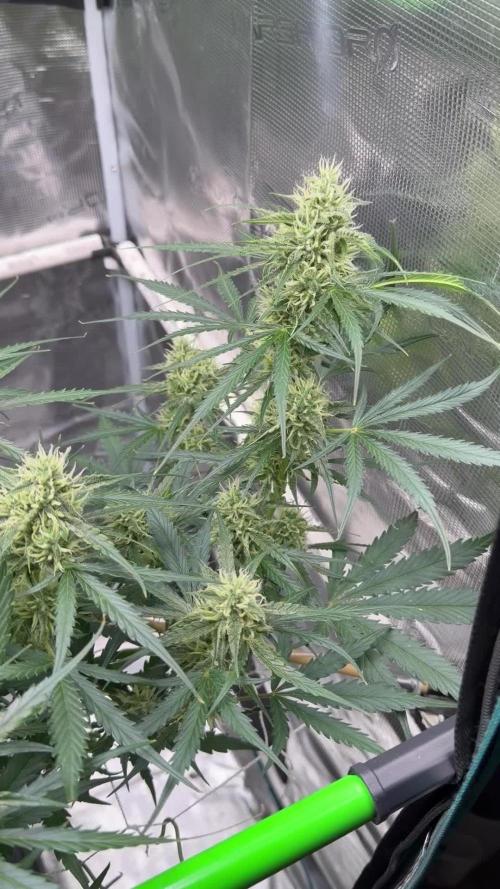
Bonjour à tous les padawans et maîtres jedis Toujours arrosage avec 2 litres d'eau ph6.3 à laquelle j'ajoute madame grow La plante est saine avec de jolies têtes chargée de trichomes
Likes
85
Share
the c99s got ten days of plain water then came the chop at week 10 and 3 days with a fairly decent 30% amber all things considered !
Likes
13
Share
Going good so far, start to smell good the Crazy Lazy!!
Likes
4
Share
@Ripper
Follow
This girl is a little behind her big sister. But she is looking great.
Likes
170
Share
Evening fellow growers. Hope all is well and you’re all doing great! This has got to be one of the hardest grows i have done. I always knew starting this early in the year was going to be hard and it’s proving that way. And again a massive shout to James and the team at RQS for supporting me and supplying me with the seeds. 🙌 Here we are week 6 the start of the second week of flower. These ladies are moving along alright (I think) although the cold weather is back and has not been to kind over the last couple days. They are still stretching out which is good, just signs of cold which isn’t the best. The bud sites are forming slowly and the structure of these plants looks good. Let’s see what this week brings. ✌️ Day 37, watered 500mil with some nutrients. Held of on them for the last week so just adding them in slowly. Hoping they pick up a little. Took a few fan leafs off that are covering bud sites but other than that just leaving them to it. No pics as it’s very cold and don’t want them out the tent too long. ✌️ Day 38, warmer today and these girls seem to be ok. Nothing done just a couple photos and a video. ✌️ Day 39, watered tonight with 500mil and a little feed. ✌️
Likes
5
Share
Va tutto bene, credo che siano meno di 20 giorni e dovrebbero entrare in prefioritura nel giro di qualche giorno altro Dovrei eliminare qualche foglia parasole?? O lascereste così?!
Processing
Likes
49
Share
So this plant is doing very well and fattening up nicely , she has had her last dose of pk now , Fast buds do not give anything away with there tester seeds , but I am wondering from the flower formation of this could be the gelato auto they are going too bring out this year ?
Likes
2
Share
We become aware at such times of man's wonderful ability to bring seemingly unrelated elements into harmonic balance, and receive a glimpse into a world where everything exists in conscious sympathetic attunement to everything else. When we listen to a piece of music that seems to strike a beautiful chord somewhere inside us, or view a painting that simply glows with harmonic awareness well executed, we probably do not spare much time to contemplate the wonderfully intricate combination of vibrations that our sensors make it possible for us to perceive. We tend to appreciate the relationship between the parts of something by an awareness of the harmony or dissonance of the whole. This ability enables us to say "what a beautiful house!" instead of "analysis has proven that this collection of building materials exhibits certain elements of harmonic proportion." While this ability to instinctively appreciate the beauty of true harmony has an important role to play in evolution, a more analytical understanding of the laws involved can be most useful. This is especially so if we wish to create works of art where each part exists in true harmony, not only with the other part of that particular whole, but with the universe within which the creator and the created exist. Everything vibrates. From the most dense matter to the most subtle cosmic rays, everything which our senses allow our thoughts to become aware of, can be specified in terms of wavelength or frequency of vibration. These two terms define the same thing, but from different points of view. The following are the approximate wavelengths of various energy carriers: Cosmic rays 0.000,000,001 mm Gamma rays 0.000,000,1 mm X rays 0.000,500 mm Ultraviolet rays 0.003 mm Visible light 0.006 mm Infrared 0.01 mm Sound waves 1 meter Radio waves 300 meters Violet light 400 nm to 450 nm Blue light 450 nm to 500 nm Green light 500 nm to 570 nm Yellow light 570 nm to 590 nm Orange light 590 nm to 610 nm Red light 610 to 700 nm 1 nanometer (nm) = 0.000,000,1 cm = 1/10,000,000 cm If a guitar string is plucked and we hear a sound, it is not too difficult for the human mind to associate this sound with the vibration of the guitar string. With color it is quite different. It is difficult for us to conceive that the color of a substance is not an inherent property of the substance itself, but an indication picked up by our senses of that substance's ability to absorb or reflect the light which happens to be shining on it at that moment. Neither the matter nor the light is colored. What happens is that the brain learns to differentiate between the frequencies reflected or transmitted by the substance the eyes are focused on. The same thing happens with sound. When we say "Oh! Listen, they're playing my favorite song," what we really mean is: "My brain has stored within it a particular pattern of frequencies. I have compared the new information being received with this stored pattern and have deduced the answer that the two patterns are similar within certain specified tolerances." The 'pleasure' involved could have something to do with our running the pre-recorded pattern at the same time, in 'sympathy' with the new pattern as it is received. The word sympathy describes very well our ability to appreciate color and sound. It also describes the reason behind certain elements of harmony. For instance, if a substance vibrating at 100 cycles per second (tone 1) is in the proximity of another substance vibrating at 200 cycles per second (tone 2), we could perceive, if we had the right equipment, a certain sympathetic relationship between the two. We will see from this that there is a uniform doubling of the first tone seen in the second. At various points along the waves, the two are the same in amplitude. At other points, they are at opposite poles to each other. This doubled frequency has more points of similarity to the original than any other frequency except the original itself. If the equipment we had available for measuring these two frequencies was a soundboard amplifier and a pair of ears, then we would hear what would sound to us like one tone. If we had the opportunity to hear one at a time, we would hear that although they sound the same, one is higher in pitch than the other. This characteristic of 'the same but different in pitch', musicians have called the octave. Any two tones produced where one has exactly doubled the frequency of the other is called an octave. Speaking in ratios, an octave would appear then as the ratio 2:1 or 1:2, depending on whether we are talking of an octave up or down. A single note produced by almost any instrument will contain more than one wavelength or frequency. It will have a dominant frequency, the wavelength of which we would call the note's 'fundamental' or 1st harmonic. It will also have a varying number of upper harmonics, gradually fading in intensity into infinity or silence. Natural harmonics always have the same pattern of intervals between them. The interval between the 1st and 2nd harmonic is a perfect octave; between the 2nd and 3rd a perfect fifth; between the 3rd and 4th a perfect 4th; and so on, the intervals becoming smaller and smaller until they lose any relationship with the western 12 tone scale as it exists at the moment. Just as an octave has certain elements of sympathy with its fundamental, so some intervals have been noted to be more perfectly in sympathy with the fundamental than others. The ratio of the 'perfect 5th' or interval of 7 semitones, as it occurs in the harmonic series, is 3:2 or 2:3, while that of the 'perfect fourth" is 4:3 or 3:4. All the tones in the western 12 tone scale can be expressed in terms of the ratio between the upper tone and its fundamental. This would seem to be an ideal way of generating a scale from any given fundamental and several attempts have been made to do this, the Pythagorean system being probably the most well known. Although when working with a single tone instrument playing on its own, the Pythagorean formula works wonderfully well, if we had several instruments tuned this way together and asked them to play almost any western music, we would find that at times they sounded quite out of tune to each other. The lack of flexibility of the various scale systems based on the harmonic series has led to what is known as the 'tempered' scale. This uses as its primary unit of interval the ratio of the octave or 2:1. It then proceeds to divide the interval between any fundamental and its upper octave into 12 smaller intervals by applying the ratio: two to the one-twelfth power, to one (21/12:1). This equals 1.059463094, so by multiplying any frequency by this number, we will obtain the tempered semitone next up from our fundamental. We will also find that any tone twelve semitones up from any other tone, in a scale generated in this way, will have exactly double the frequency. If we took the note middle C on a piano and halved the wavelength, we would have the note C one octave above. If we halved this, we would have the C above, and so on. However, within about 6 octaves, we would find that although a 'sound' was being produced, no human ear could perceive it. If we kept on going, halving and producing upper octaves of our fundamental C, we would proceed through the infrared band, into the visible light spectrum. If we happened to be outside during the day, we would, for one octave only, see the note C with our eyes. The next octave above would already be in the ultraviolet band, and outside the eye's sensitivity range. If we can think of color as being an indication of a substance's vibratory rate or wavelength, we may begin to see a relationship that could exist between the color and sound spectrums. The logical extension of what has so far been said is that there exists a scale in the color spectrum that corresponds exactly to the scale in the sound spectrum, each color tone being an octave of the equivalent note in the sound range. This is not the end of the story but only the beginning. If we can for the moment accept that any wavelength in one band has upper and lower octave stretching out to infinity, then the next question is 'fine, but what shall we use as our fundamental? A particular color? A particular sound frequency?' The musicians among us will probably say 'A 440'. This means that the note A should vibrate at 440 Hertz, or 440 times per second. They would tell us that this is standard pitch has been adopted by most orchestras around the world; pianos are tuned to it, instruments are constructed to formulas based on it, and so to them it would probably seem the most appropriate place to begin. Some of these musicians may know of the battle that is still raging with regards to this being the standard, but few would know why A = 440 Hz was chosen except that it worked when it was set to be a suitable compromise between the many different pitches in use at the time. 432 Hz is said to be mathematically consistent with the patterns of the universe. Studies reveal that 432 Hz tuning vibrates with the universe’s golden mean PHI and unifies the properties of light, time, space, matter, gravity, and magnetism with biology, the DNA code, and consciousness. When our atoms and DNA start to resonate in harmony with the spiraling pattern of nature, our sense of connection to nature is said to be magnified. Another interesting factor to consider is that the A=432 Hz tuning correlates with the color spectrum, while the A=440 Hz is off. Audiophiles have also stated that A = 432 Hz music seems to be non-local and can fill an entire room, whereas A=440 Hz can be perceived as directional or linear in sound propagation. Once you adopt the idea that sound (or vibration in general) can have an equalizing and harmonizing effect (as well as a disturbing effect), the science of harmony can be applied to bring greater harmony into one's life or tune to specific energies. There is a form of absolute and relative harmony. Absolute harmony can, for example, be determined by the tuning of an instrument. The ancients tuned their instruments at an A of 432 Hz instead of 440 Hz - and for a good reason. There are plenty of music examples on the internet that you can listen to in order to establish the difference for yourself. Attuning the instrument to 432 Hz results in a more relaxing sound, while 440 Hz slightly tenses up the body. This is because 440 Hz is out of tune with both macro and micro cosmos. On the contrary, 432 Hz is in tune. To give an example of how this is manifested microcosmically: our breath (0,3 Hz) and our pulse (1,2 Hz) relate to the frequency of the lower octave of an A of 432 Hz (108 Hz) as 1:360 and 1:90. It is interesting to note that 432 Hz was the standard pitch of many old instruments and that it was only recently (19th and 20th century) the standard pitch was increased. This was done in order to be able to play for bigger audiences. Bigger audiences (more bodies) absorb more of the lower frequencies, so the higher pitch was more likely to “cut through”. One of the oldest instruments of the world is the bell ensemble of Yi Zeng (dated 423 BC), tuned to a standard F4 of 345 Hz, which gives an A= 432 Hz. The frequency of 345 Hz is that of the platonic year! Similarly, many old organs are tuned in A=432 as well; for example, St. Peter’s Capella Gregoriana, St. Peter’s Capella Giulia, S. Maria Maggiore in Rome. Maria Renold’s book “Intervals Scales Tones and the Concert Pitch C=128 Hz” claims conclusive evidence that 440 Hz and raising concert pitch above scientific “C” Prime=128 Hz (Concert A=432 Hz) disassociates the connection of consciousness to the body and creates anti-social conditions in humanity. The difference between concert pitch A=440 Hz and Concert A=432 Hz is only 8 cycles per second, but it is a perceptible difference of awareness in the human consciousness experience of the dream we share called existence.
Likes
1
Share
@ElCapitol
Follow
Nice growth in only one week. More than doubled, she seems very happy and strong. Good stem that is thickening up so she can hopefully carry more buds :) No problems so far.
Likes
26
Share
@Targona
Follow
22 days since my little girl sprouted from a seed🌱 Third week of growth for my Purplematic CBD Auto ⚕️💚💜 Nutrients: Plagron Alga Bloom is an organic flower fertilizer for growing in soil. The fertilizer is based on algae and contains amino acids, proteins and a balanced ratio of phosphorus and potassium 🌺 ---------------------------------------------------------------------------------------------------- Plagron Green Sensation is a flower booster. Green Sensation is a 4-in-1 product, so you don't need to add additional fertilizers. Suitable for all types of substrates and systems 💚💜💚 ------------------------------------------------------------------------------------------------------------------- Bud Candy is a carbohydrate supplement from Advanced Nutrients that maximizes the growth and aroma of flowers. It supports strong root activity by providing food for beneficial microorganisms ------------------------------------------------------------------------------------------------------------------- BioBizz Calmag is a 100% organic, but also vegan-friendly fertilizer with BIO certification. Biobizz Calmag was designed for professional growers and home growers who need an extra dose of calcium and magnesium. It contains added humic acid 💩☘️- I only apply it once a week. --------------------------------------------- Biobizz Bio pH-/ Biobizz Bio pH+ is a 100% natural and vegan-friendly pH regulator. Suitable for all types of substrates and crop types. For use in growth and flowering. 💩🍋🌱 ------------------------------------------------------- PRO-MIX CONNECT MYCORRHIZAL POWDER - in the substrate General: Purplematic CBD Auto ⚕️💚💜 The plant is already strongly transitioning to flowering, beautiful white pistils are forming on the tops 🌺 Above I listed the nutrients I switched to during this period. Anyway, I stick to organics, except for the bloom booster, which is about half organic. This week - the third week - in most cases, she does LST and defoliation twice 🍃 🌿 The girl has very curled leaves down, they practically grow like that. I have no idea how it could have happened. She is not even overwatered, there are no problems with nitrogen and I measure the ph and ec regularly and she is fine. All the other girls in the tent look good, only this one is like that 😢💚💜. It looks like there will not be much of a harvest, probably unstable seed, that happens. But I am sorry because I use pure CBD to make tinctures. I use the new PH and EC meter Aqua Master Tools P110 PRO, the measurement is fast and accurate. So far I have managed to keep the PH and EC as they should be. I use Biobizz Bio +/- to correct. These are excellent products. I think that the plants are definitely very well affected by the spraying of the Vita-Race preparation and the excellent PRO-MIX Connect Mycorrhizal powder to support the roots. All the girls are very strong and stable since they were little 💚 Training: As I mentioned above, I did the first LST and defoliation, the plants usually quickly re-leaf, other branches will grow quickly. So in this third week I do two defoliations and two LSTs 🍃🌿 🌺 But I didn't cut this plant much, it doesn't have many leaves and I need it to go well for photo shoots The girls grow in a tent: Mammoth Pro+ 80, with reinforced reflective Mylar 600D foil Lighting: Mars Hydro TS1000, this light is sufficient for lighting in my growing space. The plants respond effectively and the light is technically very well managed - I try to have 50cm between the light and the plants, so I regularly move it up. Mars Hydro TS1000 Quantum Board 💡💡💡 Power: 148W Dimensions: 90 x 90 cm Dimensions: 360 x 330 x 34 mm Chip brand: Epistar Thanks for the likes See you soon 😍😻
Likes
5
Share
@TerpTime
Follow
Zeit für den Endspurt Neun Wochen liegen inzwischen hinter uns – und das Ende lässt sich förmlich riechen. Fünf Wochen Blütezeit sind geschafft, und die Ladys zeigen sich weiterhin von ihrer besten Seite. Die wohl größte Veränderung in dieser Woche ist, dass meine kleine Nachzüglerin das Zelt verlassen hat. Sie steht nun überdacht im Außenbereich. Die Entscheidung fiel mir nicht schwer, da sie im Vergleich zu den anderen deutlich hinterherhinkt und schlichtweg nicht denselben Nährstoffbedarf hat. Durch ihren Auszug konnte ich sowohl die Transpiration als auch die Wärmeentwicklung im Zelt etwas reduzieren. Der Fokus liegt nun ganz klar auf den verbleibenden drei Pflanzen – und wer weiß, vielleicht holt die Nachzüglerin am Ende draußen doch noch etwas auf, wenn der Rest bereits geerntet ist. Ernährungstechnisch blieb in der fünften Blütewoche alles beim Alten. Die Nährstoffzufuhr habe ich bewusst konstant gehalten. Für die kommende Woche ist allerdings eine gezielte Mischung mit PK 13/14 geplant, um die Blütenbildung weiter zu pushen und das Maximum aus der Reifephase herauszuholen. Die Entwicklung der Pflanzen ist weiterhin tadellos. Alle Werte – sei es Luftfeuchtigkeit, Temperatur, VPD oder pH-Wert – sind stabil und genau dort, wo sie sein sollen. Diese Konstanz in der Umgebung macht sich sichtbar bezahlt. Im Zelt liegt ein intensiver, süßlicher Duft in der Luft, der stark an Zitrone und Beeren erinnert – ein echter Vorgeschmack auf das, was kommt. Die Buds entwickeln sich sichtbar weiter, werden dichter, harziger und formen sich immer klarer aus. Besonders auffällig ist der dichte Überzug aus Trichomen, der die Blüten in ein frostiges Kleid hüllt. Beim Berühren bleiben die Finger regelrecht kleben – ein deutliches Zeichen dafür, dass sich hier eine Menge Potenzial an Geschmack und Wirkung aufbaut. Ein kleiner Wermutstropfen bleibt: Durch den begrenzten Platz mit ursprünglich vier Pflanzen musste ich in Sachen Lichtverteilung und Luftzirkulation kleine Einbußen hinnehmen. Das wird sich vermutlich leicht auf die Budgröße auswirken. Dennoch bin ich mehr als zufrieden mit dem, was sich hier abzeichnet. Die letzten Wochen des Grows sind angebrochen – das Ende rückt näher, der Anfang liegt längst zurück. Ich freue mich riesig auf das, was noch kommt, und bin sehr gespannt, welche Masse und Qualität die Buds am Ende erreichen werden.
Likes
38
Share
Gorilla Cookies is growing well. Making some nice progress. I had to give them some organic calmag because that is all I could get locally but it seems to be working. pH has held steady and the leaf color is looking great on all the plants. Haven't had to do any maintainence this week other than defoliate a few bottom leaves and spread some branches out a little. Plants are growing bigger than I thought they would so I will have to figure something out to get them spread further apart soon. Just going to keep the juice pumping and the lights beaming. Hoping to get them under the QB lights soon. She is 28 days old in a 16 oz cup. No roots have grown out of the cup at any time. No roots have been trimmed or touched. Happy growing everyone!
Likes
35
Share
❄️🤩💚 Frost for days loud Terps, dense nugs not hard to trim and a good Harvest what can you which more for...?! Def together with Tricho Jordan the best Beans I grew out so far, highly recommend trying them out !
Likes
12
Share
@Pedro_88
Follow
Volvimos, pensé que la iba a perder y estaba un poco desanimado, solo era cuestión de esperar
Likes
45
Share
@BodyByVio
Follow
Beautiful flower full of trichomes. Smell and test fantastic. Very fast flowering. She was done on day 49 but I cut her down few days later. I love the strain, the only thing that I will like this strain to have is a better yield. Beast quality buds I ever grew.
Likes
15
Share
She went to day 94. Easy to grow. No major issues.
Likes
15
Share