




Likes
1
Share


@Jordantone1
Follow
Everything going great. Smells like sour candies. Legit can smell the cantaloupe origins and it’s already getting blanketed in trichs. Can’t wait to see these girls get dense in the next few weeks.

Likes
25
Share


@Ultraviolet
Follow
Coming along, I find the urge to just let it grow vertically but last grow I was a little underwhelmed with the spread once the canopy was past the stretch, I will look to continue LST , really starting to thicken up around the base. Plant must be feeling the need for extreme reinforcement of stem trunk as the extra weight of vertical growth on the long supporting stems have little in way of support.
Filled waterbeads with a concoction of nitrogen, vitamin b, humic, phosphorus, omina.
Added aluminum suplhate to help PH medium, strain likes it slightly acidic.

Likes
2
Share


@herewegrow
Follow
Day 51 - Stour Stomper 1 is looking very frosty, excited for her to start swelling. The runt is just a little behind but still looking great. 4AM1 really chunked up quickly, quite far ahead of 4AM2. Getting pretty stinky in there. Some lower leaf issues but nothing devastating.

Likes
8
Share


@Limez
Follow
Endlich wieder fit und schön grün. Standen leider lange auf der Stelle aber so langsam läuft es wieder :)


Likes
8
Share


@Timbo_Growz
Follow
14th to 17th November - Flower week 2
No major training has been made. First signs of the flower are showing, plant made a little stretch and is getting really bushy.

Likes
19
Share


@GoldenWeedGrower
Follow
Maybe last week for Mary Jane. My first love
I will continue to give her only RO water and ripen, maybe sometimes some flora bloom.
Checking continuously to understand the best moment to harvest
Any suggestion on that would be appreciated!
Good Luck to myself
@26/06
Added 2l with 1ml of PH+
EC: 1160
PH: 6,26
@27/06
Added 2l with 1ml of PH+
EC: 1177
PH: 6,18
@28/06
Added 2l with Ripen and flora bloom
EC: 1330
PH: 6,1
@29/06
Added 2l of fresh water
EC: 1210
PH: 5,5
@30/06
New res 10l with 15ml of Flash Clean for the final rush
I'll harvest on friday.

Likes
Comments
Share


@LokalGrenz
Follow
Week one starts today well actually yesterday Feb 9th was first day but who cares imma document it as today top dressed with power bloom days ago and top watered today
Since the bottom watering pan was dry
Likes
12
Share


@Lenlen
Follow
All going good theis week. Learnt a lot through this 1st grow. Shouldn't be to long


Likes
14
Share


@TheBulldozerSicily
Follow
Le piante procedono bene, sto avendo solo un problema con il ph, diventa acido troppo velocemente, va troppo in basso. Siccome non mi era mai successo, anzi lo dovevo abbassare per portarlo a ph desiderato con ph- , non avevo il ph up, adesso sto aspettando che arriva e spero di risolvere questo grande problema.

Likes
18
Share


@Jalfax
Follow
➡️ Bella ragazzi, inizia una nuova settimana e le piccole crescono a vista d occhio, iniziano a farmi vedere le proprie infiorescenze e questa volta posso rendermi soddisfatto.
Likes
Comments
Share


@Comfrey
Follow
Beim LST habe ich den Spitzentrieb versehentlich angebrochen. Sie wird es überstehen, hatte durch den Knacks allerdings ziemlich Stress.

Likes
45
Share


@masterofsmeagol
Follow
7/3 Hot as fuck today. Japanese beetles were around. I killed a few. I'm going to have to go over and keep an eye on things. It reached 90° today for the majority of the day. I watered around 1pm as I noticed most of the bags were very light. I'm glad I held off on the BT. I've dealt with jpn beetles before so hopfully that won't be an issue. Things are getting big. It won't let me upload any pictures or the video I did. I may upload it to past week. Went back over at night and and plants looked dropy but it was after 7pm and they were just going to sleep.
7/4 Didn't take photos this morning. Found some jpn beetles. That's the damage I've been seeing. I went back over last night to hunt them but I only got two. There weren't any others. No biggie. I'll put some pics up from today after I get back
7/5 Didn't get a chance to check the plants out today. My intuition tingled around 1pm and I had just gotten home and I ran over to check them. They displayed minor signs of heat stress as seen in the pics (due to the super high humidity and 90° weather) and the bags were light. A few were REALLY light. I could see they needed water. I WATERED 4 1/2 GALLONS TO THE GARDEN. DO TO THE HIGH TENPS AND WINDS IVE HAD TO WATER THE LAST THREE DAYS IN A ROW. IVE SLOWLY STRARTED INCREASING VOLUME. I don't want to water until I get a shit ton of run off because I want to keep the nutes in my soil as long as possible. As you can see things are going great. Minor pests but notjing major. They're growing at a very rapid pace. I'll need to add another layer of supports soon and begin to LST some of these girls. I've got one seedling in a 10 gal and I'm pretty sure it's a feminized red runtz but it's in preflower and looks and SHOULD be a female but I haven't seen the white hair yet. Looks like a female preflower though. I do have one auto though in a 5 gallon tjats doing good too. I have a bunch of pics but the internet is too slow. I'll upload tomorrow. Started pouring around 6.
7/6 Poured sheet rain all night. After it had Bern super fucking hot and I watered my plants with 4 1/2 gallons. Oh well. If I didn't water we wouldn't have gotten the rain. The fabric bags makes watering easier. The wind will dry out the medium. We do have some rain in the forecast. A pallet fell over and knocked my 5 gal bucket with tje auto into a 10 gal seedling but it held the pallet up and didn't damage anything. Out of all the ways it coyldve landed it landed just right to not hurt anything. Everything is super healthy. I do have some random pest damage but it's minimal. I'll decide whether to use a spray or not. Didn't take pictures this morning. Was pressed for time.
7/7 Super hot even at 8a.m. Rained the majority of the day yesterday. Plants are getting HUGE. I'm going to have to build a second round of supports and should probably start some LSTing. They seem to like growing natural how they are (besides the original topping and FIMed. You can tell these are ALL very high % indicas. I'm seeing pistols spitting out everywhere. Event horizon and sherb cake seem to be in the lead. The seedlings have realky taken off. The one I put in the 50 has fan leaves the size of my hands.
7/8 Wow it has been extremely hot. It's going to be in the 90's again today. Checked my plants and it seems the GMOs seem to be using more water. Those bags were a little lighter. Seeing how there is no rain in for a few days I had to water. WATERED 3 1/2 GALLONS. LAST SEEDLING FINALLY SHOWED AS A FEMALE.
7/9 Bags are still heavy. Found ONE jpn beetle this morning. Plants seem to be bigger everytime I look.starying the stretch and spitting out some pistols. I took some pics of the pistles. I'll update
7/10 should've started a new week but I didn't. I'll make next week six days. Plants are starting ro stretch. Minor random pest damage but woth the heat they need lots of water. Noticed a couple dead interior leaves so I should probably go through everything and defoliate. I need to add another layer of supports as well.

Likes
32
Share


@Fatnastyz
Follow
9-15
Day 21
She had a hair showing when she woke!
Top dressing others, so I got her too!
Sprinkled HP connect on surface lightly! Sprinkled a little bit of craft blend, small amount of worm poo, TOPPED with Build-a-Flower. Around 1 inch across. Recovered with straw. Did not bloom boost her. Yucca 1/16tsp and humic 1/8tsp 6.5 liters water. Ph 6.0.
My ecowitt is a little off on this pot. Caused me to over water the pot. Fed 355 ppm and just had a slight cup of water, I had to drain out.
Oops. Shes short and poppin!
9-18
Day 24
Watered around 1000 ml. She probably coulda took 500 more. Removed very bottom leafs, were laying on the ground. Just did some fancy leaf tucking to expose the sites!
She grows!
9-21
Gave 2k ml ph 6.4
Tea brewed 30ish hrs. Worm poo, recharge, kelp, yucca and 1 tsp build-a-bloom ,molasses. 3 gallons water.
Adjusted lst, some defoliation. lower buds and blocking leaves, full on flower!
Thanks!


Likes
2
Share


@Hempire
Follow
Hello growers !
This week I started to put cannaboost and terra Flores ! They grow higher every days and the size of the second branches is huge !! Good plants and very strong ! I’m quite excited to see the flowers ! I cut a bit of leaves that cover buds from the light ;) this session I don’t pinch the branches to let the stretch doing the job
Likes
53
Share


@Chucky324
Follow
Hello. This is the end of week 7 and the beginning of week 8 of flowering.
Things are going good in here this week. I'm starting to see some yellowing of some of the older leaves as the plants are pulling back nutrients to keep the buds going. It's the last week of food for the girls. I'll be starting flushing next week. I've got a few branches of seeds going so I won't flush too hard the first week.
It smells wonderful in here. Smells like sweet hard chalky lemon/citrus candy with some skunky undertones. Delicious.
I volunteer at the local observatory and when I drove up the hill this week I thought what are those trees with the silvery leaves. So no one was behind me so I slowed to see what trees they were. All the maple trees had bad white powdery mildew on their leaves. It's been a long cold wet spring this year but it's supposed to get hot this weekend, enough to stop the WPM? or all the maples will lose their leaves early. I don't see any on my zucchini plant yet. It's usually the first to get it.
OK. Have fun. Chuck.
Likes
17
Share


@HowtoBubatz
Follow
We’re in the second week of flowering, and the plants are really starting to stretch! 🌿
They’ve gained good height, especially the one without LST, which has grown tall very quickly.
It’s been exciting to watch them reach upward as they prepare for the bud development phase.
Everything is looking good overall, and I’m happy with the progress so far. I’m really looking forward to seeing how the buds will start forming in the next few weeks! 😁✨
Likes
17
Share


@Ton_Trichomen
Follow
ruce Banner#3
See of green project
By #originalSensibleSeeds
Day 21 08:00
Now it looks like a starting S.O.G
I think i give them 1-2 more days 18/6 than i switch over to flowering
Checked all leafs and soil yesterday and all was more than good ph and salts just perfect
See you tomorrow again
Day 22 08:15
Good morning
I kicked them into flowering this morning
all so i gave Plagron Terra Bloom 60% of there normal dosis also pure zym and power roots also Plagron full dosis ...
My baby are 30cm now i count with a 150-200% stretch but i think i handle that baby ...
I dominate my Amnesia grow to, so Hulk who are you .... show me ..... 😉
Day 23 13.20
After i send them into flower feed them with nutes all is good no sighns of stress to much nutes or some else, air temp and humidity are controled so thats fine to 😉
Se ya back tomorrow
Day 25 07.10
So they do realy grow like i want them to grow thats cool
Now on 12/12 since 3 days the strech is really smooth till now and it seems its true what i heard about Bruce not to much till no leafs on the bottem of the plant know i wait till the flowering will start think mid of next week
Day 26 07.30
I see here and there starting of flowering little white hairs are comming feed them today with the full dosis of nutes but still under the limit of plagron less is more
Bruce looks really healthy at all so far
Day 27 07.30
I cleand up my room🙃 no no worrys some plants were a bit smaler some a bit higher so i switched the long ones in the back the smaler ones in the front now it looks a bit weird but that will be fixxed up in 2 days ..
But all in all are very fine and healthy
See ya tomorrow again
Temp: 27.5 lights on
19.5 °C when lights out
Humidity: 60%
Ph : 5.92
Ppm: 850
Water: 25l 23°C
CO²: No Mercy Tabs
Plagron: Terra bloom 100ml
Plagron: Pure Zym 25 ml
Plagron: Power Roots 25 ml
Light distance: 50cm
3x MarsHydro eco 120 total 675w
Air Van: 809m³ Prima Klima
AKF : 800m³ prima klima
3 l water cooling airco Diamant...
3.3l humidifier
1.8l Airdryer
Humidity control: Inkbird IHC-200
Temp control cooler - heater: Inkbird ITC-308
1.5x1.5m² Custom Grow Room
All seeds comes out #originalsensibleseeds
so they have 100% of 100%
Bruce Banner the 3. hits the ground and i really hope he gets angry as fuck and shows me the green big guy sleeping inside him ...
S.O.G.
☠️☠️☠️🌶️🌶️☠️☠️☠️
Thx to Linda Seeds, BTB Grow Supplies & Zamnesia for supporting this grow.
Zamnesia unconsciously because they sent me my seeds 2 times but I'm very grateful for that


Likes
2
Share

@ThatDudesDad
Follow
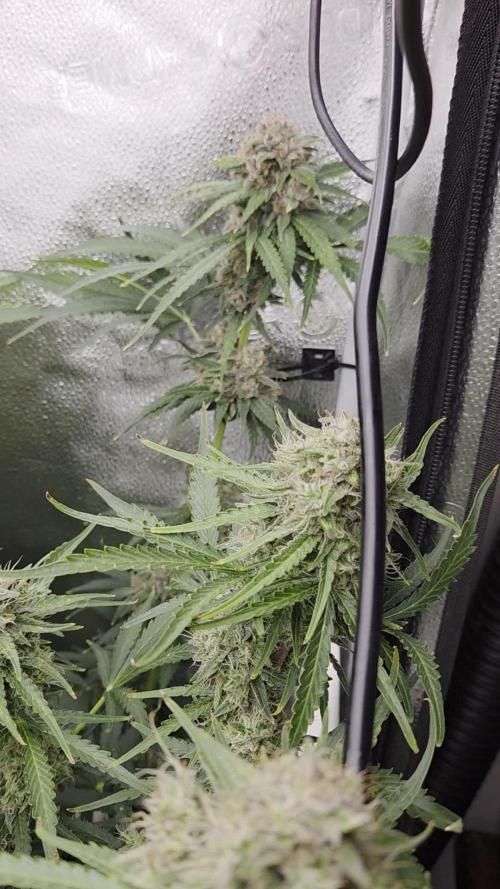
I honestly didn't think five plans in one tent would go so well. For me anyway. But it's gone very well. Two plants seem to be about 2-3 weeks from being ready. Three of them look really good and really frosty but have a ways to go. Continue to provide the best environment I can. Closely watching my nutrients which will be going up this week. Note on smell... It smells like everything in there. I would say the most prominent would be two types of fruit and a turpentine type smell which is blowing my mind. I'll have to break them down individually when they're done to see what each one actually smells like. It's pretty amazing. Will definitely be growing Tastebudz Genetics again. Hopefully for my next grow. That's how good these plants are. i'm ready to go now!

