Likes
Comments
Share
@Mr_Maes
Follow
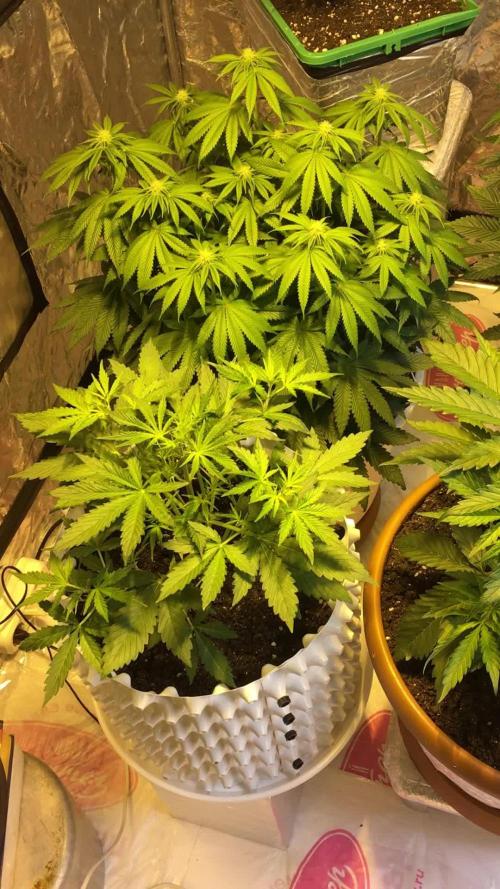
For sure this strains genetics are strong. She is really blowing up with growth. Almost a foot tall and extremely strong structure.
Likes
11
Share
Jour 76 Et commence à développer leur pistils Les plantes sont saine et prennent beaucoup de hauteur je dois en palisser quelques une J’ai fais un thé de compost oxygéné pour les booster pour la floraison Recette : 5g cendre coque de ricin 25g biochar 5 gr levure de bière 4gr pollen d’abeille 7gr ortie micronisé 5gr spiruline 10gr tourteau de karanga 8gr Kelp 20gr zéolithe chabasit 5gr de consoude 3gr hydrolysât de Kelp 5gr vers de farine 12,5gr bactérie soluble 5gr levure saccharomyces cerevisae souche myco 6420 12,5gr de prêle sauvage sécher 125gr lombricompost 2gr big foot mycorhize gold Mycorrhizae (400 propagules per gram) Endomycorrhiza Glomus aggregatum -100 propagules/gram Glomus etunicatum – 100 prop/gram Glomus intraradices – 100 prop/gram Glomus mosseae – 100 prop/gram Bacillus subtilis – 350,000,000 cfu/gram Bacillus licheniformis – 200,000,000 cfu/gram Bacillus megaterium – 200,000,000 cfu/gram Bacillus simplex – 200,000,000 cfu/gram
Likes
2
Share
This is definitely one of the slower growing autos I have run. 11 weeks after germination and the buds are only starting to fatten up now. AH#2 is looking like it could easy yield double her older sister! Let's hope the added molasses can help her get some fat nugs!
Likes
Comments
Share
@Mxlan10
Follow
Harvest Day🏻 sweet smell, like some fresh cherries. Smells and looks great
Likes
61
Share
Grape Ape Cake ! Lineage; Hotcakes (Katsu Bubba Kush X Burnt Toast (from Raw Genetics) X Grape Ape An Exciting New Collab from Katsu Bluebird ! Week 11, & the End of 4 weeks of flowering (30 Days of 12/12) Welcome back to our regular scheduled programming.... Like I mentioned we are officially 30 days into our 12/12 lighting cycle. Now taking into consideration that this is one of the first runs of this particular strain the flower period is partially undetermined, I will be guessing based on Lineage of the parents, & following her closely towards the end to ensure my desired trichome ripeness. Katsu's HotCake's run's Approximately 8-9 Weeks & The Grape Ape run's slightly quicker at 7-8 Weeks You can certainly tell the difference between all 5 plants, I'm very glad I took cuts of everything ! as plants 2 & 3 are certainly the keepers of the bunch.. plant 2 showing some very cool fall colours already (emerson effect hitting strong asf) She is already starting to purple up & smells Very Sweet. My guess is this pheno leans more to the Grape Ape side. As far as plant 3 is concerned I can smell heavy Kush aromas emulating off her already, & based on her flowering structure I believe this pheno leans more Katsu Bubba. but we'll have to wait and see. A Minor amount of leaf plucking this week should be noted.. It will probably be the last time I mess with them, its time to start swelling up. It is my opinion that most of the stretch has been completed & i'm now looking at the final colas minus the couple weeks of filling out of course. As this is the end of four weeks of flower(12/12) Their food will be increased during the next feeding, thus far i've been impressed with the ease of this strain.. I wasn't sure what to expect to be honest but I will say this I was weary of over-feeding but all of them seem to enjoy heavy feedings. Thanks for Reading 🙌 If you have a question or a comment leave it down below otherwise, I Hope You Check in Next Week, Stay Safe out there & Happy Gardening Cariboo
Likes
2
Share
Topped once, turned off IR @ nights, slowed vertical growth back down, and took off both of the very lowest internodes on each plant. Eisenia fetida Stratiolaelaps scimitus Armadillidium vulgare Red wigglers (Eisenia fetida) are highly beneficial. They are considered an ideal choice for "no-till" or container-based organic growing because they live in the upper layers of soil, feeding on organic mulch rather than the plant's root system. Red wigglers accelerate the breakdown of organic amendments and produce high-quality, nutrient-dense worm castings directly in the root zone. Clover is another exceptional component of an organic rhizosphere, offering a sustainable, self-sustaining alternative to synthetic nitrogen fertilizers produced via the energy-intensive Haber-Bosch process. By forming a symbiotic relationship with Rhizobia bacteria, clover converts atmospheric nitrogen N2 into ammonium NH4, providing a steady, slow-release nutrient source that enhances soil health and reduces environmental impacts. Red clover offers superior nitrogen fixation and biomass production compared to white or yellow clover, making it the premier choice for maximum soil vitality, particularly for improving soil structure and providing a high-volume nitrogen credit for subsequent crops. If it is fully functional and efficient soil, the rhizophagy cycle is superior long-term than any synthetic delivery when it comes to preventing deficiencies, not because it's "better," per se. The medium will require a very high CEC to make it to harvest without re-fertilization. The rhizosphere acts as a dynamic, interactive exchange where plants and soil microbes trade resources based on immediate needs. When a plant lacks a specific nutrient, it changes its physiology and releases specialized chemical cocktails—root exudates—into the surrounding soil. These exudates, which include sugars, amino acids, and organic acids, serve as a "shopping list" to attract specific microorganisms, which in turn return higher levels of desired nutrients. There is nothing in comparison when using synthetic delivery, which can cause plants to stop producing exudates, effectively "starving" the beneficial soil life, over time turning the soil barren and void of microbial life. Responsible use, applying the right amount at the right time, can minimize these negative effects. Relying solely on synthetic fertilizers without replenishing organic matter is what typically leads to exhausted soil. The use of synthetic fertilizers can utilize the Cation Exchange Capacity (CEC) of the soil, but without a robust rhizosphere and active microorganisms, the efficiency of this process is significantly reduced. This makes synthetic growing more difficult to prevent deficiencies overall compared to an efficient organic living soil with a robust rhizophagy cycle, as there is no "one size, fits all" when it comes to different nutrient profiles of strains/genetics, making it trickier to "guess" and prevent creeping deficiencies. CEC does not contribute towards EC. Add more CEC using biochar, problem solved. If you keep pH between 6.3 and 6.7, hydrogen is exudated to cycle the medium's CEC for its needs. Keeping the pH between 6.3 and 6.7 creates an environment where plants release H+ to displace positively charged nutrients (like Ca2+, Mg2+, K+ held on soil particles or within artificial media this cycle through nutrients via the medium's Cation Exchange Capacity (CEC) Microorganisms generate a stable potential of approximately 0.5 V EC. The rhizosphere creates its own food, similarly to chelation, using 1000's of varying combinations to create its own food. Start to finish, just add water. Eventually, more materials will need to be added at the beginning of each new grow, but very attainable to go from seed to harvest without ever fertilizing. ATP is important when it comes to biomass accumulation. Cellular root respiration and cellular respiration are essentially the same biological process, the breakdown of glucose to create usable energy (ATP) in the presence of oxygen, just taking place in different parts of the plant. Synthetic (salt-based) grows have significantly lower levels of total rhizosphere respiration, often referred to as root-zone activity, compared to organic living soil grows. While the plant roots themselves may respire in both systems, the surrounding soil ecosystem in a living soil setup is vastly more active, teeming with bacteria, fungi, and beneficial microorganisms. 2 pools of ATP, it won't double in growth buuuut, but improving root respiration by ensuring high oxygen in the soil is crucial. Good aeration ensures roots can fully utilize glucose to generate the ATP necessary for nutrient uptake, leading to healthier and more productive plants, even if growth isn't exactly doubled. The ATP created using root respiration is dedicated to rootzone growth; the ATP created using regular cellular respiration in a synthetic system would have to dedicate a lot of ATP to the roots when there is little or no root respiration. It's true that there is less of an initial ATP cost in breakdown when nutrients are already in their final form (synthetic), but you lose a solid chunk of ATP when the entire plant is reliant on cellular respiration alone; a large portion of ATP is dedicated to root zones for "forced" nutrient uptake rather than traded. Making it overall less efficient, even if the initial cost of breakdown is higher. Not sure if I butchered that but one can hope It makes sense. Oxygen is of critical importance when growing in living soil compared to synthetic soil because it supports the metabolic needs of the microbial, fungal, and insect ecosystem, rather than just the root respiration required by the plant itself. While synthetic grows can survive in lower-oxygen environments with precise mineral feeding, living soil systems rely on aerobic microbes to decompose organic matter (microbial mineralization) to create plant-available nutrients, which is an oxygen-intensive process. While a specific fair percentage is difficult to guess, my experience points to a massive, compound difference between the two methods and the amount of oxygen required. All the ATP spared is used on more biomass, not only that, but the extra root respiration can achieve a much higher CO2 compensation point naturally than you could with synthetic and atmospheric CO2 alone. As a plant grows faster and increases in size, its demand for nutrients to support that growth increases, requiring a higher rate of nutrient uptake. As plants enter phases of rapid vegetative/floral growth, their metabolic demand for nutrients increases exponentially. Without a robust buffer zone—whether in the soil (cation exchange capacity) or in a hydroponic reservoir—deficiencies will occur rapidly because the instantaneous demand for specific nutrients can quickly exceed the rate of supply. A growing body of evidence suggests that organic living soil provides superior long-term soil health and environmental benefits compared to synthetic fertilizers, which are often criticized for promoting a cycle of dependency and degradation. While synthetic fertilizers offer short-term convenience and high yields, they often come at the expense of long-term soil health, sustainability, and increased corporate control over growers/ farmers. Organic living soil, while slower and requiring more care to establish, creates a sustainable, resilient, and, ultimately, more fertile environment. We don't really grow; we facilitate energy conversions, and energy is just numbers. Because the universe works the same way today as it did yesterday, there is a single, fundamental mathematical quantity that remains constant. We call this quantity energy. You cannot put "energy" under a microscope. You observe matter and forces (like heat, motion, or light), but energy is just a scalar number calculated to help predict how these things will change and interact. When an object falls, or when a battery powers your phone, matter shifts and changes form. Through it all, the universe ensures the "total score" of the numbers remains exactly the same. Once all water is removed, approximately 95% to 97% of a plant’s dry matter consists of carbon, oxygen, and hydrogen. These three elements form the structural backbone of all plants. NPK & all the rest 3-5%. Indigenous Amazonians created, or at least significantly enhanced, the fertile, dark soil known as Terra Preta de Índio (Portuguese for "Indian Black Earth") by incorporating biochar and other organic materials into the soil. This anthropogenic (human-made) soil technique, which dates back roughly 2,500 to 8,000 years, allowed ancient civilizations to flourish in regions with naturally poor, acidic, and nutrient-poor tropical soils.
Likes
5
Share
3. November Alle drei Pflanzen weiterhin topfit. Trauermücken aufgetreten. Habe das abgelaufene Päckchen nematoden für die runtz genutzt. Hoffe es bringt was 4. November Cookies Gelato hat den harten Mainlinecut bekommen. Spitze wurde entfernt, Seitenteile wurden direkt danach abgeschnitten. Sie wird’s schon wegstecken. Tropimango und runtz geht’s gut :) Cookie gelato hat bereits wenige Stunden später die Blätter wieder hoch gestreckt. Stagniert. 5. November Alles gut. Die Schnitte wurden gut verkraftet. Triebe wachsen wieder Cookies gelato ist nun 21 Tage alt. Tropimango ist nun 18 Tage alt. Runtz ist nun 7 Tage Alt. 7. November Cookies gelato wächst. Sobald die Klammern da sind wird sie runtergebunden Tropimango hat schnitte und Lst bekommen. Topping werde ich noch abwarten. Runtz wächst 8. November Cookies gelato hat LST + mainlineschnitte erhalten. Wurde nicht mit gießen kombiniert da ich gestern gegossen habe. Tropimango erneut LST. Runtz wächst. Sieht aus als würde sie langsam ins Wachstum wechseln. Erster Triebe am einzahnblatt kommen. Dreizahnblatt erst frisch entwickelt. 9. November Cookies gelato wurde das erste mal zusätzlich mit Sugar Royal und calmag versorgt. Hab’s davor vergessen 😅 Shit Happens. Wurzeldünger gibt es konstant weiter. Runtz wurde mit wurzeldünger und calmag versorgt Tropimango hat noch sehr feuchte Erde. Keine Ahnung wieso.
Likes
73
Share
@Roberts
Follow
Lilly x White Widow is doing great. She is bulking nicely with a frosty coating. She really loves the Spider Farmer G5000/UVR40 lights. She is due for a solution change soon. I may try to stretch it out till bulking is over. I want her to be juiced to fill in good, and dense. Thank you Spider Farmer, Athena, and Ripper Seeds. 🤜🏻🤛🏻🌱🌱🌱 Thank you grow diaries community for the 👇likes👇, follows, comments, and subscriptions on my YouTube channel👇. ❄️🌱🍻 Happy Growing 🌱🌱🌱 https://youtube.com/channel/UCAhN7yRzWLpcaRHhMIQ7X4g Spider Farmer Official Website Links: US&Worldwide: https://www.spider-farmer.com CA: https://spiderfarmer.ca UK: https://spiderfarmer.co.uk EU: https://spiderfarmer.eu AU: https://spiderfarmer.com.au G5000 Light Amazon Link: amzn.to/4643esa UVR 40: https://www.amazon.com/dp/B0BR7SGTHS Discount code: saveurcash (Stackable)
Likes
15
Share
@AustinRon
Follow
LJ4Q23 Flower 10 
HARVEST WEEK _______________________________ Environment Targets (Flower 10 - Harvest) - Scotoperiod: [ 13, h] # Contiguous dark hours daily - TemperatureMax: [ 78, °F] - RH: [57, %] - VPD: [ 1.2, mS] - LightIntensityMax: [ 750, µMol/m2/s] - LightDistance: [ 16.5, “] Fertigation Plan: - RLA Hydro Chart, EC 1.3 - 0.8 - Primer A: [ 6, ml, gal] - Primer B: [ 6, ml, gal] - Silica Skin: [ 2, ml, gal] - Resin Bloom: [ 2, ml, gal] Penultimate 3 Days (before Harvest) - RLA Resin Bloom, EC: 0.8 __ Wed Jan 31, 2024 LJ4Q 64:F:9:1 EC: 1.3 - [x] Runoff Amount: [ 550, ml] - [x] Runoff EC: [ 3.3, mS] __ Thu Feb 1, 2024 LJ4Q 65:F:9:2 - [x] Runoff Amount: [ 650, ml] - [x] Runoff EC: [ 3.2 , mS] __ Fri Feb 2, 2024 LJ4Q 66:F:9:3 Refresh/Dilute Reservoir, EC: [ 1.1, mS] - IF Refresh - Resin Bloom Only @ [ 8, ml, gal] - [x] EC Reservoir, Dark: EC: [ 1.3, mS] - [x] Add 1 Gal, w/ Resin Bloom [ 8, ml, gal], Reservoir EC: [ 1.1, mS] - [x] Runoff Amount: [ 800, ml] - [x] Runoff EC: [ 3.2, mS] __ Sat Feb 3, 2024 LJ4Q 67:F:9:4 - [x] Reduce Feed Duration from 4 Minutes to 3 Minutes (775 ml Runoff is a tad high, yes?) - [x] Trichome Check - Are we Ready to Harvest Tuesday? - [x] Runoff Amount: [ 775, ml] - [x] Runoff EC: [ 2.9, mS] # First Day with Runoff EC Coming Down . . . __ Sun Feb 4, 2024 LJ4Q 68:F:9:5 - [x] Runoff Amount: [ 550 , ml] - [x] Runoff EC: [2.9 , mS] - [x] Dilute Reservoir to EC: [ 0.8, mS] # Resin Bloom: [ 8, ml, gal], EC: 1.0 __ Mon Feb 5, 2024 LJ4Q 69:F:9:6 Add another gallon w/ 8 ml Resin Bloom Only . . . EC Solution: [ ?, mS] EC Reservoir: [ 0.9, mS] - [x] Runoff Amount: [ 75 , ml] - [x] Runoff EC: [ 4.5, mS] __ Tue Feb 6, 2024 # HARVEST DAY 70 !!!! LJ4Q 70:F:9:7
Likes
11
Share
Put this girl into flower this week! She was getting beastly and my Autoflowers wrapped up so it was time ❤️ I decided to put her into my big tent along with my other grow and continue to flower there. I was going to scrog her in my 2x4 but decided I will need the space to get the summer beans started 🤤 Upped her Bloom nutrients and dialed back the Grow, also increased the Micro’s . Temps have been a little higher than normal, running around 81 degrees of freedom units, and keeping around 55% RH. I did a light defoliation going into flower, and decided to do some LST by tying back a few branches to allow for better light penetration. 🇨🇦👊❤️
Likes
46
Share
Been flushing from day 70 (7 days) some nice purple and red showing as the plant uses its reserves up , I will chop tomorrow at 78 days of flower .
Likes
23
Share
Hey everyone 😀. A lot has happened this week 👍. Flowering day 28 Today 1.2 liters were poured. (See nutrient table for nutrient addition). The humidifier was refilled with an Ec of 0.4. The tent has been cleaned. Flowering day 29 Today the plants and buds were checked for health and cleaned. Flowering day 30 Today was poured again. This mam she got 1 liter of water. (See nutrient table for nutrient addition). Of course, the plant was checked for its vitality 🧐😅. Flowering day 31 The humidifier was refilled a little and the tent cleaned 👍. Days of flowering 32 Today 1.2 liters of water were poured. (See nutrient table for nutrient addition). Fans, fans, electrics have been checked for functionality 😊. Flowering day 33 The plant has been carefully checked for pests, etc. Flowering day 34 Today 1.6 liters were poured, so that it had about 10% drain 👍 For nutrient addition, see the nutrient table. The tent was plastered and rubbed with disinfectant. The buds look beautiful, and already smell extremely tasty again 😍. I wish you a lot of fun with the update, let it grow 🍀 and all stay healthy 🙏🏻 You can buy this Strain at https://thecaliconnection.com/seeds/girls-scout-cookies-34.html You can buy the fertilizer at https://www.greenbuzzliquids.com/ Type: Girls Scout Cookies ☝️🏼 Genetics: GSC Tint Mint 👍 Vega lamp: 2 x Todogrow Led Quantum Board 100 W 💡 Bloom Lamp : 2 x Todogrow Led Cxb 3590 COB 3500 K 205W 💡💡☝️🏼 Soil : Canna Coco Professional + ☝️🏼 Fertilizer: Green Buzz Liquids : Organic Grow Liquid Organic Bloom Liquid Organic more PK More Roots Fast Buds Humic Acid Plus Growzyme Big Fruits Clean Fruits Cal / Mag Organic Ph - Pulver ☝️🏼🌱 Water: Osmosis water mixed with normal water (24 hours stale that the chlorine evaporates) to 0.2 - 0.4 EC. Add Cal / Mag 2 ml per l water every 2 waterings . Ph with Organic Ph - Pulver to 5.8 . Like 1
Likes
15
Share
@Sup3rNov4
Follow
Kong was an absolute trooper I have to cut her a few weeks early due to budworm causing bud rot. I will be trimming her down washing after removing infected areas. I hope i can save some of the fruits. After 6 hours i have 750g of flower washed and drying. Any buds that where on the same stem as the bud rot have been placed at the bottom of the drying wrack just in case the peroxide doesn’t work
Processing
Likes
10
Share
@BodyByVio
Follow
This week I Supercrop all the plants and spred them out over both lights. One more week of Veg and they are ready to explode Check me out on Instagram @growmorestressless
Likes
14
Share
@Jay80z
Follow
This week I started the OG SPRING. I never used this technique before but it looks pretty cool hopefully it works.
Likes
7
Share
everything looking good so far, plants are quite healthy check www.sr-organics.com and get a 10% discount on this great 5in1 fertilizer with "UNKRAUT10"
Likes
8
Share
Starting to really see some Lack of Food. But for giving them Tab water only their whole Life it does not Look to bad. I am happy with them. Lets see how much weight they can gain in the last few
Likes
14
Share
@Smile_gan
Follow
On this week(12) i decide to harvest BCN cause of found some mold on bud. As weighting on wet condition got totally 300g for 2 plant. For Pine apple as check trichrome i thing it around 70-80% cloudy and not found any mold. So, i let her continue flowering and will check trichrome again next 1-2 week.
Likes
21
Share
@Smokey89
Follow
Week 4 and these girls are looking great the cheese is looking as though it's a week behind the bubblegum but still looking nice and healthy and I was expecting it to be slower as it has a longer flower time. My 2 bubblegum are growing really well pheno number 2 is by far the biggest even after I snapped a branch completely off. I've noticed an uptake in water I'm now giving them 2 litre of 6.5 ph plain water every other day. Theres a slight hint of candy as you enter the grow tent makes my mouth water every time I walk in. The LST has gone well (baring the one snapped branch) all bud sites are exposed/tied out towards the exterior of the pot, looking forward to watching them develop and I will be keeping an eye on them for signs of pre flower as the bubblegum is supposed to be 8 weeks or less. Day 31 I think pheno 2 is in early pre flower stage, she is consuming 1.5 litres of water every day and is growing at a great rate. Pheno one is a little smaller and has no signs of flower as of yet, she has had the same feeding and watering as pheno 2 Cheese critical I think is looking good but I'm not seeing much growth I'm wondering if she may be stunted I'm going to check the ppm run off and see if theres any indication as to what's going on That's all for now guys and gals happy growing
Likes
57
Share
@ClubRiot
Follow
Start week 10 , Bio Bloom 4 ml/L + Sensi Cal-Mag Xtra 2 ml/L + CarboLoad 2 ml/L + Top Max 4 ml/L + Overdrive 2 ml/L ( Ph 6.7 ) .