The Grow Awards 2026 🏆
Likes
Comments
Share
1/19 - RO ONLY 7gal at 6.2/6.3ph and 73* PM fed remaining gal 1/20 - Feeding nutrients, 4gal at 6.1ph and 76* 1/21 - Feeding nutrients, 5gal at 6.1/6.2ph and 76* 1/22 - Feeding nutrients, 4gal at 6.1ph and 76* as well as RO at 6.2ph 1/23 - RO ONLY 4 gal at 6.1ph and 74* 1/24 - RO ONLY 6.2ph 1/25 - Feeding nutrients, 4 gal at 6.1ph and 77*
Likes
36
Share
@starke
Follow
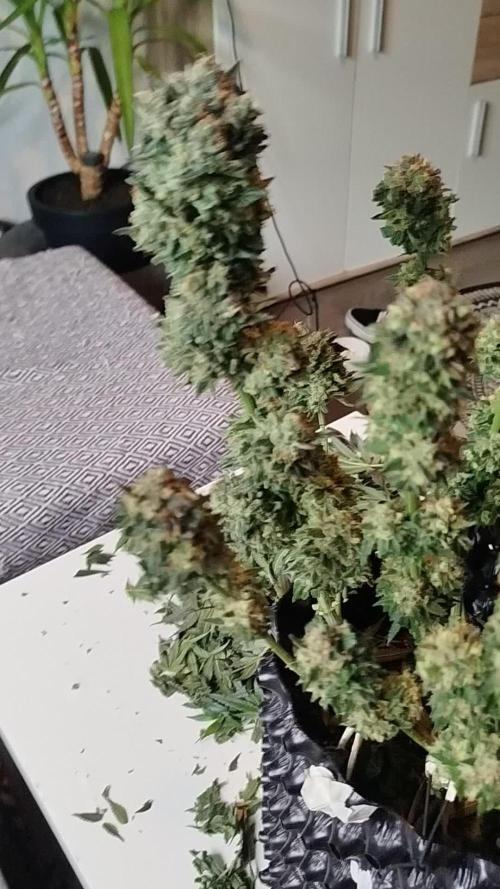
I don't know where to start and I must admit I'm completely overwhelmed by this beautiful beautiful plant ❤️❤️❤️ Aaaaaaaaaaaaaaaaaaaaaaaaaaah, I'm so happy 😍😍😍 She is a blessing! Excuse the outburst, but she is magical ☀️ I applaud you guys at Humboldt for creating such a wonderful strain 🙌 Some details upfront, before I rave some more: - 134 Days in total: 70 Days in Veg, 64 Days in Flower with 128W LED in a 60x60x160cm tent - 7 Days Drying regularly, 9 Days Drying in the Fridge - 432g - Wet weight with stems - 103g of those for Fresh Harvest Infused Oil - 190ml Olive oil with 30mg/ml THC & CBD - approx. 20g dry (for dry weight calc.) - 87g for the DrZiggy's Low And Slow Drying in the fridge - 20g dry - 242g for regular Drying @50% RH and 22°C - 55g dry - 30g dried sticky trim in the freezer Summary of my growing experience with this strain: She takes well to massive training and a little neglect in the beginning, meaning she recovers well, which is what I want 😊 I didn't experience any major deficiencies. She had a little nitrogen deficiency during the later veg phase, which she showed with lighter green leaves. I blame this on my long veg time and my pot size of only 11l. She consumed all her soil and nutes by the end of veg. I will keep that in mind for my next grow. Since I increased my nitrogen levels so close to flowering phase, I overdid it a little on the nitrogen which showed a little bit during later flowering phase with downwards clawing leaves. So I will be more careful with nitrogen especially while transitioning into Flower. I did not flush this plant and she smokes already beautifully mild after only a couple of days of curing. Drying her took 7 days in the tent and 9 days in the fridge. She crusted up with lots of stickiness while drying and gave off a good bit of scissor hash & kief when trimming. Smoking her is a great and different experience to me. It's my first time with a 1:1 strain and I can definitely notice the CBD content. She shows in a very well balanced body high with a slight and gentle knock on the THC door. The first couple of days I felt a craving for higher THC which settled down after only a couple of days. Very interesting and definitely worth growing. So you guessed right, I totally recommend growing this beauty. Especially if you are interested in exploring a 1:1 THC:CBD strain with all its magical medicinal values 🙏 Why I grew this strain: Like @Experimentgreen on here, I grew this strain for my Mama ❤️ She is open minded to trying to solve some of her health issues with these beautiful plants and the magic they bring but she also likes to have a bit of fun, she doesn't mind. So a 1:1 strain was quite handy. She suffers from neuropathic pain, arthritis in her joints, restless legs and insomnia. All very relatable issues and perfectly suitable to be introduced to some good CBD and THC content. She already has a little tolerance, since she is treating her restless legs with gummi bears I made with a strength of 1.5mg/gummi bear. This small dose already helps her on a daily for her restless legs. Beautiful 😍 So with this special mission in mind, I wanted to process the plant with only the very best options and create Cannabis Oil (Capsules) for my Mom to take. I chose a method called "Fresh Harvest Infused Cannabis oil" by the wonderful member SweetSue over at 420magazine: https://www.420magazine.com/community/threads/fresh-harvest-infused-cannabis-oil.363371/ I hope it's ok to relink, no need to duplicate already existing and well researched content, right? I will not go into detail and def. recommend reading through the whole thread. I only document the short version here, but feel free to ask me, I'm happy to share my experience. The oil I made has 30mg/ml of THC and CBD. That's a good value. I calculated the strength the following: 75g fresh Flower in 200ml Olive Oil - with 10% CBD&THC 85% extraction efficiency with the infusion method 85% * 10% THC&CBD = 0.0850 0.0850 * 75g = 6.375 gram of available THC & CBD 6.375gram * 1000 = 6375mg/THC 6375mg/CBD 6375mg/200ml = 31.875mg/ml CBD & THC I created capsules with 3mg per capsule. We are currently trying to find the right dose for her. She started taking one capsule 60-90min before bed for 3 days now and will increase by 1 capsule tonight. We continue until a max dose of 15mg/day but always re-evaluate how she feels. She's documenting her experience quite cute. Very heartwarming and powerful. So far she sleeps better and she falls asleep faster, which she hadn't done in a long while. Onset is pretty precisely between 60 and 90 minutes. She has not had any restless legs so far. I'm excited for her and can't wait to see where this takes us. I also made her a salve/creme she uses as a topical on her joints. When she uses it early enough, before the big pain hits, she feels it helps. Of course this is not a science study and everything is purely based on personal experience. I thought I share, in case anyone is interested, also I want to give back a little, since I consume so much knowledge from all over the internet, including here, so thanks 🙏
Likes
2
Share
@Amboss
Follow
Only water I gave her the last week only water I decide that this girl would be for bubble hash
Processing
Likes
2
Share
Week 2 the plants stretched so much that I ended up having to transplant them deeper into their pots
Likes
50
Share
First time running dwc. So this should be fun and interesting. I’m ready 🌱💪🏽
Likes
Comments
Share
She's very green and healthy, considering the relatively weak lamp and early problems with algae. Buds are modest in size, but sticky as all hell. She's probably only 1-2 weeks from harvesting now.
Likes
10
Share
@barlobruz
Follow
7/6/2021 - Trimmed lower fan leaves as they were being blocked completely, and a few tips were yellowing. - Continuing to lightly bend the upper branches so the lowers can catch up. - Bought some Gaia Green veg + bloom dry fertilizers as I expect I'll be flipping to flower soon. 7/7/2021 - Watered in a little bit of Gaia Green's veg fertilizer. - Foliar fed w/ DIY kelp extract. - Yellowing/browing on a new leaf, can't identify what it is. - Staked down the branches on the upper mains this evening to open her up for more light penetration, she was gettin' real bushy. 7/9/2021 - Trimmed out middle to expose canopy
Likes
9
Share
Day 1 Pink Wafers (Biscotti x Pink Champagne) The next journey has just begun and I'm looking forward to this one ✌️🏻 Update: We lost one on the way due to an amateur mistake 🤦‍♂️🏼 I didn't feed them or fill humidifier up and was a hot day so when I got back it was face down in the soil 🤦‍♂️🏼 hopefully won't make that mistake again while they are this small 🤣
Likes
1
Share
@Kusemono
Follow
Spottet one late male sortet that guy out Juju grow 2ml Juju flowa bloom 3ml Juju green mystic 3 ml 1l water
Likes
1
Share
Esta semana, nuestras plantas empiezan a mostrar las primeras flores. Ya tenemos la sala con las cuatro luminarias funcionando al 75% de su potencia y las he separado un poco más, ya que veo que con led, el espacio internodal es muy reducido. Añadimos a la mezcla de fertilizantes CALMAG de BioBizz, que aportará un extra de calcio y magnesio. Regamos cada tres días aproximadamente, una vez con fertilizantes y otra vez con agua. Comenzamos a reducir la humedad relativa en la sala y desconectamos la calefacción en fase nocturna, para que empiecen a pasar un poco de frío.
Likes
9
Share
@cannanova
Follow
D29: (Sunday 28 August). I'm not adding water today since I noticed Mario's leaves are dropping off. I will wait until tomorrow to water again and see if Mario gets better. D30: (Monday 29/08/2022). I'm not adding any water today either. Mario's leaves still dropping off, let's see. D31: (Tuesday 30/08/2022). Not any water today either. D32: (Wednesday 31/08/2022). Not any water today. D33: (01/09/2022) I added some water today, and Mario got a bit worst, I don't understand why since I waited for 5 days before watering again. D34: (02/09/2022) Just observed both plants. Mario got worst. I will not water him again in at least 7 days to see what happens. D35: (03/09/2022) Nothing new happened. Tomorrow I will add water only to Maria.
Processing
Likes
18
Share
Esta semana apesar de tener temp Máxima de 28... se va recuperando bien de las podas, el led de TodoGrowled funciona perfectamente para sus 55w farmers!🍁
Likes
16
Share
Struggling a touch with cold temps at day and night but now swapped the 400mh for a 600hps for the last few days of veg to up temps a touch. Will initiate flower in a couple of days and all looks good. Limited height room in this chamber so plants are a little smaller than I normally would have liked.
Likes
108
Share
🌱Welcome to my 2 x 4 ft autoflower tent. Here we have Seedsman Northern Lights. We just finished the 1st week of flower. She only did a 3 week veg and she's off to flower now. This week we did the first feeding of the grow cycle 😌💨 💧She has been receiving water every other day about 1 L of pH adjusted to 6.5. ✂️ TRAINING: N/A. 💡⚡Check Mars Hydro out on Instagram! @marshydro_aliexpress2 💡⚡
Likes
55
Share
2nd net is up. Early bud formations are promising. holding up to the extremes pretty well, some leaves taking minor damage, but overall, she is holding up, gave her 1 night at 50F see how she would react, stressful. Not advised as it messes with her metabolism, but I want to see if it triggers any anthocyanin response. Love to see her purp up but no signs yet. Remember, For every molecule of glucose produced during photosynthesis, a plant needs to split six molecules of water. This process provides the hydrogen needed for synthesizing glucose and other organic compounds, while oxygen is released as a byproduct. Homework. If Rubisco activity is impaired and it cannot properly function or regenerate its substrate, the plant's leaves are likely to turn a pale green or lime green, a condition known as chlorosis. Essentially, Rubisco activity is highly regulated and susceptible to various environmental and metabolic factors that can cause it to become inhibited, leading to an apparent failure in RuBP regeneration due to a lack of consumption. Rubisco regeneration is intrinsically linked to nitrogen supply because Rubisco is a major sink for nitrogen in plants, typically accounting for 15% to over 25% of total leaf nitrogen. The regeneration phase itself consumes nitrogen through the synthesis of the Rubisco enzyme and associated proteins (like Rubisco activase), and overall nitrogen status heavily influences the efficiency of RuBP regeneration. RuBisCO is a very large enzyme that constitutes a significant proportion (up to 50%) of leaf soluble protein and requires large investments in nitrogen. Insufficient nitrogen supply limits the plant's ability to produce adequate amounts of RuBisCO, thereby limiting the overall capacity for photosynthesis and carbon fixation. Maintaining the optimal, slightly alkaline pH is crucial for the proper function and regeneration of Rubisco. Deviations in either direction (too high or too low) disrupt the enzyme's structure, activation state, and interaction with its substrates, leading to decreased activity and impaired RuBP regeneration. (Lime/yellowing) Structural Component: Nitrogen is an essential building block for all proteins, and the sheer abundance of the Rubisco protein makes it the single largest storage of nitrogen in the leaf. Synthesis and Activity: Adequate nitrogen supply is crucial for the synthesis and maintenance of sufficient Rubisco enzyme and Rubisco activase (Rca), the regulatory protein responsible for maintaining Rubisco's active state. Nitrogen deficiency leads to a decrease in the content and activity of both Rubisco and Rca, which in turn limits the maximum carboxylation rate, Vmax, and the rate of RuBP regeneration Jmax, thus reducing overall photosynthetic capacity. Nitrogen Storage and Remobilization: Rubisco can act as a temporary nitrogen storage protein, which is degraded to remobilize nitrogen to other growing parts of the plant, especially under conditions of nitrogen deficiency or senescence. Nitrogen Use Efficiency (NUE): The allocation of nitrogen to Rubisco is a key determinant of a plant's photosynthetic nitrogen use efficiency (PNUE). In high-nitrogen conditions, plants may accumulate a surplus of Rubisco, which may not be fully activated, leading to a lower PNUE. Optimizing the amount and activity of Rubisco relative to nitrogen availability is a target for improving crop NUE. Photorespiration and Nitrogen Metabolism: Nitrogen metabolism is also linked to the photorespiration pathway (which competes with carboxylation at the Rubisco active site), particularly in the reassimilation of ammonia released during the process. To increase RuBisCO regeneration, which refers to the process of forming the CO2 acceptor molecule Ribulose-1,5-bisphosphate (RuBP) during photosynthesis, the primary methods involve optimizing the levels and activity of Rubisco activase (Rca) and enhancing the performance of other Calvin-Benson-Bassham (CBB) cycle enzymes. Biochemical and Environmental Approaches: Optimize Rubisco Activase (Rca) activity: Rca is a crucial chaperone protein that removes inhibitory sugar phosphates, such as CA1P (2-carboxy-D-arabinitol 1-phosphate), from the Rubisco active site, thus maintaining its catalytic competence. •Ensure optimal light conditions: Rca is light-activated via the chloroplast's redox status. Adequate light intensity ensures Rca can effectively maintain Rubisco in its active, carbamylated state. •Maintain optimal temperature: Rca is highly temperature-sensitive and can become unstable at moderately high temperatures (e.g., above 35°C/95F° in many C3 plants), which decreases its ability to activate Rubisco. Maintaining temperatures within the optimal range for a specific plant species is important. •Optimize Mg2+ concentration: Mg2+ is a key cofactor for both Rubisco carbamylation and Rca activity. In the light, Mg2+ concentration in the chloroplast stroma increases, promoting activation. •Manage ATP/ADP ratio: Rca activity depends on ATP hydrolysis and is inhibited by ADP. Conditions that maintain a high ATP/ADP ratio in the chloroplast stroma favor Rca activity. Enhance Calvin-Benson-Bassham (CBB) cycle enzyme activity: The overall rate of RuBP regeneration can be limited by other enzymes in the cycle. •Increase SBPase activity: Sedoheptulose-1,7-bisphosphatase (SBPase) is a key regulatory enzyme in the regeneration pathway, and increasing its activity can enhance RuBP regeneration and overall photosynthesis. •Optimize other enzymes: Overexpression of other CBB cycle enzymes such as fructose-1,6-bisphosphate aldolase (FBA) and triose phosphate isomerase (TPI) can also help to balance the metabolic flux and improve RuBP regeneration capacity. Magnesium ions, Mg2+, are specifically required for Rubisco activation because the cation plays a critical structural and chemical role in forming the active site: A specific lysine residue in the active site must be carbamylated by a CO2 molecule to activate the enzyme. The resulting negatively charged carbamyl group then facilitates the binding of the positively charged Mg2+ion. While other divalent metal ions like Mn2+ can bind to Rubisco, they alter the enzyme's substrate specificity and lead to dramatically lower activity or a higher rate of the non-productive oxygenation reaction compared to Mg2+, making them biologically unfavorable in the context of efficient carbon fixation. The concentration of Mg2+ in the chloroplast stroma naturally increases in the light due to ion potential balancing during ATP synthesis, providing a physiological mechanism to ensure the enzyme is activated when photosynthesis is possible. At the center of the porphyrin ring, nestled within its nitrogen atoms, is a Magnesium ion (Mg2+). This magnesium ion is crucial for the function of chlorophyll, and without it, the pigment cannot effectively capture and transfer light energy. Mg acts as a cofactor: Mg2+ binds to Rubisco after an activator CO2 molecule, forming a catalytically competent complex (Enzyme-CO2-Mg2+). High light + CO2) increases demand: Under high light (60 DLI is a very high intensity, potentially saturating) and high CO2, the plant's capacity for photosynthesis is high, and thus the demand for activated Rubisco and the necessary Mg2+ cofactor increases. Mg deficiency becomes limiting: If Mg2+ is deficient under these conditions, the higher levels of Rubisco and Rubisco activase produced cannot be fully activated, leading to lower photosynthetic rates and potential photo-oxidative damage. Optimal range: Studies show that adequate Mg2+ application can enhance Rubisco activation and stabilize net photosynthetic rates under stress conditions, but the required concentration is specific to the experimental setup. Monitoring is key: The most effective approach in a controlled environment is to monitor the plant's physiological responses e.g., leaf Mg2+ concentration, photosynthetic rate, Rubisco activation state, and adjust the nutrient solution/fertilizer to maintain adequate levels, rather than supplementing a fixed "extra" amount. In practice, this means ensuring that Mg2+ is not a limiting factor in the plant's standard nutrient solution when pushing the limits with high light and CO2. Applying Mg2+ through foliar spray is beneficial to Rubisco regeneration, particularly in alleviating the negative effects of magnesium (Mg) deficiency and high-temperature stress (HTS). While Mg can be leached from soil, within the plant it is considered a mobile nutrient, particularly in the phloem. Foliar-applied Mg is quickly absorbed by the leaves and can be translocate to other plant parts, including new growth and sink organs. Foliar application of: NATURES VERY OWN MgSO4 @ 15.0g L-1 in a spray bottle. For those high-intensity workouts when 1 meal a day is just not enough! Foliar sprays are often recommended as a rapid rescue measure for existing deficiencies or as a supplement during critical growth stages, when demand for Mg is high. Application in the early morning or late evening can improve absorption and prevent leaf burn. The plant was getting a little limey yellow in the centre. Shortly thereafter, she was back in business, green mostly regenerated. The starting point [of creativity] is curiosity: pondering why the default exists in the first place. We’re driven to question defaults when we experience vuja de, the opposite of déjà vu. Déjà vu occurs when we encounter something new, but it feels as if we’ve seen it before. Vuja de is the reverse—we face something familiar, but we see it with a fresh perspective that enables us to gain new insights into old problems. Confidence is evidence... nothing more. You are confident because you have driven 10,000 times, you are confident because you have spoken 10,000 times. People think confidence is a feeling, but it's not. If you want more confidence, then you need to create evidence, take more shots, collect more data, build more experiences, take more risks; fail, confidence doesn't come first; it is the reward you get for doing the work. no one else wants to do.
Likes
92
Share
Week 9 - First Week of Flowering 🌸 The dark period has ended, and these ladies came back into the light fully energized and ready for action! It’s just the first week of flower, and they’re all praying, stretching, and absolutely thriving—filling up every inch of the tent. This grow space is officially packed from wall to wall, with each plant competing for its share of light and showing off some of the biggest, healthiest leaves I’ve seen yet! 🌱 A few strategic plucks here and there have kept airflow smooth and light penetration balanced. Those big leaves? They’re a sign of happy, healthy growth. Large leaves help the plant capture maximum light energy, essential during this stage, especially as they start focusing on developing those flowers. When plants grow huge, vibrant leaves like these, it means they’re well-nourished and content in their environment—a true testament to the well-balanced conditions we’ve got going in the tent! Flowering Parameters 🌡️ Room Environment: • Temperature: 26.7°C • Humidity: 63.3% • CO2: 960 ppm • VPD: 1.29 kPa (prime zone for flowering health!) Lighting: • Light Intensity: 835 PPFD (ideal for boosting flower growth) • Solution: pH 5.96, TDS 460 ppm, temp 21.1°C • Medium: Moisture: 100%, TDS: 520 ppm, Temp: 21.6°C Carbon Filter Installation & Smell Management 🌬️🌱 With the transition to flower, the scent profile is already starting to kick in—crazy for the first week, right? 🌸 To keep everything fresh and under wraps, I’ve set up a carbon filter system. Here’s how it’s working: I’ve connected the filter to my Aerofan, which pulls air directly from the tent. This air is cleaned by the filter and released into the main room, where it then passes through another filter before exiting my space. This dual-filter setup means no scent escapes into the wild, keeping things stealthy and the grow room a peaceful, scent-contained environment. Perfect for anyone concerned about keeping their home free from that telltale aroma! 🕶️🌬️ Enhanced Lighting with Emerson Effect 🌞 This week, I’ve introduced an extra 15 minutes of red light at the beginning and end of each light cycle. Why? Well, this red boost taps into the Emerson effect, enhancing photosynthesis efficiency, especially during the flowering stage. By stimulating a little extra wake-up and wind-down light, we’re mimicking the natural sunrise and sunset experience for these plants, which can help reduce flowering time. Not only does it encourage smoother transitions into day and night, but in theory, it’ll help these ladies finish a bit faster, while giving them a little nudge to build more substantial, quality flowers. 🌇 Nutrient Adjustments 🌱 Now that we’re in flower, I’ve swapped out the Start Booster for P-Boost and TopBooster to specifically support flowering needs. Here’s why: • P-Boost brings in additional phosphorus, vital for energy transfer and cell division as the plant channels more resources into budding sites. • TopBooster supports the flowering phase by improving flower quality and density, helping to build those big, aromatic buds we’re after. These changes bring the nutrient mix in line with what’s most beneficial at this stage. All this precise dialing in is easy to manage thanks to the TrolMaster system. From pH to nutrient scheduling, the TrolMaster ecosystem and ThinkGrow LEDs have been the ultimate teammates in this grow journey, giving me real-time data, fine control, and peace of mind. 💯 (Not introducing UV light just yet, but stay tuned as that’s coming soon for an added boost!) Looking Forward 🌟 Next week, we’ll be upping the reds, giving us an even greater chance of activating those flowering signals for a smoother, faster transition through the cycle. I’ll keep tweaking and fine-tuning every parameter to make sure these ladies get exactly what they need to thrive. Big thanks to the TrolMaster system for keeping everything in balance and optimized, along with the supportive Grow Fam following this journey! Your enthusiasm, advice, and support are a huge part of this grow’s success. Keep following for more updates, and stay tuned for what’s next! 🌿✨ P.S. Deep Dive: TrolMaster’s MBS-S8 CO₂ Sensor & Smoke Detector 🚨 The MBS-S8 CO₂ Sensor from TrolMaster is a powerhouse for growers, especially when it comes to optimizing plant growth and efficiency in a controlled environment. This sensor continuously monitors CO₂ levels and integrates directly with the TrolMaster ecosystem, giving you real-time data on CO₂ concentration. Ideal levels of CO₂ can significantly boost growth and yield during certain stages, so understanding and managing CO₂ is key. With the MBS-S8, I can control CO₂ levels precisely, keeping them within the optimal range for photosynthesis. This sensor is a game-changer because it adjusts CO₂ delivery automatically, giving plants exactly what they need without any extra monitoring from me. Meanwhile, TrolMaster’s Smoke Detector is an essential safety device, especially in spaces with electrical equipment, lights, and heat-generating components. This detector can be set up to alert me instantly via the TrolMaster app if any smoke is detected, allowing me to respond immediately to any potential issues. Fires and smoke are rare in controlled grow setups but having this safety measure provides peace of mind and lets me focus on the plants without constant worry. It’s an incredible tool for any grower prioritizing safety and proactive monitoring. Discount Codes so you can save big on your next check out 💚💚💚 Kannabia - DOGDOCTOR 30% off SeedsmanSeeds - DOGDOCTOR 10% off CannaKan- DOGDOCTOR 15% off terpyz.eu - DOCTOR 15% off The Neutralizer - PORKIT5-DOG 15% off As always thank you all for stopping by, for the love and for it all , this journey of mine wold just not be the same without you guys, the love and support is very much appreciated and i fell honored and so joyful with you all in my life 🙏
 With true love comes happiness 💚🙏 Always believe in your self and always do things expecting nothing and with an open heart , be a giver and the universe will give back to you in ways you could not even imagine so 💚 Friendly reminder all you see here is pure research and for educational purposes only Growers Love to you all 💚💚💚
Likes
4
Share
@Bncgrower
Follow
Another week successfully completed... All the plants are developing very well, the flowers are plumping up nicely, and all the plants smell great... Everything is as expected, and now we're closer to the end than before... Happy growing to all! 🌱🌿💪