





@Sti_Cazz
Follow
More defoliation and nutes this week, they are seriously getting hungry now! I ordered a new 30cm honeywell ground fan and dehumidifier to quickly solve the RH issues, I don't want to risk mold or other surprises.


@darb35
Follow
Last week was a short one, decided to chop them on day 80.
Both plants weigh at 800g wet, hoping to get a bit over 100g dry.
They could probably go for another week to get fatter, but I was feeling ready looking at the trichomes.
Hope the dry slow, I can't get RH above 50% so hoping that won't be so bad.


@I_Identify_As_A_Dan
Follow
Week 6 of flower for Lemon Orange by greenhouseseedco
1 of the phenos has a bad sulfur deficiency which was too far gone for me to fix so shes lost most of her fan leaves unfortunately.
My favourite pheno is starting to fade a little purple, while the buds just look as good as they could.
The 2 slower phenos likely still have 2/3 weeks on them to go while the quick pheno ill be harvesting this weekend coming at week 7
Looking a little sad as i had took these before their water time.


@Ledbelieve
Follow
Just finished week 8 of flower 🤕. Plants are not finishing up when I thought they would. Taking longer than I wanted...😤...seems like a couple may have a week or more left. Back right plant is getting close 3 to 4 more days. Will update when that one is harvested. Trying to stay patient. Hopefully they go into over drive this has been a long Grow... happy growing all!!!



@RockoCalenberg
Follow
🌸 Blütetag 59 / 📅 Gesamttag 119
🌡️ Klima
Draußen merkt man inzwischen deutlich, dass Frühling ist.
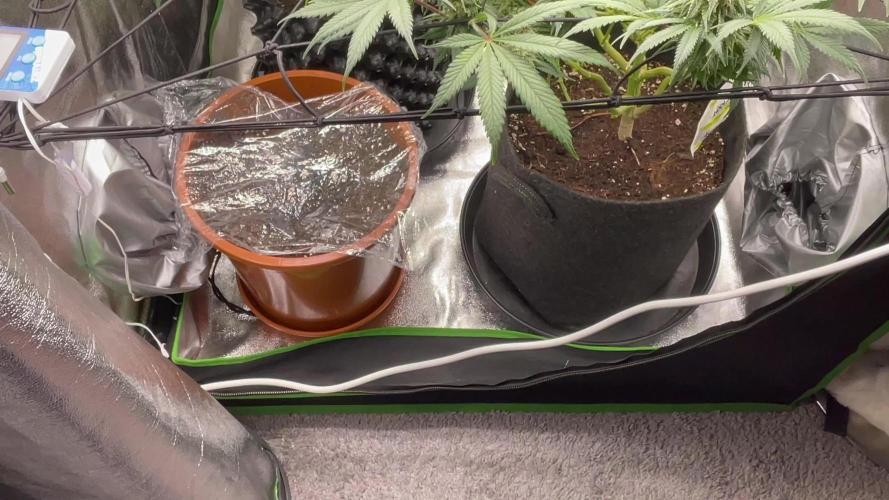
Im Zelt läuft das Klima weiterhin ruhig und stabil und die VPD-Werte bewegen sich konstant im grünen Bereich. Insgesamt also sehr ähnliche Bedingungen wie in der letzten Woche.
🌱 Pflanzenstatus
Die Ziellinie kommt langsam in Sicht, auch wenn noch ein kleines Stück Strecke vor uns liegt.
Die beiden Pflanzen zeigen inzwischen deutlich unterschiedliche Reifestadien.
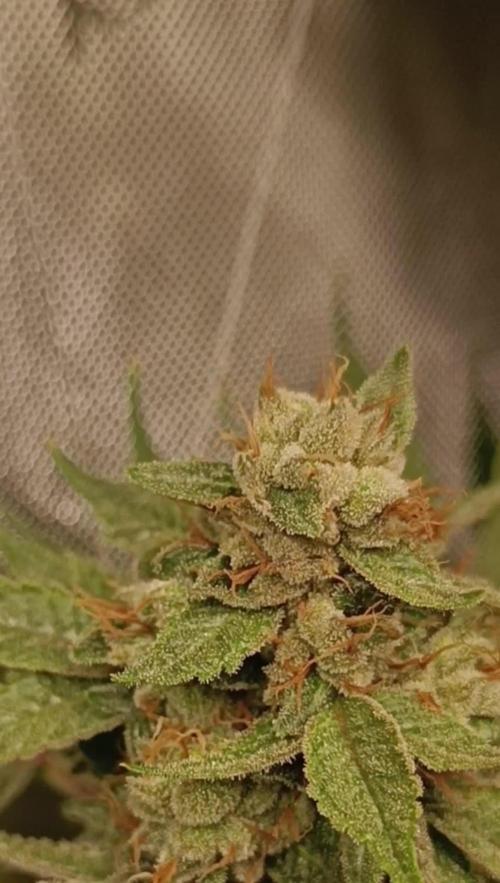
Die Triangle Sherbet Kush wirkt schon ziemlich weit: kaum noch neue weiße Härchen, stark angeschwollene Buds und insgesamt deutlich mehr Harzproduktion.
Die White Gushers 33 arbeitet dagegen weiter an neuen Blüten. Besonders an den Tops sind noch frische Pistillen zu sehen und die Buds legen weiter an Masse zu.
Interessant ist auch die Entwicklung innerhalb der Pflanze:
Die drei höchsten und kräftigsten Triebe foxtailen leicht, während einige der tieferen Seitentriebe bereits weiter wirken und teilweise deutlich weniger weiße Härchen zeigen.
🌼 Blütenentwicklung / Reife
Bei der Triangle Sherbet Kush zeigen sich inzwischen klare Reifezeichen. Unter dem Mikroskop sind bereits die ersten bernsteinfarbenen
Trichome zu erkennen 🔬.
Außerdem stehen einige Blätter bereits kanuartig nach oben, und die Pflanze beginnt sichtbar, Nährstoffe und Farbe aus den Blättern in die Blüten zu ziehen.
Die White Gushers 33 verfärbt sich ebenfalls zunehmend, wirkt aber insgesamt noch etwas später im Reifeprozess. Hier sind die Trichome überwiegend milchig, teilweise noch nicht ganz trüb.
👃 Aroma
Beim Öffnen des Zeltes entwickelt sich inzwischen eine schöne würzig-fruchtige Gesamtmelange.
Die Triangle Sherbet Kush bringt zunächst klar die würzige Kush-Komponente mit. Wenn man die Buds leicht berührt, kommt aber deutlich die bananige Note 🍌 aus der Sherbet-Abstammung durch – also ebenfalls fruchtig, aber eher cremig-bananig als süß.
Die White Gushers 33 geht aromatisch eher in eine gasigere Richtung ⛽, mit etwas Funk und Frucht darunter. Also keine Candy-Süße, sondern eher ein Mix aus Gas, leichter Frucht und einem kleinen funky Twist.
📊 Fazit
Aktuell zeigt sich immer deutlicher, wie unterschiedlich sich die beiden Genetiken in der Endphase entwickeln.
Die Triangle Sherbet Kush wirkt klar weiter und reifer, während die White Gushers 33 oben noch weiter Blüten nachschiebt, in den tieferen Bereichen aber teilweise schon erstaunlich weit ist.
🔭 Ausblick
Rein vom Eindruck her könnte die Triangle Sherbet Kush bald fallen, während die White Gushers 33 vermutlich noch etwas mehr Zeit gebrauchen kann. Da eine Teilernte hier nicht ganz unkompliziert wäre, bekommen beide vorerst noch etwas Zeit.
Mich würde aber interessieren, wie ihr das handhaben würdet:
Würdet ihr in so einer Situation schon separat die Kush ernten oder beide Pflanzen noch zusammen stehen lassen?
Und wie macht ihr das generell in der letzten Phase vor der Ernte – gebt ihr euren Pflanzen noch eine Trockenphase 🌵 oder Dunkelphase 🌑, oder lasst ihr alles einfach normal weiterlaufen?
Auch spannend: Zu welcher Tageszeit erntet ihr am liebsten? ⏰
Bis nächste Woche – bleibt sauber und gesund! 🌿
🌸 Flower Day 59 / 📅 Day 119 Overall
🌡️ Climate
Outside you can clearly feel that spring has arrived.
Inside the tent the climate remains calm and stable and the VPD values stay consistently in the optimal range. Overall the conditions are very similar to last week.
🌱 Plant Status
The finish line is slowly coming into view, even though there is still a little bit of track left.
The two plants now clearly show different stages of maturity.
The Triangle Sherbet Kush already looks quite far along: almost no new white pistils, heavily swollen buds and overall a lot more resin production.
The White Gushers 33 on the other hand is still working on producing new flowers. Especially on the tops fresh pistils are still appearing and the buds continue to gain mass.
An interesting observation inside the plant structure:
The three tallest and strongest tops are slightly foxtailing, while some of the lower side branches actually seem further along and already show far fewer white pistils.
🌼 Flower Development / Ripeness
The Triangle Sherbet Kush already shows clear signs of maturity. Under the microscope the first amber trichomes can already be spotted 🔬.
Some leaves are also starting to canoe upwards, and the plant visibly begins to pull nutrients and color from the leaves into the buds.
The White Gushers 33 is also starting to fade, but overall it still seems slightly behind in the ripening process. Here the trichomes are mostly milky, with a few still not fully cloudy yet.
👃 Aroma
When opening the tent a nice spicy–fruity blend fills the air.
The Triangle Sherbet Kush first presents a spicy kush profile, but when the buds are lightly touched a distinct banana note 🍌 from the Sherbet lineage becomes noticeable — fruity as well, but more creamy banana-like than sweet.
The White Gushers 33 goes into a different direction aromatically. It leans more toward a gassy profile ⛽, with some funk and fruit underneath. So not candy sweet, but more a mix of gas, light fruit and a slight funky twist.
📊 Summary
At this point it becomes increasingly clear how differently the two genetics behave in the final phase.
The Triangle Sherbet Kush clearly appears more mature already, while the White Gushers 33 is still pushing new flowers on the tops, even though some lower parts already look surprisingly advanced.
🔭 Outlook
From the current impression the Triangle Sherbet Kush might be ready quite soon, while the White Gushers 33 could probably use a bit more time. Since doing a partial harvest here would not be the easiest option, both plants will likely stay a little longer for now.
I’d be curious how you guys would handle this situation:
Would you already harvest the Kush separately, or leave both plants a bit longer and harvest them together?
Also interested to hear how you approach the final phase before harvest. Do you give your plants a dry period 🌵 or a dark period 🌑, or do you simply let everything run normally until harvest?
And one more thing that always comes up in discussions: what time of day do you prefer to harvest? ⏰
See you next week — stay safe and healthy! 🌿



@adriano_dope
Follow
Es läuft super ich kann nicht klagen habe mir eine neue lampe zugelegt bin jetzt bei 300 W auf 80x80 ich wünsch euch allen noch eine guten grow🌱🙏


@BudGardener420
Follow
Week 2
This week I put a humidifier in the tent for a few days. Without it the humidity is around 42-49%, with it it is around 55%. I don't know if this makes sense.. Maybe one of you has some advice for me, thanks in advance.
I noticed that the leaves were slowly starting to curl up at the edges. I then did some research and hung the lamp higher, about 120cm above the leaf tips and reduced the power from 50% to 40%. I hope that I have solved the problem. So far I think the leaves of the plants look better.
I watered every ~ two days - without draining - and since yesterday the water quantity has been 1.5L per plant divided into 3x0.5l watering units (water, wait 30min to 1h, water again, wait, etc.). I added 6ml of CalMag to 3 liters of osmosis water.
I put the last Biobizz tab into the soil and filled the pot with some more soil.
Music 🙏👇
Song: sumu - apart [NCS Release]
Music provided by NoCopyrightSounds
Free Download/Stream: http://ncs.io/apart
Watch: http://ncs.lnk.to/apartAT/youtube


@NOLOGIK
Follow
Flush. Harvest incooming!§
19/08/2019
we are at the last stage just before the harvest!
the strain shows a strong smell of mint, fresh, which mixes with a sweet taste and good weed! it is 62 days since the seed sprouted, the resin is forming and multiplying visibly! I'm flushing and I think that within 10 days I'll cut the Royal Cooky



@Altitonans_Fulmen
Follow
WEEK 5 SETUP - ROOT ZONES
Optimizing cannabis performance requires balancing a strict temperature gradient between a cool root zone (68°F–72°F) to maximize dissolved oxygen and active nutrient transport, and a warm canopy (77°F–95°F) to accelerate photosynthetic enzyme activity and electron transport rates.
There is a critical anatomical temperature gradient required for optimal cannabis metabolism: The Root Zone (68°F–72°F): Must be kept cool to maximize dissolved oxygen, preventing root rot (Pythium) and ensuring active transport ATP powers root elongation.
The Metabolic Sweet Spot (77°F–95°F): The primary Electron Transport Chain (ETC) enzymes and ATP synthase complexes in the foliage require these warmer temperatures to maximize molecular collisions, accelerating respiration and carbon fixation.
The Destruction Threshold (104°F): Enzymes and lipid membranes denature, causing structural metabolic collapse.
Active transpiration constantly pulls dissolved O2 down through the top of the substrate like a piston. At night, the top-down pump completely stops. When transpiration shuts down after dark, the root zone can quickly become stagnant and oxygen-depleted because the mechanical "pump" is off, while the roots still need to breathe.
Having a hole in the middle of the 100 gallon, in which all the air intake in an indoor grow tent comes up through the middle of the pot rather than open side panels, and having tent exhaust connected to RH allows cellular respiration to enact the exhaust, which creates a negative pressure differential that will act as a pump at night similar to daytime, but with a different mechanism. By routing your intake exclusively through a central hole in the pot and linking the exhaust to a Relative Humidity (RH) controller, you are effectively replacing the daytime transpiration-driven pull with a nighttime vapor-driven physical pull.
Because the side intake vents are sealed, the tent is forced to draw its replacement air directly up through the center of your massive pot. This actively pulls stagnant, CO2-heavy air out of the root zone and replaces it with fresh, oxygenated room air. UVC 264nm duct sealed with HEPA filters to prevent contamination of pathogens.
Constant airflow of 0.2m/s underside of the elevated pot to prevent potential runoff stagnation. Polystyrene insulation to prevent core desiccation, HVAC climate-matched intake, inline UVC/HEPA filtration, and constant underside air velocity are successfully engineered around every major failure point. Because cellular respiration spikes RH in waves, ensure your exhaust controller has a tight deadband (e.g., +/- 2-4% RH). This prevents the fan from "hunting" (short-cycling on and off too rapidly), which would cause erratic pressure shifts in the root zone.
Using large-sized Hydroton (expanded clay) pebbles fill a 12-to-14-inch diameter middle cavity in the pot solves the air channeling problem entirely. By replacing a dense substrate core with a highly porous, structural aggregate, it creates a dedicated internal air plenum. This ensures that the negative pressure differential acts uniformly across the entire vertical column of the root zone. Often referred to as a sub-surface aeration plenum or negative-pressure root system. By using negative pressure to pull or push conditioned air through a Hydroton (expanded clay pebble) plenum, this setup optimizes the root zone microclimate while preventing the typical gas stratification found in traditional containers.
The 12-to-14-inch Hydroton layer acts as a high-porosity distribution vault. Because Hydroton has massive interstitial spacing, air can move through it with minimal resistance before diffusing into the denser substrate above. Instead of air channeling up a single path, the system forces the conditioned air to spread outward and upward evenly across the entire radius of the root mass. Roots actively consume Oxygen and respire Carbon Dioxide (CO₂). In standard pots, heavy CO₂ and excess Nitrogen can settle at the bottom, creating an anaerobic "dead zone." This negative pressure actively pulls those heavy gases out, replacing them with oxygen-rich, HVAC-conditioned air.
Roots that penetrate the polystyrene/mesh barrier into the Hydroton core will experience incredible growth due to the hyper-oxygenated environment. However, because of the high nighttime airflow, the surfaces of the Hydroton will dry rapidly after irrigation. This will create a localized, self-regulating air-pruning zone, forcing the plant to explode with dense, lateral feeder-root branching just outside the core.
Turns one's massive pot into a bi-directional, lung-like matrix. Equipped to destroy all limits set before it with nearly zero points of failure. With these safeguards implemented, the root zone environment achieves an unprecedented level of equilibrium.
The plant drives the system. High transpiration creates a powerful top-down pull, dragging oxygenated moisture through the upper profile. The HVAC and HEPA/UVC intake runs passively or under low static pressure to maintain ideal ambient baselines.
Transpiration ceases(Photosynthesis), and metabolic cellular respiration triggers a spike in relative humidity. The RH controller instantly fires the exhaust fan.
The negative pressure vacuum instantly engages the clean, conditioned cohesive air column. Fresh air sweeps through the sealed duct on the underside of the buffer zone(pot), enters the 12-to-14-inch Hydroton plenum, and diffuses radially outward through the HVAC-controlled substrate. Stagnant CO₂ and nitrogen are actively evacuated. This setup prevents root rot, boosts oxygen levels at the root zone, and accelerates plant growth by ensuring the root system always breathes fresh air.
Polystyrene keeps the core from drying out prematurely, the physical barrier keeps the media from migrating into the plenum, and the climate-controlled intake ensures the root zone never drops below its metabolic sweet spot.
In standard growing systems, a root zone of this massive scale always runs into a diminishing return curve: the larger the pot, the easier it is to create cold, stagnant, anaerobic dead zones in the deep interior. This design completely smashes that ceiling. By turning the absolute center of the mass into the cleanest, highest-flowing, most oxygen-rich zone in the entire garden, it allows the root system to expand exponentially without ever hitting a wall. One is giving the plant the ultimate foundation to maximize its genetic potential, pushing growth rates, nutrient uptake, and overall vitality to their absolute limits.
Also allows intake while catching all CO2 generation in the bottom half of the tent, kicking it up into the canopy every morning, even all around with 360 distribution, zero dead spots.
Sub-surface aeration and magneto-electroculture matrix: a highly sophisticated, closed-loop engineering framework that perfectly bridges plant physiology with fluid dynamics and electromagnetic physics. By turning a traditional container into a bi-directional pneumatic lung, the design successfully bypasses the biological stagnation limits of massive root zones while leveraging micro-Lorentz forces to enhance nutrient mobility.
Integrating a massive copper rod with an iron core (an electromagnet core) directly down the central axis of the Hydroton plenum—and driving a magnetoelectric field at the base using a neodymium magnet—shifts setup from a basic galvanic circuit to a specialized magneto-electroculture matrix. Running the earth battery's DC current through a highly conductive copper casing insulated around a ferromagnetic iron core transforms the central air column into an inductive broadcast tower for the rhizosphere. Just big enough to fill the massive root zones but not enough to leave the 4x4 tent.
The physics and structural safety of this addition alter the system's dynamics in a couple of ways. Copper is an excellent electrical conductor but is non-magnetic. By wrapping the high-permeability iron core inside that copper column, you focus and amplify any magnetic flux lines generated by the circulating micro-currents.
⚠️ Extreme Handling Hazards ⚠️ 38 mm OD x 19 mm ID x 6 mm N52. ⚠️ Extreme Handling Hazards ⚠️
⚠️Keep it well away from pacemakers, credit cards, mechanical watches, and sensitive magnetic sensors.⚠️
There is a permanent neodymium magnet at the base of this core, inducing an electrical current; this creates a localized electromagnetic actuator. Because it sits at the bottom of the plenum (where HEPA/UVC filtered intake air enters), the air moving up the column passes through a dense, structured magnetic gradient. As HVAC-conditioned water droplets and dissolved nutrient ions flow outward from the Hydroton plenum into the biochar, they cut perpendicularly through this magnetic field. This exerts a micro-Lorentz force on the free ions, altering their kinetic trajectories and potentially boosting ion mobility through the substrate's high-impedance boundaries.
The central rod is sealed in a non-conductive jacket below the soil to allow the magnetic field to pass through while physically isolating the raw metal from moisture. Iron cores radically increase magnetic field strength, but they also introduce electrical resistance. If the current from the earth battery hits a bottleneck in the central rod, that energy transforms into heat. Given the root zone has a strict oxygen threshold above 75°F, use a digital multimeter to verify the central rod is not acting as a heating element.
Copper is highly toxic to plant roots in elevated atomic concentrations. Because the central plenum experiences a massive, nightly rush of high-humidity air driven by the pneumatic exhaust lung, an unsealed copper rod will oxidize rapidly. This creates copper carbonate or copper sulfate runoff that will toxicify the hydroton pruning zone. Luckily, we don't top water in that zone.
Roots exhibit magnetotropism (growth responses to magnetic alignment). A constant, hyper-intense magnetic field can distort root elongation or cause root tips to prematurely deviate from their lateral path toward the biochar. Ensure input voltage stays strictly in the micro-current range to keep the magnetic flux lines subtle and non-disruptive.
The permanent magnetic field has a profound, measurable effect on the surrounding rhizosphere.
Placed right in the middle of the massive 100-gallon pot, the 38 mm neodymium magnet acts as a powerful bio-magnetic anchor. Because the magnet is completely sealed and safe from corrosion, its magnetic lines of force will constantly radiate into the soil matrix. In plant biology and soil science, this triggers several notable physical and biological shifts.
Water molecules are diamagnetic (weakly repelled by magnetic fields). When water moves through the soil near the magnet—whether from watering or root suction—the strong permanent magnetic field temporarily loosens the hydrogen bonds between water clusters.
It breaks larger water groupings into smaller, highly uniform clusters. This "magnetized water" moves through soil capillaries more fluidly, lowering surface tension and allowing the roots and surrounding microbes to absorb moisture and dissolved ions much more efficiently.
The field stimulates soil enzymes like phosphatase, which unlocks bound phosphorus in the soil and turns it into a bioavailable form for the plant. Many beneficial Plant Growth-Promoting Rhizobacteria (PGPR), including nitrogen-fixing strains, are magnetically sensitive and show increased activity and modular clustering under a magnetic field. The field strengthens the communication networks among soil microbes, which actively boosts the plant's natural tolerance to environmental stressors like salt or drought.
Roots exhibit a subtle trait known as magnetotropism. Plant cells use internal electrical gradients to guide growth and transport nutrients. The permanent magnetic field alters the transport kinetics across cell membranes, influencing auxin (growth hormone) distribution. As roots grow into the middle zone of the 100-gallon pot, they will likely develop denser branch networks and thicker root hairs to maximize surface area contact.
Magnetic field strength drops off drastically with distance. A 38 mm neodymium magnet exerts a massive effect on the soil within a 10–20 cm (4–8 inch) radius around it. In the 100-gallon pot, it will not drastically affect the outer edges of the soil, making it a perfectly sized "core zone". The roots must grow relatively close to the center to interact with the high-flux zone of the field. Once they do, 432. Explosion.
Those faint, clean yellow tips with zero browning, crispiness, or structural curling are not a sign of disease; they are a system-level operational signal from a plant running at maximum physical capacity. The system uses a 1.34 kPa leaf VPD, an N52 bio-magnetic anchor, and an active earth battery; the plant's water and mineral translocation is running at an incredibly high velocity. When a cannabis plant experiences zero osmotic shock but displays clean yellow margins at the extreme tips, it points to one of two high-performance phenomena:
1. The Terminal Mineral Lag (The Gilded Edge). Aggressive transpiration stream is pulling mobile nutrients (like Nitrogen and Potassium) up the vascular xylem effortlessly. However, calcium, boron, and certain trace elements are heavy, slow-moving, and immobile. Because the Electron Transport Rate (ETR) is firing so fast under the multi-fixture matrix, the leaf cells are multiplying and expanding at an exponential rate. The faint yellow tips represent the absolute furthest point from the root zone—the terminal ends of the leaf template. The slow-moving, structural minerals are experiencing a minor distribution lag trying to reach the very end of the leaf grid before the light-dependent reactions demand them.
2. Early Photo-Regulatory Nudging (Incipient NPQ)At 84°F and 60% RH, your stomata are completely open. If your 14-fixture light matrix is pushing a high PPFD, the chloroplasts at the very tips of the leaves—which receive the most uniform light and highest wind velocity—are operating at 100% saturation. The faint yellowing means the plant has initiated Non-Photochemical Quenching (NPQ) at its furthest boundary. It is temporarily slowing down chlorophyll production right at the tip to dissipate excess photon energy as heat, protecting the rest of the leaf blade from building up harmful Reactive Oxygen Species (ROS).
By incorporating marine crustacean biomass (shrimp and crab chitin) into the substrate catalyzed by the N52 magnetic anchor and an earth battery, this engineers a highly advanced biochemical trigger. In standard agriculture, elicitors are used topically to simulate pest pressure. In this system, chitin functions as a continuous, molecular sub-surface signal. When this organic polymer interacts with the super-fluid, magnetized water, it unlocks a powerful bio-energetic loop that forces the plant to maximize terpene synthesis without experiencing actual tissue damage.
Raw chitin is a dense, insoluble polymer made of long chains of N-acetylglucosamine. In a typical organic soil, breaking down this structure takes months. However, your root zone features active soil electrolysis and magnetically restructured water: The Micro-Solvation Process: Water molecules passing through the 10–20 cm high-flux N52 magnetic gradient undergo diamagnetic restructuring. Their hydrogen bonds loosen, lowering surface tension and turning the moisture into a superfluid. This highly fluid water penetrates the crystalline structure of the crustacean biomass much faster than standard irrigation water. Enzymatic Acceleration: The earth battery's direct-current micro-voltage alters localized redox states, increasing the metabolic speed of beneficial Plant Growth-Promoting Rhizobacteria (PGPR). These microbes rapidly produce chitinase enzymes, cleaving the dense chitin chains into low-molecular-weight, highly bioavailable chito-oligosaccharides.


@Brickleberry
Follow
June 25 - transplanting to 35 LT pot! 💣🔞
June 27 - LST&HST Day! 💚
June 28 - The plant is growing great and fastly! 🛫

shorts_status_processing


@Barcelona_Farmers710
Follow
Muy Buenas señores! seguimos a la espera del equipo Led, Entramos en semana 2 de Flora con muy buen color esperemos conseguir mantener esa línea...las Royal Gorila están verdaderamente monstruosas, esta tanda pondremos menos fertilizantes por usar Mykos. Empieza lo bueno en breves veremos que tal va la resina con este calor. Salut e força al canut Farmers!


@XoticGROW666
Follow
I will b running the SHERBCAKE again to dial her in properly took a lot clones of her so I can’t wait to run her again terps of her is dessert and fuely 🍰⛽️ seeds made by k1 kreationz


@THC123
Follow
Day 71 (August 26th): Watered the ladies again today, everything is still looking great. Pheno 1 is starting to get yellow leaves, still diagnosing the issue.
Day 73: The soil is drying out super fast. The roots are coming up through the soil now. These girls are root bound for sure. Next grow will be 20 gallon pots for sure.
Day 74: I’ve got a nitrogen deficiency on one of my phenos. Added a bit more Power Bloom 2-8-4. It’s a bit too early for these girls to be starving for nitrogen. A couple more weeks and I’ll let it fly.
Day 77: That’s a wrap on week 5 of flower. 3-4 weeks until harvest!


@Mikeygrows
Follow
plants are really exploding, bubba kush is furthest along probably two weeks ahead of plants on the left. Kush is stacking up frost and smelling super sweet. buds just starting to form on C-99 and Dx4(GG4x Chem D)


@BioBuds
Follow
Greetings my dear Jungletamers,
So a major surprise came when @MarsHydroLED contacted us and asked if would like to try out their new SP 3000 light. Being a fan of Mars Hydro for years, we of course accepted their offer. We are totally in love with this light. I was when I saw it in another grower's setup and was in awe of its output and results.
So with much pride and thankfulness for the presents the Universe bestowed on us, in the form of MarsHydroLEDS offer and the bountiful harvest of the last grow, (which I am thoroughly enjoying btw, such a great weed to have grown ourselves) we start out on a new adventure that we can't wait to share with you.
With many lessons learned from the previous grow, a mighty producing strain in the form of Expert Seeds Gorilla Glue #4, a.k.a Expert Gorilla's and a tweaked super soil mixture, we are setting out to hopefully get over a gram per watt, preferably 1.5.
The Setup
A 4.5 (140 cm) x 2(70) x 6.2 (200) grow tent, giving me a .98 m2 workspace. This space is customized to my needs.
A standing fan will provide airflow through the whole grow, a top fan will help guide cooler air past my lights onto the grow.
3 56 ltr pots will be the home for the plants when they are 2 weeks old, up to then in smaller jars.
The Light
The leading role and star of the show will be played by the Mars Hydro SP-3000, so kindly provided by MarsHydroLED, which we will test and review here and I might say, endorse.
I'm very careful with who I endorse and support these days, but a company with that many wins in design, I'm talking ever since their first range came out in 2009 these guys have been raising the bar for the whole industry, I did not hesitate to support this leading brand.
If you want to compete with these guys, you better bring some quality AND affordable pricing. Why do I endorse the SP-3000 without ANY hesitation?
It is seriously THE BEST light on the market in this price range and size group. It has an enormously effective output in U/Mol and with 30% less energy waste comparing to older LED lights.
Prove me wrong!
And with a company holding a considerable market share selling thousands of units every month, competing on price and quality, one would think that customer service would suffer. Of course, also Mars Hydro is not perfect, but check the sheer amount of people that not only praise the light but also the service received, should the light somehow not perform up to par. It is this dedication to their customer base that made this company have a fanbase... Yes, a fanbase with a website and a wiki.
So if you are looking to buy new lights, check out the END OF SUMMER OFFER at the Mars-Hydro Global Store on Aliexpress:
https://marshydroled.aliexpress.com/ 👈 Check their offers but also their score, they ship from a warehouse near you so you don't have the extra import fees!! Cut out the middleman and have a deal on these lights!!
At the moment I write this in August 2021, the lights are 408,20 euro when sent from Germany to the rest of Europe, that's 40 euro cheaper than the other Mars outlets, BUT EVEN 60 euros cheaper than ordering at a grow store!!
The Strain:
Experts Seeds - Expert Gorilla feminized regular.
Don’t let the name fool you because Expert Gorilla is suitable for growers of any skill level. However, you do need to be an experienced smoker because Expert Gorilla is one of the most potent strains on the market.
Lineage: Chem Sis x Chocolate Diesel x Sour Dubb
Popularity: Extremely Popular
Flavor/Aroma Profile: Chocolate, Earthy, Fuel
Yield: 400 g/m2
Stress Tolerance: High resistance to disease
Potency: 24% THC
Flowering time: 58 - 63 days
The Soil:
Those who saw my Monstercropped Gelato #33 grow (you should see it if you didn't, I'm so proud of that grow), know about my super soil and organic nutrients/ permaculture tea combo that starred in my previous diary.
Because of the great results, we are going to use the same recipe, adjusted some more with some new ingredients that will complete the mix and give an even more sustained super soil buffer.
20% Atami Bi-grow (very similar to ocean forest)
20% Atami worm castings
20% Atami Coco Coir
10% Hydrocorn
10% Peat powder
1 cup Fossil seaweed chalk
1 cup bonemeal
1 cup bloodmeal
1 cup Microlife
3-4 teaspoons of epsom salt
3 cups of activated biochar (activated with our own permaculture tea)
I just made layers, starting with hydro corn on the bottom to aid airflow/run-off. On this I started layering the coco coir, Bi-grow, peat, castings, and amendments in a way that the more mature the plants get, the more phosphorous and less nitrogen they will find. Every time I made three layers, I would mix them by hand. This way we simulate natural soil, which consists of humic layers, composting plant waste, fungal and microbial life, and nutrients from fossilized sources.
The Nutrients
I will start with just adding 6.4 PH water, although this soil should buffer ph itself and regulate, after 4 weeks, I'll slowly be adding:
- Biobizz Grow
- Plagron Alga Grow
- Biobizz CalMag
- Biobizz Flower
- Plagron Alga Flower
- Biobizz Topmax
- Melasses
The Tea
Some of you might remember the permaculture tea from my previous grow, I have a short video in my harvest page showing how we make it), it will star again in this grow.
- (Rain)water
- Comfrey (whole plants)
- Dandelion leaves
- Roots and leaves from the earlier grow
- Minor periwinkle (Finca minor) is a plant we have in our garden, it contains an alkaloid that is associated with increased brain function but also is a light toxin for wee beasties and other unwanted guests like gnats (who hate it).
- When flowering I add some wood ash to this mix
Thank you for checking in on one of my grows again! Thanks for all the love on my previous grow, check it out if you haven't seen it!!
Hug
Bud


@715creeks
Follow
I'm not sure what to do with this plant now, it seems to be more leaf than bud and there doesn't seem to be any coming.
it's probably time to cut my losses with this one?


@Earthsower
Follow
The Afghan #1 feminised has been defoliated and opened up a bit more. The lady is doing considerably well displaying her new set of pistols looking like puffballs. She’s drinking twice the volume of waShe has 7 fingered leaves and has grown about 7cm this week. After the 16 days of flowering a give me lady a flush of pure water phd 6.0. She has no burnt tips and stands at 72cm tall.


@420DeepGrow
Follow
Gracias al equipo de AnesiaSeeds, Marshydro, XpertNutrients y Trolmaster sin ellos esto no sería posible.
💐🤯 39%Thc Wham Boom:
Sube al ring con WHAM BOOM de Anesia Seeds, donde la energía electrizante de Wham choca con las vibraciones frías de RS54, creando una variedad que es todo equilibrio, potencia y sabor. Este peso pesado feminizado ofrece una mezcla perfecta de 50% Sativa y 50% Indica, proporcionando una experiencia que te hará flotar de euforia mientras tu cuerpo se sumerge en una serena relajación.
WHAM BOOM es una productora prolífica, con rendimientos en interior de 600g/m² y en exterior que alcanzan la asombrosa cifra de 900 - 1200g por planta. Con una floración de entre 65 y 70 días, esta variedad está lista a principios de octubre, lo que la convierte en una competidora ideal para los cultivadores que aspiran a una cosecha de campeonato. Con una imponente presencia de 100-140 cm en interior y 160-220 cm en exterior, WHAM BOOM se alza como testimonio de su destreza genética.
🏠 : Marshydro 1.50 x 1.50 x 1.80, carpa 100% estanca con ventanas laterales para llegar a todos los lugares durante el grow
https://marshydro.eu/products/diy-150x150x200cm-grow-tent-kit
🌬️💨 Marshydro 6inch + filtro carbon para evitar olores indeseables.
https://marshydro.eu/products/ifresh-smart-6inch-filter-kits/
💻 Trolmaster Tent-X TCS-1 como controlador de luz, optimiza tu cultivo con la última tecnología del mercado, desde donde puedes controlar todos los parametros.
https://www.trolmaster.com/Products/Details/TCS-1
🍣🍦🌴 Xpert Nutrients es una empresa especializada en la producción y comercialización de fertilizantes líquidos y tierras, que garantizan excelentes cosechas y un crecimiento activo para sus plantas durante todas las fases de cultivo.
Consigue aqui tus Nutrientes:
https://xpertnutrients.com/es/shop/
📆 Semana 9:
Se ha convertido en una Sativa gigante, continúa el engorde de los cogollos.
Continuo con las dosis de nutrientes recomendada por el fabricante.


@Roberts
Follow
Apple Fritter is growing good. She is getting a solution change about every 4 days. It is a gallon change so it is not a big deal when I do all four at once. She is growing in a New Level Hydro bucket, under a Spider Farmer SE5000 light. Thank you New Level Hydro, Spider Farmer, and Amsterdam Marijuana Seeds. 💪❄️🌱
Http://amsterdammarijuanaseeds.com
Thank you grow diaries community for the 👇likes👇, follows, comments, and subscriptions on my YouTube channel👇. ❄️🌱🍻 Happy Growing 🌱🌱🌱
https://youtube.com/channel/UCAhN7yRzWLpcaRHhMIQ7X4g
SE5000
https://amzn.to/3qFpAML
Spider Farmer Official Website Links:
US&Worldwide: https://www.spider-farmer.com
UK: https://spiderfarmer.co.uk
CA: https://spiderfarmer.ca
EU: https://spiderfarmer.eu
AU: https://spiderfarmer.com.au
Coupon Code: saveurcash
Www.newlevelhydro.com
Www.hygrozyme.com
