


Likes
Comments
Share


@MrJones
Follow
I am very happy with the harvest @21% wet to dry that pretty strong for me, the buds were in the tent for 10 days, the long slow drying process has really paid off. The buds were solid and frosty, this strain was very easy to grow, and like I said Original Sensible Seeds do not disappoint, I have a few more strains by them and cant wait to get them started!

Likes
4
Share


@GLOrganics
Follow
Only sprayed twice during the cycle. I added natural predators to do the work. This time i did some Neem Oil through foliar spray

Likes
9
Share


@GrowPassionItalyChris
Follow
Da oltre venti anni che coltivo e sono sempre più felice della qualità proposta da queste magnifiche banche semi! Complimenti di cuore a chi ha selezionato e creato queste varietà autofiorenti. Crescono rapidamente,resistono agli afidi e alcune sfiorano il metro di altezza, tutte insieme sembrano una mini foresta! Iniziano a fiorire gradualmente ed essendo molto diramate tutte è spettacolare nel vederle! Appare la prima resina e sono in ottima salute. Sono felice fino ad adesso perché se guardate foto e video vi rendete conto che qui nel centro Italia in outdoor biologico abbiamo il migliore clima che si possa desiderare anche se questo 2023 fino a metà maggio ha piovuto tantissimo e ci sono stati sbalzi di temperatura, ciò non è stato un problema per queste varietà così forti e abbondanti! Adesso la magia è iniziata, il caldo è arrivato e non vedo l'ora di vederle piene di infiorescenze tutte! Si procede felicemente, un abbraccio a tutti!


Likes
6
Share


@Joshaee1
Follow
Cut a few of the colas off to dry,alot of the tops are done and now just focusing on the bottom buds to ripen and turn amber :)
Had a smoke today of the tallest cola,smokes great and haven't been this high in a long time so impressed with her !

Likes
2
Share


@PlantMike
Follow
Permanent marker keeps rolling along, found a couple developing pollen sacs on a couple branches near the zipper that I was keeping open to moderate temperature so I promptly removed them an thoroughly searched the rest of the plant and gladly it all looks good. Continuing to give 0-10-10 organic fertilizer to supplement what the biology is liberating. Let's keep it going!
Processing
Likes
11
Share


@Crwfz1
Follow
Lots of training on all the girls this week all original sensible two gorilla glue one is the biggest under scrog already ghost is right behind then going to lay the last babby gorrilla across light range stay tuned


Likes
13
Share


@Ferenc
Follow
Really nice plant. Very strong smell, Well THC coated buds and very nice effects. Lovely.

Likes
10
Share


@RockoCalenberg
Follow
Woche 1 – Erste Unterschiede zeigen sich! 🌱
Insgesamt bin ich mit der ersten Woche ganz zufrieden🌱😀
Bei den White Gushers Cake läuft es etwas schleppender als bei den Pfirsichen.🤨 Drei waren recht zügig da, zwei lassen sich deutlich mehr Zeit. Einer der beiden Nachzügler hat inzwischen das Licht der Welt erblickt, hat allerdings noch Schwierigkeiten, seine Samenhülle abzuwerfen. Da musste ich etwas nachhelfen.
Der letzte Kandidat sitzt weiterhin in der Erde und lässt auf sich warten. Ob er es überhaupt noch schafft, wird sich zeigen.
Jetzt bekommen alle erst mal eine weitere Woche Zeit. Dann schauen wir, wer sich wie entwickelt hat und wer das Zeug dazu hat, bleiben zu dürfen! 🌱
Bake a sweeter tomorrow 🍰 💚 😎



Likes
24
Share

@Ultraviolet
Follow
The cannabis strain Grape Guava can be a purple strain, depending on its specific phenotype and genetic makeup. While not all phenotypes of Grape Guava are purple, some variations, such as the Zatix Grape Guava, are noted for their striking purple appearance due to the genetic expression of anthocyanin pigments.
In a garden of green, Grape Guava gleams,
With its fruity aroma, enchanting dreams.
Clusters of grapes, guava's sweetness ignite,
A strain so divine, in purple and white.
Euphoria whispers, a lush fruity haze,
Grape Guava's embrace, a tranquil daze.
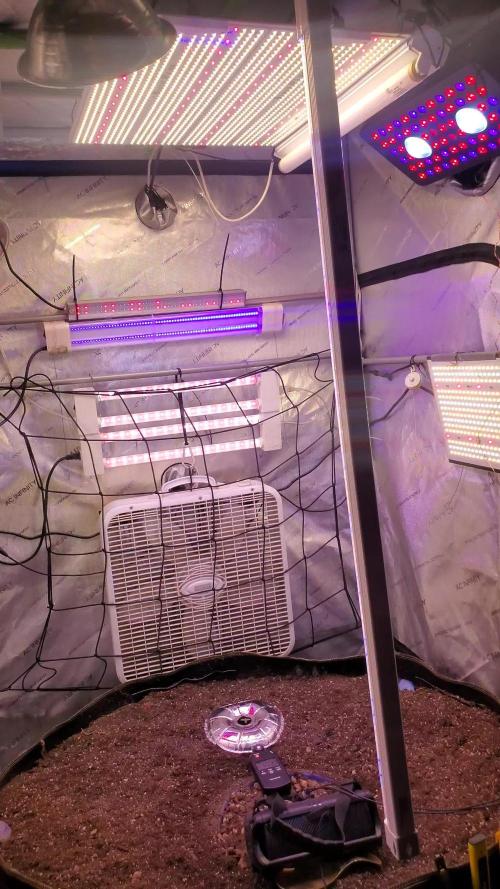
Off and away.@1400ppm. The increased CO2 allows plants to thrive at higher temperatures, which in turn necessitates higher humidity to maintain the ideal VPD for healthy growth and transpiration. 80F -5F = 75F LST with 70% RH = 0.72 kPa. Higher temperatures and humidity promote rapid growth, nutrient uptake, and photosynthesis while maintaining a lower stress level. Temperature influences the rate of enzymatic reactions involved in aerobic respiration. Enzymes, such as those involved in glycolysis, the Krebs cycle, and the electron transport chain, work most efficiently at an optimal temperature range. In low temperatures, enzymatic activity will slow down, thus reducing the rate of aerobic respiration. In high temperatures, enzymes can become denatured, thus impairing their function and stopping the process of aerobic respiration. Glucose is the primary fuel for aerobic respiration. The rate of aerobic respiration increases with the availability of glucose, as it is the starting point for glycolysis. If glucose levels are low, cells may rely on alternative energy sources such as fatty acids or amino acids , but these processes may yield less ATP or be less efficient. To determine this effect, carbon dioxide volume was measured (as carbon dioxide is an output of aerobic respiration)
A seed germinated via skotomorphogenesis (in the dark) will generally develop faster in its initial stages to reach light, though it will be etiolated (elongated and weak) and will switch to slower, more robust photomorphogenesis (light development) once it emerges into light. While skotomorphogenesis is a rapid, growth-oriented process for soil escape, it's a temporary phase; photomorphogenesis is a more sustainable development program that prepares the seedling for photosynthesis.
18/6 with the 6 being IR instead of darkness, keeping temps overnight a neat 77F-80F. PPFD overnight 1.8.
Think of my tent as a lung. What goes in must come out. When the rate of air going out exceeds the amount of air coming in, it creates a negative pressure. Tent concaves (bends in). If set up correctly, your RH will begin to drop slowly to the desired level you set, and the extraction turns off when it reaches 50% RH. The plant, as it performs cellular respiration, will always be releasing more water into the air, so the RH% of the tent overnight will always increase, so long as oxidative phosphorylation is occurring. As soon as the RH% creeps back up to 55%, the extraction turns back on, over and over, this creates a strong pressure differential which will work wonders on your grow. replicating high and low pressure fronts in nature, critical for oxygen diffusion, but more importantly, full control of your RH%.
Moisture will not transfer from a saturated atmosphere to another if that air is already at or above its saturation point, meaning the air can't hold any more water vapor. Once I understood that water is produced as a by product during cellular respiration, specifically at the very end of the electron transport chain (ETC) where electrons are finally transferred to molecular oxygen, the higher the RH of the air, the more resistance there is for more moisture to be added to that environment, and effects the ease with which it does so. But none of that water comes from the pot; it's pulled from the air. If you run high daytime RH, your medium/pot is 100% reliant on transpirational root pull to move water. ZERO evaporation happens across the atmosphere if the tent air has high RH%, the medium cannot release its water through evaporation. Once a canopy develops, light no longer slowly wicks and evaporates from the topsoil. The Soil-Plant-Atmosphere Continuum (SPAC) describes the continuous pathway and process of water movement, driven by a gradient in water potential, from the soil, through the plant's roots, stem, and leaves, and finally evaporating into the atmosphere through transpiration. There is evaporation, there is transpiration, then there is evapotranspiration; Evapotranspiration (ET) is the combined total of two processes: evaporation (water lost directly from soil and surface water into the atmosphere) and transpiration (water released from plants to the atmosphere through their leaves). Evapotranspiration represents the total amount of water that moves from the medium into the air. There is no such thing as a medium with too much water, only a medium that retains too much for too long.
The water must always flow efficiently from one atmosphere(Medium) to another(Air) in a timely manner. Moisture is a critical factor for bacterial growth and decay. Dictating how long it's allowed to sit in any one location for any given period is a key preferred control. To ensure a net reduction in a bacterial population, the rate of removal (ET) must exceed the rate of bacterial growth (decay rate), which is often modeled as a growth rate for the specific bacterium under the given conditions. By optimizing daytime VPD, we also optimize conditions for bacterial growth to explode exponentially above 77°F.. If water is allowed to sit in a medium without an escape within a timeframe, nothing good will happen. IF High RH is maintained overnight as well as during the day, placing 100% of water movement at the behest of daytime transpiration, roots can only pull where they can reach, and if soil is compressed above a certain point, moisture will become trapped in a medium with no way of moving day or night. This will begin the countdown for decay to take hold. When water stagnates in a medium, it loses oxygen, creating anaerobic conditions that foster the growth of harmful microorganisms like bacteria and fungi, which can produce toxins and disease vectors.
Thigmomorphogenesis, the process by which plants respond to mechanical stimuli like touch by altering their growth and development, resulting in significant morphological changes to improve survival against mechanical perturbations. This complex response involves sensing touch and initiating physiological and genetic responses, leading to changes in form and structure over days or weeks. The process is triggered by physical forces such as wind, rain, or touch. Plants adapt to these stimuli by changing their shape and structure, which may include slower growth, thickened stems, or altered leaf development. Plants possess sophisticated mechanisms to detect even subtle mechanical stimuli and initiate responses. A variety of molecules, including calcium ions, jasmonates, ethylene, and nitric oxide, are involved in signaling these mechanical inputs. Touch can induce the expression of genes that encode proteins for calcium sensing, cell wall modification, and defense mechanisms. A plant exposed to constant wind may become shorter and sturdier. A plant that is touched frequently might grow slower to conserve energy and develop thicker cell walls. These changes increase a plant's resilience and ability to survive in harsh environments.
Let's get Thiggy with it.


Likes
9
Share


@NanoLeaf
Follow
End of Week 11 (Fourth week of flower)
The ladies are frosting up more and more by the day and there are trichomes everywhere!
I Added about 8g per plant of GHF BioBloom and a cup of worm castings a small final feed to make sure the ladies have what they need to grow big dense buds. And increased the CO2 to 1400ppm and in 2 weeks time I will cut the CO2.
The main top-sites are bulking up more and I am very happy with the inter-nodal spacing as well as the bud formation. Trying to keep the training to a bare minimum and ONLY removing fan leaves that are blocking bud sites.
I have been keeping a cooler average temperature - and also keeping the relative humidity lower.
Pest Report: None


Likes
2
Share


@xTaps
Follow
Just checking the trichome heads daily to harvest them at the for me perfect moment.

Likes
65
Share


@bypado_farm
Follow
Day 84:
Watered the plants 0.5L with nuts
975 ppm, 2070 us/cm, PH 6.4
Flushed plants with 10L clear water
Day 86:
Watered the plants 0.5L with nuts
955 ppm, 2029 us/cm, PH 6.4
Flushed plants with 10L clear water
Day 88:
Watered the plants 0.5L with nuts
980 ppm, 2089 us/cm, PH 6.4
Added 1ml of bloom/top mix (5 ml/l total)
Flushed plants with 10L clear water

Likes
9
Share


@Southwest_budders21
Follow
Day 1
Pink Wafers
(Biscotti x Pink Champagne)
The next journey has just begun and I'm looking forward to this one ✌️🏻
Update:
We lost one on the way due to an amateur mistake 🤦♂️🏼 I didn't feed them or fill humidifier up and was a hot day so when I got back it was face down in the soil 🤦♂️🏼 hopefully won't make that mistake again while they are this small 🤣

Likes
Comments
Share


@HideAndFly420
Follow
Maybe a little slow but absolutely please to see and to grow, beautifull nice spots quite everywhere. I starte a little late oath fertilisation.
Let’s see what happen 🙂🙂🏼🏼🏼
Likes
27
Share


@CannbellFarms
Follow
I’m overjoyed with the phenos this strain is producing, strong vibrant purples with some serious flavour profiles!
Scent Profiles we have:
Candy Lemon Sherbet 🍬🍋
Sweet & Piney Diesel 🍭🌲⛽️
Sweet & Tangy Tropical Punch 🏝️🥊
Alongside this, these beauties are the frostiest and the most insanely dense koala looking nugs I’ve ever produced!
Likes
58
Share


@nonick123
Follow
Bienvenidos a la semana #5
Inicia la floración a tope! 😀 😑 🙏 😂
Día 32 (12/06)
Las plantas se muestran sedientas.- CC, RB, OF1 = 250 ml H2O pH ajustado con Biogrow, Biobloom y Top Max- NL = 500 ml H2O pH ajustado con Biogrow, Biobloom y Top Max
¡Pasan la noche en indoor por la amenaza de lluvias!
Día 33 (13/06)
No ha hecho demasiado calor pero se muestran muy sedientas! (excepto OF1)Duplicamos el riego y vigilamos- CC, RB = 500 ml H2O pH ajustado- NL = 1 litro H2O pH ajustado
Pasan mitad de día en exterior y mitad de día en interior por lluvias torrenciales
Día 34 (14/06)
Ajustes de LST, pero se nota que las plantas ya están en floración, porque los tallos y ramas son mucho más duros (menos flexibles)
Ya ha salido el sol y parece que vamos a tener muchos días soleados por delante! 😀
Día 35 (15/06)
Riego- CC, RB = 500 ml H2O pH ajustado con Bio-Grow - NL = 1 litro H2O pH ajustado
Día 36 (16/06)
Se detecta un par de orugas verdes en CC y NL y se eliminanSe hace aplicación foliar de aceite de neem y jabón potásico a todas las plantas
Hago lolippoping en las ramas más bajas de las OF1. Ya son bastante pequeñas, así que dediquen su energía a las ramas principales...
Día 37 (17/06)
Es impresionante el vigor que muestran Crystal Candy XL y Royal Bluematic. Crecen varios centímetros al día 😀
Los colores entre morado y púrpura casi negro de la Crystal Candy son espectaculares! 😀
Northern Lights se ha quedado más pequeña, y de las Orion F1 me esperaba algo más... 😑 Veremos si los próximos días ambas strains me dan Una sorpresa y se estiran.
Inspirado en @deFharo, hago mulching con corteza de pino para evitar la evaporación por las altas temperaturas que tengo en la terraza.
Humedezco la parte superior del sustrato con spray y hago un riego con agua pH ajustado con Bio-Grow, BioBloom y Top Max en las siguientes cantidades:CC, OF1 y RB = 250 mlNL = 500 ml
Gracias por leerme y buenos humos! 😀