





Likes
7
Share


@Adam22
Follow
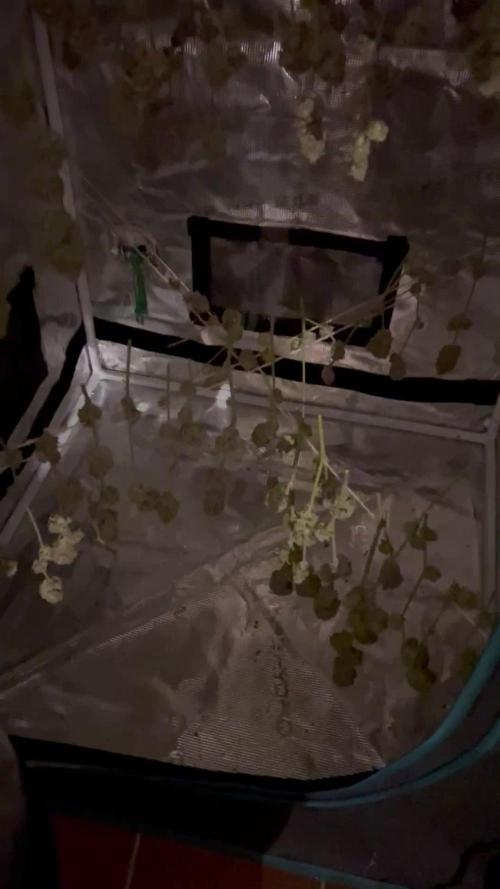
The plant on the right got chopped down the hairs were 90% dark brown while left was fully white last week when it got taken down it had only one day flush. This plant I will flush for a week and see which is better. It has decent size buds all the way to the bottom but this one growing still doesn't have as many crystals as the harvested plant which was definitely cut down way to early 😕 shame it must have forced to finish early from shock when I snapped a main branch clean off. This plant I will flush with plain filtered water for 7 days and even if it doesn't have as much crystals as the other plant, the bud size is 2x-3x the size of the plant that was cut down last week so I hope they will look a lot better size wise after they shrink when they are cut down and dried. I have also noticed some medium sized fan leads turning from green into a beautiful dark purple colour over the last 2-3 days slowly and it's spreading to other leaves the buds on this plant are also purple bits it's hard to see on here but looking sweet so far I have uploaded pic of the frost one which has been drying for a week now
Likes
25
Share

@MistaOC
Follow
Final Week – Late Flower
The final week was essentially a clean finish to the run. The buds swelled further, becoming dense and well structured. Despite the ongoing mildew issue, the situation remained controlled and never spiraled out of hand.
Lowering nighttime humidity below 50 % clearly helped slow down further spread. The focus was on maintaining stable conditions and consistently removing affected leaves.
Overall, the positives clearly outweigh the negatives: strong plants, solid bud development, and very relaxed handling thanks to Biotabs and the automatic irrigation system.
Now it’s simply about finishing strong and harvesting.
Likes
3
Share


@BlueTrees
Follow
The leaves on my plants are starting to fold up like a taco, some yellowing.. Not too sure what is going on. My friend suggested that it was a calcium or magnesium deficiency and it matches the description online but I usually give 3 or 4 ml per gallon damn near every time i water, is that enough or too much even? They are 5 weeks from seed today and all 3 are flowing very different and at a different pace..

Likes
12
Share


@3adli
Follow
Watching my baby grow all symmetrical with somehow a fast pace..
Started using 2.0gm/liter instead of 1.5gm/liter of 19/19/19 NPK powder on day 38 (25.Nov.2018).


Likes
209
Share


@BioBuds
Follow
What a beautiful strain Orange Hill Special is, nice and bushy, great internodal spacing, sturdy and healthy. Happier and happier with how this grow is going.
The less beautiful parts on top are my doing, my blind as a bat FIM destroyed half the top of the plant. More patience next time...
The super soil is still performing great and I´m pushing up the dimmer to get the ladies used to more light, very carefully because leaves are folding every time.
Some of you might be happy to find my European recipe/shopping list for super soil. I tried to make it with widely offered products throughout Europe.
Feel free to use it and elaborate on it.
If one product is not available in your country, please check the brands at the bottom, which might be available in your country, and substitute.
The only thing one could add to the recipe (which I did but forgot in the shopping list) is some Epsom salt.
Fed them again with my permaculture tea, all seem to flourish and smells are starting to come from the plant, with that same distinct dankiness I had in earlier grows with this tea.
See the germination page and other diaries for more info on my Perma tea.
Now they were big enough, some might even say too big, to start the real training. I always love to give them a little bend the week before, to get used to the idea.
With some sterilized bamboo sticks I pushed the plants down to expose their sexy undersides. Let them become forests of buddy bush.
Thats it for this week! Thanks for following and happy growing!!

Likes
44
Share


@rhodes68
Follow
Sticky as hell
over 2 pounds wet whats to say, 41.6 OZ
Very dependable strain only reason it didnt get 10 stars is no work of man is perfect 😌
Hey please check out my wife's grow of a Runtz Auto, Krisabel's Adventure its a pretty interesting little strain that's hard to find in any form.
Pulled 15 grams for test decarb, damn this bud is sticky in the extreme. (say 10g for moist cont)
11/2
Pulled 13 grams, yeah its good. (10g)
11/3 Pulled from tent 396g total , getting the drying more in line with what we need, Into cure





Likes
28
Share


@HydroHerb420
Follow
They’ve been over fed and underfed but they look and smell good. Buds are quite small but are rock hard, even the lower ones. Just running loads of rainwater through them to finish them off, has a ph of 5.8 and doesn’t even register on the ec stick so it’s perfect for flushing in hydro. Merry Christmas 💚💚

Likes
5
Share


@DE_BW
Follow
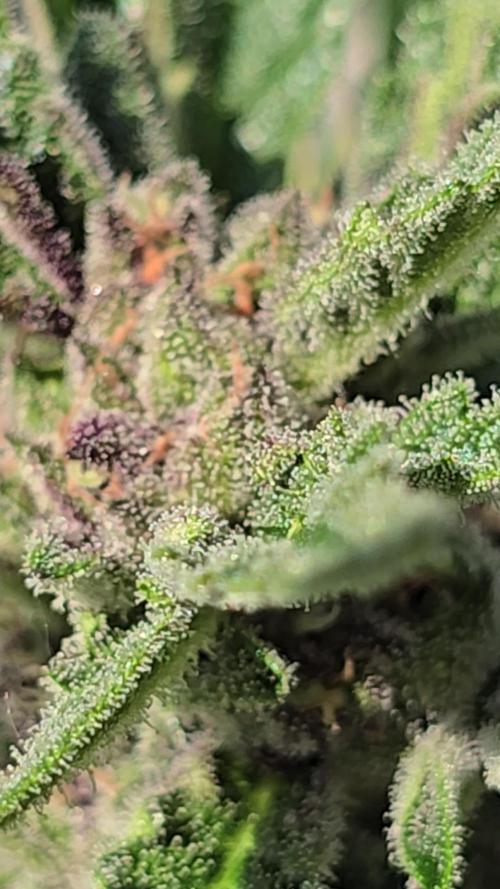
The plant is showing strong bud site development with excellent stacking across the canopy, even on a very compact structure. Pistil production is vigorous and the buds are starting to form defined shapes, though still in an early, airy stage. Overall, she looks healthy and promising, with clear signs that bulk and density will follow in the coming weeks.
Likes
12
Share

@Naujas
Follow
63 dienos!!!! Mergaitė atrodo fantastiškai gražiai :) šią savaitę nustojo lyti, dabar čia labai karšta, 36°, kitą savaitę manęs čia nebus, išvykstu 9 dienų atostogų, o kai grįšiu po atostogų, manau, padarysiu genėjimą :) Paprašysiu draugės, kad atvažiuotų nufotografuoti ir palaistytų ją:) sėkmės visiems.
Likes
3
Share


@ZombieKushAddicted
Follow
June25:🤦♂️🏿🙆♂️🏿🤷♂️🏿
June27: the lizards have attacked again... for this... today we are going to raise the girls and place a mesh
June28: I have no idea how they did it... but they got in again!

Likes
12
Share

@Xpie77
Follow
Kweekverslag: 4 x Spliff Seeds Gelato
Instellen
Zaden: 4 x Spliff Seeds Gelato (indica-dominante hybride, Sunset Sherbet × Thin Mint GSC-lijn)
Potten: 11 liter kunststof potten
Medium: Standaard potgrond (geen extra perliet of wijzigingen)
Tent: 120 × 120 × 200 cm (4 × 4 ft)
Verlichting: Bestva Pro 4000 LED (volledig spectrum, 3000K + 5000K + 660 nm + 730 nm IR) – hangt op ±45 cm boven de luifel
Lichtschema: Week 1-4 veg = 18/6, daarna flip naar 12/12
Temperatuur: 24-26 °C dag / 18-20 °C nacht
Vochtigheid: 55-65% veg → 50-55% bloei
Watergift: handmatig, pH 6,2-6,5, alleen water + Cal-Mag indien nodig
Week 4 Vegetatief (einde groeifase)
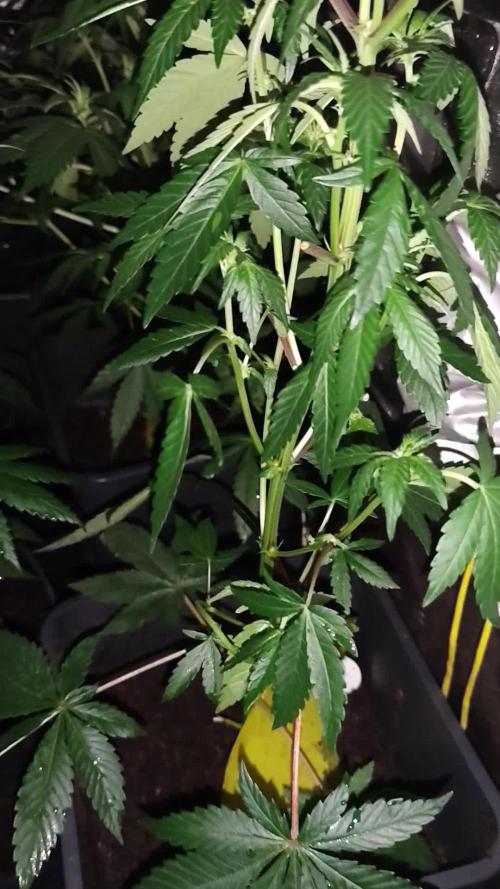
De 4 planten zijn supercompact en bossig – precies zoals je van Gelato had verwacht. Gemiddelde hoogte: 38-46 cm (plant 1 en 3 iets groter door betere hoek naar de LED).
Dikke, donkergroene waaiervormige bladeren met perfecte internode-afstand (±4-5 cm).
Goede vertakking vanaf de 3e knoop, al 6-8 zijtakken per plant.
Geen inspanning, geen tekortkomingen, geen gele randjes – de potgrond was perfect tot nu toe.
Luifel is mooi vlak, LED dekt de hele 120×120 perfect (geen hotspots).
Geur: nog bijna niks, alleen een heel licht aards/zoet ondertoontje als je de bladeren kneust.
Alles zag er top uit, dus ik heb op dag 28 van de groei direct geflipt naar 12/12. Geen training gedaan (geen LST/SCROG), pure bush-stijl.
Overgang & Bloei in week 1
Direct na de flip begon de typische Gelato-stretch. In de eerste 7 dagen bloei zijn de planten ±10-15 % gegroeid (eindhoogte week 1: 45-55 cm).
Eerste witte pistillen overal zichtbaar vanaf dag 4-5, vooral op de hoofdcola en de verhoogde zijtakken.
Toppen wordt al wat dikker en begint licht te “swellen”.
Bladeren blijven donkergroen en gezond, geen klauwen van branden.
Geur: vanaf dag 6-7 ruik je het al duidelijk – zoet, romig, met een hint van bessen en een heel licht gasachtig/munt-achtergrondje. Typisch gelato!
Waterbehoefte iets essentieel (nu ±1,5-1,8 liter per pot om de 2-3 dagen).
LED nog steeds op 45 cm, lichtintensiteit perfect (geen bleken).
Algemene observaties & tips voor deze opstelling
4 planten in 120×120 met 11L potten is ideaal: genoeg ruimte voor de bossige Gelato-structuur zonder dat ze elkaar verstikken.
Bestva Pro 4000 presteert uitstekend in deze tent – gelijkmatige dekking, geen dode hoeken.
Potgrond houdt het prima tot week 3-4 bloei, daarna waarschijnlijk starten met licht PK-boost (Gelato is een zware feeder in bloei).
Verwachtte bloeitijd: 8-9 weken (56-63 dagen) volgens Spliff Seeds info. De uiteindelijke hoogte wordt waarschijnlijk 80-110 cm.
Opbrengstverwachting met deze opstelling: 450-650 gram droog totaal (realistisch voor 4 gezonde meisjes onder deze LED).
Tot nu toe een gemakkelijke, stressvrije kweek. De planten zien er gelukkig uit en de geur begint al lekker te worden. Ik hou het verder in de gaten en update
Likes
52
Share


@Ultraviolet
Follow
Lacewings seemed to have mostly killed themselves by flying into hot light fixtures. I may have left the UV on which was smart of me :) Done very little to combat if anything but make a sea of carcasses, on the bright side its good nutrition for the soil.
Made a concoction of ethanol 70%, equal parts water, and cayenne pepper with a couple of squirts of dish soap.
Took around an hour of good scrubbing the entire canopy.
Worked a lot more effectively and way cheaper.
Scorched earth right now, but it seems to have wiped them out almost entirely very pleased.
Attempted a "Fudge I Missed" for the topping. So just time to wait and see how it goes.
Question?
If I attached a plant to two separate pots but it was connected by rootzone, one has a pH of 7.5 ish the other has 4.5. Would the Intelligence of the plant able to dictate each pot separately to uptake the nutrients best suited to pH or would it still try to draw nitrogen from a pot with a pH where nitrogen struggles to uptake?
Food for stoner thought experiments!
Another was on my mind.
What happens when a plant gets too much light?
Well, it burns and curls up leaves.
That's the heat radiation, let's remove excess heat, now what?
I've always read it's just bad, or not good, but when I look for an explanation on a deeper level it's just bad and you shouldn't do it.
So I did.
How much can a cannabis plant absorb, 40 moles in a day, ok I'll give it 60 moles. 80 nothing bad ever happened.
The answer, finally. Oh great........more questions........
Reactive oxygen species (ROS) are molecules capable of independent existence, containing at least one oxygen atom and one or more unpaired electrons.
"Sunlight is the essential source of energy for most photosynthetic organisms, yet sunlight in excess of the organism’s photosynthetic capacity can generate reactive oxygen species (ROS) that lead to cellular damage. To avoid damage, plants respond to high light (HL) by activating photophysical pathways that safely convert excess energy to heat, which is known as nonphotochemical quenching (NPQ) (Rochaix, 2014). While NPQ allows for healthy growth, it also limits the overall photosynthetic efficiency under many conditions. If NPQ were optimized for biomass, yields would improve dramatically, potentially by up to 30% (Kromdijk et al., 2016; Zhu et al., 2010). However, critical information to guide optimization is still lacking, including the molecular origin of NPQ and the mechanism of regulation."
What I found most interesting was research pointing out that pH is linked to this defense mechanism. The organism can better facilitate "quenching" when oversaturated with light in a low pH. Now I Know during photosynthesis plants naturally produce exudates (chemicals that are secreted through their roots). Do they have the ability to alter pH themselves using these excretions? Or is that done by the beneficial bacteria?
If I can prevent reactive oxygen species from causing damage by "too much light".
The extra water needed to keep this level of burn cooled though, I must learn to crawl before I can run.
Reactive oxygen species (ROS) are key signaling molecules that enable cells to rapidly respond to different stimuli. In plants, ROS plays a crucial role in abiotic and biotic stress sensing, integration of different environmental signals, and activation of stress-response networks, thus contributing to the establishment of defense mechanisms and plant resilience. Recent advances in the study of ROS signaling in plants include the identification of ROS receptors and key regulatory hubs that connect ROS signaling with other important stress-response signal transduction pathways and hormones, as well as new roles for ROS in organelle-to-organelle and cell-to-cell signaling. Our understanding of how ROS are regulated in cells by balancing production, scavenging, and transport has also increased. In this Review, we discuss these promising developments and how they might be used to increase plant resilience to environmental stress.
Temperature stress is one of the major abiotic stresses that adversely affect agricultural productivity worldwide. Temperatures beyond a plant's physiological optimum can trigger significant physiological and biochemical perturbations, reducing plant growth and tolerance to stress. Improving a plant's tolerance to these temperature fluctuations requires a deep understanding of its responses to environmental change. To adapt to temperature fluctuations, plants tailor their acclimatory signal transduction events, specifically, cellular redox state, that are governed by plant hormones, reactive oxygen species (ROS) regulatory systems, and other molecular components. The role of ROS in plants as important signaling molecules during stress acclimation has recently been established. Here, hormone-triggered ROS produced by NADPH oxidases, feedback regulation, and integrated signaling events during temperature stress activate stress-response pathways and induce acclimation or defense mechanisms. At the other extreme, excess ROS accumulation, following temperature-induced oxidative stress, can have negative consequences on plant growth and stress acclimation. The excessive ROS is regulated by the ROS scavenging system, which subsequently promotes plant tolerance. All these signaling events, including crosstalk between hormones and ROS, modify the plant's transcriptomic, metabolomic, and biochemical states and promote plant acclimation, tolerance, and survival. Here, we provide a comprehensive review of the ROS, hormones, and their joint role in shaping a plant's responses to high and low temperatures, and we conclude by outlining hormone/ROS-regulated plant-responsive strategies for developing stress-tolerant crops to combat temperature changes.
Onward upward for now.
Next!
Adenosine triphosphate
(ATP) is an energy-carrying molecule known as "the energy currency of life" or "the fuel of life," because it's the universal energy source for all living cells.1
Every living organism consists of cells that rely on ATP for their energy needs. ATP is made by converting the food we eat into energy. It's an essential building block for all life forms. Without ATP, cells wouldn't have the fuel or power to perform functions necessary to stay alive, and they would eventually die. All forms of life rely on ATP to do the things they must do to survive.2
ATP is made of a nitrogen base (adenine) and a sugar molecule (ribose), which create adenosine, plus three phosphate molecules. If adenosine only has one phosphate molecule, it’s called adenosine monophosphate (AMP). If it has two phosphates, it’s called adenosine diphosphate (ADP).
Although adenosine is a fundamental part of ATP, when it comes to providing energy to a cell and fueling cellular processes, the phosphate molecules are what really matter. The most energy-loaded composition for adenosine is ATP, which has three phosphates.3
ATP was first discovered in the 1920s. In 1929, Karl Lohmann—a German chemist studying muscle contractions—isolated what we now call adenosine triphosphate in a laboratory. At the time, Lohmann called ATP by a different name. It wasn't until a decade later, in 1939, that Nobel Prize–-winner Fritz Lipmann established that ATP is the universal carrier of energy in all living cells and coined the term "energy-rich phosphate bonds."45
Lipmann focused on phosphate bonds as the key to ATP being the universal energy source for all living cells, because adenosine triphosphate releases energy when one of its three phosphate bonds breaks off to form ADP. ATP is a high-energy molecule with three phosphate bonds; ADP is low-energy with only two phosphate bonds.
The Twos and Threes of ATP and ADP
Adenosine triphosphate (ATP) becomes adenosine diphosphate (ADP) when one of its three phosphate molecules breaks free and releases energy (“tri” means “three,” while “di” means “two”). Conversely, ADP becomes ATP when a phosphate molecule is added. As part of an ongoing energy cycle, ADP is constantly recycled back into ATP.3
Much like a rechargeable battery with a fluctuating state of charge, ATP represents a fully charged battery, and ADP represents a "low-power mode." Every time a fully charged ATP molecule loses a phosphate bond, it becomes ADP; energy is released via the process of ATP becoming ADP.
On the flip side, when a phosphate bond is added, ADP becomes ATP. When ADP becomes ATP, what was previously a low-charged energy adenosine molecule (ADP) becomes fully charged ATP. This energy-creation and energy-depletion cycle happens time and time again, much like your smartphone battery can be recharged countless times during its lifespan.
The human body uses molecules held in the fats, proteins, and carbohydrates we eat or drink as sources of energy to make ATP. This happens through a process called hydrolysis
.
After food is digested, it's synthesized into glucose, which is a form of sugar. Glucose is the main source of fuel that our cells' mitochondria
use to convert caloric energy from food into ATP, which is an energy form that can be used by cells.
ATP is made via a process called cellular respiration that occurs in the mitochondria of a cell. Mitochondria are tiny subunits within a cell that specialize in extracting energy from the foods we eat and converting it into ATP.
Mitochondria can convert glucose into ATP via two different types of cellular respiration:
Aerobic (with oxygen)
Anaerobic (without oxygen)
Aerobic cellular respiration transforms glucose into ATP in a three-step process, as follows:
Step 1: Glycolysis
Step 2: The Krebs cycle (also called the citric acid cycle)
Step 3: Electron transport chain
During glycolysis, glucose (i.e., sugar) from food sources is broken down into pyruvate
molecules. This is followed by the Krebs cycle, which is an aerobic process that uses oxygen to finish breaking down sugar and harnesses energy into electron carriers that fuel the synthesis of ATP. Lastly, the electron transport chain (ETC) pumps positively charged protons that drive ATP production throughout the mitochondria’s inner membrane.2
ATP can also be produced without oxygen (i.e., anaerobic), which is something plants, algae, and some bacteria do by converting the energy held in sunlight into energy that can be used by a cell via photosynthesis.
Anaerobic exercise means that your body is working out "without oxygen." Anaerobic glycolysis occurs in human cells when there isn't enough oxygen available during an anaerobic workout. If no oxygen is present during cellular respiration, pyruvate can't enter the Krebs cycle and is oxidized into lactic acid. In the absence of oxygen, lactic acid fermentation makes ATP anaerobically.
The burning sensation you feel in your muscles when you're huffing and puffing during anaerobic high-intensity interval training (HIIT) that maxes out your aerobic capacity or during a strenuous weight-lifting workout is lactic acid, which is used to make ATP via anaerobic glycolysis.
During aerobic exercise, mitochondria have enough oxygen to make ATP aerobically. However, when you're out of breath and your cells don’t have enough oxygen to perform cellular respiration aerobically, the process can still happen anaerobically, but it creates a temporary burning sensation in your skeletal muscles.
Why ATP Is So Important?
ATP is essential for life and makes it possible for us to do the things we do. Without ATP, cells wouldn't be able to use the energy held in food to fuel cellular processes, and an organism couldn't stay alive.
As a real-world example, when a car runs out of gas and is parked on the side of the road, the only thing that will make the car drivable again is putting some gasoline back in the tank. For all living cells, ATP is like the gas in a car's fuel tank. Without ATP, cells wouldn't have a source of usable energy, and the organism would die.
Eating a well-balanced diet and staying hydrated should give your body all the resources it needs to produce plenty of ATP. Although some athletes may slightly improve their performance by taking supplements or ergonomic aids designed to increase ATP production, it's debatable that oral adenosine triphosphate supplementation actually increases energy.
An average cell in the human body uses about 10 million ATP molecules per second and can recycle all of its ATP in less than a minute. Over 24 hours, the human body turns over its weight in ATP.
You can last weeks without food.
You can last days without water.
You can last minutes without oxygen.
You can last 16 seconds at most without ATP.
Food amounts to one-third of ATP production within the human body.

Likes
45
Share


@masterofsmeagol
Follow
9/3 Shook the plants off this morning and took a few pics and did a video. Let's see if it uploads. Plants are doing good. Toasted toffy is due for another plant doctor application tonight. It seems like I'm losing lots of leaves. Looking back on my other diaries I guess it's normal. BUT I could've had pest/pathogen problems then. I'm over thinking it. Toasted toffy only needs a few more weeks. It will definitely outvrun the disease. The nugs are super dense too. The plant in the 50 is loosing leaves faster than I'd like. It is also one of the furthest along. The big leaves that turn yellow look like it's a calcium/magnesium issue. The stalk and branches are all bright green and healthy looking. So are the flowers. It could be something below the soil. I couldve been overwatering but last time I waited until it drooped. It will be fine though. I'm happy with my results so far. Not my best or biggest year but I'm going to put in the work and Mae these plants produce the best quality cannabis that im able too. Also I think plant doctor may kill insects. K bicarb with dawn does too. I've found a few dead bugs like flies and pillars. Pillars actually seem to be gone. Not many moths either. Unless I see them I'm not going to treat them for it. This is that magical time where you get to watch the plant produce those beautiful flowers. Despite some small problems I'm very grateful for what I have. I've worked hard for it.
9/4 Watered everything but the sherb pie which was still heavy with leaves yellowing. It's tied for the furthest behind in flower with the seed in the 10. I treated the toasted toffy with 1/4 gallon (4tsp/gallon) of plant doctor. I avoided flowers as much as possible and tried to just get a few leaves. I used the rest on the soil. I just wanted it to absorb a little faster. That's why I sprayed the foliage. It's not 4 days it's 14 days when tje plant doctor just leaves behind a bunch of potassium and phosphorus after it's done its job. Can't be used in a 14 day interval with copper and I think that's what treats septoria best. I dontvknow if I can use that in flower. Doesn't really matter. Things are looking good. Plant Doctor and the K bicarb seem to be doing there job effectively as long as i stick to the application times. I made a short video but didn't upload. I'll try again but I may have some medical emergencies that need to be dealt with. If not I should defoliate and tie down some event horizon branches. I thought about treating the other event horizon as well. I'm not positive it has septoria but it wouldn't hurt anything to be practice. It AT LEAST has a couple suspucuous spots. I smelled a skunk as soon as I got out of my car. It can't get in my grow but I might put out traps to catch it. We'll see how it goes. Video seems to be uploading. It's at 31% so I'll wait for it. I think I've got like four or five weeks on my toasted toffy and one event horizon and the one in the 50 that I THINK is red runtz. That's good that I'll have different plants to harvest at different times. It's seeds from here on out though. It was hard to find info on some of the strains I'm growing but they all have ONE thing in common. They are EXOTIC and they are at least MODERATELY DIFFICULT to grow. AT LEAST lol. Last year I picked the right seefs and strains and it greatly helped. Still, if these are difficult strains to grow, then I'm doing a good job.
EDIT: I WAS STONED BUT IM PRETTY SURE I TREATED THE PLANT IN THE 50 WITH PLANT DOCTOR. DIDNT SPRAY BUDS. TRIED TO GET THE LEAVES THEN USED THE REST ON THE SOIL. I REMEMBER BECAUSE A STREAM ACCIDENTLY HIT A COUPLE LEAVES ON THE HUGE PLANT IN THE 10.
9/5 Sherb Pie was light and drooping. It's not to far in flower and still seemed moist yesterday with a little bit of weight. I watered it a gallon. I defoliated a little but I need to go through that plant. I have a bunch of plants that need a little work. The 50 gal seed is losing lots of leaves. I must not be feeding it enough, overwatering or maybe theres some sort of lock out. The plant looks nice and healthy. Leaves just turn yellow and die. Looked like a calcium or magnesium deficiency but i saw a septoria spot. I wouldn't think I've over feed or locked out using the small amounts of nutes I've used. It will be time to feed again soon. It's in the middle of flowering and still has leaves. I'm hoping things work out. I just have an anxiety disorder and worry too much. I'm GOING To have a great harve! I just need to keep moving forward and putting in the work.
9/6 What a fucking shitty morning. I did research on how to keep skunks out of your garden. Because I smelled it and the neighbors shot a few. Dad put traps out and it caught one. It wasn't a no spray trap so I approached it with him. Both had tarps. I kept telling him to throw it while I was distracting it bur he got a cramp and only got it over half. The half away from my garden. It's pretty far and down in a field but still. We had talked all morning about how to release it. I offered to drive their dog to take it for a walk so his alcoholic girlfriend wouldn't spiteful put the dog on its run. It wouldn't be sprayed but I made it out like it would ruin my plants. Picked dad up and got him to the bathroom. In that 30 seconds the stupid bitch grabbed the dog and brought it outside despite me YELLING "Can't you wait 5 minutes!? We've been dealing with this all morning. I heard fuck you in my head and she did it anyway. Dog ran at the skunk barking and it sprayed. Not a lot but I was fucking pissed. She's a full blown alcoholic and doesn't like me around early or the fact that my old man's 80 and house is mine. Anyway I got back and there was NO SKUNK SMELL. AT ALL! I WATERED EVERYTHING BUT SHERB PIE AND FED EVERYTHING BUT SHERB PIE. ILL FEED AND WATER THAT TOMORROW. WATERED A GALLON WITH A QUART OF FEED. Researched my strains found out they were all "difficult" to grow. One year ago to the Day I cut my first tenth planet. I got a couple close to a few weeks but the others will be later. If I can pull this off though I'll have some crazy quality! Grateful for what I have that's for sure! I doubled beastie bloom this time. We'll see how it goes.nothings uploading. I did some vids a pictures but I'll have to upload today.
9/7 I think it rained last night. I forgot to water and feed the sherb pie but I'll do it when I get back. I shook off the plants the best I could. I need to get the leaf blower out now and put it to use. Buds are swelling like crazy. GMOs are very tight flowers. Same with the event horizon. Rock hard nugs. With the gmo's I'm not worried. The were monster cropped so they have enough leaves even if some do die off. The toasted toffy only has like four weeks left. Same with the event horizon. The plant in the ten is the furthest behind but it's extremely healthy. I removed some leaves from the bottom and large fan leaves. The plant in the 50 I hope finishes before it loses all its leaves. I treated it with plant doctor and SOME people strip their plants but I don't. I'm grateful for what I've got. Won't be the biggest harvest but WHEN I make it to the finish line I will have some incredibly potent strains. I'm proud of myself to even get these to finish seeingvthe level of difficulty on cultivation. I'm trying to upload some stuff. We'll see.
9/8 Apparently it rained pretty hard last night. Took forever to go through and shake everything off and defoliate what needs it. Sherb pie is praying to the sky and almost totally purple. It's flowering so much more in the last couple days. Everything has. Even the one in the ten is stacking up! I defoliated most of what needed it and I was soaked. I noticed a branch on the middle gmo that was getting heavy and starting to break away from the trunk. It wad wobbly but I don't think there was a break un the Cambrian. I made a sling with rope (couldn't find zip ties) and I pulled it tight amd secured that branch to the tomato cage. GMO buds are hard as rocks. Everything is in overdrive. They liked that beastie bloom. I have cha ching but nothings ready for that yet I don't think. We'll the event horizon and toasted toffy might be I'll have to check. It's been beautiful today but not too hot. Lots of wind which is good. I'll upgrade supports as needed. Flowers are progressing at an amazing rate. Weather is supposed to be great the next few days. I'll keep this updated.
9/9 Had to shake the plants off. WATERED EVERYTHING BUT THE SHERB PIE WHICH WAS REALLY HEAVY. It's also lost a lot of leaves and the majority of leaves have turned purple. Toasted toffy and event horizon and red runts are pretty far into flower. I tried to take some pictures. Even the ten is blowing up! That looks like I'm going to switch to cha ching when flower gets further. Trichs are developing nicely on the ones further in flower. This year it's going to be quality over quantity. All these strains are ranked HARD to grow but have insane cannabinoid profiles and high THC %'s. So if I can keep it together for another month I'll be golden. Looking forward to it. This is the fun part. It's also the anxiety provoking part. I've learned a lot just since joining grow diaries.

Likes
19
Share


@Iamdisabl3dsgirl
Follow
Just did a huge 5 gallon flush on these girls they are in 8 gallon pots till runoff was clear will let them dry out completely and give them one more flush then the really frosty one will be ready probably another week week and a half and the bigger one with all the pistils will probably be another 2 or so weeks she has more bulking to do and not nearly frosty yet
Likes
25
Share


@xTherapy_Growingx
Follow
I’ve changed to a 12/12 light cycle, removed a few big fan leaves, and tied 2 of the plants tops down..