


Likes
Comments
Share


She's bushing out real good..... I'm going to pinch her again in a couple of days.... so she will be even bushier... yeah I see the brown spots...... I'm thinking nute burn.... she's growing just fine

Likes
6
Share


@midnitrtoker
Follow
This 10gal reservoir has been a game changer!!! If you’ve been wasting/going through your nutrients fast I suggest you get one of these and in the comments add Midnitrtoker from IG sent me. Trying to get sponsored and give one of these systems away!! Like I said i filled up the res with 10gal and it has gone 4weeks!!! Today I empty out what’s left and change the feed to flower. That means we up the EC a tad and let it go. If 10gal lasted up 4 weeks we will be using 5gal this time and hope it lasts us the first 3 weeks of flower. I have not experienced any deficiencies the tips are turning purple but that’s because my night temps drop to the low 70s even to 69F. I took cuts of these girls again. Next round we will be using Floraflex or Athena. Same environment different nutrients we will see which company gives us the biggest harvest. See you all at the end of week 1 Flower.
Likes
7
Share

@GREENPHOENIX6262
Follow
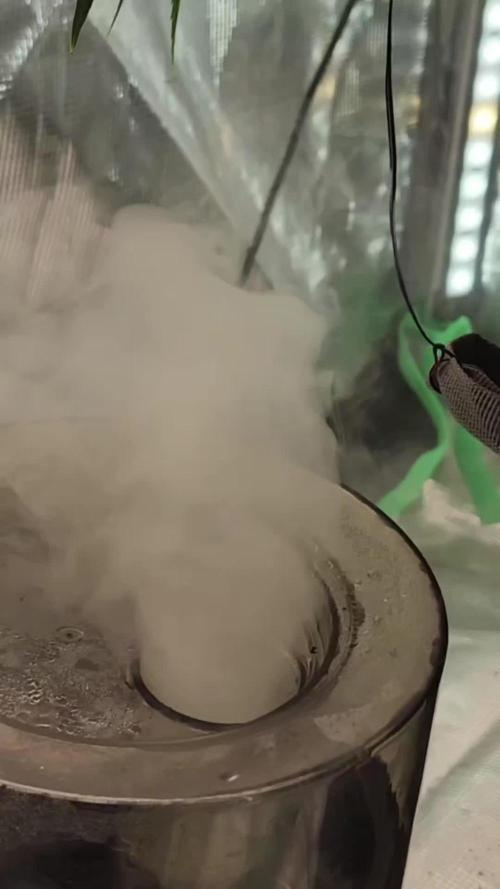
01/26 - (Clone mother) - She got a little funky last week and was in recovery mode for about 2 days - She has since then recovered (24hrs) and is performing amazingly - Running high temps High humidity - 2 part feed (Clean/Nute) on micro-dose program.
01/31 - Applied HST to lay her out - she is rebounding accordingly - Increased her feeds to once every other day alternating from nute to clean water - picked up the lights a little (19 inches above canopy) to clear room for SOG

Likes
8
Share

@GERGrowDesigns
Follow
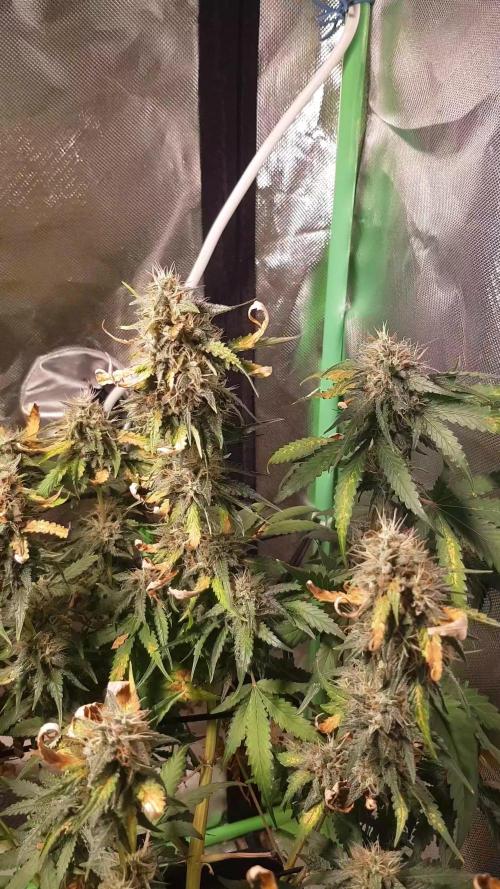
Privat Problems
Im Back soon stay tuned for more New Upcoming Content
Just doing a little break because theyrse much to do and solve behind the scenes
Finishing up the Diaries as good as Possible, theyre got harvested some weeks Ago

Likes
12
Share


@Purrple_Haze
Follow
Stretch Mystery & Waiting Game 🌱🕵️♂️
This week’s been all about patience and potential. We’re technically in Bloom Week 2, but our little mystery queen is still holding her cards close—no visible pistils yet, even though her structure and energy say she’s gearing up for something big. 🌿✨
That said, the stretch is definitely on. She’s reaching higher each day, and those side branches are starting to fan out beautifully. The symmetry is looking solid, and she seems right on track—even if she's taking her sweet time to show her true identity. 👀
Same feeding routine, steady rhythm:
🔸 BioBizz Grow, Bloom, TopMax + CalMag + Alg-a-Mic
🔸 Homemade compost tea, applied two days post-feed
🔸 Effective Microorganisms added 48h later
🔸 Silica spray every 3 days for added resilience
🔸 pH holding steady at 6.55, EC at a gentle 1400 µS/cm
She’s been soaking up plenty of sun and dancing in the breeze—no signs of pests or stress. Just one healthy, mystery-laced autoflower doing her thing at her own pace. 🌀
Let’s see what the next few days bring. Hopefully, we’ll spot some pistils soon—until then, I’m enjoying the ride. 🌸💫

Processing
Likes
141
Share


@Eyeduno
Follow
Week 5 of flower the tallest plant the pisltols are starting to turn already, wish I would have stripped the underneath abit more now

Likes
6
Share


Likes
7
Share


@logangrowgan2020
Follow
Lesson learned - wet leaves + close lamps fry plants! Plant seems to be bouncing back in a big way.
Watered with a garden globe kept it mostly moist, had a couple dry days and today Apr 4 watered from the bottom in a tub for two hours. taken out of tub and placed back on riser twenty minutes before lights on. Photo taken three hours later after some minor defoliation and tucking. Seems like flowering is happening and timing wise we turned the corner just in time for plant health and environment correction.
Loving the aquarium rock top layer over soil for aesthetic and love the vivid green on this plant what a beauty! thank you to sweet seeds for a tough baby girl who is turning into a fine young woman!
Any and all feedback welcome this is a new hobby for me. Previously have started jalepeno peppers indoors and then moved to outdoor container for summer, but never a grow tent like this wow.
Likes
14
Share


@Bread_n_Buds
Follow
Our #15 grows really well, the leaves are perfect and tapered a little curved perhaps but I think that's the effect of the beginning, the stem is straight and does not bend and is very well proportioned. I am giving Plagron Pwer Roots rooting soon starting with Alga Grow.
The plant grows well, the leaves are regular and very turned towards the light, it is very proportionate even I don't see stretching, bending and things that don't convince me.
The girls have already been poured into 11 liter jars because the biodegradable jars have started to decompose prematurely, no problem let's go to the ground.
Music of the week provided by Radio Nula from Slovenia.
https://radionula.com/
Thanks to friends of Seeds Mafia try this and their other creations
seeds > https://seedsmafia.com/en/
Light and tent > https://marshydro.eu/products/marshydro-sp3000-led/?lang=it
Likes
6
Share


@underfunded
Follow
i harvested plant number one early, and was smoking it and squishing it before i even weighed. im sure i got over 20 grams from it. the secone plant i harvested dried and am in the process of curing, and havent smoked any! it weighed in at 36 grams dried buds, and i mean nearly just buds.. i cut everything off haha. definitely happy with this run!000

Likes
10
Share

@CanOli95
Follow
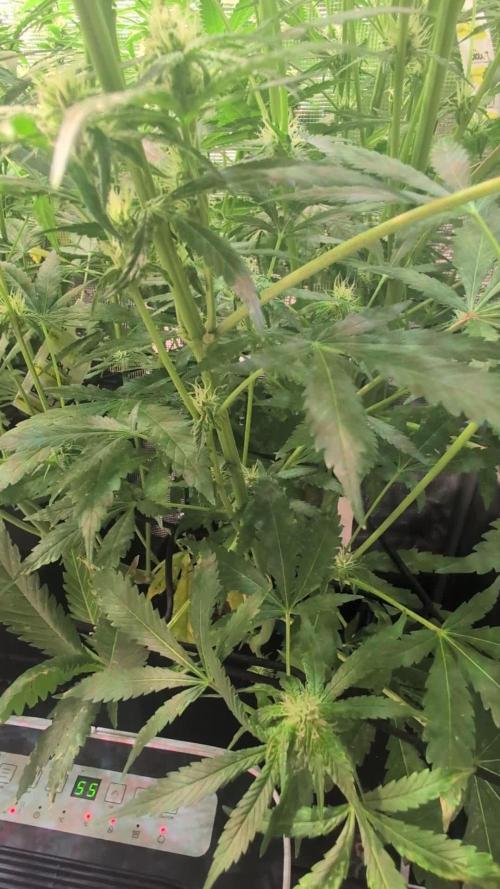
Diese Woche verlief sehr entspannt. Wir haben nun Tag 28 und somit ein Drittel der Zeit geschafft. Der Stretch scheint gestoppt zu haben, zum Glück.
Die Dame steht gut im Futter, sodass wohl keine Nährstoffe wirklich nötig sind .
Ein leichter Tip Burn ist erkennbar, was mich in der Entscheidung bestätigt.
Interessant ist vor allem die Struktur der Blüten: sie scheint die Calyx wie bei einer typischen Sativa Dame eher nach oben zu stacken, anstatt gleichmäßig zu allen Seiten. Ich bin mal gespannt ob es bei dieser Form bleiben wird, immerhin passt es auch zum starken Stretch , wie man eine Sativa ursprünglich eingeordnet hätte. Die Auswahl der Eltern dieser Dame wurde ebenfalls gut zur Einordnung passen.
Alles in allem scheint diese Dame sehr pflegeleicht zu sein, abgesehen von dem starken Stretch.
Bis jetzt gefällt sie mir echt gut. Mal schauen was da noch kommt 🌻 um den Stretch besser darzustellen, habe ich mal ein kleines Video gemacht. Interessant ist der Vergleich vor allem mit der Wizard Trees aus dem anderen Diary.


Likes
9
Share


Processing
Likes
9
Share


@Tango_Hotel_Charlie
Follow
Dealt with pm issue why I havent posted. Its gone. Fed compost tea, fpj, and foop. Also hit her with some mykos. Im already getting iny head when I want to begin amemding this for rhe next round
Likes
17
Share


@HowtoBubatz
Follow
It’s the eighth week of flowering, and the plant is looking absolutely gorgeous!
The buds and leaves have turned a deep purple with rich autumn hues, giving the plant such a unique, almost magical appearance.
The sweet smell has become even stronger and fills the whole grow space with a powerful, sugary aroma. 🍬🌿
I’ve noticed the trichomes starting to turn an amber color—just the sign I’ve been waiting for!
Most of them are still milky, but the amber hints show we’re getting close. This week, I’ve started the flushing process to clear out any remaining nutrients and prepare for harvest. 💧
Everything’s on track, and I couldn’t be more excited for the final steps! 😁✨
Likes
57
Share


@Ultraviolet
Follow
Views expressed are my own. All opinions are my own. The opinions expressed here belong solely to me and do not reflect the views of Growdiaries or Grandcru Genetics.
The cannabis strain Grape Guava can be a purple strain, depending on its specific phenotype and genetic makeup. While not all phenotypes of Grape Guava are purple, some variations, such as the Zatix Grape Guava, are noted for their striking purple appearance due to the genetic expression of anthocyanin pigments.
Grand Cru Genetics is a cannabis seed bank that emerged in 2018 from a group of breeders in Madrid to provide a satisfactory experience to all cannabis users.
"If we do things, we do them well. Due to our experience in the sector and our taste for excellence, we know high quality and we seek it in everything we propose and do."
"We have a “cultivate without giving up” philosophy that we apply to everything we do. We do not give up, we are friends of change, and we adapt as necessary in a still restricted sector."
"We speak relaxed because we know how to relax. We are not intense or preachy; we accept everyone as they are, and we understand that farming is not for everyone. But for those who do, we are here to accompany you. We like to do it and tell it. We are experts in the field because we are the first to do it. We speak from experience and connect with others because we share the passion for cultivation."
"Cannabis has the ability to show us a world of possibilities. When you cultivate and live its growth process, you enjoy a path full of emotions and not just the final destination. At Grand Cru we find beauty in small things. We are attentive, observant, detail-oriented and aware of everyday things, and we savor them without rushing."
In a garden of green, Grape Guava gleams,
With its fruity aroma, enchanting dreams.
Clusters of grapes, guava's sweetness ignite,
A strain so divine, in purple and white.
Euphoria whispers, a lush fruity haze,
Grape Guava's embrace, a tranquil daze.
Off and away.@1400ppm. The increased CO2 allows plants to thrive at higher temperatures, which in turn necessitates higher humidity to maintain the ideal VPD for healthy growth and transpiration. 80F -5F = 75F LST with 70% RH = 0.72 kPa. Higher temperatures and humidity promote rapid growth, nutrient uptake, and photosynthesis while maintaining a lower stress level. Temperature influences the rate of enzymatic reactions involved in aerobic respiration. Enzymes, such as those involved in glycolysis, the Krebs cycle, and the electron transport chain, work most efficiently at an optimal temperature range. In low temperatures, enzymatic activity will slow down, thus reducing the rate of aerobic respiration. In high temperatures, enzymes can become denatured, thus impairing their function and stopping the process of aerobic respiration. Glucose is the primary fuel for aerobic respiration. The rate of aerobic respiration increases with the availability of glucose, as it is the starting point for glycolysis. If glucose levels are low, cells may rely on alternative energy sources such as fatty acids or amino acids , but these processes may yield less ATP or be less efficient. To determine this effect, carbon dioxide volume was measured (as carbon dioxide is an output of aerobic respiration)
18/6 with the 6 being IR. The near infrared (IR-a) borders around 700nm up to 1400nm @ photon par flux density of 1.8 instead of darkness, keeping temps overnight a neat 77F-80F.
I think of my tent as a lung. What goes in must come out. When the rate of air going out exceeds the amount of air coming in, it creates a negative pressure. Tent concaves (bends in). If set up correctly, the RH will begin to drop slowly to the desired level I set, and the extraction turns off when it reaches the desired RH. The plant, as it performs cellular respiration, will always release more water into the air; therefore, the RH% of the tent overnight will increase, as long as oxidative phosphorylation is occurring. As soon as the RH% creeps back up to 55%, the extraction turns back on, over and over. This creates a strong pressure differential, which will work wonders with mass flow. Replicating high and low-pressure fronts in nature. Critical for oxygen diffusion at the critical time of peak cellular respiratory function..
Moisture will not transfer from a saturated atmosphere to another if that air is already at or above its saturation point, meaning the air can't hold any more water vapor. Once I understood that water is produced as a by product during cellular respiration, specifically at the very end of the electron transport chain (ETC) where electrons are finally transferred to molecular oxygen, the higher the RH of the air, the more resistance there is for more moisture to be added to that environment, and effects the ease with which it does so. But none of that water comes from the pot; it's pulled from the air. If you run high daytime RH, your medium/pot is 100% reliant on transpirational root pull to move water. ZERO evaporation happens across the atmosphere if the tent air has high RH%, the medium cannot release its water through evaporation. Once a canopy develops, light no longer slowly wicks and evaporates from the topsoil. The Soil-Plant-Atmosphere Continuum (SPAC) describes the continuous pathway and process of water movement, driven by a gradient in water potential, from the soil, through the plant's roots, stem, and leaves, and finally evaporating into the atmosphere through transpiration. There is evaporation, there is transpiration, and then there is evapotranspiration; Evapotranspiration (ET) is the combined total of two processes: evaporation (water lost directly from soil and surface water into the atmosphere) and transpiration (water released from plants to the atmosphere through their leaves). Evapotranspiration represents the total amount of water that moves from the medium into the air. There is no such thing as a medium with too much water, only a medium that retains too much for too long.
The water must always flow efficiently from one atmosphere(Medium) to another(Air) in a timely manner. Moisture is a critical factor for bacterial growth and decay. Dictating how long it's allowed to sit in any one location for any given period is a key preferred control. To ensure a net reduction in a bacterial population, the rate of removal (ET) must exceed the rate of bacterial growth (decay rate), which is often modeled as a growth rate for the specific bacterium under the given conditions. By optimizing daytime VPD, we also optimize conditions for bacterial growth to explode exponentially above 77°F.. If water is allowed to sit in a medium without an escape within a timeframe, nothing good will happen. IF High RH is maintained overnight as well as during the day, placing 100% of water movement at the behest of daytime transpiration, roots can only pull where they can reach, and if soil is compressed above a certain point, moisture will become trapped in a medium with no way of moving day or night. This will begin the countdown for decay to take hold. When water stagnates in a medium, it loses oxygen, creating anaerobic conditions that foster the growth of harmful microorganisms like bacteria and fungi, which can produce toxins and disease vectors.
Thigmomorphogenesis, the process by which plants respond to mechanical stimuli like touch by altering their growth and development, results in significant morphological changes to improve survival against mechanical perturbations. This complex response involves sensing touch and initiating physiological and genetic responses, leading to changes in form and structure over days or weeks. The process is triggered by physical forces such as wind, rain, or touch. Plants adapt to these stimuli by changing their shape and structure, which may include slower growth, thickened stems, or altered leaf development. Plants possess sophisticated mechanisms to detect even subtle mechanical stimuli and initiate responses. A variety of molecules, including calcium ions, jasmonates, ethylene, and nitric oxide, are involved in signaling these mechanical inputs. Touch can induce the expression of genes that encode proteins for calcium sensing, cell wall modification, and defense mechanisms. A plant exposed to constant wind may become shorter and sturdier. A plant that is touched frequently might grow more slowly to conserve energy and develop thicker cell walls. These changes increase a plant's resilience and ability to survive in harsh environments.
Let's get Thiggy with it.
Likes
44
Share


@Joni2017
Follow
Day 64 of this week do not pass 😆😜 two of my girls are ready, but the other two are missing a day more because of the three days that were with the focus spoiled☹️️ the irrigation I have reduced it to 60-70 ml 💦 of water (I have used the dehumidifier😉) in this way they stress a little😋 the humidity is between 38% -44% temperature 26ºC. Everything else ok😄👍 this week I hope to collect the harvest🙌💪

Likes
3
Share
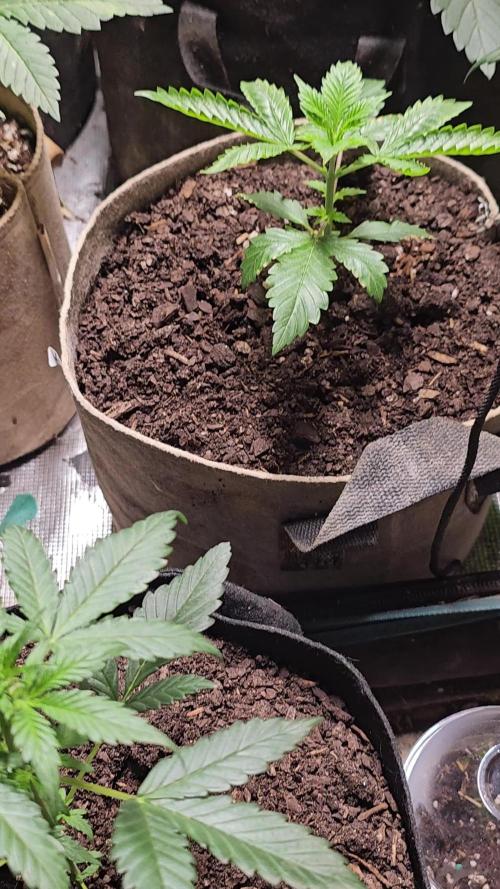

@Samsationalseeds
Follow
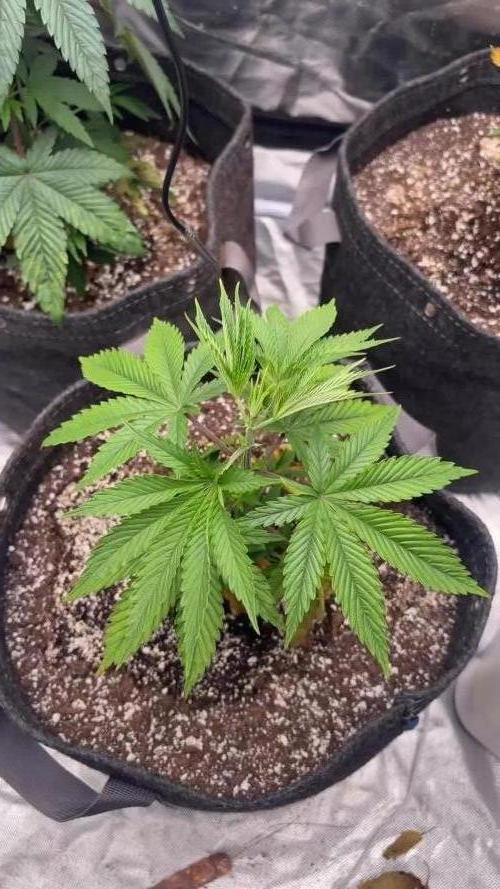
This is mainly an ongoing diary to check on the feminization rate of my autos.To see if they will, herm out, i'm not necessarily doing stress tests.I am still growing them within a given range.
I have yet to see any pollen sacks or nanners.
However, I am impressed that we're looking at
Six out of ten have gone into blooms so far. Of the oddles that I bred.
Likes
7
Share


@BIYEI
Follow
Vegetación (Tiempo estimado 28 días)
Cuarta Semana de Vegetación
28/12/2023 - 5:00hrs y 22hrs: Se Hace cambio de solución nutritiva y se limpia el recipiente, se verifican parámetros básicos del agua, mantener cuidados específicos, el Ec y PPm Varean por los aditivos.
Agua de osmosis: Ph 6.0, PPm 1050-1300, Ec 2.1-2.5, Temperatura 20°C - 24°C, Humedad 75%
Ambiente: Temperatura 22 °C, Humedad 75%, Ventilación 15%, 18 hrs de luz , 6 hrs de obscuridad.
29/12/2023 - 5:00hrs y 22hrs: Se verifican parámetros básicos del agua, mantener cuidados específicos.
Agua de osmosis: Ph 6.0, PPm 1050-1300, Ec 2.1-2.5, Temperatura 20°C - 24°C, Humedad 75%
Ambiente: Temperatura 22 °C, Humedad 75%, Ventilación 15%, 18 hrs de luz , 6 hrs de obscuridad.
30/12/2023 - 5:00hrs y 22hrs: Se verifican parámetros básicos del agua, mantener cuidados específicos.
Agua de osmosis: Ph 6.0, PPm 1050-1300, Ec 2.1-2.5, Temperatura 20°C - 24°C, Humedad 75%
Ambiente: Temperatura 22 °C, Humedad 75%, Ventilación 15%, 18 hrs de luz , 6 hrs de obscuridad.
31/12/2023 - 5:00hrs y 22hrs: Se verifican parámetros básicos del agua, mantener cuidados específicos.
Agua de osmosis: Ph 6.0, PPm 1050-1300, Ec 2.1-2.5, Temperatura 20°C - 24°C, Humedad 75%
Ambiente: Temperatura 22 °C, Humedad 75%, Ventilación 15%, 18 hrs de luz , 6 hrs de obscuridad.
01/01/2024 - 5:00hrs y 22hrs: Se verifican parámetros básicos del agua y se rellena de 1.5 litros más de solución nutritiva con los valores ajustados a esa cantidad de agua, la planta empieza a chupar agua cada vez más, mantener cuidados específicos, corregimos deficiencia de CALIMAGIC esperando vea mejoría en las hojas de la planta.
Agua de osmosis: Ph 6.0, PPm 1050-1300, Ec 2.1-2.5, Temperatura 20°C - 24°C, Humedad 75%
Ambiente: Temperatura 22 °C, Humedad 75%, Ventilación 15%, 18 hrs de luz , 6 hrs de obscuridad.
02/02/2024 - 5:00hrs y 22hrs: Se verifican parámetros básicos del agua, mantener cuidados específicos.
Agua de osmosis: Ph 6.0, PPm 1050-1300, Ec 2.1-2.5, Temperatura 20°C - 24°C, Humedad 75%
Ambiente: Temperatura 22 °C, Humedad 75%, Ventilación 15%, 18 hrs de luz , 6 hrs de obscuridad.
03/02/2024 - 5:00hrs y 22hrs: Se verifican parámetros básicos del agua, mantener cuidados específicos.
Agua de osmosis: Ph 6.0, PPm 1050-1300, Ec 2.1-2.5, Temperatura 20°C - 24°C, Humedad 75%
Ambiente: Temperatura 22 °C, Humedad 75%, Ventilación 15%, 18 hrs de luz , 6 hrs de obscuridad.