


Likes
Comments
Share


@Papastroumf
Follow
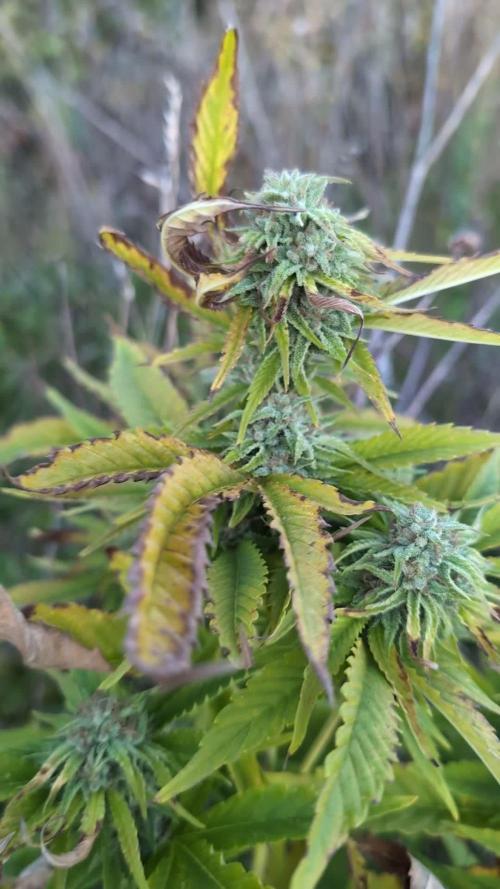
Day 66 : Continue the juices on NL because her trichomes are 50-50 milky cloudy. She is flowering very well and is like breeders photo. Each bud is like sprouting. She creates seed pockets and these pockets explode with pistils. Its amazing. Breeder suggests to leave her flower for 45-50 days. Until now she flower for 38 days , so yeh 12 remains for sure. I added Calcium because she needs it.
Edit Day 70 : I watered her with juices because she stills produces new trichomes. She also started to purple her buds. Her colas are so beautiful. We don't see buds like this every day.


Likes
2
Share

@GoodTimesOrganics
Follow
Welcome Back💚
Heute war es an der Zeit, den letzten Besuch bei den Outdoor Ladies durchzuführen.
An sich hätten die Pflanzen nochmal etwas länger stehen können.
Im Outdoor Grow unseres Breitengrades muss man jedoch Kompromisse eingehen, bevor die Pflanze nämlich abstirbt und den Frost nicht überlebt, ist es an der Zeit zu ernten.
Grüne Grüße 🌱

Likes
4
Share

@DogDoctorOfficial
Follow
💜 Purple Haze by Zamnesia – Pheno B
Week 7 | Strong Genetics, Beautiful Consistency
Welcome back to another chapter of the 8×8 Adventure!
One of the most rewarding aspects of documenting every individual phenotype is seeing just how differently sisters can express the very same genetics.
Some stretch a little more.
Some flower a little faster.
Some develop slightly different branching patterns.
Yet every now and then, you find two sisters that seem to be following almost the same blueprint.
That's exactly what has happened with Purple Haze Pheno B.
She may not be quite as tall as her sister, but looking at them side by side, it's impossible not to appreciate how similar they are.
Strong structure.
Beautiful colour.
Healthy foliage.
Balanced branching.
To me, that's a wonderful sign of stable, well-selected genetics.
🌱 One Project. One Environment. Twelve Unique Stories.
If this is your first time following the diary, welcome!
This entire grow is part of my ongoing 8×8 Adventure, where twelve different cultivars are being grown together using the 12/12 From Seed technique.
From the very first day, every seed has received exactly the same opportunity.
• The same lighting schedule
• The same Plagron nutrition
• The same AutoPot irrigation system
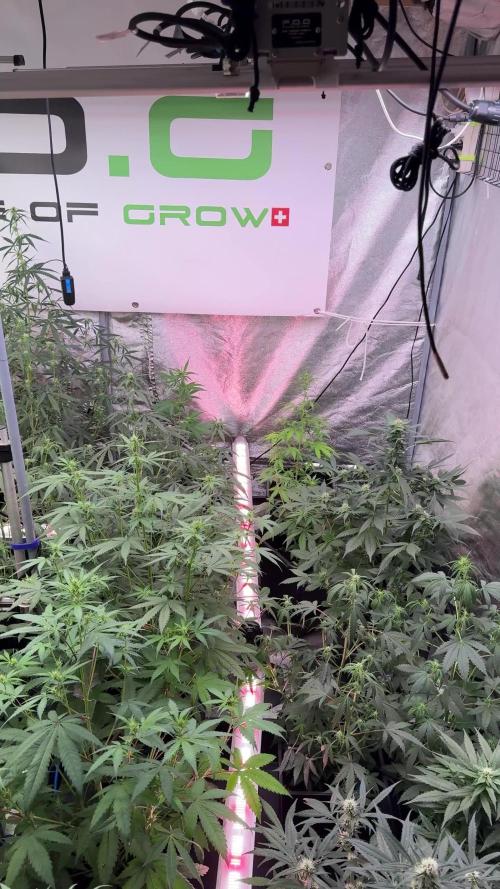
• The same Future of Grow lighting
• The same TrolMaster-controlled environment
• The same temperatures
• The same humidity
No plant receives special treatment.
No individual feeding.
No different environmental conditions.
The only variable inside this room...
...is genetics.
Watching those genetics unfold week after week continues to be one of the most enjoyable parts of this entire project.
🌿 Healthy Plants Build Great Harvests
Purple Haze Pheno B continues to impress me with her overall health.
She carries herself with confidence.
Her leaves are broad, vibrant and beautifully green.
Every branch feels sturdy.
The canopy remains nicely balanced without becoming overcrowded.
She may not be the largest plant in the room, but she's certainly far from the smallest.
Instead, she's developing into a wonderfully proportioned plant that seems perfectly comfortable in her environment.
Sometimes growers become too focused on height.
Personally, I care much more about overall health.
Healthy roots.
Healthy leaves.
Healthy branches.
Everything else is built on that foundation.
And this lady is giving me every reason to smile.
🌸 The Flowers Continue Their Journey
Week 7 marks another important step in her flowering development.
Across every growing tip, fresh white pistils continue emerging from small clusters of calyxes.
Those white hairs, known as pistils, are the female reproductive organs of the flower.
Outdoors they exist to capture pollen.
Inside the grow room they become one of the clearest signs that flowering is progressing exactly as nature intended.
Beneath those pistils sit the calyxes.
Each tiny calyx is one of the individual building blocks that eventually forms the finished flower.
As the coming weeks unfold, more calyxes will develop, stack together and gradually swell, transforming these delicate flowering sites into the dense, resin-coated colas we're all hoping to see.
The foundation she's building now will determine the harvest she'll produce later.
🍃 Gentle Training, Natural Development
One thing I've continued throughout this grow is allowing the plant to keep as many healthy leaves as possible.
Rather than aggressively defoliating, I've relied mostly on careful leaf tucking to expose developing bud sites while allowing the plant to keep producing energy naturally.
Healthy fan leaves are incredibly valuable.
They're responsible for capturing light and converting it into the energy needed to build flowers.
When the canopy already has excellent airflow and good light penetration, there's often little reason to remove perfectly healthy foliage.
Sometimes the smartest thing we can do as growers is simply let the plant do what it evolved to do.
💧 Feeding for Flower Development
As flowering progresses, nutritional demands naturally begin shifting toward flower production.
This week's feeding schedule includes:
• Terra Bloom – 2 ml/L
Provides the phosphorus and potassium needed to support healthy flower development and continued growth.
• Power Buds – 1 ml/L
Helps encourage the plant to transition its energy toward producing more flowering sites.
• Green Sensation – 1 ml/L
A bloom enhancer designed to support flower density, resin production and overall plant performance during the later stages of flowering.
• Sugar Royal – 1 ml/L
Supports the plant's natural production of sugars and aromatic compounds that contribute to flavour and terpene development.
• Pure Zym – 1 ml/L
Contains enzymes that help break down dead root material, keeping the root zone healthy and improving nutrient availability.
• pH adjustment using pH Plus and Lemon Kick
Maintaining the correct pH ensures nutrients remain available for efficient uptake throughout the flowering cycle.
Every plant in the room receives this exact same feeding schedule, allowing each phenotype to respond according to its own genetics.
💡 Lumiflora Under-Canopy Lighting
Another exciting part of this project continues to be the Lumiflora under-canopy lighting.
Traditional grow lights naturally favour the upper canopy, leaving lower flowering sites with much less usable light once plants become dense.
Under-canopy lighting helps reduce that imbalance.
Its goal isn't to replace the main fixture.
It isn't a miracle product that suddenly doubles yields overnight.
Instead, it provides additional light to the lower parts of the plant, helping secondary flowering sites remain productive while reducing the need for excessive defoliation.
As the flowers continue developing over the coming weeks, I'm looking forward to seeing just how much difference this extra layer of illumination makes.
🌡️ A Stable Environment Makes Everything Easier
Like every plant in this room, Purple Haze Pheno B continues benefiting from stable environmental conditions.
Current grow room conditions include:
• Flower Week 7
• Height: 100 cm
• Day temperature: 29°C
• Night temperature: 25°C
• Relative humidity: 60%
• pH: 5.8
• EC: 1.95 mS/cm
• Solution temperature: 24°C
• Root zone temperature: 21°C
• CO₂ concentration: 636 ppm
Stable conditions allow the plants to dedicate their energy toward growing flowers instead of constantly adapting to environmental changes.
Consistency truly is one of the biggest advantages a grower can provide.
📷 This Week's Gallery
This week's photographs capture a phenotype that looks wonderfully comfortable in her environment.
The close-up images highlight healthy clusters of fresh white pistils emerging from every flowering site, while the wider photographs showcase her balanced branching and exceptionally healthy foliage.
Comparing her with her sister has been fascinating.
They're clearly individuals.
Yet they're also remarkably similar, which speaks volumes about the quality and stability of the Purple Haze genetics from Zamnesia.
Sometimes consistency is every bit as exciting as dramatic variation.
🔮 Looking Ahead
During the coming week I expect flowering to continue accelerating.
The stretch should gradually begin slowing, while the calyxes continue stacking and the first real signs of bud bulk begin appearing.
I'm also excited to continue observing the effect of the Lumiflora under-canopy lighting as the canopy fills out and lower flowering sites receive additional illumination.
If she continues growing the way she has so far, I expect another week of calm, healthy progress rather than explosive change.
And honestly...
I'm perfectly happy with that.
Healthy plants don't need to rush.
They simply keep improving one day at a time.
💚 Thank You
Thank you so much for following another chapter of this 8×8 Adventure.
Projects like this remind me every single week that growing isn't about forcing plants to become identical.
It's about giving every phenotype the same opportunity and appreciating the unique story each one chooses to tell.
Purple Haze Pheno B continues proving that healthy, balanced growth is something worth celebrating all on its own.
A huge thank you to:
💚 GrowDiaries for providing a platform where growers from around the world can document their journeys, learn from one another and build this incredible community.
🌱 Zamnesia for providing the outstanding Purple Haze genetics behind this phenotype hunt.
💜 Plagron for supplying the nutrition supporting every stage of this grow.
💡 Future of Grow LED for delivering the light powering this entire project.
🌿 TrolMaster for maintaining the stable environment that allows every phenotype to perform at its very best.
✨ Lumiflora for bringing an exciting new dimension to this grow through their innovative under-canopy lighting technology.
And finally...
Thank you to everyone following these diaries, leaving comments, asking questions and sharing this journey with me.
Every week these plants continue teaching me something new.
And Purple Haze Pheno B is reminding me that sometimes the most impressive plants aren't the ones growing the fastest...
They're the ones growing beautifully every single day.
Growers Love! 💜🌿

Likes
2
Share

@PhinolaGreen
Follow
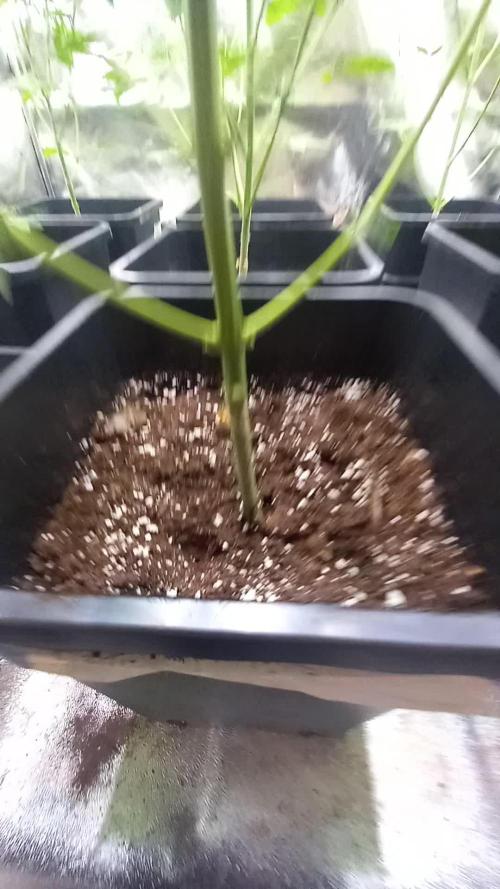
Woche 5
In dieser Woche wurden die Ladys ein bisschen gelollipopt und entlaubt, mehr dazu in dem Foto Update am Mittwoch.

Likes
3
Share


@MadBumbleBee
Follow
1 OG kush Shows Sings of Nitrogen Toxicity (cut most leafs off)
Soil PH: 5.7 - 6.8 (lowest and highest reading)
Flushed all plants with microrayza fungi
Watering with organic bio activated tea every 3 days (potassium = algae, bokashi = nitrogen, worm hummus and molasses)
Day 28 to 35
Day 32: Accidently cut off main stem of a very healthy OG kush plant, let´s see how it bounces back in a few days. Perhaps I just HST´d by accident
Day: 32: Some of my autoflower GSC already started to flower
Day 32: 3 OG kush plants are weak, one has a weak stem, second one had a problem since seedling (grew into the ground), third one i cut off main stem by accident
Day 34: OG kush plant was removed after many tries of getting it back to its feet

Likes
12
Share


@Siriuz
Follow
We started week. 10
Hey there guys I've been super busy
Day 64
Check video
Fed them 1670ppm
Followed by water with lil runoff
Day 65
Check video
Day 66
Outdoors for 3hrs
Rested for 6hrs no lights
Because of blackout
I know it sucks
Humidity 60%
Day 67
Humidity 45%
Got some vids and pics for you guys
She's all good
Buds fattening up
Day 68
Water them a lil bit
0.5l each
Temp 24C
RH 45%
Day 69
Outdoors for a day since we didn't have electricity from 10am til 7pm
Good thing we have sun light right?
And it's very bright but very hot as well
Temp reached 33 Celsius but we had her on sprayed mist until it dried out completely than refresh her again and so
She didn't stress at all shes good
After thar electricity came back and we turn on the setup grow lights ac and all stuff
Back to normal again
Day 70
Same stuff than 69
Nothing wrong all is good
Temp reached 33 then dropped to 24 at night time
Coming up next week last meal nutes

Likes
57
Share


@SmokieMcPot
Follow
***UPDATE***
ITS CHOPPIN DAY!! Late in day 87 I was going for macros. Made the decision while seeing MANY yellow trichomes that Wedding Glue from FastBuds is DONE! Attaching pics to the beginning of the weeks uploads. She sure turned out pretty asf didn't she? Lights out occurs in like 30min, and I'm going to work through the dark period stripping the large fans off. Utilizing my green Christmas lights hung up above lol. May turn light on low for a quick pic before chopping/hanging. Next update will be harvest!
2 Girls 1 Cup week 12? Hopefully the finish is this week... My my my how WG has fattened up the last 2 weeks. Trying to get some good macros since it's too hard to hold the scope to my phone and focus everything. Probably better for the existing trics too since they're not being touched.
Day 84- these trics are taking their sweet time to ripen. Was considering picking up some GHE Ripen to speed the process up.. especially because a local shop is closing and everything is 40% off. Let's keep it simple this run. I'll get some additives for the next grow to enhance GHE's perfected formulas of macro/micros in the Flora series. An update on the "sample" I clipped from WG the other day. It's not dried/cured proper. Actually been sitting in a brown bag with the outlet of the tent blowing on it lol. Can taste some vanilla in it through the chlorophyll and shit still in the flowers. VERY heady effect that hits me like a friggin wave. Creativity and energy uplifted for sure. Looking for the bodies in there too to help with pain, so we shall wait even longer for those ambers to show.
====================================================
==========================
==========================
Day 85- stepped up our hole a size or two.. lol. May bring home the step bit to drill again before a dark period at the end. The girls STINK! Getting VERY close to chopping day. Ooooh I can't wait (but I gotta). Headies lasting between 2-3hrs which is great.
====================================================
==========================
==========================
Day 86- yellowing more as the days pass. no more ambers showing yet.. wasn't able to score anything good from the local shop today since it was almost empty already. Picked up a grove bag to give it a whirl with curing. May put some in glass to compare side by side with the bags. Figured I'd give their roots an ice bath since I've done other bro science. Shit, GK still hasn't popped a nanner after all I've put her through 🤣.
*edit* added some late day WG only pics to show her fall colors coming in. Moving in fast now. Gotta get back up in WG's guts now and scope the progress daily.
====================================================
==========================
==========================
Day 87- the smell in the tent has become so powerful, I next day air'd a new charcoal filter 🤣. This one was reaching the end of its lifespan anyway.. but oh boy has the aroma increased. May be starting the 48hr lights out within the next day or two from the smells of it.
====================================================
==========================
==========================
As always, thanks for stopping by and checking out my current grow. If it's your first time, check previous weeks for these girls progress throughout their lives. days 27-70 timelapse @ https://youtu.be/8JdUkR36Wfc
Processing
Likes
13
Share


@GrowGuy97
Follow
Everything is going great, just waiting on flower tent to finish & these ladies will be going straight into flower😍✌️🏼🌱
Day 40 first day of flower, everything seems to be going ok so far!
Day 41 Can see they are starting to stretch!😍


Likes
96
Share


@Swollen
Follow
During the harvest I've collected lot of trims. I think this genetic will be great for extractions.
I've dried all the buds in the tent at 50%rh, 23°C with indirect ventilation for three weeks. Now are curing in a dark room at 21°C inside a jar with a 58% Boveda.
Thanks to everyone who followed and liked this diary! I hope you enjoyed 🙏
Likes
Comments
Share


@Growfather1
Follow
Hello everyone!
Welcome to week 4 of the MAC1 F1 hybrid clone saga.
She is doing incredibly well and just got herself something to drink.
Her current menu consists of CANNA Coco A and B at 2 ml per liter of water.
Environmentally, the humidity is sitting comfortably at 63%.
Temperatures are swinging gently between 21°C and 24°C.
Everything is looking absolutely fine on this front.
She also bounced back from the neem oil treatment like a absolute champ.
I wish I could say the same for my other plants—they look like they just survived a tiny, dramatic botanical war.
But let’s focus on the bright side and see how she looks next week!
Thank you for stopping by and have a nice day.
Best regards,
Growfather
Likes
Comments
Share

@Budoken
Follow
Not much to do this week. Nutrient solution was too strong, plant doesn't seem to need much anymore and ec kept rising from 1.6 to 1.8. I drained the reservoir, flushed the system twice with water, and then filled it back with the same solution but diluted it to ec 1.0.
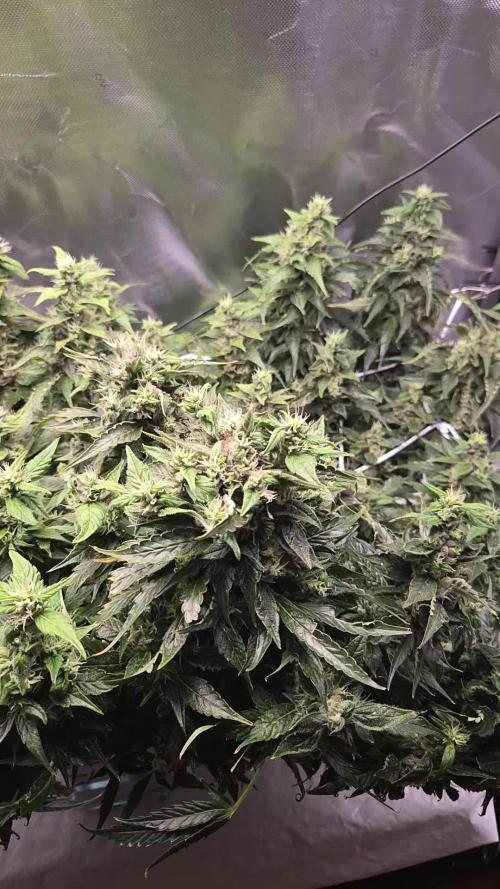
Pistils are starting to do darken, except for the new bud growth that has emerged. Will continue to keep an eye on it during next week, harvest ia not that far away. Will flush for 2-3 days once the plant is done.


Likes
6
Share


@Naujas
Follow
The girl is fantastic :) she looks strong, healthy and happy :) next week, I will defoliate her to give energy to the flowers, and at the same time improve air circulation closer to the stem :) everything is going smoothly and well :).
Likes
11
Share


@Teezkiee
Follow
Fastest Flowering I have ever seen, some magic, quickly moved to Ripening
Processing
Likes
10
Share


@teabee
Follow
Everything looking good so far, they stretched quite a bit already. Been about 2 weeks since 12/12 one week since I considered flowering.
I am going to defoliate again in a few days before I have to leave them alone for a few days/week. So it'll be about 2.5-3 weeks from 12/12 when I do another defoliation.
They seem to be drinking more, I added 2 more minutes run time to my watering schedule for next week so it works out to be 7.5 liters a plant instead of 6.5. I'll keep adjusting as needed. Haven't really got run off this past week


Likes
2
Share

@REDSTUMPZz
Follow
*** SS.3 WEEK 3
- RS 11 # 1
- RS 11 # 2
- GRAPE SLURRI (CLONE) # 1
- GRAPE SLURRI (CLONE) # 2
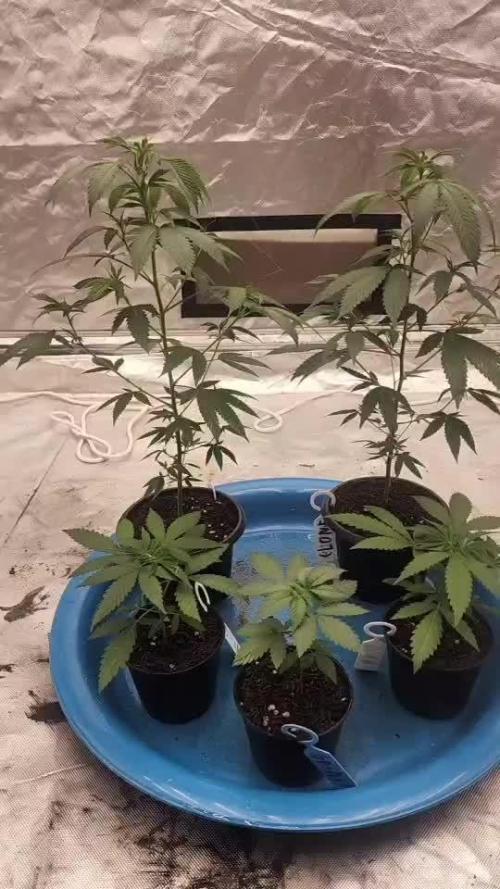
- GODFATHER * PLCG S1 SHE SMELL LIKE COCOA NIBS


Likes
3
Share


@Bdawg
Follow
Grow went well.
Spider farmer produces again the se5000. One day they myt sponsor me beofre someone else does.
Dyno myco somw gd stuff chek out ppl.
Likes
6
Share


@julian100614
Follow
El ciclo de la planta ha sido muy bueno, los fenotipos de Sweed Seeds son bastante fertes en cuanto a enfermedades, personalmente sientre uso mico vita (top crop) mezclado en seco con el sustrato y siempre me a funcionado realmente bien 👍
Los cogollos han ido cogiendo fuerza y tricomas sin parar, respondiendo al entrenamiento LST sin ningun problema 💪
BUENOS HUMOS 🔥

Likes
20
Share


@MrWolfe
Follow
Smells are getting prettt strong tbh, PKB is very grapey and gassy, washing machine is pure black licorice, BCS doesn’t have much nose and blue dream is creamy blueberry pastry.
Spotted some stamen on the top of the blue dream, I’ll see how she finishes out. I love the smell and bud size and next round is being topped properly instead of just supercropping.

