


Likes
Comments
Share


@Hypnogrow
Follow
I've pretty much been hands off this grow.
Just letting the plants do what they want.
I did a spray with insecticidal Soap which shocked some of the auto genetics. Had some leaf loss but they are bouncing back. I saw one tiny fly and wasnt worth the shock some of the susceptible plants had. Lesson learned.
I havent done much more than fimmed, topped, and lsted very lightly. Testing out fimming on autos. So far the lst only autos started flowering around day 23 to 25. The fimmed autos have stayed in veg much longer and were way more resilient. They are just starting to flower or show pistil. One of the Double Grape is showing completely different pheno than the other double grape. So much that I thought it might need 12/12 to flower. However it started showing pistils a day ago. Double grape responded very well to Fim and so did the northern lights big bud auto and purple scoops.
I had problems with a driver on a brand new fc3000 blowing up, mars hydro sent me a replacement driver. They then wanted to squabble about replacing the plastic piece that connects the driver to the light. Two weeks later they sent the part after I told them I had to buy an HLG cause I couldnt believe they wouldnt send me a plastic part.
Then the HLG I was sent was the 65 version not the 100 but they sent me the correct light right away and my plants and the clones loveeeed the HLG 100 v2. So much so that I bought the 65 version they sent by mistake and they gave me $10 bucks off for my troubles.
Even though I had to be persistent with Mars Hydro they did do me right and now both my LEDs are working. However I had a 4 by 8 of plants all stacked on one end under 150 watts for weeks trying to get this solved. I had multiple power and light issues with adding the new 4 by 8 tent that costs my plants I'm sure. I decided not to freak about it and let things go with the flow and not stress. Things will not be optimum but I learn each grow about my setup and this is my first grow in soil so learning curves.
I'm feeding very small amounts of calmag and seaweed extract in each watering which is every two to three days with ro water. I started this week three when the plants showed shock from the spray. It seemed to help them recover.
I'm using light warrior, ocean forest and living soil layered mix.
I kept 1 king tut, 3 alien tech clones which are doing good nice and rooted directly in light warrior. Transplanted week three in 3 gal pots.
Never cloned before so is a learning process.



Likes
Comments
Share

@SolitudeCorners
Follow
This breeder is a scammer**
I’m going to end this grow diary here. During the later stage, I went through a mental breakdown and kind of lost focus on life for a while. I’ll upload whatever photos I still have, but I didn’t get my friend to help take proper photos because he was dealing with military conscription at that time.
I feel genuinely sorry to the sponsors who provided the seeds. I promised to complete the grow diary for them, and I broke that promise. I tried to save some branches, but they didn’t survive. I don’t have any excuses for this.
If I get another chance in the future, I’ll buy their seeds myself and grow them again properly.
**This breeder held a grow contest and sold a lot of packages for join the contests - seeds-Shirts stuffs and then cancel it after not enough people join him while dealing with his warrant (people talk like he used to be a scammer that famous in cannabis society in 2-3yrs ago) he just rebranding himself and claimed to work with gage geen founder (michael fang) ,I used to respect him and his work but after see him fat shaming people and talk so shit with their customers its just made me see more clearly
Processing
Likes
9
Share


@Kushizlez
Follow
Day 69 (March 6th)
Just gave everyone their last watering. I’m going to harvest and wash everything tomorrow night on day 70. I‘m not going to do that whole 48 hours of darkness thing because I didn’t see a difference last time I did it. In fact, it made my plant under watered before drying which caused it to dry too fast. Slurricane and cheese will be washed with h2o2 and the rest will just be rinsed off in warm RO water and hung up. Before and after washing I’m going to go over each branch with a flashlight and make sure there is no dog hair or debris in or on the buds. I will be drying in my spare bathroom (that no one uses!) from hangers. Aiming to keep it around 60-62F and 50-60 RH. Hoping for that 10-12 day dry. I wanted to do a full plant hang but the tent got pretty dirty and I would feel more comfortable just cutting and rinsing everything off branch by branch. I’m going to try my best to keep the full plant intact. Got my humidifier hooked up and running RO water because with tap water it deposits calcium and lime all over the buds and walls. For air flow I’m just indirectly running a small usb fan. I’m not worried about air flow in the bathroom honestly. It stays nice and breezy down there anyway.
Got the food grade peroxide and RO water to wash up the slurricane and cheese. Everything except for the cheese and garlic#1 is looking more than done. Trichomes all look pretty well done. Some of them have even burst open. Smells are all super ripe and mature too. Can’t wait to smell each individually in jars.
Next week I will recap what went wrong and what I will do differently next time to keep it from happening again.
(Day 70F) Just got everything chopped, washed and hanging. The vast majority of the PM was washed out but I can still see very small amounts. When they dry out I can shake the branches a bit to get the rest off. At very least it’s sterile now. There is no question I lost some potency while washing but the amount is negligible for a much cleaner product.
I could see lots of dirt and other debris float to the surface of the water after being washed. And no those are not trichomes, those sink to the bottom. I could put that nasty water through a bubble bag and wouldn’t get all that much. Although it probably does remove a lot of the actual trichomes heads. I’ll have to check with the microscope.
Everything is rigged up for a nice slow dry. Temp is sitting at 64 and RH is at a nice 60%.

Processing
Likes
50
Share


@BarrieGrower
Follow
The one plant that has always been under the cobbs is a couple of weeks ahead. They are all fattening up and the smell is great. Humidity in the tent has dropped, this is due to the outside weather changing and running a 6" fan 24/7.
I may start the flush on the one plant, will decide in a few days.
Cheers

Likes
11
Share


@Annakonda
Follow
Pas beaucoup d'odeur mais une fois coupée une belle odeur de sucre de bois et un peu de fruit se dégageait 🤤🤤🤤.
Pour avoir fait pas mal d'erreur et réussir a en tirer 127 g humide pour une première et juste un lst sur la tige principale ( quasi un sog) . Je pense avoir fait quelque chose de plutôt pas mal. Maintenant le produit final ne sera pas a son rendement maximum, mais ça me va.


Likes
4
Share


@Constantin94
Follow
Purple shades are starting to show up… I think the size of the buds has not change from last week, I will start to flush out this lady

Likes
30
Share


@Silverback_Guerilla
Follow
9/18:
New week...fed with Boomerang and Kangaroots
9/19:
Applied Axiom harpin proteins and boomboom spray
9/20:
Fed full strength TPS One...decent growth. This strain really likes the Nitrogen..they were starving...
9/21:
Tucked a few leaves and took some photos and a video.
Looking good. Just a couple more days of 24/0...
9/22:
Switched out the 560w of 5000k CCT lighting for 720w of 3000k CCT lighting and set the timer for 12/12.
Decided against 13/11 with emerson effect...trying to save a few bucks on electricity.
I'm keeping the lights at 30" from the tops for a day or two.
9/23:
The girls loved their first night of sleep...so perky!

Likes
17
Share


@F1yboy420
Follow
This week I cut a lot of foliage off. This way the lights can get to more buds. Weed inspires creativity.

Likes
16
Share


@Reddgrower
Follow
Flipping to flower
Topped a week ago with 50/50 all purpose and power bloom
Watered with microbial tea that was brewed for 18 hours.


Likes
59
Share


@JeyGanesha
Follow
Un altra settimana è passata e tutto procede bene.per fortuna non ho più trovato nessun nanners 🙏✌️💪..belle piantine mie, continuate così che farete delle belle pannocchie....
30/8/24 gente ho combinato una bella cazzata.pur avendo esperienza, mannaggia a me,mi sono portato a casa dentro il box, il cazzo di ragnetto rosso... fanculo...
Ho già iniziato a ripulire tutto, box e piante con Neem...li sterminerò tutti 😂..

Likes
25
Share


@PrairieFrostGrow
Follow
She went into dark on Sunday Feb 23rd, day 77, and was harvested on February 25th, day 79 from her coming out of the medium
First run from Mesphisto and extremely happy with everything. It has not been without incident and she has had her fussiness. Overall this girl liked her nutrients on the lighter side.......liked her pH on the lower side........she doesn't want much light intensity for the first 4 weeks!
She started off really slow in germination but then took off around weeks 3 to 6 and shot way up! She takes up a lot of room and will not yield four ounces of bud idea but she has grown into a beautiful tree looking girl. I was timid about bending her main stem because of slow growing early on but running her again, I would bend the main stem and train that as well. She is going to be a good producer for this strain and she makes you smile looking at her.......what more can you ask for😍
The colour change was not expected and was a great surprise. Love purple leaves! Still have 4 seeds of this girl to run again. It appears to me that on my pack of seeds the right grow for me is a 3 gal pot, keep her under T5 light for most of veg, give the whole girl LST, keep her tied down tight if she starts to take off in week 3 and 4, keep her pH in the 5.5 to 5.8 range for veg and early flower. Expecting smaller, hard, fire nuggets from her based on how she grew.
Will follow up with more as she progresses through drying. In the box with temp at 62 to 66 degrees and humidity at 60%. Branches are not that long so I am expecting dry should be around 7 to 10 days. 😍

Likes
21
Share


@Budhunter
Follow
She looks amazing. I think she could handle few days more however I’m having some issues in my place so I chopped today on day 98 from this run I think now it will yield more than the others
Likes
16
Share


@drgreentips
Follow
I did low stress training on the girl nice clean smoke with a citrus taste overall happy results with stain

Likes
8
Share

@Highsenberg82
Follow
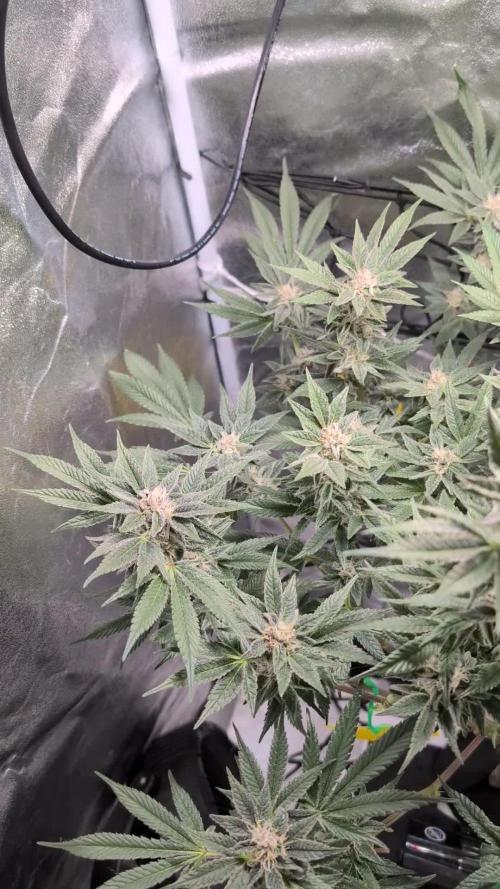
Still waiting for the buds getting bigger. Seems like the ladys will need 10 weeks of flowering, so I will switch to Athena Fade in the middle of week 8.
Sour Fraise looks so nice already. This will be nice fruity purple stuff 😋

Likes
44
Share


@RakonGrow
Follow
Note :
+ jegliches Zubehör wird in der GermniationsWoche aufgelistet . Zeitraffer Videos folgen immer nachträglich.
+ videos werden so geschnitten das nur ein geschlossenes Zelt erscheint , ergo Fehlen paar reale Minuten (ca 1 Std) .
++ nur probleme mit der Zeitrafferkamera . Sorry für die Schrägen und halben Aufnahmen . Vielleicht schaff ich beim nächsten Grow da abhilfe zu leisten.
Day 50:
Wachstumstillstand bei 68cm .
Day 51:
+ Höhe : 68cm
+ 2 Liter Flaschenwasser
+ + Dünger für Blühte
+ + + Canna Terrar Flores (Achtung wirkt wie PH-)
+ + + Canna Boost
+ + + Cannazym
+ + + Greenhouse Feeding BioEnhancer als PH+
Day 52:
Kleine Entlaubung .
Test MAX Licht : Main-Cola PPFD 1000 (16h) , sekundär Colas PPFD 750 (16h). Das wird mächtige Mangelerscheinungen geben . LED und Cal-Mag Probleme sind ja ein Standard Problem :)) Schauen wir mal was passiert bei so einer Autoflower.
Day 53:
+ Höhe : 68cm
+ 1.5 Liter Flaschenwasser
+ + Dünger für Blühte
+ + + Canna Terrar Flores (Achtung wirkt wie PH-)
+ + + Canna Boost
+ + + Cannazym
+ + + Canna PH+
+ + PH 5.81
Wegen Wetter Test verschiebung um ein paar Tage . Es wird hier einfach zu heiss im Zelt.
Day 54:
Weltuntergangsstimmung für meine Zoe . Dank des Super Wetters hab ich hier 77%-80% Luftfeuchtigkeit (draussen ist es noch höher ) und es wird auch noch warm . Ergo, schon gestern hat meine Pflanze extreme Probleme mit der Wurzeltemperatur bekommen und hat die Blätter hängen lassen . Ich hab das Licht runtergeschraubt und Abluft extrem erhöht. Ventilation direkt in die Pflanze sonst gibts Schimmel . Aber hilft halt nicht wirklich . Luftentfeuchter läuft auf Dauerschaltung und produziert dann auch noch Wärme, die ich überhaupt nicht gebrauchen kann bei den Temperaturen draussen lol. Ein Teufelskreis :((((((
Day 55:
+ 1.75 Liter Flaschenwasser
+ + Dünger für Blühte
+ + + Canna Terrar Flores (Achtung wirkt wie PH-)
+ + + Canna Boost
+ + + Cannazym
+ + + Canna PH+
+ + PH 5.88
Draussen sind 31 Grad , ich hab den ganzen Growroom + Vorraum (meine Wohnung ) über Nacht runtergekühlt so weit es ging (23°C und 22°C). Das Licht noch weiter reduziert dafür näher an die Planze gemacht. Das ist wirklich das mindeste was noch geht. Liegt ca bei PPFD 600 an der Spitze . Wenigstens ist hier die Luftfeuchtigkeit im Rahmen , zwar immer noch zuviel (67% im Zelt) aber besser so als das hier die Hitze in die Höhe schießt . Nach 12h Licht (19:00 Uhr) wird dann wieder aufgedreht und die letzen Stunden mit mehr intensität nachgeholt was nachzuholen geht , denn dann gehen hier erst wieder die Temperaturen runter .
Day 56:
Läuft wie gestern ab 19:00 wurde das Licht aufgedreht und DLI nachgeholt .


Likes
27
Share

@DivineBuds420
Follow
Harvest day has finally arrived.
Looking back, this grow was anything but perfect. There were setbacks, mistakes, pests, equipment issues and plenty of moments where things didn't go according to plan. But that's exactly what made this journey so valuable.
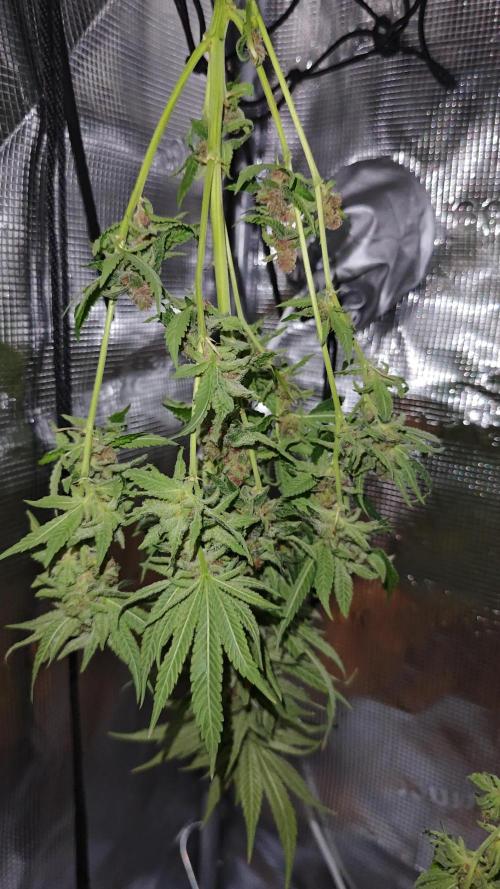
After harvest, the plant was hung upside down to dry inside the tent for 10 days. Once she reached the right moisture level, she was carefully trimmed and transferred into glass jars to begin the curing process.
Seeing the dried flowers after everything this plant has been through is incredibly satisfying. Now it's time to slow things down once again and let patience do the rest.
A huge thank you to everyone who followed along, left a comment, shared advice or simply stopped by. Your support and encouragement have meant a lot throughout this journey.
The journey isn't quite over yet. Now the cure begins, and I'm looking forward to seeing how the aromas, flavors and effects continue to develop over the coming weeks. 🌱💚

Likes
3
Share


@Selfsupply420
Follow
Amazing strain, very easy to grow and hope to do do more Royal gorilla auto in the future and see what else RQS have to offer. Absolutely solid buds and potent asf. Taste is 9/10. thc I would say 20%+. I also used terpinator in weeks 7 and 8 at a rate of 4ml/l which I didn't list in my diary. I'm sure this contributed to the density of the buds. I will use terpinator alongside advanced nutritions range for all future plants.
Likes
25
Share


@pifflestikkz
Follow
(END OF QUARANTINE)
Now I have put them to finish underground a 600w hps under 12/12 schedule with the Divine Black opium.
Luckily no more mould has spread, and all plants look happy healthy and still developing.
Day 72
12/09/24 Thursday
De-chlorinated tap water pH 6 today with Plagron products.
Finally a video and pictures update
✌️💚
Day 74
14/09/24 Saturday
De-chlorinated tap water pH 6 only today
Day 76
16/09/24 Monday
Feed today using de-chlorinated tap water pH 6.
Will update all videos and pics tonight 😁
Day 77
17/09/24 Tuesday
Feed today using de-chlorinated tap water pH 6.
Seeing good developments, buds forming nicely, divines are smaller denser structures but the buds are not lacking!
Damn I'm surprised by 2L pots.

