Likes
Comments
Share
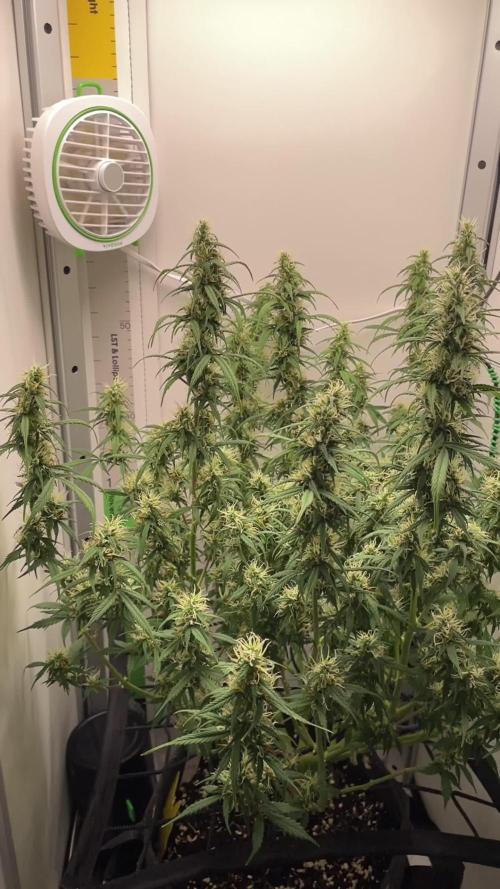
This lady has been Transplanted on day 39 since she was planted (may 10th) and I've prepared the 15L pot with the complete line of biotabs using 2 spoons of startrex for every 5L, sprinkled a couple of grams of mycotrex on the transplant hole before putting the plant and then I added 3 slow release tabs one biotab for every 5L of soil, so that's why in this case I added 3, after the Transplant was done I immediately watered the plant with 1ml/L of orgatrex and 1g/L of bactrex, I hope you guys enjoy my work this season!!
Likes
4
Share
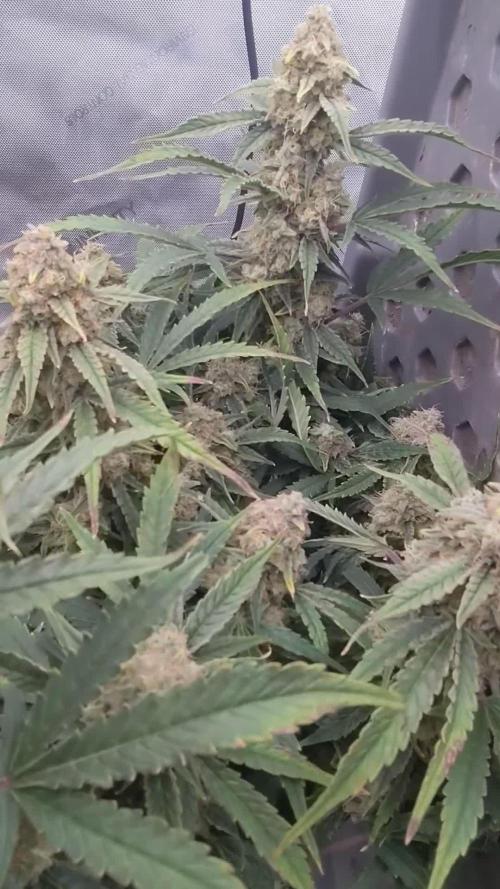
Day 49- This week I think we cut out the nutes and let them finish, atleast for the mbrxgp. The Pablo’s revenge looks to be about a week or so behind so we’ll go until they’re finished. Smells on the mbrxgp is heavy citrus, lemon almost, slight gas. Pablo’s are very earthy, I’m expecting a hashy, dank finish for them.
Likes
22
Share
So there is actually very little work this week .. She has been a real joy to grow so far.. I do understand what they meant by pheno-hunting...
Likes
14
Share
The buds are starting to grow, lots of them!! PH water and substrate between 6 and 7 👍 Looks great, slow but steady! 👍👍👍 Lamp is on at night, hope to save electricity costs
Likes
34
Share
@Birale91
Follow
Harvested on day 113 after ending week 9 of bloom. after washing week ago with adding flora kleen and then after 3 days turn light to 48 hours darkness before harvest. First trim in harvest defoliated big fan leaves with all the leaves without sugar and the tip of the small leaves. When the buds will be dry ill do second trim untill the bud will be like dense diamond. So, really love this strain and i give her a score of 9/10. First, for the buds beauty,dense. purple,red,yellow,pink and blue are showing on buds and its realy amazing.10/10. Smell are very sweet and strong of grapes.9/10. Taste is very fruity sweet grapes and i like it.9/10. Very strong effect on mind but feel very good.9/10. So, for final, 9/10. Something like week drying and ill update more pics and videos. *Added video of drying buds at day 4. *Added video and pics of well dried buds. ill add more stunning pics soon.
Likes
422
Share
Hi everyone. Welcome to my🍌💜👊 week update. Hope everyone keeping well and having a great week. Daily updates and uploads so if week not over yet. Please revisit to see full week content😊 Thank you all for such amazing support 😊🤗💜 So far everything is going great. No issues at all. Both girls started preflower on Tuesday and already I can see that they started stretching nicely. Scrog net will be installed by the end of this week. Week 5 13-19 Nov. 13/11 day 36 First runoff experience for girls. Loaded both pots with approx. 2.5 ltr each in 4 stages of 500-700ml. Runoff 100-150ml from each. Runoff PH 5.9. Nutrients for this watering were same as on previous week and added only calmag. Next watering possibly Friday but with new measurements. 14/11 day 37 Both 🍌💜👊 girls started preflower on same day. Xena is catching up quick to her larger sister and possibly soon they will be sharing this growing space 50/50 15-16/11 days 38-39 Just happy and healthy days 😁 nice steady growth. 17/11 day 40 Second watering for this week. 5.5l beetwen both. Runoff Ph 6.1 19/11 day 42 Most busiest day so far. Both girls got very bushy in last few days and they stretched enough to install scrog net. Before installing net applied selective defoliation on both girls. 8-10 fan leaves from each. It's the end of this amazing week 😁 Thank you all again for such a great support 🤗✌️💚
Likes
1
Share
10-13-2025 Date of nutrients giving. Im starting to add sugar to her like aphrodite extract. Next wanted to add Hi-brix from some reason I've had more terp's using this. what I noticed was that it help long gate the terp's making that crystal 🔮 shine. Now just gotta stay on top of feed rate and not take a break gotta lock in. No signs of purple yet it should start in 1 or 1.5 weeks from now of what photos I've saw at this point peace, love and hair grease 😍 RAge till next show
Likes
4
Share
@Kekkonen
Follow
Happy little seedlings are growing well in a plastic box with lots of humidity. 8 out of 10 seeds germinated. On day 6 planted 6 of them to 60l growbags ( 3 to each) and 2 to 20l ish pots.
Processing
Likes
4
Share
Super Hot in the tent this week 90-97 the plants have been hanging in there thanks to the CO2 blasts. They are drinking a lot from the heat, LST all 3 to even out the canopy before the stretch of flowering. Week one is done the start of week 2 seeing hairs finally and have been spraying MILF A twice a day with the CS. I transplanted the clones as well, the roots were filling up the solo cups. I up potted to 3 gallon fabric pots and straight into flower. should get some colas to dust with Feminized pollen in a few more weeks. Im so Freaking Happy that they were all girls I got the hairs to prove it😅 UPDATE: 5/12/30 I'm happy to report the CS is doing its job. I am seeing well defined Sacs in the one branch I am spraying 2 times a day for 13 days I have read that it can take up to 2 weeks so this is right on target. Clones are recovering well I top dressed all the plants with the Sea blast Bloom in the Nutrient list up top all the others were put in to a 5 gallon bucket of water PH to 5.8 and drenched the plants. that's all for now. cheers
Likes
Comments
Share
Week 4 of veg, lst done on them before flipping to flower
Likes
4
Share
@Hix57
Follow
Le 48ème jour se déroule avec grâce, malgré un léger obstacle : une carence en calcium touchant l'une de nos chères plantes. Heureusement, avec une dose ajustée de calcium, j'espère avoir rectifié ce déséquilibre, veillant à ce que notre verdoyante compagne retrouve son équilibre nutritionnel. Cette plante, bien que modeste en taille, se distingue par sa structure compacte et robuste. Ses fleurs commencent à se parer d'une riche couche de trichomes, scintillant de promesses et de potentiel. Je poursuivrai l'apport méticuleux de nutriments, dansant délicatement sur la ligne fine entre suffisance et excès. L'objectif reste clair : nourrir sans surcharger, pour éviter tout risque de brûlure par excès de nutriments. Au regard de l'état actuel de notre protégée, je prévois qu'elle atteint son apogée dans les 9 à 10 semaines. Remarque : carence en calcium a la 5/6e semaines rectifié avec l'ajout de CallMag La plante présente un grand nombre de trychomes et des feuilles violacée sur le dessous. Engrais : moitié de la dose recommandée en NPK pour corriger les carences, a vérifier si brûlures.
Likes
2
Share
@ChiTaN
Follow
Let's start another week😊The girls are doing great ! They received a single dose of Final Solution and Organic Bloom Stimulator.White Widow X Big Bud has started to give off a very intense aroma.Due to the density in the tent, it was necessary to install an additional fan.Looking at the progress, I expect a harvest sooner than declared.
Likes
11
Share
@CocoLogic
Follow
Sept 27th: (F41) Fertigation once a day with NEW recipe (1300 EC 6.1 PH) watered until 10-20% run-off Sept 28th: (F42) Fertigation once a day with same recipe (1300 EC 6.1 PH) watered until 10-20% run-off Sept 29th: (F43) Fertigation once a day with NEW recipe (1300 EC 6.1 PH) watered until 10-20% run-off Sept 30th: (F44) Fertigation once a day with same recipe (1300 EC 6.1 PH) watered until 10-20% run-off Oct 1st: (F45) Fertigation once a day with same recipe (1300 EC 6.1 PH) watered until 10-20% run-off Oct 2nd: (F46) Fertigation once a day with same recipe (1300 EC 6.1 PH) watered until 10-20% run-off Oct 3rd: (F47) Fertigation once a day with same recipe (1300 EC 6.1 PH) watered until 10-20% run-off Note: The TUT bud are getting quite heavy :) Some branches are bending, will have to tight some of those :)
Likes
13
Share
Hi Guys the triple is doing well and i think next week orthe next after i will change the light schedule and start the flowering what you think??is that a good choice?? sorry for the bad quality of the pics thx everybody Daniele & Claudia Italians from Greece
Likes
21
Share
Heyókȟa I desire naught but the study of nature, to find my way back home. 12x12=144, A dodecahedron is a polyhedron with 12 faces, and in coordination chemistry, it refers to a geometry where ligands surround a central metal atom (in this case, Magnesium) in a specific, 8-coordinate arrangement. Dodecahedrane is a hydrocarbon, meaning it's composed solely of carbon and hydrogen atoms. The carbon atoms are arranged at the corners of a dodecahedron, a 3D shape with 12 pentagonal faces. The water molecules in the dodecahedron form hydrogen bonds that are individually slightly weaker than in either the dimer or the tetramer. However, because three-quarters of the O -H groups in the dodecahedron form hydrogen bonds, it has a more negative energy per molecule than has either the dimer or the tetramer. Magnesium (Mg2+) is the essential, central metal ion in the chlorophyll molecule, crucial for photosynthesis by enabling light absorption and energy transfer. It is chelated by four nitrogen atoms within the porphyrin (or chlorin) ring structure. Chlorophyll appears green because it reflects light in the green region of the visible spectrum, specifically between 490 and 570 nm. The main resonance electronic frequency of a neutral Magnesium (Mg) atom corresponds to the transition from the ground state to the first excited state. Resonance Line Wavelength of Mg2+: 285.1nm (UVB light). The central atom of the chlorophyll molecule is Magnesium (Mg2+), which is coordinated within a porphyrin ring. The electronic "resonance frequency" of this central atom—meaning the frequency at which its electrons absorb energy—is primarily driven by the electronic transitions (ETR) of the surrounding conjugated chlorin ring structure, rather than a discrete atomic transition of the Magnesium atom itself. The resonant electronic frequencies of the chlorophyll porphyrin (technically, a chlorin) ring are determined by the energy required to promote π-electrons within its conjugated system, primarily appearing in the blue and red regions of the visible spectrum. In standard physics, Chloryphyll b has peak absorption at 460nm (Blue). If we take the peak wavelength 460nm and a UV-B, UVR8 peak absorption wavelength 285nm Tryptophan-285 (W285) Sensing protein. 460/285=1.618 Φ, "natural harmony" and the "structure of light". The cryptochrome photoreceptor (CRY) is a UV-A/blue light receptor that shares this dual sensitivity with several other biological structures and functions, including significant sequence similarity and a common evolutionary ancestor with DNA photolyase enzymes. These are light-activated enzymes that use blue/UV-A light to repair DNA damage caused by UV-B radiation in plants. Dodecahedrane (C20H20) is a hydrocarbon with a cage-like structure where carbon atoms form 12 pentagonal faces (a regular dodecahedron). It is highly symmetric (icosahedral), contains no delocalized electrons (no aromaticity), and has minimal angle strain, but significant torsional strain. Water Dodecahedron (H2O) forms hydrogen-bonded cages. While individual hydrogen bonds in this structure are weaker than in the linear dimer or tetramer, it has a more negative total energy per molecule. This is because three-quarters (75%) of the groups are involved in hydrogen bonding, creating a very stable, closed-shell configuration. a 3D carbon hydrocarbon (C20H20) to stable water clusters in hydrate, while the Magnesium ion acts as the central activator within a conjugated ring in biological systems, with its electronic absorption dominated by the ring, not the atom itself. Effective quantum efficiency of photosystem II, often denoted as ΦPSII In horticultural lighting, adding 730 nm (far-red) LEDs alongside standard red/blue lights has been shown to increase canopy photosynthesis by 20–30% in several crops by acting synergistically with shorter wavelengths. However, the limitation is that excessive, pure IR/Far-red light (without accompanying red light) can trigger the "shade avoidance response," causing plants to grow tall, weak, and spindly rather than robust. Knowing is half the battle however, engineering or utilizing infrared light (specifically the 700-750 nm far-red range) is a viable method to boost photosynthetic efficiency. It acts as a bridge to allow PSII to utilize a broader spectrum of light, breaking the traditional 700 nm barrier. Extend, then multiply. UVR8-mediated signaling (often in conjunction with CRY proteins) triggers protective mechanisms that maintain the stability of the photosynthetic apparatus (including LHCII and reaction center proteins), thus ensuring that the efficiency of Photosystem II remains higher in UV-B-exposed plants compared to plants lacking this receptor. ΦPSII indictates the rate of electron transfer from water to plastoquinone, which drives the production of ATP and NADPH. There is a close link between ΦPSII and the true rate of CO2 fixation (Φ*co2), particularly in C4 plants. Effective quantum efficiency of photosystem II, often denoted as ΦPSII, represents the proportion of light absorbed by Photosystem II (ΦPSII) that is actually used in photosynthetic electron transport. It is a key indicator of how efficiently a plant is using light for photosynthesis, as opposed to losing it as heat or fluorescence. ΦPSII (effective quantum yield of photosystem II) functions primarily as a "multiplier" (a coefficient of efficiency) rather than an additive factor when estimating the overall photosynthetic electron transport rate (ETR). Multipliers are considered far more beneficial than additions because they generate exponential growth, leverage existing resources to their full potential, and create sustainable, self-multiplying capacity, rather than just incremental, linear increases. Humans, and most other mammals, rely on other mechanisms, such as nucleotide excision repair, to manage and repair UV-induced DNA damage. As such, humans do not have the direct, light-driven repair mechanism that photolyase offers in plants.
Likes
371
Share
D64. We're at the start of the fourth week of flower, and today was a busy day. First, I had to remove the old lights before swapping in the light from my auto tent. All while trying to avoid trashing the plants in the way too full tent. Not an easy task. The entire mission, with changing the light in the auto tent as well, took a couple of hours. I wish I could keep the Greenception lights in the tent as they're high-quality lights, but the Kingbrite has a much lower profile and thus takes up much less space. Space that I desperately need considering how insanely much these girls stretched. One of the tops on the second girl has unfortunately already been bunt by being too close to the light, and I'm sure I will run into light bleaching and probably foxtailing as the grow progress, but I hope I will be able to pull it off with the Kingbrite light. I also added some wire support to the branches that I super-cropped, as they looked somewhat sad after all the abuse to the canopy while swapping the lights. ------------------------------ D66. It looks like the girls have FINALLY stopped stretching. Phew! Yesterday, I gave each girl 2.5 liters of water @ pH 6.2 with humic acid and EM-1. Today, the green lacewing larvae (Chrysoperla Carnea) arrived, and I dispersed them in the tent to deal with the thrips. ------------------------------ D68. All is well in the tent, but now when the thrips are (hopefully) under control, it's time to address the VPD. It has gotten seriously out of wack due to dropping temps, plus I increased the humidity to make the environment more inhospitable for the thrips. The temps were low due to the light change as the new one is running a lot cooler, but the temps have also dropped outside. The heating in the lungroom has been off until now, so I turned that on and lowered the humidity threshold on my exhaust fan. Finally, I put my small humidifier in the tent, generating extra heat and decreasing the humidity. So far, the VPD has increased from a terrible 0.4-0.5 to an acceptable 0.9, and I'm hoping it will increase further as the ambient RH drops as we move into winter. ------------------------------ D70. We're at the end of the fourth week of flower, and all is well in the tent. The VPD has gone up to 1.0, which is a nice improvement to what it was only a couple of days ago. I haven't scouted yet for thrips, but I will give the lacewings a couple of days to do their thing and then look closer. However, I went to WAR against the spider mites we have in our ornamental plants in the apartment. I sprayed all plants with my homemade pesticide (capsaicin, alcohol, horticultural soap.) since I had it at hand. If that fails to knock the spider mites back, I'll bring out the neem oil instead. The infestations aren't bad (yet), but it would suck to get mites into my tents, so better to be proactive. ------------------------------
Likes
63
Share
@AsNoriu
Follow
Day 114. Gorilla Max is totally ready, maybe she would bulk up, but last white pistil went brown at least a week ago. Time to trim. Bud not solid, but kinda hard, bottom all airy and small, but she smells and sticky like hell, so fruity ... Had to chop her, because got tiered of seeds everywhere, so cleaned my draws and fridge, from 45 found bag seeds started new diary, had to make space for them. Want to try out 12/12 from start and even if i would leave them under natural sun , they would stretch too much in first stage of grow and would repeat that grow patern indoors. Scissors hash was nice, super soft, hard to roll, all stays on hands. On this plant found two seeds, maybe some hidden in colas, but its not even close to bad that i was imagining at the beginning. My watering damage is obvious, Gorilla Max and Bunny were best plants, now - they are smallest... Last weeks very important, till week 5 of flower and that incident they were leaders, overdrying don't work . Hope i will learn this lesson. Day 120. Last 3 girls are down. Gorilla Max - 88 g. Of dry bud. Think she and Bunny will be smallest of them all. Buds are airy, but very sticky and all calaxies went pink. So in spliff it looks really funky. Needed to lolitop them higher, maybe overall look and cola structure would be better then. Lanky Gorilla is a champ, no doubt. Think this girl should beat 4 ounces easy. Day 126. So total of all 4 plants is 401. A bit less than was hoping, but target achieved. Update will follow.
Likes
9
Share
Day 40 They are into full flowering and I went at max with Advanced Nutrients; 4ml per lt. With my t-Rex super soil i don’t need much ppm so I will give such amount of fertilizers only for this week. Going back to 3ml per lt the next week.
Likes
6
Share
Likes
24
Share
29 May 2021 I started the flowering stage yesterday, 5/28/21, and plan on defoliating and topping my Blue Ox baby today. I wanted to get any and all stressful alterations done before we got too far into flower to limit potential damage it can’t spring back from. The light is on a timer now, so from here on will be 12/12 schedule. I’m also adjusting the nutrients to flower, and starting this week at the “Transition to Flower” levels. I’m also starting to give a whole gallon of water for the first time as well. H2O was chilled to 41 degrees F, and contained: CALiMAGic 5ml, FloraMicro 7.5ml, FloraGro 7.5ml, and FloraBloom 7.5ml. The initial pH was 6.7, and didn’t require adjustment. The TDS going in was 807 ppm. Runoff pH was 6.2, and TDS runoff was 2103 ppm. The tent temp was 75 degrees F, and humidity was 50%. I practically stripped her naked today, and after finally getting a look at her branches will most likely do some LST in the coming days. I also took some cuttings to clear up space to control the grow better. I may try to clone them, but I haven’t decided yet. 31 May 2021 My Blue Ox is looking great! She adjusted to me practically taking all of her large leaves off without any issues. She looks so much better than she did before. I’m still using the “Transition to Flower” level nutrients with a gallon of chilled water (47.1 degrees F). I fed: CALiMAGic 5ml, FloraMicro 7.5ml, FloraGro 7.5ml, and FloraBloom 7.5ml. The initial pH was good at 6.8, and TDS going in was 924 ppm. The pH runoff was 6.2, and TDS runoff was 2400 ppm. Tent temp was 79 degrees F, and humidity was 44%.