


Likes
Comments
Share


@RadDad
Follow
So after doing just a couple of weeks of LST on my Elixer CBD auto I realised I didn't like how it was sitting in the pot. It was too late for the CBD but I still had plenty of time for this girl. so I filled up her pot with soil which kinda negated the LST I had already done. No biggie, I enjoy the work so doing a little extra is okay. That's pretty much the only change other wise she's growing well. Continuing on with Dutch Science Nutrition and LST.


Likes
24
Share

@Grow_for_Happiness
Follow
Busy week this week, both in the garden and in life, hence the later update than usual.
Early week gave the girls a good leaf stripping on the inside of the plants. Also removed any scraggly growth that was not getting any sun. As usual really helped open them up to more airflow and light penetration. At start couldn't even see the sun through them! Next day both looked great with no visible signs of stress.
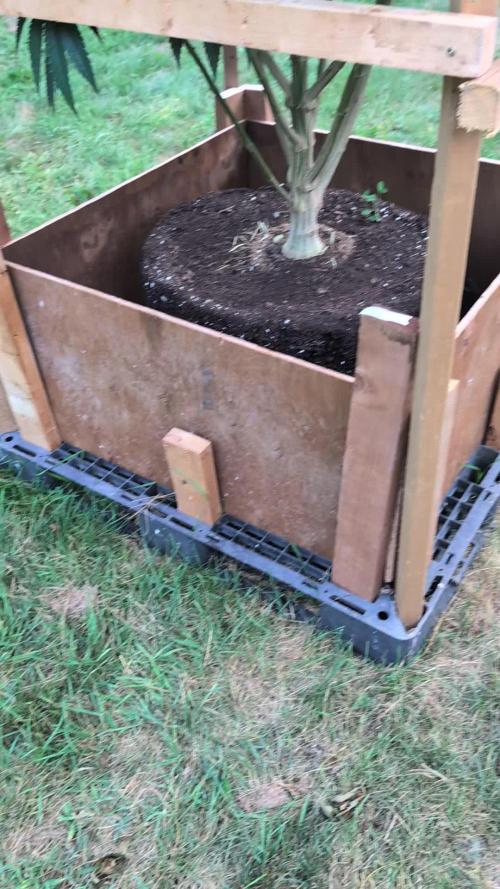
Now I'll say it was a VERY hot week this week, daytime highs 32°C feeling like 42°C with 90% humidity and the girls were thirsty AF, dropping heavy every night, . Watering every evening, hose on full soaker setting for 3 minutes per plant, roughly 35 liters of water each! Even with all the water, the bigger plant was looking sad, and I had a sneaking suspicion that it just did not have enough root space. So I tuned into my inner MacGyver again, and came up with a solution. Using no nails or screws, I was able to fashion a 3x3 bed for her! All thanks to growing on plastic skids. Just slid 2x4 PT into the slots in a 3x3 square, and then slid 1/2" PT sheet (cut to size) on the inside of the wood. Afterwords cut the fabric pot, and lay it down to make the perfect base inside the new bed to prevent soil from coming out. Topped it up with three wheel barrow of garden soil that I had left from the spring load, watered and hoped my idea worked. The next day, she's looking happier than ever, and I haven't seen a droopy leaf on her since! Now she's really ready to bring on some serious bud weight. Mentioning that, I also added the second layer of horizontal trellis, as well as vertical trellis around the smaller plant.
Temps look cooler for the next two weeks, and not much of any rain forecast, even though we desperately need it. At least with forecast being 25°C highs and 10°C lows the girls should slow down on water intake, trying to conserve where we can right now but got a keep them fed.
Until next week!
Likes
262
Share


@TheBudWhisperer
Follow
Nov. 5 - start of week 6 and this grows so far gone off without a hitch. Third node on each side come’n out now so expect to be topping some time this week. Until then it’s all keepn er spread and low until we have our last 4 tops. The clone experiment is a 2/3’ds fail. The last one is hangn in there but probably just dying slower than the other 2. THANKS FOR CHECKn er out. More pics and video to follow.👊👍😎👌
Nov. 6 update - photos and weekly vid uploaded. Added a little blurb about topping in response to a fellow grower's question. This community rocks and the constant support and advice from everyone is greatly appreciated. Cheers y'all!😎👊✊
Nov. 7 update - so I lied and she stretched out from her second nodes over night. Bent er down a little and reset the thing ties. Alls good!
Nov. 10 update - they’re drinking a consistent 3L a piece on a 3:1 nute feed to ph/calmag only regimen and loving it. Trimmed off some fan leaves dragging in the dirt and covering the first set of tips. Was hoping to top again this week but it’s starting to look more and more like next week at the this point. That 4th node just hasn’t stretched stretched out enough yet. Alls good!👍
Background
After the batshit nonsense with this years outdoor grows getting jacked, I need some kush and I need it fast! This girls an indoor grow in the cabinet and she'll be manifolded and defo'd for 8-10 fat ass colas. They’ll spend a first week or so under a cfl assembly while the last harvest dries out in the cabinet. This grow is going to be nute sched. heavy and will hopefully test the limits of my smaller grow space (2sq/ft). Ive had my eye on a critical & kush cross for awhile and really looking forward to seeing this one grow out. Thanks for take'n a peek, stayed tuned, and happy grow'n folks! 👊

Likes
15
Share

@Brujha77
Follow
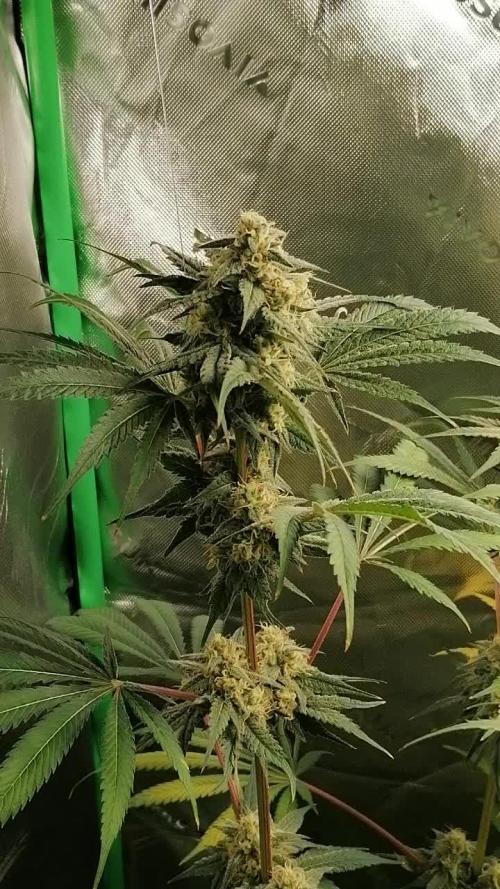
Beginn Woche 8 Blüte
So langsam beginnt der Endspurt..
Schätze so in 2-3 Wochen könnte es soweit sein.
Muss sagen gefallen mir alle 3 und bisher wieder ein absolut entspannter Run🤞🤞
Geruch wird von Tag zu Tag stärker und auch die Trichome sehn gut aus. Grade bei Licht aus Funkelt das ganze Zelt 🤩
Heute gab es wieder wie gewohnt Green Bull mit in die Tray's 🍀🍀
Tag53 Blüte
Schaut recht gut aus. Die ganz links wird wohl die erste sein, aber auch bei den andren gehts richtung Ende zu💪
Wird wieder schön Bunt😊

Likes
8
Share


@TightNugs
Follow
All good topped pretty early,gonna top x 3 for this mother
🤞🏴🍁
Discount code- TightNugs voost.com
https://voost.com/


Likes
25
Share


@crystal_garden_0
Follow
Great week, these lemon pies have gotten huge. Had to stop LST awhile ago because ran out of space . If all turns well they will be the biggest Autoflowers I've grown. The pheno type I have is definitely more Sativa leaning
Likes
3
Share

@GroloCup
Follow
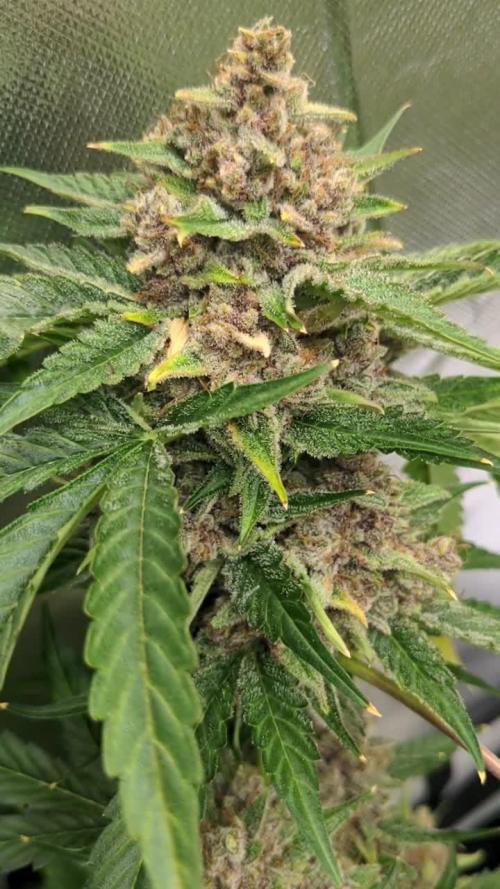
This one has the frost, makes me want to bust out the bubble bags and hash her out! Another that's been very simple to grow, easy feeder and not to picky on anything else. Super dense nuggies with that lovely purple hint to them, an ode to her Purple Haze lineage, with a very earthy, almost nutty aroma. Another day or so then I'll swap out the nutes for some flawless finish (10/14) and properly flush her out. I have to bet this one's gonna be an evening indulgence. Please do yourself a favor and visit the HBS site and give Geoff's work a run in your tent, I promise you'll be in awe of his selected crosses from some of the most prestigious breeders out there.
Likes
13
Share


@Drawer
Follow
A sad week, I found bud rot and had to take my plants out and do a big check and remove all dense underdeveloped growth.
It will be a pretty big hit on the yield I guess but the most important thing is learning and that I did.
The bud rot could spread due to my RH being 65/70 at nights and it used to be +80 before, + bad airflow.
I got new fans in the tent and my dehumidifier was ordered already but its not in yet.
On the other side, the plants are looking pretty damn good, they smell amazing
and 3 of the 4 plants is getting a very dense nug structure.

Likes
11
Share


@Willy_Balls
Follow
23.08
These girls with co2 and so much light exploded in growth and are really packed in the tent. Never had such density. I will defoliate hard after this week and hope it will turn out fine.
Fingers crossed cause the yield can be huge.


Likes
17
Share


@CanadianFillmore
Follow
Thanks for stopping by growfessors, week 4 begins. Not much to report other than I'm happy with the bud development.
Likes
15
Share


@SouthernOnions
Follow
Chopped all plants down on October 18th. Will report back soon with final harvest pics and dry weight for each plant. I have multiple grows coming down around the same time and I'm still backed up with the outdoor harvest but will update with final numbers asap!

Likes
1
Share


@ElCapitol
Follow
This multi strain grow was interrupted and they were left alone for four weeks with only light and water.
This was the biggest of all plants, she needed more water than she got and has suffered. When I got back to her she was only just survive. Leaves had turned brown and dropped, crunchy to touch. But, despite this mistreatment here she is producing some nice buds for me. Aroma is of very sweet berry but sour too. Remind me of strawberry cough chews. Buds are light and not dense at all, lots of of them though easily twice as many as the next strain. I think this would be a favourite for the guys who extract rosin. Lot of frosting, trimming looks difficult I won't lie, I cannot look forward to this trim. Mainly as leaves have died in the bud so unless I trim tight it will effect the smoke so I will have to be careful.
If you want to grow be aware of the stretch, very sativa structured plant will need some room or training.
She needs a week more than other strains to finish maybe two. Sativa usually do. See you at harvest time :)
Likes
17
Share


@RDWCGrowing
Follow
Week 6 Day 1 10/28/2023
Water Change Day!!
Added:
36 gallons of Water
CALMag- .75mil/Gal
GH FLoraMicro-4.3mil/Gal
GH FlroaGro-4.3mil/Gal
GH FLroaBloom-6.5Mil/Gal
Liquid KoolBloom 2.5mil/Gal
TPS SIGNAL- 4.0mil/Gal
ORCA-.5mil/Gal
I setup my PH automation system.. I will start it running in 24 hours after the system settles in.
Week 6 Day 2 10/29/2023
Going to be interesting.. I left the old monitor in to do a double check behind the new auto PH monitor.. not eh problem is I configured the New one and I am pretty sure that it is more accurate than the previous one I was using but the difference is 5.9 on the new one and 6.19 on the old. So it leaves me to questions if I was always running my PH higher but still just within safe range? or is this one off by that much. Questions, Questions.. But so far it is working I had to make several adjustments to dial in how much of each gets released but right now they are sitting around 5.9
Week 6 Day 3 10/30/2023
Worked on adjusting the auto PH system and I think I will need to change out some of the gear to make it work better.. Right now the suction/ flow rate has to be up to high in order to get the Up or down out of the Containers and the UP kicks on before the Down has a chance to settle.. I would have hoped there is a steady reading for X seconds before it starts the other.. but there isn't it is automatically kicking off the Up even while it is still adjusting from adding Down.
Week 6 Day 4 10/31/2023
Today I did nothing but take some pics.. Nice day.. the experiment of the PH auto system is a bust as of right now.. the range is out of what I want.. and it keeps immediately kicking off without giving the water time to balance.. since this is a res system which the water moves.. not the best.. it doesn't have a wait time before release more.. and it keeps releasing even after it starts reading in range.. so it drops it lower than it should.. I could probably dilute the PH up and Down and make it a little more effective.. but not sure what I want to do at this point.
Week 6 Day 5 11/01/2023
Today I did nothing but take some pics..
Week 6 Day 6 11/02/2023
Ground Hogs day... Today I did nothing but take some pics..
Week 6 Day 7 11/03/2023
I had to re-super crop two branches at a lower node to bring them back down they had grown up and hit the light again. I had to empty the dehumidifiers out but that was pretty much it.. She seems to be happy happy and growing well..
Processing
Likes
47
Share


@Mrs_Larimar
Follow
January 1st.
They were showing up very fast, Iam going for Day one today,,,
,,Because there are more vessels than only the " Ladyhead"
I planted 4 tealightholders in ametal Frame
I hope I can so some training on them
Until now Iam quite Happy , and we will see more soon
Thank you Silky_smooth for this Egghunt_Invitation----- i needed some Challenge for sure


Likes
8
Share


@Listening2thestatic
Follow
Week 1 of Veg, here we go!
Watering with 1/2 Oz of water every other day.
Day 10,
Now watering with 1oz. The crystal widow is growing happily!

Likes
1
Share


@Herbsmanington
Follow
Week 1 of flowering. These plants recovered quickly since the last defoliation. Probably gonna do some light defloration on day 14. Feeding with an npk ratio of 5-5-10. Using molasses, humic acids, amino acids, silica and kelp as a compliment. I'll cut out Silica and kelp around day 14.
Greenhouse feeding
Short flowering 663ppm
PK booster 139ppm
Calcium 260ppm


Likes
12
Share


@Cheeba_Inu
Follow
As of day 14, the Blackberry is growing well! The growth is vigorous and pretty healthy, so I am going to just keep doing what I am doing.
I am temporarily using dry cal-mag crystals to the same ppm/EC (.5-.6) as calimagic hasn't caused any issues yet. I can make my way through the bag I have before buying more calimagic, and not be wasteful!
The Blackberry will be ready to be topped this week, so that will definitely be updated when the time is right.
Happy growing, and stay safe everyone! 🌱👍
Day 15: plant has been FIMed!
Day 17: the plant is continuing to have healthy vegitative growth. I am waiting for slightly longer branches, and then I can start training the plant.
Day 19: good, bushy growth 👍