Likes
Comments
Share


@Chocolopeison
Follow
Seguimos ultima semana con alimentacion de estas nenas, esperando ansiado por lograr esas frutas
No olvidar que tenemos 3 nenas en un armario y 1 en otro armario
Al día 43 haremos raleo masivo y sacaremos nuevamente gran mayoria de las hojas abanico
En Instagram @chocolopeison , pueden ver seguimiento diario de estas nenas!
Saludos


Likes
407
Share


@LegacyMarketFarm
Follow
MAY 1st 2024 - LAST batch of clones have come in, Did 3 runs off each to get the plant count high enough to have the ability to pick and choose which clones to keep to get the best of the best. So a nice surprise was that we got to add in purple ghost candy to the run ! @seedsman seeds PURPLE GHOST CANDY , Out rooted every other strain in the room showing as soon as 5 days in some cases. The EXOTIC ANIMAL was extremely hard to get to root and take and grow vigorously. So we ended up cutting back on the exotic animal to fill out the bed with the PGC.
We will be axing 3 of the mom's out of the tent right away & keeping the rest for evaluation after harvest, Stinkin Bishop is going, Even though it roots well, I did not like how much it haired up & for that reason its gone, Exotic animal is gone as well. As much as I love animal cookies and the sound of this strain, It HATES to clone and is damn near impossible to get it to take well. We ended up getting enough for a few rows, Then the Gorilla Sherbert is going as well, As it is a weird mutant sort of phenotype just shooting strange leaf patterns out.
So our ROSTER going forward after this harvest well be :
PURPLE GHOST CANDY
RAGE KILLER TUNA
JUNGLE LAVA
LAMB CHOPS
STRAWBERRY COOKIES
from our original seeds, Then our GENERATION 2 mothers will be :
Sugar Cane
Jaeger
Banana Jealousy @seedsman
Peyote Skittlez @seedsman
Rude Boi OG @Seedsman
Fuel Do.G @seedsman
after we have run the Generation 2 mothers as clones & get the harvest in, We will be finalizing our mother plant selection & cutting out the weakest of the lot. We are looking to keep 6 of the absolute best of the best.
@seedsman WAIT until you see the RUDE BOI OG, I knew not to give up on it... This one is going to be special 6 year old seed but its gonna be a banger.

Strawberry Cookies · Super Sativa Seed Club

Exotic Animal · Exotic Seed

Jungle Lava · Original Sensible Seeds

GG4 Sherbet FF · Fast Buds
Stinkin' Bishop · Original Sensible Seeds

Lamb Chops · Thug Pug Genetics

Purple Ghost Candy · Seedsman
Fuel DOG · Seedsman
Peyote Zkittlez · Seedsman
RudeBoi OG L.E. · Seedsman
Banana Jealousy · Seedsman

Sugar Cane · In House Genetics


Processing
Likes
1
Share


@regionallystoned420
Follow
Had to come
Down early due to poor weather and rot . Wish I got the full flowering cycle but a lot of weed and good smoke. F***ing monster !!!
Cured for 3 months

Processing
Likes
3
Share


@Eauderay
Follow
No problems this week, succeeded in restraining myself with the water input, and they really liked that, sadly leaves damages done 2 weeks ago due to over watering is showing spots and looks like it will turn necrotic soon, but new growth are undamaged and seems to support a good growth so far. I make sure she is not receiving too intense light radiation and fed a light feed of old timer grow and some Epsom salt.
From the beginning of flowering she has developed light pink coloured trichomes, and now you can see them more and more , so pretty with flash on in the dark, Misty G shinning with pink hues, lovely!

Likes
9
Share


@MenaceFantome971
Follow
Cette semaine 3 et 4 a été sans plus un seul bémol est que ma deuxième fille qui montrait nettement des nuances violettes sur ses pointes de têtes s’est cassé pendant un essai de LST, faute entièrement personnelle, j’assume néanmoins on continue avec quand même.
La 2e s’est étiré un peu et a reçu parfaitement son LST et a même commencé à montré ses pistils de pré floraison donc on engraisse.
Du coup on a profité de ces essai de LST sur les deux fifilles pour commencer les engrais BIO GROW & BIO TOP MAX et bientôt BIO BLOOM pour la phase complète de floraison.
En attendant je vous laisse admirez les vidéos et photo, pas dans l’ordre mais celle en B&W est d’aujourd’hui ! 1 mois pile depuis sa mise en terre 👏🏾💯 ainsi que une petite WW de chez RQS que je développerais dans un autre agenda
Likes
Comments
Share


@Robom069
Follow
Hello there from Colorado,
i germinated the seeds a few days ago.
lookin great, its not my first rodeo and definetly not my last.
i bought the ripper seeds online and the black domina on our trip to poland from a local shop at a mall.

Likes
36
Share


@Fayah_Burn
Follow
Today on Day 141 and at the same time @ the end of the 9th week of flowering it is Harvest day (final harvest) for the remaining two Tropicanna Banana's (Plants #1 and #3).
Plant #4 was harvested on Day 134 (8th week of flowering) - see harvest pictures week 8
Plant #3 was harvested on Day 138 (9th week of flowering) - see harvest pictures week 9
Did not take any wet weights as i am drying the buds on the stalks and i dont wanna know how many stalkes i grew 😂
Will be back soon with the dry weights of each one of the four ladies. Some pacience is asked now 😬
Likes
5
Share

@Chucky324
Follow
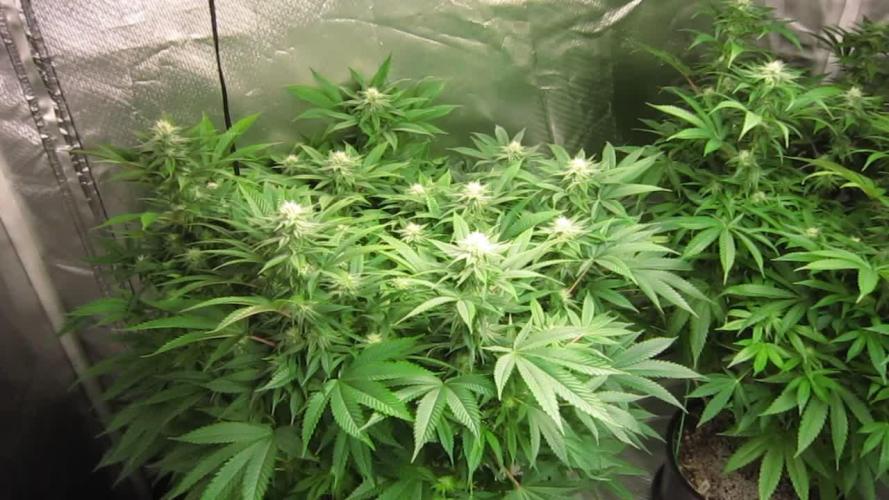
Hello. This is the end of week 4 and the beginning of week 5 of flowering.
Did a smell check of the resin and found that
Plant #1 smells of Sweet Mandarin Orange.
Plant #2 smells like a freshly washed Sweet Carrot right out of the garden.
Plant #3 smells like a average Sweet Round Orange.
I'm hoping plant #1 have big, dense, strong smoking, buds. Love that smell.
OK. Be Cool.
Chuck.
Likes
5
Share


@Ensign420
Follow
Greetings fellow growers 🖖 and welcome to my first grow ever. This adventure actually started several months ago when I decided to stop buying flower from dispensaries and just grow my own bud. How hard can it be!?
This is actually my second seed of this strain. The first bean sadly died due to over watering (sorry girl, RIP). I was literally watering the cube to the point where water was dripping from the bottom, then heavily sprayed the humidity dome and tray with the vents completely closed. Everyday. Multiple times. I never let the dome or try dry out. So after about 8 days of not sprouting, there was a funky smell of rot. So that was that.
Later I learned that rockwool retains a lot of water and can easily drown seeds. So a wet/dry cycle is best for rockwool germination.
So even after hours of researching and digging through forums and tutorial videos, I was still under prepared for this journey. Did not consider how delicate the germination phase is. Oh well. Lesson learned. Reset and try again!
I hope everyone is safe and stoned during this corona crisis. Just like everyone else in the world, I want this pandemic to be over with. But in the meantime, let's grow some weed! 🖖
[START OF WEEK 01]
Day 01 - Monday - 08/03/20 - Total Days: 001
-----------------------------------
- [0830]: Light Schedule: 24Hrs/0
--- Soaked cube in 5.5 PH water for 10 min. Did not shake water out.
--- NO NUTES! Only PH'd down to control the PH levels.
--- Did not use the default hole (way too deep).
--- Flipped cube upside down and made a shallow hole for the seed (less than 0.25" deep).
--- Placed seed in and pinched hole close. No additional water added.
--- Sprayed the tray and dome with straight water (5.5 PH).
--- Vents are cracked opened a for ventilation (about 1/4 opened each).
--- Distance between the light and tray was 53"
--- AC was set to 80 °F
--- Exhaust fan was set to 86 °F
--- Room average temp was at 85 °F
--- Dome humidity was at 85-99% when sprayed.
--- Allowing to completely dry before respraying.
- [2200]: Dome and tray were completely dry! Sprayed only tray and dome with more water.
Day 02 - Tuesday - 08/04/20 - Total Days: 002
-----------------------------------
- [0845]: Sprayed dome and tray in the morning. Everything was dry.
--- Hoping for the best!
- [2130]: Everything was dry again, so sprayed dome and tray at night along with a light spray on the cube.
Day 03 - Wednesday - 08/05/20 - Total Days: 003
-----------------------------------
- [0830]: Everything was dry again. Resprayed dome and tray. Slightly sprayed cube.
- [2125]: Hooo damn!! She popped! Am little stub is visible! Resprayed dome and tray again.
--- Still going 24/0 for lights.
- [+0033]: Just checked up on her and I swear she grew a bit taller! Getting excited!
Day 04 - Thursday - 08/06/20 - Total Days: 004
-----------------------------------
- [0845]: Wow! Went from a little stub to fully sprouted overnight! Everything was pretty dry again so resprayed dome and tray.
- [2200]: Tap root is visible! Over 1" long too! Just resprayed dome and tray again.
-- Going to prep for hydroton transplant tomorrow!
Day 05 - Friday - 08/07/20 - Total Days: 005
-----------------------------------
- [0930]: She keeps growing!
-- Added a bit of CalMag to the spray bottle (8 drops to 650ml of distilled water). Resprayed dome and tray. Water was at a 5.4 PH with 141 PPM.
- [1045]: Prepped the bubble bucket with 4.5gal of water. Water is high enough to reach about 0.25" above the bottom of the net pot.
--- Added 3 drops of Superthrive
--- Added 3.5ml of CaliMagic
--- Added 2ml Hydroguard
--- Then PH'd down to 5.6
--- Solution Strengh: 120 PPM
--- Water chiller is set to 20 °C
- [1100]: Transplant time!
--- Filled the net basket 1/3 with hydroton. When placed in the bucket, air bubbles are not visible, but are slightly below the surface (slight digging will reveal the water/bubbles below).
--- Removed plastic on rockwool cube and placed in basket, then filled around and covered with hydroton. Making sure to block any light from passing through the net pot and into the nutrient solution.
--- Covered with a half-bottle dome sprayed with the CalMag water from earlier.
--- Hoping for the best!
- [1300]: Raised Bucket 5" higher. Now light distance is 48" to top of bucket.
- [1820]: Lowered tent exhaust temp to 76 °F
--- Lowered AC to 75 °F
--- Raised bucket even higher so light distance is 30" to top of bucket.
- [2300]: Looking good!
--- Sprayed dome and surrounding hydroton with more CalMag water.
--- Attached timer to light! So new 18 Hrs On/6 Hrs Off light schedule.
--- Lights On: [1600] (4pm)
--- Lights Off: [+1000] (10am the next day)
--- Decided to go with lights on during the evening/night and off during the later mornings/afternoon (the hottest part of the day) to see if temps can be controlled better.
--- Please survive girl!
Day 06 - Saturday - 08/08/20 - Total Days: 006
-----------------------------------
- [0800]: Everything was dry. Resprayed hydroton and dome.
- [2000]: Here first night cycle seemed to go well! Get'n taller!
--- Dry again. Removed the dome.
--- PH went up to 6.5 so PH'd down to 5.7
--- Ran the top feed drip ring for a bout a minute to wet the hydroton and rockwool with the nutient solution.
---Too scared to leave the top feed on 24hrs (I don't want over water her and cause dampening-off). Will let dry before re-watering.
- [2100]: After closer inspection, I think she's looking a bit yellow.
--- Decided to add a bit of grow nutes to the bubbler solution.
--- Added 2ml of Sensi Grow A
--- Added 2ml of Sensi Grow B
--- Solution strength after adding more nutes: 176 PPM
--- PH went up to 6
--- I hope that the extra chelating properties of the 'PH Perfect' solution is enough of a buffer for proper nutrient uptake.
Day 07 - Sunday - 08/09/20 - Total Days: 007
-----------------------------------
- [0800]: Water dropped a bit (mostly due to evaporation) so solution strength was at 190.
--- Checked PH again. Was still at 6, so PH'd down to 5.4
--- Ran the top feed for a minute to wet the hydroton a bit.
- [0915]: Since she's looking perky but still a bit yellow. So decided to up the nutrient concentration even more before lights out.
--- Added 2ml more of Sensi Grow A
--- Added 2ml more of Sensi Grow B
--- Solution strength after adding more nutes: 199 PPM
--- PH went up to 5.8
- [1700]: Checked nutrients.
--- PH: 5.9
--- Solution strength: 202 PPM
--- Added 4ml of Voodoo Juice
--- Added 4ml of B-52
--- PH after adding more nutes: 5.9
--- Solution strength after adding more nutes: 238 PPM
- [2130]: Decided to make a new foliar spray to address the continued yellowing.
--- Started with 500ml of distilled water.
--- Added 3 drops of CaliMagic
--- Added 3 drops of Sensi Grow A
--- Added 3 drops of Sensi Grow B
--- Added 3 drops of B-52
--- Added 1 drop of Superthrive
--- Solution strength: 164 PPM
--- PH was at 5.9 and did not adjust.
--- Gave her one spray.
--- Also sprayed the surrounding hydroton.
[END OF WEEK 01]



Likes
27
Share


@Ts1Ko
Follow
Finally she has shown some signs of flowering. I thought that she would stay short, because i accidentally broke her in half. But she survived and grew much bigger than i even thought she would. The main cola, that i broke is the biggest of them all 😁 Other than that everything looks nice. No signs of any kind of dis balance ✌️
Likes
Comments
Share

@edezfer
Follow
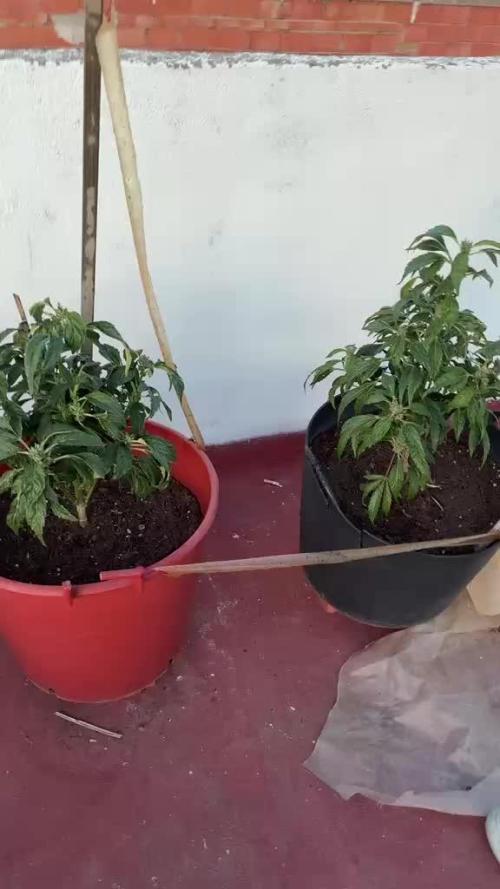
No buds formed; the calyxes where the seed goes were created, but without seeds


Likes
26
Share


@HowtoBubatz
Follow
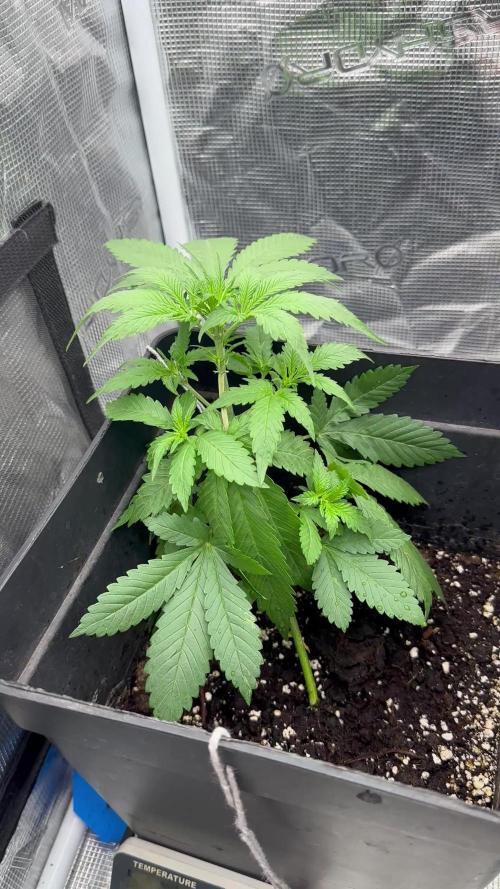
The second week of vegetation is over and watching the plant grow is a rewarding experience for me.
Now that the plant is well-established, it is time to begin training it. This involves LST to ensure it reaches its full potential in this case.
I look forward to discovering what this plant will become 😋😊


Likes
55
Share


@pifflestikkz
Follow
Day 64
05/07/24 Friday
Start of week
Big feed today 4L pH 6.2 only 20% run off.
So I have done final LST on her, I'm proud of what she has grown into over this veg period.
What a BEAST 🙌💪🤯💚
I'm allowing this week to be final veg week before I flip her.
She has so many tops I'll count them and add to diary tomorrow ✌️💚
Day 65
06/07/24 Saturday
The day after LST, she has bounced straight back 💪, she's a damn beast 👌
Picture update
Day 66
07/07/24 Sunday
Watering with De-chlorinated tap water, pH 6.0 and added cal-mag 7ml for 5L.
No run off but bottom of fabric pot is lovely and moist so will leave it there today 😁
Day 67
08/07/24 Monday
De-chlorinated tap watering today 5L with DyNoMyCo. Hoping this will help root zone uptake more nutrients during flush- we will see.
Updated short video
Day 69
10/07/24 Wednesday
Feed today! De-chlorinated tap water pH 6.0. did a 3L run through had about 1ltr run off due to high humidity this week, she never needed it I guess. But just wanted something to pull fresh oxygen through substrate.
She's getting so damn big, have to flip her tomorrow else she'll never fit under 600w hps in tent 🤦♂️😍

Likes
10
Share


@BR1CK_SANCHEZ
Follow
Just chuggin along this week, didn't do much... struggled to keep temperature at stable 68°
Likes
30
Share


@DrewbieDoobieNoobie
Follow
Well I went and named all the girls after rock and roll songs with their name in the title. see if you can guess all 6 artists 😁 A few are taking off some are still putt sing along, one looks like a Nutrient lock out (N) it looks a little yellow. #3 and #6 are under a different mfg. light and I think that is what is shifting the color. When they are under white light they do not look as bad
I gave them there first mid sized meal today 2/15/19 850 ppm @ 5.8 ph the runoff is pretty high 6.8 so tomorrow ill water the runoff I collected in the saucers and ph'ed it 5.5 and re-water ea. with an equal portion of that mix. I have a tripod now for the camera and the time-lapse should be more stable and less jumpy. Ill post some pics from the start of the week and the end.
Cheers

Likes
9
Share


@Nruperti78
Follow
This is the first aerogarden grow I’ve done that I actually had to remove the light and place it in the closet with my other plants. Had a little foxtailing because of that but a great grow otherwise.

Likes
7
Share


@MrLahey
Follow
Day 42 of flower. Pulling the tops within the next week or so and will let the other buds lower in the canopy a couple extra weeks.
Def gonna have to start chopping soon. I don’t want any issues if any fan or sugar leaves that are dying get too close to the buds.