The Grow Awards 2026 🏆
Likes
2
Share
@Romobo16
Follow
They are growing so fast, I’m in love lol I bought Hydroguard because I was losing the battle with hydrogen Peroxide and I’m so glad I did the change, I no longer have root rot, I highly recomend Hydroguard.
Likes
13
Share
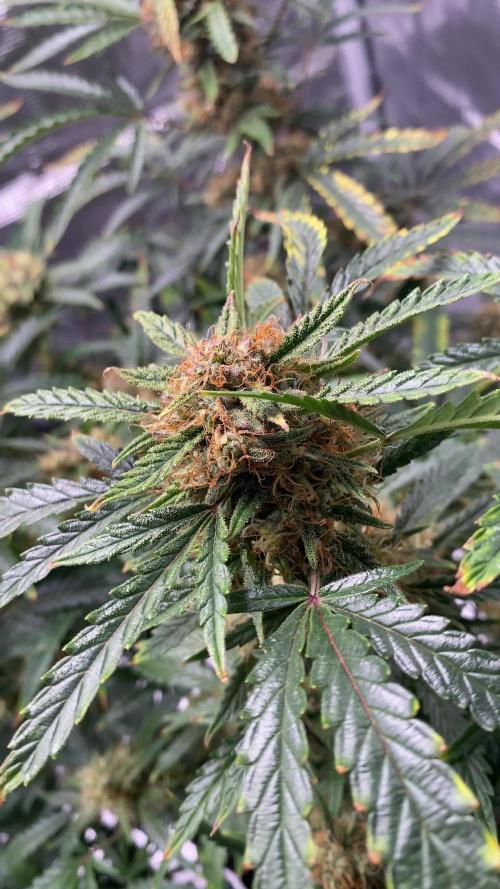
📆 Semana 6 – Permanent Jealousy XL Auto La floración avanza con fuerza. Los cogollos han ganado volumen notable, presentando una estructura más cerrada y densa. La capa de resina se multiplica y empieza a cubrir zonas que hasta ahora estaban limpias, como las puntas de las hojas más cercanas. El aroma se vuelve más afilado y complejo: dulzor cremoso con matices afrutados que se combinan con una base terrosa y un toque químico que recuerda a gasolina suave. Esta evolución del perfil terpenoide apunta a un bouquet muy expresivo al final. A nivel estructural, la planta responde bien: ramas fuertes, sin signos de flaqueza, aunque ya empieza a notarse algo de tensión en algunas laterales por el peso acumulado. La respuesta al plan de nutrientes es óptima: sin señales de excesos ni carencias, el verde sigue profundo y equilibrado. El ambiente se mantiene estable, y eso favorece una floración limpia. A estas alturas, cualquier estrés (temperatura, luz, riego) podría afectar la producción de terpenos o provocar detenciones parciales en el engorde. ¡Seguimos creciendo fuerte 💪!
Likes
28
Share
@Frenchie
Follow
Hi everyone, this week went pretty smoothly. She is growing well and she actually took 15 cm during this week. I'm pretty happy with that and I guess it's gonna be the same the coming week. I'm just adjusting the distance between the lamp and the canopy and that's pretty much it. I'm questioning if I shouldn't have taken the little branches from the middle out as they are now putting some lower bud sites on the main branches in the shadow. That's how it is now so I'll go along with it. Today I removed some lower leaves on the branches that are in the middle. They are pretty thin so it won't produce anything anyway. The coming week will pretty much be the same as this one I guess. I'm looking forward to doing the massive defoliation from the schwazzing technique next week. That'll be the first time I do it, hopefully that won't be a mistake! As usual, let me know in the comments if you have any advice or remarks. Take care everyone and see you next week!
Likes
26
Share
we will carry out this cultivation under the sponsorship of Mars Hydro with an FC-E 4800 lamp , to view this lamp or any other marshydro product go to: https://instagram.com/marshydro_aliexpress?igshid=YmMyMTA2M2Y=
Likes
5
Share
@Thedibber
Follow
13/06/25 - Gorilla cookies all sprouted. Little did I know the headache I would have from now on stunting plants and going down the rabbithole of trying to fix everything at the same time instead of taking a step back checking my carbon filter wasnt blocked until 07/08/25 😭
Processing
Likes
16
Share
GSC is basically done, just waiting for 10% amber trichomes GG4 and Kush look like they'll be while before there ready for harvest
Likes
36
Share
Likes
Comments
Share
@Naujas
Follow
Well here's another new experience on the way !!!!!! I haven't encountered @ original sensible yet, this is my first time with them:) photo periodic strain Citrus slurp !!!! so for now everything is in sight, good luck to everyone.:)
Likes
23
Share
Well as always I'm super happy with what the team over at @fastbuds are doing ! To be honest they were my first auto flowering brand I tried and they sponsors that grow because they like helping growers. Easy to approach and great customer service I have not been disappointed yet and this strain here is a keeper . I wish I could bottle the scent up and keep it forced 🙂. In the beginning I wanted to grow her out in a Christmas themed container do she was put into a snowman ⛄ deal placed into a 2 gallon pot . The soil and all additives are organic , living soil a Canadian company blend . She honestly was knocked out twice from her container and her size is tall but not many buds I stressed her out a lot . If she wouldn't have fallen out and been in a 4-5 gallon container then I would be even happier . The scent alone makes up for the size I could smell it all day . Never have I smelt an auto flowering strain like this before . Over fruity like ripened strawberries and lots of gas to be had as well . Today I decided to chop her down and make room for the next generation a head . The fact is that I enjoy all strains and don't care whether it's an auto or a photoperiod this company makes some fine plants and have been in my garden for almost two years now they are my go to auto flowering company ..cheers We got a smoke report going now and it's a bomb smoke I can't believe this was what I got . So much fruity and earthy undertones with such sticky buds I'm in love .. wish I had this whole plant in my garden it's fire smoke a great indica buzz
Likes
10
Share
started off first time grow with cyco nutrients line was struggling to maintain ph but getting the full swing from 5.6 to 6 happy days
Likes
3
Share
@PalmaGrow
Follow
5 - 11 octubre terminando séptima semana de floración
Likes
5
Share
Started some LST early in the week for the slightly older plant, then later in the week with the other two. I was going to let them go Christmas tree style, but I can tell already they will out stretch the others. Ended up just bending the top and tying with pant ties. This should promote some busier plants. Still figuring out the Correct Cronk Dosage, it’s pretty strong stuff, just trying to find the balance. Happy Gardening 🇨🇦👊❤️
Likes
12
Share
Checkout my Instagram @smallbudz to see the Small budget grow setup for indoor use, low watt, low heat, low noise, step by step. 27/12/2019 - Fed her 1.5l of 6.4PH water with 0,5ml of each: Grow, Bloom and Max, and 1ml of each: Heaven, Alga-mic and Vera, I use about 1/3 of the nutrient dosage on the chart, to achieve about 200/300PPM (500 scale). 01/01/2020 - Fed her 1.5l of 6.4PH water with 0,25ml of Grow, 0,75ml Bloom and 0.5ml Max, and 2ml of each: Heaven, Alga-mic and Vera, mesured about 280PPM (500 scale).
Likes
39
Share
@valiotoro
Follow
Hello everyone 😎 A wonderful genetic thank you Dutch ❤️‍🔥🤩 The trim was super easy the buds are FAT & FROSTY full of resin 🤤 I’m very happy with the harvest 134g !! For the light i’ve used the Mars Hydro FC-E6500💡
Likes
56
Share
What's in the soil? What's not in the soil would be an easier question to answer. 16-18 DLI @ the minute. +++ as she grows. Probably not recommended, but to get to where it needs to be, I need to start now. Vegetative @1400ppm 0.8–1.2 kPa 80–86°F (26.7–30°C) 65–75%, LST Day 10, Fim'd Day 11 CEC (Cation Exchange Capacity): This is a measure of a soil's ability to hold and exchange positively charged nutrients, like calcium, magnesium, and potassium. Soils with high CEC (more clay and organic matter) have more negative charges that attract and hold these essential nutrients, preventing them from leaching away. Biochar is highly efficient at increasing cation exchange capacity (CEC) compared to many other amendments. Biochar's high CEC potential stems from its negatively charged functional groups, and studies show it can increase CEC by over 90%. Amendments like compost also increase CEC but are often more prone to rapid biodegradation, which can make biochar's effect more long-lasting. biochar acts as a long-lasting Cation Exchange Capacity (CEC) enhancer because its porous, carbon-rich structure provides sites for nutrients to bind to, effectively improving nutrient retention in soil without relying on the short-term benefits of fresh organic matter like compost or manure. Biochar's stability means these benefits last much longer than those from traditional organic amendments, making it a sustainable way to improve soil fertility, water retention, and structure over time. Needs to be charged first, similar to Coco, or it will immobilize cations, but at a much higher ratio. a high cation exchange capacity (CEC) results in a high buffer protection, meaning the soil can better resist changes in pH and nutrient availability. This is because a high CEC soil has more negatively charged sites to hold onto essential positively charged nutrients, like calcium and magnesium, and to buffer against acid ions, such as hydrogen. EC (Electrical Conductivity): This measures the amount of soluble salts in the soil. High EC levels indicate a high concentration of dissolved salts and can be a sign of potential salinity issues that can harm plants. The stored cations associated with a medium's cation exchange capacity (CEC) do not directly contribute to a real-time electrical conductivity (EC) reading. A real-time EC measurement reflects only the concentration of free, dissolved salt ions in the water solution within the medium. 98% of a plants nutrients comes directly from the water solution. 2% come directly from soil particles. CEC is a mediums storage capacity for cations. These stored cations do not contribute to a mediums EC directly. Electrical Conductivity (EC) does not measure salt ions adsorbed (stored) onto a Cation Exchange Capacity (CEC) site, as EC measures the conductivity of ions in solution within a soil or water sample, not those held on soil particles. A medium releases stored cations to water by ion exchange, where a new, more desirable ion from the water solution temporarily displaces the stored cation from the medium's surface, a process also seen in plants absorbing nutrients via mass flow. For example, in water softeners, sodium ions are released from resin beads to bond with the medium's surface, displacing calcium and magnesium ions which then enter the water. This same principle applies when plants take up nutrients from the soil solution: the cations are released from the soil particles into the water in response to a concentration equilibrium, and then moved to the root surface via mass flow. An example of ion exchange within the context of Cation Exchange Capacity (CEC) is a soil particle with a negative charge attracting and holding positively charged nutrient ions, like potassium (K+) or calcium (Ca2+), and then exchanging them for other positive ions present in the soil solution. For instance, a negatively charged clay particle in soil can hold a K+ ion and later release it to a plant's roots when a different cation, such as calcium (Ca2+), is abundant and replaces the potassium. This process of holding and swapping positively charged ions is fundamental to soil fertility, as it provides plants with essential nutrients. Negative charges on soil particles: Soil particles, particularly clay and organic matter, have negatively charged surfaces due to their chemical structure. Attraction of cations: These negative charges attract and hold positively charged ions, or cations, such as: Potassium (K+) Calcium (Ca2+) Magnesium (Mg2+) Sodium (Na+) Ammonium (NH4+) Plant roots excrete hydrogen ions (H+) through the action of proton pumps embedded in the root cell membranes, which use ATP (energy) to actively transport H+ ions from inside the root cell into the surrounding soil. This process lowers the pH of the soil, which helps to make certain mineral nutrients, such as iron, more available for uptake by the plant. Mechanism of H+ Excretion Proton Pumps: Root cells contain specialized proteins called proton pumps (H+-ATPases) in their cell membranes. Active Transport: These proton pumps use energy from ATP to actively move H+ ions from the cytoplasm of the root cell into the soil, against their concentration gradient. Role in pH Regulation: This active excretion of H+ is a major way plants regulate their internal cytoplasmic pH. Nutrient Availability: The resulting decrease in soil pH makes certain essential mineral nutrients, like iron, more soluble and available for the root cells to absorb. Ion Exchange: The H+ ions also displace positively charged mineral cations from the soil particles, making them available for uptake. Iron Uptake: In response to iron deficiency stress, plants enhance H+ excretion and reductant release to lower the pH and convert Fe3+ to the more available form Fe2+. The altered pH can influence the activity and composition of beneficial microbes in the soil. The H+ gradient created by the proton pumps can also be used for other vital cell functions, such as ATP synthesis and the transport of other solutes. The hydrogen ions (H+) excreted during photosynthesis come from the splitting of water molecules. This splitting, called photolysis, occurs in Photosystem II to replace the electrons used in the light-dependent reactions. The released hydrogen ions are then pumped into the thylakoid lumen, creating a proton gradient that drives ATP synthesis. Plants release hydrogen ions (H+) from their roots into the soil, a process that occurs in conjunction with nutrient uptake and photosynthesis. These H+ ions compete with mineral cations for the negatively charged sites on soil particles, a phenomenon known as cation exchange. By displacing beneficial mineral cations, the excreted H+ ions make these nutrients available for the plant to absorb, which can also lower the soil pH and indirectly affect its Cation Exchange Capacity (CEC) by altering the pool of exchangeable cations in the soil solution. Plants use proton (H+) exudation, driven by the H+-ATPase enzyme, to release H+ ions into the soil, creating a more acidic rhizosphere, which enhances nutrient availability and influences nutrient cycling processes. This acidification mobilizes insoluble nutrients like iron (Fe) by breaking them down, while also facilitating the activity of beneficial microbes involved in the nutrient cycle. Therefore, H+ exudation is a critical plant strategy for nutrient acquisition and management, allowing plants to improve their access to essential elements from the soil. A lack of water splitting during photosynthesis can affect iron uptake because the resulting energy imbalance disrupts the plant's ability to produce ATP and NADPH, which are crucial for overall photosynthetic energy conversion and can trigger a deficiency in iron homeostasis pathways. While photosynthesis uses hydrogen ions produced from water splitting for the Calvin cycle, not to create a hydrogen gas deficiency, the overall process is sensitive to nutrient availability, and iron is essential for chloroplast function. In photosynthesis, water is split to provide electrons to replace those lost in Photosystem II, which is triggered by light absorption. These electrons then travel along a transport chain to generate ATP (energy currency) and NADPH (reducing power). Carbon Fixation: The generated ATP and NADPH are then used to convert carbon dioxide into carbohydrates in the Calvin cycle. Impaired water splitting (via water in or out) breaks the chain reaction of photosynthesis. This leads to an imbalance in ATP and NADPH levels, which disrupts the Calvin cycle and overall energy production in the plant. Plants require a sufficient supply of essential mineral elements like iron for photosynthesis. Iron is vital for chlorophyll formation and plays a crucial role in electron transport within the chloroplasts. The complex relationship between nutrient status and photosynthesis is evident when iron deficiency can be reverted by depleting other micronutrients like manganese. This highlights how nutrient homeostasis influences photosynthetic function. A lack of adequate energy and reducing power from photosynthesis, which is directly linked to water splitting, can trigger complex adaptive responses in the plant's iron uptake and distribution systems. Plants possess receptors called transceptors that can directly detect specific nutrient concentrations in the soil or within the plant's tissues. These receptors trigger signaling pathways, sometimes involving calcium influx or changes in protein complex activity, that then influence nutrient uptake by the roots. Plants use this information to make long-term adjustments, such as Increasing root biomass to explore more soil for nutrients. Modifying metabolic pathways to make better use of available resources. Adjusting the rate of nutrient transport into the roots. That's why I keep a high EC. Abundance resonates Abundance.