


Likes
Comments
Share


@LumberjackBuds
Follow
These guys seem to have some stunted growth from being in that shitty rock wool dish setup I had but they are making up for it now that they are in the air pots. I transplanted them into sunshine #4 because my other plants have had problems with N tox in coco loco, the only other soil mix I have...probably won’t ever be using fox farm soil again. Too expensive for what it is and it’s a pain in the ass dealing with nute probs.
Day 8: into the new grow tent tomorrow
Day 10: My Timber Grow Lights 480/500W QB came in! This thing is so sleek. I got it in 3000k which is a tiny bit orange/yellow because I plan on spending most of my time in flower with autos. But I find it works just as well for veg too, hard to notice any slower growth or anything. Since I’m in veg I might add my 2000w blurple to the mix to keep the girls happy

Processing
Likes
3
Share


@Fibro_Witch
Follow
Transplanted into 6.5L pots for now until I figure out where to put them in the garden. I did a top layer of more Sprout Island Blend and then my own homemade compost the rest of the container. I figure keep it nice and mild on nutrition at first and then they can reach down for more if they need it. The compost has a lot of worm activity.
I also put them down a couple inches because they were so leggy to give them more support. I have them in a wire dog kennel with deer netting around the outside to keep critters from munching. They're much happier with actual sun and are taking in the fresh air well🌞
2 out of the 3 have red stems so maybe an indica hybrid?👀

Likes
22
Share


@Oklahomasunrise
Follow
I've been pretty sick so keeping up with pictures and diaries have not been in the forefront of my mind. However!!!! I just have to show you guys these ladies!!! They amaze me! The one I transplanted has taken off!
Thank you fastbuds for the opportunity!!

Likes
37
Share


@RickJames_Mcdank
Follow
Well this week I start to increase Green sensation and Alga bloom. She is responding really wel to it and fatten up really good. She is getting frostier and frostier. So far so good.

Likes
241
Share


@Still_Smoq
Follow
📆 Week 15, 30 April - 6 May 2024
30 April - Turned light power to 75%.
1 May - Did a significant defoliation.
2-6 May - Observed and let the plant grow.
📑 I was debating on keeping the lights at 100%, or defoliating the plant. Defoliating won this time. There just wasnt enough light penetration getting to the lower buds (half the plant) to mature them for maximum growth and quality yield. So leaving the lights that bright did not achieve my expectations. It is a tricky situation when you start taking leaves away from a plant in flower, but when shadows are blocking bud developement you have to balance your grow and open it up. My method is to start with the lowest leaves and work your way up, use common sense, discard yellowing and damaged ones first, leaving the healthy green leaf on the plant. Then strategically remove the few that shadow the buds you want more focus on. This will help ensure the plant continues processing energy while avoiding possible shock by removing too much leaf.
🍶 30 April changed nutrient solution
🍽️ 30 April updated feeding schedule
💧 Using reverse osmosis water with EC/TDS at 0
🐉 Nutrient Solution EC 2.2 at 72 degree F
🔆 Light power at 75%, DLI 45-50 canopy coverage at 12hrs
😤 Using General Hydroponics, HGC728040, Dual Diaphragm Air Pump, 320 GPH
That is it for this week. Thanks for the look, read and stopping by.


Likes
18
Share


@Luca90
Follow
Back to lst, my homemade scrog wasn’t too good so I decided to order a professional one for the next grow in the meanwhile I tide them back doing lst
Also now they are really growing bigger and bigger
Again not sure if I’m doing a good job only time will speak
Got a microscope posted a pic and video of how my watermelon is doing with its flowers, the northern light is still not in full flower but its switching

Likes
1
Share


@KannaGrowing
Follow
Ya estamos en plena floración y con las luminarias a max potencia... Evidentemente el aire acondicionado también está trabajando durante la fase de encendido.
Flowa-Bloom es la estrella de los nutrientes a incorporar, pero todos son importantes... Así que sigo la tabla de fertilización de JUJU Royal al pie de la letra.
Eso si, primero humedezco bien el sustrato con agua, para aprovechar bien la solución con los nutrientes y que no filtre por las macetas textiles.
Riego cada cuatro días.

Likes
21
Share


@MG2009
Follow
01/01/2022
Potting up and amending with
5-2-4 to give a little kick before mid flower
#6 is first girl to show herself, also got two different males and only difference is that one is lighter green and other darker green
(also dark green one seems to drink more than lighter green) 💚. Other than that structure is very similar I wonder which is a better breeding male? I guess I might pollinate and LABEL TWO BRANCHES ON each female one for each male. and find out.🙏🏻
01/06/2022
#3 showed today, reppoted and into flowering closet, along with#6,who showed earlier this week lights at 14-10 see how they respond to that schedule, which should help use up the 5-2-4 going into week 3 should help with her stretch. Which isn't really that much I believe maybe double her current height, which I will check at lights on.Week ,#3 if I think of it I'll give a good fungal dominant tea.
Likes
233
Share


@Tropicannibis_Todd
Follow
🐶🐶🐶🐶🐶 👉Alrighty Then👈🐶🐶🐶🐶🐶🐶
We're 21 days in and we be moving along great 👍 I've now started some slight LST and began my nutrients plan 👈
We've also got some double tops on some branches as well as some triple internode branching so unexpected but not concerned 👈
All plants showing there sex 🙀
We got some great growth right across the board on all plants 👈 All plants receiving at least a min of 750 PPFD
So we are back for another round 😛 But this grow is special because my big boy needs some love too , he's been getting on the old side of things and his hips have been giving him trouble so I've been buying CBD treats for him and it works great so 😉 👍
I've decided to grow this for my little buddy 🐶 so I can make him some Doggy 🐕 Treats and plus I've never tryed it myself and I really wanna give it a go👈 😊 so let's see what it's all about 👈
I will post the recipes at the end of harvest 👏
So Let's Do This👈
👉Soil Provided by ProMix.ca
👉Nutrients Provided by Agrogardens
👉Lighting Provided by MarsHydro.ca
👉Seeds Provided by Kannabia Seeds
Likes
3
Share


@DjDaveAtHome
Follow
It should be said that originally, I had planted 3 ASD and 1 Critical+ only to discover down the road that one of the ASD's was not a genetic abnormality as I thought (Even Humboldt replied back that it was a genetic anomaly. I think it's a Black Dog. Totally different plant). As we go, you'll see Black Dog suddenly appear once I had made up my mind that's what it was.


Likes
4
Share


Likes
16
Share


@Mrg7667
Follow
Another eventful week! Transplanted into 5 gallong pots. Its interesting to see that there hasnt been much vertical growth but allot of branchung out compared to how it was with the other lights

Likes
10
Share


@Hazehouse
Follow
Transplanted into a 5 gal pot added some support for lst to force main stem to grow evenly as when transplanting one of the plants tilted and was placed on angle.
Didn’t want to disturb the roots and mess with digging it back up.
Plant number two looks a bit stunted from the previous stress but looks like it will recover. Looks like it was running out of room in the 1.5 gal but both plants look happy now . Will treat with some more fert in a few days and will be flipping to 12/12 shortly

Likes
1
Share

@NewNewbie
Follow
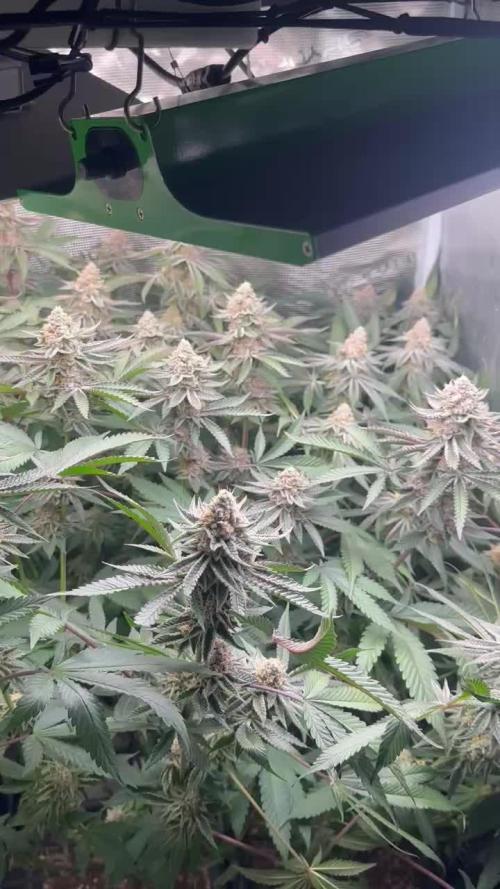
Buds are getting bigger and gain width and mass. Trichomes everywhere, and the smell is very nice. From WW i get a somewhat minty cherry, very pleasent. Love the strains, beautiful plants.
Likes
15
Share


@GardenOfEden
Follow
Harvest wet weight was 65.5 grams as a whole plant. Have her drying at 70 degrees and around 50% rh with a fan to circulate air. Will update with more info and pics when I start the cure.
Update: dry weight is 12 grams. Buds were not as dense as I would’ve liked but very potent and sticky. Smoke is smooth and taste is more pronounced. After cure I’m sure it will be even better. I’m not upset at the final weight as it was 1 of 3 plants in a tiny 12x24x24 inch tent with weak lighting.

Likes
19
Share


@BB_UK
Follow
Such a beautiful plant! She’s fully developed and finishing off her flowers now! Swelling everyday and naturally fading! She’s drinking a lot slower now too so I checked her under the loupe and all trichromes are cloudy so I’m sure she’ll finish at 8 weeks! She’s currently on week 6 and 3 days in bloom! So In her 7th week! I’ll continue to follow the requirements to bionova and then flush once!, as I said I’ll check her under the loupe! Smells like it’s going to be full of terps! I just open the tent and smell her! Fantastic strain!

Likes
24
Share


@Stinkfox
Follow
She’s recovered from defoliation and buds are everywhere. THe tent is smelling great. Almost to the halfway point in flowering. Getting excited to see her swell.

Likes
5
Share


@GREENPHOENIX6262
Follow
*Week 4 Veg - Seedsman Critical+2.0 - 10/29 - She has grown about an half an inch since yesterday (8.3inches) - Her fan leaves are twice in size in width*
* End of Week 4 Veg - Seedsman Critical+2.0 - 11/04 - Hard defoliation - LST tie down - (11 inches ) - Fan leaves removed *
*End of Week 4 Veg - Critical 2.0 - 11/4 -11 Inches - End of week recap - Split Cola - Sideview pic added.
Likes
34
Share


@Grey_Wolf
Follow
Original Sensible seeds Girl Scout cookies
5 weeks of Flowering Completed
8th March 2020
This Lovely Smelling lady is really starting to add some bulk to her flowers 💪 She still has about 5 more weeks to go so I'm hoping for Good things from her.
Ive been needing to feed her a bit more often as she seems to be taking everything I give her and wants more.
So as a supplement to what is already in the super soil Ive been adding Lots of Compost and Worm casting teas plus Liquid potassium @ 1ml/ L
Checked soil Ph and temp and was 6.3 and 23 c check out the video update 👊
That's it for this weeks update Thanks for stoppping by 👍

Likes
179
Share

@Tropicannibis_Todd
Follow
💩Holy Crap We Are Back At It And Loving It💩 👉FOLKS WE R ALMOST TO THE FINISH LINE👈
Growmies we are at DAY 63 and she's just killing💀it👌
👉We are in full flowering mode and she's doing great 👈 Everything is looking good even the Tiny Cup 🥤
So Shit , I gave them just a tad to much nutes at the start of feeding 👈 But I have since fixed it
So I'm still doing some low stress training 🙃 and some defolation 😳
Lights being readjusted and chart updated .........👍rain water to be used entire growth👈
👉I used NutriNPK for nutrients for my grows and welcome anyone to give them a try .👈
👉 www.nutrinpk.com 👈
NutriNPK Cal MAG 14-0-14
NutriNPK Grow 28-14-14
NutriNPK Bloom 8-20-30
NutriNPK Bloom Booster 0-52-34
I GOT MULTIPLE DIARIES ON THE GO 😱 please check them out 😎
👉THANKS FOR TAKING THE TIME TO GO OVER MY DIARIES 👈