


Likes
63
Share


@GuerrillaNo_4
Follow
UPDATES:
Insanely frosty and insanely stinky already. Very suprised!
GENETICS:
-Mephisto ~ Sour Stomper
Been waiting to plant my first Mephisto seed. I had a hard time getting a hold of some, but got the Sour Stomper from Harvest Mutual eventually.
WATER:
-Condensed (Starting at 40ppm)
-Disinfected prior to adding nutrients etc. (Using COOSPIDER UVC - 253nm & 187nm bulb)
CLIMATE:
- Ambient Air Temp = 29'C ~ 27'C LST ~ Leaf to air temp variance of between 1-2'C
- Night Temp = 22/23'C ~ Day/Night temp differential 6-7'C
- Under Canopy Temp: 27'C (Day) ~ 22'C (Night)
- Relative Humidity = 50-60%RH (Avg. 55%RH)
- VPD = 1.45kPa (Avg.)
- Co2 ranges from 900ppm to 1500ppm (Avg. 1200ppm)
AIR PRESSURE:
- Avg. ambient Air Pressure (outside tent) = up to 1010 mbars (101 Kilopascals)
- Avg. actual Air Pressure (inside tent) = up to 1005 mbars (100.5 Kilopascals)
- Air Pressure Differential = up to 0.5 kPa range between inside & outside
LIGHT:
- 2 x CREE COBs
- At plant canopy = PPFD 900-1000umols/s/m2 ~ Lux 35,000-45,000 ~ Daily Light Integral 55-65
NUTRIENTS:
- Mostly Advanced Nutrients (For base nutrients and most additives, as only company I could find scientific data on)
- Canna (For Calmag Agent and Cannazym)
- Plant Success (Great White Mycorrhizae)
ADDITIONAL GROW TECHNIQUES:
- Mostly getting out of the plants way and letting nature take its course.
- Some LST. (i.e. tying down branches and tucking large leaves away)
- No HST or Defoliation.
INFECTION PREVENTION & CONTROL:
Infection control practices i.e
-PPE, Alcohol Hand wash
-Gray room outside tent,
-Carbon filter
-HEPA filter
-Plasma Ionizer
-Inline UV-C germicidal bulb
- Also using an additional higher powered COOSPIDER (UVC) 253nm & 187nm bulb, to disinfect the gray room outside of the tent once a week for 30 mins.
- Ozone (o3) gas that is produced using the COOSPIDER, is then directed into the tent to further control any unwanted pathogens.
- Ed Rosenthal (Zero Tolerance organic pesticide), sprayed once a week as preventative measure. On hand for heavier use (Once every 3 days before lights out for 15 days) in the case of an outbreak
(No outbreaks yet, due to aforementioned preventative measures)

Likes
20
Share


@Hashy
Follow
Week 2
Light cycle=18/6
Light Power=120w 50%
Extractor controller settings
High temp= 24c
Low temp= c
Temp step=0c
High Rh= 65%
Low Rh= %
Rh step=0%
Speed max=5
Speed min=1
Smart controller settings (during lights on).
Lights on=06.00am
Radiator on= below 19c
Radiator off= above 20c
Humidifier on= brlow 60% above 23c
Humidifier off= above 63%
Dehumidifier on= not in use
Dehumidifier off= not in use
Smart controller settings (during lights off).
Lights off=00.00am
Radiator on= below 17c
Radiator off= above 18c
Humidifier on= not in use
Humidifier off= not in use
Dehumidifier on= not in use
Dehumidifier off= not in use
VPD aim=0.6-1.0
DLI aim=18-22
EC aim=0.8
PH aim=6.2
Thur 4/1/24
#2 (Day 8)
📋
Was H=9cm D=69cm DLI=16.9
Now H=9cm D=69cm DLI=19.7
Fri 5/1/24
#2 (Day 9)
📋 was in need of watering. Starting it's 3rd set of true leaves.
💧💧💧💧💧💧💧💧💧💧💧💧💧💧💧💧
Method= manual
Neutralise=0.1ml/L
Roots=5ml/L
Feed=nutes
Volume=200ml
Easy Ph down=0 drops/L
Ec=0.27 PH=5.9/6.2
Time=2.30pm
Runoff.
Total runoff=55ml
Ec=2.08 PH=5.7/6.0
💧💧💧💧💧💧💧💧💧💧💧💧💧💧💧💧
Sat 6/1/24
#2 (Day 10)
📋 Looks good.
Sun 7/1/24
#2 (Day 11)
📋 Potted up to 8L pot with biobizz light-mix.
💧💧💧💧💧💧💧💧💧💧💧💧💧💧💧💧
Method= manual
Neutralise=0.1ml/L
Roots=5ml/L
Feed=nutes
Volume=3L
Easy Ph down=0 drops/L
Ec=0.27 PH=6.0/6.3
Time=1.30pm
Runoff.
Total runoff=400ml
Ec=5.1 PH=5.2
💧💧💧💧💧💧💧💧💧💧💧💧💧💧💧💧
Removed humidifier.
Adjusted light height.
Light Power=100w 42%
H=10cm D=62cm DLI=18.9
Mon 8/1/24
#2 (Day 12)
📋 Looks ok, foliar sprayed (cal-mag 5ml/L)
Tue 9/1/24
#2 (Day 13)
📋 Having a cold spell at the moment so I'm adjusting the smart settings to compensate.
Smart controller settings (during lights on).
Lights on=06.00am
Radiator on= below 20c
Radiator off= above 21c
Humidifier on= not in use
Humidifier off= not in use
Dehumidifier on= not in use
Dehumidifier off= not in use
Smart controller settings (during lights off).
Lights off=00.00am
Radiator on= below 18c
Radiator off= above 19c
Humidifier on= not in use
Humidifier off= not in use
Dehumidifier on= not in use
Dehumidifier off= not in use
Wed 10/1/24
#2 (Day 14)
📋 H=12cm D=60cm DLI=20.1
✂️ Topped after the 3rd set of true leaves and left the lowers for now.
Considering this one was started nearly a week behind the others she soon caught them up.
Back soon.
Take it easy.

Processing
Likes
27
Share


@Frosty_farm
Follow
Nothing much to say about my grow this week. Gave he a flush with pH 6.0 to kick off the week. Day 86..... Gave her a feeding today a whole gallon. Ive been doing some research and maybe I'm feeding my plants a little too much nutrients. So from now on I will be feeding a lot less and the next day I will feed just plain water. So my plants will get nutrients every 3 or 4 days. I also bought a few advanced nutrients supplements which I'll be experimenting with. Day 87... Gave her a feeding today of advanced nutrients Nirvana and voodoo juice and pH to 5.9.
Day 88.....gave her a 2l feeding today of nutrients. Also defoliated some of her big fan leaves.

Likes
8
Share


@Mo_Powers
Follow
she tolerated the first topping well. i will continue to use LST on her and also try FIMing on her. the attempt is to generate a nice bushy plant
Likes
4
Share


@Skillgrower
Follow
Começamos a 3° semana no domingo está agora com 18 dias a correr bem, vou dar continuidade ao lst ate à 5 ou 6 semana e mudar o ciclo pra floração
As mais pequenas no vídeo uma tem agora 12 dias e a outra está com 15 no fim da segunda semana começou hj o lst

Likes
4
Share

@Ninjabuds
Follow
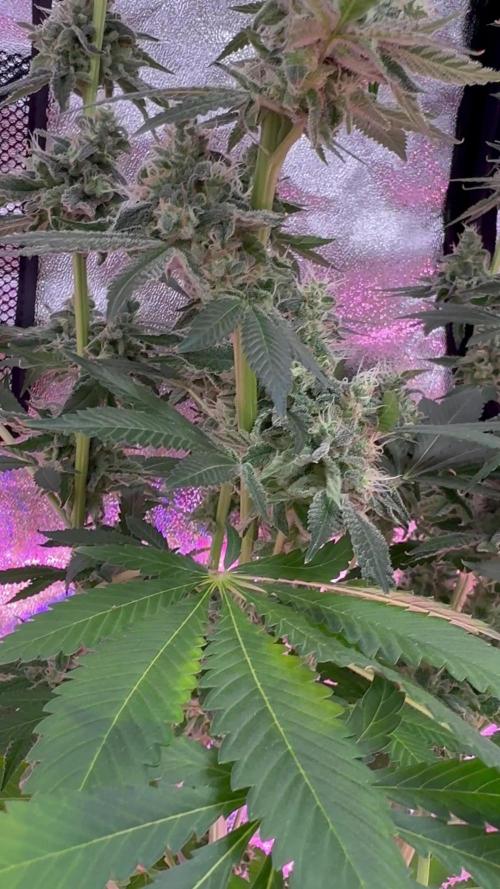
My new grow pros solutions under canopy lights are really making the colors pop
Likes
Comments
Share


Likes
1
Share


@Ultraviolet_
Follow
Turned off IR @ nights
Red wigglers (Eisenia fetida) are highly beneficial. They are considered an ideal choice for "no-till" or container-based organic growing because they live in the upper layers of soil, feeding on organic mulch rather than the plant's root system. Red wigglers accelerate the breakdown of organic amendments and produce high-quality, nutrient-dense worm castings directly in the root zone. Clover is another exceptional component of an organic rhizosphere, offering a sustainable, self-sustaining alternative to synthetic nitrogen fertilizers produced via the energy-intensive Haber-Bosch process. By forming a symbiotic relationship with Rhizobia bacteria, clover converts atmospheric nitrogen N2 into ammonium NH4, providing a steady, slow-release nutrient source that enhances soil health and reduces environmental impacts. Red clover offers superior nitrogen fixation and biomass production compared to white or yellow clover, making it the premier choice for maximum soil vitality, particularly for improving soil structure and providing a high-volume nitrogen credit for subsequent crops.
If it is fully functional and efficient soil, the rhizophagy cycle is far superior long-term than any synthetic delivery when it comes to preventing deficiencies, not because it's "better," per se. The medium will require a very high CEC to make it to harvest without re-fertilization. The rhizosphere acts as a dynamic, interactive exchange where plants and soil microbes trade resources based on immediate needs. When a plant lacks a specific nutrient, it changes its physiology and releases specialized chemical cocktails—root exudates—into the surrounding soil. These exudates, which include sugars, amino acids, and organic acids, serve as a "shopping list" to attract specific microorganisms, which in turn return higher levels of desired nutrients. There is nothing in comparison to synthetic delivery, which causes plants to stop producing exudates, effectively "starving" the beneficial soil life, over time turning the soil barren and void of microbial life. Responsible use, applying the right amount at the right time, can minimize these negative effects. Relying solely on synthetic fertilizers without replenishing organic matter is what typically leads to exhausted soil. The use of synthetic fertilizers can utilize the Cation Exchange Capacity (CEC) of the soil, but without a robust rhizosphere and active microorganisms, the efficiency of this process is significantly reduced. This makes synthetic growing more difficult to prevent deficiencies overall compared to an efficient organic living soil with a robust rhizophagy cycle, as there is no "one size, fits all" when it comes to different nutrient profiles of strains/genetics, making it trickier to "guess" and prevent creeping deficiencies.
CEC does not contribute towards EC. Add more CEC using biochar, problem solved. If you keep pH between 6.3 and 6.7, hydrogen is exudated to cycle the medium's CEC for its needs. Keeping the pH between 6.3 and 6.7 creates an environment where plants release H+ to displace positively charged nutrients (like Ca2+, Mg2+, K+ held on soil particles or within artificial media this cycle through nutrients via the medium's Cation Exchange Capacity (CEC)
Microorganisms generate a stable potential of approximately 0.5 V EC. The rhizosphere creates its own food, similarly to chelation, using 1000's of varying combinations to create its own food.
Start to finish, just add water. Eventually, more materials will need to be added at the beginning of each new grow, but very attainable to go from seed to harvest without ever fertilizing, regenerative cultivation.
ATP is king above all else when it comes to biomass accumulation. Cellular root respiration and cellular respiration are essentially the same biological process, the breakdown of glucose to create usable energy (ATP) in the presence of oxygen, just taking place in different parts of the plant. Synthetic (salt-based) grows have significantly lower levels of total rhizosphere respiration, often referred to as root-zone activity, compared to organic living soil grows. While the plant roots themselves may respire in both systems, the surrounding soil ecosystem in a living soil setup is vastly more active, teeming with bacteria, fungi, and beneficial microorganisms.
2 pools of ATP, it won't double in growth buuuut, but improving root respiration by ensuring high oxygen in the soil is crucial. Good aeration ensures roots can fully utilize glucose to generate the ATP necessary for nutrient uptake, leading to healthier and more productive plants, even if growth isn't exactly doubled. The ATP created using root respiration is dedicated to rootzone growth; the ATP created using regular cellular respiration in a synthetic system would have to dedicate a lot of ATP to the roots when there is little or no root respiration. It's true that there is less of an initial ATP cost in breakdown when nutrients are already in their final form (synthetic), but you lose a solid chunk of ATP when the entire plant is reliant on cellular respiration alone; a large portion of ATP is dedicated to root zones for "forced" (active) nutrient uptake. Making it overall less efficient, even if the initial cost of breakdown is higher. If that makes sense. Oxygen is of critical importance when growing in living soil compared to synthetic methods because it supports the metabolic needs of the microbial, fungal, and insect ecosystem, rather than just the root respiration required by the plant itself. While synthetic grows can survive in lower-oxygen environments with precise mineral feeding, living soil systems rely on aerobic microbes to decompose organic matter (microbial mineralization) to create plant-available nutrients, which is an oxygen-intensive process. While a specific fair percentage is difficult to guess, my experience points to a massive, compound difference between the two methods and the amount of oxygen required. All the ATP spared is used on more biomass, not only that, but the extra root respiration can achieve a much higher CO2 compensation point naturally than you could with synthetic and atmospheric CO2 alone.
As a plant grows faster and increases in size, its demand for nutrients to support that growth increases, requiring a higher rate of nutrient uptake. As plants enter phases of rapid vegetative/floral growth, their metabolic demand for nutrients increases exponentially. Without a robust buffer zone—whether in the soil (cation exchange capacity) or in a hydroponic reservoir—deficiencies will occur rapidly because the instantaneous demand for specific nutrients can quickly exceed the rate of supply.
A growing body of evidence suggests that organic living soil provides superior long-term soil health and environmental benefits compared to synthetic fertilizers, which are often criticized for promoting a cycle of dependency and degradation. While synthetic fertilizers offer short-term convenience and high yields, they often come at the expense of long-term soil health, sustainability, and increased corporate control over growers/ farmers. Organic living soil, while slower and requiring more care to establish, creates a sustainable, resilient, and, ultimately, more fertile environment.
We don't grow; we facilitate energy conversions.
Once all water is removed, approximately 95% to 97% of a plant’s dry matter consists of carbon, oxygen, and hydrogen. These three elements form the structural backbone of all plants. Corporate interest sells you the other 3-5% NPK & all the rest in RATIOS! Why not throw the 3-5% in a pot, and focus your energy on the other 95-97%?
Indigenous Amazonians created, or at least significantly enhanced, the fertile, dark soil known as Terra Preta de Índio (Portuguese for "Indian Black Earth") by incorporating biochar and other organic materials into the soil. This anthropogenic (human-made) soil technique, which dates back roughly 2,500 to 8,000 years, allowed ancient civilizations to flourish in regions with naturally poor, acidic, and nutrient-poor tropical soils.


Likes
5
Share


@Ninjabuds
Follow
Last week, my pound cake auto plant totally exploded with growth! It's insane how much it's changed. I swear it grew several inches overnight. The leaves are this gorgeous shade of green, and the whole thing looks super healthy and happy. I'm seriously so proud of my little plant baby.
Likes
98
Share


@DogDoctorOfficial
Follow
And my army as arrived lol its IPM time with in this case is not preventive but its attacking a situation !!!!
In my humble opinion wen growing in organics one fight life with more life and in this case i broth the big guns, i am talking about applying nematodes (steinernema faltiae) with you cant see at naked eye but will do they’re job on the soil and take on a microscopical way, i also am introducing some beneficial bugs to be more exact the stratiolaelaps scimitus they are machines killing trips, soil flies and a bunch of other plages we dont want around our girls and i also invited some Noseilus Californicus as a preventive for Any kind of non beneficial mites. With this i recipe i have faith my girl will be in control until the end of the run were i can clean it all up good !!!
Appart from the bugs situation and that this girl is always starving dont ask me how but just in case i start adding NPK in liquid mineral way lol she is doing amazing to my eyes, i mean the bud formation its amazing , i can already see a canopy full of golf balls , she is not an easy one to grow but i believe she will compensate me with amazing fruits, lets see … <3 <3 <3
As always thank you all for stoping by, for checking my journey , for the love support and for it all, i am blessed and humble with you all.
Just a reminder , all i grow is medicine for myself, for me and for my best friend with is me nothing to sell, so don’t even ask.
All info and full product details can be find in can find @
https://ganjafarmer.com
https://aptus-holland.com/
https://marshydro.eu/
#aptus #aptusplanttech #aptusgang #aptusfamily #aptustrueplantscience #inbalancewithnature #trueplantscience #Ganjafarmer #growerslove
With true love comes happiness 💚🙏 Always believe in your self and always do things expecting
nothing and with an open heart , be a giver and the universe will give back to you in ways you could not even imagine so 💚💚💚
More info and updates @
https://growdiaries.com/grower/dogdoctor
https://instagram.com/dogdoctorofficial
https://youtube.com/channel/UCR7ta4DKLFMg2xxTMr2cpIg
💚💚💚Growers love to you all 💚💚💚

Likes
45
Share


@Theia
Follow
Another not much to say week I'm afraid. She still eats she grows. Flower sites are out and the flowering begins.
Coco is magic and I'm converted. I have them on an auto feed that gives water every 3 hrs 200ml. Then I manually feed them with nutes every other day.
3 clones of the cough are looking good. May do another diary for those or I might gift them to some friends.
Thanks for stopping by.
I hope all your grows are successful 👍
Stay safe from the Vid 19.😷😷
Be happy❤️🌿🌱

Likes
8
Share


@Aleks555
Follow
Test FBA 2503 – 42Fast Buds
68 days from seed — and we’ve reached the final stage: harvest time!
Although the plant didn’t grow very big, it truly impressed us — the buds are dense, large (as big as a fist!), and absolutely drenched in sticky resin. The pinkish hue of the buds gives this beauty an extra touch of elegance — she looks stunning! But the most striking thing is the smell. It’s incredibly strong, sharp, and long-lasting. Our girl has a seriously intense chemical scent — it fills the entire grow tent instantly and lingers for hours. Not for the faint of heart!
From the beginning, we focused on giving her everything she needed: a well-balanced substrate, a stable environment, and, of course, proper nutrition.
Huge thanks to Xpert Nutrients for their powerful line of fertilizers — they played a key role in helping this plant reach its full potential, delivering impressive trichome production, vibrant colors, and strong structure.
And special thanks to 42Fast Buds for the opportunity to test this unique and powerful autoflower — it’s been an amazing experience!
Harvest results coming soon — stay tuned!
Likes
5
Share


@eldruida_lamota
Follow
Que pasa familia, vamos con la segunda semana de floración de estas GG4 Sherbet Fast Flowering, de FastBuds.
Agradezco a Agrobeta todos los kits obtenidos de ellos 🙏.
Ya veis que llevan buen ritmo ya tiene un color espectacular.
Vamos al lío, El ph se controla en 6.2 , la temperatura la tenemos entre 21/24 grados y la humedad ronda el 50%, 7 litros de sustrato. Iremos viendo cómo avanzan.
Agrobeta:
https://www.agrobeta.com/agrobetatiendaonline/36-abonos-canamo
Hasta aquí todo, Buenos humos 💨💨💨


Processing
Likes
74
Share


@Mr_Maes
Follow
We are officially in full bloom. The have been enjoying 6-7 hours of sun light per day for about 4 days now, then brought back in under the cobs. The girls are all exploding with growth and stacking what I expect to be huge buds.


Likes
38
Share


@Snakeking
Follow
Sweet aroma with a beautiful view
This week max temp is 33 and lowest 18 degrees centigrade no rain and cloud conditions
I stoped spraying neem oil and wood vinegar ,I hope pests let my girls bloom with no stress
They have to protect themselves against pests and also mother nature will


Likes
4
Share


@Jimmy_Jankens
Follow
1/12/23 all plants stretching nicely. P4 is vary one sided and P1-3 have similar structures. Starting 12/12 cycle tomorrow, still no pre-flower but should have signs by the end of next week. Hoping for at least 2 oz of or each plant.