The Grow Awards 2026 🏆
Likes
46
Share
@Crwfz1
Follow
This plant has been a literal joy to grow thing was so stress free didn't give me any problems at all and grew Soo fast and vigorously I was so impressed with how much she yielded indoor highest one plant yield indoor yet and the bud is absolutely blasted with trics I harvested little early because me and my wife like a little less than 50 percent amber seems to be little less couch locking no matter the strain but anyways great grow amazing plant and couldn't have asked for more !! Definitely one of my favorites
Likes
15
Share
@No_Clout
Follow
Everything’s looking well just waiting for them to swell up now.
Processing
Likes
15
Share
The two larger (and older) CBD Cracks are looking very good, the younger one needs to kick it's butt into gear! We have a heat wave going through right now so hopefully they'll like it😎 I went out to water early this morning so they got a little lime water. I was hoping for a little more growth this week but hopefully the lime will do it's trick and help them along. They have plenty of nutes in the soil to use up and I don't want to mess with them too much early on. And yes, I did put tomato cages in their bags because my evil, spiteful cat was trying to dig in there and take a 💩 and I really don't need that...
Likes
4
Share
They suffered a little stress from trips attack and cold weather, but are recovering well. Did the LST today and foliar spray with EM5 (5ml/l)
Processing
Likes
5
Share
Day 28: Happy days folks. hope we are all well and sane still. This week has been a good week for node stacking and starting her frost making it seems. She is a great size to work with now and has responded well to the stripping out of the lower larf and leaf. The airflow is perfect below decks now and allows air to move through the whole canopy and also light to make it through. Her buds are showing her Gelato 41 genetics with their appearance and are identical to the white flame like pistils. She is giving a slight terpene of sweetness and a little diesel too. Her stripping out had my fingers feeling a nice tacky , oily feel to them so she is certainly starting to nurture the budlets. Their golfball appearance is swelling daily and seeing how lose they are to joining up already , holds hope for some long chunky colas. She is approx 3ft now and a good circumference to her too. It is a safe assumption to think she will go the full 11 weeks flowering based on her parentage. The cross of these two strains is so far producing a perfect sized plant for my room and has given me the confidence to dabble in this area in the future I think. Gorilla Zkittelz/Blue Gelato41 is a good X and I know from another seed popped by a friend that Gelato41/Hulkberry creates a 5ft cola'ed monster plant. ( pic in my photos) and I still have crosses of Gelato41 and Cookie Kush , Gelato41 and Phantom O.g , Gelato41 and Orange Sherbet to run !!. I am fortunate to have a lot of these new beans now but I also have some amazing sponsored genetics running and some exciting testers still to do ( 9 more fast flowering strains to put through the wringer and try to identify !.lol) . Well that's another week down and only 7 to go for her. !!!!!!! she has a lot of big stacking buds growing time left. WATCH THIS SPACE !!!!!. Be safe people.
Likes
38
Share
Hi guys So end of week 4 and entering week 5 now. Few issues this week with the feeding of the plants. Dark phoenix are hungry well half of the plants are anyway 🤔🤷‍♂️ so I upped the feed to 1200ppm the dark phoenix didnt mind it as it needed it but my blue cheese suffered and has significant burnt tips on every leaf 😅 I will disconnect this from the auto feeder and flush and add half nutes by hand in a few days. Othere than that the plants buds are growing and getting frosty. Thanks for looking and happy growing guys👌💪💚 Day 37 flower I changed the marshydro tsl2000 to a 400watt hps to finish the job on the scrog along with the bloomplus bp2500 250watt led light. So cheese got burnt quite bad I totally disconnected it from auto pot system and feeding ph 6.5 water only for a week. Dark phoenix is really frosty now still loads of pistils standing on end and filling out now and smells amazing. The next 2 weeks I will keep feeding bloom and top max then I will start the flush on them. Happy growing guys.
Likes
59
Share
Song of the week : Kranium - Sidung ------- Day 58 - 03.12 - No more vertical grow but I had to do some more Hst on the tallest to fit in the tent. They are all forming buds but only #2 is green like I want to , the 2 others are pale ------- Day 60 - I made a short video to show them how they looks when they are outside from the tent. The #3 have a light burn due to the nights under 150w how. The soil I used was a regular gardening soil from the local store but It's astonishing how heavy this soil is even when It's dry bit when drying the surface becomes hard like rocks ( more than usual ) ------- Day 61 - Due to the rain I did not not them out today , I think it's the second time it happens and I hope it will stop soon because they are clearly too high and whatever the position I choose their is always one leaf touching the HID bulb 😒 I also made a short video to show you the box , I have add an extra 10w white light spot under the canopy and a 7w full spectum bulb under just because I had them at home , it wasn't planned at all.
Likes
79
Share
@Salokin
Follow
Hello Growmies, Week four of vegetation for our Epic Buzz by Anesia has been marked by remarkable progress and environmental optimization. The uniform growth has continued, with each plant reaching a robust 20 cm in their spacious 12.5-liter air-pots, signaling a very successful vegetative phase. The integration of the heater and humidifier into the tent's system has been a game-changer, allowing for precise control of the growing conditions. The environmental graphs are showing admirable consistency in temperature and humidity, which is key to maintaining an ideal VPD level for the plants, ensuring optimal transpiration and nutrient uptake. The Photone app indicates that the light intensity is within the ideal range for this stage, with readings of 150-180 PPFD. The lights, dialed down to 25%, along with the strategic use of IR lighting for 30 minutes at the transitions of the day, support the natural growth cycles of the plants. Concurrently, the UV lighting's midday cameo for 30 minutes is a masterful touch, potentially enhancing plant resilience and future resin production. Once the connectivity issues are ironed out, the Mars Hydro inline fan will be operational, enhancing nighttime dehumidification, a critical aspect of maintaining plant health by preventing excess moisture and the issues it can bring. This will round out the environmental controls, making them as meticulous during the night as they are throughout the day. The Epic Buzz plants are set to continue their vegetative journey in an almost perfectly controlled environment, thanks to the thoughtful and precise adjustments made around the garden. The upcoming week is poised to be another step forward in a vegetative phase that's been characterized by attentive care and environmental mastery. Stay lifted, salokin.
Likes
75
Share
@Pungolian
Follow
Week 7 of flower starts today. Hoping to make it to 11-12 minimum before the cold sets in! Water consumption is half what it was a month ago. Still top coating with Happy Frog every three waterings. Love taking photos of my girls. Great week everyone!
Likes
36
Share
@nonick123
Follow
Día 94 (02/09) Aplico Insect Frass como Top Dress para ver si revierto un poco el amarilleamiento que muestran algunas hojas, ya que empieza a ascender por la planta Riego con 500 ml H2O pH 6,5 Día 95 (03/09) Dia nublado y de temperaturas entorno a 24 ºC. NO es necesario regar! Día 96 (04/09) Llueve que te llueve! 🌧️. Temperatura 21 ºC. Dias de humedad alta por aquí! Riego con 500 / 1000 ml H2O pH 6,5 Día 97 (05/09) Floración en progreso. No veo ni una sola oruga con el bacillus thuringiensis y espero que siga así! 🤞 Dia muy nublado. No hace falta riego Día 98 (06/09) Riego con 500 / 1000 ml H2O pH 6,5 + 4 ml/L de BioGrow de Biobizz para tratar de parar el amarilleamiento que asciende por la planta Día 99 (07/09) Riego con 500 / 1000 ml H2O pH 6,5 + 4 ml/L de BioGrow de Biobizz para tratar de parar el amarilleamiento que asciende por la planta Día 100 (08/09) Riego con 1 Litro de Té Floración de Lurpe Solutions. Preparación: 24 horas con bomba de aire (oxigenación) con ingredientes: Healthy Harvest 8 ml/L + Insect Frass 16 ml/L + Hummus Lombriz 8 ml/L + Melaza 1 ml/L + Kelp Hidrolizado 0,25 g/L Aplico de nuevo Insect Frass como Top Dress 💦Nutrients by Lurpe Solutions - www.lurpenaturalsolutions.com 🌱Substrate PRO-MIX HP BACILLUS + MYCORRHIZAE - www.pthorticulture.com/en/products/pro-mix-hp-biostimulant-plus-mycorrhizae
Likes
144
Share
@roro_204
Follow
***I’m not sure why but it’s only letting me put 100 growing plants, but I actually harvested 180 plants in three separate rooms of about 300 sqfeet almost each, running in at 350 g per plant *** Given her being my first grow, I don’t really have anything to compare to but me and my plants have gone through a lot this year. Definitely going to need filters with this one, for the strong scent. 10 out of 10 would recommend this strain. I tried some fish fertilizer through some of the early growth and everytime I did, I would notice the plants beginning to burn so I completely stopped it, I learned organic is the best way to go if I’ll ever be using fertilizer again. This is the only way I would’ve learned it through experience! I didn’t think I can make it all the way through with my harvest, but ever since I got on Growdiaries everybody has helped me tremendously with every question I had, without the site my whole to harvest would’ve went to shit along time ago. Haha I really can’t thank my Growmies here enough for all their support. Every time I thought about giving up I would have uplifting comments assuring me my plants we’re doing fine. A message to all nee growers. Don’t be afraid of failure. Ask questions. I don’t know when my next grow will be but when, or if I decide to grow again, I’ll definitely document it on the best possible weed growing platform. Cheers friends!
Likes
27
Share
@MrJones
Follow
I harvested four plants today, putting 884 grams of wet flowers into the dry tent. I am trying to keep the environment as close as possible to 60F / 60% RH, but with the current temperatures, I will be lucky to keep it around 65. I am looking forward to the terpenes moving towards the skunky aromas.
Likes
4
Share
1/12/23 all plants stretching nicely. P4 is vary one sided and P1-3 have similar structures. Starting 12/12 cycle tomorrow, still no pre-flower but should have signs by the end of next week. Hoping for at least 2 oz of or each plant.
Likes
68
Share
Removed autoflower and put her in her own pot outside the tent. Foliars applied in strong blue 430nm with 4000Hz tone. 20-minute dose prior to application. In essence, you're seeing a combination of the infrared light reflected by the plant, which the camera perceives as red, and any residual visible blue light the plant reflects, which results in a purple hue. I was doing more stretching of the stems, adjusting weights, just a little too much, and it snapped almost clean. I got a little lucky in that it was still connected, wrapped her almost instantly while holding her in place with yoyo's. The core framework is now in place. If your soil has a high pH, it's not ideal; you want a pH of 6.4, 6.5, or 6.6, which is ideal. If you are over a pH of 7, you have no hydrogen on the clay colloid. If you want your pH down, add Carbon. If you keep the pH below 7, you will unlock hydrogen, a whole host of new microbes become active and begin working, the plant will now be able to make more sugar because she has microbes giving off carbon dioxide, and the carbon you added hangs onto water. Everything has electricity in it. When you get the microbes eating carbon, breathing oxygen, giving off CO2, those aerobic soil microbes will carry about 0.5V of electricity that makes up the EC. The microorganisms will take a metal-based mineral and a non-metal-based mineral with about 1000 different combinations, and they will create an organic salt! That doesn't kill them, that the plant loves, that the plant enjoys. This creates an environment that is conducive to growing its own food. Metal-based: Could include elements like iron, manganese, copper, or zinc, which are essential nutrients for plants but can exist in forms not readily accessible. Non-metal-based: Examples like calcium carbonate, phosphate, or sulfur are also important for plant growth and potentially serve as building blocks for the organic salt. Chelation in a plant medium is a chemical process where a chelating agent, a negatively charged organic compound, binds to positively charged metal ions, like iron, zinc, and manganese. This forms a stable, soluble complex that protects the micronutrient from becoming unavailable to the plant in the soil or solution. The chelate complex is then more easily absorbed by the plant's roots, preventing nutrient deficiency, improving nutrient uptake, and enhancing plant growth. Chelation is similar to how microorganisms create organic salts, as both involve using organic molecules to bind with metal ions, but chelation specifically forms ring-like structures, or chelates, while the "organic salts" of microorganisms primarily refer to metal-complexed low molecular weight organic acids like gluconic acid. Microorganisms use this process to solubilize soil phosphates by chelating cations such as iron (Fe) and calcium (Ca), increasing their availability. Added sugars stimulate soil microbial activity, but directly applying sugar, especially in viscous form, can be tricky to dilute. Adding to the soil is generally not a beneficial practice for the plant itself and is not a substitute for fertilizer. While beneficial microbes can be encouraged by the sugar, harmful ones may also be stimulated, and the added sugar is a poor source of essential plant nutrients. Sugar in soil acts as a food source for microbes, but its effects on plants vary significantly with the sugar's form and concentration: simple sugars like glucose can quickly boost microbial activity and nutrient release. But scavenge A LOT of oxygen in the process, precious oxygen. Overly high concentrations of any sugar can attract pests, cause root rot by disrupting osmotic balance, and lead to detrimental fungal growth. If you are one who likes warm tropical high rh, dead already. Beneficial, absolutely, but only to those who don't run out of oxygen. Blackstrap is mostly glucose, iirc regular molasses is mostly sucrose. Sugars, especially sucrose, act as signaling molecules that interact with plant hormones and regulate gene expression, which are critical for triggering the floral transition. When sucrose is added to the growth medium significantly influences its effect on floral transition. Probably wouldn't bother with blackstrap given its higher glucose content. Microbes in the soil consume the sugar and, in the process, draw nitrogen from the soil, which is the same nutrient the plant needs. Glucose is not an oxygen scavenger itself, but it acts as a substrate for the glucose oxidase (GOx) enzyme, effectively removing oxygen from a system. Regular molasses (powdered if you can), as soon as she flips to flower or a week before, the wrong form of sugar can delay flower, or worse. Wrong quantity, not great either. The timing of sucrose application is crucial. It was more complicated than I gave it credit for, that's for sure. When a medium's carbon-to-nitrogen (C:N) ratio reaches 24:1, it signifies an optimal balance for soil microbes to thrive, leading to efficient decomposition and nutrient cycling. At this ratio, soil microorganisms have enough nitrogen for their metabolic needs, allowing them to break down organic matter and release vital nutrients like phosphorus and zinc for plants. Exceeding this ratio results in slower decomposition and nitrogen immobilization, while a ratio below 24:1 leads to faster breakdown and excess nitrogen availability. Carbon and nitrogen are two elements in soils and are required by most biology for energy. Carbon and nitrogen occur in the soil as both organic and inorganic forms. The inorganic carbon in the soil has minimal effect on soil biochemical activity, whereas the organic forms of carbon are essential for biological activity. Inorganic carbon in the soil is primarily present as carbonates, whereas organic carbon is present in many forms, including live and dead plant materials and microorganisms; some are more labile and therefore can be easily decomposed, such as sugars, amino acids, and root exudates, while others are more recalcitrant, such as lignin, humin, and humic acids. Soil nitrogen is mostly present in organic forms (usually more than 95 % of the total soil nitrogen), but also in inorganic forms, such as nitrate and ammonium. Soil biology prefers a certain ratio of carbon to nitrogen (C:N). Amino acids make up proteins and are one of the nitrogen-containing compounds in the soil that are essential for biological energy. The C:N ratio of soil microbes is about 10:1, whereas the preferred C:N ratio of their food is 24:1 (USDA Natural Resource Conservation Service 2011). Soil bacteria (3-10:1 C:N ratio) generally have a lower C:N ratio than soil fungi (4-18:1 C:N ratio) (Hoorman & Islam 2010; Zhang and Elser 2017). It is also important to mention that the ratio of carbon to other nutrients, such as sulfur (S) and phosphorous (P) also are relevant to determine net mineralization/immobilization. For example, plant material with C:S ratio smaller than 200:1 will promote mineralization of sulfate, while C:S ratio higher than 400:1 will promote immobilization (Scherer 2001). In soil science and microbiology, the C:S ratio helps determine whether sulfur will be released (mineralized) or tied up (immobilized) by microorganisms. A carbon-to-sulfur (C:S) ratio smaller than 200:1 promotes the mineralization of sulfate, when the C:S ratio is low, it indicates that the organic matter decomposing in the soil is rich in sulfur relative to carbon. Microorganisms require both carbon and sulfur for their metabolic processes. With an excess of sulfur, microbes take what they need and release the surplus sulfur into the soil as plant-available sulfate A carbon-to-sulfur (C:S) ratio higher than 400:1 will promote the immobilization of sulfur from the soil. This occurs because when high-carbon, low-sulfur materials (like sawdust) are added to soil, microbes consume the carbon and pull sulfur from the soil to meet their nutritional needs, temporarily making it unavailable to plants. 200:1 C:S 400:1: In this range, both mineralization and immobilization can occur simultaneously, making the net availability of sulfur less predictable. This dynamic is similar to how the carbon-to-nitrogen (C:N) ratio regulates the availability of nitrogen in soil. Just as microbes need a certain amount of nitrogen to process carbon, they also require a balanced amount of sulfur. Both mineralization and immobilization are driven by the metabolic needs of the soil's microbial population. Sulfur is crucial for protein synthesis. A balanced ratio is particularly important in relation to nitrogen (N), as plants need adequate sulfur to efficiently use nitrogen. A severely imbalanced C:S ratio can hinder the efficient use of nitrogen, as seen in trials where adding nitrogen without balancing sulfur levels actually lowered crop yields. Maintaining a balanced carbon-to-sulfur (C:S) ratio is highly beneficial for plant growth, but this happens indirectly by regulating soil microbial activity. Unlike the C:N ratio, which is widely discussed for its direct effect on nutrient availability, the C:S ratio determines whether sulfur in the soil's organic matter is released (mineralized) or temporarily locked up (immobilized). Applied 3-day drought stress. Glucose will hinder oxygenation more than sucrose in a solution because glucose is consumed faster and has a higher oxygen demand, leading to a more rapid decrease in oxygen levels. When cells respire, they use oxygen to break down glucose, and this process requires more oxygen for glucose than for sucrose because sucrose must first be broken down into glucose and fructose before it can be metabolized. In a growth medium, glucose is a more immediate and universal signaling molecule for unicellular and multicellular organisms because it is directly used for energy and triggers a rapid gene expression response. In contrast, sucrose primarily acts as a signaling molecule in plants to regulate specific developmental processes by being transported or broken down, which can be a more complex and slower signaling process. Critical stuff. During wakefulness (DC electric current) life can not entangle electrons and protons. During the daytime, the light is sensed as multiple color frequencies in sunlight. Coherence requires monochromatic light. Therefore, at night, IR light dominates cell biology. This is another reason why the DC electric current disappears during the night. The coherence of water is maintained by using its density changes imparted by infrared light released from mitochondria in the absence of light. This density change can be examined by NMR analysis, and water is found to be in its icosahedral molecular form. This is the state that water should be in at night. This is when a light frequency is lowest and when the wave part of the photoelectric effect is in maximum use. 3600
Likes
10
Share
@rickytpb
Follow
Hey everyone, I have a sour ripper plant in my 40x40 cm grow tent, and I've shared my light setup above. I need your opinions on whether I should transition her into the flowering stage or wait a bit longer. I think I may have trimmed the main stem too much to the side, and I'm a bit worried about it, honestly. This is my first grow, and I've made some mistakes along the way. Should I perform more low-stress training (LST) to the opposite side of where I trimmed the main stem? I've also removed four big leaves from the bottom that were covering a significant amount of light to the lower branches, and I've just performed four toppings. I need your opinions , happy growing all!
Likes
39
Share
@J_diaz420
Follow
Se hace defoliación extrema 5 días antes del corte para intentar hacer madurar la planta de forma mas pareja.✌️👨‍🌾🏻
Likes
38
Share
@Tesla
Follow
We're almost there. There're some amber trichomes, just a few. I'm gonna wait a few more days to harvest it. It smells nice! :) And there's sign of nuts deficiency, and some light purple tones.
Likes
18
Share
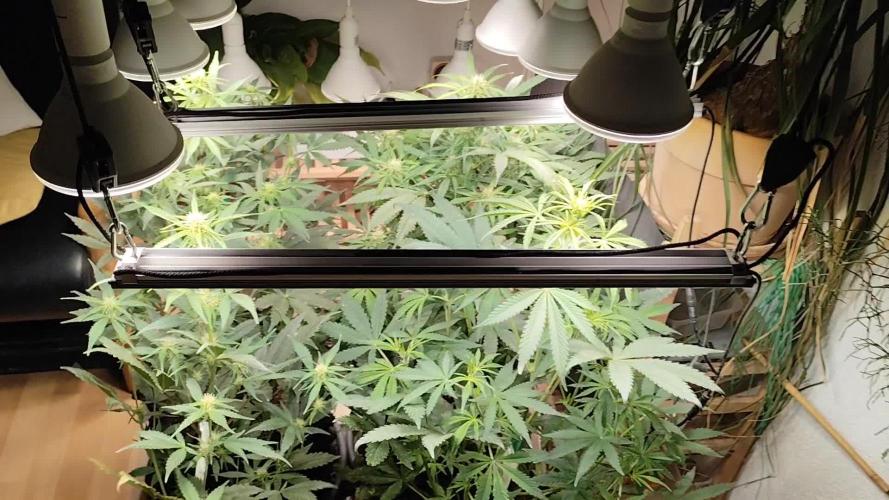
Die Plants wurden umgetopft und sind unter der grossen lampe gekommen, haben etwas stress anzeichen was normal beim umtopfen ist ,ansonsten sehen sie gut aus .
Likes
13
Share
@Loulou
Follow
Lots of growth this week Bkackberrys taking off so had to raise other plants hoping she dont take up too much room Blueberry still hasn't shown what sex it is yet so waiting on hopefully her to show