


Likes
Comments
Share


@TheCannaBrit
Follow
Just time to finish these guys with a flushing agent then we HARVEST!!

Likes
9
Share


@Growing88
Follow
La settimana è partita con qualche carenza dovuto al calcio e magnesio non fissato nel cocco,ho aumentato la fertilizzazione e sembrano recuperare bene,però ho notato che le due orange sherbet hanno malformazioni,sara dovuto alla bassa umidita al 50% ,le piante sono cresciute senza i parametri vpd,hanno solamente una finestra aperta e una ventolina che ricircola l'aria, sono già sotto attacco del moscerino del substrato e le sue larve,volevo cercare un predatore biologico per tutti gli stadi del moscerino del substrato, se conoscete un predatore che uccide il moscerino adulto,indicatemelo per favore 🙏

Likes
16
Share


@Maskedcucumber
Follow
Well most of them are sick,, some have lost or never had many pistils. It starts to smell a bit now. I still don't know how to deal with collective flushing and harvesting early rippen flowers.
Found out the roots were badly burnt,(no slime or foam): 3 of them lost the roots beneath the pot, Jah only knows the state the roots are in. Hoping they won't die before harvest...

Likes
39
Share


@Bluemels
Follow
Tag 84: Die letzte Woche hat meiner Shogun aufgrund der Hitze nicht so gut getan. Ihre Blätter sind sind insgesamt recht hellgrün. Ich versuche es aktuell mit noch mehr Alg a mic, vielleicht giebt ihr das ein wenig mehr grün zurück.
Tag 89: Um die Shogun noch etwas in Form zu bringen habe ich das scrogging Netz hochgeschoben. Sie scheint langsam weniger Wasser zu benötigen, auch die Blätter sind schon recht hell, was wohl an den heißen Tagen liegen mag. Ist nur so das es noch über 5 Wochen sind bis zur Ernte 😲

Likes
4
Share


@QixxGrows
Follow
Day15 - Day17: I had some difficulties to get the humidity right. It was either too high or fluctuating too much. I ended up getting a timer for the plug and running the humidifier 15mins every hour. To help with air flow, I have the main duct fan running 4 times a day for an hour. To ensure that there's airflow around the plant, I have a fan in the light as well as a smaller clip-on fan that runs during light hours. I'm not sure how the camera moved on day17... I only watered it mid-day.
Day18: The timer on the humidifier and Duct Fan is now keeping the humidity in a good space. VPD now under control
Day19: The Vivosun controller perfectly adapted the lighting schedule to an hour earlier, to ensure 6hrs of darkness. UInfortunately the RPi kept it's 04:00 schedule (makes sense). So I captured an hour of darkness. Adapted everything. Will have 18hrs again from Day20 onwards.
Day20: In the next days I'll lift the camera higher for a better view of what's happening up top. My mesh-netting-dingsbums will arrive and I'll use this as a platform for the pi+camera.
Day21: I'm not sure if I like this angle. I'll only keep it like this until she goes into veg-mode. It at least shows the new nodes growing from different perspective

Likes
6
Share


@RegadorDeCactus
Follow
BIGGER:STRONGER:FASTER
#NITROHAZE
#OUTDOORGANG
D115 Han engordado más los cogollos, se ven resinosos-atricomados-nevados y eso que aún no entra mucho en floración. Veo que aún crece y se sigue estirando haciendo caso omiso a entrar en floración y queriendo directamente crecer aún más y estirar sus brazos(todos). Se ve que es muy buena compañera.
En las noches la estoy entrado a un cuarto oscuro para que pueda cumplir sus 12 horas de oscuridad.
D120 (26julio)Avanzando en su floración, intento no regar mucho porque la humedad de noche es mucha y cuesta que baje lo húmedo del sustrato. Ah entregado muchos tricomas, ah comenzado a nevar. Lento pero Seguro.
D121 Me encantan esas fotos nocturnas donde se ve la nieve ❄️🌨️


Likes
Comments
Share
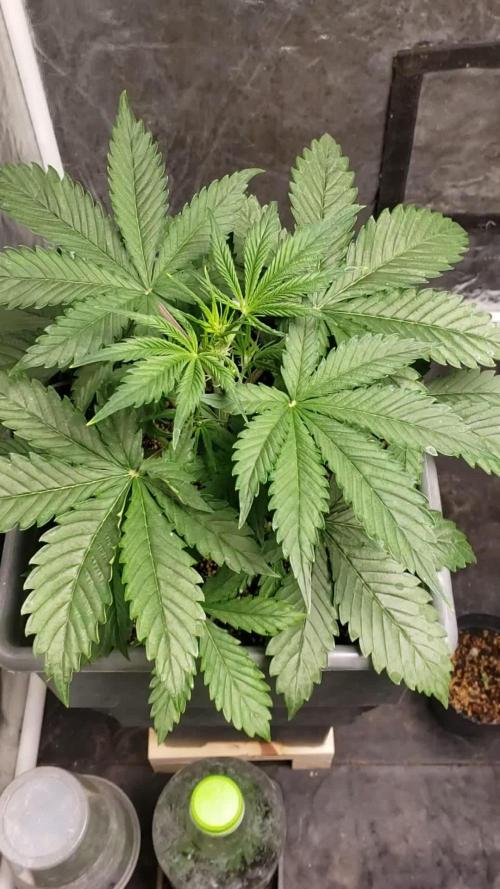

@The_Doctor_Green
Follow
Hola a todos!!!.
Les comento como le fue esta semana a la auto black opium.
La he regado en 2 ocasiones, en una solo con agua y en la otra regue con top auto 1.5ml x l y la última de top veg 2ml x litro de agua.
En ambas ocasiones regue con 400ml .
Ya comenzó a mostrar los pestillos, asique la próxima semana intuyo que será de floracion.
El ph de dichos riego anduvo en los 6.4 , las ppm no las he medido..creo que no me olvido de anotar nada más.
Hasta la próxima semana, y buenos humos!!!.

Likes
9
Share


@Grisly
Follow
Harvest 2024
Total Hash: 102g
Total Kief: 95g
Total Flower: 3868g/138oz/8.6lb
Total Yield: 4065g/145oz/9lb/4kilo
———-/-////////—vs———-/////————/
Sugar Diesel #1: 117g
Sugar Diesel #2: 313g
White widow Clone: 14g
Dual OG:
112g
LA Affie North Field: 248g
Granddaddy Purple N: 63g
Black Raspberry Kush N: 210g
————————————————-
Total North: 1077g/38oz/2.5lb
————————///——/—————-/
Fruity Pebbles: 184g
Granddaddy Purp S H2: 54g
Granddaddy Purp S H1: 275g
Granddaddy Purp Total: 329g/12oz
Black Rasp Kush S H1: 160g
Black RaspKush S H3: 70g
Black Rasp Kush S H2: 511g
Black Rasp Kush S H4: 17g
Black Rasp Kush S: 758g/27oz
Blue Cheese S H1: 281g
Blue Cheese S H3: 83g
Blue Cheese S H2: 285g
Blue Cheese Total: 649g/23oz
Dr Grinspoon S H1: 485g
—————————————————-
Total South: 2405g/85oz/5.3lb
————————///——/—————-/
North Popcorn: 148g
BC Popcorn: 100g
GP Popcorn: 73g
BRK Popcorn: 65g
—————————————————-
Total Popcorn : 386g/14oz/0.9lb
————————///——/—————-/
Trim: 8lb
—————————————————
————————///——/—————-/


Likes
Comments
Share

@DogDoctorOfficial
Follow
💜 Week 7 – Purple CousKush Auto (Pheno B)
Quiet Confidence
One of the things I love most about growing multiple phenotypes side by side is discovering that every plant has its own way of telling a story.
Some demand attention from the very beginning.
Others slowly earn it.
This Purple CousKush has always belonged to the second group.
Since germination she's chosen her own rhythm, never trying to become the tallest plant in the room or the fastest to flower. Instead, she's quietly built herself into an incredibly balanced, healthy and elegant little lady.
For anyone joining this 8×8 Adventure for the first time, this entire project is about growing multiple phenotypes side by side under exactly the same conditions. Every plant receives the same environment, nutrition and care, allowing their unique genetics and personalities to tell the story.
This Purple CousKush is proving that sometimes the quietest phenotype becomes one of the most rewarding to watch.
Week after week she's reminded me that confidence doesn't always need to be loud.
Sometimes it simply grows.
🌱 Plant Development
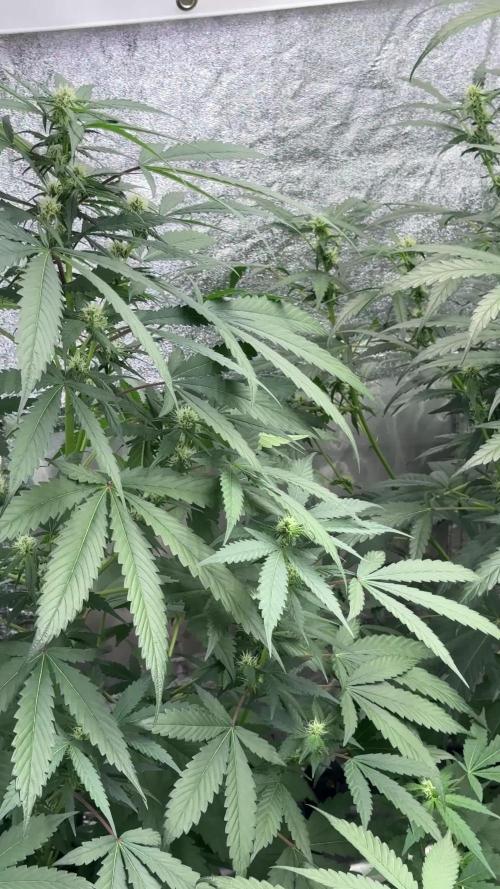
Week 7 finds this beautiful phenotype standing at approximately 88 cm, adding another impressive stretch since last week's update while maintaining the same wonderfully symmetrical structure she's displayed from the beginning.
Although she still isn't the tallest Purple CousKush in the tent, she's becoming one of those plants that immediately catches your eye for all the right reasons.
Every branch has continued developing evenly, creating a beautifully open canopy where light reaches almost every flowering site. The spacing between nodes has proven to be nearly ideal, giving each future cola plenty of room to develop without feeling crowded.
The flowers themselves have taken a noticeable step forward this week.
Fresh white pistils continue exploding from every bud site, while the individual flowers are beginning to connect into the first recognizable colas. They're still young, but the direction is becoming very clear.
One thing that really stands out is her colour.
The foliage has shifted into an incredibly rich emerald green that almost glows under the lights. Every leaf looks healthy, every stem feels strong, and the entire plant gives the impression of being perfectly comfortable in her environment.
She may not be shouting for attention.
But she's certainly earning it.
🌿 Environment & Growing Conditions
Another week of stable environmental conditions has allowed this phenotype to continue flowering without interruption.
• 12/12 light schedule from seed
• Future of Grow Black Series LED delivering approximately 850 PPFD
• Lumiflora under-canopy lighting now supporting lower flower development
• Mammoth Pro grow tent
• Day temperature around 29°C
• Night temperature around 25°C
• Relative humidity averaging 60%
• CO₂ approximately 639 ppm
• pH 5.8
• EC 1.95 mS/cm
One exciting addition this week has been introducing the Lumiflora under-canopy lighting.
While the main Future of Grow Black Series continues driving the canopy from above, the Lumiflora fixtures now provide additional light beneath the canopy, helping lower flowering sites receive energy that would normally be lost in the shadows.
As the flowers continue stacking over the coming weeks, this extra light should contribute to more uniform bud development throughout the entire plant instead of concentrating production only at the top.
It's another small detail that helps maximize every square centimetre of the grow space.
💧 Feeding Program
Growing in a 15 L Plagron Lightmix container and receiving approximately 1.1 litres of solution per irrigation, she continues responding beautifully to the current bloom programme.
This week's nutrient solution consisted of:
• Terra Bloom – 2 ml/L
• Pure Zym – 1 ml/L
• Sugar Royal – 1 ml/L
• Power Buds – 1 ml/L
• Green Sensation – 1 ml/L
The slightly increased EC has been welcomed without hesitation.
Leaf colour remains beautifully vibrant, new flower growth is accelerating and the plant continues showing absolutely no signs of nutrient excess or deficiency.
Sometimes the best feeding schedule isn't the most complicated one.
It's simply the one the plant happily accepts.
🌸 Phenotype Notes
This Purple CousKush continues reminding me that beauty isn't measured in height.
She's growing with incredible balance.
The main stem has become noticeably thicker, every branch is supporting itself confidently, and each flowering site appears to be developing at almost exactly the same pace.
There's something incredibly satisfying about watching a plant where nothing seems forced.
Everything feels natural.
The rich green foliage frames the developing flowers perfectly, while the bright white pistils almost sparkle against the darker leaves.
She isn't trying to steal the spotlight.
She simply shines in her own quiet way.
Sometimes those become the most memorable plants of the entire run.
🔍 Looking Ahead
The stretch now appears to be slowing, which means the next phase should become increasingly exciting.
Over the coming week I expect the flowers to begin stacking much more aggressively as the plant redirects more of her energy into building density rather than height.
The introduction of the Lumiflora under-canopy lighting should also begin showing its benefits as the lower bud sites receive additional usable light, helping create a more consistent canopy from top to bottom.
The framework has been built.
Now comes the part every grower loves watching.
The swelling.
The stacking.
And slowly, the first hints of the beautiful Purple CousKush she's been promising all along.
💭 Final Thoughts
This week made me smile.
Not because she's suddenly become the biggest plant in the room.
But because she's becoming exactly what she was meant to be.
Healthy.
Balanced.
Elegant.
Every photograph tells the same story.
Deep green leaves.
Strong stems.
Beautiful flower formation.
And a plant that looks completely at peace with herself.
She reminds me that growing isn't always about chasing the biggest harvest or the tallest canopy.
Sometimes it's simply about appreciating a plant that's doing everything right.
And this beautiful lady...
She's doing exactly that.
🙏 Thank You
A huge thank you to everyone following this 8×8 Adventure. Every comment, every question and every shared experience make this journey even more rewarding.
A special thank you to the amazing companies helping bring this grow to life:
💜 Zamnesia for the incredible Purple CousKush genetics.
💜 Plagron for providing the nutrition that keeps these ladies thriving.
💜 Future of Grow for delivering outstanding lighting from above with the Black Series LED.
💜 Lumiflora for helping illuminate the canopy from below, ensuring every flower has the opportunity to reach its full potential.
💜 TrolMaster for maintaining the stable environment that allows these plants to perform at their very best.
And finally, thank you to the entire GrowDiaries community. Whether you're here to learn, share your own journey or simply enjoy watching these phenotypes develop, I truly appreciate every visit, every comment and every conversation.
Until next week...
Growers Love and happy growing! 🌱💚
Likes
5
Share


@pzwags420
Follow
I installed a PH controller but it didn't work right and only the ph up peristaltic pump is working. I will use this over my vacation as my PH drifts down naturally so this should work until i get a replacement. I watered in my gsc and other seedlings until runoff with 850 ppm heavy in nitrogen to green them up as the organic top dressing is taking too long.will see how they respond.on week 4 day 4 They are responding well to nitrogen Gsc is taking off!!!will continue nitrogen until end of this week as needed.




Likes
120
Share


@Kitties_and_Colas
Follow
~_~_~_~_~_~_~_~_~_~_~_~_~_~_~_~_~_~_~_~_~_~_~_~_~_~_~_~_~_~_~_~_~_~_~_~_~_~_~_~_~_~_~_~_~_~_~_~_~_~_~_~_~_~_~_~_~_~_~_~_~_~_~_~_~_~_~_~_~_~_~_~_~_~_~_~_~_~_~_~_~_~_~_
02/13/22
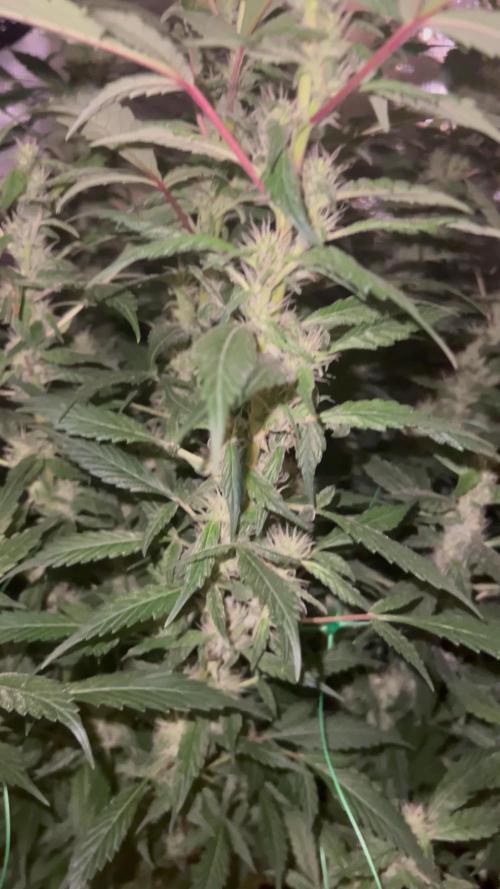
😻These ladies are sooo close! ❤️🌱.. the Peyote Gorilla looks especially sticky (has to be the GG#4) , as far as eye appeal, its definitely my favorite strain in the tent (shhhhh.. don't tell the others 😹).. we're still rocking a lot if clear trichs but the cloudiness is coming on fast, we're about 30%/70% atm..we gave them all their last heavy feeding 2 days ago, we dropped the lights again (app reading approx. 40k LUX at plant tops)...we're only doing water only from here on out, the whole tent should be entirely faded in 2weeks or less and some nice white ash in our future (and some killer tincture for yours truly lol🤘🐱).. thanks for reading if you made it this far and happy harvests everyone!!!! ❤️💡🌱😽💨
~_~_~_~_~_~_~_~_~_~_~_~_~_~_~_~_~_~_~_~_~_~_~_~_~_~_~_~_~_~_~_~_~_~_~_~_~_~_~_~_~_~_~_~_~_~_~_~_~_~_~_~_~_~_~_~_~_~_~_~_~_~_~_~_~_~_~_~_~_~_~_~_~_~_~_~_~_~_~_~_~_~_~_
Likes
2
Share

@Budhunter
Follow
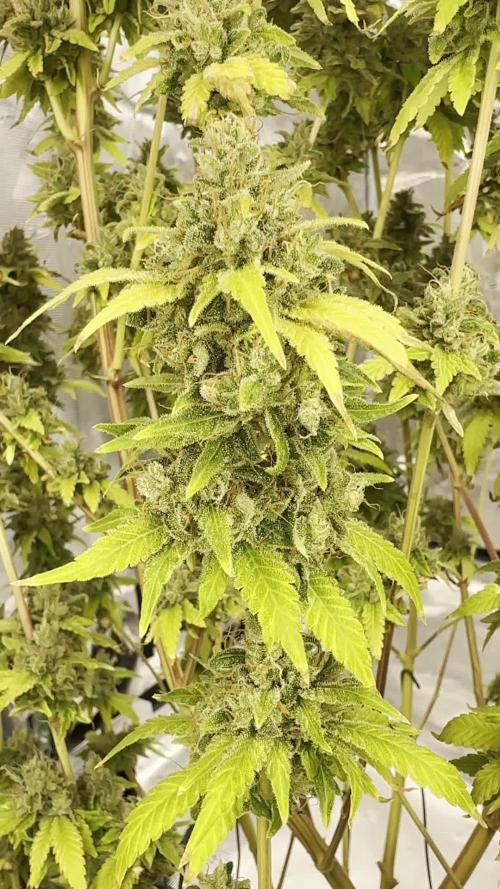
Week 11 flower - day 82 flw - day 140 of cycle
End of week 11 flower and plant could not be more ready. I postponed the harvesting day because I will be traveling so it can dry in my time away. Still trichomes are around 15-20 amber.
Likes
10
Share


@Ieiogrow94
Follow
Eccoci qui...
Tutto va per il meglio, questa settimana non ho applicato stress alle piccole, ma ho guardato l'evoluzione che hanno avuto dando i nutrienti.
Ora hanno un odore davvero intenso ed uno strato di resina pauroso, vediamo come si riprendono dalla defogliazione che ho fatto settimana scorsa.
Seguiranno aggiornamenti, grazie a tutti per il supporto🔥🌲❤️
Likes
165
Share


@SlowpokeFuegobud
Follow
🐟 🐠 🐙 🐡 🐟 🐠 🐙 🐡 🐟 🐠 🐙 🐡 🐟 🐠 🐙 🐡
Welcome to week 9, dear fish lovers! 💙
The fish is doing great for her age, haha! 🐟
I can't water as often as needed, and I start getting a bit worn out. We are going to chop the little sweetheart soon! 🙏 I had such a great time! 😍
You can see all kinds of problems on the leaves, but the buds swell and smell. 🍪 🍍 🍎 🍊
I will flush and get some nice weed out of this grow! Woohooo!!! 🎉
Thanks, growmies, for checking in! 💚 💚 💚 😘
Always remember, we are not our thoughts, nor are we our emotions, or experiences, we are limitless, immortal and divine souls making a 3D experience. 🙏 ❇️
____________________________________________________________________
Strain info:
Tropicana Cookies Auto is the perfect variety for growers of all levels, especially beginners as this strain performs very well outdoors and indoors, and can produce up to 500gr/m2 in 56-63 days without needing extra maintenance. Reaching up to 110cm, this strain grows fairly tall with medium-sized branching, showing its mixed heritage. Definitely the right choice for those with a high tolerance looking to get their hands on the strongest autoflowers out there. Thanks to the 27% THC, you can expect an extremely powerful and long-lasting high that’ll boost your mood and give you that extra push you need to start your days on the right foot. This variety offers the whole range of citrusy and woody flavors with a strong candy-sweet background that will keep you coming back for more and more.
Bud description
Tropicana Cookies Auto produces gorgeous dark purple flowers, so expect really dark buds with gorgeous hues of pink, purple and blue, and thick dark-orange hairs that get completely covered in resin by harvest time, giving them an almost shiny-white appearance.
This variety develops a typical Indica-like structure and very few sugar leaves that will make your trimming sessions a breeze. But make sure to store your trimmings as the gorgeous flowers reek of a mouth-watering blend of lemon peels, orange juice, and sandalwood that gives it almost a citrus candy-like flavor that makes for the most aromatic hash and extractions.
Smoke report
Thanks to the 27% THC, Tropicana Cookies Auto’s effect starts with an energizing head rush that gets your mind up and running while leaving you in a nice calm state. As the Indica-dominant side kicks in, the powerful cerebral effect gradually moves downwards and hits your whole body with a deep relaxation that leaves you with a joyful stoney sensation that alleviates chronic pain while leaving you in an overall happy and positive state of mind.
It’s the perfect daytime and nighttime strain as it can boost your mood and enhance a night out with friends but can also quiet your mind as you get ready for a good night of sleep. No matter the scenario, expect a powerful high that lasts for hours on end.
Plant appearance
Tropicana Cookies Auto reaches up to 110cm and develops a tall main cola with shorter side branches, typical of hybrid strains. You can expect a stocky yet tall main cola with medium-sized side branches and thin fan leaves that fade into a yellowish hue with a beautiful dark purple tint. Thanks to the excellent selection, this variety develops a short internodal spacing that makes the medium-sized flowers look like they’re growing stacked on top of each other. It’s the ideal choice for growers who want to get big yields without having to deal with huge plants, as this monster yielder can produce up to 150g per plant while growing relatively short.
Grow tips
This variety grows super dense buds so make sure to space out the branches by tying them down, this way you improve airflow which helps prevent mold and other pests. Tropicana Cookies auto reek of a delicious sweet and sour smell so make sure to flush thoroughly to enhance the aromas even more. This terpene heavyweight finishes with lots of resinous sugar leaves that make for fantastic hash and extractions so remember to have your trim bucket ready!
Flavor
Tropicana Cookies Auto boasts remarkably sweet flavors that resemble a blend of lemon peels and fresh orange juice, with subtle floral undertones that make it the perfect choice for extractors looking for unique terpene profiles.
Expect an overall citrusy zest that’ll coat your whole mouth and leave a delicious tropical candy-like flavor aftertaste. The sweet and sour flavors get balanced out with a herbal background that gets stronger as you exhale and gradually opens up, bringing out the whole range of woody, floral, and spicy flavors, making it the perfect choice for the most flavorful extracts.
https://2fast4buds.com/seeds/tropicana-cookies-auto
_________________________________________________________________________________
SETUP:
80x80x180 cm Zelsius
240W Full Spectrum LED IR UV dimmable
DW240H-A6-HS
Heatsink color red
LED Chips:
512pcs SAMSUNG LM301H + 24pcs Osram 660nm + 8pcs Osram IR 730nm + 8pcs UV 385nm
Color mix: 2700K + 4000K
2,8umol/J
Driver HLG-240H-C2100B
Coverage: veg 5x3ft / flower 4x2ft
Product size: 628x205x68mm
Green Buzz Nutrients
Shouts go out to my sponsors @GreenBuzzNutrients, thanks so much for your support! ❤️
If anyone would like to try their amazing organic products, use code GD42025 for generous 25% discount (for orders of minimum 75€) ✨
https://greenbuzznutrients.com/
Mills Nutrients
Biobizz Lightmix
custom exhaust fan 320/270cm³/h
Carbon Active Granulate 240cm³/h
tab water pH 8 - EC 0,25 with Calmag to 0,5
Advanced Hydroponics pH minus Grow + Bloom to pH 6.2
🐟 🐠 🐙 🐡 🐟 🐠 🐙 🐡 🐟 🐠 🐙 🐡 🐟 🐠 🐙 🐡
Likes
25
Share


@GERGrowDesigns
Follow
🥦 Vegetative Week 4 Structural Consolidation Phase
Eternity Grow Cup 2026 Sticky Broccoli Feminized
Stage: Vegetative Phase Week 4
Day:~Day 28
🌡️Environmental Control:
-Temperature: ~26°C consistent
-Humidity: balanced for vegetative growth
-Light Schedule:18/6
-Airflow: optimized for stem strength and canopy health
No major adjustments were required, indicating a established grow environment.
🌿 Plant Development
Observations:
-Strong vertical expansion
-Noticeable thickening of main stems
-Excellent development of lower and inner branches
-Deep, vibrant green coloration
-No visible deficiencies or stress symptoms
Overall health can be described as robust and highly stable of all 4 Plants .
🍵 Nutrient Strategy till Flower , Hy-Pro Program:
-Hy-Pro Terra (Growth/Bloom combination)
-Hy-Pro Terra Rootstimulator
-Hy-Pro Spraymix applied once daily as foliar support
The plant’s deep green coloration and upright leaf posture suggest strong nutrient uptake and efficient root function.
🥦Strain Observation Sticky Broccoli:
-Strong vegetative energy
-Excellent stress tolerance
-Dense node stacking
-Promising canopy architecture
Lower branch development is becoming increasingly strong, indicating high potential for productive flowering sites.
📸 Weekly Summary
Vegetative Week 4 was a controlled and strategic growth phase.
With no additional stress introduced, the plant was able to fully express its natural vigor and structural potential.
The foundation is now firmly established one final vegetative week stands between this stage and the flowering transition.
See you in Veg Week 5 Final Prep Before Flower 🌿✨

Likes
3
Share


@Dabking
Follow
I originally thought this was an autoflower, but it turns out it was a photoperiod. It was still in veg on day 65, so I switched the light cycle to 12/12 and 10 days later (day 75) it went into flower. This video is two weeks (14 days) after it went into flower.
Likes
12
Share


@Amsterdamsonkruid
Follow
Its been a pleasure,
Looking for the best weed ever? Go and grow OMG the name says it
