


@SinSemillaWhisperer420
Follow
I’m very satisfied with the results on my experiments and riding out the actions of my conclusions: Supplemental UVB PM only, microbes away, and foliage spray AM only.


@SMELLYBUDZ
Follow
Week 3 day 7.
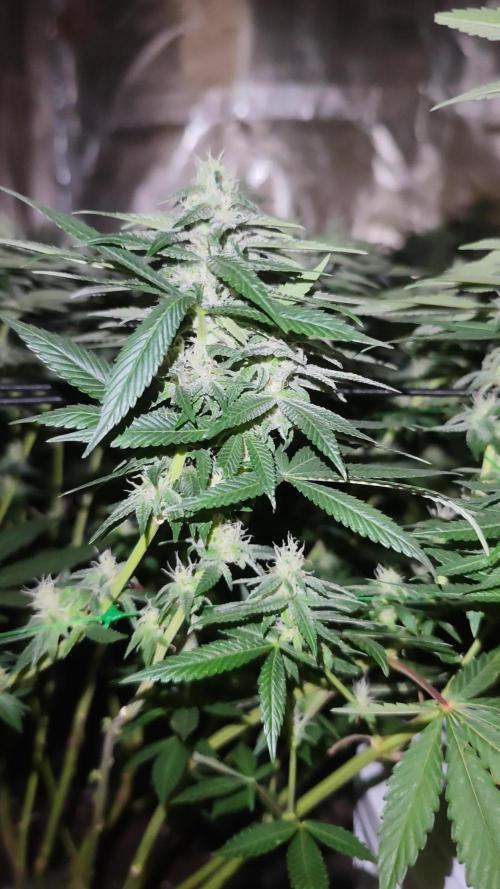
Buds are getting icey and stretching around 1-2” a day.
Dropped the carboload and is going to be replaced by a PK booster (big bud).
Watering everyday. Plain RO on every 3rd water.
The kind LED is pissing on the hps if im being honest. Bud development and vigor seems a lot nicer.
Stay baked.


@Skuuuunk
Follow
Germinated 10/06
Defoliated pretty heavily a few days before the pictures. Have lights cranked up to 8 now. Turned down chiller 2 degrees and humidity down 5%. Changed feeding ratios to 1-1-1 for “Flora Trio”.
Quit using Flora Micro and switched to my own blend (see photo). Now using 3 different solutions, Miller Microplex, Calcium / Potassium Nitrate, Ammonium Sulfate. Still same target ppm as FloraMicro, just can’t mix sulfates with Calcium Nitrate so I dose Ammonium Sulfate into my res first and then wait 15 minutes.




@gottagrowsometime
Follow
Grow is going great. The bigger pheno has taken to the bamboo shoots really well & now both plants are growing really well. Coming into preflower without a care in the world.
Days 29-32 2nd/2/
Growth is steady. I really haven't done anything differently so there's not much to report on. Keeping the feed ppm steady & I haven't touched anything LST or any defols. I haven't had the need. It'll do a good amount of stretching over the next few days. I haven't switched to bloom feed yet. Maybe in a few days.
3rd/3 Day 33
Growing like nothing in her way. Moving like a pair of mad women. Added 500ml of Master Root/Enzymes/Calmag ph'ed to 6.9, little higher than I'd like but I wasn't wasting a mix for a point out of what I normally give.
5th/2 day 35
Wow, just blow away by the growth in 2 days. DAMN Herbies got it going DOWN.
She has one or 2 blemishes. Still learning the nutrients. With these you can only improve the more you use, I'd she'll easily put on another 20-25cm for each plant. One is much bigger.
DISCOUNT CODES
20 OFF ZAMNESIA WITH CODE: ZAMMIGROW2024
20% OFF XPERT NUTRIENTS& KANNABIA WITH CODE: GGST
20% off Oringal Sensible Seeds with code:


@Huckleberry39
Follow
I am loving this plant!! Her buds are deep deep purple and super dense and covered in trichs!!! The smell is awesome....sweet and fruity with gasseyness, pretty sure that's not a word. This is going to be a great grow!! Thank you @



@GreenHobbit
Follow
The Hobbit Hole Outdoor Grow 2026 – Woche 9
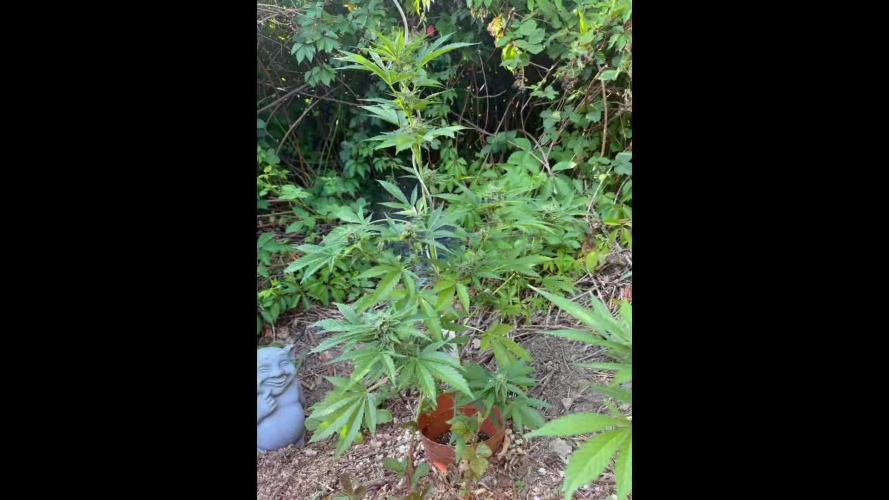
Eine weitere Woche liegt hinter dem Hobbit Hole und trotz zwei Tagen mit anhaltendem Regen entwickelt sich der Outdoor-Grow weiterhin hervorragend. Natürlich war ich etwas nervös, denn ohne festes Dach über den Pflanzen steigt in dieser Blütephase das Risiko für Schimmel deutlich an. Umso erleichterter war ich, als alle drei Ladies nach dem Wetter vollständig abgetrocknet waren. Bei der Kontrolle konnte ich keinerlei Anzeichen von Bud Rot oder anderer Fäulnis entdecken – genau so hatte ich es mir erhofft.
Gelato bleibt weiterhin die Spitzenreiterin. Sie ist nach wie vor die am weitesten entwickelte Pflanze und ihre Hauptcola legt inzwischen sichtbar an Volumen zu. Auch die Seitenblüten werden Woche für Woche kräftiger. Im unteren Bereich beginnen inzwischen einige der ältesten Fächerblätter gelb zu werden. Da ausschließlich die älteren Blätter betroffen sind und die Blüten selbst kerngesund aussehen, werte ich das als normalen Nährstoffumschichtungsprozess während der Blüte. Die ersten vereinzelten bernsteinfarbenen Trichome lassen sich bereits entdecken, insgesamt dominiert aber noch ein milchiges Bild. Bis zur Ernte wird sie also noch etwas Zeit brauchen.
Cinderella entwickelt sich immer mehr zur Harzkönigin des Hobbit Holes. Schon jetzt sind die Zuckerblätter extrem dicht mit Trichomen überzogen und jedes Makrofoto macht einfach Spaß. Sie wirkt insgesamt etwas schlanker als die Gelato, gleicht das aber mit einer beeindruckenden Harzproduktion aus. Ich bin sehr gespannt, wie stark die Blüten in den nächsten Wochen noch anschwellen werden.
Purple Punch holt ebenfalls weiter auf. Die Colas wirken inzwischen deutlich kompakter als noch vor wenigen Wochen und die ersten dunkleren Farbtöne zeigen sich bereits an einzelnen Zuckerblättern. Sie entwickelt ihren ganz eigenen Charakter und könnte am Ende geschmacklich noch eine echte Überraschung werden.
Auch bei der Düngung gab es eine kleine Anpassung. Da sich im Bereich des Hobbit Holes Brombeeren und wilder Wein ebenfalls über die Nährstoffe freuen, werde ich künftig bei jedem zweiten Gießen nach Hesi-Schema düngen, um den zusätzlichen Verbrauch im Boden auszugleichen.
Insgesamt bin ich mit Woche 9 mehr als zufrieden. Nach den Regentagen sehen alle drei Pflanzen gesund aus, die Blüten legen sichtbar an Masse zu und die Harzproduktion nimmt Woche für Woche weiter zu. Jetzt beginnt die Phase, in der sich Geduld auszahlen wird – die nächsten Wochen werden entscheiden, welches Potenzial wirklich in den drei Ladies steckt.


@DogDoctorOfficial
Follow
Hello, my wonderful green-thumbed friends! Welcome to the Week 5 veg report for our fabulous P.C.R.s. This week has been all about new beginnings and meticulous care, as we continue to nurture these beauties towards their full potential. Let’s dive in!
New Home, Sweet Home
This week, our P.C.R.s made the big move to their new 3x3 tent, and boy, do they love it! Under the bright and consistent light of the ViparSpectra P2000, these plants are set to thrive. The P2000 is a game-changer, offering a full spectrum that mimics natural sunlight, ensuring our plants get the best light for every stage of their growth. It’s like bringing a slice of the sun indoors!
Leaf Love and Clones
We also took some leaves and cuts this week to encourage bushier growth and to propagate new plants. Each cut was carefully treated with Clonex Gel, a rooting hormone that gives our clones the best start. Think of it as a nutrient-packed smoothie for our cuttings, providing all they need to develop strong, healthy roots.
To keep our new clones happy and hydrated, we used Clonex Mist, which is like a gentle rain shower, supplying essential nutrients and promoting robust root development. It’s all about giving them the TLC they need to become the next generation of thriving plants.
TLC and Maintenance
With the move, I made sure to maintain the optimal environment inside the tent. Our TDS is holding steady at 410, with a pH of 5.8 and a temperature of 21°C for watering. These parameters are crucial for nutrient uptake and overall plant health, ensuring our P.C.R.s have everything they need to flourish.
Why We Do What We Do
Understanding the importance of each step is key. The ViparSpectra P2000 not only ensures our plants receive the perfect light spectrum but also helps in energy efficiency, which is great for our environment and our energy bills! The Clonex Gel and Spray ensure that our clones have the best possible start, reducing transplant shock and speeding up root development.
Keeping our grow space clean and organized also helps in preventing pests and diseases, creating a safe and healthy environment for our plants to thrive. It’s all about setting the stage for success and letting nature do the rest.
In Conclusion
Week 5 has been all about setting up our P.C.R.s for success. From the new tent setup to taking care of clones, every step has been filled with excitement and careful planning. The journey is just as important as the destination, and I’m thrilled to see these plants grow and flourish.
Shout Outs
A huge shout out to @aptusholland, our main sponsor, for their incredible products that keep our plants thriving. Another big thank you to @artgenetix for creating the phenomenal P.C.R. strain. And to the wonderful community at Grow Diaries and all our followers, your support and enthusiasm keep us going. Let's continue to grow together!
Until next time, happy growing, and may your gardens be lush and green!
Genetics - P.C.R. @Art_Genetix_Team https://artgenetix.world/
Nutricion @aptusholland https://aptus-holland.com/
LED Power @Lumatek and @viparspectra
As always thank you all for stopping by , for the love and for it all, i fell blessed to have you all with me for one more love journey Thank you Thank you Thank you , you guys are great and have been amazing , thank you for everything !
#aptus #aptusplanttech #aptusgang #aptusfamily #aptustrueplantscience #inbalancewithnature #trueplantscience #dogdoctorofficial #growerslove
With true love comes happiness , Always believe in your self and always do things expecting nothing and with an open heart , be a giver and the universe will give back to you in ways you could not even imagine so !
Growers love to you all



@youdan
Follow
E andata da DIO! Questa genetica mi ha letteralmente reso l'uomo più felice della terra😂 i suoi colori sono strepitosi e adesso che ho iniziato il flush abbasserò anche la temperatura di 2-3c in modo da fare uscire ancora più colori😇.... E veramente una varietà spettacolare questa di Fast buds e mi viene l'acqua alla bocca solo a vederla! Ho intenzione di lavare per 7 giorni minimo anche se il substrato è di cocco ma vorrei cercare di avere un prodotto finale veramente pulito (anche se ho coltivato organicamente)....ci vediamo alla prossimo aggiornamento e ricordatevi di aggiungermi su Instagram curati_da_solo🌱🌈💫
Volevo ringraziare BAC per i suoi prodotti da urlo! E spero di poter usare tutta la linea nella prossima coltivazione così da avere risultati ancora migliori! Peccato che non ho avuto un calmag il PROACTIVE e il silicapower ...perché penso che se avessi avuto una tabella più completa sarei riuscito a fare ancora meglio! Ma mi interessa fare vedere che sonusare i loro prodotti così forse posso avviare un progetto più serio con loro! (Prossimo progetto a brevissimo 😇)
Vi lascio al prossimo aggiornamento per il taglio! Spero che piaccia a tutti
FAST BUDS SEI SPECIALE!🌱🌈💫



@Ultraviolet_
Follow
67 days since April 16th, 2026
We become aware at such times of man's wonderful ability to bring seemingly unrelated elements into harmonic balance, and receive a glimpse into a world where everything exists in conscious sympathetic attunement to everything else. When we listen to a piece of music that seems to strike a beautiful chord somewhere inside us, or view a painting that simply glows with harmonic awareness well executed, we probably do not spare much time to contemplate the wonderfully intricate combination of vibrations that our sensors make it possible for us to perceive. We tend to appreciate the relationship between the parts of something by an awareness of the harmony or dissonance of the whole. This ability enables us to say "what a beautiful house!" instead of "analysis has proven that this collection of building materials exhibits certain elements of harmonic proportion." While this ability to instinctively appreciate the beauty of true harmony has an important role to play in evolution, a more analytical understanding of the laws involved can be most useful. This is especially so if we wish to create works of art where each part exists in true harmony, not only with the other part of that particular whole, but with the universe within which the creator and the created exist.
Everything vibrates. From the most dense matter to the most subtle cosmic rays, everything which our senses allow our thoughts to become aware of, can be specified in terms of wavelength or frequency of vibration. These two terms define the same thing, but from different points of view.
The following are the approximate wavelengths of various energy carriers:
Cosmic rays 0.000,000,001 mm
Gamma rays 0.000,000,1 mm
X rays 0.000,500 mm
Ultraviolet rays 0.003 mm
Visible light 0.006 mm
Infrared 0.01 mm
Sound waves 1 meter
Radio waves 300 meters
Violet light 400 nm to 450 nm
Blue light 450 nm to 500 nm
Green light 500 nm to 570 nm
Yellow light 570 nm to 590 nm
Orange light 590 nm to 610 nm
Red light 610 to 700 nm
1 nanometer (nm) = 0.000,000,1 cm = 1/10,000,000 cm
If a guitar string is plucked and we hear a sound, it is not too difficult for the human mind to associate this sound with the vibration of the guitar string. With color it is quite different. It is difficult for us to conceive that the color of a substance is not an inherent property of the substance itself, but an indication picked up by our senses of that substance's ability to absorb or reflect the light which happens to be shining on it at that moment. Neither the matter nor the light is colored. What happens is that the brain learns to differentiate between the frequencies reflected or transmitted by the substance the eyes are focused on. The same thing happens with sound. When we say "Oh! Listen, they're playing my favorite song," what we really mean is: "My brain has stored within it a particular pattern of frequencies. I have compared the new information being received with this stored pattern and have deduced the answer that the two patterns are similar within certain specified tolerances." The 'pleasure' involved could have something to do with our running the pre-recorded pattern at the same time, in 'sympathy' with the new pattern as it is received.
The word sympathy describes very well our ability to appreciate color and sound. It also describes the reason behind certain elements of harmony. For instance, if a substance vibrating at 100 cycles per second (tone 1) is in the proximity of another substance vibrating at 200 cycles per second (tone 2), we could perceive, if we had the right equipment, a certain sympathetic relationship between the two.
We will see from this that there is a uniform doubling of the first tone seen in the second. At various points along the waves, the two are the same in amplitude. At other points, they are at opposite poles to each other. This doubled frequency has more points of similarity to the original than any other frequency except the original itself. If the equipment we had available for measuring these two frequencies was a soundboard amplifier and a pair of ears, then we would hear what would sound to us like one tone. If we had the opportunity to hear one at a time, we would hear that although they sound the same, one is higher in pitch than the other. This characteristic of 'the same but different in pitch', musicians have called the octave. Any two tones produced where one has exactly doubled the frequency of the other is called an octave. Speaking in ratios, an octave would appear then as the ratio 2:1 or 1:2, depending on whether we are talking of an octave up or down.
A single note produced by almost any instrument will contain more than one wavelength or frequency. It will have a dominant frequency, the wavelength of which we would call the note's 'fundamental' or 1st harmonic. It will also have a varying number of upper harmonics, gradually fading in intensity into infinity or silence.
Natural harmonics always have the same pattern of intervals between them. The interval between the 1st and 2nd harmonic is a perfect octave; between the 2nd and 3rd a perfect fifth; between the 3rd and 4th a perfect 4th; and so on, the intervals becoming smaller and smaller until they lose any relationship with the western 12 tone scale as it exists at the moment. Just as an octave has certain elements of sympathy with its fundamental, so some intervals have been noted to be more perfectly in sympathy with the fundamental than others. The ratio of the 'perfect 5th' or interval of 7 semitones, as it occurs in the harmonic series, is 3:2 or 2:3, while that of the 'perfect fourth" is 4:3 or 3:4. All the tones in the western 12 tone scale can be expressed in terms of the ratio between the upper tone and its fundamental. This would seem to be an ideal way of generating a scale from any given fundamental and several attempts have been made to do this, the Pythagorean system being probably the most well known. Although when working with a single tone instrument playing on its own, the Pythagorean formula works wonderfully well, if we had several instruments tuned this way together and asked them to play almost any western music, we would find that at times they sounded quite out of tune to each other.
The lack of flexibility of the various scale systems based on the harmonic series has led to what is known as the 'tempered' scale. This uses as its primary unit of interval the ratio of the octave or 2:1. It then proceeds to divide the interval between any fundamental and its upper octave into 12 smaller intervals by applying the ratio: two to the one-twelfth power, to one (21/12:1). This equals 1.059463094, so by multiplying any frequency by this number, we will obtain the tempered semitone next up from our fundamental. We will also find that any tone twelve semitones up from any other tone, in a scale generated in this way, will have exactly double the frequency.
If we took the note middle C on a piano and halved the wavelength, we would have the note C one octave above. If we halved this, we would have the C above, and so on. However, within about 6 octaves, we would find that although a 'sound' was being produced, no human ear could perceive it. If we kept on going, halving and producing upper octaves of our fundamental C, we would proceed through the infrared band, into the visible light spectrum. If we happened to be outside during the day, we would, for one octave only, see the note C with our eyes. The next octave above would already be in the ultraviolet band, and outside the eye's sensitivity range. If we can think of color as being an indication of a substance's vibratory rate or wavelength, we may begin to see a relationship that could exist between the color and sound spectrums.
The logical extension of what has so far been said is that there exists a scale in the color spectrum that corresponds exactly to the scale in the sound spectrum, each color tone being an octave of the equivalent note in the sound range.
This is not the end of the story but only the beginning. If we can for the moment accept that any wavelength in one band has upper and lower octave stretching out to infinity, then the next question is 'fine, but what shall we use as our fundamental? A particular color? A particular sound frequency?' The musicians among us will probably say 'A 440'. This means that the note A should vibrate at 440 Hertz, or 440 times per second. They would tell us that this is standard pitch has been adopted by most orchestras around the world; pianos are tuned to it, instruments are constructed to formulas based on it, and so to them it would probably seem the most appropriate place to begin. Some of these musicians may know of the battle that is still raging with regards to this being the standard, but few would know why A = 440 Hz was chosen except that it worked when it was set to be a suitable compromise between the many different pitches in use at the time.
432 Hz is said to be mathematically consistent with the patterns of the universe. Studies reveal that 432 Hz tuning vibrates with the universe’s golden mean PHI and unifies the properties of light, time, space, matter, gravity, and magnetism with biology, the DNA code, and consciousness. When our atoms and DNA start to resonate in harmony with the spiraling pattern of nature, our sense of connection to nature is said to be magnified.
Another interesting factor to consider is that the A=432 Hz tuning correlates with the color spectrum, while the A=440 Hz is off. Audiophiles have also stated that A = 432 Hz music seems to be non-local and can fill an entire room, whereas A=440 Hz can be perceived as directional or linear in sound propagation.
Once you adopt the idea that sound (or vibration in general) can have an equalizing and harmonizing effect (as well as a disturbing effect), the science of harmony can be applied to bring greater harmony into one's life or tune to specific energies. There is a form of absolute and relative harmony. Absolute harmony can, for example, be determined by the tuning of an instrument. The ancients tuned their instruments at an A of 432 Hz instead of 440 Hz - and for a good reason. There are plenty of music examples on the internet that you can listen to in order to establish the difference for yourself.
Attuning the instrument to 432 Hz results in a more relaxing sound, while 440 Hz slightly tenses up the body. This is because 440 Hz is out of tune with both macro and micro cosmos. On the contrary, 432 Hz is in tune. To give an example of how this is manifested microcosmically: our breath (0,3 Hz) and our pulse (1,2 Hz) relate to the frequency of the lower octave of an A of 432 Hz (108 Hz) as 1:360 and 1:90.
It is interesting to note that 432 Hz was the standard pitch of many old instruments and that it was only recently (19th and 20th century) the standard pitch was increased. This was done in order to be able to play for bigger audiences. Bigger audiences (more bodies) absorb more of the lower frequencies, so the higher pitch was more likely to “cut through”. One of the oldest instruments of the world is the bell ensemble of Yi Zeng (dated 423 BC), tuned to a standard F4 of 345 Hz, which gives an A= 432 Hz. The frequency of 345 Hz is that of the platonic year! Similarly, many old organs are tuned in A=432 as well; for example, St. Peter’s Capella Gregoriana, St. Peter’s Capella Giulia, S. Maria Maggiore in Rome.
Maria Renold’s book “Intervals Scales Tones and the Concert Pitch C=128 Hz” claims conclusive evidence that 440 Hz and raising concert pitch above scientific “C” Prime=128 Hz (Concert A=432 Hz) disassociates the connection of consciousness to the body and creates anti-social conditions in humanity.
The difference between concert pitch A=440 Hz and Concert A=432 Hz is only 8 cycles per second, but it is a perceptible difference of awareness in the human consciousness experience of the dream we share called existence.


@MrJones
Follow
47th Parallel Crowly's Comet
🔹⊱╮🔹╰⊰🔹 GROW Started 03.10.24 INFORMATION 🔹╰⊰´🔹⊱╮🔹
🌞Environment - Maintaining 80F and 65%Humidity
🌾Training - Nothing this week, just letting the seedlings veg out.
⚱️3-Gallon 📊6.2 PH
💧 Feeding - Using Horti Grow 8-11-21, Bloom 5-15-26, Late Bloom 0-24-26, Cal 12-0-0
🌞Medic Grow Smart 8 760 Watts
🕷️ IPM - CannControl from Mammoth and Mosquito Bits as needed
🔹⊱╮🔹╰⊰🔹 PLANT UPDATES 🔹╰⊰´🔹⊱╮🔹
📝 Notes - These ladies are just going nuts; they are stretching aggressively, and the vertical growth is outstanding. I want to defoliate these plants, but I need to be cautious and not stunt the stretch.
📝Fertigation injects fertilizers into an irrigation system to supply dissolved nutrients to crops.
🗓️04.27.24 Just feeding daily, sometimes twice; today, fed with Hort-Bloom @ 2.7 GRMS Per Gal and Horti-Cal @ 2.5 GRMS Per Gal.
🗓️04.28.24 Just feeding daily, sometimes twice; today, fed with Hort-Bloom @ 2.7 GRMS Per Gal and Horti-Cal @ 2.5 GRMS Per Gal.
🗓️04.29.24 Just feeding daily, sometimes twice; today, fed with Hort-Bloom @ 2.7 GRMS Per Gal and Horti-Cal @ 2.5 GRMS Per Gal.
🗓️04.30.24 Just feeding daily, sometimes twice; today, fed with Hort-Bloom @ 2.7 GRMS Per Gal and Horti-Cal @ 2.5 GRMS Per Gal.
🗓️05.01.24 Just feeding daily, sometimes twice; today, fed with Hort-Bloom @ 2.7 GRMS Per Gal and Horti-Cal @ 2.5 GRMS Per Gal.
🗓️05.02.24 Just feeding daily, sometimes twice; today, fed with Hort-Bloom @ 2.7 GRMS Per Gal and Horti-Cal @ 2.5 GRMS Per Gal.
🗓️05.03.24 Just feeding daily, sometimes twice; today, fed with Hort-Bloom @ 2.7 GRMS Per Gal and Horti-Cal @ 2.5 GRMS Per Gal.
╰⊰🔹╰⊰´🔹⊱╮🔹╰⊰🔹╰⊰🔹STRAIN INFORMATION🔹⊱╮🔹╰⊰🔹╰⊰🔹╰⊰🔹⊱╮
Crowley's Comet / https://www.47thgenetics.com/product-page/crowley-s-comet-10-fem-birdseeds
It's everyone's favorite piece of space rock, Crowley's Comet! The culmination of reversing our Matterhorn cut off Mr. Crowley to Intergalactic Runtz, and the results were out of this world (I had to do it). These ladies were slow to start, but once they hit their stride, they put any worries we had to rest. Compact, short-framed, and robust. They pack beautifully boulder-like flowers that reek of garlic and sickly sweet cotton candy. Dark green to a mosaic of purples, yellows, and silvers. Frost production is off the charts, the internode spacing is tight, and they certainly will impress in their last few weeks of flower. This is one of our favorite crosses in the new fem lineup. If you're looking for your hype fix, here you go.
Yield: Heavy to XL
Flower Time: 63 days
Feeding Schedule: Heavy






@Wookie
Follow
1 week if 12/12 and you can see the first light green showing, she will stretch for sure!
Awesome health, nice scrog, great lollipopping. I wont touch her until week 4 shes perfect for my liking!
Watering 2.5 Liters every 2 Days and we will up it now




@THcHunteR23
Follow
Belle formation je donne de l’eau 2 l au 2 jours . Je suis passé 3 cuillères par gallon de bloom et 1 cuillère de grow . Reste plus qu’à laisser agir et attendre patiemment la fin
Jour 23 😲😲 mon coeur s’emballe 🤪 les terpènes et les thricomes semblent avoir explosé 🤯 odeur sucré citron orange super doux mais puissante 🧡.
Pas besoin de plus temps et tomber pour tomber en amour avec Kannabia 💯🔥
Elle s’adapte vraiment bien

shorts_status_processing


