


Processing
Likes
Comments
Share


@710_Squish
Follow
She is going all out right now. Nothing slows her down. I did a heavy defoliation and she just kept going balls to the wall. The silica blast has really toughened her up.

Likes
11
Share


@Dendegrow
Follow
Radical Juice – Week 4 of Flowering
The Radical Juice is looking amazing! 🌿 The buds are starting to form beautifully, and the scent is becoming more noticeable with every day! 🌸 The plants are doing great and are getting more and more frosty as time goes on. The first trichomes are appearing, and I’m already excited about the upcoming harvest! ✨
The stretch seems to be slowing down now, and the plant is focusing more on bud development. Everything is progressing as expected. I’m still only using water, and I’m letting the soil and the microorganisms do the work. 🌱
As for the clone trial, the clone that received my homemade fertilizer with every watering is noticeably bigger and healthier than the other clones that didn’t get it. It’s really interesting to see the results! 📈
Stay tuned for more updates, and don’t forget to follow so you won’t miss anything! 😎
---
Radical Juice – Woche 4 der Blüte
Die Radical Juice sieht einfach großartig aus! 🌿 Die Buds beginnen sich wunderschön zu entwickeln, und der Duft wird mit jedem Tag intensiver! 🌸 Die Pflanzen machen sich bestens und werden von Tag zu Tag frostiger. Die ersten Trichome sind bereits sichtbar, und ich freue mich schon sehr auf die Ernte! ✨
Der Stretch scheint jetzt langsamer zu werden, und die Pflanze konzentriert sich mehr auf die Budentwicklung. Alles läuft wie erwartet. Ich gieße immer noch nur mit Wasser und lasse den Boden und die Mikroorganismen die Arbeit erledigen. 🌱
Was die Klon-Versuchsreihe angeht, ist der Klon, der bei jedem Gießen meinen selbstgemachten Dünger erhalten hat, deutlich größer und gesünder als die anderen Klone, die ihn nicht bekommen haben. Es ist wirklich spannend, die Ergebnisse zu sehen! 📈
Bleibt dran für weitere Updates und vergesst nicht zu folgen, damit ihr nichts verpasst! 😎

Likes
5
Share


@Ensign420
Follow
Greetings fellow growers 🖖 and welcome to my first grow ever. This adventure actually started several months ago when I decided to stop buying flower from dispensaries and just grow my own bud. How hard can it be!?
This is actually my second seed of this strain. The first bean sadly died due to over watering (sorry girl, RIP). I was literally watering the cube to the point where water was dripping from the bottom, then heavily sprayed the humidity dome and tray with the vents completely closed. Everyday. Multiple times. I never let the dome or try dry out. So after about 8 days of not sprouting, there was a funky smell of rot. So that was that.
Later I learned that rockwool retains a lot of water and can easily drown seeds. So a wet/dry cycle is best for rockwool germination.
So even after hours of researching and digging through forums and tutorial videos, I was still under prepared for this journey. Did not consider how delicate the germination phase is. Oh well. Lesson learned. Reset and try again!
I hope everyone is safe and stoned during this corona crisis. Just like everyone else in the world, I want this pandemic to be over with. But in the meantime, let's grow some weed! 🖖
[START OF WEEK 01]
Day 01 - Monday - 08/03/20 - Total Days: 001
-----------------------------------
- [0830]: Light Schedule: 24Hrs/0
--- Soaked cube in 5.5 PH water for 10 min. Did not shake water out.
--- NO NUTES! Only PH'd down to control the PH levels.
--- Did not use the default hole (way too deep).
--- Flipped cube upside down and made a shallow hole for the seed (less than 0.25" deep).
--- Placed seed in and pinched hole close. No additional water added.
--- Sprayed the tray and dome with straight water (5.5 PH).
--- Vents are cracked opened a for ventilation (about 1/4 opened each).
--- Distance between the light and tray was 53"
--- AC was set to 80 °F
--- Exhaust fan was set to 86 °F
--- Room average temp was at 85 °F
--- Dome humidity was at 85-99% when sprayed.
--- Allowing to completely dry before respraying.
- [2200]: Dome and tray were completely dry! Sprayed only tray and dome with more water.
Day 02 - Tuesday - 08/04/20 - Total Days: 002
-----------------------------------
- [0845]: Sprayed dome and tray in the morning. Everything was dry.
--- Hoping for the best!
- [2130]: Everything was dry again, so sprayed dome and tray at night along with a light spray on the cube.
Day 03 - Wednesday - 08/05/20 - Total Days: 003
-----------------------------------
- [0830]: Everything was dry again. Resprayed dome and tray. Slightly sprayed cube.
- [2125]: Hooo damn!! She popped! Am little stub is visible! Resprayed dome and tray again.
--- Still going 24/0 for lights.
- [+0033]: Just checked up on her and I swear she grew a bit taller! Getting excited!
Day 04 - Thursday - 08/06/20 - Total Days: 004
-----------------------------------
- [0845]: Wow! Went from a little stub to fully sprouted overnight! Everything was pretty dry again so resprayed dome and tray.
- [2200]: Tap root is visible! Over 1" long too! Just resprayed dome and tray again.
-- Going to prep for hydroton transplant tomorrow!
Day 05 - Friday - 08/07/20 - Total Days: 005
-----------------------------------
- [0930]: She keeps growing!
-- Added a bit of CalMag to the spray bottle (8 drops to 650ml of distilled water). Resprayed dome and tray. Water was at a 5.4 PH with 141 PPM.
- [1045]: Prepped the bubble bucket with 4.5gal of water. Water is high enough to reach about 0.25" above the bottom of the net pot.
--- Added 3 drops of Superthrive
--- Added 3.5ml of CaliMagic
--- Added 2ml Hydroguard
--- Then PH'd down to 5.6
--- Solution Strengh: 120 PPM
--- Water chiller is set to 20 °C
- [1100]: Transplant time!
--- Filled the net basket 1/3 with hydroton. When placed in the bucket, air bubbles are not visible, but are slightly below the surface (slight digging will reveal the water/bubbles below).
--- Removed plastic on rockwool cube and placed in basket, then filled around and covered with hydroton. Making sure to block any light from passing through the net pot and into the nutrient solution.
--- Covered with a half-bottle dome sprayed with the CalMag water from earlier.
--- Hoping for the best!
- [1300]: Raised Bucket 5" higher. Now light distance is 48" to top of bucket.
- [1820]: Lowered tent exhaust temp to 76 °F
--- Lowered AC to 75 °F
--- Raised bucket even higher so light distance is 30" to top of bucket.
- [2300]: Looking good!
--- Sprayed dome and surrounding hydroton with more CalMag water.
--- Attached timer to light! So new 18 Hrs On/6 Hrs Off light schedule.
--- Lights On: [1600] (4pm)
--- Lights Off: [+1000] (10am the next day)
--- Decided to go with lights on during the evening/night and off during the later mornings/afternoon (the hottest part of the day) to see if temps can be controlled better.
--- Please survive girl!
Day 06 - Saturday - 08/08/20 - Total Days: 006
-----------------------------------
- [0800]: Everything was dry. Resprayed hydroton and dome.
- [2000]: Here first night cycle seemed to go well! Get'n taller!
--- Dry again. Removed the dome.
--- PH went up to 6.5 so PH'd down to 5.7
--- Ran the top feed drip ring for a bout a minute to wet the hydroton and rockwool with the nutient solution.
---Too scared to leave the top feed on 24hrs (I don't want over water her and cause dampening-off). Will let dry before re-watering.
- [2100]: After closer inspection, I think she's looking a bit yellow.
--- Decided to add a bit of grow nutes to the bubbler solution.
--- Added 2ml of Sensi Grow A
--- Added 2ml of Sensi Grow B
--- Solution strength after adding more nutes: 176 PPM
--- PH went up to 6
--- I hope that the extra chelating properties of the 'PH Perfect' solution is enough of a buffer for proper nutrient uptake.
Day 07 - Sunday - 08/09/20 - Total Days: 007
-----------------------------------
- [0800]: Water dropped a bit (mostly due to evaporation) so solution strength was at 190.
--- Checked PH again. Was still at 6, so PH'd down to 5.4
--- Ran the top feed for a minute to wet the hydroton a bit.
- [0915]: Since she's looking perky but still a bit yellow. So decided to up the nutrient concentration even more before lights out.
--- Added 2ml more of Sensi Grow A
--- Added 2ml more of Sensi Grow B
--- Solution strength after adding more nutes: 199 PPM
--- PH went up to 5.8
- [1700]: Checked nutrients.
--- PH: 5.9
--- Solution strength: 202 PPM
--- Added 4ml of Voodoo Juice
--- Added 4ml of B-52
--- PH after adding more nutes: 5.9
--- Solution strength after adding more nutes: 238 PPM
- [2130]: Decided to make a new foliar spray to address the continued yellowing.
--- Started with 500ml of distilled water.
--- Added 3 drops of CaliMagic
--- Added 3 drops of Sensi Grow A
--- Added 3 drops of Sensi Grow B
--- Added 3 drops of B-52
--- Added 1 drop of Superthrive
--- Solution strength: 164 PPM
--- PH was at 5.9 and did not adjust.
--- Gave her one spray.
--- Also sprayed the surrounding hydroton.
[END OF WEEK 01]

Likes
22
Share


@donovanliam
Follow
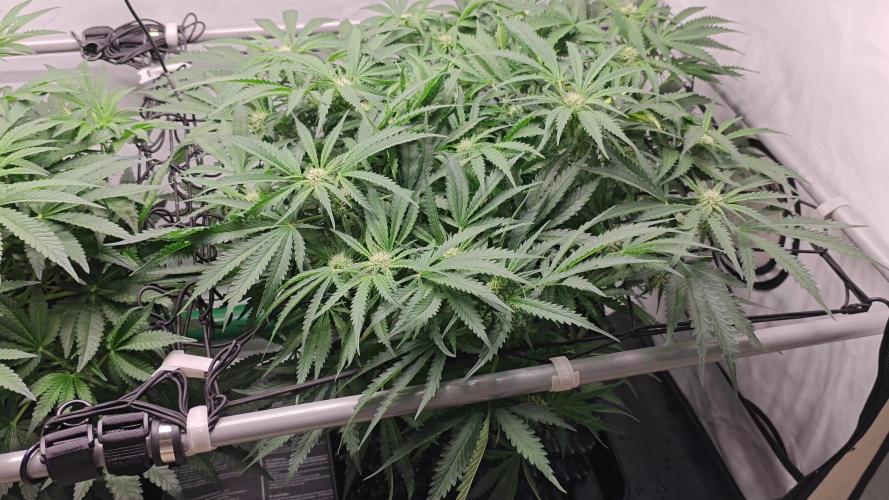
Really happy with the growth. Full of buds. Not much smell get close its a cat piss smell. Im hoping for more bud size development something close too @doctorphilgood

Likes
1
Share


Likes
11
Share


@KcKoolaidMan
Follow
What’s up this is the very start of week five these plants are huge really filling out the screen good. The grow XL really kicked into high gear. Got tons of tops and nodes poking up. Keep folding everything down under the screen and it’s really getting good results. Nutrients are doing great everything has a really nice color.
The DWC plant water got a little high on the PPM for a day towards the end of last week so I started to see a little bit of tipp nute burn butt got the water changed out and everything is looking great again. I topped that plant really good and it’s got a really nice round shape trying to get it to fill the whole end of the tent screen. I’m pretty excited about this plant.
This will probably be the last week of veg well I know it will everything’s in pre flower pretty heavy. And they have a really strong smell for being where they’re at in their life cycle which is cool!
I’ll update again in a few days thanks for stopping by and as always 🍻
Likes
14
Share


@Fatbudz
Follow
I'm sorry, but at the time I stopped updating the diaries because I moved to a new house and changed my routines. I'll leave a photo of the final product here, but don't worry, I'll be back at full speed. 🚀🚀
new diaries coming 🔜🔜

Likes
11
Share


@Sauce_XL
Follow
1.20.2024: Time to gives this a go. 2.3x2.3 tent, XS1500 light, 2 gal fabric pots. Pots filled with FFOF(90%) & Perlite(10%.) Don't ask me why I chose 90/10. Nutrents are the FF Trio. Freebee seed from Humboldt Seed Co(Emerald Fire OG Auto.) Decided to germinate directly into the medium. Light is at 50% power at 2.5ft from the top of the pot(s). I'll have the light running 24hrs until it sprouts(fingers crossed it does.) I sprayed the top soil with pH 6.5 water when i stuck the seeds in then placed clear plastic cups over the seed location. My 4inch fan is on the way and it comes with a monitor for temp and humidity....no idea what current stats are. Just hope the damn thing spouts. Fingers crossed. More to come.
1.24.2024: We've sprouted!
1.25.2024: Took the lil domes off, opened 2/3 vents for some circulation. Been misting the top soil just to keep it moist with 6.5ph water. I also "bottom fed" 12oz of water just to keep things lubricated. On the fence about when to give the plants a proper watering. Might keep things going "as is" for the next two days. Inline fan and associated hygrometer comes tomorrow(1.26) so i'll finally have an idea on what the current stats are in the tent. Will make adjustments at that point in time. Light is 2.5 ft from soil at 50%.
1.26.2024: Inline fan came yesterday. Only set up the probe just to understand temp and humidity. With the light at 50%, 2 ft from the soil, all vents closed except one(1) port at the top, my current temp hovers around 79 and the RH is 50%. After setting up a humidifier, i'm now running 75 degrees, 64% RH and VPD .58. All within tolerance. I can already tell it will be a delicate dance managing heat, exhaust fan speed and humidity. Still haven't given the plant more than 2 cups of water and i'm only watering when the soil is dry. Tomorrow(1.27) marks 1 week since the seed was dropped. Plan is to lightly water the entire pot when dry for the next week or until growth really kicks in.

Likes
7
Share


@Mr_nugs_lover_David
Follow
My beloved Black cherry punch pheno 2 is looking absolutely stunning, those indica leaves makes me go nuts 🤪, absolutely beautiful strain not only for its grow patterns but also because her effects is really special to me, it's the perfect mix between sedative sleepy high but has a really mellow happy sensation, this is plant is the perfect choice for all of the people that consume pills that fucking kill you with overdose, cannabis is a miracle! Follow me on my journey growing my cannabis that I use with recreational intentions however It helps me with certain little pains due to sport. Hope you guys enjoy my work!!


Processing
Likes
13
Share


@VALHALLA
Follow
Northern Light & Quick one - Week 3 vegetation
Box 60x60x180cm
Bio - bizz light mix
Mars hydro TS600 - 18/6
Plagron alga grow 3ml/L
Plagron Vita race 5ml/L , once a week
I'm happy with the RQS strains for my first time :)
Likes
3
Share


@Adam420
Follow
She is short but damn she packs a punch.
Bushiest plant I’ve had.
Bottom 1/3 has reveg issues. Some dead/brown calyx closest around the stem. Cleanup is a bitch but I want to keep the bottom 1/3 weed as personal

Processing
Likes
28
Share


@Datiko
Follow
She is doing soo good. i think she will give me a lot of buds. I think that 2th LST experience was succesfull too... she will have 4 main cola now.

Likes
21
Share


@BLAZED
Follow
Week 14 (2-5 to 8-5)
2-5
Temperature: 27.3 degrees (lights on) 19.5 degrees (lights off)
Humidity: 69% (highest) 52% (lowest)
Watering: 2000 ml.
3-5
Temperature: 24.2 degrees (lights on) 19.3 degrees (lights off)
Humidity: 68% (highest) 50% (lowest)
Watering: None.
No pictures.
Increased the light's power output to 90%
LUX: 22.500
4-5
Temperature: 24.1 degrees (lights on) 20.3 degrees (lights off)
Humidity: 63% (highest) 43% (lowest)
Watering: 1000 ml.
5-5
Temperature: 24.8 degrees (lights on) 20.3 degrees (lights off)
Humidity: 66% (highest) 43% (lowest)
Watering: 1000 ml.
No pictures.
6-5
Temperature: 24.4 degrees (lights on) 19.4 degrees (lights off)
Humidity: 66% (highest) 44% (lowest)
Watering: None.
7-5
Temperature: 24.4 degrees (lights on) 19.2 degrees (lights off)
Humidity: 66% (highest) 44% (lowest)
Watering: 1000 ml.
8-5
Temperature: 24.2 degrees (lights on) 19.4 degrees (lights off)
Humidity: 65% (highest) 48% (lowest)
Watering: 1000 ml.


Likes
119
Share


@Natrona
Follow
***DIVINE SEEDS *****
*****OPIUM*****
Sponsored grow
Week 4
Germination April 6.
Week 1 water only
Week 2 water only
Week 3 added recharge and* TPS1 increasing ppm to 570.
Week 4 added calmag, did LST and defoliation. Before & after pics. Increase ppm to 685
This week 4/28-5/4 consisted of plain ph 6.6-6.9 water with recharge, calmag and TPS1.
4/24 updated my ACInfinity app and started using the advanced programming settings for early vegetation. This is keeping humidity in 70% with temps in 80.
What I don't like is using advanced programming, the humidifier is at level6 . This spews moisture directly on my plants, into the drain tray and floor.
5/1 I did some LST and defoliation. Before and after pics above.
Until the plants are big enough to go outside, I will be using my AC Infinity tent and equipment. Once outside, I will be watering with well water and recharge and any additional fertilizers or amendments will be determined at that time.
Thank you @DivineSeeds
Thanks for the likes and comments, I appreciate all the plant love💚.
Have fun & love what you grow 💚
Sending love and light 💫
💫Natrona 💫
DIVINE SEEDS
***OPIUM***
Harvest:1000 g/m2
Divine Seeds developed Opium as a new champion strain, unprecedently powerful and loaded with unbelievable quantities of resin. Certainly, no average genetic base could be behind such brilliant parameters! Several Afghani Indica landraces, recognized as most potent and resinous, were bred together with a mighty Brazilian Sativa which Opium inherits its bright berry taste from. Then a great deal of work followed aiming for the highest THC level and endurability as well as a branchy structure that would provide maximal yields. Now we can proudly title Opium the best Indica you could dream of growing!
Indoors these plants mostly stay mid-height (1.5 m), reaching up to 2.0 m out of doors. Depending on your height limitations, Opium flourishes universally in grow boxes, balconies, green houses and terraces. Due to its Afghani parentage, this strain can stand hot weather if provided enough water and some shadow. Responds well to any training techniques: ScroG and SoG, LST, topping and FIM, supercropping. The start of blooming is marked with a rush of growth, when plants stretch almost 1.4x. Expect heavy colas that often require additional supports. Whilst ripening, Opium gives off a pungent earthy stench with fruity and berry undertones, also a bit of pine. Ready for outdoor harvesting in October.
The stoning psychedelic impact of Opium is like being hypnotized (unless you’ve had too much, then it feels more like a blackout). Stone-lovers will appreciate every minute with Opium: its spicy taste immerses your mind into daydreaming, while the body rests flat. Recreation with this psychedelic Indica means silent tripping from one insight to another. Mighty enough to kill chronical pains, Opium is also medically efficient against insomnia, nausea, appetite disorders, muscle spasms, headaches, irritation, fatigue, panic attacks, epilepsy. Best consumed at night time, the effects keep going for up to 4 hours.
Equipment and nutrients
Pots: 5gallon Air pots
Soil Fox Farm Happy Frog Amended with worm castings, dolomite lime and mychorihiza Recharge
Seeds provided by Divine Seeds
Divine Seeds breeding company
The link to Opium Feminized Seeds
Opium - Divine Seeds breeding company
The link to Opium Auto Seeds
Auto Opium - Divine Seeds breeding company
=================================
Equipment: AC Infinity
CLOUDLAB 844 – Advance Grow Tent 48”x48”x80”
CONTROLLER 69 PRO – Grow Tent Controller
CLOUDLINE LITE 6 - Inline Fan 6"
IONBOARD S44 – LED Grow Light Board 400W
CLOUDRAY S6 – Oscillating Circulation Clip Fan
Carbon Filter 6” 4
Likes
6
Share

@OldDrGreen
Follow
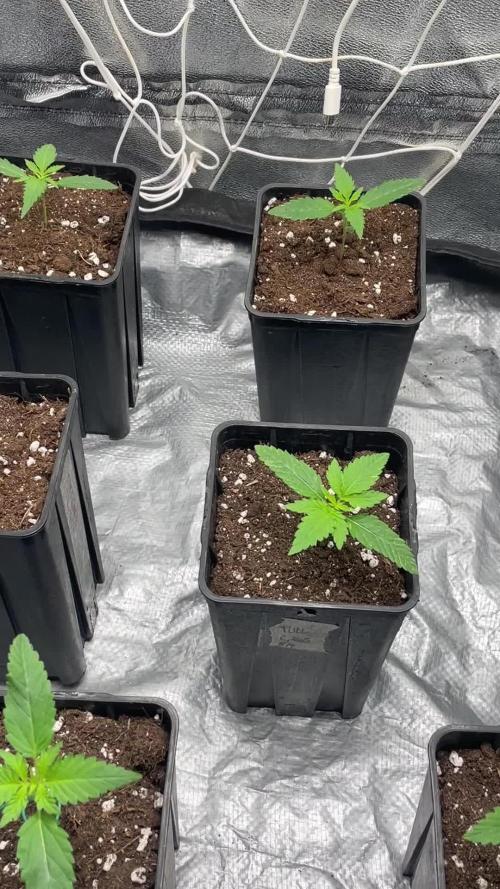
Vasi da 1 litro**: Assicurati che i vasi abbiano fori di drenaggio per evitare ristagni d'acqua, che possono danneggiare le radici.
- **Terriccio Biobizz**: Questo tipo di terriccio è già arricchito con nutrienti organici, ideale per la coltivazione di cannabis. Riempi i vasi con il terriccio, lasciando un po' di spazio in alto
- **Solo acqua**: Utilizzando solo acqua, il terriccio Biobizz fornirà nutrienti per un periodo iniziale. Tuttavia, dopo alcune settimane, le piante potrebbero necessitare di ulteriori nutrienti. Puoi considerare di aggiungere un fertilizzante organico quando le piante mostrano segni di carenza. H
Likes
43
Share


@TheCannaProphet
Follow
~ FastBuds PAPAYA SHERBET Photoperiod~
Well here we go on another journey together through 'Canna-land' and this one's kinda special... forget that, it's VERY special because this is FastBuds newest surprise for the community, a FEMINIZED PHOTOPERIOD STRAIN!🤯
I was fortunate enough to score these seeds, of which only 1000 were available and can't wait to see what this strain can do! This Papaya Sherbet, according to FastBuds, is a hybrid with a 9-10 weeks flowering period. For a more detailed and accurate description of this strain the following from FastBuds says it best:
"Combining the massive stature of Papaya (Oni Selection) with the strength and resilience of one of our best keeper cuts (Sunset Sherbet), this strain develops into a big, expansive bush adorned with numerous bud sites that later transform into a generous harvest of medium-sized buds. Papaya Sherbet flowers deliver a signature flavor of premium cannabis with subtle citrus undertones that emerge upon inhaling. During growth, her aroma makes for a sweet yet pleasantly bitter fragrance, giving you an idea of what the smoke will taste like. Notably stress-resistant, Papaya Sherbet is a great choice for growers working in challenging environments. She is very forgiving and rebounds quickly from any adversity, allowing growers the freedom to experiment with confidence that she will take everything like a champion she is. This strain embodies resilience, flavor, and abundant yields in every grow cycle."
Sounds like an epic strain and I personally cannot wait for this lady to strut her stuff!😍
________________________________________________________________________________________________________________________________________________________________________________________________________________________________________________________________________________________________________________________
The Setup:
This is going to be an outdoor grow, but I have started the Papaya Sherbet photoperiod indoors as our weather is still a bit too chilly to put a newly sprouted seedling outside (nighttime temp's dipping regularly into the 40's℉).
The plan is simple... let her grow inside under a 19/5 light schedule until the nighttime temperatures are in the mid 50's℉, which shouldn't be long. After which, she'll be moved outside and transplanted into the soil which I have already setup and inoculated with beneficial microbes from BioTabs and slow release dry amendments from Gaia Green. Once she's established herself outside she'll be given periodic top dressings of Gaia Green 4-4-4 and 2-8-4 along with worm castings and Compost Tea's. Her grow area is approx. 5'x5' and I have posts and a trellis net set up already for when she gets bigger to aid in training her. Let the fun begin!🤪💚
________________________________________________________________________________________________________________________________________________________________________________________________________________________________________________________________________________________________________________________
Weekly Updates:
7/26- Week Eleven of veg is here and the FastBuds Papaya Sherbet photoperiod is getting taller by the day and is looking fantastic!
Our summer weather continues to be brutal with daytime high temperatures hitting over 90℉ everyday, and nighttime low temp's rarely going below 75℉ with super high nighttime RH in the 70-90% range.
7/28- I am continuing with my daily watering regime of 5-8g every afternoon after sunset, with the exception of days that we receive measurable rain.
7/30- The Papaya Sherbet photo is continuing her growth spurt and is at 6 1/2 feet tall now! She's got that wide node spacing reminiscent of Sativa's, and I'm just hoping that she doesn't wait too long to begin flowering which would run into our wet season when issues with fungus and mold become more of a concern.
8/1- The FastBuds Papaya Sherbet photoperiod is now 84 days since she first appeared, and she has really come a long way since. Hopefully in the next few weeks she will shift gears and begin to flower which will be a welcome sight to see!
Thank you for checking out my diary, your positive comments and support make it all worthwhile! 💚Growers Love!💚😎🙏
Likes
30
Share


@DankeyeBeaverjuice
Follow
The aroma of wood and lemon is over whelming as I did a light defoliation during the start of the week, this will aid in finishing up the lower bud sites.. Super close to harvest now but she is still throwing out fresh white hairs so I know there's some fattening up to do. Counting these last fleeting days can always feel so taxing don't you agree? Anxiously awaiting harvest time now, patience in all good things. 💪

Likes
8
Share


@OrionSparkles
Follow
🐹I pruned them FIM a few days ago, and future outbreaks appear. I also did a slight large leaf defoliation. 👌🏻

Likes
40
Share


@Drgreenthumb627
Follow
This girl is growing gorgeous and super frosty, hints of blue/purple are starting to show deep in the buds. she doesn’t seem close to finished pushing out new pistils, i would say she has at least 3 weeks left. i am switching to only water at this point, so that she starts to utilize the last of the nutes in her soil
