


Likes
Comments
Share


@Brown832
Follow
Topped two of the taller ones, trying to get them all the same height. Possibly thinking of doing scrog or sog.
Brought the light down an inch or so.
Started to give them bio buzz bio grow
1.5ml /l
Little video and a picture of the setup.
Seem fine at the moment no complaints

Likes
5
Share


@CaliBlueDreamin
Follow
Despite the scrog failing, I was able to train some branches to the outer band. Have a lens coming in tomorrow for trich inspection. Currently most mature plant (red) is looking to have some cloudy for sure. Red probably got her last heavy nutes this week. Cut grow big for white. Will do a semi flush with pH'd water with light cal mag and big bloom on next feeding followed by a final full flush. Ripening seems to be staggered 5-7 days plant to plant red -> white -> blue -> yellow
Depending on how things look on the lower buds.I am definitely considering a gradual (ripe bud) harvest approach.

Likes
3
Share

@DE_BW
Follow
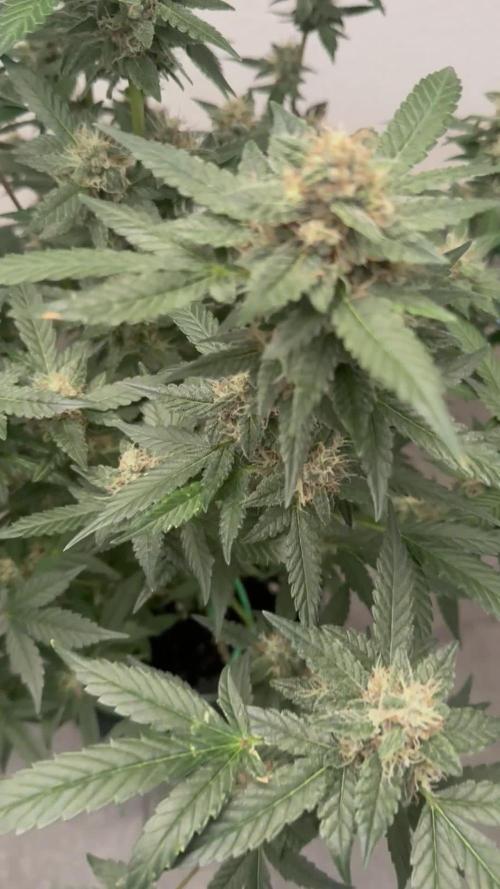
She is looking great. I would guess that the harvest is in ~10days
D65: 4l
D67: 4l
D69: 4l

Likes
5
Share


Likes
4
Share


@buzbun
Follow
smoke is really good.strong taste and effect that you feel imideately.some times i catch a good paranoia with this strain.good psy effect. maybe it cause 11/13 light cycle. few hours after smoke good to sleep or eat smth good.not for day smoking.somy buds i stored in vacuum bags they very dense after this


Likes
27
Share


@PotCasso
Follow
This girl was a last minute space filler, but she is so much more than just that. So purple she is black so frosty she looks white. When you open up the bud the rich purple completely covered in white frost continues all the way through the dense resinous buds. She smells sweet and fruity with hint of milk and pepper hidden in there and OG finish with gas and that flavour come straight through the smoke and lingers on the tongue.
Of course I didn’t clone her so we’re trying a reveg!

Likes
6
Share

@sedygrows
Follow
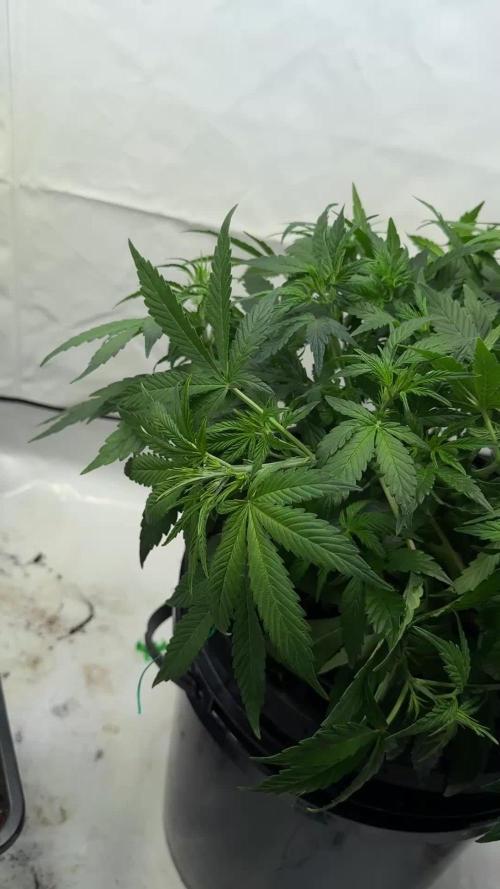
The scrog was no good idea. Had to remove it today. Problems: unable to switch water properly and can‘t clean the tank during the process. So.. scrog is gone and the LST is back 😂


Likes
9
Share


@Medgrow93
Follow
Haven't had much time to take care of the plants, just fed once with 2ml/l of Bachumus Evolution Floración and that's it. The leaves continue to yellow. They're starting to smell a lot now, will probably have to use the filter in the next couple of weeks.



Likes
71
Share


@TOTEM
Follow
Day 29: She’s growing fast now. I’m trying to keep her short with continuous LST. I think I saw the first pre-flower on day 28.
Day 30: There were too many leaves, so I did a huge defoliation to free up lower branches.
Day 31: She reacted in the best way possible to the defoliation. Look at the amazing growth from 4:30AM to 11AM. 😜 Later that day I did a SUPER CROPPING (hyper would be better) on EVERY branch I could see. I know, that’s a crazy, fool, move, but if I don’t do stuff like this I’m not happy. Many hearts for you, lovely Stress Killer. I know you hate me now, but it’s for your best interests!
Day 32: Recovering from super cropping.
Day 33: Almost totally recovered, creating new branches, strengthening existing ones and showing new pre-flowers. Veery nice!
Likes
28
Share


@Luv2Grow
Follow
Day 50 - Starting week 8 and looks like her stretching has just about stopped and hopefully now she’ll really start packing on the flowers. She’s getting fairly dry already so she’ll get another round of plain water tomorrow then the feeding after that, she’ll get some nutes. She’s got a couple of burnt tips from the nutes but not many so I’ll continue at the dosage I’m using.
Day 52 - Didn’t get the chance to update yesterday but she got two gallons of water and nutes. I’m seeing a few leaves starting to lighten up a bit so thinking she’s gonna need higher doses of nutes so next feeding I’ll up the dosage. Other than that, just trying to keep everything tucked nicely in the tent and the flowers are really starting to stack up nicely.
Day 54 - Overall she’s looking good and really starting to pack on the flowers. I am a little worried because she’s got a little yellowing going on with some of the upper to middle leaves but not too bad. Hoping I fixed the issue with a nutrient feeding the other day cause pH and everything are all good, right in mid to upper 6’s. Just gonna keep an eye on her and make sure it doesn’t get worse. As long as she’s packing on flower, she should be ok.
Day 55 - All still looking good and not noticing any new leaves yellowing so hoping I caught the deficiency early enough. Other than that, flowers are really filling in nicely. She’s got another day or two before she needs some water.

Likes
16
Share


@BluHaze007
Follow
All girlz are about to finish up on time and are doing well. I hoping that they all don't finish at once because I only have a 2x2 drying tent. I gave them their last feed this week. They are still drinking up water every three days. I increased the PPFD, but I read that it's not going to increase the size of the buds or harvest time. Just wanna make sure the buds at the bottom get more exposure to light.
Likes
15
Share

@Bread_n_Buds
Follow
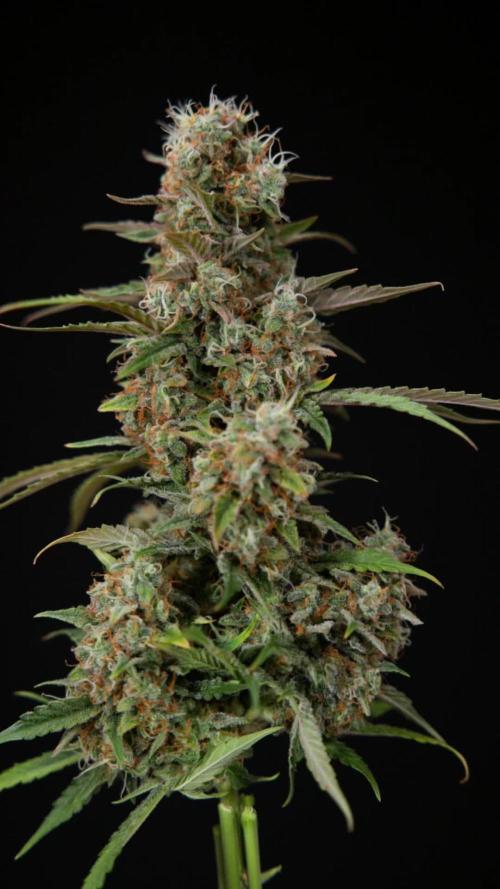
Our Tangerine Dream was born slightly later than her sisters, which is why she finished last; otherwise, in about 10 weeks, she would have done everything, and done well too.
The plant has developed a nice cannabis body where it has developed some really juicy, resinous, meatball-shaped flowers.
We flushed well, so much so that we can see some natural yellow discharge on the plant's leaves.
Ripeness - The trichomes are even more ripe than usual; for me, they're around 40% amber and beautiful red, 40% milky white, and 20% transparent. The plant is slightly sativa-dominant, say about 60%-40%, and for this reason, I didn't want to let it ripen too much to avoid turning it into an indica. I vape a lot during the day and don't want to be distracted.
The pistils are 80% red and the rest white. We're ripe for me.
The buds are abundant and of high quality, both in the main cola and the peripheral part. We'll exceed the 100 grams we've often reached or exceeded with recent autoflowering plants.
The overall shape of the plant is truly splendid. It was harvested correctly at the right time, naturally.
Techniques chosen: As mentioned, the planta was left to grow freely and beautifully.
We went 100% organic and 1000% Plagron, as always.
The soil we chose is the recently launched Plagron Bio LightMix, which will allow us to start with more gradual and reliable watering, without the sudden changes that liquid fertilizers can cause. A week of soil is sufficient, so don't overdo it.
Choose your favorite style and calculate your results on the website:
www.plagron.com
Visit the new Growshop area on the Zamnesia website:
Z - https://www.zamnesia.io/it/531-growshop
An excellent strain, excellent yields, compact buds, and excellent resin! Smells like heaven!
Z - https://www.zamnesia.io/it/10967-zamnesia-seeds-tangerine-dream-automatic.html
Z - Looking for a strain with citrus aromas, an uplifting effect, and a short life cycle? Tangerine Dream Auto ticks all these boxes and more. Combining G13, Afghan, and Ruderalis genetics, this strain is a faithful reproduction of the original feminized Tangerine Dream, but in a more compact and faster autoflowering version. With 60% sativa-dominant genetics and 21% THC, it produces a stimulating and creative cerebral high with a relaxing physical sensation. Whether grown indoors, outdoors, or in a greenhouse, this autoflowering strain offers a one-way journey into the euphoric world of sativas.
The original Tangerine Dream is renowned for its striking appearance, vigor, and productivity. And Tangerine Dream Auto is no exception. Expertly bred to preserve the characteristics of its photoperiod cousin, Tangerine Dream Auto plants produce tall, sturdy plants that quickly complete the vegetative phase, forming a dense canopy of healthy green leaves. True to their sativa heritage, these plants tend to stretch once flowering begins. However, Tangerine Dream Auto rarely exceeds 70 cm, whether grown indoors or outdoors. Around 11 weeks after germination, these sturdy plants will be covered in long, bright green buds coated in orange fuzz and glossy, milky resin. On average, Tangerine Dream Auto plants produce up to 500 g/m² indoors and 300 g/plant outdoors.
You know it, but I recommend it. Here you'll find so many wonderful things, essentially "all the best that nature has to offer."
Z - www.zamnesia.com
Music //
www.radionula.com
+ Feng Shui Music
+ 432 Hz Frequencies

Likes
5
Share


@CannaBossBizz
Follow
Nothing really Changed. Did a topping today. She's A little taller. Love to See her growing ❤️


Likes
21
Share


@Mr_Motalovah
Follow
Hello Growers and Tokers! 👋 👩🌾 🧑🌾.🔥💨
Sorry for the delay on the weekly updates, had some things I had to attend but I'm back and at it!
21-day defoliation has come..
These pictures were taken on day 20 of flower
As you can see in the pictures I did a little defoliation of the bigger fan leaves.
She's pretty advanced compared to the other ladies. Buds sites are formed, strong aroma going.
Her structure looks like a straight up garden bush. Took the LST great ended up with a nice open, spread canopy.
With the defoliation done, buds will be getting much more light exposure and grow a bit more before gaining weight.
Really happy with the results so far with this strain.
That's it for this week
One love!

Likes
38
Share


@FrulaFrulaki
Follow
A lot of spreading this week. They basically doubled in size if not more and are now starting to grow up. Due to this incredible growth I've cut some leaves of the bottom; they've just gotten over grown by other leaves and the top to let more light in.

Likes
176
Share


@DevilsBud
Follow
Hallo fellow growers.
Happy to be in week 3 of veg with Cookies Gelato . I def enjoy how they are developing into something beautiful.
Hopefully with all the love there getting
They will continue to grow happily ☺️
I maybe going to be doing some Topping at one of plants in the end of the week and start little LST test with the LST clips see if they work
Day 15 Veg Phase
💪🌿👍
Day 16 Veg Phase
Today i am going do some LST test on the cookies gelato #2 . The other plant i am going to leave alone for now #1 is going a lil slower then #2 and maybe i am going to do nothing to #1 and see if there is a difference . I am still learning and want to try out all Dif grow techniques .
Also later today i have topped the #2 too hope it all goes well
Day 17 Veg Phase
I think topping has worked will see in few days if heals up quickly so far so good 🤞
Also the soil was way to dry and i think i put almost 1 liter per plant extra the sides where bone dry and that is not good for roots to move true dry soil
Day 18 Veg Phase
Overwatering was not harmful at all they are still growing strong . So i might start giving them more water every 24 hours then they would normally get . Also i recommend the LST CLIPS 👌👌💯
Also have bin LST the main on both plants
Day 19 Veg Phase
I have bin pulling the main on both plants further to the side bit by bit don't want to overstress them . It will also be the only thing i am Going to do to the plants. And let topping heal and the LST on the main get more of a bend . The LST clips going to use later in stage
Day 20 Veg Phase
Did some more LST on main of plant #2
Plant #1 got topped and some more LST
Day 21 Veg Phase
Leaving the girls alone today to let them heal and grow
Have nice weekend growmies 🤘🤘