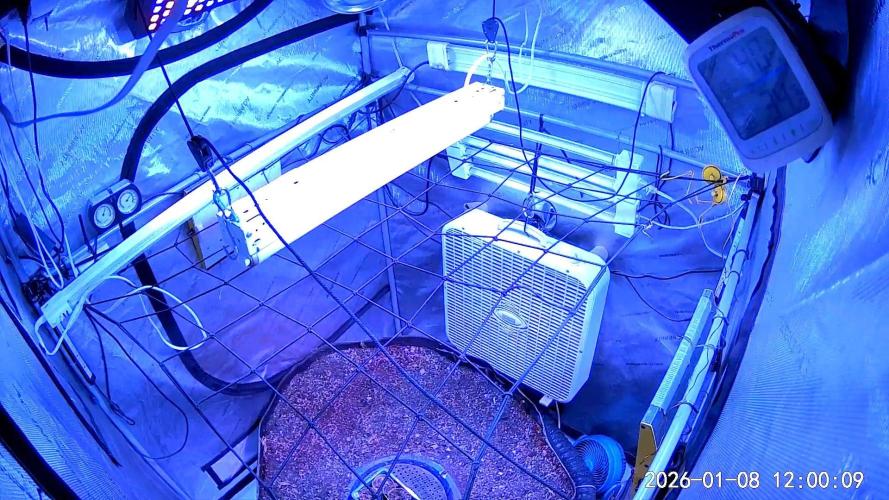
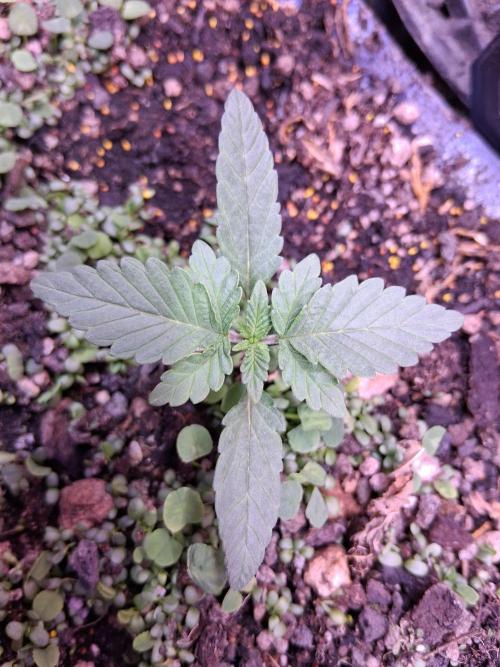
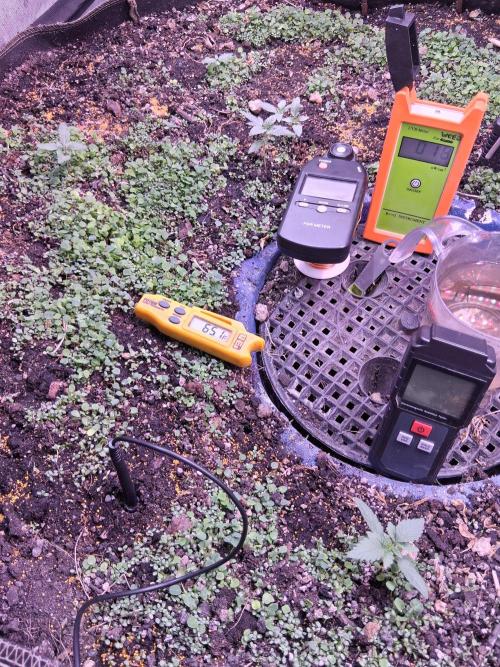
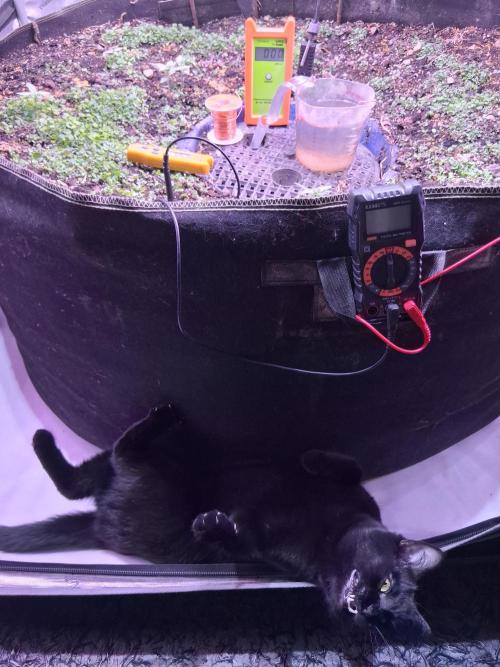
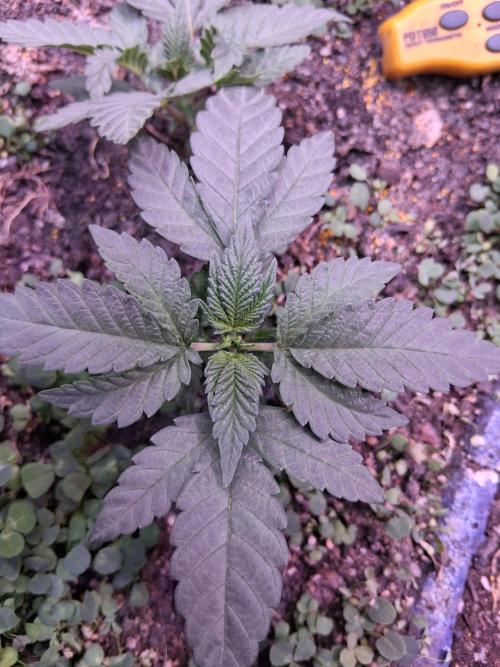
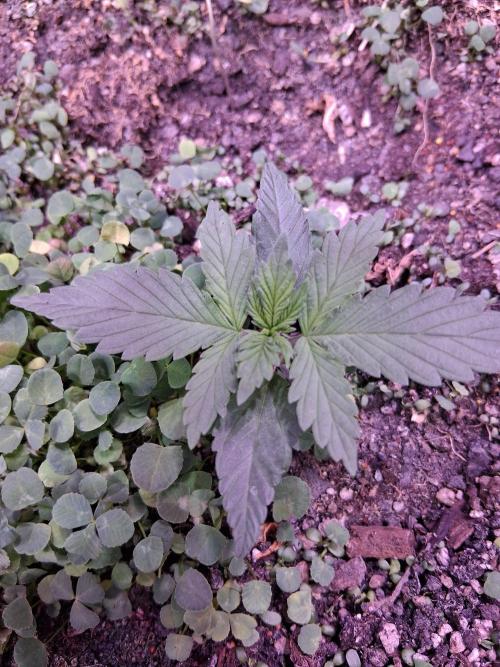
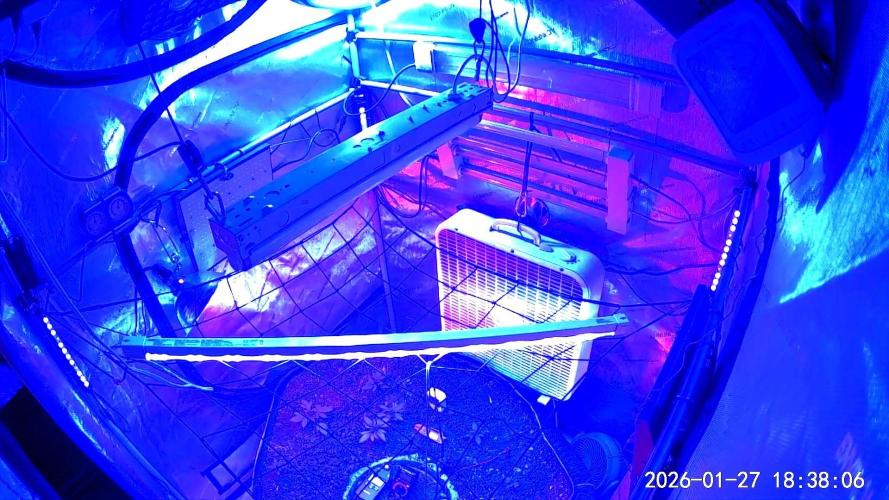
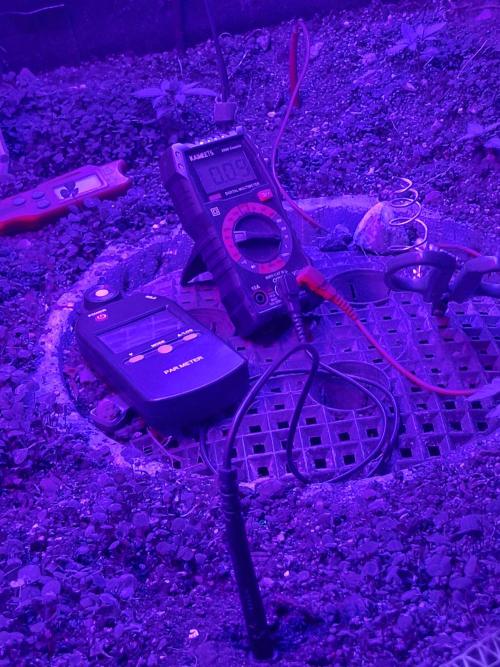
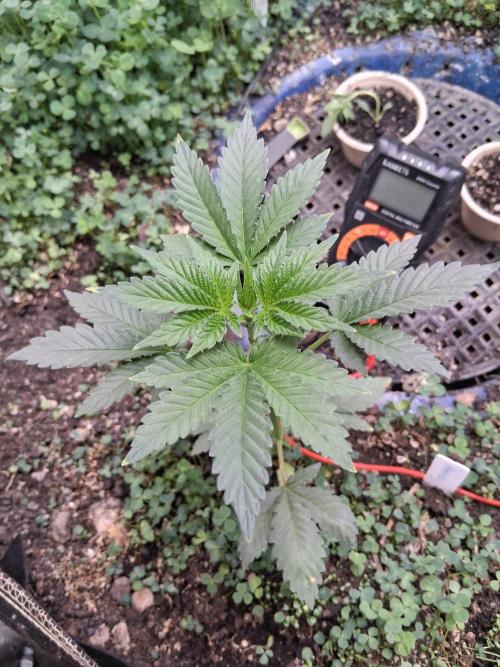
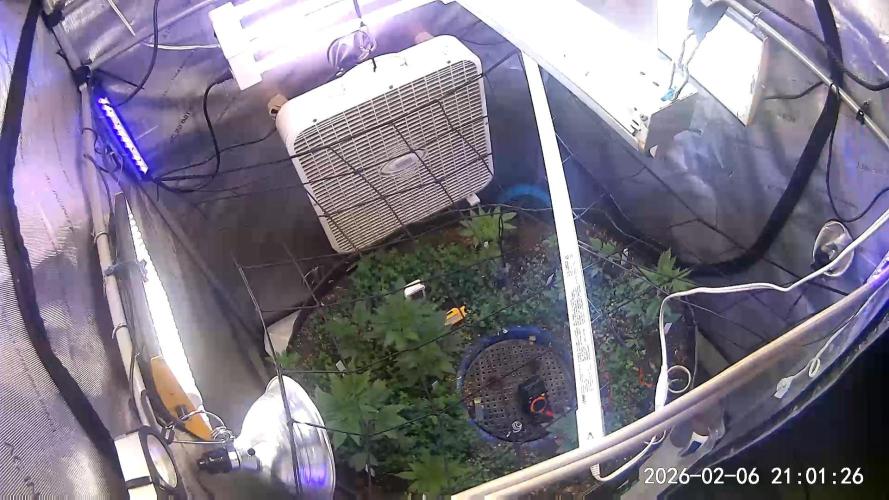
Ultraviolet Not particularly growing for speed or any dedicated reason this time round, just adding water and a abundande of positivity, gotta admit I do like the autoseed logo. Off we go again into the magical forest.
(Arthrospira platensis) cultivated in high-alkaline, mineral-rich water in Kailua-Kona, Hawaii. It is renowned for having a higher nutrient content, including more carotenoids and essential fats, compared to other spirulina brands. It is frequently cited as a "complete food" due to its dense concentration of proteins, vitamins, minerals, and pigments.
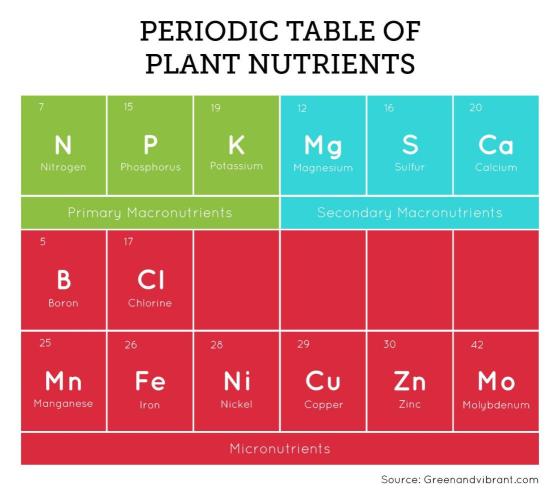
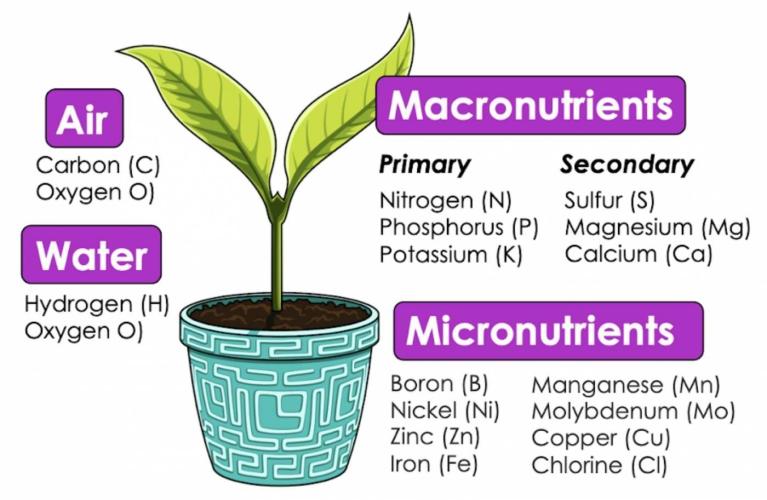
The nutritional profile of standard dried Spirulina platensis biomass. 3kg of spirulina powder has an approximate NPK ratio of 10-2-1 (or 10% Nitrogen, 2% Phosphorus, and 1% Potassium).
Here is the breakdown of the nutrient content for 3kg of powder:
Nitrogen (N): ~300g (10% of total mass)
Phosphorus (P): ~60g (roughly 2% of total mass)
Potassium (K): ~30g (roughly 1% of total mass)
3kg of spirulina powder is more than enough nitrogen for 4 cannabis plants in a 100-gallon pot—in fact, it is likely excessive and could cause severe nutrient burn or toxicity if not properly managed. Spirulina has a very high protein content (46% to 63% dry weight), which translates to a significant nitrogen source. It is often described as a 5-1-1 NPK fertilizer.
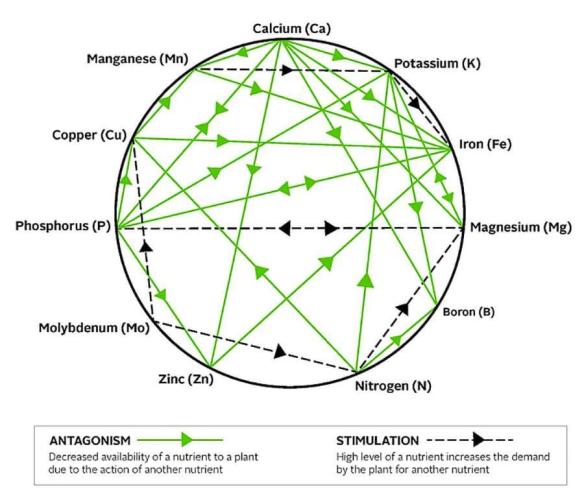
3kg (3000g) of powder in 100 gallons means 30g per gallon. General organic recommendations for potent amendments (like frass) are often around 1–3 tablespoons per gallon. 30g of powder is roughly 2-3 tablespoons, making this a very high-strength application rate if added all at once. Balance this with calcium/magnesium, and organic nutrient delivery in soil growing can lead to deficiencies in these nutrients.
Not all of that 100 gallon is used, so figuring out precise measurements was ballpark, but there is about 10kg of engineered biochar in that pot. Mostly in the top half. Ideally, I'd have 25kg in a full active 100-gallon, but......... don't mess with something that is not broken. Roots do not utilize the entire 100 gallons. This has been a couple of years of trial and error, mostly error. The amount of cations you can add in grams depends entirely on the specific cation exchange capacity (CEC) of your biochar and the type of cation being added. Biochar CEC values vary widely, typically ranging from 4 to over 300cmolc/kg. Multiple Biochars in use, ranging upwards of 100cmolc/km.
Different cations have different atomic weights
Potassium K+ 39.1g/mol.
Calcium Ca2+ 40.1g/mol.
Magnesium Mg2+ 24.3g/mol.
Nitrogen NH4+ 18.04g/mol.
You get more nitrogen bang for your buck. It all depends on the CEC of the biochar you use, but brrrrrrrrrr roughly I'm looking at 500-600 grams worth of elemental cation exchange capacity, give or take. That's just for the biochar alone. Elemental cation exchange capacity refers to the ability of materials—such as soil, minerals, and biochar to adsorb, hold, and release positively charged ions Ca2+, Mg2+, K+, Na+, Al3+, and Zn2+. This capacity is a critical measure of nutrient availability in soil and energy density in electrochemical systems.
Added calmag 2:1 to complement spirulina.
Calcium (Ca): Approximately 150g - 300g of elemental calcium.
Magnesium (Mg): Approximately 75g - 150g of elemental magnesium.
So long as pH stays in 6.3 to 6.7 ish, the plant will unlock hydrogen. Plants will be able to cycle CEC for their own needs. Hydrogen ion pumping (proton pumping) is a fundamental mechanism used by plant roots to facilitate the cycling of nutrients within a medium's Cation Exchange Capacity (CEC), directly increasing nutrient availability. A growing medium's Cation Exchange Capacity (CEC) does not contribute directly to Electrical Conductivity (EC). CEC represents potential nutrient storage, while EC represents active nutrients in the water/soil solution. A medium with a high CEC can hold many nutrients, but if there is no water present, the EC will be low.
98% of plant nutrient uptake comes directly from the soil solution.
2% of nutrient uptake is directly from soil particles.
Nutrients held on exchange sites (CEC) are not directly measured by EC until they are released into the soil solution through exchange with other ions (e.g., hydrogen ions from roots or fertilizer).
Plants source the H+ ions (protons) used in cation exchange primarily by exuding carbon sugars into the rhizosphere, then microorganisms perform root respiration, which reacts with soil water to form carbonic acid H2CO3 that dissociates into H+ and bicarbonate. Roots also actively pump out H+ ions directly to acidify the rhizosphere, plants trade hydrogen produced through metabolism for essential nutrients held by the soil.
In plant cells, the H+ (protons) used in proton pumping across the plasma membrane come primarily from the cytoplasm (cytosol). The protons are derived from internal cellular sources, including metabolic processes that release H+, and the regulation of intracellular pH homeostasis.
Distilled water is highly useful in managing the electrical conductivity (EC) of a growing medium by allowing for precise control over nutrient concentration and assisting in the mobilization of nutrients from the cation exchange capacity (CEC) into the active, plant-available nutrient solution.
Just add water & positive energy.
Potential hydrogen. pH. + - , potential charge balance for hydrogen.
So long as there is adequate oxygen in the soil and air and water moves at a decent interval, its practically impossible for the pH to skew in a soil that is taking in oxygen and releasing CO2 and nitrogen, I say practically, but meh, even with plenty of oxygen, the process of converting ammonium NH4+ to nitrate NO3- by bacteria releases hydrogen ions H+, which directly causes acidification (lowering pH). While water movement is necessary, consistent water moving through the soil can leach away basic cations Ca2+, Mg2+, K+, Na+, leaving behind acidic hydrogen and aluminum ions, causing pH to drop, especially in humid regions. High levels of CO2 in the soil (from intense respiration) dissolve in soil water to create carbonic acid, H2CO3, which lowers the pH. (barometric pumping removes that possibility) The pH in a cannabis cultivation environment, particularly in hydroponic or soilless setups, will often naturally drift towards acidic (lower pH) over time. Understand how to know when to lime the pH back up. Complex but critical. Once I understood this it helped ease the pain of understanding pH.
Base saturation directly reflects the percentage of CEC occupied by base cations. Generally, as base saturation increases, soil pH increases because fewer acidic cations, H+ and Al3,+ are present on the soil colloid surfaces.
At a pH of 7 or higher, the soil colloids are saturated with base cations, resulting in a base saturation of 90+%.
While many sources include Sodium Na+ as a base cation, some calculations focused specifically on plant nutrients (like in some nutrient management contexts) may focus solely on the "Big 3": Ca2+, Mg2+, and K+. However, in soil science and CEC (Cation Exchange Capacity) measurements, sodium is usually included in the definition of total base cations, making it the "Big 4" base cations.
At a pH around 5.5, soils often have a 45–55% base saturation, while a soil with a pH between 6.5 and 6.8 generally has an 80–90% base saturation.
Base saturation is considered a reliable, albeit complex, indicator of soil fertility and the degree of soil weathering, acting as a crucial metric in soil classification and management.
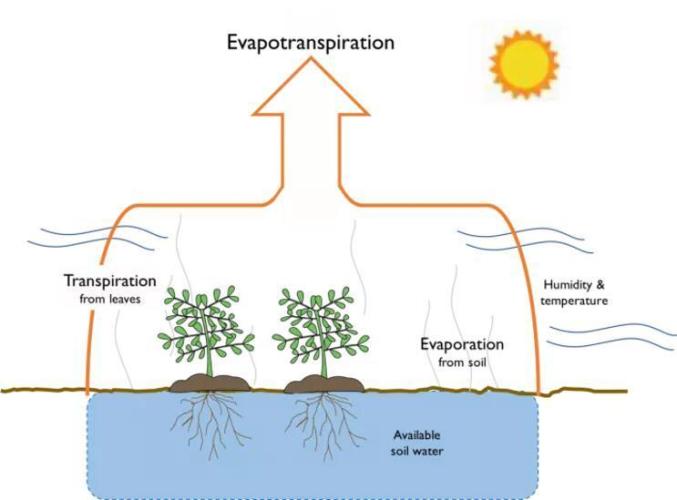
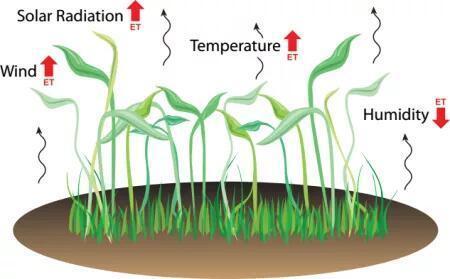
Once you take full control of the pH, so long as there is oxygen, and one keeps tabs on base saturation levels. Its near impossible for anything to go wrong. All you are essentially doing is adding water and waiting for any sign of deficiency. Not so much growing as eliminating the possibilities of things going sideways. Can't over or under water, can't skew pH, can't go anaerobic. Everything runs in optimal cycles, watering every 2 to 3 days or as required, depending on the rate of combined ET. A little warmer, a little drier, but never short on water. All the nutrients are already there in the medium, we still focus on the water, just not adding salts, but to mobilize nutrients held in the Cation Exchange Capacity (CEC) and move them into the active soil solution for plant uptake, the best supplements to add to water are fulvic acid, humic acid, or seaweed/kelp extract. Liquid solutions with high concentrations of essential trace elements. Distilled water has no alkalinity or minerals to help buffer or release nutrients. Adding these supplements turns the "empty" water into an active agent that forces nutrients off the CEC colloids into the solution for plant uptake.
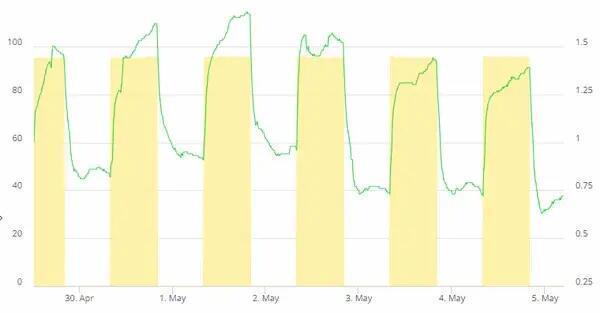
When to water? When Electrical Conductivity of soil gets low. No water, no conductivity.
The Facts:
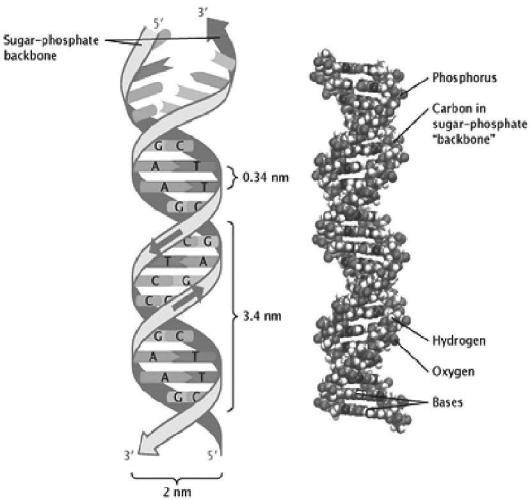
In 1995, scientists placed human DNA inside a sealed, air tight tube with photons. Without the DNA, the photons arranged themselves in a random scattered patter, but when the DNA was inserted, the photons formed an alignment.
Reflect On:
Are there metaphysical, multidimensional aspects to our DNA? Have we just begun to understand what DNA is and what it represents?
Vladimir Poponin is a well known Russian scientist who in 1995, with his colleagues, including biophysicist Peter Gariaev, conducted a very interesting experiment during their time at the Russian Academy of Sciences. In their paper (P.P. Gariaev and V.P. Poponin. Vacuum DNA phantom effect in vitro and its possible rational explanation. Nanobiology 1995 (in press)), Poponin states, in the introduction of the report, that, “We believe this discovery has tremendous significance for the explanation and deeper understanding of the mechanisms underlying subtle energy phenomena including many of the observed alternative healing phenomena.”
Why did he feel this way? We will get to that.
Poponin and Gariaev tested the behaviour of DNA on photons, little tiny bits of matter, in the “quantum” that our world is made up of. They put photons into a tube specially designed to simulate a vacuum, just like the vacuum of space. With no air inside, they inserted the photons as they wanted to see what they did and how they behaved. The photons were distributed in a way that was completely unordered and random, scattered all over the container. This of course was what the team of researchers expected.
Next, samples of human DNA were placed inside the tube with the photons, and what happened next is what’s truly mysterious. The photons reacted to the DNA, and changed their pattern and formed a specific alignment. In the presence of living material, the human DNA, the photons organized! This signified that the DNA was clearly having a direct influence over the photons. It’s one of many examples hypothesizing that something within us has a direct affect on the physical material matter outside of us. This experiment was repeated and confirmed, and it was further observed that human DNA has a direct affect on the quantum ‘stuff’ that our world is made up of. Fascinating to say the least.
The Next Big Surprise
The next big surprise was observed when the researchers removed the DNA from the container. The scientists assumed that the photons would simply return to their original scattered state, but this didn’t happen. Instead, the photons remained ordered as if the DNA were still in the tube. Poponin described the light as behaving “surprisingly and counter-intuitively.”
The researchers hypothesized and were “forced to accept the working hypothesis that some new field structure is being excited.” Is there something being left behind? Something in non-physical form? This experiment tells us that DNA is communicating with the ‘stuff’ our world is made of, and that there is some sort of invisible field that exists. Perhaps DNA represents a place of storage and communications to the past? To the future? To others in the universe who have left their mark, so to speak. Who knows.
Quantum Physics and Consciousness
Nobel laureate of the twentieth century Richard Feynman once said, with regards to quantum mechanics, “we choose to examine a phenomenon which is impossible, absolutely impossible, to explain in any classical way, and which has in it the heart of quantum mechanics. In reality, it contains the only mystery.”
Another great quote that comes to mind anytime the world of science dives deep into the mysterious world of quantum physics:
There seems to be a deep concern that the whole field will be tarnished by studying a phenomenon that is tainted by its association with superstition, spiritualism and magic. Protecting against this possibility sometimes seems more important than encouraging scientific exploration or protecting academic freedom. But this may be changing.” – Cassandra Vieten, PhD and President/CEO at the Institute of Noetic Sciences (source)
The reason why the association with superstition, spiritualism and magic mentioned in the quote above exists when it comes to examining certain phenomenon is simply because the observed phenomenon is unexplainable. But it’s important to remember, just because something is unexplainable does not mean that it’s not real, it simply means we don’t fully understand it yet. Academia has a long history of rejecting phenomenon, that’s clearly real, yet simply unexplainable.
Quantum physics clearly has a strong connection to consciousness, and metaphysical phenomenon. Max Planck, a physicist who originated quantum theory, regarded consciousness as “fundamental,” and matter as “derivative from consciousness.” He said that “we cannot get behind consciousness. Everything that we talk about, everything that we regard as existing, postulates consciousness.”
This has been demonstrated quite clearly by multiple experiments, like the quantum double slit experiment.
A paper published in the peer-reviewed journal Physics Essays by Dean Radin, PhD, explains how this experiment has been used multiple times to explore the role of consciousness in shaping the nature of physical reality. (source)
In this experiment, a double-slit optical system was used to test the possible role of consciousness in the collapse of the quantum wave-function. Photons were shot through two slits, in multiple different ways. The study found that factors associated with consciousness “significantly” correlated in predicted ways with perturbations in the double slit interference pattern. In this experiment, tiny bits of matter (photons, electrons, or any atomic-sized object) are shot towards a screen that has two slits in it. On the other side of the screen, a high tech video camera records where each photon lands. When scientists close one slit, the camera will show us an expected pattern, as seen in the video below. But when both slits are opened, an “interference pattern” emerges — they begin to act like waves.
You can refer to the actual study to find out more about that. If you want to see a visual demonstration of the quantum double slit experiment. The point is, consciousness changes the behaviour of the particles.
“Observation not only disturbs what has to be measured, they produce it. We compel the electron to assume a definite position. We ourselves produce the results of the measurement.”
The study sourced above points out that “factors associated with consciousness, such as meditation experience, electrocortical markers of focused attention, and psychological factors including openness and absorption, significantly correlated in predicted ways with perturbations in the double-slit interference pattern. The results appear to be consistent with a consciousness-related interpretation of the quantum measurement problem.”
The Takeaway
DNA is fascinating, and it’s probably the least understood part of our biology. There are definitely interesting metaphysical non-material aspects to our DNA, and changes to our DNA can come as a result of our thoughts, feelings and emotions alone. HeartMath researchers have shown that physical aspects of DNA strands could be influenced by human intention. The article, Modulation of DNA Conformation by Heart-Focused Intention – McCraty, Atkinson, Tomasino, 2003 – describes experiments that achieved such results.
15 likes
5 comments
Share
1
Week 1. Vegetation
14d ago
1/26
7.62 cm
Height
12 hrs
Light Schedule
Ultraviolet The most important contribution that any man can make to a garden -- even more important than water or compost-- is the radiation he himself puts into the soil while cultivating it.
Epinoia
(ἐπίνοια) is a Greek term meaning thought, intention, purpose, or conception, stemming from "mind" (nous) and "upon" (epi), representing the mind's reflective or creative process, used in philosophy (Aristotle, Gnosticism) and theology to discuss understanding and divine names, appearing once in the New Testament for the "intent of your heart" (Acts 8:22). It signifies the mind's operation to form ideas or designs, contrasting with raw data or innate perception, and in Gnosticism, it's an emanation of divine wisdom (Sophia).
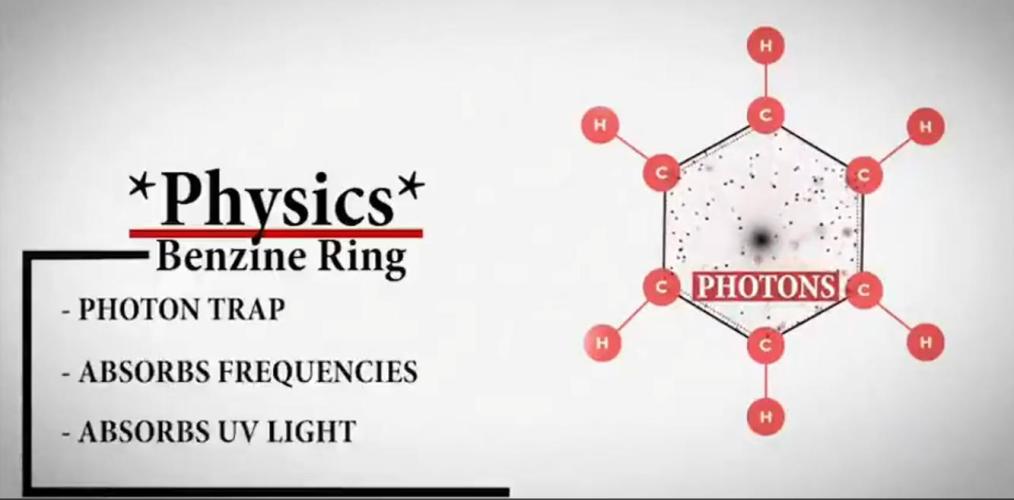
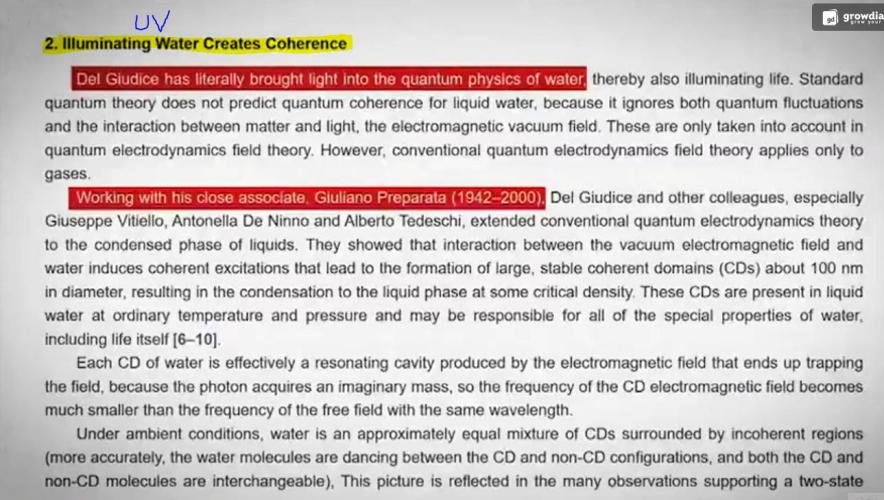
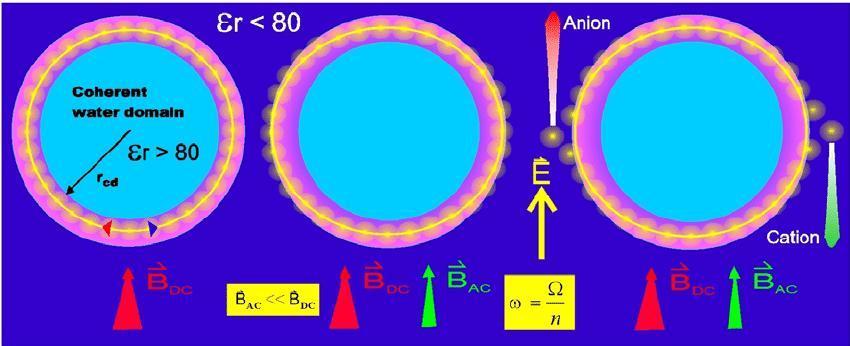
Exclusion Zone and Coherent Domains in water, broken down into layman’s terms. Imagine you have a glass of water with tiny particles (like dust or dye) mixed in. Now, put a special surface—like a gel or a hydrophilic (water-loving) material—into that water. Next to that surface, a layer of water forms that is totally clear. All the particles and dye are pushed away from it. This water is not just liquid; it has changed into a structured, gel-like state. It "excludes" solutes (particles), hence the name "Exclusion Zone" or EZ water. To understand why the water behaves this way, scientists look at "Coherent Domains" (CDs). Molecules move randomly, like a chaotic crowd. A group of water molecules gets energized and starts acting as one single unit, moving together in perfect rhythm. This state is created by electromagnetic energy and quantum effects, forming organized, crystalline-like structures. Think of a flock of birds or a school of fish. They aren't tied together, but they move in perfect unison, reacting as one. In a Coherent Domain, water molecules act like this synchronized flock rather than independent, random molecules.
Coherent Domains are the "rhythm" or the "structure" inside the water.
The Exclusion Zone is the physical space where this structured, coherent water builds up next to surfaces.
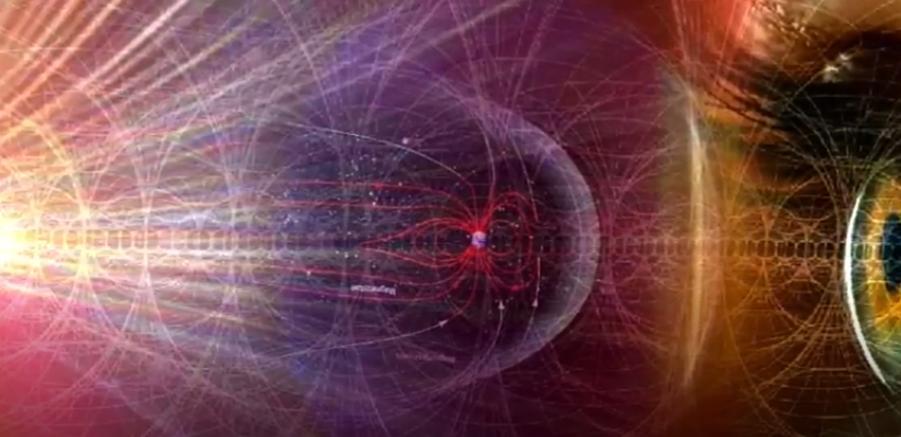
The interaction of light—specifically UVB light—with liquid water generates quantum Coherent Domains (CDs).
This type of water is believed to be vital for biology, acting as an energy storage system inside our cells, as EZ water forms naturally around membranes and proteins.
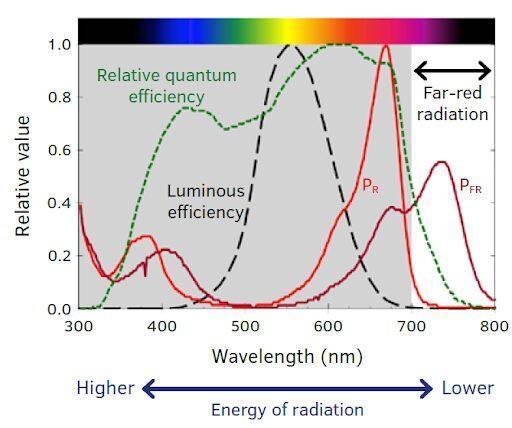
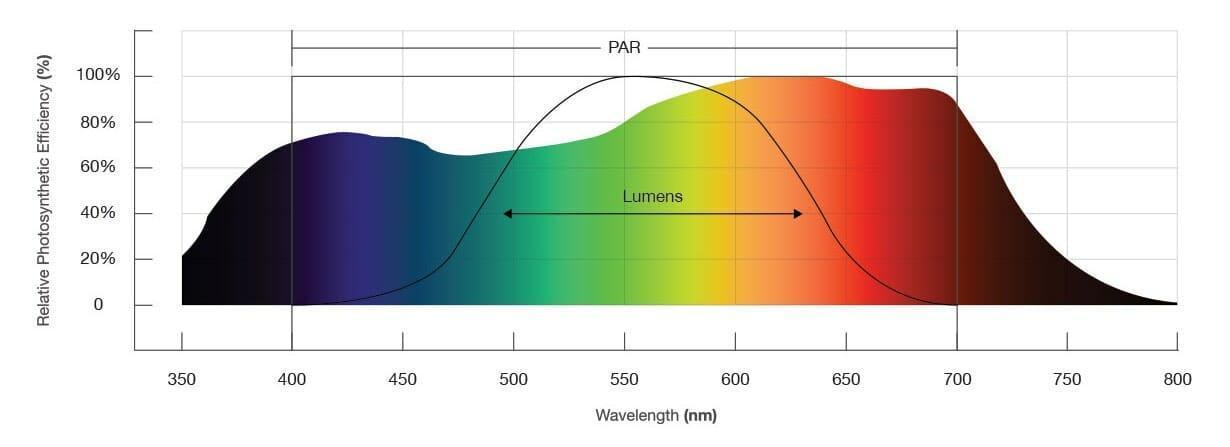
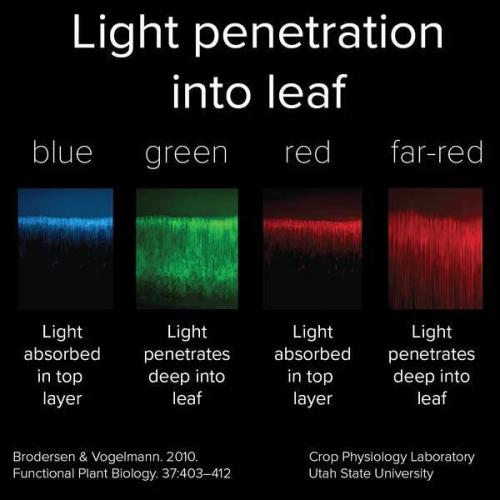
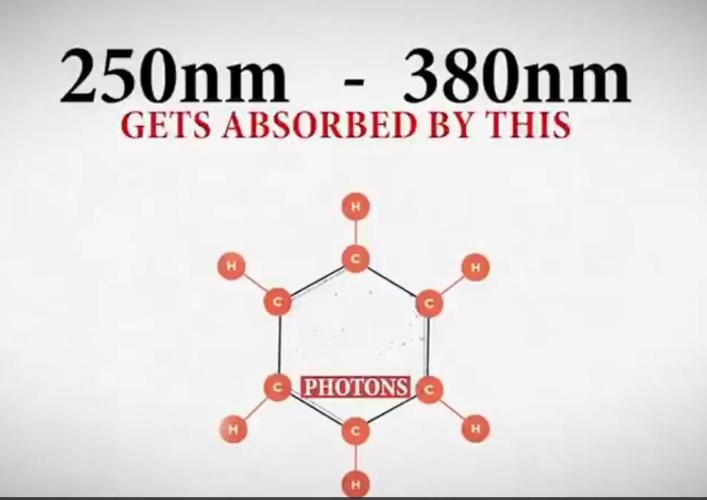
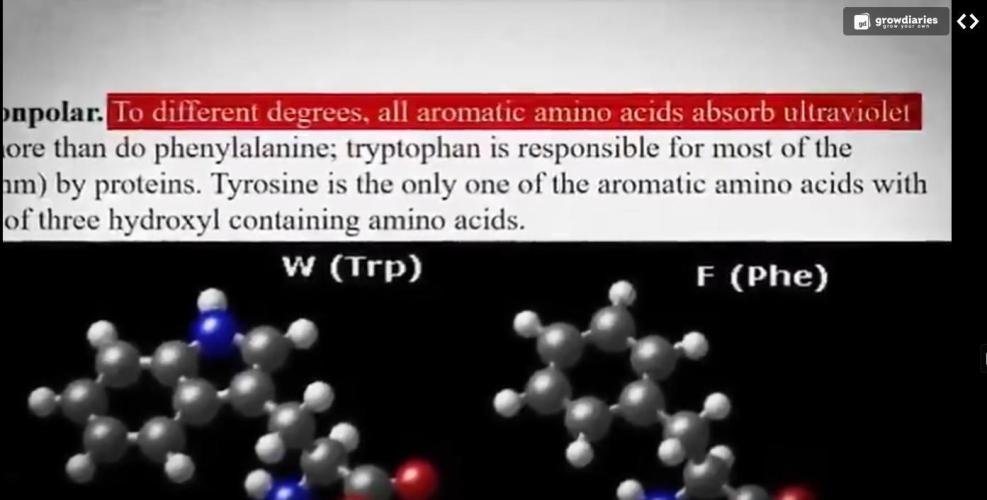
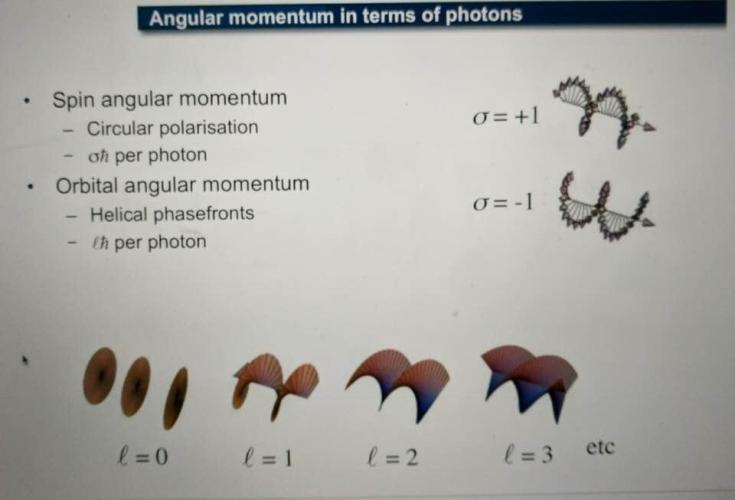
Light has a duality fundamentally. It can act as a particle or a wave photoelectrically. You do not have to understand or like this, just accept it because nature is absurd at times in what she gives us. When the EZ forms, the EZ then begins to absorb light in the 270 nm range to increase the EZ power and potency. This is in the ultraviolet range. Water absorbs ideally in the red frequency range 1500 nm -3000 nm. Red light builds the battery, and once the EZ is formed, UV light adds massive power to the EZ to drive all biochemical reactions via enzyme flux using proton tunneling. Releasing millions of almost free electrons. But shhhhh it's a secret.
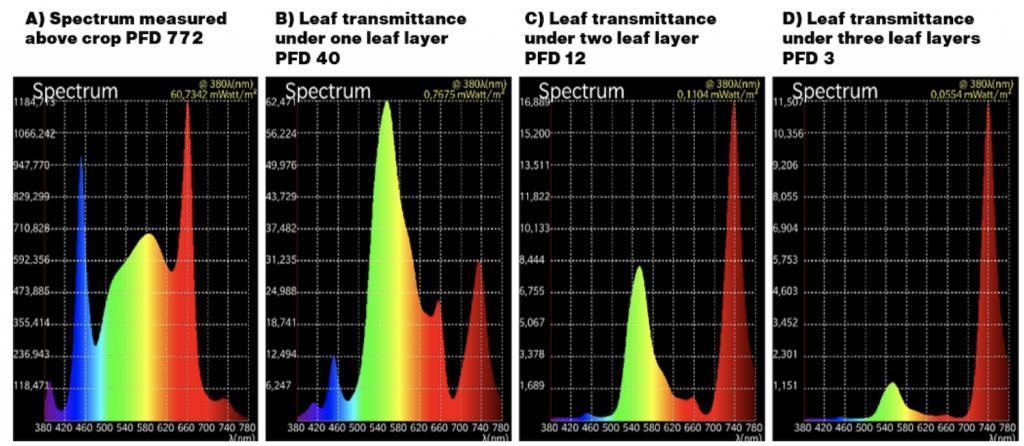
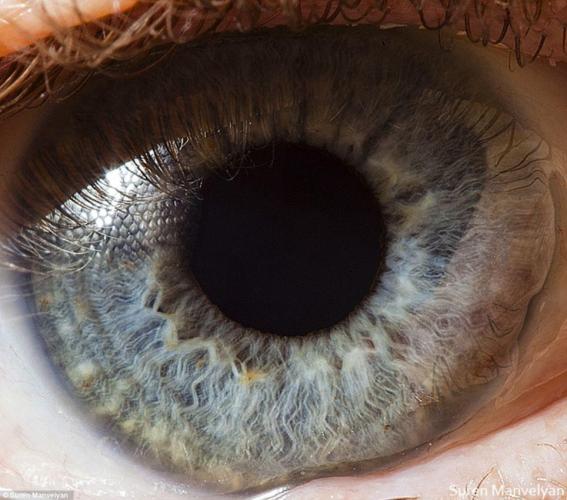
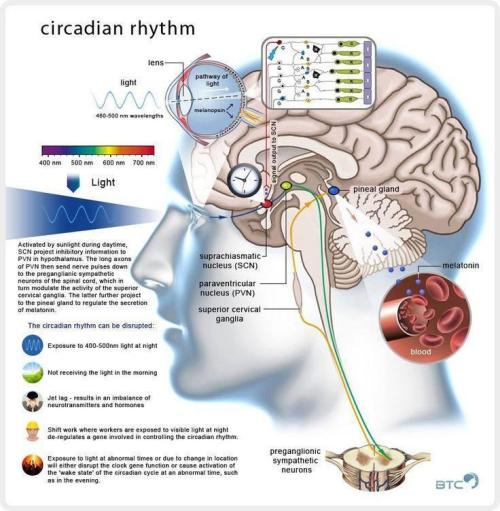
The light that enters the retina does not just enable vision; it acts as the primary environmental cue (zeitgeber) that synchronizes the body's internal biological clock with the 24-hour solar cycle, profoundly influencing the endocrine system. This process regulates hormone production, metabolism, sleep-wake cycles, and mood. If you mess with the natural ratio found in nature, it messes with the body in unexpected ways. Skewing the ratio to have a high level of blue light causes ocular degeneration and destruction of the endocrine system. Dopamine plays a dual role in fear, acting not just in pleasure but as a crucial modulator of fear learning, memory formation, and extinction.
Research indicates a complex, direct link between ultraviolet (UV) light exposure and the dopamine system, with evidence suggesting that UV radiation influences dopamine production and receptor activity, particularly through a skin-brain axis. Exposure to UV light (specifically UVB) has been shown to increase dopamine levels not just in the skin, but also in the blood, adrenal glands, and specific brain regions like the prefrontal cortex and hypothalamus. When skin is exposed to UVB, it triggers the production of β-endorphins and vitamin D, which are associated with reward-seeking behavior and neurotransmitter release.
Studies show that UV-induced increases in dopamine lead to the activation of the dopamine D1 receptor signaling pathway. Research has indicated that dopamine receptor availability is significantly higher in individuals with more sun exposure. The activation of these receptors by UV-induced dopamine is linked to neurobehavioral changes, memory, and synaptic plasticity. The connection is so strong that researchers hypothesize a neurocutaneous pathway where UV light causes a "feel-good" dopamine response, potentially driving compulsive sun-seeking behavior. While moderate sun exposure is linked to mood improvement, excessive or chronic UV exposure can cause dysregulated dopamine signaling, leading to hippocampal memory deficits and impaired neurogenesis. Separate from UV, blue light stimulation (found in sunlight) has also been shown to rapidly increase dopamine concentration in the eye.
UV light acts as an environmental stimulus that triggers the body to produce and release dopamine, activating specific receptors that affect brain function, mood, and behavior. Sunlight exposure triggers vitamin D production when ultraviolet-B (UVB) rays hit the skin, converting 7- dehydrocholesterol in the epidermis into pre-vitamin D3, which then becomes active vitamin D3.
Low dopamine levels cause symptoms resembling an " NPC" (Non-Player Character)—apathy, lack of motivation, low energy, pleasure loss (anhedonia), and dull, repetitive behaviors. Without this neurotransmitter, the brain’s reward system fails, leading to sadness, cognitive issues, and a "robotic" existence.
Blotching out the sun (losing sunlight exposure) directly leads to lower dopamine levels and reduced dopamine receptor availability. Your chemical dependence on dopamine can lead to what's called downregulation. When this happens, you've developed a tolerance by shutting down the dopamine receptors in your brain, so you're less receptive to the pornography you continue to consume. Why endless categories exist. Scientific research suggests that the human brain, particularly the subconscious, has difficulty distinguishing between or treats similarly, vividly imagined experiences, memories, and perceived reality.
UVB light does not pass through regular glass, windscreens, office windows, or sunglasses.
Sunlight exposure triggers vitamin D production when ultraviolet-B (UVB) rays hit the skin, converting 7-dehydrocholesterol in the epidermis into pre-vitamin D3, which then becomes active vitamin D3
Vitamin D deficiency is a major, "silent" global health epidemic affecting over one billion people worldwide, spanning all age groups and regions. Driven by indoor lifestyles, low sun exposure, and diet, it causes widespread health issues, linked to bone diseases, weakened immunity, and chronic illnesses.
A severe vitamin D deficiency cripples the body's ability to utilize several other crucial nutrients, particularly calcium and phosphorus. There is no single, definitive number for the total number of diseases linked to calcium deficiency because it affects nearly every system in the body, ranging from direct skeletal issues to metabolic and cardiovascular conditions. Rather than a fixed count, research identifies it as a broad risk factor for a wide range of diseases and chronic health outcomes.
I get it, sunburn is bad, UV can harm, but it's far far worse to go without. Eating a sunshine pill is not the same.
Great book
Library of Congress Control Number: 2020930536
ISBN 978-1-64502-009-7.
14 likes
7 comments
Share
2
Week 2. Vegetation
7d ago
1/19
15.24 cm
Height
12 hrs
Light Schedule
Ultraviolet She is being remembered by those who are finally quiet enough to listen.
The link between DC current quantum circuits, the golden ratio phi and plant biology lies at the intersection of quantum biology, energy transport efficiency, and self-organizing structures. While they seem disparate, all three involve optimized, wave-like, and quasi-periodic phenomena.
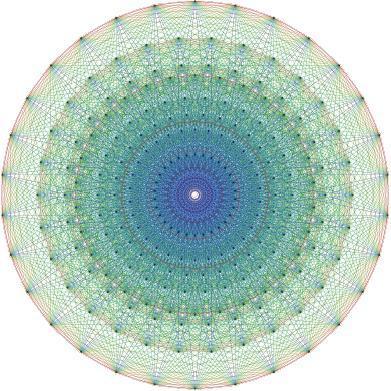
In quantum circuits, superconducting qubits often use Josephson Junctions. These junctions carry a "supercurrent" (DC current) determined by the phase difference phi between two superconductors. Quasi-periodic structures (like Fibonacci chains), which exhibit the golden ratio, are used in mesoscopic quantum rings to study quantum mechanical properties. Research has shown that the golden ratio appears in quantum systems, such as in the spin chain dynamics of certain materials, reflecting a "hidden symmetry". E8.
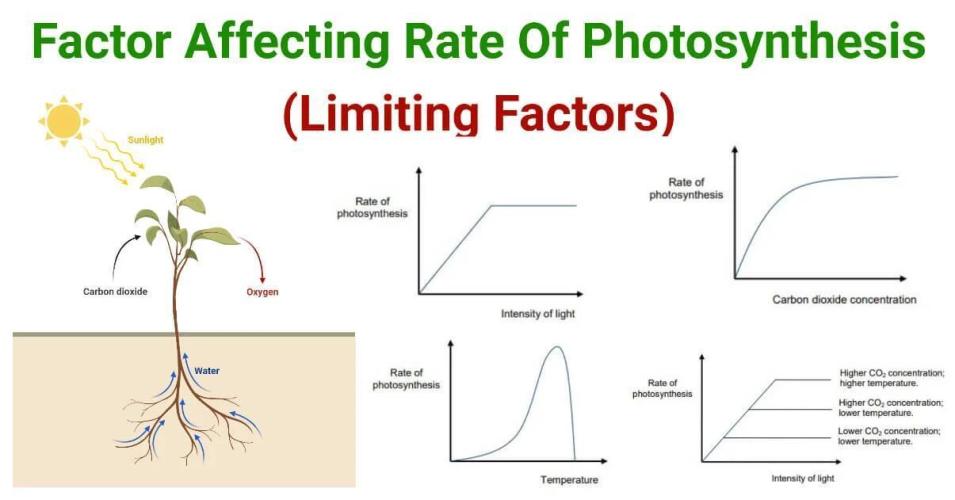
Plants use quantum mechanics to achieve near 100% efficiency in energy transfer during photosynthesis. Energy travels through photosynthetic complexes not as particles, but as waves (excitons) that explore multiple pathways simultaneously—similar to quantum computing algorithms. The light-harvesting complexes act like antenna rings, sharing energy, which conceptually mirrors the way quantum circuits handle flux.
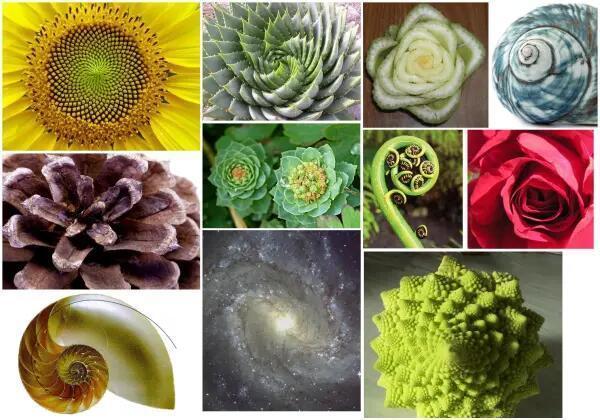
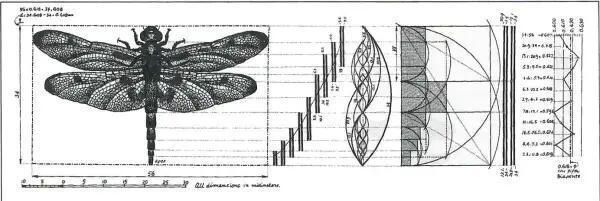
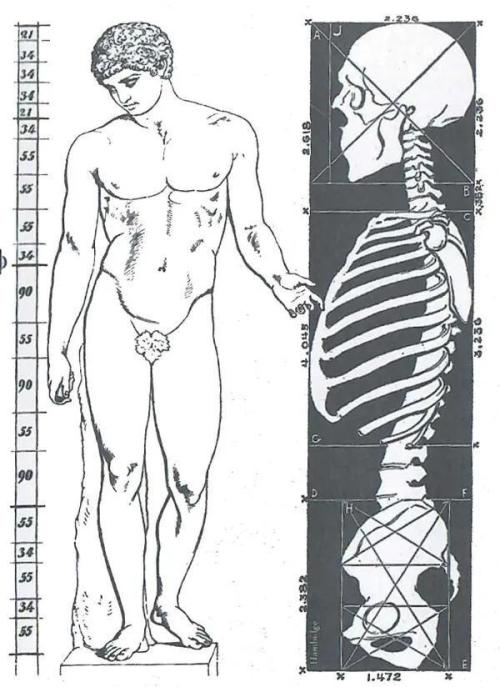
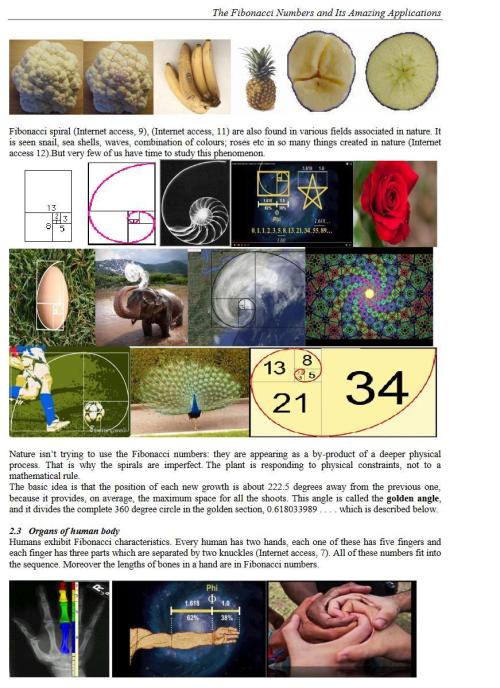
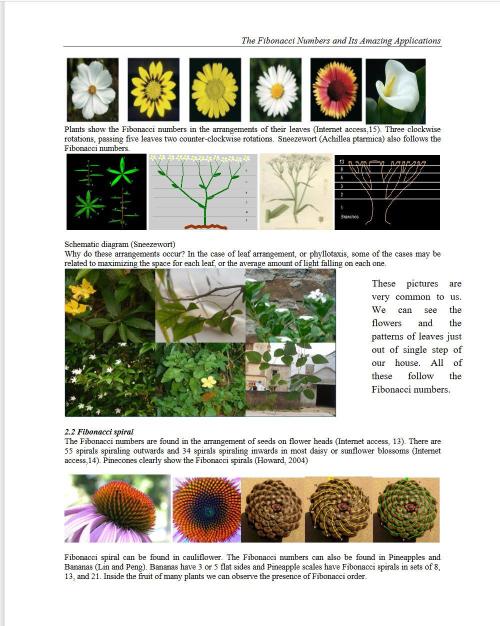
Phi is famously found in the spiral arrangements of leaves, seeds, and petals, optimizing space and light exposure. Fibonacci numbers and the golden ratio appear in nature when self-organization processes are at play, often representing minimum-energy configurations.
Plants use quantum coherence to optimize energy flow. Quantum Circuits use phase relationships phi to control charge flow. (Golden Ratio) governs the structural growth patterns for efficiency. Essentially, nature uses quantum phenomena for speed/efficiency (similar to how we design quantum circuits), and uses the golden ratio to structure those systems for optimal performance. 1.618
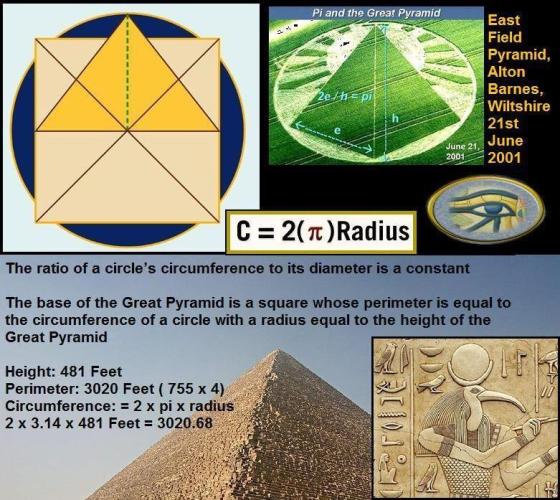
π 3.14159 and Φ phi 1.61803 are connected through trigonometry, geometry (pentagons/pyramids), and limits.
The ratio of a circle's circumference to its diameter, governing roundness, waves, and cycles.
(Phi/Golden Ratio): The ratio governing growth patterns, aesthetics, and self-similar division.
The "golden angle," which dictates how leaves and petals grow in nature, is derived from phi but is measured in radians using pi, roughly 137.5
Stay with me.
11 likes
7 comments
Share
Used techniques
Just add water
Technique
3
Week 3. Vegetation
4d ago
1/19
35.56 cm
Height
12 hrs
Light Schedule
Ultraviolet Lux in tenebris lucet, Darkness can only flourish where there is an absence of light. Shadows can only exist in the presence of light. By facing what we despise or fear in ourselves, we often uncover the source of our true strength, authenticity, and individuality. True enlightenment is not a fantasy of pure light, but a process of confronting what we have buried. You cannot appreciate or fully experience the light without accepting the shadow that defines it. Once you see the illusion, the mind tends to do something clever. It turns awakening into something it can categorise. Concepts. Insight. Something to think about rather than something to live. The ancient Gnostics warned about this. They taught that awakening isn’t measured by what you understand — but by what you can no longer tolerate. Evils are the more apparent things, whereas the Good can never show itself unto the eyes, for it hath neither form nor figure. Habitual fear. Living on autopilot. Saying yes where something deeper is saying no. This is where discernment begins. Not withdrawal from the world. But a quiet clarity about what feeds your inner light — and what slowly drains it. If you’ve felt a subtle friction lately — less patience for the false, more sensitivity to noise, a deeper hunger for what’s real. That isn’t you losing motivation. It’s wisdom sharpening.
"For neither can he who perceiveth It, perceive aught else; nor he who gazeth on It, gaze on aught else; nor hear aught else, nor stir his body any way.
Inhale for 13s, Exhale for 13s,
Inhale for 8s, Exhale for 8s,
Inhale for 5s, Exhale for 5s,
Inhale for 3s, Exhale for 3s,
Inhale for 1s, Exhale for 1s,
Alignment. 1.618
UNI-a prefix meaning having or consisting of only one.
VERSE-A single metrical line in a poetic composition; one line of poetry.
We become aware at such times of man's wonderful ability to bring seemingly unrelated elements into harmonic balance, and receive a glimpse into a world where everything exists in conscious sympathetic attunement to everything else. When we listen to a piece of music that seems to strike a beautiful chord somewhere inside us, or view a painting that simply glows with harmonic awareness well executed, we probably do not spare much time to contemplate the wonderfully intricate combination of vibrations that our sensors make it possible for us to perceive. We tend to appreciate the relationship between the parts of something, by an awareness of the harmony or dissonance of the whole. This ability enables us to say "what a beautiful house!" instead of "analysis has proven that this collection of building materials exhibits certain elements of harmonic proportion." While this ability to instinctively appreciate the beauty of true harmony has an important role to play in evolution, a more analytical understanding of the laws involved can be most useful. This is especially so if we wish to create works of art where each part exists in true harmony, not only with the other part of that particular whole, but with the universe within which the creator and the created exist.
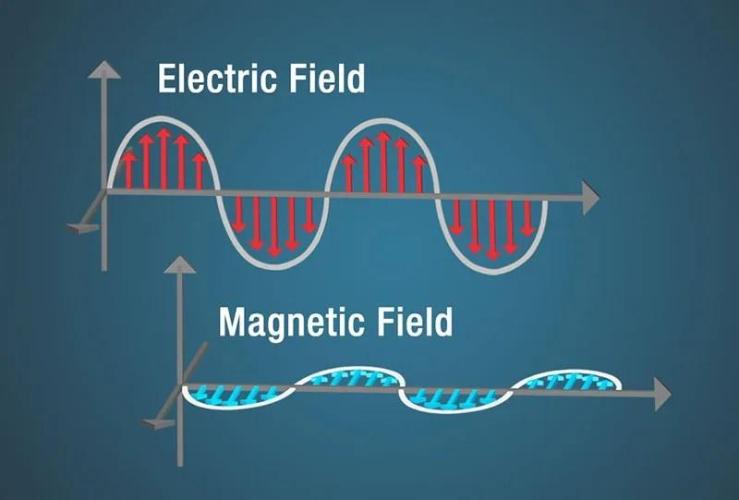
Everything vibrates. From the most dense matter to the most subtle cosmic rays, everything which our senses allow our thoughts to become aware of, can be specified in terms of wavelength or frequency of vibration. These two terms define the same thing, but from different points of view.
The following are the approximate wavelengths of various energy carriers:
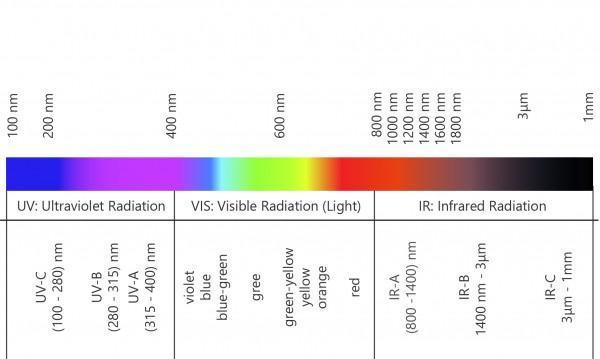
Cosmic rays 0.000,000,001 mm
Gamma rays 0.000,000,1 mm
X rays 0.000,500 mm
Ultraviolet rays 0.003 mm
Visible light 0.006 mm
Infrared 0.01 mm
Sound waves 1 meter
Radio waves 300 meters
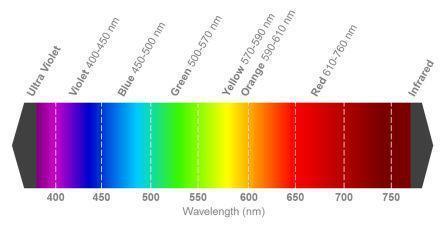
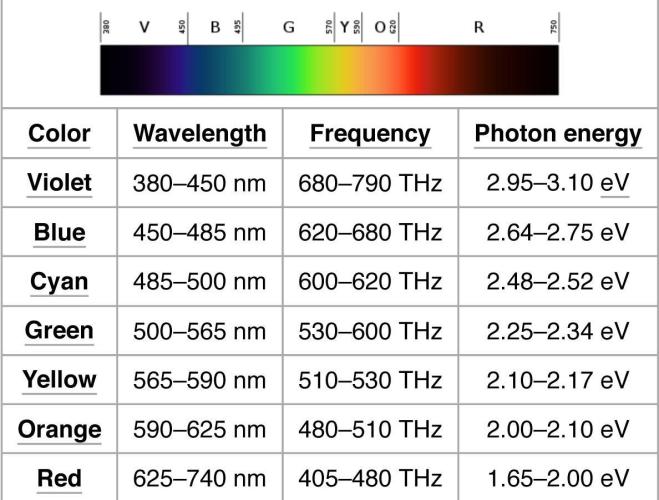
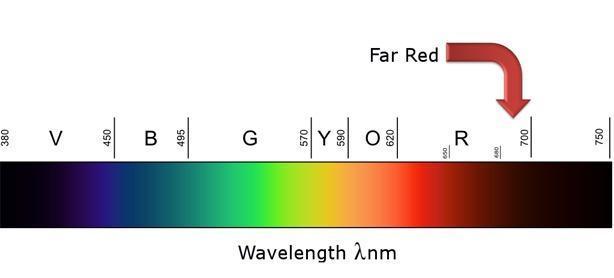
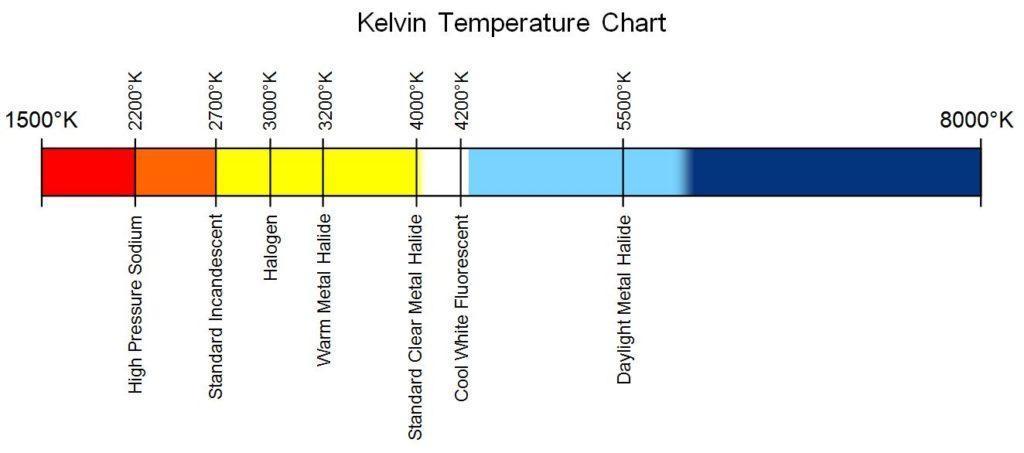
Violet light 400 nm to 450 nm
Blue light 450 nm to 500 nm
Green light 500 nm to 570 nm
Yellow light 570 nm to 590 nm
Orange light 590 nm to 610 nm
Red light 610 to 700 nm
1 nanometer (nm) = 0.000,000,1 cm = 1/10,000,000 cm
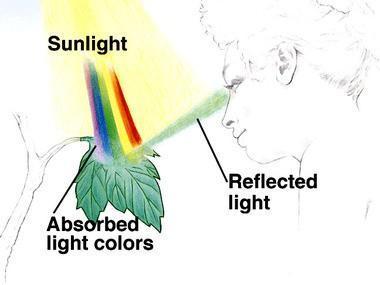
If a guitar string is plucked and we hear a sound, it is not too difficult for the human mind to associate this sound with the vibration of the guitar string. With color it is quite different. It is difficult for us to conceive that the color of a substance is not an inherent property of the substance itself, but an indication picked up by our senses of that substance's ability to absorb or reflect the light which happens to be shining on it at that moment. Neither the matter nor the light is colored. What happens is that the brain learns to differentiate between the frequencies reflected or transmitted by the substance the eyes are focused on. The same thing happens with sound. When we say "Oh! Listen, they're playing my favorite song," what we really mean is: "My brain has stored within it a particular pattern of frequencies. I have compared the new information being received with this stored pattern and have deduced the answer that the two patterns are similar within certain specified tolerances." The 'pleasure' involved could have something to do with our running the pre-recorded pattern at the same time, in 'sympathy' with the new pattern as it is received.
The word sympathy describes very well our ability to appreciate color and sound. It also describes the reason behind certain elements of harmony. For instance, if a substance vibrating at 100 cycles per second (tone 1) is in the proximity of another substance vibrating at 200 cycles per second (tone 2), we could perceive, if we had the right equipment, a certain sympathetic relationship between the two.
We will see from this that there is a uniform doubling of the first tone seen in the second. At various points along the waves, the two are the same in amplitude. At other points, they are at opposite poles to each other. This doubled frequency has more points of similarity to the original than any other frequency except the original itself. If the equipment we had available for measuring these two frequencies was a soundboard amplifier and a pair of ears, then we would hear what would sound to us like one tone. If we had the opportunity to hear one at a time, we would hear that although they sound the same, one is higher in pitch than the other. This characteristic of 'the same but different in pitch', musicians have called the octave. Any two tones produced where one has exactly doubled the frequency of the other is called an octave. Speaking in ratios, an octave would appear then as the ratio 2:1 or 1:2, depending on whether we are talking of an octave up or down.
A single note produced by almost any instrument will contain more than one wavelength or frequency. It will have a dominant frequency, the wavelength of which we would call the note's 'fundamental' or 1st harmonic. It will also have a varying number of upper harmonics, gradually fading in intensity into infinity or silence.
Natural harmonics always have the same pattern of intervals between them. The interval between the 1st and 2nd harmonic is a perfect octave; between the 2nd and 3rd a perfect fifth; between the 3rd and 4th a perfect 4th; and so on, the intervals becoming smaller and smaller until they lose any relationship with the western 12 tone scale as it exists at the moment. Just as an octave has certain elements of sympathy with its fundamental, so some intervals have been noted to be more perfectly in sympathy with the fundamental than others. The ratio of the 'perfect 5th' or interval of 7 semitones, as it occurs in the harmonic series, is 3:2 or 2:3, while that of the 'perfect fourth" is 4:3 or 3:4. All the tones in the western 12 tone scale can be expressed in terms of the ratio between the upper tone and its fundamental. This would seem to be an ideal way of generating a scale from any given fundamental and several attempts have been made to do this, the Pythagorean system being probably the most well known. Although when working with a single tone instrument playing on its own, the Pythagorean formula works wonderfully well, if we had several instruments tuned this way together and asked them to play almost any western music, we would find that at times they sounded quite out of tune to each other.
The lack of flexibility of the various scale systems based on the harmonic series has led to what is known as the 'tempered' scale. This uses as its primary unit of interval the ratio of the octave or 2:1. It then proceeds to divide the interval between any fundamental and its upper octave into 12 smaller intervals by applying the ratio: two to the one-twelfth power, to one (21/12:1). This equals 1.059463094, so by multiplying any frequency by this number, we will obtain the tempered semitone next up from our fundamental. We will also find that any tone twelve semitones up from any other tone, in a scale generated in this way, will have exactly double the frequency.
If we took the note middle C on a piano and halved the wavelength, we would have the note C one octave above. If we halved this, we would have the C above, and so on. However, within about 6 octaves, we would find that although a 'sound' was being produced, no human ear could perceive it. If we kept on going, halving and producing upper octaves of our fundamental C, we would proceed through the infrared band, into the visible light spectrum. If we happened to be outside during the day, we would, for one octave only, see the note C with our eyes. The next octave above would already be in the ultraviolet band, and outside the eye's sensitivity range. If we can think of color as being an indication of a substance's vibratory rate or wavelength, we may begin to see a relationship that could exist between the color and sound spectrums.
The logical extension of what has so far been said is that there exists a scale in the color spectrum that corresponds exactly to the scale in the sound spectrum, each color tone being an octave of the equivalent note in the sound range.
This is not the end of the story but only the beginning. If we can for the moment accept that any wavelength in one band has upper and lower octave stretching out to infinity, then the next question is 'fine, but what shall we use as our fundamental? A particular color? A particular sound frequency?' The musicians among us will probably say 'A 440'. This means that the note A should vibrate at 440 Hertz, or 440 times per second. They would tell us that this is standard pitch has been adopted by most orchestras around the world; pianos are tuned to it, instruments are constructed to formulas based on it, and so to them it would probably seem the most appropriate place to begin. Some of these musicians may know of the battle that is still raging with regards to this being the standard, but few would know why A = 440 Hz was chosen except that it worked when it was set to be a suitable compromise between the many different pitches in use at the time.
The frequency 7.83 Hz has been called the Earth's “heartbeat.” Progressively weaker harmonics have been measured at around 14.3, 20.8, 27.3, and 33.8 Hz. For example, if a wave has a frequency of 50 Hz, its period would be 1/50 = 0.02 seconds. 1 Hz means one cycle per second. Alpha brain waves are tied to 7.83 Hz. Like a processor, they clock to a cycle speed.
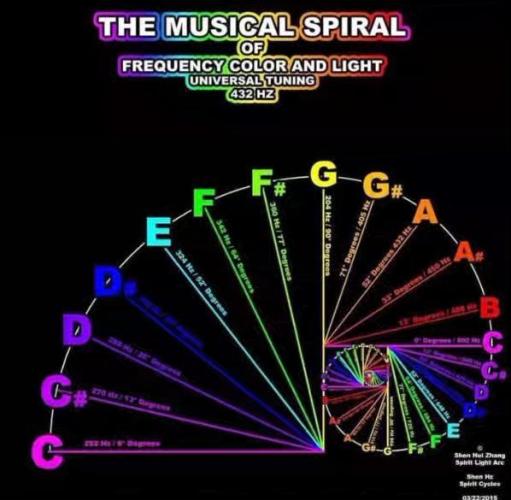
432 Hz is said to be mathematically consistent with the patterns of the universe. Studies reveal that 432 Hz tuning vibrates with the universe’s golden mean PHI and unifies the properties of light, time, space, matter, gravity, and magnetism with biology, the DNA code, and consciousness. When our atoms and DNA start to resonate in harmony with the spiraling pattern of nature, our sense of connection to nature is said to be magnified.
Another interesting factor to consider is that the A=432 Hz tuning correlates with the color spectrum, while the A=440 Hz is off. Audiophiles have also stated that A = 432 Hz music seems to be non-local and can fill an entire room, whereas A=440 Hz can be perceived as directional or linear in sound propagation.
Once you adopt the idea that sound (or vibration in general) can have an equalizing and harmonizing effect (as well as a disturbing effect), the science of harmony can be applied to bring greater harmony into one's life or tune to specific energies. There is a form of absolute and relative harmony. Absolute harmony can, for example, be determined by the tuning of an instrument. The ancients tuned their instruments at an A of 432 Hz instead of 440 Hz - and for a good reason. There are plenty of music examples on the internet that you can listen to in order to establish the difference for yourself.
Attuning the instrument to 432 Hz results in a more relaxing sound, while 440 Hz slightly tenses up the body. This is because 440 Hz is out of tune with both macro and micro cosmos. On the contrary, 432 Hz is in tune. To give an example of how this is manifested microcosmically: our breath (0,3 Hz) and our pulse (1,2 Hz) relate to the frequency of the lower octave of an A of 432 Hz (108 Hz) as 1:360 and 1:90.
It is interesting to note that 432 Hz was the standard pitch of many old instruments and that it was only recently (19th and 20th century) the standard pitch was increased. This was done in order to be able to play for bigger audiences. Bigger audiences (more bodies) absorb more of the lower frequencies, so the higher pitch was more likely to “cut through”. One of the oldest instruments of the world is the bell ensemble of Yi Zeng (dated 423 BC), tuned to a standard F4 of 345 Hz, which gives an A= 432 Hz. The frequency of 345 Hz is that of the platonic year! Similarly, many old organs are tuned in A=432 as well; for example, St. Peter’s Capella Gregoriana, St. Peter’s Capella Giulia, S. Maria Maggiore in Rome.
Maria Renold’s book “Intervals Scales Tones and the Concert Pitch C=128 Hz” claims conclusive evidence that 440 Hz and raising concert pitch above scientific “C” Prime=128 Hz (Concert A=432 Hz) disassociates the connection of consciousness to the body and creates anti-social conditions in humanity.
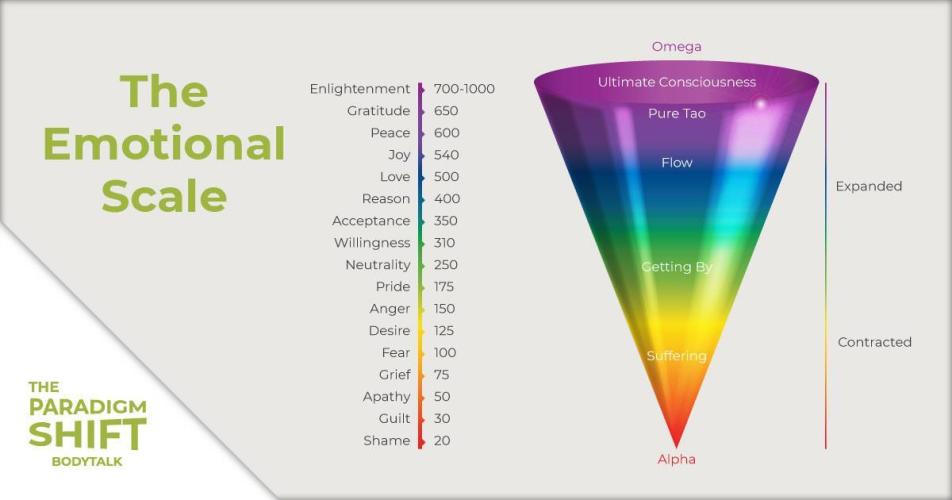
The difference between concert pitch A=440 Hz and Concert A=432 Hz is only 8 cycles per second, but it is a perceptible difference of awareness in the human consciousness experience of the dream we share called existence.
Nature's clock: cycles, waves, days, time, degrees, arcs of measure, Mechanism of the clock: The KaiC protein undergoes phosphorylation cycles, where it is alternately phosphorylated and dephosphorylated, and the KaiA and KaiB proteins act as modulators to control this cycle, resulting in a rhythmic oscillation.
To calculate the time interval of a known frequency, divide 1 by the frequency (e.g. a frequency of 100 Hz has a time interval of 1/(100 Hz) = 0.01
Hertz are cycles per second. To convert Hertz to seconds, you need to multiply by seconds squared and divide by cycles.
The tidal system operates on a precise,, yet complex, 24-hour and 50-minute cycle (a lunar day), with high and low tides dictated by the rotation of the Earth through the moon's gravitational bulges. Because the Earth rotates faster than the moon revolves, the tidal cycle shifts about 50 minutes later each day.
Time between successive High Tides: 12 hours and 25 minutes.
Time between consecutive High and Low Tides: 6 hours and 12.5 minutes.
Full Tidal Cycle (Two high/two low): 24 hours and 50 minutes.
Daily Shift: High tides occur roughly 50 minutes later each day.
Flood Tide: The rising water level over several hours, covering the shore.
High Tide: The maximum water level.
Ebb Tide: The falling water level over several hours, revealing the shore.
Low Tide: The minimum water level.
Spring Tides: Highest tides, occurring during full or new moons (every 14.77 days) when the Earth, Sun, and Moon align.
Neap Tides: Lowest high/high-low tides, occurring during the first and third quarter moons when the Sun and Moon are at right angles.
Perigee/Apogee: Tides are higher when the Moon is closest to Earth (perigee) and lower when farthest (apogee).
Local Influences: Coastal geography, ocean depth, and weather (wind/pressure) can modify these times.
The "Rule of 12ths": A common rule of thumb for estimating tidal heights: 1/12 of the total range in the first hour, 2/12 in the second, 3/12 in the third, 3/12 in the fourth, 2/12 in the fifth, and 1/12 in the final hour.
While generally semi-diurnal (two highs/lows per day), some regions experience diurnal (one high/low) or mixed tides.
To calculate the frequency, we divide the number of cycles (2) by the time period (12 hours):
Frequency = 2 cycles / 12 hours = 0.1667 cycles per hour.
The unit hertz Hz is the standard unit of frequency, defined as one cycle per second {-1}. A unit conversion is required to express the frequency in hertz. The correct frequency is approximately 4.63x10^-5 Hz. half-power frequencies.
The Earth's principal tidal frequencies are in the microhertz (μHz) range: The semi-diurnal (twice daily) lunar principal tide (M2) has a frequency of approximately 2.23x10^-5Hz, 23.1μHz or a 12.42-hour period. The diurnal (once daily) principal lunar tide (O1) has a frequency of approximately 1.07x10^-5Hz, 11.57μHz or a 25.82-hour period).
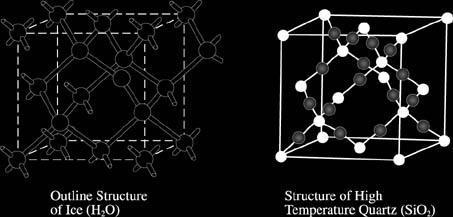
Quartz crystals are used in clocks and watches to precisely measure time by leveraging their piezoelectric properties, which allow them to vibrate at a very stable frequency when an electric current is applied, creating a reliable signal for counting time intervals; essentially, the crystal's consistent vibrations act as a highly accurate timekeeping mechanism. The most frequently utilized of crystal timeekeeping devices such as watches and clocks. When pressure is applied to a quartz crystal, it generates an electric charge, and conversely, when an electric field is applied, it vibrates at a specific frequency. The quartz crystal is placed within an electronic circuit that amplifies and maintains the vibrations, creating a stable electrical signal. Quartz clocks are significantly more accurate than traditional mechanical clocks due to the consistent frequency of the quartz crystal.
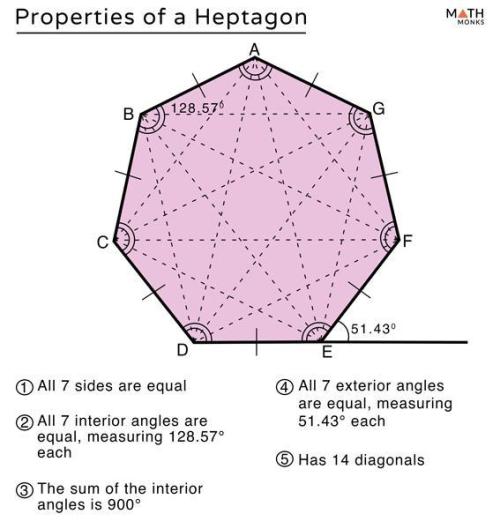
The phase angle within the vibrating ring of water molecules is 60° degrees (360° divided by 6°). If there were 7 molecules in the ring, the phase angle would be 360/7 or 51.43° degrees. This is the principal phase angle of quartz. Most of the internal angles of water and quartz are either fractions of this angle or multiples of it. UV light passes through quartz but not regular glass because quartz (fused silica) is nearly pure silicon dioxide with fewer impurities, creating a large energy gap that allows UV photons to pass. While scientific literature typically cites the "critical angle" of quartz as approximately 40.5° for internal reflection, some specialized or metaphysical theories suggest that if quartz molecules were arranged in a ring of seven, the resulting phase angle would be 360/7, or 51.43°. This connects the heptagonal geometry directly to the theoretical molecular "principal phase angle" of the mineral.
A regular heptagon has the following properties: 7 interior angles measuring ~128.57° each. 7 exterior angles measuring 51.43° each. 7 congruent vertices.
Sequence:
A sequence is an ordered list of numbers. For example, 1, 2, 3, 4 is a sequence.
Series:
A series is the sum of the terms of a sequence. For example, 1 + 2 + 3 + 4 is a series.
Summation:
The addition, and also the resulting value, are called the "sum" or the "summation".
Use summation:
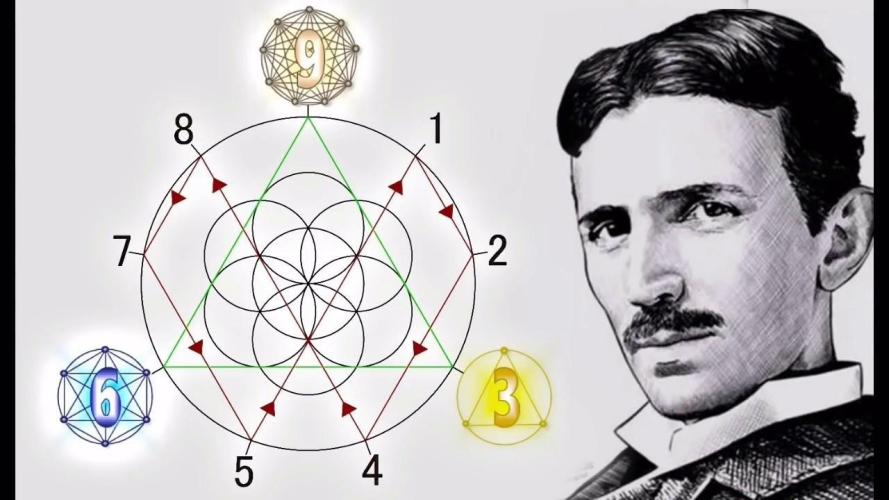
207,360=9
103,680=9
51840=9
25920=9
12960=9
6480=9
3240 =9
1620=9
00=0
09=9
18=9
27=9
36=9
45=9
54=9
63=9
72=9
81=9
90=9
180=9
360=9
720=9
1440=9
2880=9
5760=9
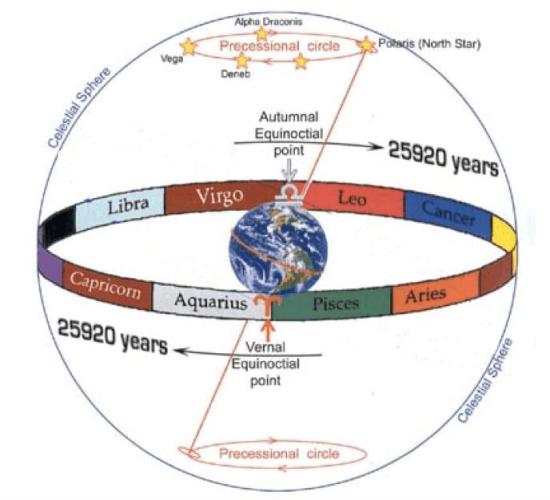
The number 25,920 is relevant in the context of astronomical phenomena, specifically the Earth's axial precession, a cycle that takes about 25,920 years to complete as the Earth's axis "wobbles," causing the Earth to shift its orientation relative to the stars.
Axial Precession (Great Year): A slow wobble of Earth's axis, completing a cycle approximately every 25,920 years, causing the apparent shift of constellations over long periods.
72 Years per Degree: The 25,920-year precession cycle is divided by 360 degrees, resulting in roughly 72 years per degree (25920 / 360 = 72).
The number 72 is connected to the golden ratio in pentagonal geometry. The angles of a golden triangle, an isosceles triangle where the ratio of the longer side to the shorter side is 1.618, are 36°,72° 72°. The central angle of a regular pentagon is also 72(360°/5=72°).
Trigonometry: The golden ratio can be expressed using trigonometric functions of angles related to 72°, such as in the formula for the cosine of 36° or the sine of 54°
The Sacred Cubit (or Royal Egyptian Cubit) is an ancient unit of measure, typically 20.6 to 25.26 inches, derived from the length of the forearm from the elbow to the tip of the middle finger. It was used to design sacred structures like the Giza Pyramids. Discovered and popularized by Slim Spurling in the 1990s, this technology involves measuring a specific length of wire—typically 20.6 inches (52.4 cm) based on measurements from the King’s Chamber of the Great Pyramid of Giza—and twisting/looping it into a "tensor ring". Within the context of Tensor Technology and sacred geometry, the Sacred Cubit is considered to create or resonate at a frequency of 144 MHz (megahertz).
Proponents, such as Bruce Cathie and Jain 108, define the speed of light (c) as a "harmonic" value of 144,000 minutes of arc per grid second within a hypothetical universal grid system, rather than the standard physical constant of approximately 3x10^8m/s.
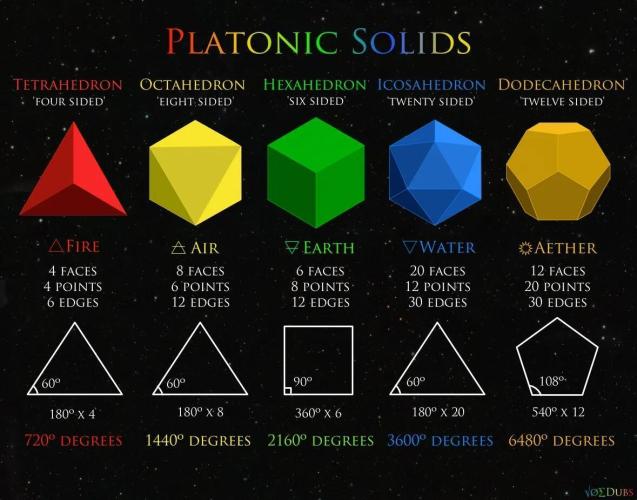
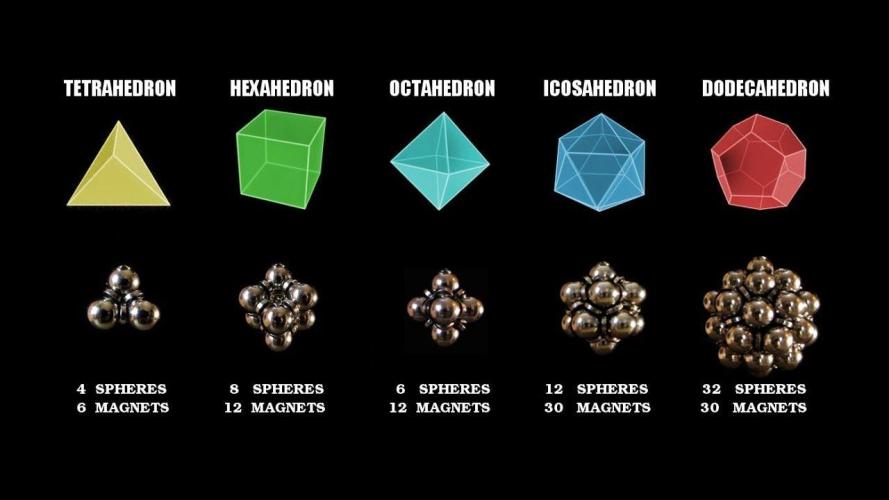
The Tetrahedron totals 720°, (7+2=9)
The Octahedron totals 1440°, (1+4+4=9)
The Cube totals 2160°, (2+1+6=9)
The Icosahedron totals 3600°, (3+6=9)
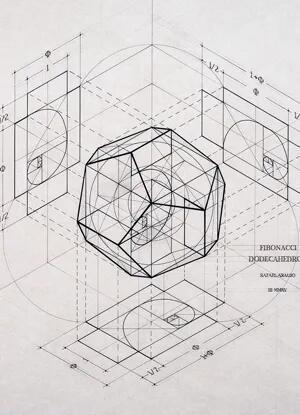
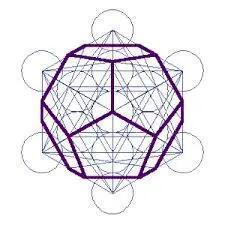
Dodecahedron totals 6480°. 6+4+8= 18 1+8=9
Unlike the standard tuning of 440 Hz, which is used in most music today, 432 Hz is said to be mathematically consistent with the patterns of the universe. It is often referred to as the “frequency of the universe” or the “miracle tone.”
432 X 2 = 864 and when we look at the sun's diameter above 864,000 miles.
864,000 x 108 = Sun’s Distance From Earth: 93312000 miles.
It's also interesting to point out we have 86,400 seconds in a day.
The Cube (Hexahedron - earth) is 2160 degrees, 216 x 2 is 432
Everything is energy. Energy is represented by numbers. Numbers are frozen music. Music is moving sacred geometry of the Uni-verse. Here the tension comes from the interaction between spins causing them to magnetically resonate. For these interactions, we found a series (scale) of resonant notes: The first two notes show a perfect relationship with each other. Their frequencies (pitch) are in the ratio of 1.618…, which is the golden ratio famous from art and architecture. It reflects a beautiful property of the quantum system — a hidden symmetry. Actually, quite a special one called E8 by mathematicians.
The E8 structure itself has relationships to Phi (1.618).
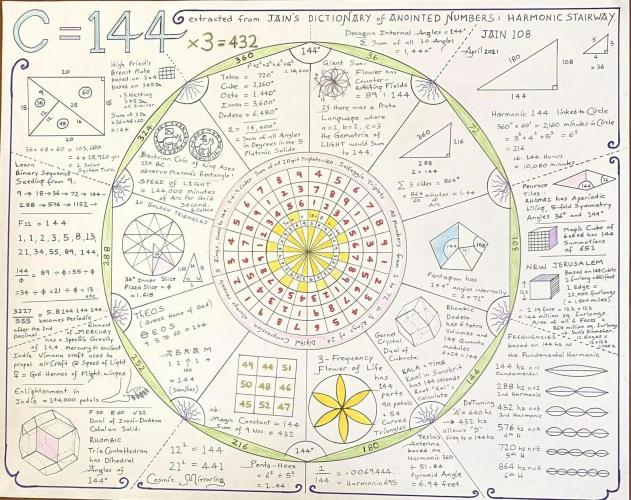
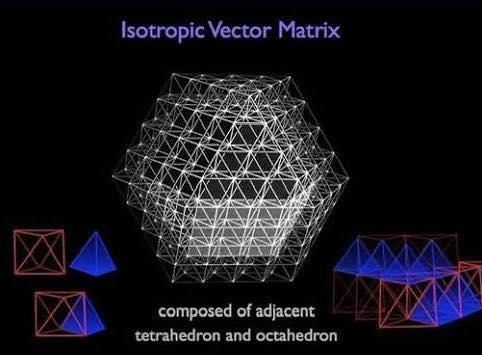
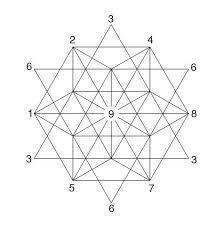
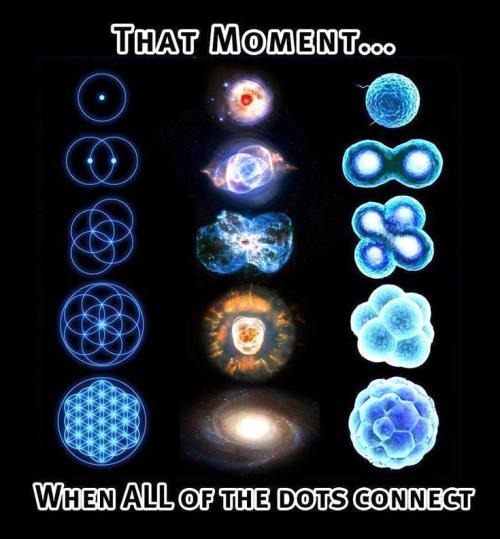
The golden ratio is the limit of the ratio of consecutive numbers in the Fibonacci sequence. The number 144, which is the 12th Fibonacci number, appears in calculations related to the 25,920-year cycle in some esoteric contexts 144°x180°=25,920° total degrees in a 64-tetrahedra structure's surface). The outer surface of a structure made from 64 tetrahedrons, often referred to as the 64 Tetrahedron Matrix or the Isotropic Vector Matrix (IVM), is composed of 144 equilateral triangles. This complex geometry is significant in sacred geometry and some unified field theories. The 64 Tetrahedron Matrix is a three-dimensional representation that is related to the two-dimensional "Flower of Life" symbol, where the arrangement of spheres around each tetrahedron creates the dense sphere-packing lattice of the Isotropic Vector Matrix.
The golden ratio has been reported to appear in the overtones of magnetic resonance at the quantum scale. Some theories propose a mathematical framework where the golden ratio is central to the absorption and emission of light photons (electromagnetic energy) by electrons. This dynamic process is linked to the fine structure constant, a fundamental physical constant relating the electron's charge, Planck's constant, and the speed of light. The ratio of certain color frequencies in the visible light spectrum (e.g., infrared to green and green to ultraviolet) has been posited by some researchers to approximate the golden ratio, suggesting an underlying harmonic principle.
In standard physics, green light has a wavelength of approximately 500--570nm. Ultraviolet light begins below 400nm. If we take a typical green wavelength 550nm and a UV wavelength 340nm. 550/340=1.6176 This value is remarkably close to phi (1.618), which is why this specific pairing is cited in discussions about "natural harmony" and the "structure of light".
Philosophical and theoretical frameworks suggest that the golden ratio acts as a "universal resonance constraint" for frequency in a unified mathematical model of reality and consciousness. Electromagnetic vibrations, such as those from electrons and photons, are thought by some to travel along biological structures like proteins and DNA, where the golden ratio is found in geometric patterns, suggesting a link to biological electromagnetism. The golden ratio emerges in discussions regarding quantum gravity, black hole physics, and even the potential shape of the universe (a dodecahedron based on 1.618) The geometry is considered fractal, meaning it can be scaled infinitely while maintaining its fundamental properties and structure.
The dodecahedron is the only Platonic solid on which an infinite number of non-repeating, straight-line paths from a vertex can return to the starting point without passing through any other corners. For the other four Platonic solids (tetrahedron, cube, octahedron, and icosahedron), all such paths are finite and eventually reach another corner. This unique property of the dodecahedron was a subject of mathematical investigation for over 2,000 years until a team of mathematicians (Jayadev Athreya, David Aulicino, and Patrick Hooper) proved in 2018/2020 that such infinite paths exist. The existence of these paths is attributed to the specific angles of its pentagonal faces and the resulting geometric properties, which involve the golden ratio.
The paths can be grouped into 31 distinct families of trajectories on the dodecahedron's surface.
1. The sacred number 216 times the biblical cubit 144 = 31,104 The great precession of the equinox is 25,920 years.31,104 - 25,920 = 5,184
2. The Great Pyramid of Giza has a slope of 51.84°
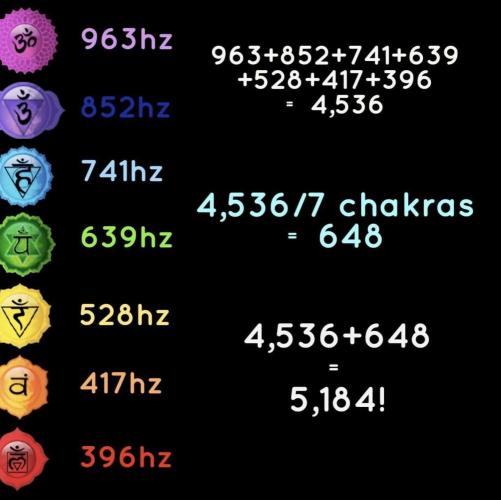
3. The sum of your seven chakra frequencies is 4,536. Divide the number of chakras by the total and you reveal the 8th natural frequency.
7 endocrine centres in the physical human body. The gonads, cells of Lydig, adrenals, thymus, thyroid, pineal, pituitary. These are paralleled by the seven energy vertices or "Chakras".
•396hz
•417hz
•528hz
•639hz
•741hz
•852hz
•963hz
4,536 / 7 = 648hz
4,536 + 648 = 5,184hz
Hertz are cycles per second. To convert Hertz to seconds, you need to multiply by seconds squared and divide by cycles.
When you multiply 51.84 by sixty minutes and sixty seconds you get the speed of light.
51.84 x 60 x 60 = 186,624
432 squared (432²) is 186,624
Here's the calculation: 432 * 432 = 186,624
The actual speed of light is not exactly 186624, but (depending on the source) 299792458 meters/s. = 186282.397 miles/s. That is about 341.603 miles per second off. If you would use that number instead to calculate the square root, you get: √186282.397 = 431,60444506515453634375 (432)
light speed in MPs 1+8+6+6+2+4 =27 2+7=9
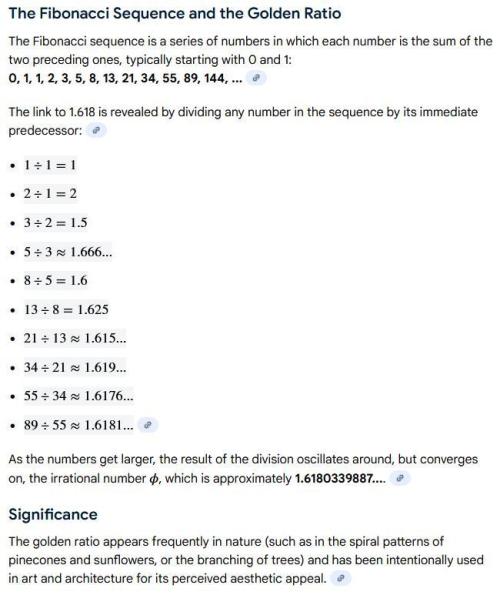
Golden Ratio (Phi, 1.618): A special number, approximately 1.618, appearing in nature, art, and architecture, related to the Fibonacci sequence (0, 1, 1, 2, 3, 5...) where larger numbers divided by smaller ones approach Phi.
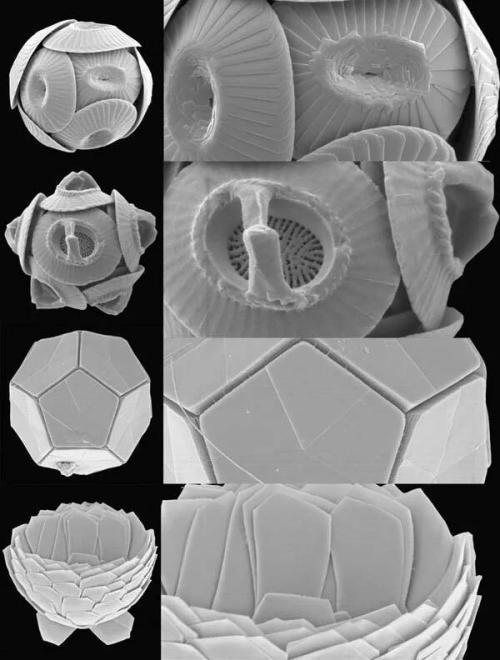
A dodecahedron is a polyhedron with 12 faces, and in coordination chemistry, it refers to a geometry where ligands surround a central metal atom (in this case, Magnesium) in a specific, 8-coordinate arrangement. Dodecahedrane is a hydrocarbon, meaning it's composed solely of carbon and hydrogen atoms. The carbon atoms are arranged at the corners of a dodecahedron, a 3D shape with 12 pentagonal faces. The water molecules in the dodecahedron form hydrogen bonds that are individually slightly weaker than in either the dimer or the tetramer. However, because three-quarters of the O -H groups in the dodecahedron form hydrogen bonds, it has a more negative energy per molecule than has either the dimer or the tetramer.
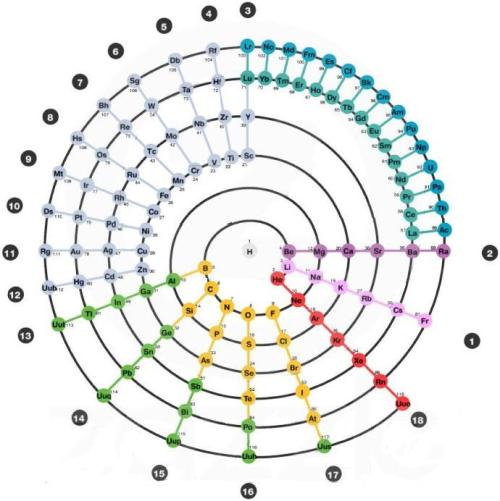
Hydrogen is atomic number 1
Thorium is atomic number 90. 232.038 =18,1+8=9
Of the fifth Platonic solid, the dodecahedron, Plato obscurely remarked, "...the god used [it] for arranging the constellations on the whole heaven".
In traditional symbolism, the dodecahedron was the form that best represented the manifestation of God in Nature. For Plato it symbolised “Cosmic Harmony”. It is a three-dimensional representation of the symmetry of the pentagon and the “Golden Ratio”, that occurs naturally throughout the natural world.
Gnosis is the common Greek noun for knowledge (γνῶσις, gnōsis, f.).
Each zodiac or sign lasts 2160 years. 12x2160=25920
“A cat has 9 lives”
“On cloud 9”
“Dressed to the nines”
"To go “the whole nine yards”
“A stitch in time saves nine”
“Nine-ness” seems to be synonymous with the maximum, with the furthest extent of what’s possible. With fullness, completion, and when every effort has been exhausted.
In the ancient world (which is, let’s face it, is where numbers and their spiritual power were understood SO much more than they are today) the number 9 resonated with sacred structure and the furthest limitations of this world before human experience meets the Divine. Perhaps more than any other, the number nine had an extra special significance, which spread far and wide. It features across pretty much all cultures, worldwide, rippling through culture, mythology, history, law and time.
Nine is the central number in the ancient Celtic tradition.
Nine expresses through the triple Goddess (see Number 3) and in myths of the nine Celtic maidens or sorceresses. In fact, stories of nine mystical women presiding over nature spread from England, Ireland and Wales to Scandinavia, Iceland, and even as far as Kenya. Even today, it’s tradition for nine groups of nine men to dance around Beltane fires. The limit of winter (which is what Beltane
Almost all of the mythological tales from around the world have patterns of the number 9 weaving throughout.
The Northern European sagas tell of Odin, who rules over the nine Norse worlds. His trial to win the secrets of wisdom for mankind was to hang on the Yggdrasil tree for nine days.
Demeter, the Greek Goddess of the Earth searched for nine days for her daughter Persephone (who was in the underworld with Hades). Demeter is often depicted holding nine pieces of corn. Once recovered, Persephone was obliged to spend three months per year below the ground, and nine months above.
Native American, Mayan and Aztec myths tell of a total of nine cosmic levels (and many of the temples comprise 9 stories).
And in ancient China, nine was the most auspicious number of divine power: the Chinese had nine sacred rites, nine social laws, nine classes of officials in the government and built nine-story pagodas.
In astrology, the planet Mars vibrates to the frequency of the nine.
The ninth sign of the Zodiac is Sagittarius (where the Sun sails from November 22nd – December 21st)
InTarot, card number nine is the Hermit.
In Hinduism, nine is the number of Brahma.
In the Greek Sagas, the city of Troy was under siege for nine years.
Jacob's Ladder. Zodiac 25920
A cell is a quantum measuring device for light’s frequency to make elegance from the chaos light frequencies brings from our environment.
Father Time, Mother Nature.
The E8 lattice is deeply connected to the dodecahedron (and its dual, the icosahedron) through shared symmetries, particularly the {3,3,5} polytope (the 4D analogue of the icosahedron/dodecahedron), which forms the first shell of the E8 lattice's 240 root vectors, revealing icosahedral symmetry within the complex 8D structure, often visualized through projections that highlight these Platonic solids as fundamental geometric building blocks.
Symmetry Groups (McKay Correspondence): The symmetry group of the icosahedron/dodecahedron (the Coxeter group H3 or A5) is a fundamental subgroup of the E8 Lie algebra's symmetry group, linking these Platonic solids to the exceptional E8 structure. Root Systems: The 240 shortest vectors (roots) of the E8 lattice naturally form the vertices of a {3,3,5} polytope (a 4D object with icosahedral symmetry) when projected or considered in specific ways, embedding icosahedral geometry within E8. Constructions of E8 use "icosians," a special ring of quaternions related to the icosahedron, to build the lattice, showing how the golden ratio and icosahedral structures are intrinsic to E8. The E8 lattice's projection into 3D (or 4D) reveals patterns seen in quasicrystals and can describe the structure of icosahedral quasicrystals, where dodecahedra and icosahedra appear.
"Theory of Everything"
In some physical theories (like Lisi's E8 theory), the E8 structure's geometry, incorporating these fundamental symmetries, is proposed to describe all particles and forces, with the icosahedron/dodecahedron appearing in the particle classification., The icosahedral symmetry of the dodecahedron isn't just an external feature of E8; it's an inherent, fundamental component of its structure, revealed through its roots and symmetries.
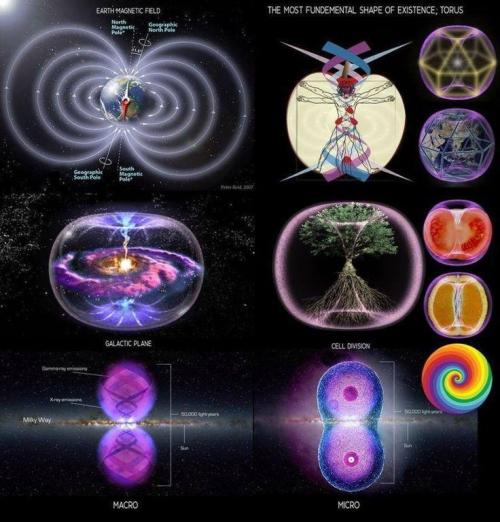
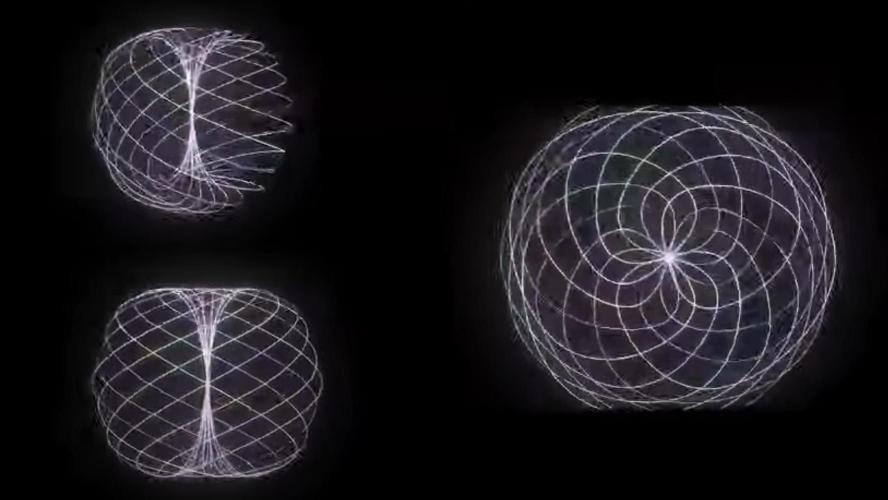
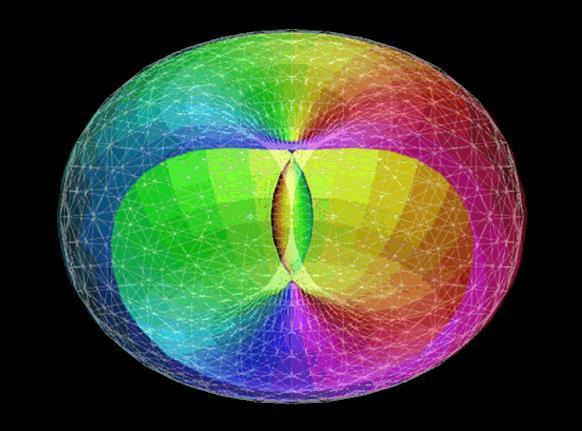
The torus is a donut-shaped energy field or structure found in various natural and scientific contexts, such as electromagnetic fields and plasma physics. The connection between the golden ratio and the torus is primarily explored in the realms of sacred geometry and theoretical physics: Some theoretical frameworks, such as the "PHI-TORUS framework," suggest that channeling "cosmic energy" through the toroidal field is related to the golden ratio, offering a way to understand a "Unified Field" of energy and consciousness. The golden ratio divides a 360-degree circle into two "golden angles" of approximately 222.5 and 137.5 degrees. These angles are related to the efficient packing and distribution patterns observed in nature (like leaves on a stem), which can be conceptualized as a flow or field pattern, such as that within a torus. The relationship between 1.618 and the toroidal field is seen as an illustration of the interconnectedness of mathematical principles and natural phenomena, suggesting that beauty and symmetry are fundamental to the universe's design.
When applying a magnetic field at right angles to an aligned spin the magnetic chain will transform into a new state called quantum critical, which can be thought of as a quantum version of a fractal pattern. Prof. Alan Tennant, the leader of the Berlin group, explains “The system reaches a quantum uncertain — or a Schrödinger cat state. This is what we did in our experiments with cobalt niobate. We have tuned the system exactly in order to turn it quantum critical.” By tuning the system and artificially introducing more quantum uncertainty the researchers observed that the chain of atoms acts like a nanoscale guitar string. Dr. Radu Coldea from Oxford University, who is the principal author of the paper and drove the international project from its inception a decade ago until the present, explains: “Here the tension comes from the interaction between spins causing them to magnetically resonate. For these interactions we found a series (scale) of resonant notes: The first two notes show a perfect relationship with each other. Their frequencies (pitch) are in the ratio of 1.618…, which is the golden ratio famous from art and architecture.” Radu Coldea is convinced that this is no coincidence. “It reflects a beautiful property of the quantum system — a hidden symmetry. Actually quite a special one called E8 by mathematicians, and this is its first observation in a material,” he explains.”The E8 structure itself has relationships to Phi (1.618).
An infinity mirror dodecahedron is a geometric light sculpture that uses the principles of an infinity mirror to create an illusion of infinite space or a "tunnel of light" within a 12-faced shape.
In astrology, there are 144 possible combinations for Mercury's placement in the 12 signs and 12 houses. This number results from the 12 zodiac signs multiplied by the 12 astrological houses (12x12=144).
@Ultraviolet, there are people who say that if you consume lean, you can do that too, or even die in the process. I don't want to try it. Sometimes in the evening, I feel close to the edge of twilight when I consume my medication and Shiva's herb together. I'd rather be a cat. You can go anywhere and be so quiet that no one notices you. How awesome that must be. Just imagine being able to be so agile again when you can't do it yourself anymore...
@Kushycat, when I got her she was very sick and had terrible issues with her breathing, whenever she jumps or lands on her front paws she squeezes air out her little lungs, squeezes and wails like a tiny little set of bagpipes. Cute as! But hearing a bagpipe run up and down stairs all night haha. Be good 👍 🙏
@Ultraviolet, That sounds awful, and I've never understood how people can treat other living beings that way. It's terrible to think that they're just animals or something... If you treat animals like that, how do you treat people? It's a miracle that you managed to do that at all, considering how traumatized she was.
Your other cat probably experienced the exact opposite and received a lot of love, so she is a good, non-traumatized, balanced creature who gives back what she has experienced.
I suppose it's no different with humans.
Of course, you're right, I won't, but it's one of those days again.
It's nice that you're still here. I was really sad when I couldn't access your profile anymore. Thank you for your kind words. 🙏🏼
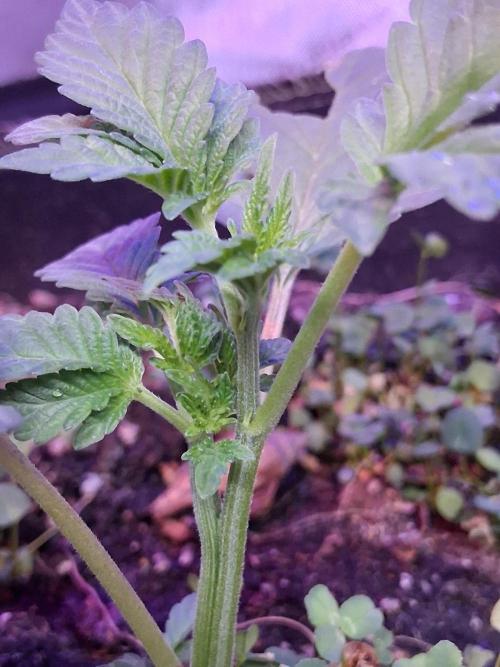
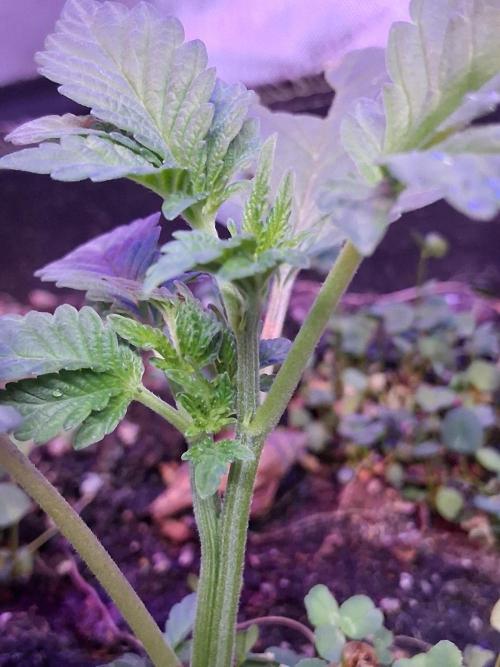
@Kushycat, lol, yeah I don't know, I haven't seen this before, one plant decided to siamese the stem. Ill get some better pics when home, hopefully 🤪 its a good thing!
@Kushycat, dichotomous branching tis called apparently. Im not sure if it was damage induced or genetical, as the shitty kitty had a chew last week. I'll keep an eye on how it develops.