diversiv0 ### Week 1 – Germination (October 5–11, 2026)
**Strain:** Epsilon F1 – Royal Queen Seeds
**Seed planted:** October 5, 2026
**Sprouted:** October 9, 2026 (4 days after planting)
**Germination method:** Click & Grow Smart Garden
Started this grow by placing the Epsilon F1 seed directly into a Click & Grow experimental soil pod on October 5.
The seed successfully sprouted on October 9, showing its first green cotyledons. I used the Click & Grow system for the entire germination phase, benefiting from its integrated LED lighting and self-watering reservoir.
A transparent humidity dome was used during germination to maintain a stable, humid environment. The seedling emerged with a short, upright stem and healthy green cotyledons.
By the end of the first week, the seedling had established itself in the growing medium and was beginning its early development.
**Nutrients:** No dedicated cannabis nutrients were added during germination.
**Overall:** Successful germination in four days, with a healthy-looking seedling and no obvious complications.
4 likes
3 comments
Share
Used method
Other
Germination Method
3
Week 3. Vegetation
12d ago
1/4
5 cm
Height
18 hrs
Light Schedule
21 °C
Day Air Temp
6.5
pH
63 %
Air Humidity
26 °C
Night Air Temp
12 liters
Pot Size
38 cm
Lamp Distance
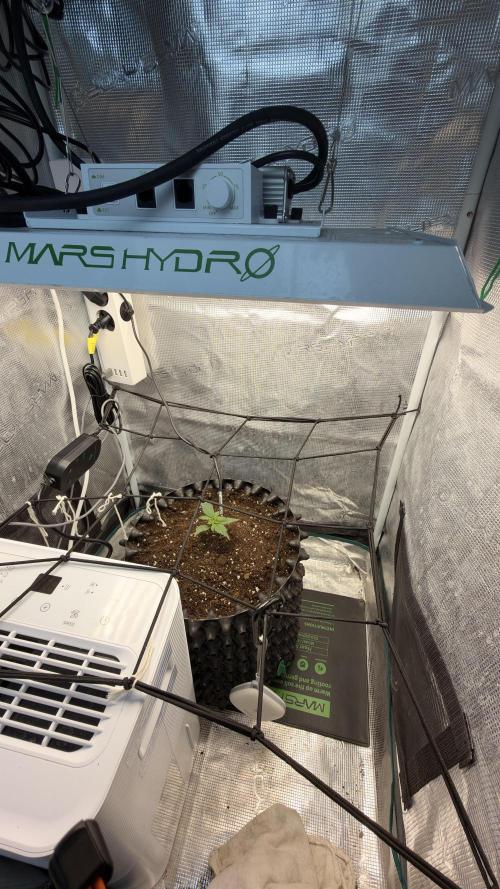
diversiv0 **Day 12 from sprout – Transplant Day (October 21, 2026)**
Epsilon F1 by Royal Queen Seeds was germinated in a Click & Grow experimental pod, with the seed planted on October 5 and sprouting on October 9.
After 12 days of healthy, compact growth, today she was transplanted into her final 12L Air-Pot filled with BioBizz Light Mix.
The root system looked healthy and well-developed, with numerous white roots extending throughout the original plug. The seedling has a sturdy stem, tight internodal spacing, and several sets of true leaves, with fresh growth emerging from the center.
The substrate was initially dry, so approximately 500–660 ml of water was applied around the root zone after transplanting. No additional nutrients were added.
She is now inside the Mars Hydro grow tent under a TS1000 LED, initially dimmed to 25%, following an 18/6 light schedule (6 PM–12 PM). Temperature and humidity are monitored using Govee sensors, with automated ventilation.
The focus for the next few days is recovery from transplanting, root establishment, and monitoring environmental stability before gradually increasing light intensity.
**Overall:** A promising start, with compact structure, healthy roots, and no obvious signs of significant stress.
2 likes
comments
Share
4
Week 4. Vegetation
1d ago
1/6
9 cm
Height
18 hrs
Light Schedule
21 °C
Day Air Temp
6.3
pH
66 %
Air Humidity
26 °C
Night Air Temp
12 liters
Pot Size
35 cm
Lamp Distance
diversiv0 Week 4 – Steady Growth Despite the Cold
Dionisio is now 22 days old since sprouting on October 9 and 10 days past transplanting into the final 12L Air-Pot filled with BioBizz Light Mix.
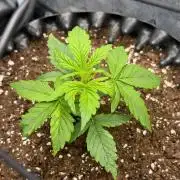
This week brought noticeable vegetative development. Plant height increased from 6 to approximately 9 cm, while the canopy became significantly fuller. The main stem is sturdy, internodal spacing remains remarkably tight, and several lateral shoots are developing nicely. Fresh green growth continues to emerge from the top.
On October 26, I watered with pH-adjusted water at 6.3, without adding nutrients. On October 28, I increased the Mars Hydro TS1000 from 40% to 50%, maintaining the 18/6 light schedule. The last measured lamp distance was 35 cm.
The biggest challenge remains temperature. According to Govee sensor data, average temperatures during the light and dark periods were 15.6°C and 18.3°C respectively, with average relative humidity around 65.5%. The lowest recorded temperature was 11.3°C, considerably colder than expected.
I’ve ordered a Spider Farmer 540W grow tent heater to improve temperature stability before winter.
Despite the cold conditions, Dionisio continues to develop a compact, bushy structure with healthy-looking new growth and no obvious signs of significant damage.
Overall, I’m pleased with her progress, especially the short internodes and lateral development. Looking forward to seeing how she responds once the environment becomes more stable.


 commentedweek 017d ago