


Too much defo for Automatics?

Organic_Gstarted grow question 2mo ago
Did I do too much defo? Only removed lower branches & leaves that don‘t get any light ( day 38 since sprout / week 2 of Flower )
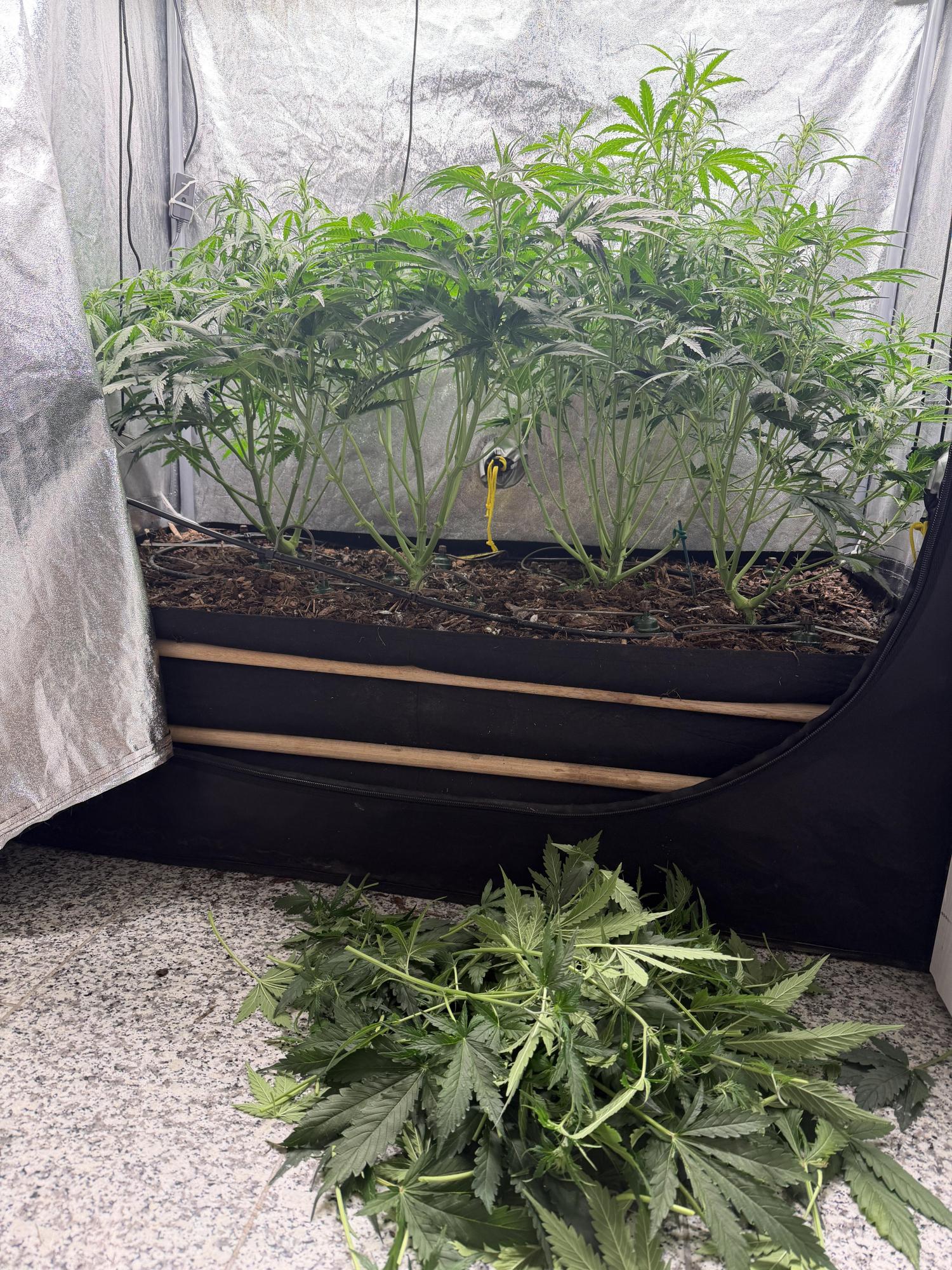
Solved
3 likes

DrGruenanswered grow question 2mo ago
hi Organic.......
für meinen Geschmack hast du für eine Automatic etwas zu viel entlaubt.......😳
Aber es hält sich ja in Grenzen und in den oberen Bereichen hast du ja noch ordentlich Blattwerk.......
Jetzt kommt untenrum wenigstens ordentlich Luft und Licht ran .😎
Mach dich nicht verrückt, es hätte schlimmer kommen können......😂
Viel Glück

00110001001001111Oanswered grow question 2mo ago
too much defo for any plant. Leaves are incredibly important organs that do more than just absorb light. You ahve reduce co2 intake, which is a limiting factor, and you have thrown out a bunch of nutrients you fed the plant up to this point, too. there's absolutely no good evidence to support this so-called "technique."
This is one of those weird myths people repeat and think it helps the plant somehow. If you don't over-crowd a canopy, there's never a reason to do a mass defoliation with a healthy plant. Removing a select leaf here or there for a very specific reason is not "defoliation." Defoliation is masturbatorial in nature -- makes someone feel good for a moment, but doesn't really accomplish much, lol.
in re to some criticism of another's answer below
"store sugars" -- sugar is the vessel for energy, lol. So yeah, the leaves do store energy. That's existing knowledge that isn't up for debate.
When it comes to bro science, realize it's inductive dreck. It's a top-down narrative possibly based on some bits of real knowledge, but never tested. E.g. for a long time peopel said if you interrupt the dark cycle, green wavelengths are safe.. turns out green has just as strong if not stronger impact, lol. People just assumed since green wavelengths are less important for photosynthesis that it was safer for the plant. A lot of this stuff will sound science-y but most never bothered to test their hypotheses. Just as nobody ever bothered to test whether flushing at harvest reduces mineral content.. for decades the peanut gallery just repeated a false premise with extreme confidence and belligerence toward anyone that contradicted their dogma, lol. That's how stupid people form conclusions... top-down (inductive reasoning), limited evidence (or ignoringn existing knowledge), and too lazy or incapable of testing the hypothesis.
1 like
Complain

John_Krameranswered grow question 2mo ago
@Ultraviolet_ nice setup man 👍 22/4 man are u high xDD
@Organoman what energy ? is there much of photosynthesis in the shadows ? 👈😂
i mean yeah they breath and store sugars and salts but energy ? 😁
1 like
Complain

Green_Clawsanswered grow question 2mo ago
Squalino with his same wrong bullshit, kissing the ass of the beholder for points like a dog beg behaviour 🤣🤣
4 likes
Complain

Ultraviolet_answered grow question 2mo ago
I don't mean your nights are shitty, erm, i meant like to understand first what is "optimal" for cellular respiration, it helps to know it's strongly tied to temperature, to even scratch the surface of beiing efficent enough you need to run over 80F at nights, by doing so this changes things at night, any temps above 77F increase bacterial multiplies 10x fold, so your entire setup and understanding of water movement and its importance come into play, very unforgiving, there can be no "breakdowns" in the cycle of growth when "cycling" metabolically this fast.
The only way a 22/4 can work to balance assimilation with utilization is if you are smashing the nights hard by optimizing co-enzyme conditions, giving the plant the average joe 70F 60RH, is like throwing an egg in a fridge and wondering why it's not boiling, barely going to convert a thing.
4x 86-day automatics @ 12/12 from germination, 154g per plant, dry.
growdiaries.com/diaries/269085-grow-journal-by-ultraviolet/week/1556846
1 like
Complain

Organomananswered grow question 2mo ago
Yes.................far too much...............what sort of benefit do you believe this will provide to these (smallish) plants?
Less leaves = less energy production = less potential.
2 likes
Complain
Ultraviolet_answered grow question 2mo ago
Whether it's too much or not is arbitrary imo.
"Only removed lower branches & leaves that don‘t get any light."
Is an incorrect way of thinking about the role and responsibility of leaves, which is not in line with the reality of what you are actually losing.
Cellular respiration occurs 24/7, not just at night. The mitochondria within each leaf have limited photooxidative capacity. If a leaf is not 100% photosynthetically active, it opens up the oxidative capacity for cellular respiration, even during daytime. (Essential for anyone who runs high humidity at night)
Photosynthesis is responsible for the capture of carbon, but only preocesses 10% into usable ATP; cellular respiration is responsible for the other 90% of that ATP. In my eyes, all you have done is remove 100% of daytime cellular respiration, putting 100% of the cellular respiratory workload on the "nights", which can be very easily stifled with cool, damp nights.
You can capture all the carbon you want, but if your plant cannot process any of it, it severely limits the energetic conversions during each cycle. You don't just cut off 30% of the plants' mitochondria and call it a good thing, not when you are on autoflowers, photoperiods, sure. Carbon assimilation (photosynthesis) must be balanced by carbon utilization (metabolism/respiration).
Plant growth is fundamentally dictated by the efficiency of energetic conversion, where light energy is transformed into chemical energy (ATP) and (NADPH) to drive biomass production. far too much emphasis imo is given to the capture of the carbon, not enough emphasis is placed on the conversion and optimization of what imo is far more important to balance. I realize this opinion goes against the grain, but I've witnessed myself on the same plant with different branches defoliated to different levels on the same plant, and over the years, I've noticed one thing: every cola I could never reach to defoliate was always bigger than the ones I could reach come harvest.
My 2 cents.
The thing about autos is they normally do 18/6 or 22/0 as if that somehow benefits the plant.........asking a plant to convert 22 hours of carbon assimilation in 4 hours of sub-optimal conditions at night (high rh/ low temps), This happens because by defoliating every single leaf that possibly had any oxidative capacity for cellular respiration to occur during daylight is now gone placing 100% of the responsiblity for the conversion of 90% of the entire energetic glucose conversion to ATP is now done in the 4-6 hours of shitty sub optimal nighttime. The entire plant is generally bottlenecked to this conversion rate, which limits the plant to a % of its potential.
Analogy akin to gassing up your car every day and wondering why your vehicle isn't getting any faster when you only travel 20km per day. While simultaneously stripping it down for parts.
Investing excessive resources (fuel/energy) into a system without increasing the intensity or output (speed/distance), results in wasted potential rather than improvement.
6 likes
Complain

cangrowzanswered grow question 2mo ago
Hey Organic_G! Honestly, looking at image , you did a great job with that defoliation. Removing only the lower branches and shaded leaves that don't receive light is exactly how you should approach "lollipopping".
By clearing out that bottom growth at day 38 (week 2 of flower), you are helping the plant focus all its energy on the top colas where the real bud development happens. It also significantly improves airflow around the base, which is key for preventing mold or pests as the canopy thickens up. Since your plants still have a lush green canopy on top, they have plenty of "solar panels" left to power through the rest of flowering.
Happy Growing Growmie🌱
1 like
Complain
John_Krameranswered grow question 2mo ago
i think that's a good idea about lollipop 👇
or at least prune those between plants day by day, let em not fight for light and space 👌
2 likes
Complain
squalinoanswered grow question 2mo ago
Hi
Your plant has a “clean” and well-ventilated look. no, I don't think you were too heavy-handed.
it's good timing
It's the perfect time for Lollipop. The plant has finished (or is finishing) its stretch. Removing the lower branches now allows the plant to redirect all of its energy to the higher bud sites which benefit from the maximum light intensity.
The space under the canopy is clear. This will drastically improve air circulation, reducing the risk of mold and gnats. You kept the large fan leaves on the upper part. These are the “solar panels” that the plant needs to produce large buds.
You did a good job in my opinion. your a beautiful plant. keep it up.
1 like
Complain
Green_Clawsanswered grow question 2mo ago
Way to much for 1 defoliation, I like the plants look OK but ouch!!
2 likes
Complain
John_Krameranswered grow question 2mo ago
In my opinion u did too much in 1 go
Now could be consequence
1 like
Complain

Nocone_Purpleanswered grow question 2mo ago
No, you didn’t overdo it. What you did is textbook light management removing only lower branches and dead/shaded leaves is exactly what autos need. That’s not aggressive defoliation, that’s maintenance. At day 38 (week 2 of flower), your timing is spot on. Autos have a tight timeline, so you want to remove obstacles to light early, before flower really kicks in. By the time they’re in full flower (weeks 3+), you should leave them alone completely. You’ve got that window and used it right. What you’re seeing is Healthy structure, good canopy airflow, and plants focused on buds instead of feeding lower branches. That’s the goal.
Don’t touch them now. They’ll finish faster than photoperiods, and at week 2 of flower, they’re committed. Let them run to chop. Any stress from pruning at this point is wasted energy.
Your defoliation was conservative and well-timed. Most people either do too much too late, or don’t touch them at all. You found the sweet spot. The plants look great just let them finish.
2 likes
Complain