


Likes
Comments
Share


@Chedderbob112
Follow
Thanx for al the Support guys well appreciated there are some people on hear that a seriously do respect and consersider 💯 percent real deal growmies but hit me up ye never wee might end homies stay safe stay blessed n stay baked @chedderbob112


Likes
3
Share


@Moli77
Follow
Vorab, die sind bisschen durchs Zelt gewandert. Beschriftung von links oben nach recht unten, von links nach recht.
Ich habe mich gescheut viel auf einmal abzuschneiden, hab lieber 2-3 Tage gewartet, geschaut wie sie es annehmen, bis es wieder notwendig war zuschneiden, um die Mitte der Sherbet Queen freizuhalten und Blätter die kein Licht bekommen wegzunehmen.
Bei der Sherbet Queen habe ich die ersten Seitentriebe der unteren beiden "Haupttriebe" entfernt, da diese eh lost sind und die Pflanze sich deshalkb auch mehr gestreckt hat.
Die Cherry Pie, mein eigentliches Sorgenkind, sieht mittlerweile aus wie ein richtiger Blumenstrauß, hier habe ich das LST zum richtgen Zeitpunkt angwendet.
Bei der Hulkberry ist mir einer der ersten beiden Seitentriebe, der zu einem fetten Arm hätte werden können, leider abgebrochen, außerdem zeigen zwei weitere Risse durch das biegen der Stiele. Sind schon wieder verheilt, nur jetzt angeknackst und nicht mehr allzu stabil.
Ansonsten immernoch sehr zufreiden.
Likes
3
Share

@ChubbyBudBros
Follow
-
Day 57
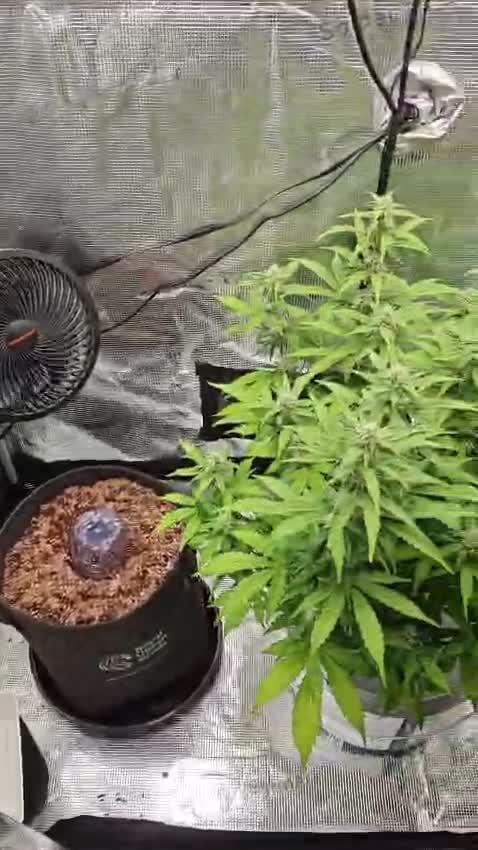
Noticed quite a dramatic drop in pH today, went from 6.0 to 5.3 in one day. I noticed one of my bubblers was blocked, put in a new one and it's fixed now, hope the issue was due to that. the plant is doing good otherwise. Brought the pH back up to 6.2 now.
Day 58
Was happy to see today that the pH drift has been fixed! Seems like the broken bubbler was the problem. pH only dropped down to 6.1 today.
I topped the reservoir up with some 6.1 pH water to keep it there. Happy this is fixed now .
Day 59
Sadly the water bubbler was not the issue :/. pH dropped down again from 6.1 to 5.3. I fear that she is just drinking so much compared to how small the water reservoir is, which makes the nutrient concentration very strong, brining down the pH. I did a res change today, Let's see what it looks like tomorrow.
Day 60
pH went up to 6.5 today after the water res change, which seems to be how it always goes. It goes up the first 1-2 days then it drops hard the next days after. I gave it 6.1pH water today topped the res up more than usual because I will be gone for 2 days, hopefully the pH will stay somewhat stable until I get back.
Day 62
Back from my long weekend! The reservoir still had about 1 liter in it, she been drinking a lot. Came home and immediately refilled the reservoir. Noticed pH had also dropped so 5.1!! With the newly added water now it's sitting at 5.9 now. Seems like she is doing well however. Some of the of lower fan leaves yellowed a lot more but that is probably due to all the flowers developing right now.
Day 63
Water topped up again with 1.5 liters of pH 6.6 water, which brought the pH back up to 6.1.
Likes
41
Share


@Silverback_Guerilla
Follow
11/2:
They're off to a good start!
11/3:
Some of the other seedlings almost immediately started showing signs of N deficiency, but these two are fine.
I fed them a little bit today, and am foliar feeding them every few hours with Microlife Super Seaweed.
11/4:
They are the most vigorously growing seedlings in the garden.👍
11/7:
Growing very well now!

Likes
7
Share


@Reaper
Follow
This strain reminds me of purple kush but then this is the best phenotype, very dark purple buds ready in 70 days

Processing
Likes
8
Share


@Max1973
Follow
Day 35 - few pics and vids..... everything going along nicely 👍
This is a pretty big update, so i'll add to it over the next few days, as i
finish building it all....
i'm building these 2 x SS haze, the full tent, just finishing up the setup.....
trimming them, changing solutions to 12/12 and flower.....
changed the exhaust fan and filter setup to the better outside the tent method....
and installed 12v CPU computer fan, lol ("alta9" fits in 4in ducting perfectly), drops wattage on extractor fan.... 10w tops...
got a few kg of active carbon and making/replacing the carbon filter ....
i'll add afew vids of the new setup in afew days...
Day 36 - few pics/vid of new tent setup...... "alta 9" fan :)
post tomorrow after i finish trimmin and settin up night mode etc......
and into tomorrow we go, lol ... Day 37....
slowly getting there..... little bit more to go...
this should make things abit more interesting..... right tank (short babie) has : 19 lts of tap water @18oC + 150 ml -dutch master one gold FLOWER.... 6.4 PH - 1400 PPM
left tank has : 19 lts of tap water @18oC + 50 ml of elements a and 50ml of b and 10 ml of nitro and 20ml of Crystalic (molasses/pot) .... 6.5 PH - 1200 PPM
more pics / vids of the finished tent setup.... roots, transfer, etc... Day 37 is alot of vids of the clean and change to flower.....
edit - day after build noticed left tank (nutrifield) not enough bubbles..... pulled out the 4 air pump and swapped to the 2 x original oxipumps...
much better, also to fix the problem with ph goin high, and bubbles not stirin the mix, was to add another 10ml of crystallic and another 5ml of nitro...
then pumped both tanks with ph down and set em to 5.8-6.2 - both plants have fully recovered from the big trim, and bounced back within 12-24hrs,
post pics/vid in abit.....
Day 39 - made a freaky video... was curious about what the plants would see looking up at the lights...
the lights and buzzing of air compressors and bubbling tank water, and dazzling lights turned out pretty cool in vid editor,
was in selfie mode....
and final vid of the bounceback from trim :)
👍😎

Likes
27
Share


@adam_pawloski87
Follow
Over all was an amazing grow, super sticky dense nugs with smell of berries, highly recommended for everyone!!
Likes
27
Share


@Endriu
Follow
Here we are again Bros&Sis!
During my first indoor grow with Bubblegum XL I've had took some cuts to keep them alive and have some good plants to play with and exploring a little more the vaste world of growing cannabis...
Long story short, 5 of them has radicated (some with plain water technique, some in rockwool cube) and then I started to play with them and tested my chinese Meizhi R300W LED panel (real wattage is 136w) it was full of dust, so why not? 😎
Now, the plants. They are in good conditions, some are in the same pot by weeks now (soil and coco), and try to keep them alive, so maybe they shows sign of suffering. Except for the One:
In the video you will see my REALLY HIGH SCIENTIFIC METHOD (😂) wich I use to choose the best clones that will goes directly under a Scrog net (i am a DIYer) to fill the entire area lighten by the panel, it's a bit ambitious, but it will be fun for sure!
I choose that one because she is the only one that gives me really good vibes and shows me she is strong enough to pass through hst, crop, supercrop and so and so... even if my original intentions was to keep them as a bonsai mothers, I've decided that this project have priority!
10weeks old Bubblegum XL clone
Pot 11lt NetPot
Coco brick with mycos
Canna Coco A+B
Liquid silicon from Growth Technology- guys, this thing is magical, besides the great effects on the plants' roots and system, after a couple of apply the plants were much more flexible and resistant to mites (yes, they are still there, fu**inmotherfu**ers, but this time they will die. forever gone, bye!)- I will never stop to thank @Mr_Di for his precious tips😘Higly basic product, it will raise your solution's PH, so watch out!
Let me know what you think about, mates! CIAO! 😀
Likes
14
Share


@Chi_K24
Follow
hey guys, into week 10 and the start of the flowering phase. Getting closer to 12/12 and the ladies are starting to stretch.
Not much going on this week. A little bit of lst and the usual maint on the canopy.
Iv notice that some plants are having issues with brown/copper spots forming on some of the leafs edges. Hope someone can point me in the right direction.

Likes
12
Share


@Tanjalope
Follow
Good week in the tent 👌 only given ph'd water again. Been a lot warmer so been good for the girls in the then but not so good for some seedlings I had going on my window.
Every day now seeing more growth the original Russian is the furthest along. Kind of surprised about this because i was expecting #Quick one to be the fastest out of the lot. Not the case for me here at the minute.
Excited for the next few weeks to see what different strains start looking like smelling like all that jazz! Hoping for a couple of oz all together. A few different flavours not expecting any monster yield here.
Took a pic of each individual plant all are quite small. Seem to have 4 I'd class as big girls for my space. Six shooter, zkittles og, missile 33 and cosh kush are all nice little bushy plants. The white widow and the Rusian are nice as well maybe if I had positioned them differently in the tent it could all have been different who knows.
Peace 🍁


Likes
4
Share


@GothBotanical
Follow
She’s cruising through late flower now with strong stacking, steady trichome development, and some beautiful natural fading. The canopy stayed balanced and open this week — no new LST applied, but I did remove a few large fan leaves (3–4) to improve airflow and reduce the risk of moisture buildup. Buds are visibly frosting up across all sites, and I’m starting to see early signs of purpling on some of the upper fans, which matches what I’ve seen in the breeder photos. Lower fan leaves are beginning to fade and crisp at the edges — normal end-of-life senescence, nothing widespread or concerning. I continued alternating feedings: watered with Big Bud (5 ml/gal) mid-week, then gave Cal-Mag (1 ml/gal) on Day 63 along with a refill of the auto-watering base. Temps ranged between 86–88°F with humidity steady around 39–42%, which seems to be keeping everything dry, resin-rich, and stress-free. Week 10 starts tomorrow — I’ll begin checking trichomes more closely and start prepping for flush and harvest. Still smelling sweet and staying strong!
Likes
17
Share


@XoticGROW666
Follow
🎩🌈🍧🍨🍬
No toppin
No trainin
Jus test run
Terps on her is insane str8 candy fruity ice cream can’t wait till run her again with full toppin and trainin!! This a winter test grow outdoor so the buds won’t be that big but We will see 🤭


Likes
10
Share


@Elcoquigrow
Follow
Primera semana desde el cambio de fotoperiodo creciendo y comiendo como locas 🤣 go crazy
Likes
38
Share


@MadeInGermany
Follow
Flowering day 59
since time change
to 12/12 h.
Hey guys :-)
The lady is slowly coming to an end 😍.
The buds start to swell extremely .
The trichomes are 80 % milky and 20 % amber :-) .
This week she was given a very light flush with Clean Fruits so that she can use up her remaining nutrients in the coming days 👍.
It will be harvested in the next 6-10 days 😍.
I can't wait to try them all :-) .
Otherwise everything was cleaned and checked.
Have fun and stay healthy 💚🙏🏻
👇🏼👇🏼👇🏼👇🏼👇🏼👇🏼👇🏼👇🏼👇🏼👇🏼👇🏼👇🏼
You can buy this Nutrients at :
https://greenbuzzliquids.com/en/shop/
With the discount code: Made_in_Germany you get a discount of 15% on all products from an order value of 100 euros.
👇🏼👇🏼👇🏼👇🏼👇🏼👇🏼👇🏼👇🏼👇🏼👇🏼👇🏼👇🏼
You can buy this strain at :
https://www.exoticseed.eu/de/hanfsamen/hippie-therapy-cbd
Water 💧 💧💧
Osmosis water mixed with normal water (24 hours stale that the chlorine evaporates) to 0.2 EC. Add Cal / Mag to 0.4 Ec Ph with Organic Ph - to 5.8 - 6.5
MadeInGermany

Likes
4
Share


@AlpAge_Cino
Follow
Not so much to say this week : everything looks OK. OAH #7 is still struggling to live and will be replaced by feminized Runtz from Pevgrow soon (mother plant for a futur run).
I put back the FC-E3000 driver in tent in order to warm up inside day air to 28-30°C range and let plants manage high RH and CO2 (still between 700-900 ppm, so no CO2 supplement for now) : no problem for Amnesia as it enjoy this kind of temp.
2023/06/13 : another (and last) round of Boom Boom Spray, 5 days after first one, during vegetation grow.
2023/06/16 : as planed, I removed dying plants (#1 and #7) and added one Runtz feminized from PEVseeds for next run with clones. From 10 seeds, 1 never popped and 3 died as root could'nt get out of the Jiffy, so it will be a poor 60% rate!😪
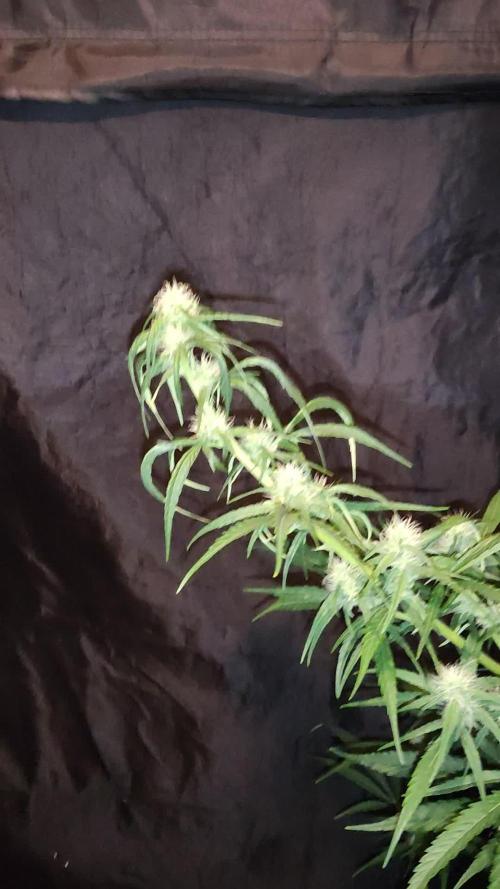
And I almost forgot, pistils are out!




Likes
6
Share


@midnitrtoker
Follow
This week has been awesome. Reservoir has been lasting is pretty well these 3weeks. I filled it with 10gals and have not had to top it up. Dropped the trellis net on the girls to get her to open up more, I will be adding 1-2 more layers of trellis just in case when we flower we make sure to really spread them out. I’m really loving this Autopot 10gals has really gone a long way I just make sure to check the ph and we are good. Next week I’ll be flipping so you will get to see what she looked like before the flip. Thank you all again for watching. See you all next week.