


Likes
Comments
Share


@Va_smoking
Follow
After dropping my plant last week I thought it was done for.
But the new light really seemed to make all the difference for her. Having her in the tent is good because I can control the humidity a little better. But to be honest I'm doing a crap job at it ... Humidity can be anywhere between 50 and 80%.
When I went to work on Tuesday the plant jumped up. Amazing how much growth in just a few hours. I was thinking about whether I should top her or not. I don't think I will though because she seems like a nice sturdy little plant
At the end of the week I decided she really needed to be repotted.. I thought I was pushing it going early but I got a new light in and was planning to take her off the shelf and move her to the floor so it seemed a good time.
Turned out to be a good choice. She's lovely


Likes
52
Share


@TheFoxFarmer
Follow
Thank you to RQS for creating and sending me this girl. She's fat, full of flavour and a pleasure to grow! Highly recommended even for a beginner. Thanks to all that follow, like and comment. Without you guys it'd be pretty boring so I appreciate all of your input!
She was harvested on Day 58 and left to dry for at least a week. I then gave her a dry trim and thrown the buds in a jar for curing. I put a couple of boveda 62% humidity packs in there too, to keep the moisture level correct. I'll soon be switching to Integra boost packs as they seem to get a better review and are purposely made for cannabis.
Because I have 4 seperate plants/strains in one tent, under one light, I've had to calculate these by dividing the conditions by 4 (4 plants in total sharing same conditions). This is the fairest and only way to work it out on average as a full tent.
Happy growing! 🐺


Processing
Likes
43
Share


@Jack_Greenstalk
Follow
week 6 seeing strong new growth in both plants, trying to contain vertical growth with low and high stress training before I add the double layer trellis netting next week. started roots by heavy 16 at 1 ml per gal, and i have foliar 2 times past week (once every 3 days) heavy 16 foliar at 40 ml /1 l (breaks down to 4 ml per 100 ml of water, mist about 50 mls on bottoms of plants then all over an hour after lights turn off.
did some defoliation on lower fans to allow light penetration to potential mid level tops

Likes
34
Share

@Cooky_420L
Follow
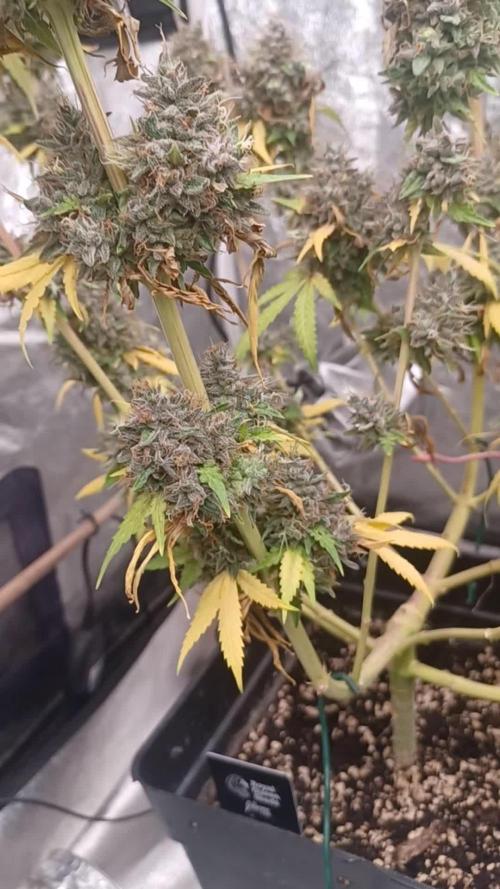
11' semaine de floraison 113 jours de vie et 76 en flo. Après vérification de mon planning elles ont 66 jours de floraison, la pre-floraison avait duré 10 jours. Niveau réglages lumière j'ai réduit mon spectre et réduit de 1hr , je suis en 11/13 espérant accélérer la fin de floraison. Ce week-end je prévois de récolté A2 elle m'a l'ai bientôt prête.
Merciaux Growmies qui me suivent ✌️ Bonne semaine de culture à toutes les p'tites ✋️ vertes 🌱🌞🌱
Likes
7
Share


@weedelicious
Follow
Hey ihr Lieben! Nach 10 Tagen Trocknung habe ich das Curing begonnen. Die Äste haben geknackt und mir signalisiert, dass sie bereit sind. Nach 5h Handarbeit war ich dann fertig. Mega anstrengend :P! Aber hat sich sehr gelohnt :). Trotz das ich dieses Mal anstatt mit mineralischem Dünger mit einem ein Komponenten-Dünger gedüngt habe (Hesi Bio-Bloom), habe ich sogar mehr herausbekommen... Bin sehr zufrieden :). Nach dem Curing habe ich das Material in die Terplocbags gepackt und lasse sie nun dort schön fermentieren - das hat letztes Mal sehr gut geklappt und kann ich nur empfehlen. Danke an alle die mich bei meinem 2ten Run begleitet haben, ihr seid die Besten! Mir hat es auch mega Spaß gemacht und ich freue mich schon darauf, meinen 3ten Run mit euch zu teilen - mehr Infos dazu kommen bald.


Likes
7
Share


@CannabisRelated
Follow
Had to harvest a little early, the high is very clarifying, and long lasting. The trichomes were mostly clear, with some slightly milky, not much amber at all. Flavours will be updated after a bit more testing.
20inx20inx36in grow space, 100w quantum board. Taste/effects/more info will be added after some curing time.
A little bit sad that I had to harvest around a week early due to a small amount of bud rot, but it looks and smells great, I cant wait to actually try it out.
Harvested 125 grams(dried) total from the 3 plants, I honestly didn't expect to get such an amount on the first try.
Bud was so sticky during the final dry trim, my scissors kept getting stuck on themselves and I had to keep cleaning them often.
Out of the 3 plants it was probably around 50g/50g/25g as the one in the back corner was smaller than the rest, but just as frosty.
Great seeds, I would like to try the photo period version in the future.

Likes
42
Share


@TheCannaProphet
Follow
~Humboldt Seed Co. AMHERST SOUR DIESEL~
???Secret origins???
The mystery of the unknown🧐
Amherst Sour Diesel is a cannabis seed whose origins are kept a secret. This wonderful vigorous marijuana plant will reward your work with large, elongated, compact buds complemented by a rich complex aroma. Indoors it performs best with a short growth and outdoors, in temperate, warm, dry and Mediterranean climates or in a greenhouse. A marijuana plant that boasts balanced properties.
-Top-notch flavor and effect
-Idyllic feelings to treat the senses
-The aroma of this cannabis hybrid is a pleasant combination of ripe fruit and oil. The flavor is rich and complex, with hints of tropical fruit, oil and exotic wood.
-The effect, typically Sativa, is euphoric, uplifting, powerful and long-lasting. A cannabis strain Sativa lovers will know how to appreciate.
________________________________________________________________________________________________________________________________________________________________________________________________________________________________________________________________________________________________________________________________________________________________________________________________________________________________________________________
Tech Specs:
~Amherst Sour Diesel~
Feminized
Genotype: 20% Indica / 80% Sativa
Cross: Chemdawg x Amherst Super Skunk
Suitable for: Indoors and outdoors
Indoor flowering: 65-70 days
Indoor yield: 400-600 g/m2
Outdoor harvest time: Late October
Outdoor yield: 2000-3000 g/plant
Outdoor height: 2-3 m
THC: 27%
CBD: 0.1%
________________________________________________________________________________________________________________________________________________________________________________________________________________________________________________________________________________________________________________________________________________________________________________________________________________________________________________________
THE SETUP:
~Planted into Jiffy Peat Pellets that were hydrated with de-chlorinated water with SuperThrive added then ph'd to 6.0 @ 80℉
~Grown 100% organic in 10g fabric pots with Mother Earth 70/30 Coco/Perlite medium amended with 2tbs/g of Down To Earth 4-4-4 / 2 cups/g of Earthworm Castings / 1tbs/g of Dr. Earth Flower Girl 3-9-4, 1tbs/g of Dr. Earth Bat Guano, 3/4 cup of Down To Earth Azomite and 1 tsp/g Down To Earth Fish Bone Meal.
~24hr light cycle during Germination / 19/5 light cycle for Vegetation and 12/12 for Flower
~Straight water ph'd @ 6.2-6.8 when needed and weekly Compost Tea's.
________________________________________________________________________________________________________________________________________________________________________________________________________________________________________________________________________________________________________________________________________________________________________________________________________________________________________________________
WEEKLY UPDATES:
9/13- With approx. 9 weeks of growth behind her now she's going into her 4th week of flower now and let me tell you the pictures don't do her justice... She has really come along well! 😍
She was given Compost Tea yesterday and today was still fairly heavy so I skipped watering and just removed a few leaves to maintain light penetration, turned her pot and sat and chatted with her awhile!
9/15- Well she really must have liked that last batch of Compost Tea as she looks exceptionally vibrant today!
She's continuing on her mission of stacking her flowers, which are developing beautifully and have a delicious sweet fruity aroma to them right now.
I did not water yesterday, so today I watered with 0.75g of straight de-chlorinated water that was ph'd to 6.5 @ 72℉ and rotated her pot... Damn she is looking great! 🤩💖
9/17- Yesterday I top dressed her with 1/4 cup of Down To Earth Bio-Fish then watered it in with 0.75g of straight de-chlorinated water that was ph'd to 6.5 @ 72℉.
Her flowering is continuing beautifully and she's smelling stronger every day it seems! I'm staying on top of tucking leaves blocking light and turning her pot daily as well.
9/19- Four weeks of flower on the books! We're almost halfway there now, she's stacking her flowers tightly going into Week Five and she's looking phenomenal! 🤩
When I watered her today I added 1 tbsp/g each of Kelp Extract and Fish Emulsion (both liquid) to the 0.75g of straight de-chlorinated water she received, which was ph'd to 6.2 @ 74℉.
~Thanks for stopping in! Things should be getting a lot more interesting in the coming weeks...Stay lifted and be Blessed! 😎🙏~
Likes
252
Share


@Tropicannibis_Todd
Follow
Well folks we chopped the Last of the Strawberry Blast 😁 The Strawberry Banana 🍌
Strawberry Blast Series 🍓 🍓 🍓 🍓 was a real blast , ive now done 5 Strawberry Cultivars and I'm extremely happy with all the results 😀 Killer Stuff 😀
I want to thank all my growmies for stopping in and showing your support 🙏 it's been much appreciated 🙏
Well my friends that's it for me for awhile😌
So until next time my friends 👉 Happy Growing and of course 🙂 Happy Smoking ........ Later Growmies 👊👊 be well 👌
FC4800 from MarsHydro Lights being readjusted and chart updated .........I've added a RU45 to the mix
www.marshydro.ca
👉I am using Agrogardens for nutrients for my grows and welcome anyone to give them a try .👈
👉 www.agrogardens.com 👈
Agrogardens Cal MAG
Agrogardens Grow A B
Agrogardens Bloom A B
Agrogardens Bud Booster
Agrogardens PK13/14
I GOT MULTIPLE DIARIES ON THE GO 😱 please check them out 😎
👉THANKS FOR TAKING THE TIME TO GO OVER MY DIARIES 👈
Would you like to hang with the growdiary community 👉 https://discord.gg/gr4cHGDpdb 👈


Likes
2
Share


@Bluemels
Follow
Tag 22: In 2 Tagen werde ich die Pflanze umtopfen.
Tag 24: Umgetopft in einen 15L Topf.
Tag 25: getoppt bei 4 Nodien.
Tag 27: Ich fange an die Zweige runterzubiegen.
Likes
8
Share


@Black_Widow
Follow
Привет любители травки
Началась новая неделя
С утра я подгибал ветки на цветке и одна кола лопнула и переломилась и осталась висеть на четверти стебля
После перелома меня охватила паника и боль , но я вовремя зафиксировал стебель и наложил ей шину
Прошло пол дня и вроде все обошлось
Стебель у этой девочки жесткий , но хрупкий
с ней LST очень аккуратно надо проводить
А в целом мне нравится её генетика .
Day 40
Сегодня я поменял раствор на стадию цветения
будем дальше наблюдать как пойдут дела

Likes
3
Share


@Snuffys_garden
Follow
Week 8 is going great, started flush
toward the end of week 7 on Zkittlez and OG Kush. Also started flushing Pink Kush CBD and Purple Punch at start of week 8. All are packing weight still and smelling very fragrant. Trichomes are starting to cloud out and I am planning on harvesting when trichomes are starting to amber.


Likes
49
Share

@THcHunteR23
Follow
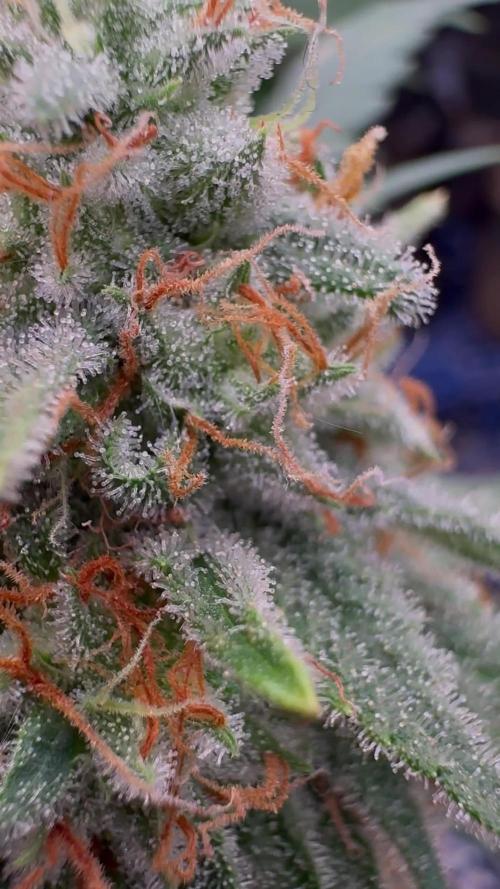
Elle tire vraiment vers la fin les nutriments s’épuise tranquillement. Je leur est donné 2 fois de plus grande quantité d’eau . Les tête son très dure !!

Likes
37
Share


@Aedaone
Follow
The temperatures, humidity, and watering volume(if measured) in grow conditions are all averaged for the week. The pH is soil pH. Any watering done by me is well water which is 7.6 pH and 50° F. Any listed nutrients are ml/gallon of soil to be top dressed.
Day 1 we had high temperature of 89°F. We had scattered thunderstorms and roughly two hours of rain. No watering today
Day 2 we had a high temperature of 80°F. The skies were partly cloudy with a healthy breeze. I water 2-2.5 gallons today.
Day 3 we had a high temperature of 79 and partly cloudy skies. This cooler weather has been nice. I watered 2-3 gallons each pot once.
Day 4 we had high temperature of 92°F. I watered 3-4 gallons from the hose.
Day 5 we had a high temperature of 85°F. Skies were cloudy to overcast with off and on rain until noon. Then partly cloudy in the afternoon. I added 50ml of blood meal and 50ml of iron spread evenly across the tops of the pots. Watering done by rain today. The roots have begun to grow out of the soil on top and down through the pots into the ground.
Day 6 we had a high temperature of 86°F, a short rain shower, with cloudy to partly cloudy skies. Watering done today by the rain.
Day 7 we had high temperature of 81°F skies were cloudy to partly cloudy. We had some intermittent heavy rain so everyone was watered by nature today.
This week was a success.bthe plants topped out at 70" of height. They've begun to feed heavy, so I added blood meal and iron. Next week I'll add some plant tone and coop poop. I defolated the #2 plant as it was getting super bushy. I've not shaped these as much as they need so they don't have a great shape. I'll work on getting them spread out next week.
Likes
19
Share


@Tazard
Follow
Color me absolutely impressed! This girl is huge and covered in Bud’s. The bud sites are tight! She really is a beautiful plant no wonder she’s currently sold out! Thanks for following along.
Likes
39
Share


@SamDo
Follow
Hello, 1ère semaine, on démarre en douceur, les plantes ont 1 jour, une graine de critical+ 2.0 n’a pas germé, mais cela arrive, je l’ai remplacée aujourd’hui.
J’ai mit vidéos du set up de la box et une qui reprend rapidement les conditions de cultures. C’est mon 1er journal, j’attend vos conseils et vos suggestions bienveillantes.. je ferais un update en fin de semaine...
Update fin de semaine fait. Toutes les graines sont cette fois bien sorties!!👍Il y a donc un léger décalage entre elles, mais aucuns soucis. happy grow!!😎

Likes
18
Share


@Luca90
Follow
Week four was definitely the week when the plants started to really grow bigger, I started some LST at my way cause even if I check thousands of videos I end it up doing what I thought was better for my plants, I perhaps was a bit late so it wasn’t stretching as I thought it would have, maybe I shouldn’t have wait this long, but again first time learning a lots.. I let the plant grow with LST only in week 4 in week 5 I introduced a scrog I made myself cause I thought that I couldn’t keep doing lst because I started too late
Likes
19
Share


@adam_pawloski87
Follow
Let’s go day 72 from seed!!! Another great week it’s been , 2 Ogreberrys an brucy b been flushing for a week, an the 3 others will continue to get there normal feed of nutrients, they are just not quite ready so they will start getting flushed around next week!! Sweet sweet smell of Grapes And gooey frosty nugs is all I can really say, photos do no justice, some of the craziest fruitiest smelling buds I’ve ever had, Real High quality meds !! Hope you all enjoy an have an amazing productive day as well as a great week!! Peace love an positive vibes to all y’all Cheers 😶🌫️💨💨💨💨💨🤙🏻If there’s any questions, please ask!! 💚🙏🏻💯

Likes
18
Share


@BigDaddyK
Follow
keep an eye on ph and EC
i top up approx 2ml of A+B per day
I think she finally stopped stretching , this is when I start to lower the base nutrients , one of them is a little behind the other , she has some wicked buds forming

Likes
13
Share


@FlavoursUk
Follow
Start of week 5, the girls are looking promising. Trichome production is in full flow now, leaves and buds getting very frosty. Slowly increasing the EC in 0.1 increments to avoid overfeeding and nutrient burn but still push the genetics.
Also added a dehumidifier to help keep the humidity down and in range. Although not a whole lot to do, pH and EC parameters are still very important. Will be checking in, the next few days.
