


Likes
12
Share


@PolezGardn
Follow
week four flower everything looks fine so far :D
I water them with 1.5l every 48h
the light I use was set to 100% and it hangs 80cm away from the tops


Likes
21
Share


@Highgrade_Harvests
Follow
Week 8 is all done for the blueberry pie! This plant is finishing up real strong. Aroma has increased substantially in the last week. Purple hues are starting to cover the entire plant. Buds are extremely dense and covered in trichomes. About a week of flushing and this plant should be all set for the chop. I hope you all have enjoyed the journey! Wish I had more time lapse videos. My camera stopped working halfway through the grow. I'll figure it our for the next one. I will probly run this plant again and try to scroll it out. Thanks for following along!


Likes
11
Share


@Hellishjam
Follow
Working on day 47, 17 days into flower and one of these GSC what really taken off she's stacking up well. Dealing with some cal mag problem in these as well, did a flush with 4 gals per pot and will amend the soil on the on the next watering after we get a nice dry. Will be using bloom and oystershell flour. One of these ladies had some lst done to her as she was just way to close to the light. Did some defoliation with all the girls in the tent to try and open things up a bit, I know autos but things were pretty crazy and a lot of bud hidden. The intake filter for the hood works very well the glass inside is very clean after 28 days, just gave the outside a quick wipe and good as new. Ive got the temps back down a bit and holding strong at 25, when I checked the tent it was running around 28, highest being 30 at one point not sure how long that went on for but it's all fixed up now. Its a working progress learning indoor growing 2 weeks at a time but hey it is what it is and were having fun. hope you enjoyed.

Likes
6
Share

@DogDoctorOfficial
Follow
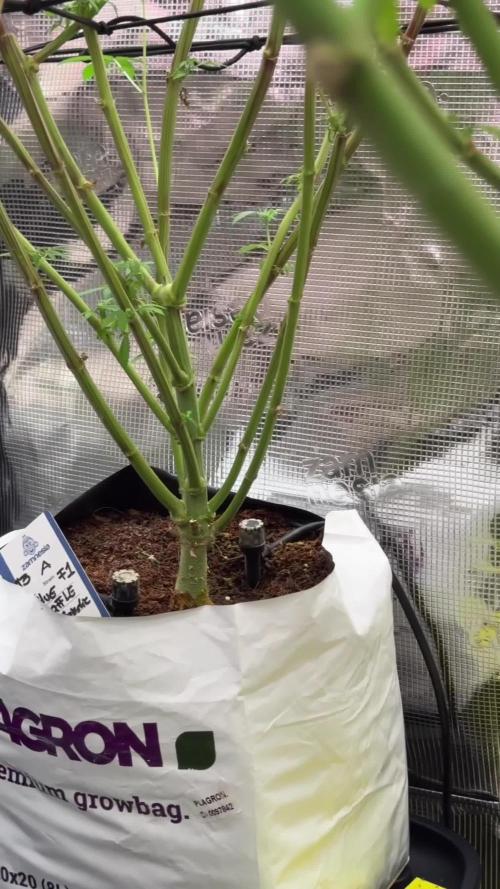
💙 Project Blue Tent – Week 11
💙 Blue Waffle F1 – Pheno B
🌸 Same Room. Same Conditions. Another Beautiful Expression.
Hello everyone, and welcome back to another chapter inside Project Blue Tent! 💙🌱
And once again...
I'm looking at these girls and thinking:
How can four plants look this similar?
😂💙
If you've been following Project Blue Tent, you'll know that we're documenting four individual plants from seed to harvest, each with her own dedicated diary.
All four share the same tent.
The same lighting.
The same irrigation.
The same reservoir.
The same nutrition.
The same environmental conditions.
The same cultivation philosophy.
And yet...
each one gets her own chapter.
Today it's time to give the spotlight to Blue Waffle F1 – Pheno B.
And honestly?
She's looking absolutely beautiful.
🌿 PHENO B – LET HER SHINE
Pheno B has reached approximately 145 cm and has developed a fantastic flowering structure.
At this stage, there isn't really a lot I want to change.
And that's actually a good thing.
The big work has already been done.
The long vegetative period gave us the structure.
The topping and training shaped the plant.
The first SCROG organized the canopy.
The aggressive flowering stretch forced us to rethink the vertical space.
The major defoliation opened the plant.
The second SCROG gave the flowering branches additional support.
The ventilation system was moved outside the tent.
The LEDs were raised.
The airflow was improved.
And now...
we're watching all of those decisions come together.
The plant is doing exactly what we wanted her to do.
Grow.
Flower.
Develop.
And increasingly...
FROST.
😂💙🌸
🌸 THE FROST IS GETTING SERIOUS
I have to say this because the photographs really don't need much explanation.
The frost levels are beautiful.
The flowers are becoming increasingly covered in trichomes, and every week the close-up photographs seem to reveal more.
This is the part of the grow where you start looking at the plants differently.
Earlier, we were looking at structure.
Now we're looking at flowers.
And those flowers are beginning to tell us their own story.
The density.
The development.
The resin production.
The structure.
The way the flowers are forming along the branches.
Everything is becoming much more interesting.
And Pheno B is absolutely shining.
💙🌸
🌿 THE TOPPING AND STRUCTURE – LOOK AT THAT OPENING
Another thing I'm really happy with this week is the structure created by the topping and training.
When you look closely at Pheno B, you can really see how the plant opened up.
The main structure divided beautifully.
The branches spread through the available space.
And the flowering sites are now positioned throughout that structure rather than all trying to occupy the exact same vertical point.
This is one of those things that can be difficult to appreciate when you're doing the training weeks earlier.
At the time, you're making cuts.
Moving branches.
Supporting growth.
Trying to imagine what the plant will eventually become.
Then several weeks later...
you look at the flowering plant and suddenly understand why you did it.
And that's exactly what I'm seeing now.
The structure is there.
The opening is there.
The flowering sites are there.
And the plant is filling that framework beautifully.
🕸️ THE X-CROSS – KEEPING THE STRUCTURE WORKING
The support system is also doing exactly what we wanted.
The second SCROG remains in place, helping organize and support the upper flowering structure.
And with the way we've arranged the support through the canopy, we've created that X-cross structure that helps distribute and organize the flowering branches.
The idea isn't to keep forcing the plant into a new shape.
That stage is behind us.
Now the structure simply needs to support what the plant has already built.
And looking at Pheno B...
I'd say it's doing a damn good job.
😂💙
The branches are supported.
The flowers have room.
The canopy is organized.
And we can actually see through the plant.
That's exactly where I want to be at this stage.
💡 UNDER-CANOPY LIGHTING – NOW PART OF THE SYSTEM
The LumiFlora under-canopy lighting is also now fully integrated into the room.
We're using the 150W full-spectrum LumiFlora fixtures underneath the canopy to provide supplemental light to the lower flowering structure.
The main LEDs continue doing the primary work from above.
The LumiFlora units are simply giving the lower portions of these very tall plants another source of light.
And with plants reaching approximately 145 cm, this makes a lot of sense to me.
The canopy is no longer a flat surface.
It's a three-dimensional structure.
There are upper flowers.
Middle flowers.
Lower flowers.
Interior branches.
And naturally, not all of those areas receive the same amount of light from above.
So instead of constantly removing more foliage to chase light penetration...
we're experimenting with bringing light into the lower part of the plant.
And now?
We watch.
That's the fun part.
😂💡🌸
🌿 TWO LIGHT SOURCES. ONE VERY LARGE CANOPY.
The interesting thing about this setup is that we're effectively looking at the plant from both directions.
The main fixtures illuminate from above.
The LumiFlora fixtures supplement from below.
And the plant sits right between those two lighting environments.
I'm particularly interested in seeing how the lower flowering sites continue developing as we move deeper into flowering.
We're not making any promises about what the additional lighting will achieve.
We're documenting it.
We're watching.
We're comparing.
And we're letting the plants tell us what happens.
That's the whole point of Project Blue Tent.
🔬 SAME ROOM – SAME CONDITIONS – DIFFERENT DIARY
And this brings me to something I've been thinking about a lot during this project.
People often use the word "genetics" when talking about individual plants.
And obviously, genetics are involved in every plant.
But I personally like using the word:
"Cultivar."
Why?
Because we're looking at cultivated plant varieties.
We're not simply talking about an abstract collection of genes.
We're talking about plants that have been selected, developed and cultivated as a particular variety.
And here we're working with Blue Waffle F1 cultivars.
So throughout these diaries, when I talk about Pheno A, Pheno B and the other girls as individual cultivars, that's what I'm referring to.
And honestly...
the uniformity we're seeing makes this distinction particularly interesting.
Because look at them.
😂💙
Same environment.
Same reservoir.
Same feeding.
Same irrigation.
Same lighting.
Same training philosophy.
And yet we're getting remarkably similar expressions.
That's one of the things that makes these F1 plants so fascinating to observe.
And if you already know all of this...
beautiful.
You know.
😂
If you didn't...
hopefully you learned something today.
And that's never a bad thing.
I love learning.
So I don't think there's ever too much useful information.
🌸 F1 UNIFORMITY – THEY REALLY DO LOOK LIKE SISTERS
This is probably one of the most impressive things about this whole project.
The plants are beginning to look almost like copies of one another.
Different individual plants.
Different diaries.
But under the same conditions...
the similarities are incredible.
Similar height.
Similar flowering structure.
Similar development.
Similar response to the training.
Similar response to the defoliation.
And now...
similar frost.
😂💙🌸
Of course, we're still documenting them individually because the subtle differences are exactly what become interesting over time.
Maybe those differences will become more obvious as flowering progresses.
Maybe one will develop a slightly different structure.
Maybe one will finish earlier.
Maybe one will produce a different flower shape.
Maybe the differences will become much more obvious closer to harvest.
Or maybe...
they'll continue looking like sisters all the way to the end.
That's what we're here to discover.
🌬️ AIRFLOW – THE SYSTEM IS WORKING
The airflow arrangement remains unchanged.
We've got movement above and below the canopy, keeping the air circulating throughout this large flowering structure.
And that's particularly important now that the canopy is so developed.
The previous defoliation opened the plant.
The additional airflow helps take advantage of that space.
The lower portion of the plant isn't being ignored.
And the under-canopy lighting is working inside that same environment.
Everything has a role.
Light.
Air.
Structure.
Irrigation.
Nutrition.
And observation.
Nothing needs to be dramatic.
It simply needs to work.
💧 THEY'RE DRINKING BEAUTIFULLY
Another thing I'm very happy with is how these girls are drinking.
They're consuming well.
The irrigation is keeping up.
And the plants are showing us that they're comfortable with the current setup.
The reservoir remains shared.
The feeding remains shared.
The irrigation remains shared.
And yet Pheno B continues developing beautifully.
This is exactly why having a consistent system is so valuable for this experiment.
When all four plants receive the same inputs, we get a much more interesting opportunity to observe how the individual cultivars respond.
⚗️ SAME RESERVOIR – SAME NUTRITION
The nutrition remains unchanged.
We're continuing with:
PLAGRON Hydro A — 2.2 ml/L
PLAGRON Hydro B — 2.2 ml/L
PLAGRON Hydro Roots — 1 ml/L
PLAGRON Power Buds — 1 ml/L
pH adjustment as required
No need to start changing things simply because another week has arrived.
The plants are happy.
They're drinking.
They're flowering.
They're producing frost.
So we continue.
Consistency is part of the experiment too.
And honestly...
when the plants look this good, I'm not interested in fixing something that isn't broken.
😂💙
🌸 THE PREVIOUS DEFOILATION IS NOW A DISTANT MEMORY
It's also interesting to look at Pheno B now and remember what she looked like immediately after the major defoliation.
At the time, there was a dramatic difference.
A lot of foliage had been removed.
The structure became much more open.
And then we had to wait.
That's the difficult part.
You make the decision.
You do the work.
And then...
you leave the plant alone.
Now we're seeing the result.
The plant has continued growing.
The flowers have developed.
The structure has filled out.
And the flowering sites are clearly visible.
The plant didn't need us to keep interfering.
She simply needed time.
🌿 SOMETIMES DOING NOTHING IS DOING SOMETHING
This is probably one of the biggest lessons from this stage of Project Blue Tent.
There's a temptation in cultivation to constantly do something.
Adjust something.
Move something.
Change something.
Feed something.
Cut something.
Measure something.
😂
But sometimes...
the plants don't need another intervention.
They need stability.
They need time.
They need the environment to remain consistent.
And they need us to have enough discipline to leave them alone.
That's where we are now.
The structure is built.
The support is installed.
The lighting is established.
The airflow is working.
The irrigation is working.
The nutrition is stable.
So...
let her do her thing.
🌸 CURRENT GROW CONDITIONS
🌸 Flowering: Week 11
📏 Height: approximately 145 cm
💡 Light schedule: 12/12
☀️ Day temperature: 28°C
🌙 Night temperature: 27°C
💧 Relative humidity: 63%
⚗️ pH: 6.01
⚡ EC: approximately 2.24 mS/cm
🌡️ Solution temperature: 24.9°C
🌱 Substrate temperature: 24°C
🌬️ CO₂: approximately 666 ppm
💦 Watering: approximately 1.6 L per plant / 24h
? Pot size: 8 L
NUTRIENT RECIPE
PLAGRON Hydro A — 2.2 ml/L
PLAGRON Hydro B — 2.2 ml/L
PLAGRON Hydro Roots — 1 ml/L
PLAGRON Power Buds — 1 ml/L
PLAGRON pH Plus — 0.03 ml/L
PLAGRON pH Minus — 0.03 ml/L
💡 UNDER-CANOPY LIGHTING
2 × LumiFlora 150W Full Spectrum
🌸 THE FLOWERS ARE TAKING OVER
This is where the story becomes really exciting.
For weeks, we were talking about the plant.
Now we're talking about the flowers.
And Pheno B is giving us plenty to talk about.
The flowering sites are developing beautifully throughout the structure.
The branches are carrying them well.
The frost is becoming increasingly obvious.
And the entire plant has that unmistakable look of a flowering plant entering a very interesting stage.
The close-up photographs really show it.
The trichomes are becoming more visible.
The flowers are becoming more defined.
And the whole plant is starting to sparkle.
💙🌸
🔭 WHAT I'M WATCHING NOW
At this point, my list is actually pretty simple.
I'm watching the flowers.
I'm watching the frost.
I'm watching the lower canopy under the LumiFlora lighting.
I'm watching the structure.
I'm watching how the second SCROG continues supporting the branches.
I'm watching how much the plants continue to drink.
And I'm watching the four cultivars develop under exactly the same conditions.
That's it.
No major intervention.
No unnecessary changes.
Just observation.
Because right now...
the plants are doing exactly what we want.
🌿 WHAT WILL THE FUTURE BRING?
And this is the part where I honestly don't know.
We have a beautiful flowering structure.
We have impressive uniformity.
We have increasing frost.
We have healthy development.
We have stable environmental conditions.
And we have four incredibly interesting F1 cultivars sharing the same environment.
But what happens next?
That's the exciting part.
Will the flowers continue stacking at this rate?
Will the frost become even heavier?
Will the subtle differences between the cultivars become more obvious?
Will the lower flowering sites respond noticeably to the supplemental lighting?
And what will Pheno B look like when she reaches maturity?
I have no idea.
😂💙
And I absolutely love that.
Because if we already knew the ending...
what would be the fun of documenting the journey?
💙 FINAL THOUGHTS – SAME ROOM, BEAUTIFUL RESULT
So...
Week 11.
Same tent.
Same room.
Same reservoir.
Same irrigation.
Same nutrition.
Same lighting from above.
Same environmental conditions.
And yet...
another beautiful individual story.
Blue Waffle F1 Pheno B is looking fantastic.
She's approximately 145 cm tall.
Her structure is beautifully opened from the topping and training.
The flowering branches are supported by the second SCROG.
The canopy is receiving airflow from above and below.
The LumiFlora under-canopy lighting is now helping illuminate the lower flowering structure.
She's drinking beautifully.
She's flowering beautifully.
And the frost...
Oh my God.
😂💙🌸
The frost is becoming ridiculous.
And that's exactly the kind of problem I like having.
😂
The most interesting part for me, though, is seeing how similar these F1 cultivars are behaving.
Four individual plants.
One controlled environment.
And remarkably consistent results.
That doesn't mean every plant will finish identically.
It doesn't mean there aren't individual differences.
That's exactly why we're documenting them separately.
But right now...
they're giving us a fascinating look at just how uniform these plants can be under consistent conditions.
And that's something I want to keep watching.
We're not going to force the story.
We're not going to chase numbers.
We're not going to keep changing things just so we have something to write about.
We're going to let the plants write the next chapter.
And Pheno B?
She's writing a beautiful one.
💙🌸🌿
The structure is ready.
The support is ready.
The lighting is ready.
The airflow is ready.
The irrigation is ready.
The nutrition is ready.
Now...
we wait.
We watch.
We learn.
And we enjoy the show.
Let's see what the future has waiting for this beautiful girl.
Because if she keeps going like this...
I have a feeling we're going to have some very special flowers to photograph.
😂💙🌸
🙏 A HUGE THANK YOU
A huge thank you once again to Zamnesia for making Project Blue Tent possible and for giving us the opportunity to explore these beautiful Blue Waffle F1 cultivars individually.
Thank you to PLAGRON for the Hydro nutrient line supporting these girls throughout this vigorous flowering cycle.
A massive thank you to Mars Hydro for the irrigation and drainage system that continues keeping this entire ecosystem supplied and running beautifully.
Thank you to Zamnesia for the Phytonaut LED lighting, the curved scissors and the clip fans that have become such important parts of this project.
And a huge thank you to LumiFlora for the 150W full-spectrum under-canopy lighting that we're now using to explore supplemental lighting throughout this very large flowering structure.
And of course...
thank you to GrowDiaries for giving us the platform to document every part of this journey.
The good.
The unexpected.
The experiments.
The mistakes.
The lessons.
And now...
the frost.
😂💙🌸
Most importantly, thank you to everyone following Project Blue Tent.
Four individual cultivars.
One room.
One environment.
One reservoir.
One cultivation philosophy.
And four girls showing us just how beautifully consistent these F1 plants can be.
But we're not at the finish line yet.
There's still a lot of flower development ahead.
There's still a lot of frost to watch.
There's still a lot to learn.
And Pheno B has plenty more story left to tell.
Until next week...
Same room.
Same conditions.
Same beautiful girl.
More flowers.
More frost.
More observation.
And hopefully...
even more reasons to smile when we open that tent.
💙🌸🌿
Growers Love, happy growing, and take care everyone! 🌱💙

Likes
37
Share


@Smoking_Joe_Frasier
Follow
Week 4: Growth Spurts and New Challenges
Continued Growth and Health
As we move into the fourth week, the plants are showing impressive growth. Their leaves are a lush, vibrant green, and the stems are becoming stronger. The transition to the larger 11-liter fabric pots has clearly paid off, providing the roots with ample space and better aeration.
Adjusting Nutrient Levels
Given their positive response to the nutrients, I decided to continue with 2/3 of Terra Aquatica Tripart feeding schedule, adjusting slightly to meet their increasing demands. Here's the updated feeding plan for this week:
CalMag: 2.5 ml/l (Starting EC before adding nutrients: 0.50 mS/cm)
Grow: 1.5 ml/l
Bloom: 1.0 ml/l
Micro: 0.5 ml/l
EC: 1.2 mS/cm (600 ppm PPM-500/TDS)
pH: 6.0
Each plant is watered with approximately 20% runoff to ensure there's no nutrient buildup in the coco mix. I will maintain this nutrient level until the pre-flowering stage to avoid the risk of nutrient burn due to over-fertilization.
Weather Improvements and Adjustments
The weather has been steadily improving, with temperatures expected to rise to around 25°C starting Wednesday, accompanied by abundant sunshine. This upcoming forecast is excellent news for my plants, as I anticipate a final growth spurt before flowering begins. Every centimeter of growth counts at this stage, and I'm optimistic about maximizing their potential under these favorable conditions.
Strengthening with Wind Exposure
On days with good weather, I move the plants out of the greenhouse to expose them to natural wind. This practice helps strengthen their stems, improving overall stability. Additionally, the wind creates a more challenging environment for pests, helping to keep them at bay.
Smart Watering Strategy
I only water the plants when the pots feel noticeably lighter. This encourages the roots to search for water, promoting the development of a stronger and more extensive root system. This method helps ensure the plants remain healthy and resilient.
Pest Management: Observations and Actions
At the beginning of the third week, I noticed dark discolorations on the undersides of some leaves. A few days later, these spots turned into yellow patches. I am still unsure about the cause of these spots. To prevent a potential insect infestation, I sprayed all the leaf surfaces, both top and bottom, with a mildly dosed neem oil mixture. Since then, the spots have not spread further.
Because these discolorations are only affecting the lower leaves, they are not causing me significant concern at the moment. Regular inspections and preventive measures are crucial to maintaining the health of the plants and ensuring that any issues are caught early.
Decision Against LST
At first I have decided against using LST. But some of your comments made me try some LST on two of my plants. I choose Tangie and Gorilla cookies to try out and learn some stuff. Blue dream and Banana purple punch stay without any training. Thanks guys for your advice 👍
Monitoring and Care
My daily routine involves checking the plants every morning and evening. This includes:
Monitoring the moisture level of the coco mix.
Inspecting the plants for any signs of pests or nutrient deficiencies.
Growth Observations
The plants are responding well to the controlled environment and balanced nutrition. They are growing rapidly, with new leaves appearing almost daily. The stems are thickening, and the overall structure of the plants is robust and healthy.
Looking Ahead
As we head into week 4, I am optimistic about the continued growth and health of my plants. The combination of a stable environment, appropriate nutrient levels, and diligent care is proving successful. I’m excited to see how they progress and adapt as they move closer to the flowering stage.
Seeking Feedback and Tips
Your feedback and tips are valuable to me! If you have any suggestions on how I can improve my growing techniques or insights based on your own experiences, please feel free to share them in the comments below. Let's grow together!
Likes
8
Share


@420DeepGrow
Follow
📆 Semana 6
El mal tiempo persiste 🌧️, con lluvias continuas y escasa luz, lo que sigue afectando el desarrollo de la planta. Aunque el crecimiento sigue siendo lento, se mantiene sana y sin signos de estrés o deficiencias. Los nudos continúan formándose de manera adecuada, aunque con menos vigor del esperado.
Esta semana se traslada a su lugar definitivo, buscando mejorar su desarrollo cuando el clima acompañe.
¡Seguimos creciendo fuerte! 💪
Likes
15
Share


@SweetheartOG
Follow
The girls started to pre-flower on the 6th of June. They all have a slight smell when you rub the leaves. Kosher cake, Strawberry banana and the Forbidden runtz have a sweet smell to them. The Forbidden runtz reminds me of the smell of skywalker OG which is totally LUSH..!! The blackberry has more of an deep earthy smell with a slight bit of fruitiness. Super excited for the next few weeks with these ladies. Happy toking my peeps 😁
Likes
2
Share


@Selectamikoo
Follow
Pflanze ist inzwischen 1,70 groß und langsam wird’s eng aufm Balkon. Ebenso wird es langsam zeitlich knapp. Brauche dringend Hilfe Pflanze ist immer noch nicht in der Blüte obwohl wir schon Mitte august haben. Was denkt ihr abends früher reinstellen? Um die Blütephase einzuleiten? Letztes Jahr ging mein Experiment wesentlich früher in der Blüte ca Ende Juli, dieser unbekannte strain scheint länger zu brauchen.
Likes
199
Share


@PEAKYPLANTERS
Follow
hello to all, fellow cultivators!
my girls are starting to show the first symptoms of pre-flowering ...
they eat regularly and have formed a beautiful and solid structure.
stay on track for the next updates
also follow us on instagram


Likes
4
Share


@Constantin94
Follow
Purple shades are starting to show up… I think the size of the buds has not change from last week, I will start to flush out this lady
Likes
49
Share


@Ferenc
Follow
Day 71, 29th of November 2021:
Nice group strong girl! They are different in sizes and structure but all of them are lovely! We just getting closer to the final week as we just entered to the 5th week of the flowering stage.
The only changes I made is the ventilation and the extraction fan is off at the same time with the lamp so only switches on when the lamp does.
So this is the set up and and operation schedule now:
ViparSpectra XS2000 is on full power which is 240W so 100% capacity.
Ventilation: As I mentioned it is off when the lamp is off so 12 hours. When the lamp is on it switches on in every hour and off for one hour.
The extraction fan is on 12 hours when the lamp is, and then it takes a rest with the lap together lol ;)
Watering pretty much remains the same. Humidity quite is approx 50%, temperature as well approx 26-27 Celsius.
Fertilization remains the same since last week, the BioBizz family raised up to be 2ml/L each so it is like 2ml/L of BioGrow, 2ml/L of BioBloom, 2ml/L of TopMax... see the ratio above.
The schedule of the fertilization has not changed happnes 2x a week except epsom salt just 1x a week.

Likes
5
Share


@LeedsCityFarmz
Follow
This week all the plants started to take off in flower. Buds swelling up by the day. Stopped feeding flower burst and added Pk9-18 and advanced meta boost to aid with flowering. Smell has started to increase but not to potent as of yet. EC also increased to 1.6 for increased demand in flower. Also stopped spraying IPM this week as it don't want it to effect the bud smell or taste come harvest.
Likes
4
Share


@I_Identify_As_A_Dan
Follow
Week 5 for 9lb hammer F2,
They have been moved outdoors to make space in the indoor tent. They have been topped also but still being kept in the shade as they have only gone outside 2 days ago.
The mulch to keep her soil cool is just straight up hay (going for as low spending costs as possible) which i had laying around the garden already from a few years ago😇
Looking forward to seeing how they react being moved outdoors.
Likes
25
Share


@Kingseeds
Follow
MB is amazing strain from exotic genetix ,great teast and aroma and very powerful (absolutely greasy) Heavy yield and bery strong genetics

Likes
18
Share

@PEAKYPLANTERS
Follow
Hello friends!
Welcome back to the enchanted gardens of PEAKY
These sweets seem to develop differently
My God ... It looks like a meteor fell from uranium into my tent
It gives off radiation ... be careful!😎