Likes
101
Share
@Ferenc
Follow
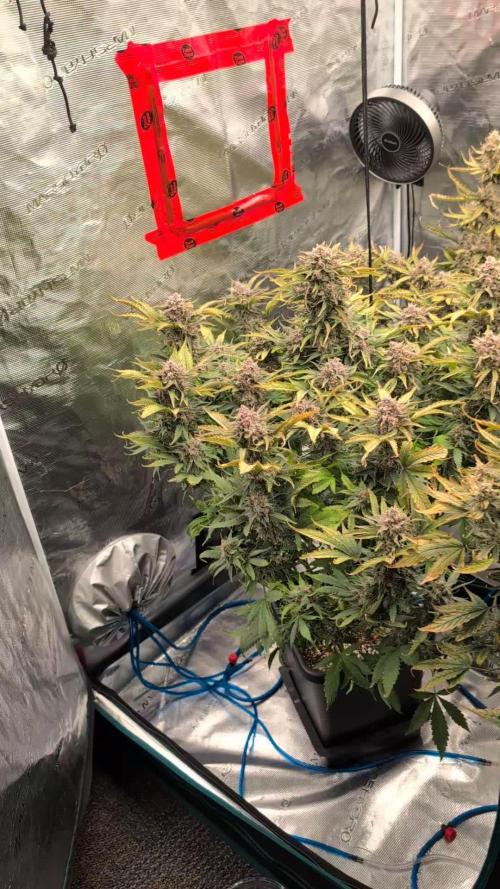
Day 65, 17th of November 2020: Welcome back at the beggining of the 3rd week of flowering. They seem to be stopped streching and now concentrating on buds. All of them are gorgeous..... The 2 Zamnesia genetics Gelato and Kalini Asia are pretty and buds are forming nicely. Kalini Asia might strech a bit more but not long. The Sweet Seed ones are really nice and I am so happy because Red Hot Cookies is already getting red.... pistils and around the leaves.. I hope the same happens to the Red Mandarine and Tropicanna Poison also. They are so gorgeous. They calmed down I don't expect more strech. Fertilization still the same every 2nd day with the ratio and mix above. Some lollipopping (Defoliation) is also done. I removed all the LST the plant remains in the same shape from now. The lamp is on 11.30 min and off 12.30 min. Last week was 15 min longer light cycle.... So every week 15 min shorter light cycle until the 5th week. So far -30 min. It switches on at 6 am and off at 17.30 pm.
Likes
31
Share
Likes
47
Share
2nd net is up. Early bud formations are promising. holding up to the extremes pretty well, some leaves taking minor damage, but overall, she is holding up, gave her 1 night at 50F see how she would react, stressful. Not advised as it messes with her metabolism, but I want to see if it triggers any anthocyanin response. Love to see her purp up but no signs yet. Remember, For every molecule of glucose produced during photosynthesis, a plant needs to split six molecules of water. This process provides the hydrogen needed for synthesizing glucose and other organic compounds, while oxygen is released as a byproduct. Homework. If Rubisco activity is impaired and it cannot properly function or regenerate its substrate, the plant's leaves are likely to turn a pale green or lime green, a condition known as chlorosis. Essentially, Rubisco activity is highly regulated and susceptible to various environmental and metabolic factors that can cause it to become inhibited, leading to an apparent failure in RuBP regeneration due to a lack of consumption. Rubisco regeneration is intrinsically linked to nitrogen supply because Rubisco is a major sink for nitrogen in plants, typically accounting for 15% to over 25% of total leaf nitrogen. The regeneration phase itself consumes nitrogen through the synthesis of the Rubisco enzyme and associated proteins (like Rubisco activase), and overall nitrogen status heavily influences the efficiency of RuBP regeneration. RuBisCO is a very large enzyme that constitutes a significant proportion (up to 50%) of leaf soluble protein and requires large investments in nitrogen. Insufficient nitrogen supply limits the plant's ability to produce adequate amounts of RuBisCO, thereby limiting the overall capacity for photosynthesis and carbon fixation. Maintaining the optimal, slightly alkaline pH is crucial for the proper function and regeneration of Rubisco. Deviations in either direction (too high or too low) disrupt the enzyme's structure, activation state, and interaction with its substrates, leading to decreased activity and impaired RuBP regeneration. (Lime/yellowing) Structural Component: Nitrogen is an essential building block for all proteins, and the sheer abundance of the Rubisco protein makes it the single largest storage of nitrogen in the leaf. Synthesis and Activity: Adequate nitrogen supply is crucial for the synthesis and maintenance of sufficient Rubisco enzyme and Rubisco activase (Rca), the regulatory protein responsible for maintaining Rubisco's active state. Nitrogen deficiency leads to a decrease in the content and activity of both Rubisco and Rca, which in turn limits the maximum carboxylation rate, Vmax, and the rate of RuBP regeneration Jmax, thus reducing overall photosynthetic capacity. Nitrogen Storage and Remobilization: Rubisco can act as a temporary nitrogen storage protein, which is degraded to remobilize nitrogen to other growing parts of the plant, especially under conditions of nitrogen deficiency or senescence. Nitrogen Use Efficiency (NUE): The allocation of nitrogen to Rubisco is a key determinant of a plant's photosynthetic nitrogen use efficiency (PNUE). In high-nitrogen conditions, plants may accumulate a surplus of Rubisco, which may not be fully activated, leading to a lower PNUE. Optimizing the amount and activity of Rubisco relative to nitrogen availability is a target for improving crop NUE. Photorespiration and Nitrogen Metabolism: Nitrogen metabolism is also linked to the photorespiration pathway (which competes with carboxylation at the Rubisco active site), particularly in the reassimilation of ammonia released during the process. To increase RuBisCO regeneration, which refers to the process of forming the CO2 acceptor molecule Ribulose-1,5-bisphosphate (RuBP) during photosynthesis, the primary methods involve optimizing the levels and activity of Rubisco activase (Rca) and enhancing the performance of other Calvin-Benson-Bassham (CBB) cycle enzymes. Biochemical and Environmental Approaches: Optimize Rubisco Activase (Rca) activity: Rca is a crucial chaperone protein that removes inhibitory sugar phosphates, such as CA1P (2-carboxy-D-arabinitol 1-phosphate), from the Rubisco active site, thus maintaining its catalytic competence. •Ensure optimal light conditions: Rca is light-activated via the chloroplast's redox status. Adequate light intensity ensures Rca can effectively maintain Rubisco in its active, carbamylated state. •Maintain optimal temperature: Rca is highly temperature-sensitive and can become unstable at moderately high temperatures (e.g., above 35°C/95F° in many C3 plants), which decreases its ability to activate Rubisco. Maintaining temperatures within the optimal range for a specific plant species is important. •Optimize Mg2+ concentration: Mg2+ is a key cofactor for both Rubisco carbamylation and Rca activity. In the light, Mg2+ concentration in the chloroplast stroma increases, promoting activation. •Manage ATP/ADP ratio: Rca activity depends on ATP hydrolysis and is inhibited by ADP. Conditions that maintain a high ATP/ADP ratio in the chloroplast stroma favor Rca activity. Enhance Calvin-Benson-Bassham (CBB) cycle enzyme activity: The overall rate of RuBP regeneration can be limited by other enzymes in the cycle. •Increase SBPase activity: Sedoheptulose-1,7-bisphosphatase (SBPase) is a key regulatory enzyme in the regeneration pathway, and increasing its activity can enhance RuBP regeneration and overall photosynthesis. •Optimize other enzymes: Overexpression of other CBB cycle enzymes such as fructose-1,6-bisphosphate aldolase (FBA) and triose phosphate isomerase (TPI) can also help to balance the metabolic flux and improve RuBP regeneration capacity. Magnesium ions, Mg2+, are specifically required for Rubisco activation because the cation plays a critical structural and chemical role in forming the active site: A specific lysine residue in the active site must be carbamylated by a CO2 molecule to activate the enzyme. The resulting negatively charged carbamyl group then facilitates the binding of the positively charged Mg2+ion. While other divalent metal ions like Mn2+ can bind to Rubisco, they alter the enzyme's substrate specificity and lead to dramatically lower activity or a higher rate of the non-productive oxygenation reaction compared to Mg2+, making them biologically unfavorable in the context of efficient carbon fixation. The concentration of Mg2+ in the chloroplast stroma naturally increases in the light due to ion potential balancing during ATP synthesis, providing a physiological mechanism to ensure the enzyme is activated when photosynthesis is possible. At the center of the porphyrin ring, nestled within its nitrogen atoms, is a Magnesium ion (Mg2+). This magnesium ion is crucial for the function of chlorophyll, and without it, the pigment cannot effectively capture and transfer light energy. Mg acts as a cofactor: Mg2+ binds to Rubisco after an activator CO2 molecule, forming a catalytically competent complex (Enzyme-CO2-Mg2+). High light + CO2) increases demand: Under high light (60 DLI is a very high intensity, potentially saturating) and high CO2, the plant's capacity for photosynthesis is high, and thus the demand for activated Rubisco and the necessary Mg2+ cofactor increases. Mg deficiency becomes limiting: If Mg2+ is deficient under these conditions, the higher levels of Rubisco and Rubisco activase produced cannot be fully activated, leading to lower photosynthetic rates and potential photo-oxidative damage. Optimal range: Studies show that adequate Mg2+ application can enhance Rubisco activation and stabilize net photosynthetic rates under stress conditions, but the required concentration is specific to the experimental setup. Monitoring is key: The most effective approach in a controlled environment is to monitor the plant's physiological responses e.g., leaf Mg2+ concentration, photosynthetic rate, Rubisco activation state, and adjust the nutrient solution/fertilizer to maintain adequate levels, rather than supplementing a fixed "extra" amount. In practice, this means ensuring that Mg2+ is not a limiting factor in the plant's standard nutrient solution when pushing the limits with high light and CO2. Applying Mg2+ through foliar spray is beneficial to Rubisco regeneration, particularly in alleviating the negative effects of magnesium (Mg) deficiency and high-temperature stress (HTS). While Mg can be leached from soil, within the plant it is considered a mobile nutrient, particularly in the phloem. Foliar-applied Mg is quickly absorbed by the leaves and can be translocate to other plant parts, including new growth and sink organs. Foliar application of: NATURES VERY OWN MgSO4 @ 15.0g L-1 in a spray bottle. For those high-intensity workouts when 1 meal a day is just not enough! Foliar sprays are often recommended as a rapid rescue measure for existing deficiencies or as a supplement during critical growth stages, when demand for Mg is high. Application in the early morning or late evening can improve absorption and prevent leaf burn. The plant was getting a little limey yellow in the centre. Shortly thereafter, she was back in business, green mostly regenerated. The starting point [of creativity] is curiosity: pondering why the default exists in the first place. We’re driven to question defaults when we experience vuja de, the opposite of déjà vu. Déjà vu occurs when we encounter something new, but it feels as if we’ve seen it before. Vuja de is the reverse—we face something familiar, but we see it with a fresh perspective that enables us to gain new insights into old problems. Confidence is evidence... nothing more. You are confident because you have driven 10,000 times, you are confident because you have spoken 10,000 times. People think confidence is a feeling, but it's not. If you want more confidence, then you need to create evidence, take more shots, collect more data, build more experiences, take more risks; fail, confidence doesn't come first; it is the reward you get for doing the work. no one else wants to do.
Likes
2
Share
@pzwags420
Follow
Plants are growing well. set up veg tent with new ac infinity tent and fan.
Likes
33
Share
Letzte Woche wurden die Damen in ein größeres Zelt gebracht nachdem sie vorher in 18l Töpfe gepflanzt wurden. Leider kann ich bei dem Grow die Beleuchtung ändern. Alle pfanzen stehen jetzt unter einer GC Bar 8 von "Greenception".
Likes
18
Share
High temperatures, high transpiration, high turgor pressure, and lots of cell elongation. Cannabis plants can sense and respond to their surroundings. They don't have brains like humans, but they have evolved sophisticated ways to perceive and react to various environmental cues, including light, gravity, touch, water, sound, and even the presence of other plants. This ability, known as plant perception, allows them to adjust their growth, defend themselves, and even communicate with each other. Infrared light, particularly near-infrared (NIR), can influence plant growth and development by impacting various processes including initiation and elongation. UVB radiation inhibits stem and hypocotyl elongation in plants. Moderate UV-B exposure can cause a decrease in stem and leaf elongation, leading to a more compact plant architecture. Higher UV-B intensities, like 7.5 kJ·m−2, can lead to reduced elongation. So it becomes a dance of initiating a stretch to seek to higher ppfd, then whenever you want the stretching to slow down,UVB inhibits the stretch by altering hormone balance,, coupled with the high-intensity dli once you get her to a height where you want. Being autos I don't have much time to play around. So we are playing fast and loose, get stretched, and then spread her open. You get the idea. 86F 30% RH with the lower side of optimal on ppfd, with a smudgering of infra-red to initiate response of making her stretch more so than normal. Once she sprouts up in height, I drop metrics to 77F 55%RH% while upping the ppfd, giving her a dash of extra 430nm, giving the grow more of a 6000K. This encourages denser growth with less elongation. Higher side of optimal PPFD, with the auxin hormone balance changed, the side stems are starting to shoot up to the same canopy level as the apex (almost). Normally takes me 2 untrained toppings before a plant will flatten its canopy. I didn't take enough off the apex to do it in one chop, it was only day 10, so there really wasn't much to top from without creating unpredictable results using fim, opted just to keep it to a clean topping. Even predictability over the Chaos of the"Fim". Brainfart: Remember, the veg stage creates the skeleton that will stretch out into flowers. How dense you create the skeleton through light intensity will determine the density of your clusters as they form cola, as long as you can keep up with the demands. Increasing light intensity generally leads to plants having shorter internodal spacing, meaning the distance between nodes (where leaves grow) on a stem is reduced. This effect is particularly noticeable under LED grow lights, with great stress comes great dense clusters. Hello, temperature, my old friend! Goodbye, money on AC. What did the flower decide to study in college? STEM.
Likes
5
Share
Semana 13 de los esquejes y su segunda semana de floración, en realidad llevan 16 días de flora. Hago los riegos 1/1, uno solo con agua(EC: 0.4) y el otro con los fertilizantes. En los riegos estoy utilizando Sensi cal-mag para llegar a una EC base de 0.4 y luego aplicar los fertilizantes. Regulo el PH con los reguladores de BioBizz. Durante esta semana se hizo la tercera y ultima aplicación de Delta9 la cual se hizo vía riego. Esta se hizo el décimo día de floración, es decir, el día 14/08. Por lo demás todo va bastante bien, las dos plantas van con buen aspecto y sin posibles carencias, espero que todo siga así. Seguimos con todo la flora!! Cualquier recomendación será bien recibida!!
Likes
34
Share
@Salokin
Follow
Hello Growmies, As we wrap up the first week of vegetation for our Watermelon Candy F1 Hybrid by Zamnesia, we've observed that despite being a mere seven days behind, these plants are making their mark with remarkable uniformity. They might be smaller compared to their peers, but they're growing with a precision that speaks to their strong genetics. Their identical appearances aren't just skin deep; from their symmetrical leaf patterns to their sturdy little stems, it's as if they were meticulously 'copied and pasted'. Their compact nature is a characteristic of their breed, suggesting a deliberate breeding choice for a smaller, more manageable plant. The same attentive care provided to their companions in the tent—comprising the Orca, Rhizotonic, and pH-ed water blend, administered every three days—has been extended to these youngsters. And they've responded in kind, with a vibrancy that promises much for the weeks ahead. Even in these early days, the Watermelon Candy plants are showing a resilience that bodes well for their continued development. As they embark on the second week of vegetation, we’ll be keeping an eye out for the unique traits they'll undoubtedly begin to express as they grow. Stay lifted, Salokin
Likes
3
Share
@Amboloco
Follow
Da sie nun in die Blüte gehen habe ich ein weing Lolipoping versucht.
Likes
10
Share
the girls are now in my backyard, they are in a 1.5 x 1.2m terrace completely amended by @elcaudilloorganicproducts
Likes
126
Share
Last 2 weeks only plain water on blue medi kush. Flushing other girls for a week now and this should be their final week of life but dinafems grape and og kush are still shooting white hairs or they are just turning them to orange very slow. I got the runoff ppm on all girls down to 200(my tap water), want the smoke to be as clean as possible.
Likes
48
Share
@AsNoriu
Follow
Day 64. Girls took defoliation like champs and they are overstretched Champs !!! Girls slow down with drinking, thinking today will be first watering after training session, but its normal, i have full shoping bag of leaves ... This week Feed, water and hopefully one more water. Let's see flowers forming everywhere !! Day 67. Girls got Great White and its Jungles, think I will be doing at least second wave of defoliation. Girls are stretched with tops, highest 3-4 nods covering loads of flowers under secondary crown, need to get light there !!! 3 huge plants at the back - Blue Dreams, they are MONSTERS !! 3 lowest in the middle - Runtz, super compact and super stacked ! 4 infront - Kalini Asias, still no pink colours yet ... Day 69. Got some funky box from a friend. He grew Barneys Farm - Jack Ripper and its lovely weed, some lemony aftertaste, really strong i would say ! But !!! Zamnesia will be better ;))))) They are pure JOY !!! Happy Growing !
Likes
37
Share
@MG2009
Follow
9/27/2018 Been a rainy damp week,cooler nights, no moulds as of yesterday and will update photos shortly if weather permits. Speak of the Devil, this am #2 has two spots of mould,cut ✂️ out,and trashed. All others no mould, #4 is covered with sand it keeps getting blown over!.#2 fading, #1 still Growing nice green very little fade just lower leaves lots of new pistils,#3 all hairs gone brown, and smells like Real old school Skunk!👍not much bud but still have couple weeks of flowering to fatten up and taste of Skunk getting me excited😁 10/02/2018 Week 7, day 5. Rainy days still very little mould just #3 so far. #1 looking fantastic.#2 pistils brownish,#3 pistils all brownish red dont see any New pistils but branches drooping from their weight #4 is still popping New flowers but lots brown all over, hope 2 weeks to finish! But cold is coming soon. #1 no signs of slowing down putting out lots of fresh flowers! Does not mind the cooler weather. Last bit of molasses to super charge microbes in the soil. Hope she comes in at 8-10 weeks👍 53-70 days flowering.
Likes
13
Share
Day 49 of flower. Lovely! The Buds begin to bring flesh to them self. They grow up. The smell is a little bit diskret till now. I mean the strength of it. Sweet! SWEET! Glorious. I know for the most of north and south (maybe) it's an old wallpaper from Yesterday. But for me, its the first time I smell sticky Watermelon Zkittlez on my Fingers. AMAZING. (If in normal zkittlez is no watermelon smell) than:Like a voice of an God. "BONUS! DOUBLR XP FOR THE REST TIME OF THE GROW! YOU CHOOSE! MORE YIELD? UNIQUE COLORS?" "God(of Ganja maybe)…?" "YES? MY GROWMI?" "can i have both bonus?" WHAT THE FUCK! TRY TO DEAL WITH A GOD? What followed know is unknown. Just you heared some screams in the night. Not the funny ones. except you re an sadomasochist. Than you had really fun. I got still some aphids. But less than ever before. Still 3 weeks of flowering.. I can wait. The yield will not be big. I don't care about. I care about mouthwatering strong healthy weed. Thats why i grow. (and, i love to see them grow. But that was unexpected). WATERMELON ZKITTLEZ. I Love this plant. The colours. The height, the smell, and the sticky buds. Day 52 of flower. TRICHOMES RE MILKY the most 75% ca. The Buds re hard. The smell has changed to Haschisch. The fruity smell is still there, but getting less. Lets see. Phylaxien re 50% brown. Down under(Australia?). 20% and the lowest 5% brown. 18 days still to go. BARNEYS FARM, once again you satisfie me.. Hello @ day 54 of flower. The buds re becoming harder , and now they begin to grow up. In height. The colors of buds. Brown phylaxien, till bottom. She got 16 days to go now. Lets see if we take some amber trichoms till the harvest. The chop will be in stages, because Iwant the maturity ( is this right?) In every bud, and light helps. Day 55 of flower. The Light Spektrum has been Modified. I kill switched the blue Spektrum. In previous Grows it helps to increase the trichom productivity and faster maturity. But warning! If you kill the blue light to early, she stretches a lot.. Thank you for reading. I hope you enjoyed it. Day 55again. Aphids found! Damn! Should i defoliate the infested leaves? Day 57 of flower. I will not defoliate. I will wash the buds. Stay strong baby, youre my first photo period plant. And this is my first plant without any influences from a ruderalis.. And she is a beauty. By the way still some glass trichrome DAY 58 OF FLOWER. nothing happend Phylaxien went brown. Some new came... The buds re still hard. But they grow up.. 😛 24.09. 59 days of flower. Everything pretty. 25.09 AMBER trichomes starting on top buds. 60 days of Flowering. 27.09.... The Buds. Not soo big. But soo solid! I ve the pheno with the hard buds and slow growing but heavy earthy and INDICA lasting one! WITH THE HARD STEELBUDS YES, HAPPY!! Fruity smell is like zkittlez, but with an heavy earthy tone. Still not many Amber trichoms. But Hey we are in FLOWERWEEK 9!!! And 8-10 weeks the Breeder said. Did a defoliation cause prepare to harvest soon. And to get to the lowest benches some light, so they get harder. Trichome check says. WAIT! Gave water ph 6,5. Trichomes re mostly foggy. Still some clear Trichomes. AMBER ist not so much. Maybe on every bud 1%. Harvest, were coming closer... Boah SMOKE REPORT: First bong hit. Häh? Something happend. 30 sec later... Ok here we go, should i take another one? Its so smooth... Three minutes later... Damn my eyes, im so fxxxxxx relaxed, i liked to take a nap. Smooth A Smooth Criminal (AYE) The Buds re heavy. And the hardest i ever had. 30.09. 65 day of flower. Did a little prechop. The Rest still can ripen.
Likes
2
Share
Oct 5-11 Vegetative steering? Aiming for: leaf Temp -80f CO2 -1250ppm VPD +1.04 (65%/75F) Vegetative Steering 6P1/ 2P2/1P3 Each P1 water event is 15 minutes apart. Seems to far apart. I think i Need More water events, with less time in between events in order to get a strong veg signal? Watering for 2min(110)ml May need 3min waterings(currently not getting runoff) I have to hand water every two days. Day 11 flo 18.5inches tall 12inches from light(moved to 16) 1300ppm Day 18 Defol Sprout chickpea(2days) Soaked 1cup for 4 hours then rinsed. Completely covered then Soaked overnight. Rinsed then poured water out and layed jar on the side for one day. Blended with water(aloe vera and coconut) Day 19&20 foilarspray Alfalfa/Chickpea SST with Kelp,aloe,coconut,silicate,microbes brewed for 1.5 days Day 21 Fed the Tea blend Leaf temp 80 65kluxx Co2 100 Plants look like they responded well to the foilar. The flowers at this stage are my best performance yet .crop steering may be working?
Likes
7
Share
estamos no 6° dia de 12/12 por aqui, ela está crescendo muito e tomando muita água. Esperar mais uns 10 dias pra fazer uma limpeza de folhas e seguir no MiP mais uma semana. já comecei a usar JLF ( jadam) faz 10 dias pra suprir algo que possa faltar. estou gostando demais do desenvolvimento dela.
Likes
3
Share
- 3.5 gals in bucket - Splitting nutes in half (0.95 micro, 2.5 bloom, 1.5 calmag, 1 hydro) and feeding every 3-4 days so it gets full nutes over a 7-8 day period - 356 ppm for half nutes - started noticing browning on leaves
Likes
14
Share
Likes
10
Share
This will go down as one of my favorite harvests to date. The rosin produced from this flower is so strong it had me TOO high lol