Likes
Comments
Share
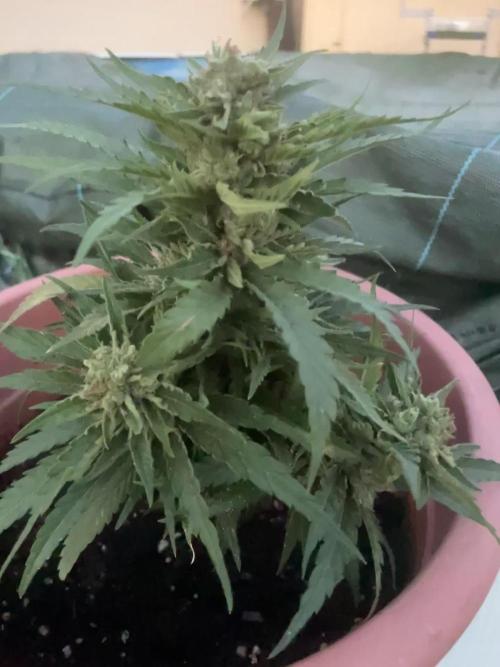
I moved the lamp away from the plant, and it seemed to have a good impact on the yellow leaves. The plant is over 50 days old so it's starting to develop some yellow leaves just from age. I really am enjoying watching the buds fat and up but I'm a little bit nervous because it only has about 20 to 25 more days and they don't look very fat.
Likes
39
Share
The grow went amazing started off what was supposed to be a auto GSC strain but didn’t auto flower which is no issue at all so went ahead an let her veg out an get the lst done that i wanted done on her she was showing pistils by week 8 veg letting me know she wanted to flower but some areas had a bit of catching up to do which turned out amazing. Got almost all the branches the same size to produce equivalent bud sizes throughout the whole canopy. During flower stage 2 weeks in started giving her a Pk boost of incredible bulk 1/2tsb per gallon. An did the GSC so good for flower stage she bulk up nice an the trichomes came in heavy. Total wet weight came in at 2.5lb stump was 1.5in circumference. I will update with finish photos an how the smoke was after cure. GSC currently being cured with love 63% Rh at 70 degrees temp. Thank you viewing an happy growing everyone!
Processing
Likes
10
Share
Added stakes for better light penetration. checked trichomes with jeweler's loop and are still clear. Plenty of time left to go. More details in video.
Likes
40
Share
Today is day 85 and all looks good... the Gummiebears is huge and is starting to get some awesome purple colors in the fan leaves .. the Froot by the foot is nearing her last 2 weeks as we flush her and Grease Gun... Cream is still stacking hard but her and Gummiebears days are numbered then it's their time for flushing...hopefully 3 weeks and all are done ... happy growing ✌️. I took the 4 colas off the Gummiebears as they were so close to the light and were finished...now I have an even canopy I can turn the light up on and harden those buds up ✌️. Update...3 of the 4 are chopped and hanging... Gummiebears being the only one still up but shes about to come down in a day or so..I will update with individual harvest for each plant ... I have no carbon filter just fans so my landlord called saying everywhere stinks like weed 😂 ..ooops ... Can't get umm in grove bags soon enough.. updates should be soon. Stay tuned.. All are harvested updates on all strains coming soon
Likes
18
Share
@BlaKX
Follow
Ai Gude Growmies, Zum Glück habe ich keine neuen Pollensäcke entdecken können! Mittlerweile ist die Pflanze so typisch Sativa vom Erscheinungs Bild samt typischen Sativa Speere. Die Terpene sind Mittlerweile gut wahrzunehmen und die Harz Produktion hat sichtbar zugenommen. Leider musste ich noch etwas entlauben und Seitentriebe entfernen für den Platz.
Likes
17
Share
We’ll week ten is here and I’m amazed to say the least. The girls are doing wonderful. Getting sticky and thick. Probably going to start flushing the zkittles and purple lemonade here in the next day or so. Most of the tricomes are milky noticed one or two ambering. The blackberry has another week I believe. They all smell amazing. Can’t wait to smoke them!
Likes
20
Share
Not particularly growing for speed or any dedicated reason this time round, just adding water and a abundande of positivity, gotta admit I do like the autoseed logo. Off we go again into the magical forest. (Arthrospira platensis) cultivated in high-alkaline, mineral-rich water in Kailua-Kona, Hawaii. It is renowned for having a higher nutrient content, including more carotenoids and essential fats, compared to other spirulina brands. It is frequently cited as a "complete food" due to its dense concentration of proteins, vitamins, minerals, and pigments. The nutritional profile of standard dried Spirulina platensis biomass. 3kg of spirulina powder has an approximate NPK ratio of 10-2-1 (or 10% Nitrogen, 2% Phosphorus, and 1% Potassium). Here is the breakdown of the nutrient content for 3kg of powder: Nitrogen (N): ~300g (10% of total mass) Phosphorus (P): ~60g (roughly 2% of total mass) Potassium (K): ~30g (roughly 1% of total mass) 3kg of spirulina powder is more than enough nitrogen for 4 cannabis plants in a 100-gallon pot—in fact, it is likely excessive and could cause severe nutrient burn or toxicity if not properly managed. Spirulina has a very high protein content (46% to 63% dry weight), which translates to a significant nitrogen source. It is often described as a 5-1-1 NPK fertilizer. 3kg (3000g) of powder in 100 gallons means 30g per gallon. General organic recommendations for potent amendments (like frass) are often around 1–3 tablespoons per gallon. 30g of powder is roughly 2-3 tablespoons, making this a very high-strength application rate if added all at once. Balance this with calcium/magnesium, and organic nutrient delivery in soil growing can lead to deficiencies in these nutrients. Not all of that 100 gallon is used, so figuring out precise measurements was ballpark, but there is about 10kg of engineered biochar in that pot. Mostly in the top half. Ideally, I'd have 25kg in a full active 100-gallon, but......... don't mess with something that is not broken. Roots do not utilize the entire 100 gallons. This has been a couple of years of trial and error, mostly error. The amount of cations you can add in grams depends entirely on the specific cation exchange capacity (CEC) of your biochar and the type of cation being added. Biochar CEC values vary widely, typically ranging from 4 to over 300cmolc/kg. Multiple Biochars in use, ranging upwards of 100cmolc/km. Different cations have different atomic weights Potassium K+ 39.1g/mol. Calcium Ca2+ 40.1g/mol. Magnesium Mg2+ 24.3g/mol. Nitrogen NH4+ 18.04g/mol. You get more nitrogen bang for your buck. It all depends on the CEC of the biochar you use, but brrrrrrrrrr roughly I'm looking at 500-600 grams worth of elemental cation exchange capacity, give or take. That's just for the biochar alone. Elemental cation exchange capacity refers to the ability of materials—such as soil, minerals, and biochar to adsorb, hold, and release positively charged ions Ca2+, Mg2+, K+, Na+, Al3+, and Zn2+. This capacity is a critical measure of nutrient availability in soil and energy density in electrochemical systems. Added calmag 2:1 to complement spirulina. Calcium (Ca): Approximately 150g - 300g of elemental calcium. Magnesium (Mg): Approximately 75g - 150g of elemental magnesium. So long as pH stays in 6.3 to 6.7 ish, the plant will unlock hydrogen. Plants will be able to cycle CEC for their own needs. Hydrogen ion pumping (proton pumping) is a fundamental mechanism used by plant roots to facilitate the cycling of nutrients within a medium's Cation Exchange Capacity (CEC), directly increasing nutrient availability. A growing medium's Cation Exchange Capacity (CEC) does not contribute directly to Electrical Conductivity (EC). CEC represents potential nutrient storage, while EC represents active nutrients in the water/soil solution. A medium with a high CEC can hold many nutrients, but if there is no water present, the EC will be low. 98% of plant nutrient uptake comes directly from the soil solution. 2% of nutrient uptake is directly from soil particles. Nutrients held on exchange sites (CEC) are not directly measured by EC until they are released into the soil solution through exchange with other ions (e.g., hydrogen ions from roots or fertilizer). Plants source the H+ ions (protons) used in cation exchange primarily by exuding carbon sugars into the rhizosphere, then microorganisms perform root respiration, which reacts with soil water to form carbonic acid H2CO3 that dissociates into H+ and bicarbonate. Roots also actively pump out H+ ions directly to acidify the rhizosphere, plants trade hydrogen produced through metabolism for essential nutrients held by the soil. In plant cells, the H+ (protons) used in proton pumping across the plasma membrane come primarily from the cytoplasm (cytosol). The protons are derived from internal cellular sources, including metabolic processes that release H+, and the regulation of intracellular pH homeostasis. Distilled water is highly useful in managing the electrical conductivity (EC) of a growing medium by allowing for precise control over nutrient concentration and assisting in the mobilization of nutrients from the cation exchange capacity (CEC) into the active, plant-available nutrient solution. Just add water & positive energy. Potential hydrogen. pH. + - , potential charge balance for hydrogen. So long as there is adequate oxygen in the soil and air and water moves at a decent interval, its practically impossible for the pH to skew in a soil that is taking in oxygen and releasing CO2 and nitrogen, I say practically, but meh, even with plenty of oxygen, the process of converting ammonium NH4+ to nitrate NO3- by bacteria releases hydrogen ions H+, which directly causes acidification (lowering pH). While water movement is necessary, consistent water moving through the soil can leach away basic cations Ca2+, Mg2+, K+, Na+, leaving behind acidic hydrogen and aluminum ions, causing pH to drop, especially in humid regions. High levels of CO2 in the soil (from intense respiration) dissolve in soil water to create carbonic acid, H2CO3, which lowers the pH. (barometric pumping removes that possibility) The pH in a cannabis cultivation environment, particularly in hydroponic or soilless setups, will often naturally drift towards acidic (lower pH) over time. Understand how to know when to lime the pH back up. Complex but critical. Once I understood this it helped ease the pain of understanding pH. Base saturation directly reflects the percentage of CEC occupied by base cations. Generally, as base saturation increases, soil pH increases because fewer acidic cations, H+ and Al3,+ are present on the soil colloid surfaces. At a pH of 7 or higher, the soil colloids are saturated with base cations, resulting in a base saturation of 90+%. While many sources include Sodium Na+ as a base cation, some calculations focused specifically on plant nutrients (like in some nutrient management contexts) may focus solely on the "Big 3": Ca2+, Mg2+, and K+. However, in soil science and CEC (Cation Exchange Capacity) measurements, sodium is usually included in the definition of total base cations, making it the "Big 4" base cations. At a pH around 5.5, soils often have a 45–55% base saturation, while a soil with a pH between 6.5 and 6.8 generally has an 80–90% base saturation. Base saturation is considered a reliable, albeit complex, indicator of soil fertility and the degree of soil weathering, acting as a crucial metric in soil classification and management. Once you take full control of the pH, so long as there is oxygen, and one keeps tabs on base saturation levels. Its near impossible for anything to go wrong. All you are essentially doing is adding water and waiting for any sign of deficiency. Not so much growing as eliminating the possibilities of things going sideways. Can't over or under water, can't skew pH, can't go anaerobic. Everything runs in optimal cycles, watering every 2 to 3 days or as required, depending on the rate of combined ET. A little warmer, a little drier, but never short on water. All the nutrients are already there in the medium, we still focus on the water, just not adding salts, but to mobilize nutrients held in the Cation Exchange Capacity (CEC) and move them into the active soil solution for plant uptake, the best supplements to add to water are fulvic acid, humic acid, or seaweed/kelp extract. Liquid solutions with high concentrations of essential trace elements. Distilled water has no alkalinity or minerals to help buffer or release nutrients. Adding these supplements turns the "empty" water into an active agent that forces nutrients off the CEC colloids into the solution for plant uptake. When to water? When Electrical Conductivity of soil gets low. No water, no conductivity.
Likes
35
Share
Pflanzen sehen ok aus Eine zeigt leichte Wachstumsstörung bzw. defizite, die anderen wachsen recht gut Gab in den ersten Tagen ein Bewässerungsproblem mit überwässerung deshalb musste die Erde für ein paar tage erst wieder trocknen bis ich erneut gießen konnte.
Likes
96
Share
Hi growers, And that's a wrap for this grow diary! What a great experience this grow has been. It was my first time growing Jack Herer, and I honestly couldn't have asked for a better introduction to this legendary cultivar. I was lucky enough to find two completely different phenotypes, and I genuinely enjoyed growing both of them. The Haze pheno especially blew me away with its incredible aroma and authentic old school character. Now it's time for a slow dry, a proper cure, and then the best part... seeing how these ladies really shine after a few weeks in the jars. A huge thank you to everyone who followed the diary, left comments, and shared advice along the way. I really appreciate it! ------------------------------------------------------------------------------------------------------------------------------------------------ A tím je tenhle deník u konce! Byla to parádní jízda. Jacka Herera jsem pěstoval úplně poprvé a lepší seznámení s touto legendární genetikou jsem si ani nemohl přát. Měl jsem štěstí na dva úplně rozdílné fenotypy a pěstování obou mě opravdu bavilo. Haze fenotyp mě navíc naprosto dostal svou neuvěřitelnou vůní a pravým old school charakterem. Teď už je čas na pomalé sušení, pořádné zrání a pak přijde ta nejlepší část, zjistit, jak se naplno projeví po pár týdnech ve sklenicích. Velké díky všem, kteří deník sledovali, komentovali a podělili se o své zkušenosti. Moc si toho vážím! Peace and happy growing! ✌️
Likes
149
Share
Hi all the happy people here in GrowDiaries. This is my second cultivation ever and it will be fun to try a bigger space than my closet grow. First, I'm just going to say I'm done with the construction of my new growroom. I put some pictures on the construction here in week one. The room is 2.14 meters by 1.7 meters and has a ceiling height of 2 meters. It provides a floor area of ​​3.6 square meters. I use a 54 Watt Lightwawe T5 for germination and 2 Pcs 400 Watt HPS lamps. I have a channel fan that replaces the room air about 40 times an hour to get a comfortable theme in the room, the air enters a fresh air intake from the outside. The air is purified through a carbon filter to then leave the room to the rest of the basement. Then I use that heat to heat the rest of the basement. I will use 8 pcs 15 liter Autopots to grow with and a 100 liter water tank that supplies the pots of water and nutrition. I will grow completely organically in soil and will watercure my buds to get the best possible medicine for me. But there are no cultivation rooms to be displayed here, so I continue with what is most important. I am very excited to see how the new growroom will work and how this Blue cheese Auto from Royal queen seeds will turn out. Blue Cheese automatic cannabis seeds are a cross of Blueberry Automatic and Cheese Automatic that has been perfected over five years of breeding and careful selection. The result is a feminized, autoflowering strain with superior yield, flavor, and effects to either of its distinguished parent strains. THC: 16% CBD: Low Yield Indoor : 325 - 375 gr/m2 Yield Outdoor: 60 - 110 gr/plant Height Indoor: 40 - 70 cm Height Outdoor: 60 - 110 cm Flowering: 7 - 8 weeks Harvest month: 9-10 weeks after planting Genetic Background: Blueberry x Cheese x Ruderalis Type: Sa 35% In 40% Ru 25% Effect: Cerebral and uplifting Climate: Mild ----------------------------------------------------------------------- 2017-09-18. Week 5 starts and the girls are doing fine. Girl Nr 1 is 37 cm high, Nr 2 is 88 cm and Nr 3 is 23 cm. Did a lot of defoliation. --------------------------------------------------------------------------------------------------------------------------------------------------------- 2017-09-19. 2 new fans is installed in the grow room. Added pic and video. --------------------------------------------------------------------------------------- 2017-09-20. Kl 10.00. New pics and video. Girl Nr 1 is 39 cm high, Nr2 is 99 and Nr 3 is 21 cm. Kl 23.00. Did some massive defoliation, added video and pics ------------------------------------------------------------------------------------------------ 2017-09-22. The girls have recovered well after my massive defoliation. Girl number 1 is now 40 cm high, number 2 is 105 cm and number 3 is 25 cm. It is strange that 3 plants from the same strain, with the same care and environment, can distinguish so much in appearance and size. It separates 80 cm in numbers 2 and 3. In 4 days Nr1 has grown 3 cm, Nr 2 has grown 17 cm and Nr 3 has grown 4 cm. They have received 7 liters of water and nutrition today.
Likes
2
Share
@Sammy23
Follow
Bonne semaine j'ai aidé les deux du fond à partir, la coque de la graine les ralentissaient. Sinon j'arrose à l'eau pour l'instant elle sont petites et en plus ce sont des automatiques. Je suis assez content du départ de cette variété qui a l'air super bonne 😋
Likes
22
Share
Gave her a nice LST+Defoliation session after the week 1 of flower stretch! She's currently drinking a 1 gallon dosage of the above listed nutes, every 4-5 days!
Likes
7
Share
@Akapibara
Follow
Day 15 - She went for few days outside (not for night of course!) she'll get some fresh air and a lot of sun! Day 16 - She's good now i think. Day 18 - She grow like crazy now! Day 20 - Her next stage of leaves is incoming i think
Likes
3
Share
This week I’m defoliated the baby’s hard so all the nuggs are getting light
Processing
Likes
6
Share
@Kalosoma
Follow
La semana ha ido bien, aunque la humedad sigue siendo bastante alta. Las flores están hinchadas y tienen una buena capa de azúcar en polvo. La próxima semana cambiaré su tanque por uno más bajo para separar los cogollos.
Likes
5
Share
In week 4-5 a fellow grower pointed out that the plants may be receiving too much nitrogen, so I just watered with ph water for a week! Not too sure how to tell if the water is working but planning on switching to flower nutes after this week.
Likes
2
Share
@blaze_fpv
Follow
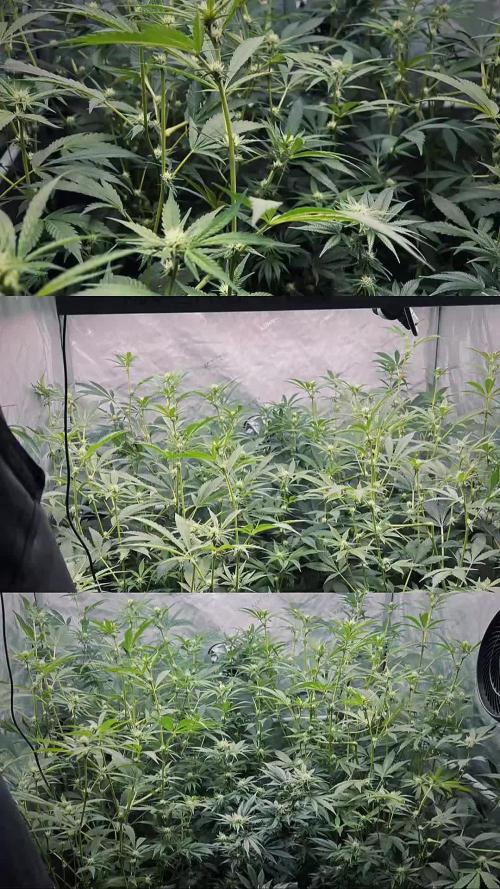
Mid week 5 | the plant grows insane | looking extremely healthy | some really fat nugs start to form | way better than last time | I bought 2 full spectrum led panels for 15€ | now I have about 20W under canopy light 26 deg C 55% rlf 1200 ppm co2 about 750ppfd ---------------------------------------------------------------------------- Night time pics are all end of week 5 flower | under canopy light is going really strong| plants look really healthy | they evaporate a hell lot of water at the moment | buds are seriously swelling up | sugar starts to form rapidly | currently giving a really strong bubble gum candy scent 27 deg 50% 1200ppm co 2 ppfd didnt measure 😂 (light is set to 90%)
Likes
17
Share
@Hoodoo
Follow
2020-07-05 New week. Reduced nutrients because of the slight burn on plant 2... and plant 1 drinks so quickly that it rapidly raises PPM so I have to actually find the right sweet spot. It's drinking about a gallon a day? Plant 2 is still a week behind and slightly stunted but the flowers are coming out. They are more compact than Plant 01. This is supposed to be the same species but I'm getting 2 very different phenotypes on the exact same nutrients.. not very strong genetics? Not sure. 2020-07-05 2020-07-05 2020-07-08 Forgot to take pics this week! Here you go! Plant 01 has grown so insanely strongly and is producing so many nice looking bud sites, i am blown away!! I have had to 'supercrop' the top by bending the stem very carefully and adding a wire knuckle so that it wouldn't immediately just stand back up overnight. I tried this with 2 experimental colas and they perked back up and stayed laying down. They will slightly obstruct the lower flowers but the tops all looked so promising, I couldn't bring myself to cut them. I will seriously have to cut down on veg time next grow! I can easily stop at week 5 in the future with these seeds and grow up nice buds. 2020-07-11 Updated with yesterday's photos. Changed nutrients today, stuck with 1600 EC for plant 01 and went back down to 1400 for plant 02.