The Grow Awards 2026 🏆
Likes
Comments
Share
@JaeMack
Follow
Hopefully the next time I grow this strain, I can get it to stretch more! Fruity but has a really gassy under tone.
Likes
31
Share
@AsNoriu
Follow
Day 36. Girl is a stretcher, will have to do something, but most damage is behind and I think next watering I'll give her food again. Couple leaves taken off, couple branches bended , thinking to put support after main stretch will be over. Happy Growing !!!
Likes
26
Share
All went well in the germination process, 100 percent success rate per usual with Seedsman seeds. Dropped the seeds in spring water for 12 hours and then transferred into the paper towel method until the tap roots were a half inch or so. Then planted into solo cups of Jiffy starting mix and watered with RO water with about 150ppm of CalMag.
Likes
7
Share
Thanks Pyramid Seeds for your good genetics. Not my first experience with PS, like them so much. I was happy to grow this baby. It my first experience with coco. No pH or ppm meters, nothing just my eyes and feeling whole process. Thanks to ru brend Plantators for good feedings and stims for awesome price. You always can ask me about everything, I'm always in connection.
Likes
226
Share
@HighTV
Follow
| 📅 Week 5 | Days 29 - 35 | 💡 562w 📏42' | | ☔ 29%-38% | | đŸŒĄïžïžđŸŒž 76 - 79 | | đŸŒĄïžïžđŸŒ‘ 73 - 75 | 12/07 Weekly Reservoir swaps on all plants to clean them and give fresh nutrients. 2 plants repeated week 4 nutrients with no micro and the other two (including the focus plant in the lapse) are accurate with the Dairy. 12/08 PHed all plants to 5.8 and updated the LST on all the plants. Spread some of plants out to get better lighting as I raised the light s few inches. 12/09 Topped off the reservoirs and PHed them to 5.6 because they have been rising alot. Rotated plants half turn. Did more LST for more light penetration. 12/10 Signs of preflower are starting to show on two plants and the tent is starting to get that flowering smell not to much longer until I need to hook up the carbon filter to stop the stench. 12/11 Updated front left and back left plants to week 5 nutrients with no Floramicro, because these plants hate nitrogen. PH in all reservoirs set to 5.6 12/12 PHed adjusted to 5.8 and topped off all the reservoirs. Did more LST and tucked plenty of leaves away for better light on new growth! 12/13 First real signs of Flower! PH adjusted to 5.8 and reservoirs topped off with water to keep the nutrient levels balanced. Lollipopped the front left plant for experimental purposes. These plants overall are doing fine and I have 2 different phenotypes displaying. One is extremely reactive to nitrogen and taller while the shorter phenotype is slightly less reactive to nitrogen (both hate it). I am pleased with the growth at this stage and the smell is just starting There is slight purple coloration displaying with the preflowers but nothing really noticeable yet. I am excited for the flowering to start so these girls can start showing their true colors 😍 edit: changed final picture for better lighting.
Likes
2
Share
@Race91
Follow
Usually I start my diary after they all pop but I’m feeling lucky and especially green this round. After numerous failed attempts at getting auto seeds from various sources and not having them pop no matter what I did. I finally got in touch with THSeeds and told them that the Critical Hog auto they sent me were totally bunk and not one popped. They had Truenorth seedbank send me this bubblegum Within a week of my complaint. I’m hoping these are fresh vigorous seeds and after much touch up learning on seed popping Iv decided to go straight from the water cup to the medium which is Black Gold seedlings mix in the center 6 inches of my coco soil so to give them a easy start with no added nutes. So it begins.... Stay tuned fellow growers!
Likes
44
Share
@RakonGrow
Follow
Note : + jegliches Zubehör wird in der GermniationsWoche aufgelistet . Zeitraffer Videos folgen immer nachtrĂ€glich. + videos werden so geschnitten das nur ein geschlossenes Zelt erscheint , ergo Fehlen paar reale Minuten (ca 1 Std) . Day 57: + 2.0 Liter Flaschenwasser + + DĂŒnger fĂŒr BlĂŒhte + + + Canna Terrar Flores (Achtung wirkt wie PH-) + + + Canna Boost + + + Cannazym + + + Canna PH+ + + PH 5.91 Da es heute heiss ist , wird wie Gestern laufen . Bis 19:00 Uhr wird das Licht reduziert und dann DLI nachgeholt. Day 58: Da es immer noch heiss ist , wird wie Gestern laufen . Bis 19:00 Uhr wird das Licht reduziert und dann DLI nachgeholt. Day 59: + 2.0 Liter Flaschenwasser + + DĂŒnger fĂŒr BlĂŒhte + + + Canna Terrar Flores (Achtung wirkt wie PH-) + + + Canna Boost + + + Cannazym + + + Canna Rhizotonic + + + Canna PH+ + + PH 5.91 16h jetzt mit 1000 PPFD und jeweils 1 Stunde Sonnenaufgang und Sonnenuntergang. Day 60: Mal ein bissel GrĂ¶ĂŸenvergleiche gemacht .Das Clipper Feuerzeug ist 7.5 cm hoch . Day 61: + 1.75 Liter Flaschenwasser + + DĂŒnger fĂŒr BlĂŒhte + + + Canna Terrar Flores (Achtung wirkt wie PH-) + + + Canna Boost + + + Cannazym + + + Canna Rhizotonic + + + Canna PH+ + + PH 6.01 Day 62: Das Wetter bleibt stabil, damit bleiben die Growwerte auch stabil. Bisher LĂ€uft das 1000 PPFD Spitze und 750 PPFD SekundĂ€triebe ganz gut . Ihre Freundin die leider ein Wasserschaden erlitten hat (tja da war wohl irgendwas im Wasser was ein Regenbogenfilm erzeugt hat , im schlimmsten Fall Waschmittel) nimmt der einen Seite zwar licht, aber geht halt nicht anderes bei nur einer Lichtquelle . Ich fahr halt gleich ein doppel Experiement mit dem Licht. Bisher aber holt sie ganz gut nach mit 900-1000 PPFD auf die ziemlich gleich hohe Krone . Day 63: + 1.75 Liter Flaschenwasser + + DĂŒnger fĂŒr BlĂŒhte + + + Canna Terrar Flores (Achtung wirkt wie PH-) + + + Canna Boost + + + Cannazym + + + Canna Rhizotonic + + + Greenhouse Feeding BioEnhancer + + + Canna PH+ + + PH 6.01
Likes
33
Share
Tra un paio di giorni la taglierĂČ e aggiungo a questa settimana qualche altra foto delle cime fresche, a breve il raccolto... Molto curioso di vedere i risultati... Wowww ❌❌❌
Likes
170
Share
Bonjour Ă  tous les padawans et les maĂźtres jedis Jour42 ma plante entre bien en floraison je pratique sur elle une defolliation pour permettre aux tĂȘtes de prendre la lumiĂšre La floraison des plantes de cannabis La plante de cannabis passe par diffĂ©rentes Ă©tapes de vie avant de parvenir Ă  la rĂ©colte. Ces Ă©tapes sont : la germination, la prĂ©-croissance, la croissance et la floraison. Pour les autofloraisons il n'est pas nĂ©cessaire d'avoir de changer le cycle de lumiĂšre elle entre en floraison automatiquement voilĂ  d'oĂč elle tient son nom "d'autofloraison" L'origine de l'auto-floraison vient de la sous-espĂšce "cannabis sativa ruderalis" , qui Ă  l'origine produit de trĂšs faibles niveaux de THC. C'est en croisant cette variĂ©tĂ© de marijuana avec d'autres qui produisent des niveaux de THC plus Ă©levĂ©s qu'Ă  vu le jour ce magnifique compromis que sont les variĂ©tĂ©s auto-fleurissantes avec des taux de THC trĂšs satisfaisants. En parallĂšle, cela a permis d'amĂ©liorer la production de ces variĂ©tĂ©s, qui initialement Ă©taient exceptionnellement basse. Pour des rĂ©sultats optimaux, en culture Outdoor (extĂ©rieur), je recommande que la germination des graines de marijuanaAuto-flo se fasse entre avril et aoĂ»t. En culture Indoor(intĂ©rieur), la photopĂ©riode idĂ©ale que ce soit pour la croissance comme pour la floraison est de 20h de lumiĂšre. N'oubliez pas que ces graines ne sont pas tributaires de la photopĂ©riode pour passer en floraison. Il est prĂ©fĂ©rable d'utiliser des pots d'une capacitĂ© de 10 Ă  20L dĂšs le dĂ©but, Ă©tant donnĂ© que leur cycle de vie est rĂ©duit, les auto-flo n'ent pas besoin de plus de volume pour se dĂ©velopper. Vu sa petite taille (et la discrĂ©tion) elle fait l'objet d'un bon choix pour la culture de cannabis sur balcons. La premiĂšre variĂ©tĂ© de Lowryder auto-floraison a Ă©tĂ© créé Ă  partir de cannabis indica sativa croisĂ© avec des gĂ©nĂ©tiques de cannabis sativa rudelaris par la banque de graines de marijuana "The Joint Doctor". Puis vinrent la White Dwarf de "Buddha Seeds", la Roadrunnerde "Dinafem", l' Auto Stoned d' "Autofem", la Speed Devil de "Sweet Seeds" , la Maxi Gom de "Grassomatic", la Flash, la Gnomo de Kannabiaet bien d'autres. Jour42 defolliation (video) Avant toute chose n'oublions pas de bien dĂ©sinfecter ses outils et bien ce laver les mains. Quesque la defolliation ? LES CULTIVATEURS AMATEURS, PRENEZ GARDE, MAIS NE PRENEZ PAS PEUR La dĂ©foliation consiste Ă  retirer les feuilles des plants de cannabis en intĂ©rieur afin d'accroĂźtre le rendementfinal. Le cultivateur amateur doit faire preuve de vigilance lorsqu'il commence Ă  appliquer cette technique de taille. MalgrĂ© le dĂ©bat sans fin entre ceux qui prĂŽnent cette technique et ceux qui la dĂ©nigre, il n'y aucune raison pour qu'un amateur ne s'y essaie pas afin de voir si ça lui convient ou non. COMMENT DÉFOLIER Que vous tailliez les feuilles ou les branches des plants de cannabis, il vaut mieux utiliser un sĂ©cateur stĂ©rile qui est confortable en main. Arracher des feuilles Ă  la main manque de finesse et engendre souvent par accident, l'arrachement des couches d'une tige en plus de la feuille. L'objectif principal de la dĂ©foliation est de permettre une meilleure pĂ©nĂ©tration de la lumiĂšre et de promouvoir la production de plus grosses tĂȘtes. Les feuilles Ă©ventails qui font de l'ombre doivent ĂȘtre retirĂ©es. Tailler la tige principale et/ou les pousses secondaires n'est pas de la dĂ©foliation. La rĂšgle d'or lorsque vous donnez Ă  vos plantes un rafraĂźchissement est de commencer avec les feuilles nourriciĂšres les plus grandes et les plus larges, en taillant du bas vers le haut. Il est important de retirer les feuilles stratĂ©giquement et non pas au hasard. Pensez Ă©galement qu'il vous faut limiter votre rafraĂźchissement Ă  approximativement 10 Ă  20 % des feuilles totales de votre pied. Il est trĂšs facile de s'emporter durant la taille et de se retrouver avec des plantes chauves. Un excĂšs de taille de feuilles empĂȘchera la photosynthĂšse et paralysera vos plants. QUAND FAUT-IL DÉFOLIER Il est assez rare d'appliquer la dĂ©foliation comme seule technique pour obtenir un fort rendement. La taille des feuilles est gĂ©nĂ©ralement associĂ©e Ă  d'autres mĂ©thodes de tailles et de palissage pour un meilleur rendement telles que le topping ou Ă©tĂȘtage, le FIMming, le LST, le manifolding, le supercropping et le ScrOG. Les cultivateurs utilisant la mĂ©thode ScrOG auront besoin de retirer toutes les croissances infĂ©rieures ainsi que les feuilles et les tiges se trouvant sous le filet. Les plants de cannabis peuvent ĂȘtre dĂ©foliĂ©s dĂšs lors qu'ils sont passĂ©s de la phase de plantule vers la phase de croissance vĂ©gĂ©tative. Cependant, il est recommandĂ© aux cultivateurs amateurs de laisser aux plantes 1 Ă  2 semaines de croissance vĂ©gĂ©tative avant de s'attaquer Ă  la dĂ©foliation de celles-ci. De plus, certaines variĂ©tĂ©s sont plus sensibles Ă  la taille que d'autres et de ce fait, seront plus stressĂ©es par la taille des feuilles. Surveillez minutieusement le comportement de vos plants aprĂšs la taille. Une pĂ©riode de convalescence de minimum 3 Ă  7 jours avant de recommencer la dĂ©foliation est fortement recommandĂ©e pour Ă©viter trop de stress aux plants. Les cultivateurs peuvent Ă©galement dĂ©folier pendant la phase de floraison, ce qui permettra Ă  l'Ă©nergie de la plante d'ĂȘtre concentrĂ©e vers la production de tĂȘtes tout en limitant l'ombre et l'excĂšs d'humiditĂ©. NĂ©anmoins, il est important de ne pas dĂ©folier trop tard sous peine de simplement blesser ses plants inutilement. LES AVANTAGES DE LA DÉFOLIATION Évidemment, l'avantage numĂ©ro un de la dĂ©foliation, c'est l'augmentation du potentiel de rendement de cette technique de taille pour tous types de cannabis allant de la photopĂ©riode aux variĂ©tĂ©s autofloraison. Ce n'est pas un secret que les fleurs qui reçoivent plus de lumiĂšres deviennent plus grandes et larges que celles dissimulĂ©es dans l'ombre des feuilles. De plus, retirer les feuilles intĂ©rieures des plants touffus aide Ă  prĂ©venir toutes menaces de moisissure. Les plants trĂšs feuillus avec un feuillage intĂ©rieur dense produiront une quantitĂ© importante de tĂȘtes pop-corn. Dans le pire des cas, les branches de tĂȘtes et les tĂȘtes qui sont denses succomberont au pourrissement. Si vous observez des gouttes d'eau se former sur la surface des feuilles, il est grand temps de penser Ă  faire de la dĂ©foliation. LibĂ©rer la zone infĂ©rieure et mĂ©diane des feuilles est un excellent moyen d'amĂ©liorer la circulation de l'air. LES DÉSAVANTAGES DE LA DÉFOLIATION Les plants de cannabis en intĂ©rieur bĂ©nĂ©ficient de la dĂ©foliation pour deux raisons. La premiĂšre est parce qu'ils reçoivent la lumiĂšre d'une source stationnaire au-dessus d'eux, et la deuxiĂšme est parce que les conditions environnementales sont contrĂŽlĂ©es par le cultivateur et non MĂšre Nature. Les plants d'extĂ©rieurs eux, n'y gagnent pas beaucoup, car les cas Ă©chĂ©ants se vĂ©rifient pour eux. Le soleil traverse le ciel, illuminant sur sa route, diffĂ©rentes portions de la plante de son lever Ă  son coucher. Les cultivateurs en extĂ©rieur n'ont pas besoin de manipuler les plantes afin qu'elles se dĂ©veloppent en adoptant une structure plate puisque le soleil est infiniment plus puissant que n'importe quelle lampe de culture et qui plus est, il est toujours en mouvement. Tailler les feuilles des plants extĂ©rieurs les rend Ă©galement plus vulnĂ©rables aux conditions humides et brise leurs barriĂšres naturelles contres les nuisibles. De nombreux cultivateurs d'intĂ©rieur peuvent, et malheureusement, c'est souvent le cas, rĂ©duire le rendement final Ă  cause d'une dĂ©foliation faite au mauvais moment et/ou excessive. Tailler les plantules n'est pas conseillĂ© et engendre souvent des plants nains. Scalper les plants matures est encore pire, et au lieu d'obtenir de longues branches de tĂȘtes, vous obtiendrez probablement encore moins de fleurs. De mĂȘme, tailler des plants malades ou en mauvaise santĂ© Ă  n'importe quelle pĂ©riode de la croissance risque de paralyser la croissance plutĂŽt que d'encourager la formation de fleurs denses. Jour44 Arrosage une fois sur 2 topmax de biobizz Jour46 arrosage avec de l'eau ph6.3 Ă  laquelle j'ajoute 0.8g par litre d'eau de feeding enhancer greenhouse. Jour47 lĂ©ger arrosage. Jour48 lĂ©ger arrosage
Likes
5
Share
@PhatRobs
Follow
I don’t know where I really went wrong, pretty sure it’s some type of nutrient burn. 100% organic nutrients a 645 blend OmRI listed. I’m using the same organic blend on all of my trees and this is the only one that looks like that, using the HLG 550s temperatures have stayed under 80° and above 70 with more than sufficient airflow!
Likes
119
Share
Ahoy, green comrades and Power Buds enthusiasts! Gather 'round for the Week 5 Veg Report, where the saga of Jelousy continues to unfold in all its leafy glory. This week has been nothing short of spectacular, filled with growth, joy, and a touch of botanical magic. Now, brace yourselves for the root revelation – it was a week of root madness! Jelousy's roots decided to throw a green party of their own, growing with such vigor and enthusiasm that I couldn't resist but give her a grand ticket to her final pot. Yes, folks, the time has come for our green companion to settle into her permanent botanical abode. Let's talk about the grand ceremony – the transplantation. As always, I employed the mystical Aptus Holland Mycor Mix to accompany Jelousy on her journey. This mix isn't just a sprinkle of magic; it's a symphony of beneficial microorganisms, working in harmony with the plant. During transplanting, the mycorrhizal fungi in the mix establish a connection with Jelousy's roots, creating a dynamic partnership. They extend the root system, enhancing nutrient and water absorption, while Jelousy graciously provides them with sugars. It's like setting up a botanical support system, ensuring our green companion has everything she needs to flourish in her new and final home. Now, let's talk about a little gardening finesse – defoliation. As Jelousy reached for the skies, I decided to give her a little grooming session. Removing some of the older, lower leaves not only allows for better light penetration but also encourages the plant to focus its energy on the growing tips. It's like giving our green friend a botanical spa day, where she can channel her energy into the areas that truly matter. But wait, there's more! I couldn't resist taking a few clones. It's like preserving a piece of Jelousy's green magic for the future. Who knows, maybe we'll have a whole family of Jelousies thriving in the garden. And speaking of the garden, we've welcomed a new member – a little Buddha acting as the guardian of our growing oasis. He stands tall, radiating tranquility and showering blessings upon our flourishing green kingdom. He seems to be particularly fond of the tree growing beside him – our very own Jelousy. It's like having a silent guardian, watching over the botanical wonders unfolding. As we revel in the beauty of Week 5, let's extend our gratitude to Zamnesia and Plagron for guiding us through this enchanting journey. Their support is the wind beneath our leaves, propelling us toward horticultural greatness. A nod of appreciation to the vibrant Grow Diaries community – your shared passion and wisdom continue to enrich our collective knowledge. To my fellow contestants and growers, may your plants continue to thrive, and may the joy of cultivation accompany you through every green endeavor. Here's to a week of roots finding their home, leaves reaching for the heavens, and the garden flourishing under the watchful eye of our Buddha guardian. Stay green, stay inspired, and keep cultivating those dreams! As always, thank you all for stopping by, for the love and for it all. This journey of mine would just not be the same without you guys. The love and support are very much appreciated, and I feel honored and blessed with you all in my life !!! With true love comes happiness. Always believe in yourself and always do things expecting nothing in return, with an open heart. Be a giver, and the universe will respond in ways you can’t even dream of . Friendly reminder: all you see here is pure research and for educational purposes only. Genetics - Jelousy @Zamnesia Nutrients @Plagron Light - @viparspectra P2000 Room size - 3x3 - 0,9x0,9
Processing
Likes
70
Share
@MephistoGenetics, Hi all the happy people here in GrowDiaries. This is my second cultivation ever and it will be fun to try a bigger space than my closet grow. First, I'm just going to say I'm done with the construction of my new growroom. The room is 2.14 meters by 1.7 meters and has a ceiling height of 2 meters. It provides a floor area of ​​3.6 square meters. I use a 54 Watt Lightwawe T5 for germination and 2 Pcs 400 Watt HPS lamps. I have a channel fan that replaces the room air about 40 times an hour to get a comfortable environment in the room, the air enters a fresh air intake from the outside. The air is purified through a carbon filter to then leave the room to the rest of the basement. Then I use that heat to heat the rest of the basement. I will use 10 pcs 15 liter Autopots to grow with and a 100 liter water tank that supplies the pots of water and nutrition. I will grow completely organically in soil and will watercure my buds to get the best possible medicine for me. But there are no cultivation rooms to be displayed here, so I continue with what is most important. I am very excited to see how the new growroom will work and how this Illuminauto 21 - Sour Crinkle will turn out. Illuminauto 21 - Sour Crinkle (Grape Crinkle x Sour Crack) Two of our fastest and frostiest varieties collide to make a sweet and sour delight! Expect super frosty, compact nugs that won't be a toke for novices. Destined to be a great strain for extraction work too! Plant size - Small - Medium Cycle time - 60-65 days from sprout Indica/Sativa - 80/20 Frost level - Extra Ridiculous https://www.mephistogenetics.com/product-page/illuminauto-21-sour-crinkle -------------------------------------------------------------------------------------------------------- 2017-09-25. Week 5 starts. Added a video of the girls. Gave the girl water and nutrients. This girl is 27 cm high and have grown 7 cm in 7 days. I flushed the girl yesterday with 40 liters of tap water. Im lowering the humidity in the room with a dehumidifier and try to have 50% air humidity. ---------------------------------------------------------------------------------------------------------------------------------- 2017-09-29. Installation of the New light rail in the grow room. Its Advanced star light V 5.0. Added a video of it.
Processing
Likes
3
Share
@JamesB330
Follow
Saw slight nute burn cut grow big from 5ml/G to 2.5ml/Gallon
Likes
43
Share
Vegetation Week 13: Heatwave Growth & Bokashi Boost Update: 12.06.2025 | Day 97 Hey Growmies, Week 13 rides the heatwave momentum with explosive progress. The battle scars from pest wars are fading, and the ladies reward us with textbook vigor. Growth Report: - Stems hardened into woody trunks, new shoots erupt daily. - Canopy density doubled – Durban’s sativa stretch is accelerating, now clearly overtaking Blueberry’s bushier frame. - Subtle aromas intensify when stems are rubbed. I can smell where this is going... and I love it! Pest Status: - Aphids: Down to occasional stragglers. Jet-spray maintenance continues. - Ants: Fully absent after duct-tape stem barriers. Victory holds! Care Tactics: - Bokashi Boost: Fed 1:100 dilution today. Plants thrive on this – expecting deeper greens within 48h. - Water Discipline: Deep irrigation at dawn during 32°C days, but only every 2-3 days. Encouraging roots to seek water and expand. Environmental Notes: - Weather: Consistent highs near 30°C, lows at 16°C (perfect recovery temps). - Soil: Mulch layer doing its job – soil beneath stays moist and fluffy. Next Steps: - Scout for spider mites (heat invites new threats) and aphid resurgence. - Monitor ant activity – they’re the aphid "farmers." Otherwise: Observe and let nature work. Minimal intervention! Week 13 Takeaway: Resilience rewarded. From pest chaos to photosynthetic fury – these Dutch Passion genetics are hitting their stride. Bokashi juice = liquid gold. As always, thanks for checking in and commenting. I appreciate you guys – grower love to all! – Smoking_Joe_Frazier
Likes
47
Share
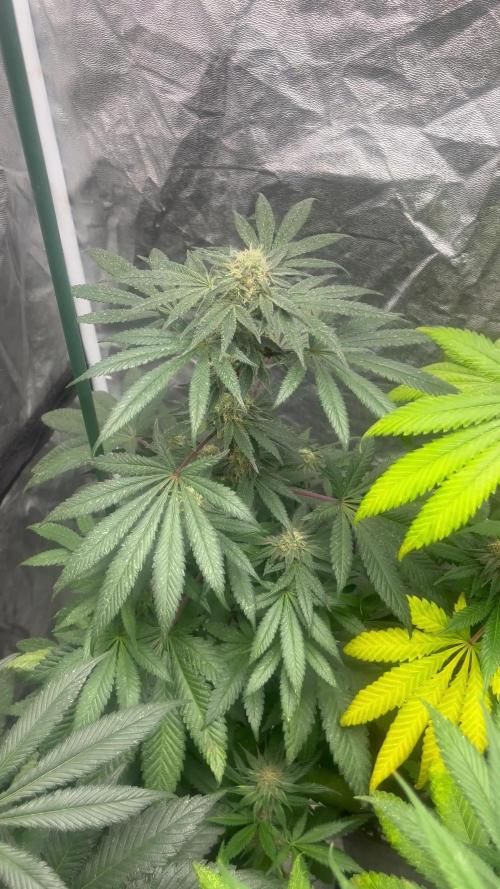
2nd net is up. Early bud formations are promising. holding up to the extremes pretty well, some leaves taking minor damage, but overall, she is holding up, gave her 1 night at 50F see how she would react, stressful. Not advised as it messes with her metabolism, but I want to see if it triggers any anthocyanin response. Love to see her purp up but no signs yet. Remember, For every molecule of glucose produced during photosynthesis, a plant needs to split six molecules of water. This process provides the hydrogen needed for synthesizing glucose and other organic compounds, while oxygen is released as a byproduct. Homework. If Rubisco activity is impaired and it cannot properly function or regenerate its substrate, the plant's leaves are likely to turn a pale green or lime green, a condition known as chlorosis. Essentially, Rubisco activity is highly regulated and susceptible to various environmental and metabolic factors that can cause it to become inhibited, leading to an apparent failure in RuBP regeneration due to a lack of consumption. Rubisco regeneration is intrinsically linked to nitrogen supply because Rubisco is a major sink for nitrogen in plants, typically accounting for 15% to over 25% of total leaf nitrogen. The regeneration phase itself consumes nitrogen through the synthesis of the Rubisco enzyme and associated proteins (like Rubisco activase), and overall nitrogen status heavily influences the efficiency of RuBP regeneration. RuBisCO is a very large enzyme that constitutes a significant proportion (up to 50%) of leaf soluble protein and requires large investments in nitrogen. Insufficient nitrogen supply limits the plant's ability to produce adequate amounts of RuBisCO, thereby limiting the overall capacity for photosynthesis and carbon fixation. Maintaining the optimal, slightly alkaline pH is crucial for the proper function and regeneration of Rubisco. Deviations in either direction (too high or too low) disrupt the enzyme's structure, activation state, and interaction with its substrates, leading to decreased activity and impaired RuBP regeneration. (Lime/yellowing) Structural Component: Nitrogen is an essential building block for all proteins, and the sheer abundance of the Rubisco protein makes it the single largest storage of nitrogen in the leaf. Synthesis and Activity: Adequate nitrogen supply is crucial for the synthesis and maintenance of sufficient Rubisco enzyme and Rubisco activase (Rca), the regulatory protein responsible for maintaining Rubisco's active state. Nitrogen deficiency leads to a decrease in the content and activity of both Rubisco and Rca, which in turn limits the maximum carboxylation rate, Vmax, and the rate of RuBP regeneration Jmax, thus reducing overall photosynthetic capacity. Nitrogen Storage and Remobilization: Rubisco can act as a temporary nitrogen storage protein, which is degraded to remobilize nitrogen to other growing parts of the plant, especially under conditions of nitrogen deficiency or senescence. Nitrogen Use Efficiency (NUE): The allocation of nitrogen to Rubisco is a key determinant of a plant's photosynthetic nitrogen use efficiency (PNUE). In high-nitrogen conditions, plants may accumulate a surplus of Rubisco, which may not be fully activated, leading to a lower PNUE. Optimizing the amount and activity of Rubisco relative to nitrogen availability is a target for improving crop NUE. Photorespiration and Nitrogen Metabolism: Nitrogen metabolism is also linked to the photorespiration pathway (which competes with carboxylation at the Rubisco active site), particularly in the reassimilation of ammonia released during the process. To increase RuBisCO regeneration, which refers to the process of forming the CO2 acceptor molecule Ribulose-1,5-bisphosphate (RuBP) during photosynthesis, the primary methods involve optimizing the levels and activity of Rubisco activase (Rca) and enhancing the performance of other Calvin-Benson-Bassham (CBB) cycle enzymes. Biochemical and Environmental Approaches: Optimize Rubisco Activase (Rca) activity: Rca is a crucial chaperone protein that removes inhibitory sugar phosphates, such as CA1P (2-carboxy-D-arabinitol 1-phosphate), from the Rubisco active site, thus maintaining its catalytic competence. ‱Ensure optimal light conditions: Rca is light-activated via the chloroplast's redox status. Adequate light intensity ensures Rca can effectively maintain Rubisco in its active, carbamylated state. ‱Maintain optimal temperature: Rca is highly temperature-sensitive and can become unstable at moderately high temperatures (e.g., above 35°C/95F° in many C3 plants), which decreases its ability to activate Rubisco. Maintaining temperatures within the optimal range for a specific plant species is important. ‱Optimize Mg2+ concentration: Mg2+ is a key cofactor for both Rubisco carbamylation and Rca activity. In the light, Mg2+ concentration in the chloroplast stroma increases, promoting activation. ‱Manage ATP/ADP ratio: Rca activity depends on ATP hydrolysis and is inhibited by ADP. Conditions that maintain a high ATP/ADP ratio in the chloroplast stroma favor Rca activity. Enhance Calvin-Benson-Bassham (CBB) cycle enzyme activity: The overall rate of RuBP regeneration can be limited by other enzymes in the cycle. ‱Increase SBPase activity: Sedoheptulose-1,7-bisphosphatase (SBPase) is a key regulatory enzyme in the regeneration pathway, and increasing its activity can enhance RuBP regeneration and overall photosynthesis. ‱Optimize other enzymes: Overexpression of other CBB cycle enzymes such as fructose-1,6-bisphosphate aldolase (FBA) and triose phosphate isomerase (TPI) can also help to balance the metabolic flux and improve RuBP regeneration capacity. Magnesium ions, Mg2+, are specifically required for Rubisco activation because the cation plays a critical structural and chemical role in forming the active site: A specific lysine residue in the active site must be carbamylated by a CO2 molecule to activate the enzyme. The resulting negatively charged carbamyl group then facilitates the binding of the positively charged Mg2+ion. While other divalent metal ions like Mn2+ can bind to Rubisco, they alter the enzyme's substrate specificity and lead to dramatically lower activity or a higher rate of the non-productive oxygenation reaction compared to Mg2+, making them biologically unfavorable in the context of efficient carbon fixation. The concentration of Mg2+ in the chloroplast stroma naturally increases in the light due to ion potential balancing during ATP synthesis, providing a physiological mechanism to ensure the enzyme is activated when photosynthesis is possible. At the center of the porphyrin ring, nestled within its nitrogen atoms, is a Magnesium ion (Mg2+). This magnesium ion is crucial for the function of chlorophyll, and without it, the pigment cannot effectively capture and transfer light energy. Mg acts as a cofactor: Mg2+ binds to Rubisco after an activator CO2 molecule, forming a catalytically competent complex (Enzyme-CO2-Mg2+). High light + CO2) increases demand: Under high light (60 DLI is a very high intensity, potentially saturating) and high CO2, the plant's capacity for photosynthesis is high, and thus the demand for activated Rubisco and the necessary Mg2+ cofactor increases. Mg deficiency becomes limiting: If Mg2+ is deficient under these conditions, the higher levels of Rubisco and Rubisco activase produced cannot be fully activated, leading to lower photosynthetic rates and potential photo-oxidative damage. Optimal range: Studies show that adequate Mg2+ application can enhance Rubisco activation and stabilize net photosynthetic rates under stress conditions, but the required concentration is specific to the experimental setup. Monitoring is key: The most effective approach in a controlled environment is to monitor the plant's physiological responses e.g., leaf Mg2+ concentration, photosynthetic rate, Rubisco activation state, and adjust the nutrient solution/fertilizer to maintain adequate levels, rather than supplementing a fixed "extra" amount. In practice, this means ensuring that Mg2+ is not a limiting factor in the plant's standard nutrient solution when pushing the limits with high light and CO2. Applying Mg2+ through foliar spray is beneficial to Rubisco regeneration, particularly in alleviating the negative effects of magnesium (Mg) deficiency and high-temperature stress (HTS). While Mg can be leached from soil, within the plant it is considered a mobile nutrient, particularly in the phloem. Foliar-applied Mg is quickly absorbed by the leaves and can be translocate to other plant parts, including new growth and sink organs. Foliar application of: NATURES VERY OWN MgSO4 @ 15.0g L-1 in a spray bottle. For those high-intensity workouts when 1 meal a day is just not enough! Foliar sprays are often recommended as a rapid rescue measure for existing deficiencies or as a supplement during critical growth stages, when demand for Mg is high. Application in the early morning or late evening can improve absorption and prevent leaf burn. The plant was getting a little limey yellow in the centre. Shortly thereafter, she was back in business, green mostly regenerated. The starting point [of creativity] is curiosity: pondering why the default exists in the first place. We’re driven to question defaults when we experience vuja de, the opposite of dĂ©jĂ  vu. DĂ©jĂ  vu occurs when we encounter something new, but it feels as if we’ve seen it before. Vuja de is the reverse—we face something familiar, but we see it with a fresh perspective that enables us to gain new insights into old problems. Confidence is evidence... nothing more. You are confident because you have driven 10,000 times, you are confident because you have spoken 10,000 times. People think confidence is a feeling, but it's not. If you want more confidence, then you need to create evidence, take more shots, collect more data, build more experiences, take more risks; fail, confidence doesn't come first; it is the reward you get for doing the work. no one else wants to do.