




Likes
7
Share


@Nassmou
Follow
Hello,
This week has been relatively calm, there has not been a big change before I do a watering with fertilizer every other time and I noticed that the new leaves at the top with the tips a little burnt so I will reduce the quantities of fertilizer instead of watering once in two I will water once in three with fertilizer.
This week there was watering again.
Temperatures range from 30° during the day to 19° at night.
Next week there will be more photos.
see you soon


Likes
11
Share

@BudBrewerz
Follow
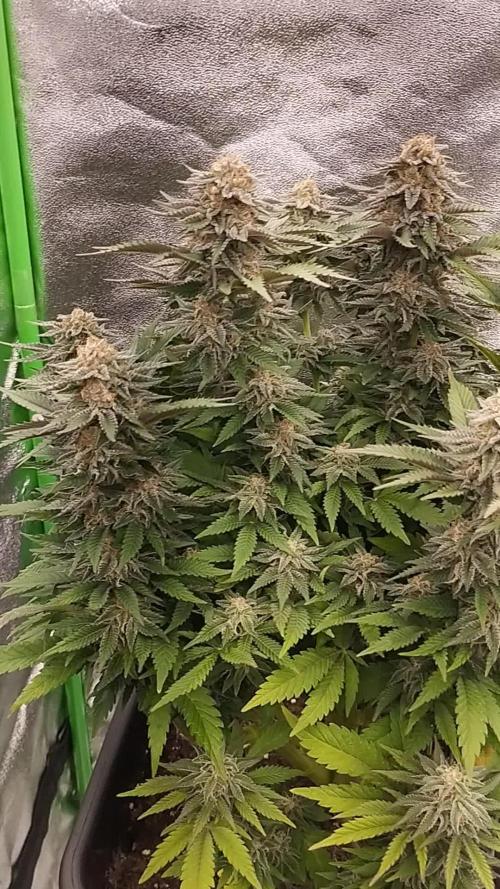
The Widow is doing pretty good, she's coming very close to harvest day. I've started flushing her because her hair is starting to get really amber. She is smelling nice but not too hard either. The other plants in bloom seem to be a little louder,however het buds are really thick and look very yummy. Looking forward to tasting this lady. I'm pretty sure she will be harvested by next week.

Likes
41
Share


@Kmikaz420
Follow
Bonjour a toutes et à tous , bon dimanche .. je passe juste vite mettre quelque photos (je n ais pas trop le temp en ce moment , je vais être opéré mercredi donc pas mal de chose à préparer)
Je passerai (si tous ce passe bien ) fin de semaine vous mettre des photos des plantes hors de la tante histoire de voir les filles plus en détails.
Je vous dit à très vite (enfin j espere:)

Likes
5
Share

@HighGrower0711
Follow
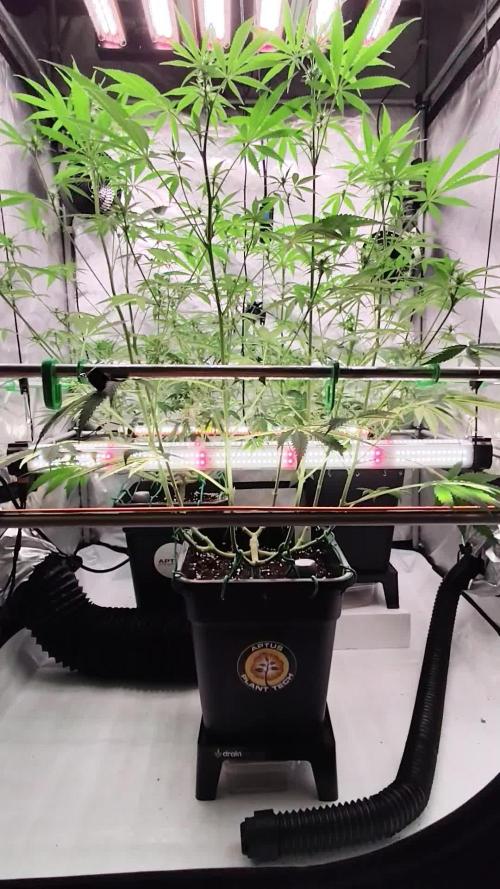
Temperatur:
Tag: 26°C
Nacht: 23°C
• RLF:
62 %
VPD 1.1 (Blatttemperatur -1°C kühler)
• Licht:
DLI (mol/m2/d): 30
B:R Spektrum 1:1.3
• Abstand: 50 cm
• Ionisator:
80/20
8 Sekunden negative Ionen im wechsel mit 2 Sekunden postive

Likes
1
Share

@Pepe_Ramone
Follow
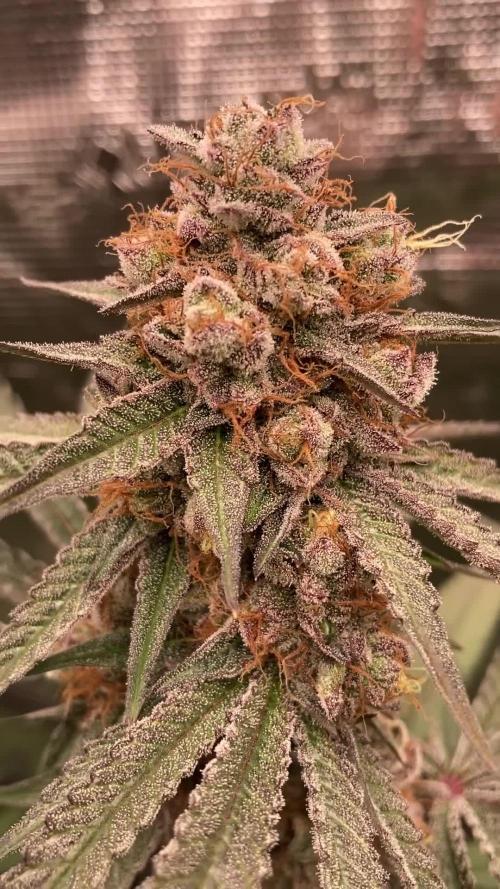
Day 63 today.
I've now stopped feeding, so they are just getting plain water until they are ready to harvest.
Likes
9
Share

@DogDoctorOfficial
Follow
💜 Purple Haze by Zamnesia – Pheno B Week 8 | The Bush With Her Own Rhythm
Welcome back to another chapter of the 8×8 Adventure!
Last week I talked about how remarkably similar the two Purple Haze sisters had been looking.
Well...
That story has changed. 😄
This week, Purple Haze Pheno B is making it very clear that she has her own personality.
While her sister has developed a different structure and expression, Pheno B has settled into something completely different:
She's a bush. 🌿💜
Compact.
Dense.
Lush.
Full of life.
And absolutely comfortable being exactly what she is.
This is one of the reasons I love growing multiple phenotypes from the same genetics. You can give two sisters exactly the same environment, exactly the same nutrition and exactly the same light...
And eventually, genetics starts whispering:
"Let me show you who I am."
And this girl is definitely talking.
🌱 One Project. One Environment. Twelve Unique Stories.
If you're new to the diary, welcome!
This plant is part of my ongoing 8×8 Adventure, where twelve different cultivars are being grown together using the 12/12 From Seed technique.
From the beginning, every plant has received the same opportunity:
• The same lighting schedule
• The same Plagron nutrition
• The same AutoPot irrigation system
• The same Future of Grow lighting
• The same TrolMaster-controlled environment
• The same temperatures
• The same humidity
No individual feeding.
No special environmental treatment.
No different light schedule.
The genetics are the variable.
And now, eight weeks into flowering, those genetic differences are becoming increasingly obvious.
That's the beauty of this project.
One environment. Twelve stories.
And Purple Haze Pheno B is writing hers in a very different handwriting from her sister.
🌿 The Compact Purple Haze
If I had to describe this phenotype in just a few words, I would say:
Compact. Bushy. Lush.
She's not trying to become the tallest plant in the room.
Instead, she's building herself outward.
Her branches are packed closely together, her foliage is abundant, and flowering sites are appearing throughout that dense structure.
Looking at her now, I can see why she has developed into such a compact plant.
There is simply a lot of plant packed into a relatively small space.
And I love it.
She has created her own little ecosystem.
Everywhere I look, there are leaves.
Behind those leaves, more branches.
And behind those branches...
flowers. 🌸
This is a phenotype that seems much more interested in building density than chasing height.
And that's perfectly fine with me.
🌸 Week 8 – The Flowers Are Taking Shape
The flowering sites are becoming much more established now.
The delicate little clusters from the earlier weeks have developed into recognizable young flowers, with pistils continuing to emerge from the developing calyxes.
There is still plenty of time for these flowers to swell and mature, but the direction is becoming very clear.
She's flowering.
She's stacking.
And she's doing it everywhere.
One thing that really stands out in the photographs this week is just how much healthy foliage surrounds the flowers.
The plant remains intensely green and full of vitality.
There is no shortage of leaves here.
In fact...
there may be a few too many. 😄
Which brings me to what's coming next.
✂️ The Defoliation Is Coming
Until now, I've deliberately allowed this girl to keep her healthy foliage.
I wanted to see how she developed naturally before deciding how much intervention she actually needed.
And I'm glad I waited.
Because now I can see exactly what I'm dealing with.
She's lush.
Very lush.
The canopy is becoming increasingly dense, and as flowering progresses, I want to make sure the developing flowers have enough space, airflow and light penetration.
So I believe next week will probably be the right moment for some selective defoliation.
Not a dramatic haircut.
Not stripping the plant bare.
Just a thoughtful cleanup.
Removing selected leaves that are:
• Blocking developing flowering sites
• Creating unnecessary layers of foliage
• Restricting airflow inside the bush
• Sitting in places where they provide little additional benefit
The goal isn't to change who she is.
The goal is to help her express what she's already built.
And honestly...
I think she's going to shine after it. ✨
🍃 Keeping the Plant Healthy
One thing I continue to appreciate about this phenotype is the overall quality of her foliage.
The leaves are broad, healthy and strongly developed.
The plant has maintained excellent colour and structure, and there are no major signs that she's struggling with the demands of flowering.
This is particularly important at this stage.
A plant can be large and impressive while still being stressed.
That's not what I'm seeing here.
Instead, she looks comfortable.
She's growing at her own speed.
She's building flowers at her own speed.
And she's maintaining her own balance.
That's exactly what I want to see.
💧 Feeding for Week 8
As flowering progresses, the feeding program continues to support the plant through this important period of flower development.
This week's Plagron feeding consists of:
• Terra Bloom – 2.2 ml/L
Supporting the nutritional demands of flowering and continued flower development.
• Power Buds – 1 ml/L
Supporting the transition and development of the flowering sites.
• Green Sensation – 1 ml/L
Providing additional support during the flowering phase as the flowers continue developing.
• Sugar Royal – 1 ml/L
Part of the flowering nutrition strategy supporting the plant as she progresses toward maturity.
• pH Plus – 0.03 ml/L
• Lemon Kick – 0.03 ml/L
Used as required to bring the nutrient solution into the desired pH range.
The current nutrient solution is sitting around EC 2.0 mS/cm, with a solution temperature of approximately 24°C.
And, as always...
every plant in this project receives the same recipe.
The phenotype decides how she responds.
💡 Light From Above and Below
The combination of the main Future of Grow lighting and the Lumiflora under-canopy lighting continues to be particularly interesting with this phenotype.
Because Pheno B has such a dense, bushy structure, the additional light lower in the canopy becomes especially relevant.
The upper canopy naturally receives the strongest illumination.
But with a plant this compact, there are flowering sites developing throughout the interior and lower portions of the structure.
The under-canopy lighting provides another layer of illumination in those areas.
Again, I'm not expecting miracles.
It's simply another tool in the ecosystem.
And as I selectively remove some of the excess foliage next week, I'm particularly curious to see how the combination of improved airflow, better visibility of the flowering sites and additional lower-canopy light affects her development.
🌡️ A Stable Environment
The room continues to provide a consistent environment for all twelve phenotypes.
Current conditions for this update:
• Flower Week: 8
• Height: 111 cm
• Light schedule: 12/12
• Day temperature: 20°C
• Night temperature: 25°C
• Relative humidity: 60%
• pH: approximately 6.0
• EC: approximately 2.0 mS/cm
• Solution temperature: 24°C
• Substrate temperature: 21°C
• CO₂: 636 ppm
• Watering: approximately 1.2 L per plant / 24h
• Pot size: 15 L
Note: the temperature values are recorded exactly as shown in this week's GrowDiaries data.
Consistency continues to be one of the most important parts of this experiment.
The environment stays consistent.
The feeding stays consistent.
The plants don't.
And that's exactly what we're here to observe.
📷 This Week's Gallery
This week's photographs really tell her story.
The wider shots show a plant that has become incredibly dense and compact, with foliage filling almost every available space.
The closer photographs reveal something even more interesting.
Behind that wall of leaves are flowering sites developing throughout the plant.
The pistils are fresh.
The flowers are forming.
And the resin production is already becoming visible across the developing structures and surrounding sugar leaves.
She's not trying to be her sister.
She's not trying to be the tallest.
She's not trying to follow the same path.
She's simply being Purple Haze Pheno B.
And I think that's beautiful.
🔮 Looking Ahead – Time to Let Her Shine
Next week may be an important little turning point for this girl.
After allowing her to develop naturally for so long, I think she's finally reaching the point where a selective defoliation will benefit the structure she's created.
I'll be looking for the leaves that are doing more blocking than contributing.
I'll open some of the interior.
I'll improve airflow.
I'll give those developing flowers a little more breathing room.
But I won't take away her personality.
That bushy structure is part of what makes this phenotype interesting.
The goal isn't to turn her into her sister.
The goal is to help this phenotype become the best version of herself.
And I have a feeling that once we open her up a little...
She's going to surprise us.
💜 Different Doesn't Mean Less
One of the biggest lessons from this 8×8 Adventure continues to be that there isn't just one definition of a great plant.
Purple Haze Pheno A and Purple Haze Pheno B may share the same genetics.
They may share the same room.
They may share the same nutrients, lights, irrigation and environmental conditions.
But they're telling different stories.
And that's exactly what makes phenotype hunting so fascinating.
Pheno B has chosen a different path.
She's compact.
She's dense.
She's incredibly lush.
She's building her own little world instead of reaching for the ceiling.
And honestly?
I'm loving her for it. 💜
Every phenotype deserves the opportunity to shine in its own way.
And next week, when we carefully open this beautiful bush and give those flowers a little more room to breathe...
I think we're going to see just how much potential has been hiding underneath all that green.
💚 Thank You
Thank you so much for following another chapter of the 8×8 Adventure.
This project continues to remind me that growing isn't about forcing plants to become identical.
It's about creating the right conditions...
Then stepping back and watching genetics tell its story.
A huge thank you to:
💚 GrowDiaries — for providing the platform where growers from around the world can document, share and learn together.
🌱 Zamnesia — for the Purple Haze genetics that are giving us these fascinating phenotype differences to explore.
💜 Plagron — for supplying the nutrition supporting the plants throughout this journey.
💡 Future of Grow LED — for providing the lighting powering this project.
🌿 TrolMaster — for helping maintain the stable environment shared by all twelve phenotypes.
✨ Lumiflora — for bringing the under-canopy lighting into this experiment and giving us another variable to observe.
And finally, thank you to everyone following these diaries, leaving comments, asking questions and enjoying this adventure with me.
Last week, I thought these two Purple Haze sisters were following almost the same blueprint.
This week, Pheno B looked at that blueprint and apparently said:
"Nah... I'm doing my own thing." 😂💜
And you know what?
That's exactly what I wanted to see.
Different phenotype.
Different rhythm.
Different story.
Same beautiful genetics.
Growers Love! 💜🌿





Likes
5
Share


@Purplepassion
Follow
Leider sind in Woche 5 nicht so viele Bilder entstanden, wenigstens ein kleines Video.
In dieser Woche habe ich ein paar Blätter jeder Pflanze entfernt.


Likes
3
Share


@Ghost17
Follow
Still learning day by day. Felt like I should back track a bit on the amount of nutes I have been feeding so I did almost cut my dosage in half for the past two watering. So far, so good.
Training the girl on the right is a breeze (almost at the point where I would just let her be) but feel the need to keep training her to get down to the girl on the lefts height.
Other than that, knock on wood, things are going well in my opinion!
Another week or so of veg then it's time to flip! Can't wait!

Likes
9
Share


@OGbros
Follow
ITA: finalmente ho comprato il deumidificatore che mi serviva. L'ho attaccato alla spina il giorno36 e spero che svolga il suo lavoro. Le piante stanno bene senza sintomi di eccessi o carenze di fertilizzazione.
edit: il deumidificatore sta svolgendo il suo lavoro: ha abbassato l'umidità che è passata da 80-90% a 50% circa.
ENG: I finally bought the dehumidifier I needed. I plugged it in on day 36 and hope it will do its job. Plants do well with no symptoms of excess or deficiency in fertilization
edit: the dehumidifier is doing its job: it has lowered the humidity which has gone from 80-90% to about 50%.


Processing
Likes
97
Share


@DudeGrowsWeed
Follow
The 2 older BlackBerry's still look like they are struggling. They are growing, but I'm not seeing the branches starting to develop as I would expect by this point. The newer BlackBerry seedling looks fine. We'll see what happens over the next few weeks.


Likes
39
Share


@Hashy
Follow
Week 6
Light cycle=12/12
Light Power=150w
Extractor controller settings
High temp= 25c
Low temp= c
Temp step=0c
High Rh= 56%
Low Rh= %
Rh step=0%
Speed max=8
Speed min=2
Smart controller settings (during lights on).
Lights on=10.01-21.59
Radiator on= below 21.5c
Radiator off= above 22.5c
Dehumidifier on= not in use
Dehumidifier off= not in use
Smart controller settings (during lights off).
Lights off=22.00-10.00
Radiator on= below 18c
Radiator off= above 19c
Dehumidifier on= not in use
Dehumidifier off= not in use
VPD aim=0.6-1.4
DLI aim=35-40
EC aim=1.9
PH aim=6.2
Tue 30/1/24
#4 (Day 36)(Day 2 flower)
📋
Wed 31/1/24
#4 (Day 37)(Day 3 flower)
📋 H=52cm D=40cm DLI=26.5
🚿 foliar sprayed (Sumo Boost 2ml/L).
Thur 1/2/24
💧💧💧💧💧💧💧💧💧💧💧💧💧💧💧💧
Method= automatic
Feed=water
Neutralise=0.1ml/L
Roots=0.2ml/L
Easy Ph down=0.ml/L
Ec=0.2 PH=6.6/6.6
Time start=12.00pm
Finish time=13.45pm
(11×5 minute runs with 5 minute gaps)
Total flow rate=181ml/min
Flow rate per plant=45ml/min.
Total volume made=14L
Total volume left=4L
Total volume used=10L
Volume per plant=2.5L (Est)
Runoff.
Total runoff=1L
Ec=2.0 PH=6.1/6.2
💧💧💧💧💧💧💧💧💧💧💧💧💧💧💧💧
#4 (Day 38)(Day 4 flower)
📋 H=54cm D=38cm DLI=29.5
Lifted light and increasd power to 196w.
H=54cm D=45cm DLI=31.5
Extractor controller settings
High temp= 25c
Low temp= c
Temp step=0c
High Rh= 56%
Low Rh= %
Rh step=0%
Speed max=10
Speed min=2
Fri 2/2/24
#4 (Day 39)(Day 5 flower)
📋 raised camera, nearly touching the roof.
Sat 3/2/24
#4 (Day 40)(Day 6 flower)
📋 Defoliate a lot of lower leaves.
Sun 4/2/24
💧💧💧💧💧💧💧💧💧💧💧💧💧💧💧💧
Method= automatic
Feed=bloom nutes.
Neutralise=0.1ml/L
Silicon=1.0ml/L
Calmag=1.0ml/L
Terra Bloom=4.0ml/L
Sumo Boost=1.0ml/L
Roots=0.2ml/L
Easy Ph down=0.115ml/L
Ec=1.9 PH=6.1/6.5
Time start=12.00pm
Finish time=13.45pm
(11×5 minute runs with 5 minute gaps)
Total flow rate=190ml/min
Flow rate per plant=47ml/min.
Total volume made=13L
Total volume left=2.5L
Total volume used=10.5L
Volume per plant=2.62L (Est)
Runoff.
Total runoff=1.75L
Ec=2.4PH=5.9/6.2
💧💧💧💧💧💧💧💧💧💧💧💧💧💧💧💧
#4 (Day 41)(Day 7 flower)
📋 HST 1 cola.
Mon 5/2/24
#4 (Day 42)(Day 8 flower)
📋 H=69cm D=30cm DLI=46.0
She has started flowering now. She has grown 20cm during this week, fairly confident I have a good grip on this one and I'll be able to keep her from getting to big. I have seen how this strain can produce massive plants.
Back soon.
Take it easy.



Likes
15
Share


@MG2009
Follow
08/20/2020
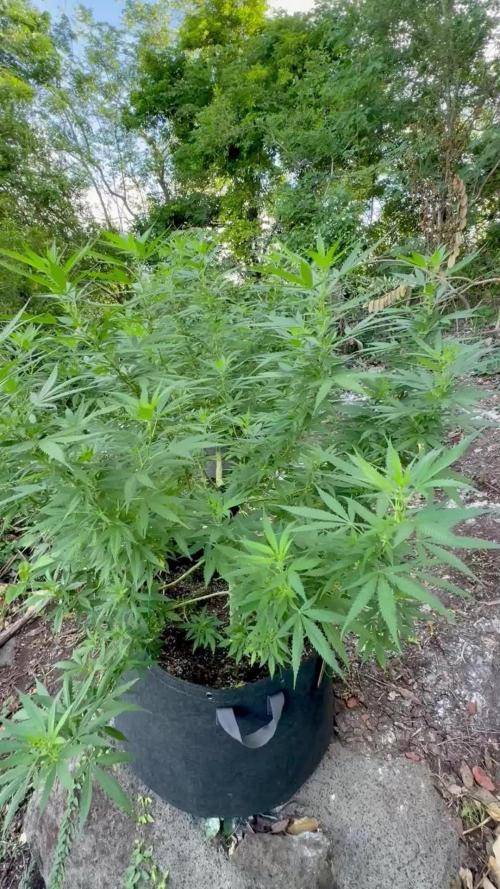
Soil temp a little warm,it is hot and humid going to water her good,and mulch the topsoil.
Flowering has started!
Likes
30
Share


@SooSan
Follow
12/12 + 81 jours
Vu qu’il y a 16 plantes mais que sur growdiaries on ne peut mettre que 8 variétés j'ai divisé en 2 diaries pour le bas de la tente
1️⃣
🏠 90x60x90
☀️ FC-E 4800 => puissance a 75%
🍁
1x Black Bomb / Philosopher Seed
2x Amnesia Lemon / PEV Seeds
1x Blueberry / PEV Seeds
1x Blueberry / 00 Seeds
1x Wappa / Paradise Seed
1x Dark Phoenix / Green House Seed
1x Quick Sherbet / Exotic Seeds
1x Mango Cream / Exotic Seeds
1x Banana Frosting / Sensi Seed
1x Hindu Kush / Sensi Seed
4x Fast Mix / Sweet Seed
📎 https://growdiaries.com/diaries/122084-grow-journal-by-soosan
📎https://growdiaries.com/diaries/124052-grow-journal-by-soosan
2️⃣
🏠 30x60x50
☀️TS1000 => puissance a 80%
🍁
Quick Sherbet - Exotic Seed = 12g
Quick Sherbet - Exotic Seed = 12g
Quick Sherbet - Exotic Seed
Quick Sherbet - Exotic Seed
📎 https://growdiaries.com/diaries/122080-grow-journal-by-soosan
