


Likes
Comments
Share


@Nothingbutcolas
Follow
Great first week getting everything dialed in. First time growing for me, spent a lot of time thinking about it and have an advanced background in Agronomy, but haven't applied it before now, all new :)
Have an Infinity S6 fan with the 067 controller, pretty awesome, wish it was wifi and not just Bluetooth. Have a Govee wifi temp/hum sensor which helps keep track while away. Heating pad and dome have been invaluable.
The SE7000 is working perfectly, doesn't put out that much heat at all, especially with the detachable driver and 8ft cable. Pretty sweet.

Likes
13
Share


@Kviatech
Follow
Pineapple Express by Fast Buds is growing so nicely. She already produces a very strong smell, despite being only 4.5 weeks old.
Today I took her out to do some minor LST training and trimming. So far she's growing without any issues

Likes
44
Share


@ILoVeThiSpLaNt
Follow
Giorno 81 (21 fioritura)
Come sempre le Rainbow Belts provocano dipendenza se toccate 😀 il solito mix di gas, lime e caramelle zkittlez che ti viene voglia di toccare sempre di più.
Sto aspettando qualche odorino delle altre piante perché sono proprio curioso di tutti gli incroci che ho nel box.
A settimana prossima 💪 🤞


Processing
Likes
23
Share


@GrowGuy97
Follow
Wish the buds would have got a little bigger but feel like that’s particularly my fault for a short Veg but overall I am blow away by the outcome for all the seeds to just be random bag seeds! 2 of the plants are drying now 3rd one will be cut tomorrow & the other 2 got probably 2 more weeks! Will do a taste & smoke report and also give a weight as soon as they dry & cure a little bit but honestly couldn’t be happier with my first grow! Thanks for all the support & help along the way & happy growing friends!🤙🏼✌️🏼🌱
Update on 1st plant - dry weight 42g, still smelled pretty Earthy when I put it in the jar but the smell is definitely coming out now, extremely sticky & frosty buds❄️: 1:🏼🙏🏼
Update - plant 2 Dry weight was 40 grams! Extremely happy with the out come this is honestly some of the best bud I have ever smoked! Amazing to me this came from a random bag seed, it has a very citrusy flavor, smells & smokes amazing! Honestly a 10/10 in my book, wish I could knew what strain this was so I could grow it again!😫❄️✌️🏼🌱
Update - plant 3 Dry weight 34g, smells & look phenomenal, the buds are much smaller & had the smallest yield so far but this is by far the best smelling so far! Will have a smoke update on this one soon, stay tuned friends & happy growing!✌️🏼🌱
Update - plant 5 dry weight was 52g it dried a little faster than plant 4 which I will probably jar tomorrow! Will update again with a smoke report soon, this plant brought my total so far up to 168 off 4 plants👍🏼 Thanks for following friends & happy growing! Also the butter I made from the trim was 🔥🔥
Likes
55
Share


@pifflestikkz
Follow
Day 135
14/09/24 Saturday
De-chlorinated tap water pH 6 with Plagron products.
Day 137
16/09/24 Monday
Feed today using de-chlorinated tap water pH 6.
She is seriously stacking now, zesty aroma with a fruity kick.
Trichomes incoming 🤩
Picture and video update, ✌️😎
Day 138
17/09/24 Tuesday
De-chlorinated tap water pH 6 today with Plagron products.
Pic update
Day 140
19/09/24 Thursday
De-chlorinated tap water pH 6 only today.
Day 142
21/09/24 Saturday
Another feed to push this week they seem to be handling it 💚. Fattening up on the buds now and pistils starting to mature.

Likes
22
Share


@SirBudAlotts
Follow
So there is actually very little work this week ..
She has been a real joy to grow so far..
I do understand what they meant by pheno-hunting...
Likes
4
Share


@Mo_Powers
Follow
not much has happened this week. there is still some sun per day. however, the temperatures drop to 4-8 degrees at night. these are not exactly the best conditions. maybe this late outdoor experiment was not a good idea after all. however, they have not died yet.
Likes
18
Share


@Thckaos
Follow
25-10-20 Se cambia la solución y se realiza un lavado de raíces. Para bajar la conductividad de las raíces de 2.05 a 0.2 ms para que la solución nueva sea más efectiva. Se corrige el PH de 7.8 a 5.6. La solución tiene 2.6 ms y 5.6 PH. Se añade una pastilla de CO2.
25-10-20 (2 horas más tarde) Se corrige el PH 6 a 5.6 Conductividad 1.9 ms con los nutrientes ya.
26-10-20 Se corrige el PH 5.8 a 5.6 Conductividad 1.95 ms.
27-10-20 Se corrige el PH 5.9 a 5.6 Conductividad 2.00 ms.
28-10-20 Se corrige el PH 6.00 a 5.6 Conductividad 2.03 ms.
29-10-20 Se corrige el PH 6.00 a 5.6 Conductividad 2.10 ms.
30-10-20 Se corrige el PH 6.00 a 5.6 Conductividad 2.14 ms.
31-10-20 Se corrige el PH 6.00 a 5.6 Conductividad 2.20 ms.

Likes
34
Share


@SalocinSpecial
Follow
D40 (31/12/2020): Second week of flower and everything is good! They are still stretching a lot. I'm not continuing LST with ties but just by tucking and banding stems and leaves. I will continue to slowly remove leaves and small bud site under canopy that will never receive enough light. The higher buds receive around 520 and 600 PPFD (40 000 to 46 000 lux) for a DLI (for 20 hours of continuous light) around 37,44 and 43,2 moles of photons which is perfect. This Glue Gelato phenotype is weird as it grows weird leaf structure since a couple of weeks. Probably since I discovers a nutrient lock in the soil with too much nutrients. Banana Kush is super healthy and look amazing! 😎
- temp: 25C
- no water
- RH: 56%
D41 (01/01/2021): They are stretching like crazy so it's a sign of good health! I fed with nutrients 3/4 of the recommended dose for transition week. I gave more then a gallon approx. 4L per plant. I did remove leaves today but no bending. I want to let them grow in height.
- temp: 25 C
- water: PH6.3, 820 PPM approx. 4L each plant
- run off: PH6.7, 1150PPM for BK ; PH6.8, 1120 PPM for GG
- RH: 54%
D42 (02/01/2021): Nothing special today. I try to turn the plant 180 degree each day to make sure fan is blowing air on every side of the pot and plant and to make sure light is distributed evenly. I also swap the two plants every 2-3 days to make sure again that the plants receive light equally. I continue removing leaves and small buds site under canopy.
- temp: 25 C
- no water
- RH: 54%
D43 (03/01/2021): The lights are now at 16 inch from the top buds and just 12h later I saw a big difference. They are now ready to receive intense light 😎. They receive approx. 650 to 780 PPFD and even 900 PPFD for the top buds (50 000 to 60 000 lux, and even 70 000 lux). I will check closely in the next days to make sure the buds and leaves are not burning. I fed only Max Minerals full recommended dose for transition week. I gave more then a gallon approx. 4L per plant. I placed a round stake in each pot for when the buds will be heavy.
- temp: 25 C
- water: PH6.3, 460 PPM approx. 4L each plant
- run off: PH6.8, 1550PPM for BK ; PH6.9, 1480 PPM for GG
- RH: 55%
D44 (04/01/2021): Nothing new today.
*** UPDATE ON BUGS: I did not see any more larvae since last week. It's the 3rd week since adding nematodes and after adding 2 pouch per plant, doing 2 insecticidal soap treatment and removing 1 inch of soil, I feel like I did control the infestation. I still see some mature fungus gnats on sticky traps but nothing alarming. Increasing air flow and reducing RH also helped a lot for those bugs.
- temp: 25 C
- no water
- RH: 55%
D45 (05/01/2021): Nothing special today. I let them grow without new LST. I did not removed leaves since a couple of days. They are growing in height and that's what I want. I might do a defoliation in beginning of week 7 (or week 3 of flowering). I want to reduce RH in the tent under 50%. When the lamps are off, I have a lot of difficulties to maintain a proper RH for flowering stage. During night, it is around 57% with the 4 inch AC Infinity inline fan blowing full speed. RH in the room where the tent is is around 35%-40%. With 5 plants in the tent (2 cannabis, 2 tomatoes and 1 mint) it will be more difficult to control RH in the next week with flower and fruit growing bigger. I ordered a small dehumidifier on Amazon to help me reduce the RH.
- temp: 25 C
- no water
- RH: 53%
D46 (06/01/2021): I fed today half of the recommended dose for transition week. The PPM of the run off from last fed was high so I want to cut a bit on nutrients. The run off of both plant is down under 900PPM which is what I wanted 👍
-temp: 25 C
- water: PH6.3, 480 PPM, approx. 3.5L each plant
- run off: PH6.9, 860PPM for BK ; PH6.9, 766PPM for GG
-RH: 52%


Likes
119
Share


@DogDoctorOfficial
Follow
Salutations, my fellow cultivators and botanical enthusiasts! Welcome to the much-anticipated Week 3 Flower Report for our radiant queen, Jealousy, in the Power Buds competition. The journey through the flowering phase is akin to watching a mesmerizing performance, and Jealousy, true to her name, has us all captivated.
As we transition into the third week of flowering, the grow room has transformed into a sanctuary of delicate buds, and Jealousy, adorned in green jewels, is perpetually in prayer. It's like witnessing a botanical congregation, where each bud is a devout follower, reaching for the heavens in pursuit of the ultimate floral nirvana.
Now, let's talk about the delay. The ticking clock of the contest deadline has kept us on our toes, and yet, Jealousy stands resilient. Despite the time constraints, she continues to unfurl her petals with grace, and I can't help but marvel at her determination. It's like a race against time where our green queen is sprinting toward the finish line with unwavering resolve.
In the midst of this floral ballet, the clones, those green offshoots of our regal Jealousy, have rooted with astounding success. It's like witnessing the next generation of botanical royalty sprouting from the roots of their majestic ancestor. These rooted clones are not just a testament to Jealousy's genetic prowess but also a green insurance policy for the future.
And let's not forget the continuous prayer pose that Jealousy maintains. This phenomenon, known as "praying leaves," where the foliage points upward toward the light source, is a visual testament to the plant's happiness and optimal conditions. It's like Jealousy is sending leafy blessings to the botanical gods, asking for a plentiful harvest.
As we navigate the third week of flowering, let's extend our gratitude to Zamnesia and Plagron, the silent architects of our green utopia. Their contributions continue to shape the landscape of our horticultural adventure.
A hearty applause to the Grow Diaries community – your shared experiences and collective wisdom are the threads that weave the fabric of our green journey.
To my fellow contestants and growers, may your buds swell with abundance, and may the contest deadline bow down to the prowess of your green kingdom. Here's to a week of perpetual prayer, botanical grace, and the anticipation of a harvest that will leave us all in awe. Stay green, stay inspired, and keep cultivating those dreams!
As always, thank you all for stopping by, for the love and for it all. This journey of mine would just not be the same without you guys. The love and support are very much appreciated, and I feel honored and blessed with you all in my life !!!
With true love comes happiness. Always believe in yourself and always do things expecting nothing in return, with an open heart. Be a giver, and the universe will respond in ways you can’t even dream of .
Friendly reminder: all you see here is pure research and for educational purposes only.
Genetics - Jelousy @Zamnesia
Nutrients @Plagron
Light - @viparspectra P2000
Room size - 3x3 - 0,9x0,9


Likes
9
Share

@CheeRz
Follow
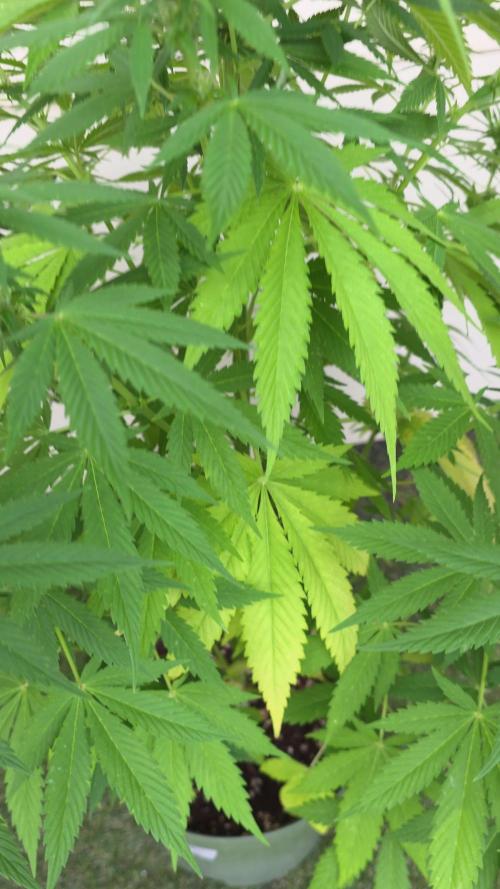
It's week three of flowering, and Divine Rapier is slowly forming buds. She appears to have a slight deficiency, but she looks great overall.
Likes
42
Share


@Theia
Follow
Hello thanks for stopping by. These beautiful ladies from weedseedsexpress are just so easy to grow, they have amazing leafsets and the branch spacing for me is perfect. Lots of space for light and air to get through. Get them in for your summer grows because if the smell is anything to go by i can not wait. I took some leaf off yesterday from the lowest nodes and my hands were sticky with a sweet smelling candy smell.. Just so inviting..😻
i dont really know what i was thinking with how i shaped them. I started out with the thoughts to mainline for 8 colas but then i remembered my triple cheese grow and i can not do another 12+weeks of veg... So i have just shaped them how my eye wanted them. Smoked a big joint then sat and just let it happen.lol so i dont know how it will effect yeild but then i am not growing for max yeild i am growing because i like it and theres the bonus of some great weed..😇
For me i love the tall shape i expect i will have to tie them to the roof to stop breaking (i hope)
Feeding is still once a week with some N and otherwise just 6.4 H20 and beneficials when needed.Will be adding some Bloom possibly this week when i see some flowers but at a low EC. I dont know how strong the Ecothrive charge i used at potting is?!? i dont want to stress them with an over feed so will start very very light and build up as they ask for it.
Thanks for looking.
Grow well and stay safe..👍

Likes
207
Share


@Hattiwatti
Follow
Everything just fine. Lst and defoliation done. New fan and grow light added last week.


Likes
6
Share
@Chrisandweed
Follow
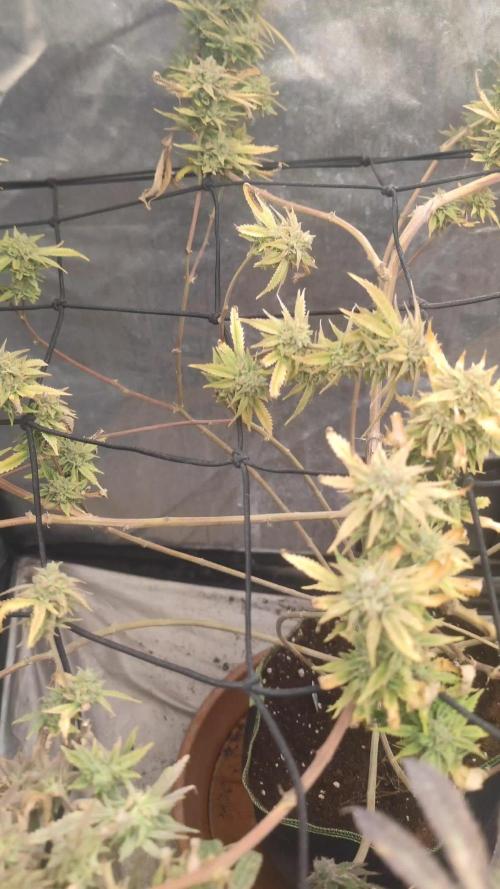
Puues ya queda meenos, o una semana si corren o dos, pero no mas. Las puntas blancas! Jajajajaja blaancas infestadas de resina.
Likes
11
Share


@Budking420
Follow
This week she has the most amazing colors and smells. I am very pleased with her and I'm going to pop another strawberry gorilla and cherry cola off for 2 more diaries! Might not pop them off till next week but I'm thinking this plant is very close another week or so and she should be done or very close!!!! Check back next week to see just how fast she finishes and remember it's always 4:20 somewhere!!!!!
Likes
7
Share


@Athos_GD
Follow
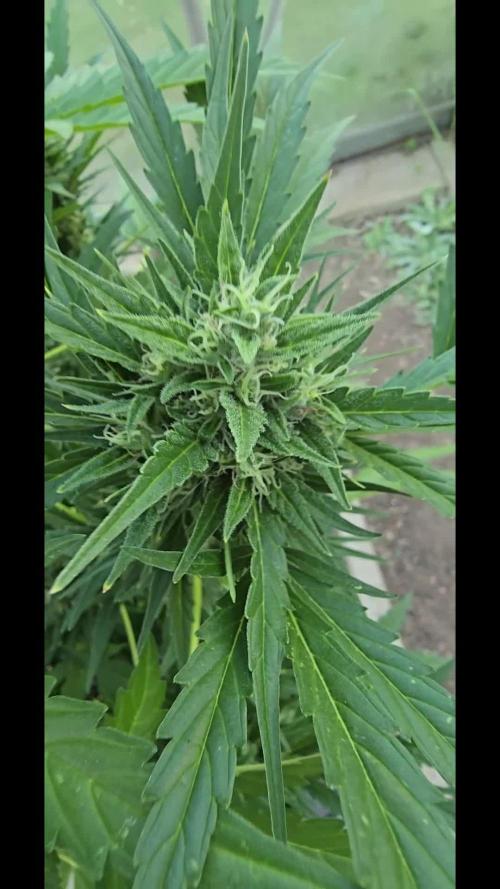
D71. Almost done.
D73. Last week.
D77. Last watering. RO water and Athena Cleanse last 3-4 days.
Plants have been drying for 14 days and ready to be trimmed.

Likes
13
Share

@NSABND
Follow
Day57 hot summer day 😎👍🙏
Day58 cloudy and normal temp 😳😵
Day59 cloudy and cold temp 😵😵😕
Day60 the sun came back but late 😩😵
Day61 sun and warm weather 😁🙏👍
Likes
25
Share


@Densko
Follow
End of week 8 for medusa 1/5. Plant is looking beautiful with the LST.
I will reduce thd nutrients week by week from now, ensuring for a clean finish without flushing.
I still feel the veg time for these genetics are too short for big yields. I reckon it will yield around 60 grams.
2/5 was topped and will yield more by the looks of the amount of shoots compared to 1/5. Check my other diaries for the entire experiment.
Watering 3L every 2/3 days
Smell is very strong now.
It will probably be ready in 3 weeks time

Likes
26
Share


@CannaBoy7
Follow
#myseed.ge
#soil-N1
#mysun.ge
#GROWROOM
#MYSEED-GROWROOM
Another defoliation and lst , every second day needs some defoliation, she grows and grows perfectly 😍
