


Likes
Comments
Share


@NO_DRAMA
Follow
Let the new week begin 💪
We transfer plant in to the big pot and make toping 💪👍
I hope plant had minimum stress 😬

Likes
2
Share
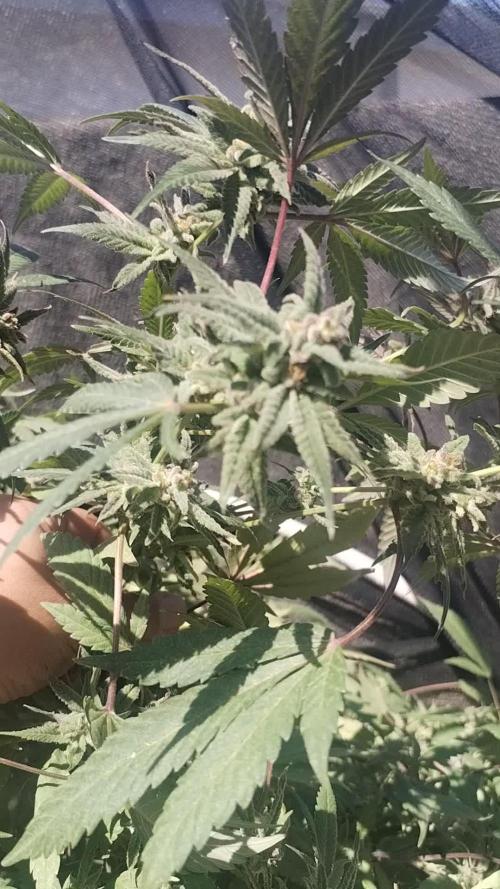

@Riboh
Follow
Week 8 and the Tart Pops girl is looking frosty and fragrant — sweet candy terps with a tangy twist filling the tent. Buds have packed on some serious weight over the past two weeks, with dense colas coated in a thick layer of sticky trichomes. The colors are starting to show hints of purple and pink under the sunlight, giving them that “dessert shelf” look.
Pistils are about 70–80% turned, and trichomes are mostly cloudy with a few clear still hanging around. Feedings are being tapered down, and the plants are cruising into their final phase before the flush begins.
Estimated harvest window Day 63–70 (Week 9–10) depending on trichome maturity. A few more days to let those terps peak and resin fully ripen before the chop. The Tart Pops are almost ready to live up to her name — sweet, sticky, and seriously tempting.

Likes
9
Share


@Cestlaweed
Follow
La temperatura sigue elevada debido la zona, pero las plantas no presentan problemas y se cuenta con buen sistema de ventilación.
Día 18 noche se riega con 1ml/L de Top Veg, fertilizante de crecimiento de TopCrop.
Día 19 segundo día de entrenamiento


Likes
9
Share


@Headies
Follow
So I had a few issue. I over watered early on, took them out the seed tray early, started feeding them a week or two late, no humidifier yet but they recovered well.
Likes
20
Share


@pifflestikkz
Follow
Day 98
Day 63 Flower
30/05/24 Thursday
Finally the time has come!!
The fox tails aren't a issue for me as it's Percy smoke, and to be fair, there decent fox tails 😍😂.
The plant is huge for a auto.
I have wet trimmed,
Removed all excess stem.
Wet bud weight is 587g
Wet trim is 35g
I will update dry weight and smoke report 👌
Thank you to everyone who liked, commented and followed 🙌
Love for the grow 💚
Till next time ✌️

Likes
68
Share


@Teamdirtbag2
Follow
Well reveg is happening to only the plants in the ground. All plants are in the same place. This is so fucking strange. The potted plants are staying in flower. This is a strange occurrence for me. Everything should have reveged... better yet the difference between a potted plant and one in the ground. It's an incredible difference in size. And I water the ones in the ground with plain hose water. Straight city tap water. So this is a strange year. Its obvious the bar has been set really low this year. There will be no "tree" just bushes this year. But how big a bush you got?


Likes
13
Share


@Rikymaru66
Follow
Amazing high. And the bud never smelled like hay. Not even at 85% rh . Still had smelled berries and gas.
I am still curing on it and I am very happy with the results. Buds are hard as rock. Not having a big long cola but many big buds, was also good, good trichome production. When smoked cali kush and gorilla glue terpenes profile are felt instantl. It is a delifghyful experience that comes in wjth a cerebral high and turns later into a relaxed body high that leaves you smiling
Likes
13
Share


@HeavyHead
Follow
Really starting to fatten up. Love the structure of this plant. Not crazy bushy and very simple to LST.
Seems to be just going crazy for the nutes, been going at about 90% strength and it’s still wanting more.
Been having to add tons of cal mag as my new place I moved to seems to have very soft water.
Still new to the advanced nutrients but love them so far. Even the stalks on these are sticky and building up :p


Likes
18
Share


@Spliffing_Around
Follow
I feed up to 1300 now , try to mix properly at least and water 2-3 times a day. But handwatering half of them became hard. What do you think , I’m good to transplant ? I see the root from some pots already.
Likes
2
Share


@Ultraviolet_
Follow
67 days since April 16th, 2026
We become aware at such times of man's wonderful ability to bring seemingly unrelated elements into harmonic balance, and receive a glimpse into a world where everything exists in conscious sympathetic attunement to everything else. When we listen to a piece of music that seems to strike a beautiful chord somewhere inside us, or view a painting that simply glows with harmonic awareness well executed, we probably do not spare much time to contemplate the wonderfully intricate combination of vibrations that our sensors make it possible for us to perceive. We tend to appreciate the relationship between the parts of something by an awareness of the harmony or dissonance of the whole. This ability enables us to say "what a beautiful house!" instead of "analysis has proven that this collection of building materials exhibits certain elements of harmonic proportion." While this ability to instinctively appreciate the beauty of true harmony has an important role to play in evolution, a more analytical understanding of the laws involved can be most useful. This is especially so if we wish to create works of art where each part exists in true harmony, not only with the other part of that particular whole, but with the universe within which the creator and the created exist.
Everything vibrates. From the most dense matter to the most subtle cosmic rays, everything which our senses allow our thoughts to become aware of, can be specified in terms of wavelength or frequency of vibration. These two terms define the same thing, but from different points of view.
The following are the approximate wavelengths of various energy carriers:
Cosmic rays 0.000,000,001 mm
Gamma rays 0.000,000,1 mm
X rays 0.000,500 mm
Ultraviolet rays 0.003 mm
Visible light 0.006 mm
Infrared 0.01 mm
Sound waves 1 meter
Radio waves 300 meters
Violet light 400 nm to 450 nm
Blue light 450 nm to 500 nm
Green light 500 nm to 570 nm
Yellow light 570 nm to 590 nm
Orange light 590 nm to 610 nm
Red light 610 to 700 nm
1 nanometer (nm) = 0.000,000,1 cm = 1/10,000,000 cm
If a guitar string is plucked and we hear a sound, it is not too difficult for the human mind to associate this sound with the vibration of the guitar string. With color it is quite different. It is difficult for us to conceive that the color of a substance is not an inherent property of the substance itself, but an indication picked up by our senses of that substance's ability to absorb or reflect the light which happens to be shining on it at that moment. Neither the matter nor the light is colored. What happens is that the brain learns to differentiate between the frequencies reflected or transmitted by the substance the eyes are focused on. The same thing happens with sound. When we say "Oh! Listen, they're playing my favorite song," what we really mean is: "My brain has stored within it a particular pattern of frequencies. I have compared the new information being received with this stored pattern and have deduced the answer that the two patterns are similar within certain specified tolerances." The 'pleasure' involved could have something to do with our running the pre-recorded pattern at the same time, in 'sympathy' with the new pattern as it is received.
The word sympathy describes very well our ability to appreciate color and sound. It also describes the reason behind certain elements of harmony. For instance, if a substance vibrating at 100 cycles per second (tone 1) is in the proximity of another substance vibrating at 200 cycles per second (tone 2), we could perceive, if we had the right equipment, a certain sympathetic relationship between the two.
We will see from this that there is a uniform doubling of the first tone seen in the second. At various points along the waves, the two are the same in amplitude. At other points, they are at opposite poles to each other. This doubled frequency has more points of similarity to the original than any other frequency except the original itself. If the equipment we had available for measuring these two frequencies was a soundboard amplifier and a pair of ears, then we would hear what would sound to us like one tone. If we had the opportunity to hear one at a time, we would hear that although they sound the same, one is higher in pitch than the other. This characteristic of 'the same but different in pitch', musicians have called the octave. Any two tones produced where one has exactly doubled the frequency of the other is called an octave. Speaking in ratios, an octave would appear then as the ratio 2:1 or 1:2, depending on whether we are talking of an octave up or down.
A single note produced by almost any instrument will contain more than one wavelength or frequency. It will have a dominant frequency, the wavelength of which we would call the note's 'fundamental' or 1st harmonic. It will also have a varying number of upper harmonics, gradually fading in intensity into infinity or silence.
Natural harmonics always have the same pattern of intervals between them. The interval between the 1st and 2nd harmonic is a perfect octave; between the 2nd and 3rd a perfect fifth; between the 3rd and 4th a perfect 4th; and so on, the intervals becoming smaller and smaller until they lose any relationship with the western 12 tone scale as it exists at the moment. Just as an octave has certain elements of sympathy with its fundamental, so some intervals have been noted to be more perfectly in sympathy with the fundamental than others. The ratio of the 'perfect 5th' or interval of 7 semitones, as it occurs in the harmonic series, is 3:2 or 2:3, while that of the 'perfect fourth" is 4:3 or 3:4. All the tones in the western 12 tone scale can be expressed in terms of the ratio between the upper tone and its fundamental. This would seem to be an ideal way of generating a scale from any given fundamental and several attempts have been made to do this, the Pythagorean system being probably the most well known. Although when working with a single tone instrument playing on its own, the Pythagorean formula works wonderfully well, if we had several instruments tuned this way together and asked them to play almost any western music, we would find that at times they sounded quite out of tune to each other.
The lack of flexibility of the various scale systems based on the harmonic series has led to what is known as the 'tempered' scale. This uses as its primary unit of interval the ratio of the octave or 2:1. It then proceeds to divide the interval between any fundamental and its upper octave into 12 smaller intervals by applying the ratio: two to the one-twelfth power, to one (21/12:1). This equals 1.059463094, so by multiplying any frequency by this number, we will obtain the tempered semitone next up from our fundamental. We will also find that any tone twelve semitones up from any other tone, in a scale generated in this way, will have exactly double the frequency.
If we took the note middle C on a piano and halved the wavelength, we would have the note C one octave above. If we halved this, we would have the C above, and so on. However, within about 6 octaves, we would find that although a 'sound' was being produced, no human ear could perceive it. If we kept on going, halving and producing upper octaves of our fundamental C, we would proceed through the infrared band, into the visible light spectrum. If we happened to be outside during the day, we would, for one octave only, see the note C with our eyes. The next octave above would already be in the ultraviolet band, and outside the eye's sensitivity range. If we can think of color as being an indication of a substance's vibratory rate or wavelength, we may begin to see a relationship that could exist between the color and sound spectrums.
The logical extension of what has so far been said is that there exists a scale in the color spectrum that corresponds exactly to the scale in the sound spectrum, each color tone being an octave of the equivalent note in the sound range.
This is not the end of the story but only the beginning. If we can for the moment accept that any wavelength in one band has upper and lower octave stretching out to infinity, then the next question is 'fine, but what shall we use as our fundamental? A particular color? A particular sound frequency?' The musicians among us will probably say 'A 440'. This means that the note A should vibrate at 440 Hertz, or 440 times per second. They would tell us that this is standard pitch has been adopted by most orchestras around the world; pianos are tuned to it, instruments are constructed to formulas based on it, and so to them it would probably seem the most appropriate place to begin. Some of these musicians may know of the battle that is still raging with regards to this being the standard, but few would know why A = 440 Hz was chosen except that it worked when it was set to be a suitable compromise between the many different pitches in use at the time.
432 Hz is said to be mathematically consistent with the patterns of the universe. Studies reveal that 432 Hz tuning vibrates with the universe’s golden mean PHI and unifies the properties of light, time, space, matter, gravity, and magnetism with biology, the DNA code, and consciousness. When our atoms and DNA start to resonate in harmony with the spiraling pattern of nature, our sense of connection to nature is said to be magnified.
Another interesting factor to consider is that the A=432 Hz tuning correlates with the color spectrum, while the A=440 Hz is off. Audiophiles have also stated that A = 432 Hz music seems to be non-local and can fill an entire room, whereas A=440 Hz can be perceived as directional or linear in sound propagation.
Once you adopt the idea that sound (or vibration in general) can have an equalizing and harmonizing effect (as well as a disturbing effect), the science of harmony can be applied to bring greater harmony into one's life or tune to specific energies. There is a form of absolute and relative harmony. Absolute harmony can, for example, be determined by the tuning of an instrument. The ancients tuned their instruments at an A of 432 Hz instead of 440 Hz - and for a good reason. There are plenty of music examples on the internet that you can listen to in order to establish the difference for yourself.
Attuning the instrument to 432 Hz results in a more relaxing sound, while 440 Hz slightly tenses up the body. This is because 440 Hz is out of tune with both macro and micro cosmos. On the contrary, 432 Hz is in tune. To give an example of how this is manifested microcosmically: our breath (0,3 Hz) and our pulse (1,2 Hz) relate to the frequency of the lower octave of an A of 432 Hz (108 Hz) as 1:360 and 1:90.
It is interesting to note that 432 Hz was the standard pitch of many old instruments and that it was only recently (19th and 20th century) the standard pitch was increased. This was done in order to be able to play for bigger audiences. Bigger audiences (more bodies) absorb more of the lower frequencies, so the higher pitch was more likely to “cut through”. One of the oldest instruments of the world is the bell ensemble of Yi Zeng (dated 423 BC), tuned to a standard F4 of 345 Hz, which gives an A= 432 Hz. The frequency of 345 Hz is that of the platonic year! Similarly, many old organs are tuned in A=432 as well; for example, St. Peter’s Capella Gregoriana, St. Peter’s Capella Giulia, S. Maria Maggiore in Rome.
Maria Renold’s book “Intervals Scales Tones and the Concert Pitch C=128 Hz” claims conclusive evidence that 440 Hz and raising concert pitch above scientific “C” Prime=128 Hz (Concert A=432 Hz) disassociates the connection of consciousness to the body and creates anti-social conditions in humanity.
The difference between concert pitch A=440 Hz and Concert A=432 Hz is only 8 cycles per second, but it is a perceptible difference of awareness in the human consciousness experience of the dream we share called existence.
Likes
4
Share


@CarpediemOK
Follow
After almost 1 week with my girls with MarsHydro 100w znd a proper tender with

Likes
34
Share


@LockDownGrow
Follow
My first time making alcohol tintcure
Using the c1 ,
Hold on tight gonna be a trip

Likes
63
Share


@CrazyHorse
Follow
Good afternoon gromies 😄 😇 😊
Week 9 was absolutely crazy. All my girls start to achieve an about high.
NYC diesel is a smallest as she was but developing beautiful small hairy flowers 💐 😍 😇
Have a good night, You Lovely Girls Growers 😇 🙏 😉
Likes
245
Share


@Nor_Cal_Kannabliss
Follow
June 21st : Figured I started off last week with a video update So i'd do the same this week. Buds are really fattening up. Making my mouth water when I stare at them. Smell is very strong when the exhaust is off and the tent open. Getting Hot around here lately 106 outside today. Trying my best to keep them cool but it seems like a losing battle. Good thing I have that co2 tank. 🙌
June 22nd : Decided to try out my Digital Microscope tonight see what I could see. WOW am I going to have fun doing Macro Shot's! This is gonna be so much fun! Nothing else done with the plants except some admiration!
June 23rd : Didn't have time to get to pictures darn real life.
June 24th : Watered tonight as they were showing signs of drooping from under-watering. I expected as much due to the recent 106-111F. Temps around my area lately. Hard to keep them all cool but trying my best. Everything's looking good as far as I can tell. 👌
June 25th : Tried my hand at more closeups boy was it a failure. Gotta turn off those damn fans next time *lol* 3 out of like 40 clicks were "ok". Oh well.. Another day..
June 26th : Had the breaker for the room my tent was in keep tripping after adding the t5 lights to everything that's already on the same circuit.. had to move the ac to another circuit.
June 27th : Ended up bumping the timer switch on the lights to always on and ended up giving the girls 18 hours of light. 😭 Praying nothing goes hermie.. Didn't have time for pics the last two nights as I've had previous obligations.

Likes
43
Share


@420DeepGrow
Follow
Gracias al equipo de Kannabia Seed y XpertNutrients, sin ellos esta magia no seria posible.
🍁💐 Runtz (Auto):
Si esta cepa se ha ganado su popularidad a pulso, esta versión autofloreciente es digna heredera de sus atributos. No es de extrañar que nuestros criadores hayan acertado con su programa de reproducción, al combinar dos de las cepas más fascinantes de la actualidad: Zkittlez y Gelato.
planta resistente y robusta, de cuerpo esbelto y fuerte ramificación lateral, que se puede cultivar prácticamente en cualquier entorno; pero prefiere los veranos largos y cálidos, tal y como quiere la madre naturaleza, donde bañada por el sol se eleva hasta los 120 cm. para producir unos rendimientos muy gratificantes de 100-150 gramos por planta.
En interior, y tras solo 70 días desde la semilla, también recompensará con cosechas abundantes de hasta 500 gr./m²
Inmediatamente después de encontrarte con ella, lo primero que notarás es su aroma descaradamente afrutado, con un toque tropical cortado con reminiscencias terrosas y amaderadas, que se entremezclan de forma agradable para ofrecer un combo que hace salivar las papilas gustativas.
Ofrece un sabor confitado, refrescante y similar a sumergirse en una piscina de frutas cítricas y flores de fragancia intensa. Al inhalar, obtienes la bondad de la dulzura; al exhalar, el humo se convierte en suave y cremoso, dejando suficiente profundidad en cada bocanada para satisfacer a aquellos que buscan los matices más complejos.
⛽ XpertNutrients: es una empresa especializada en la producción y comercialización de fertilizantes líquidos 🍶y sustratos🐛, que garantizan los mejores resultados y cosechas de la más alta calidad. A través de una cuidadosa selección de materias primas y un proceso de producción avanzado, sus productos son sinónimo de resultados confiables.
🛒 Consigue aqui tus fertilizantes:
https://xpertnutrients.com/es/sobre-nosotros/#:~:text=Xpert%20Nutrients%20es%20una%20empresa,de%20la%20m%C3%A1s%20alta%20calidad.
📆 Semana 13:
Gran semana aunque algo tarde, los cogollos siguen engordando y aparecen nuevas flores, ella sigue cargada de resina y su aroma citrico y dulce es celestial .
Aplico una dosis de nutrientes y agua hasta el corte

Likes
13
Share


@GERGrowDesigns
Follow
-fast Diarie Finish up sorry ( allready Harvested )-
[Be Back soon !]



Likes
21
Share


@FatYappas
Follow
Welcome back all, following a week that has been a fairly straight forward seven days or so in Fat Yappa's Garden, as the older Bruce Banners reach day 51, day 44 for the runt of the sisters, planted on the same day but that took a week longer to germinate, and day 42 for the two Wedding Cheesecake's, one growing in Coco Coir, the other in the same living soil as her Bruce Banner Fastbuds cousins.
The week began with last weeks humidity issues brought well and truly into hand with the addition of the new 20L dehumidifier from Meaco, specifically designed for the UK weather. However a shift in the aforementioned from the falls dawn of an early spring, to a return to more usual climate conditions for this time of year through things off kilter once again. Despite pulling around 6L of water out the air a day, she was struggling to keep the RH down to around 50% with my central heating returned to its usual position of 18c, but an increase to 20c has taken things back in line, and the humidity has returned to the mid 40's I was aiming for.
Humidity concerns during this off period however, and a subsequent inspection below the top layer of the canopy, which resulted in the discovery of quite a lot of whitish, moist growth, prompted a mass defoliation, mostly of the Bruce Banners. I had been performing very light defoliation up until this point, only removing dead/almost dead leaves, and very select leaves from the top of the canopy that were blocking what looked like bud sites, but the lack of light and air getting through past the top layer, together with the fact that now bud sites are far clearer to a novice such as I, lead me to the conclusion that the time was right. Besides the runt, all these plants have not even skipped a beat. The runt has been a bit droopier in her leaves than the others all in all, but I have looked in on them and seen her with leaves pointing up and praying a few times since so I trust all is well.
Following the defoliaton on day 47, the plants stuck to their two day watering schedule, but di threatened to need an increase to daily, as day 50 saw waterings a mere 24hrs after the previous day, but feeling the weight of the pots yesterday I elected to wait til 48 hours to water again. The water amounts per plant has also become more erratic than previously, so I have been watering more carefully.
Other than that the week has been pretty much plain sailing, and what look like to be some big looking flowers coming up all over the canopy, as all bar the Wedding Cheesecake in living soil are now fully in flower, but she will be there by next week. The Bruce banner I accidentally snapped the top off from the second node down doing LST a few weeks ago seems to be about half a week ahead of the other two of the same age, and trichomes have began to appear on the leaves around the buds. The biggest plant in the tent is still the wedding Cheesecake in Coco coir, as she now stand a metre tall and her top is the same level as the light now. Her size is a concern because it has caused me to neglect her in favour of the other plants, certainly in terms of light, but she doesn't seem to have any more bud sites than the other plants, and for the time being at least, her older cousins are leaving her to shame in this department, but she still has a week to catch up.
Lastly, day 39 saw another compost tea feeding, the same recipe as last time.
Happy growing everyone, and I will catch you all again next week.
Likes
2
Share


@FarmerRasa
Follow
Week six. She is probably about ready to flip to flower. I did some defoliation and cut some lower branches to root clones. This thing is bushy as fuuuuu, even after my fan disaster damaging her!
I am doing some LST on lower branches and will SCROG as best I can when I flip to flower. She is happy and healthy right now. No issues.
Humidity in the tent has been a bit high so I may have to get a dehumidifier in the tent soon.
This strain has been putting out the prettiest ridged leaves. Ive been having a blast taking artsy photos of them lol


