


Likes
Comments
Share


@R_Dank
Follow
Officially 2 weeks into flower..
The wedding cheese cake is looking faster than the guava jelly


Likes
24
Share


@Secretflower
Follow
Hello my friends,
...May 16, 2022....Day N°64...
My three Automatic Strawberry Cheese Cake are fine, the flowers are beautiful and smells very good.
I feed them with the complete stuff of the Green Buzz Liquids from Germany.
They are under a Viparspectra P4000 at 80% of power and at 40cm of the canopy.
www.seedsman.com
www.viparsprectra.com
www.gbliquids.com
15% discount code : secretflower
Wish you the best with your green projects, peace.
See you soon 💨💨💨

Likes
Comments
Share


@0ni_wan_kenobi
Follow
This week nothing changed except for growth. This is the last week in Veg.
Likes
8
Share


@WGDarkside
Follow
first self made clones... yeahhhh fyto lights and tents perfoming perfect. no complains at all! 3 different mothers.. hope all clones will survive. wedding gelato/ green punch and afghan og.. will what genetic will perform best for my plan to make SOG... ;)


Likes
6
Share


@Andreskaja
Follow
this is the peyote with some problems in the leaves but moving forward ;)
Likes
21
Share


@greenthumbartisan
Follow
Day 44 - March 25, 2021
Started noticing a couple gnats in our house. It's been warm outside and they are starting to come out. Unfortunately saw some in the room as well and can only assume there are many more feeding on the ladies. Gave foliar spray using Bee Safe Organicide.
Gave all the girls a thorough haircut today and worked on trying to get canopy under control. Vegatation was very thick.
Doesn't look like deficency issue with F7 is spreading. Continuing to watch for any changes indicating the problem is still ongoing.
Gave foliar spray (1:00AM):
* Bee Safe Organicide
Watering:
03:00AM-3:10AM
~0.33 gallons per pot
11:00AM-11:10AM
~0.33 gallons per pot
7:00PM-7:10PM
~0.33 gallons per pot
Reservoir:
* tested 10:45PM
* 2.21 EC
* 5.9 PH
* 73.94F (with ambient temps being higher, res temp is higher as well)
* ~13-gallons remaining before topping off
* Added ~5-gallons (solution mixed 3/24) (11:00PM)
* 2.16 EC (after topping off)
* 5.9 pH (after topping off)
* 73.40F (after topping off)
* ~18-gallons remaining (after topping off)
Lights:
* Gavita LEDs On 20-hours (8:00AM - 4:00AM)
** 8:00AM Lights On (100%)
** 1:00AM-4:00AM (Reduced light intensity to 50% for foliar spray)
* Gavita LEDs Off 4-hours (4:00AM - 8:00AM)
* UV Bars Off 24-hours
Air control:
69F-82F (80F AVG) (Lights On)
66F (Lights Off)
50%-65% (56% AVG) humidity (Lights On)
60%-70% RH (Lights Off)
~1181PPM CO2 (Lights On)
~690PPM CO2 (Lights Off)
Day 45 - March 26, 2021
Didn't do much in the garden today. Tucked a couple branches under trellis netting and that's pretty much it. Hoping will have the trellis on each cage filled out by next weekend.
Nutrient deficiency with F7 seems to be resolved. New growth not showing any issues.
Found a dead gnat on a leaf. Bee Safe foliar spray seems to have done the trick. Continuing to keep close eye out for pests.
Mixed of nutrient solution (11:00PM):
** 50-gallons RO water (0.06 EC)
** 10ML h2o2 per gallon
** 5ML Botanicare Cal-mag+ per gallon (0.54 EC after Cal-Mag)
** 0.5ML Mills Nutrients Vitalize per gallon
** 10ML Mills Nutrients Basis A & B per gallon
** 4ML Mills Nutrients Start-R per gallon
** 1.25ML pHup per gallon (bring PH from ~5.1 to 5.8)
** ~2.02 EC
** 5.8/5.9 pH
Watering:
03:00AM-3:10AM
~0.33 gallons per pot
11:00AM-11:10AM
~0.33 gallons per pot
7:00PM-7:10PM
~0.33 gallons per pot
Reservoir:
* tested 11:30PM
* 2.16 EC
* 5.8/5.9 PH
* 73.94F (with ambient temps being higher, res temp is higher as well)
* ~10-gallons remaining
* Didn't top off today
Lights:
* Gavita LEDs On 20-hours (8:00AM - 4:00AM)
** 8:00AM Lights On (100%)
* Gavita LEDs Off 4-hours (4:00AM - 8:00AM)
* UV Bars On 8-hours (12:00PM - 8:00PM)
Air control:
69F-82F (81F AVG) (Lights On)
66F (Lights Off)
50%-65% (60% AVG) humidity (Lights On)
60%-70% RH (Lights Off)
~1268PPM CO2 (Lights On)
~620PPM CO2 (Lights Off)
Day 46 - March 27, 2021
Did some more pruning to remove thick foliage and open up nodes. Continuing to tuck branches through trellis. Expect will be ready to go into flower in apprxomately a week.
CO2 tank ran out and co2 levels dropped to 330PPM for the first couple of hours of lights on. Replaced tank at 10AM.
Watering:
03:00AM-3:10AM
~0.33 gallons per pot
11:00AM-11:10AM
~0.33 gallons per pot
7:00PM-7:10PM
~0.33 gallons per pot
Reservoir:
* topped off with ~18-gallons
* tested 9:30PM
* 2.06 EC
* 5.9 PH
* 73.94F (with ambient temps being higher, res temp is higher as well)
* ~20-gallons remaining
Lights:
* Gavita LEDs On 20-hours (8:00AM - 4:00AM)
** 8:00AM Lights On (100%)
* Gavita LEDs Off 4-hours (4:00AM - 8:00AM)
* UV Bars On 8-hours (12:00PM - 8:00PM)
Air control:
69F-82F (80F AVG) (Lights On)
66F (Lights Off)
55%-70% (64% AVG) humidity (Lights On)
60%-70% RH (Lights Off)
~1397PPM CO2 (Lights On)
~330PPM CO2 (Lights Off)
Day 47 - March 28, 2021
Didn't do much in the garden today. Deficiency issue on new growth is continuing to newest nodes on F7 and is starting to show in F6, F2, and F3 as well. Also noticed a few leaves with small tip of nutrient burn.
Flushed F2, F3, F6, and F7 until runoff EC was equal to input. F1,F4, F5, and F8 look good but will flush those tomorrow as well just in case.
Flushed with:
* RO Water (starting EC 0.05)
* 0.5ML Mills Nutrients Vitalize per gallon
* 5ML Cal-Mag+ per gallon
* pH 5.8
* EC 0.53
Watering:
03:00AM-3:10AM
~0.33 gallons per pot
11:00AM-11:10AM
~0.33 gallons per pot
7:00PM-7:10PM
~0.33 gallons per pot
Reservoir:
* tested 8:30PM
* 2.06 EC
* 5.9 PH
* 74.48F
* ~13-gallons remaining
Lights:
* Gavita LEDs On 20-hours (8:00AM - 4:00AM)
** 8:00AM Lights On (100%)
* Gavita LEDs Off 4-hours (4:00AM - 8:00AM)
* UV Bars On 8-hours (12:00PM - 8:00PM)
Air control:
69F-82F (79F AVG) (Lights On)
66F (Lights Off)
55%-70% (65% AVG) humidity (Lights On)
60%-70% RH (Lights Off)
~1312PPM CO2 (Lights On)
~1292PPM CO2 (Lights Off)
Day 48 - March 29, 2021
Flushed F1, F4, F5, and F8 until runoff EC was equal to input.
Gave Foliar Spray
Foliar Spray:
* 1 Gallon RO Water (EC 0.08)
* 10ML CalMag+ per Gallon
* 0.5ML Mills Nutrients Vitalize per gallon
* PH 6.0
* EC 1.19
Flush with:
* RO Water (starting EC 0.05)
* 0.5ML Mills Nutrients Vitalize per gallon
* 5ML Cal-Mag+ per gallon
* pH 5.8
* EC 0.54
Watering:
03:00AM-3:10AM
~0.33 gallons per pot
11:00AM-11:10AM
~0.33 gallons per pot
7:00PM-7:10PM
~0.33 gallons per pot
Reservoir:
* tested 8:30PM
* 2.06 EC
* 5.9 PH
* 73.40F
* Topped off to approximately 20-gallons
Lights:
* Gavita LEDs On 20-hours (8:00AM - 4:00AM)
** 8:00AM Lights On (100%)
* Gavita LEDs Off 4-hours (4:00AM - 8:00AM)
* UV Bars On 8-hours (12:00PM - 8:00PM)
Air control:
69F-82F (78F AVG) (Lights On)
66F (Lights Off)
55%-70% (67% AVG) humidity (Lights On)
60%-70% RH (Lights Off)
~1301PPM CO2 (Lights On)
~1117PPM CO2 (Lights Off) [Goofed up on setting timer for UV bars and were on during dark period causing CO2 to stay on.]
Day 49 - March 30, 2021
No work in the garden today.
Gave Foliar Spray
Foliar Spray:
* 1 Gallon RO Water (EC 0.08)
* 10ML CalMag+ per Gallon
* 0.5ML Mills Nutrients Vitalize per gallon
* PH 6.0
* EC 1.19
Watering:
03:00AM-3:10AM
~0.33 gallons per pot
11:00AM-11:10AM
~0.33 gallons per pot
7:00PM-7:10PM
~0.33 gallons per pot
Reservoir:
* tested 8:00PM
* 2.05 EC
* 5.9 PH
* 73.76F
* Topped off to approximately 20-gallons
Lights:
* Gavita LEDs On 20-hours (8:00AM - 4:00AM)
** 8:00AM Lights On (100%)
* Gavita LEDs Off 4-hours (4:00AM - 8:00AM)
* UV Bars On 8-hours (12:00PM - 8:00PM)
Air control:
69F-82F (76F AVG) (Lights On)
66F (Lights Off)
55%-70% (70% AVG) humidity (Lights On)
60%-75% RH (Lights Off)
~1288PPM CO2 (Lights On)
~793PPM CO2 (Lights Off)
Day 50 - March 31, 2021
Deficiency Issues:
Still having issues with what looks like Zinc deficiency. Also found 4 of 5 fan leaves with Calcium deficiency over the last couple of days. Runoff is PH 5.8 and EC is 0.78. EC in runoff has been very low. I'm pretty confident it's not a PH issue at this point. Seems plants are rapidily soaking up the nutrients in the water. I also found 8 or 9 fan leaves with slight nutrient burn a few days ago. Nutrient burn seems to have tapered off and haven't noticed any spreading. Going to try adding an additional watering to the schedule to see what happens. I'm hesitant to mix stronger nutrients due to nutrient burn I started to see earlier this week. At the same time, need to figure out the cause of the nutrient deficiencies. I'm currently using the Light Feeding Schedule from Mills Nutrients (says "light", but is still 2.06 EC including 0.54 EC for water + CalMag) Need to switch to flower soon but need to figure out deficiency issues before the switch.
Defoliation:
* Removed quite a bit of fan leaves suffocating nodes. Girls are 10lbs lighter.
Despite the nutrient issues, the girls have been filling out fast. Did a timelapse over the past couple days and can see significant growth in a short period.
Gave Foliar Spray
Foliar Spray:
* 1 Gallon RO Water (EC 0.08)
* 10ML CalMag+ per Gallon
* 0.5ML Mills Nutrients Vitalize per gallon
* PH 6.0
* EC 1.19
Watering:
03:00AM-3:10AM
~0.33 gallons per pot
11:00AM-11:10AM
~0.33 gallons per pot
8:00PM-8:10PM
~0.33 gallons per pot
Reservoir:
* tested 11:30PM
* 2.06 EC
* 5.9 PH
* 73.40F
* Topped off to approximately 20-gallons
Lights:
* Gavita LEDs On 18-hours (10:00AM - 4:00AM)
** 10:00AM Lights On (100%)
** 11:00AM Reduced intensity to 50% for foliar spray
** 12:00PM Increase intensity to 75%
** 1:00PM Increased intensity to 100%
* Gavita LEDs Off 6-hours (4:00AM - 10:00AM)
* UV Bars On 8-hours (12:00PM - 8:00PM)
Air control:
69F-82F (77F AVG) (Lights On)
66F (Lights Off)
55%-70% (67% AVG) humidity (Lights On)
60%-75% RH (Lights Off)
~1574PPM CO2 (Lights On)
~880PPM CO2 (Lights Off)

Processing
Likes
49
Share


Processing
Likes
20
Share


@Silverback_Guerilla
Follow
2/10:
I watered today with about 3/4 gallon each, plus cal-mag, signal, bembe, armor si, a little open sesame, and their final dose of endoboost.
The short one is budding up nicely, but the taller one is still stretching. The short one looks to be considerably more indica than the other.
2/11:
Wife home sick today....postponing construction project to raise the lights.
2/12:
Today, I tackled the project to raise my ceiling another foot. In addition to that project, I installed and hooked up my new AC Infinity 6" intake fan. It's pulling in fresh air from the soffit vent on the eave of the attic, and currently feeding the garden with 46f fresh air. I'm able to easily maintain daytime temps in the lower 70f's now. I am able to drive the nighttime temps as low as I want. The only issue is that the outdoor RH varies quite a bit, so I ordered a 30-pint dehumidifier to put in the top of the closet.
I sprayed everybody with boomboom spray to try and mitigate the light burn damage that is likely to ensue.
2/13:
The taller one is still stretching a little bit, but the 2-footer is just budding up.
2/14:
I fed them today with about 3/4 gallon each including grow big, big bloom, tiger bloom, cal-mag, signal, bembe, humic acid, and I switched over from Open Sesame to Beastie Bloomz. Raised the lights another couple of inches. I did some training on them and defo'd a little bit.
2/15:
Installed the new dehumidifier and rigged the continuous drain on it...works great.
2/16:
I rotated the edge plants and removed some old leaves. I added another 22w 3000k 4' bar light under the canopy.
2/17:
I rearranged the garden and defoliated a little bit. That's it for week 8-

Likes
14
Share


@Uglys_buds
Follow
Tuesday February 28th I dropped 5 Exotic Genetix “Yikes” in ph’d to 6 water. After 8 hours they’ll go into paper towels. Eventually ending up in rockwool. This is my first time running a RDWC system. I have to thank @budz_alot for helping me get this all together!!!

Likes
23
Share


@canongun
Follow
Day 36 - 42
So fun to see her little flowers!! Everyday they are becoming bigger and noticeable. I am keeping the nutrients same as past week.
I hope she is happy!

Likes
3
Share


@Briangrowss
Follow
I think she start to look delicious
28/7 she really start to smell good
30/7 give her this morning the first time green sensation and build it up to 0,5 in the next week that starts tomorrow ☘️

Likes
127
Share


@DutchFarmer
Follow
1 week done!
Really impressed with how strong she is!
Let’s gooo we will keep on pushing forward
Time to start the plagron sauce
Likes
4
Share


@CarpediemOK
Follow
After almost 1 week with my girls with MarsHydro 100w znd a proper tender with

Likes
77
Share


@cheetah844
Follow
I'm so excited I have a purple phenotype!
I've wanted one for the past year 💜
The flowers are coming along - putting that carbon filter to use 😁
*I hope I'm not infringing on any rules about the music video.
I'm very excited about a purple phenotype - I put some music on while updating my GD & this song started playing on YouTube autoplay. 🤣 I had to edit it & add it.*
Likes
3
Share


@TS_Greens23
Follow
This grow is stretching out a Lot longer than I anticipated,,, but goes to show that good things take good time ,,and this girl doesn’t want to leave any stones unturned,,packing it on top to bottom,,,😉😁🙏💚💚💚🇦🇺
Likes
2
Share


@High_Grade_Dadli
Follow
Didn't bother with the defoliation this week....maybe this upcoming week let's see how she takes to the food first😎
Likes
2
Share
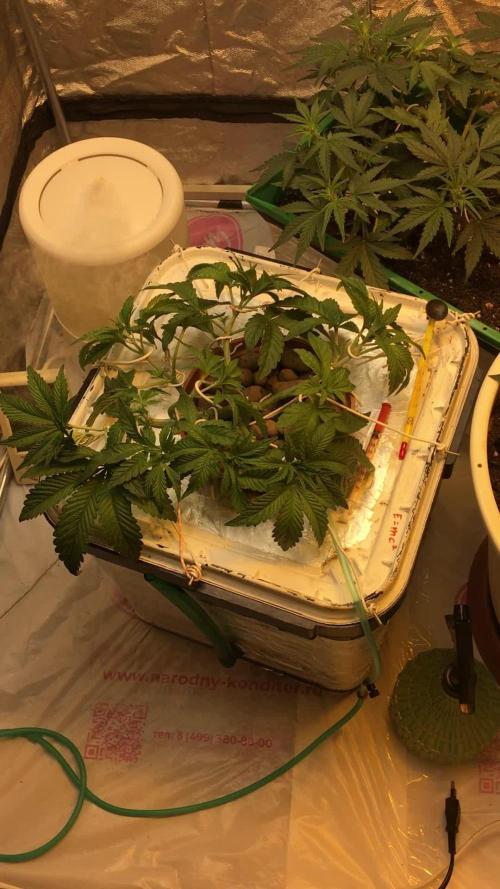

@Black_Widow
Follow
Привет садоводы !
Началась новая неделя
сегодня я заменил питательный раствор на новый и сделал его немного покрепче
все в пределах таблицы кормления
теперь он в значении 700 ppm
а PH также я держу в пределах 5,6
тот цветок ,что в земле после пересадки я пока не поливал
растения выглядят хорошо ,но растут немного медленно
а в общем вроде не плохо
😎
Likes
11
Share


@Lazuli
Follow
I think 12 liter airpot was too small, i opened the pot and was one rootball
Likes
56
Share


@Prilyfe13
Follow
March 29, 2024 Day 43
This week will focus on watering and light intensity. Training is done for the most part. At least the structures are on point. Now it's just a matter of keeping the canopy level. So far everything looks great! There's a couple branches on each plant that aren't quite as tall yet, but they are strong. I expect them to grow quickly very soon.
The plants are 14" tall now and will definitely be taller by the end. If I'm right, I should get a height of 24" to 36" total. Unless both stunt somehow, but I don't think so. Anyway, just by the health and current growth time and amount, I can expect some robust plants. The buds are going to be super heavy. Just by looking at the bud structure now, tells me I'm going to have to fat dense and sticky weedy do.
I changed the lighting as I was scheduled to do today. The light was at 22" from the plants growth. For the week, I reset the light height back to 24" and increased the light power back up to 90%. The DLI is 44 mol/m²/d. PAR should be around 675 ppfd. However, as I said at the beginning of the grow, I focus on DLI over everything else. PAR is fine, I just prefer the DLI. It tells me more I think.
As it's a new week, watering needed some maintenance. I cleaned out the other reservoir and filled it up with the new nutrient regimen. That includes the B-52 today and Sensizym next watering for when it gets here. I had to look up a good feeding schedule specifically for autoflowers and advanced nutrients. As the time is all wrong with BudLabs. It's designed for Photoperiods only. So things needed to be adjusted. For example, I'll be starting Big Bud later this week as it calls for week 2 of flower with a photoperiod. But the schedule I found makes more sense and calls for the Big Bud a week earlier. Anyway, it's a good schedule. Just makes sense.
The environment will be staying the same this week. 77° and 55%. In the next 2 weeks, I'll drop the temp down to 75° with the humidity at 50%. Then I'll drop it weekly until I get to the final week. I'll drop the temp down to 73° and the humidity down to 40%. 35% if I can manage. However, I'm not all that worried about 40% to 45%. The space is extremely clean and the room itself is really dry. So no worries.
So, now that the auxiliary branches are just as tall as the side branches, Banana Purple Punch B has an extremely level canopy. The branches have all caught up to the top and everything is looking great! Banana Purple Punch A is doing the exact same thing. They are both the same height. I wonder if that is the plants keeping up with each other. Like a reaction to the other plants in the tent? Who knows. This is my first completely level canopy for all 4 plants. Very happy so far. As long as none of them take off, we should see a beautiful ocean of fat buds throughout the whole tent.
Grow System Environment:
Temp: 76.0°
RH: 53.8%
VPD: 1.38 kPa
March 30, 2024
Some notable information today. I'm very curious about this, so if anyone knows what's up, leave me a comment. Thanks!
Banana Purple Punch A is taking in way more water than Banana Purple Punch B. I believe now it has to do with the roots. The bottom of the container for Banana Purple Punch A is FILLED with roots, while Banana Purple Punch B doesn't have any roots showing yet except for the bottom outside of the container. I thought the roots would have shown up by now.
The thing is though, Banana Purple Punch A is still roughly the same height as the rest of the plants in the tent, but clearly is further along than the rest. Not saying she isn't growing, she is. It's just that she should be stretching like crazy right now and she isn't. The canopy is staying level. I will say that the Tropicana Cookies sharing the tent is slight taller and stretchier. It's ok though, the SCroG net is going up at 18" from the container base.
Anyway, it's kind of confusing how these two plants are growing in such a different way, but not any bigger or smaller than the other. Insight please. Lol.
Both ladies got a haircut today. Just clearing out the massive leaves that grew and some of the outside leaves to keep them in their own quadrant. It worked wonders. No stress, no issues so far that I can see.
I also had to lift the light a couple inches today. The DLI was actually a bit higher than I wanted and it showed last night with one of the plants. A bit droopy before lights out. That tells me there's too much light in that one quadrant. So the light went up to 25" from the canopy. I could drop the power level, but I really like this footprint. Dead center of the tent is around 48 mol/m²/d while the outside is at 43 mol/m²/d. What a spread. Honestly though, I really want a bar style light setup. One for a 4x4 so it fills the whole 3x3 tent.
Back to watering. Banana Purple Punch A got a full gallon today. She's drinking a half gallon a day now. I also realized the nutrient schedule I'm using doesn't have the Tasty Terpenes in it. So I started that today as well as the big bud. I also increased the Cal/Mag dose from 4 ml to 8 ml. Big Bud and Tasty Terpenes are both at 4 ml/gal. I also added this week's dose of Recharge. HOWEVER... The PH was Way off. Down to 5.4, so I dosed the shit out of it with PH Up. I got to 6.18 and that's where I stopped. The nutrients are supposed to be PH Perfect, but adding something slammed it down. So I'll start to PH before adding nutrients. Then I hopefully won't have to dump 3 ml of PH Up in a gallon of water. However, I will say the PH in our tap water is ridiculously high at like 8.2, so that may be a factor. But shouldn't the high PH balance out the PH with nutrients? No real clue what happened. It doesn't make sense. It definitely has to be one of the new nutrients. When I do another mix, I'll PH after each nutrient. That way I can see which nutrient is messing up my perfection. I've also read that a PH of 6.5 to 7 is ideal for the flowering stage. Is this correct? If so, how the hell do I get the PH to increase more? Or is my PH meter out of calibration? Damn, things I need to learn. Moving on.
The environment is a bit off. The temp is kinda high at 79.5°. However, the humidity is perfect at 55%. Unfortunately the temp is throwing the VPD way off. It's now 1.50 kPa where it should be around 1.33 kPa. I'm trying to fix it, but it takes time. It should be fine by this afternoon.
Grow System Environment:
Temp: 75.9°
RH: 54.5%
VPD: 1.35 kPa
March 31, 2024
Not much to do today. The plants are doing their thing. Banana Purple Punch A drank about a half gallon from yesterday's reservoir top off. She'll definitely need to be watered tomorrow though. In which case I'll be adding the Sensizym. However, Banana Purple Punch B needs a reservoir refill today. Not first thing, but maybe just after noon. The reservoir is nearly empty, not enough to fill, but enough to be completely dry tomorrow. That can't happen with this system, so I'll have to refill today.
I'd also like to note the lack of roots on Banana Purple Punch B. There are none. I'm really confused now. One would think the roots would be through by now. I hope they didn't just stop there. Hopefully I start seeing them in the next couple days.
Banana Purple Punch A has roots through everywhere.
Honestly, it seems as though growing in my setup with my techniques extends the veg time. That's the only thing I can think of. The lack of roots shows lack of growth. But it's an Indica dominant phenotype. Maybe the root system just takes longer. But she's definitely in flower. Still waiting for the stretch to start, by the way.
They are both 14.5" now with yesterday being 14". That's not stretching. I seriously cannot have small and big plants together in this size tent. Maybe if it were a 4x4, it would be fine, but a 3x3 is much smaller... Weirdly enough.... and for 4 plants, there just isn't that type of space. I'll will absolutely implement the SCroG net if things get out of control. I'd rather not use it yet though. I still want to be able to pull them out and clean out the reservoirs and check over each plant thoroughly. At least until I need the net. But really only to keep the tops from falling over. But training has stopped for these ladies. I don't have anymore horizontal space to train them out. But I have plenty of vertical space. Maybe they will only grow to 24" after all. We shall see. Either way, I'm going for quality, so regardless of the size, everything is in order. Maybe they average on the smaller side.
Still, they have really packed buds already popping up. They will definitely be super dense.
I didn't move the light today. No point. The plants are very happy and reaching slightly. Just a nice little prayer.
The environment is really good. Sticking at 55% humidity and the temp has been steady between 76° and 79°. Very nice. The VPD is happy as well.
Grow System Environment:
Temp: 77.4°
RH: 54.6%
VPD: 1.43 kPa
April 1, 2024
Not much to do today. Banana Purple Punch A got her full gallon top off. I also got the Sensizym in so that went in as well.
Also, I need to calibrate my PH meter. It seems to be reading low. Maybe. It's reading 5.4 with PH Perfect Nutrients. I also added a full 1 ml of PH up. It brought it up to 5.49. No idea what's happening.
Both plants grew a couple inches last night. Now they are at 16" tall. Let the stretch begin!
Banana Purple Punch B is just hanging out. Still not drinking as much as her sister plant, but still very healthy and happy. The roots aren't showing either. Still confused by that.
I had to cut a couple leaves off each plant today. Just a bit of overcrowding. Like 2 leaves each. Not much, obviously, but it's still important to notate. And good to keep up with the leaf coverage.
I raised the light nearly 2" today. It was too close, and the DLI was close to 50 mol/m²/d with the center being 58 mol/m²/d.
Now the DLI is sitting pretty at 45 mol/m²/d with the inside being closer to 50 mol/m²/d. However, I have an advantage. The center of the tent is not filled in totally. I did this on purpose to keep the light intensity fairly even throughout the canopy. (I really need to get a bar style light.)
The environment is pretty good today. It's a smidge off. The temp is cooler at 75° with the humidity being closer to 58%. So the VPD is slightly off at 1.20 kPa. It should adjust accordingly in the next few hours as it has been. However, the daily average is right on point.
Grow System Environment:
Temp: 75.4°
RH: 55.2%
VPD: 1.31 kPa
April 2, 2024
A bit to do today. No watering or anything, but I did some defoliation and raised the light an inch.
Banana Purple Punch A got a bit more trimmed off than I had originally intended, but I wasn't off by the mark completely. So it should be all good. She also grew another 2 or so inches and is now a bit taller than her sister plant at 19". Not much, but enough for me to notice. She looks great! Roots galore, beautiful green color. Fat buds and a wonderful aroma. She is 19" and still stretching. Let's see what she turns out to be.
Banana Purple Punch B also got a haircut. She definitely needed it. In 2 days, she completely filled back out and needed to be opened up a bit. As I said before, I have stopped training, so if she doesn't catch up, which she may, I'll have to lift her up to the canopy. She's 18" now. An inch or so shorter than Banana Purple Punch A. However, she finally has roots showing throughout the bottom of the container. Nothing crazy, but lots of them popping up. It should be a matter of a couple days and those roots should be pretty long and sucking in water like crazy. Maybe not as much as her sister plant, but much more than she is now. Also, I think she may end up being a much more robust plant than her Banana Purple Punch A. The roots took longer to hit bottom and that may mean the root ball is already massive. That being said, I can hopefully expect her to take off and catch up to the rest of the occupants in the tent. Like she's setting up to stretch.
The light definitely needed to be raised again. It was all the way down to 22". I may raise it again if I don't see praying. Anyway, I dropped the DLI back down to roughly 45 mol/m²/d. It should be good now. But may be a tiny bit too high. I'll see what happens in the next couple hours.
The environment is pretty good today with the temp hovering around 76° and the humidity at 55%. The average for the day looks great as well.
Grow System Environment:
Temp: 74.2°
RH: 58.2%
VPD: 1.18 kPa
April 3, 2024
Today has been enlightening. The plants weren't reaching this morning. That meant the light was too close. So I lifted it up AGAIN. I'm running out of space between the light and the exhaust fan. I still have a good 6" or so left. I can also lower the power level if need be.
Both ladies got reservoir refills today. Banana Purple Punch A was still a out half full, but Banana Purple Punch B was empty. So now that they are the same level and seem to be drinking roughly the same amount now, they should drink evenly now.
Banana Purple Punch A is about 21" with Banana Purple Punch B slightly behind at 20". Either way, they are growing quite nicely. The stretch is in full swing now. I may have to put the SCroG up afterall. Some of the tops in the canopy are starting to take off. I'll install it tomorrow when my side bar support gets here.
The lighting, as I said, needed to be raised up again. The DLI was up to 50 mol/m²/d and now I have it back down to 45 mol/m²/d. I also have the light distance just above to 24". Should be good for now.
The environment is a bit off today. It's raining and the humidity is a bit high even with the dehumidifier on. The humidity is stuck around 59% with the temp staying around 75°. Hopefully it adjusts in the next couple hours. I may have to turn my main dehumidifier on. It doesn't work the best, but it should be fine.
Grow System Environment:
Temp: 75.6°
RH: 56.2%
VPD: 1.29 kPa
April 4, 2024
Not a lot going on today. I got my side bars in and mounted the SCroG net. Some of the tops are noticably taller than the others, so they needed to be taken care of.
No watering today. The reservoirs still have water in them. They might not need water tomorrow. I'll see how things go.
I didn't move the light today as I am pushing the tops down some. I may have to turn the power down a bit if they stretch as tall as I hope, but that would be a good thing. I'll just make sure to use the supplemental lighting I have for the tent.
The environment is actually pretty good today. The temp is 76° and the humidity is at 55%. The VPD is basically perfect at 1.33 kPa. So everything looks pretty good from here. I'll start dropping the humidity down more in a week or so. Just after the stretch.
Grow System Environment:
Temp: 75.5°
RH: 54.8%
VPD: 1.33 kPa