


Likes
Comments
Share


@MG2009
Follow
04/23/2022
I think lemon OG is done
Give her a few days more, Biscotti Skunk, grape skunk about 2 -3 weeks out, the Biscotti Skunk has very strong camphor mothballs smell. Not quite sure what to think of her hope buds fill out well. Grape Skunk is doing a bit better but lemon og has performed best in my specific micro climate, others have more flowering to.
If I'm going 63 days in flower it might as well be a Sativa variety.

Likes
37
Share


@The_Projexx
Follow
We did really well this round with this strain even though she grew very different from what Im used too. We ended up with a half pound of some excellent smelling and tasting cannabis!


Likes
Comments
Share


@Lushgaia
Follow
Plain water as usual, did top some of them with bat guano only the ones I think need it the rest looks ok

Processing
Likes
10
Share


@Trying4Trees
Follow
Week 1 - Day 1
20L Super Air Pots with a bottom layer of clay pebbles, (an inch deep at the centre point) and topped off with Growdog’s 70/30 coco perlite mix.
The tops of the pots are covered by green plastic water distributers to evenly spread the water from the 12” watering rings.
2 lights; each 300W actual draw, currently inside the tent. 2 more coming next week to make a total of 4, across the 6 plants achieving a true watt draw of 1200W.
Aiming for 1g/watt
Germinated seeds from FAST BUDS, were planted and hand watered using tap water pH’d to high 5.8 to low 5.9 with H&G Roots Excl. giving a nice PPM of 362 to start.
The BudBox tent is a 2x2x2m, using a Medusa Boosted XL run off trays to a waste brain were the run off can be tested. This will then be recirculated into the feeding tank again. The feed tank will a standard 100L water butt, retro fitting pumps inside for Feeding and Pump to waste - for cleaning the tank out each week. Another 100L water butt will contain a store of filtered RO water which will fill the feeding tank.
A 10L PureMate humidifier is set at 65%, along with 2x RAM 16” oscillating wall fans which are mounted to the top of the tent for maximum coverage - set to lvl1 on swing giving the 25°C. No extraction yet. This is ready and waiting. 8” HyperFresh fan with a RHINO 8”x600 pro filter. We are using 8” acoustic ducting.✌️🏻
Week 1 - Day 2
No change. Keeping the new environment stable is difficult. The humidifier is not large enough for the space.
Week 1 - Day 3
Fed PH RO water this morning. Trying to keep the humidity up inside the tent.
They have popped up! It begins :D
Did a feed of 5.8PH RO with CocaA&B 0.4ml/l, Roots excl 0.3ml/l, Calmag 0.2ml/l for a 150PPM. 300ml was used to moisten the coco per pot.
Extraction fully connected. Environment stable at 23-24°C, trying to stay at 23.3°C. Humidity fluctuating 47-60%, humidifier struggling, but hopefully be okay.
Week 1 - Day 4
All 6 are up and reaching. Husks hopefully will pop off soon. Will be doing another small feed this evening to keep the coco moist.
Little leaves have appeared!! Fed another 300ml, 5.8PH @ 151PPM/ plant.
Week 1 - Day 5
All shooting up now, tallest at 5cm down to 3.5cm 🌱
I gently helped the last 2 husks off the smallest ones to hopefully even them up. Gave the coco 1L of RO water around the edges.
Week 1 - Day 6
Nothing to report this morning. Another PPM feed to be done shortly.
Soaked the coco until run off with around 3-4L per pot using 5.8PH nuit water; 0.4 Canna A&B, 0.2 Calmag, 0.3 Roots Excl. 152PPM.
First time we tested the Medusa brain - works well and pumps away to the feed tank, need to change one of the low trays to be a boosted tray for better drainage. Giving 5 boosted trays and one normal. Hand feeding up until this point, but will connect up the automation in the next week.
Week 1 - Day 7
Strongest are growing around 1cm a day now. Tallest 6cm, smallest at 4cm. Looking forward to next weeks progress :)
Bought a wet&dry vac - best thing ever!! Haha. Cleans everything in sight plus all the water from the dirty run off.
Lifted all the pots, still a good weight to them so no feed or RO water today I think. Bring on week 2! 💪🏻

Likes
1
Share

@kdifiori_
Follow
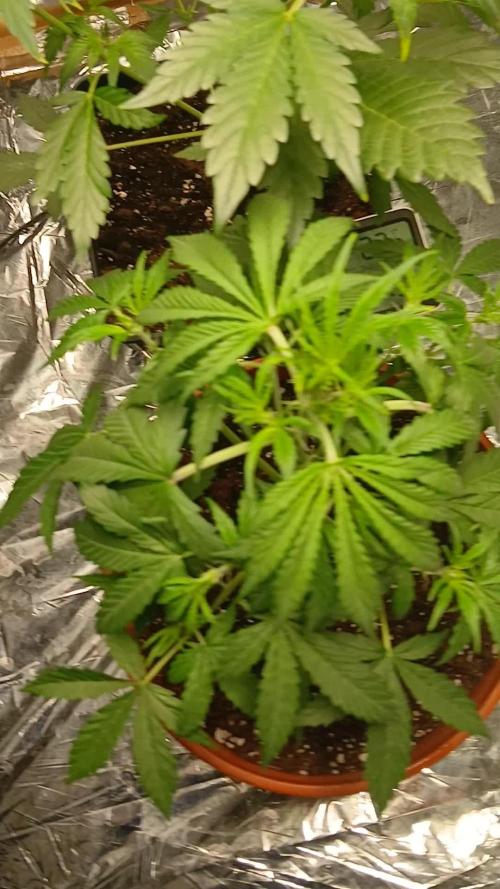
Week five! This plant continues to grow despite having some nutrient issues. When the first yellow tips appeared, I thought I had overdone it with the nutrients, but they kept coming back even though I halved the dose. At the beginning of the week, I gave her 0.5 L with half the nutrients and during the week another 2 L of water only, hoping she would recover. Studying the problem, I discovered that it could be more of a K block. Either something is preventing proper absorption, or she is simply not getting enough. During the sixth week, I will try adding 0.25 ml/L of Atami B'Cuzz Blossom Builder to the nutrient chart to boost N and K and see if anything changes. Despite everything, this week she reached 63 cm and is still growing upwards towards the light. The lamp was dimmed to 75% all week and then brought up to 100% on the last day, still at 30 cm. I hope to be able to recover from this minor setback and get the best out of this girl. Week six is coming, are you ready? I can't wait!
Likes
3
Share


@Unculti_responsable
Follow
Esta semana la dejamos más tranquila a la Jack solo le hicimos un trasplante a 5 litros quedo bien , la dejamos recuperar unos días y después le hacemos las últimas podas y ya va a estar lista para florecer


Likes
Comments
Share

@SolitudeCorners
Follow
📓 Cultivation Diary: The 12/12 Flip & Transition Week
📅 June 5, 2026 (Veg Day 17)
Irrigation/Reservoir: Prepared a full 100L reservoir refresh.
Nutrients: Kept the feeding aggressive with a double dose of vegetative nutrition (x2 Nutrient formula) to ensure the root zones and plant tissues are fully stocked with elements before the transition.
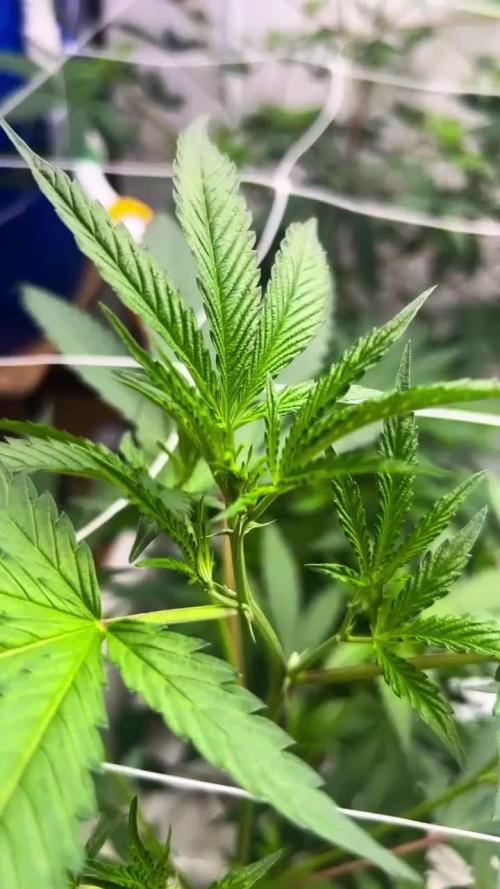
Canopy Observation:the canopy is thick, uniform, and fully occupying the table space. The trellis net is officially filled out, and the lower branches are strong and rigid.
📅 June 6, 2026 (Day 1 of Flower / Bloom Week 1)
The Flip: Officially switched the timers to a 12/12 photoperiod (Lights ON at 6:00 PM / Lights OFF at 6:00 AM).
Schedule: First irrigation shot triggers exactly 1 hour after lights on (7:00 PM), followed by a shot every 1.5 hours.
Volume: Configured the drip stakes to run for 1 minute per shot, delivering 5 shots total per day. This provides roughly 450ml per plant per day, creating excellent target dry-backs overnight to force vigorous root searching.
📅 June 11, 2026 (Day 6 of Flower / Bloom Week 1)
Irrigation/Reservoir: Bumped reservoir capacity up to 110–120L to keep up with increased transpiration as the plants begin their post-flip stretch.
Nutrient Recipe (TargetingpH 6.0 EC 2.5
Water: 110–120L
Athena Cleanse: 120ml
Silica: 220ml (Essential for stem strength during the stretch)
CalMag: 10ml
Athena Bloom: 600ml (Adjusting base to target 1.2–1.3 EC from Bloom component)
Athena Core: 400ml
Irrigation Adjustments: Increased the shot duration slightly to 1 minute and 15 seconds to match the accelerating growth pace.
The early flowering stretch has officially begun. The tops are noticeably pushing past the trellis net layers, and the node spacing remains tight and stacked. Leaf color is an excellent dark green with healthy, bright yellow-green shoots driving upward at the growth tips. No signs of stress or stalling from the schedule shift.

Likes
3
Share


Likes
6
Share


@MadeInGermany
Follow
Flowering day 42
since time change
to 12/12 h .
Hey guys :-)
A lot happened this week :-).
The buds develop really nicely .
The scent wafts through the whole room when I open the tent 💚.
This week was poured 3 times with 1 l each (nutrients see table above) This week there was the maximum amount of fertilizer, which will be slowly reduced from next week :-) .
Have fun with the update and stay healthy 🙏🏻
👇🏼👇🏼👇🏼👇🏼👇🏼👇🏼👇🏼👇🏼👇🏼👇🏼👇🏼👇🏼
You can buy this Nutrients at :
https://greenbuzzliquids.com/en/shop/
With the discount code: Made_in_Germany you get a discount of 15% on all products from an order value of 100 euros.
👇🏼👇🏼👇🏼👇🏼👇🏼👇🏼👇🏼👇🏼👇🏼👇🏼👇🏼👇🏼
You can buy this strain at :
Clearwater Seeds
Water 💧 💧💧
Osmosis water mixed with normal water (24 hours stale that the chlorine evaporates) to 0.2 EC. Add Cal / Mag to 0.4 Ec Ph with Organic Ph - to 5.8 - 6.5
MadeInGermany

Likes
19
Share


@adam_pawloski87
Follow
Let’s Go Day 67 from seed !! So this week went real great! 2 Ogreberrys an Bruce Banner started getting flushed! The rest will follow up and start flush next week ! Today the 3 will continue getting flushed while the 3 others get there dose of nutrients, PHd at 6.5! Let’s grow lil ladies let’s grow!!! You all have an amazing productive day as well as a a great safe week !! Peace love and positive vibes to y’all Cheers 😶🌫️💨💨💨💨🤙🏻If there’s any questions please ask, I’ll be opened up to answer at best of my knowledge! Thank you all have a dank day !!

Processing
Likes
9
Share


@Kushizlez
Follow
Zkittlez
Yield: 39.4
Smell: 7/10 - sweet, candy, berry, gassy, piney hints
Bag appeal: 6.5/10 - slightly leafy/stemy
Crystal coverage: 7.5/10 - very impressed
Ash: 8/10 - thick, uniform white ashes
Fire holding: 8/10 - stays lit for seconds
Smoke: 7.5/10 - taste is decent, needs curing
High: 7/10 - indica dom
Comment: looks nice, smells nice, tastes nice, burns great but smalls didn’t fill out.
51.5/70 = 73% 👍🔥

Likes
1
Share


@secretcedar
Follow
Growdiarie of 2021:
2nd week of flowering for the 3 dinafem cheese plants and a half-automatic seed (sort of early flowering, start flowering at mid august).
The auto one is a little hermaphrodite an pollinated the other plants a little, especially the closest one.
The seeds resulting have very different phenos.


Processing
Likes
8
Share


@eldruida_lamota
Follow
Que hay fumetillas, terminamos el primer mes de floración, pensé que serían algo más rápidas pero bueno, tengo tiempo, aun así hay que ver hasta el final que es lo que sucede.
Controlamos ph humedad por debajo de 45% temperatura media de 24.5 grados, aumentó una vez por semana la cantidad de ml por producto, último cultivo con advancednutrients, los próximos proyectos los trabajaré con AgroBeta.
Buenos humos fumetillas 💨💨💨

Likes
4
Share


@Finsfan
Follow
I did a heavy defoliation with the green crack for the first time.. the first 3 pics are pre- and the last 3 pics are post-defoliation.
Definitely better air flow now as well as more "tops" being seen.
Tomorrow going to do the durban.. update w more pics then.

Processing
Likes
12
Share


@Fleetwood
Follow
Day 1: Auto flowers are getting some nice crystal. Purple Kush smells nice, Pink Kush smells like wet veg. The root mass on Purple Kush is huge! The photos were defoliated, and finally both showing flowers. pH is 6
Day 3:. Finally got to LST Red Purps, she really needed it. I pulled some of the Purple Maroc branches and tried defoliating, but it's thick in there. The previous LST still has a lot of branches bent, but a lot of new growth has popped up. I wonder if it's because I broke the main collar last week. I have to find more weights to tie down the last few branches.
Day 7: Purple Kush wreaks of grape bubble gum. Pink Kush wreaks of gas.


Likes
52
Share

@Growingdaddyo
Follow
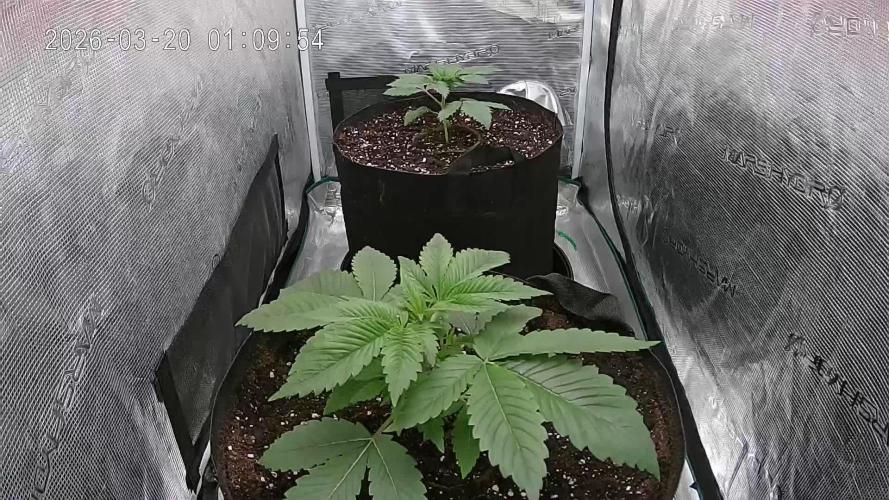
Die dritte Woche ist gestartet. Wächst bisher wie sie soll und das ziemlich flott. Darf gerne so weitergehen..
Habe die Lichtintensität etwas herunter geregelt, die Blätter kräuseln sich etwas.
18.03. Entwickelt sich und wächst sehr schön. Denke am Ende der Woche wird umgetopft.
Und auch hier bleibe ich bei 30 Liter Stofftöpfen. Als Drainageschicht kommen Plagron Pebbles zum Einsatz, ca. 3cm. Darüber ein Mix aus Plagron light mix, Plagron Batmix und zusätzlich etwa 10% Perlite.
Als Dünger nehme ich den Greenhouse biogrow. Davon 3 g pro Liter Substrat, also 90 g. Wird direkt mit der Erdmische gut vermischt.
Das neue zu Hause wartet bereits auf die Damen..
19.03. Umzug ins größere Zelt und Pott. Leider sind mir dabei ein paar Wurzeln abgerissen, hoffe der Schaden hält sich in Grenzen..
Habe zur leichteren Handhabung Drehteller unter die Untersetzer getan😅 isoliert zusätzlich vom kalten Kellerboden.
21.03. Habe mich entschieden an Tag 21 zu toppen und zwar oberhalb der 2. Nodie. Direkt das Training gestartet.
Jetzt darf sie sich erstmal davon erholen..