




Likes
8
Share


@Brujha77
Follow
Start Woche 4.
Der Strech scheint langsam fertig zu sein.
Werden halt 2 kleine Damen, aber bin froh wies grade ausschaut nach dem Stress..... 😌
Hoffe einfach es bleibt wies ist. Im Moment sehen die 2 gut aus, wobei die rechte etwas verbrannte Spitzen hat. Aber der Dünger bleibt nu wie er is😉
Tag81
Die Damen machen sich ganz gut.

Likes
2
Share


@eldruida_lamota
Follow
Vamos familia tercera semana floración de estás Pink Runtz de RoyalQueenSeeds.
Que ganas tengo de ver el progreso de esta variedad, las plantas están marcando una deficiencia que estoy ya solucionándola aplicando los nutrientes necesarios, y estos días espero que recuperen el color.
La cantidad de agua cada 48h entre riegos.
Esta semana ya añadimos nutrientes de floracion estas próximas semanas veremos cómo avanzan.
Agrobeta:
https://www.agrobeta.com/agrobetatiendaonline/36-abonos-canamo
Hasta aquí todo, Buenos humos 💨💨💨

Likes
10
Share


@taisoncreamcaramel
Follow
Die kleinere Pflanze ist in der Blüte etwas weiter und wird gespült . Trichome etwas milchig . Die größere Pflanze bekommt noch etwas Dünger ... Die Ernte naht😇
Tag 70 : Ab heute wird auch die größere Pflanze gespült (nur Wasser) ....

Likes
6
Share


@CanarianGrow92
Follow
Last week of veg, i think these girls will start to flower the next couple of days! At the moment great results under this TS1000 as always! We gave a very light nutrients this week just to jave some nitrogen as im using a light mix as soil, lets see how it goes the next weeks 😁💪
1 of the 6 cherry colas showed some strange leaves not sure if its genetics or what happened with that plant but lets see if she continues to flower normally now or not

Likes
8
Share


@jaydee702
Follow
She is small Due to the restricted Root Space in the tiny pot but She Is A Sticky
Girl that looks like a Stripper with all the Glitter that formed on her in the last week of flowering she could go a few more days but then i wouldt have harvest
on my contest diary

Likes
10
Share


@StarletBud21
Follow
The week has been going very well plants are reacting good to nutrients and seem to be happily growing , haven’t fiddled around too much this week as starting to get the hang of things slowly ! The grow so far has been quite smooth And haven’t run into any Major problems all plants have been topped and will continue lst throughout I believe they look quite healthy haha ?
First timers luck 😉🤨 we hope so
Good end to the week next week I shall trim and see how that goes
Happy growing 💎


Likes
10
Share


@agricola
Follow
My good friend convinced me that trimming and training are paramount, so I've started with slowly defoliating the Creme de la Chems to try and get to lollipop status. They're just starting to flower, so I figured I could get away with a more aggressive approach. Because I failed to train these girls early, I'm stuck dealing with a little rain forest. What I've tried to do is trace each flower topped stalk up from the base, and trim away from the bottom up. 1/3 of the way up per day. I've now got a thick canopy, and I've been trying to just use leaf tucking and manual manipulation every few hours in order to keep the different height flowering sites in direct light. These ladies have really been thriving, and it's been such a joy to watch them grow! I like having two plants in one net pot letting them grow wild, but I think in my next grow I'll keep it to one per pot and train better from the start.
As for the Super Orange Haze ... not as good. I attempted to pull the main branch over to train her to some empty space, but I was too aggressive and ended up popping her head off :(. First grow, first disaster. I took the head and stripped her/coated in clonex and pushed her into some potting soil just to see what would happen. There hasn't been enough foliage to really make me want to do any trimming, I've just tried to tie the stalks off to train them apart. I'm really sad about my mistake decapitation, but she seems to be doing well still. She's probably week 2 of flower based on others' journals.
I changed the water midway through the week (which is when the videos were taken). I drained most of the water out, but roots prevented me from getting the last few gallons. When I refilled the res with RO, I measured the PPM at around 200. I have to assume that remaining nutrient was completely unbalanced leftovers, so feeding will have to just have to be experimental. My approach has been to give around 1:1 Gro vs Bloom and Micro every 2-3 days when I refill with RO. I want to build my PPM up to 1000, but slowly so that I can detect if I hit a ceiling first. It's hard to measure how much food is in the water based on PPM. CalMag is what drives it mostly, so I've been using CalMag as a sort of measuring stick. I keep the CalMag pegged to the Bloom food, but I know it's only good for initial dosing. I can't assume the plants are eating CalMag in the same proportion as anything else :(. If anyone has a line on cheap lab testing ... hit me up. I'd love to be able to test a few hundred samples at a time for NPK and trace so that I can tell (even if post facto) what was going on.

Processing
Likes
19
Share


@CannabisAprendiz
Follow
Esta es una genética de un olor muy fuerte y pesado se siente intenso desde la vegetación , es una variedad muy resinosa con unos colores morados hermosos , probando las flores cuando terminó el secado y ahora curando las flores se siente un sabor terroso , al principio no me gusto ya que nunca había probado este , pero después al seguir fumando se siente un sabor final muy agradable.
Esta genética se conservará para futuros cruces y experimentar algo nuevo.
muy conforme con la producción de cada clon

Likes
29
Share


@MadeInGermany
Follow
Info:
Unfortunately, I had to find out that my account is used for fake pages in social media.
I am only active here on growdiaries.
I am not on facebook instagram twitter etc All accounts except this one are fake.
Flowering day 29
since time change
to 12/12 h.
Hey guys :-)
Once again a nice week has passed in which the lady has developed super :-).
The buds start to grow and are now getting more pk.
This week it was poured 3 times with 1.2 l each (nutrients see table above).
Fresh osmosis water was filled in canisters for the next 2 weeks.
Everything was cleaned and the plant was checked for health :-).
I wish you a lot of fun with the update and stay healthy 👍
You can buy this Nutrients at :
https://greenbuzzliquids.com/en/shop/
With the discount code: Made_in_Germany you get a discount of 15% on all products from an order value of 100 euros.
You can buy this Strain at :
https://www.amsterdamgenetics.com/product/kosher-tangie-kush/
Type:
Kosher Tangie Kush
☝️🏼
Genetics:
Kosher Kush
X
Tangie
👍
Vega lamp:
2 x Todogrow Led
Quantum Board 100 W
💡
Bloom Lamp :
2 x Todogrow Led
Cxb 3590 COB 3500 K 205W
💡💡☝️🏼
Soil :
Canna Coco Professional +
Nutrients :
Green Buzz Liquids :
Organic Grow Liquid
Organic Bloom Liquid
Organic more PK
More Roots
Fast Buds
Humic Acid Plus
Growzyme Big Fruits
Clean Fruits
Cal / Mag
Organic Ph - Pulver
☝️🏼🌱
Water: Osmosis water mixed with normal water (24 hours stale that the chlorine evaporates) to 0.2 EC. Add Cal / Mag to 0.4 Ec Ph with Organic Ph - to 5.8

Likes
27
Share


@Bluemels
Follow
Ich habe die Royal Highness länger in der Wachstumsphase gelassenwie gedacht.
Aber die Pflanzen sind recht empfindlich und erholen sich nur langsam von diversen Eingriffen.
In 3 Tagen werden ich die 3 aber endlich in Blüte schicken, ich hoffe sie bilden im Laufe der Zeit nicht mehr soviel Verzweigungen aus.
Meine Growbox ist nun halbwegs ausgefüllt mit Trieben.
Likes
6
Share


@masterofsmeagol
Follow
5/25 Some pics may be repeated because I forgot to add a new week. Waited until about 11 to bring the girls outside. They were definately dry on top so I used the rest of the gallon to water them. When going outside I noticed a specific kush plant that's lighter than the rest. I really need to up my water volume on these big plants. They are also getting close to not liking it in the 1 gal. and are ready for a transplant. I cleaned the cage so as soon as the weather permits these girls will be outside in the direct sunlight. Basking in the sun in the cage to finish hardening before going into their final homes which will be 20-30 gal smart pots and a 50 gal grow pot. Well SOME of them are ready for transplant. The link kush seems to take its time but it looks extremely indica-E. Weather looks like it will be amazing this week so I'm obviously stoked. Wouldn't suprise me if these girls were outdoors be the end of the week!
EDIT: THE GIRLS STAYED OUT FOR 3.5 HOURS AND LOOKED FANTASTIC. TUEY GOT SOME INTENSE SUN, EXPOSIRE TO THE HIGH RH AND A LITTLE EXPISURE TO THE HIGH WINDS. SPECIAL KUSH SEEMS TO BE THRIVING. I THINK IT WILL DO WELL IN THIS CLIMATE. THAT ONE MK ULTRA IS GROWING AT A RIDICULOUS RATE. I WATERED THE PIBK KUSH THAT WAS LIGHT. I CANT WAIT FOR THE UPCOMING WEATHER. I CAN EXPOSE THE PLANTS TO SOME DIRECT SUNLIGHT AND SEE HOW THEY HANDLE IT. I CAN ALSO GET THE GROW BAGS READY WITH SOIL MOXED AND THEM IN THE RIGHT LOCATION THE DAY BEFORE THE TRWNSPLANT TO FINAL HOME BUT IM GETTING AHEAD OF MYSELF. IM HAPPY THUS FAR. I also added another half hour of darkness so the plants will be closer to actual daylight times. They're down to 16.5. I'd like to have them lower by now but it is what it is. If some reveg I'll deal with it.
5/26 Plants seem to grow an inch I'm a day. MOST are getting to the point where they want to stretch their feet out. Good thing they'll be going in their final homes as soon as they are hardened off completely. I brought them out around 8 this morning. I have to be back at noon but I'm uncertain if leaving them out that long is a good idea. I'll probably have to check them in an hour or so. They're in the lean-to but THAT gets direct sun until the sun rises high enough in the sky to block it. I put them in here rather than the cage so they can build a tolerance to these harsh winds. Topsoil was dry as fuck. I watered everything. I focused on those that SEEMED the lightest and the largest plants. That MK Ultra plant I fimmed is going to be MASSIVE. I'll update what I do as I do it. Oh I also cleaned the bags twice and they are hanging inside the cage with the direct uv rays hitting any part that's discolored. I MIGHT do one more cleaning but I doubt it. Twice is enough. Technically three times but still. I want things to go right. It looks like I've got some pretty good phenos.
EDIT: I PULLED IN (BLOCKING VIEW FROM PART OF THE DRIVEWAY OFF) BECAUSE THAT WAS CLOSER TO MY PLANTS. I GET OUT AND START ADMIRING MY PLANTS AND LOOK ACROSS THE STREET TO SEE TWO STATE TROOPERS AND SOME DETECTIVE ACROSS THE STREET. DAD SAID AN AMBULANCE CAME BUT LEFT WITH NO LIGHTS ON. THEY WERE TALKIMG TO THE COUPLE SEPERATELY. I ATE LUNCH AND THEY WERE STILL THERE. MY HOT WIFE WENT OUT AND THE ALL STARTED FUCKING RUBBER NECKING. MEANWHILE I BROUGHT THE PLANTS INSIDE WITH THE SMALL COVER MY S.U.V PROVIDES LOL. PLANTS WERE LEFT IN DIRECT LIGHT UNTIL IT ROSE HIGH ENOUGH TO CUT IT OFF TO THE LEAN TO. PLANTS SEEM LIGHT. WELL SOME DO. I NEED TO GET A GOOD WATERING SCHEDULE DOWN. JUDGING BY HOW THESE PLANTS TOOK IT TODAY I THINK THEYLL BE OUTSIDE IN FOREVER HOMES WITHIN A WEEK.
5/27 Just poked my head in and checked on them real quick. NO damage whatsoever from all that time in the sun. I left them inside this morning so I can bring them out later in the day to see what happens. I'll add pics later and update what I do.
EDIT: BROUGHT THE PLANTS OUT TO THE CAGE AT A LITTLE BEFORE 10AM AND LET THEM BASK IN THE 85° SUN. THE WIND WAS A LITTLE ROUGH ON THEM. IT WAS ACTUALLY THRASHING THEM BUT MY INTUITION SAID 'LEAVE THEM BE' SO I DID. I DID MORE CLEANING AND FIGURED OUT SPACING IN THE CAGE AND I MIXED A 30GAL GROW BAG AND 2 20GAL GROW BAGS WITH A 50/50 MIX OF FOX FARM OCEAN FOREST AND HAPPY FROG. SOUL WAS MIXED WITH A GRADE STAKE AFTER BEING PUT IN A GALLON AT A TIME (TO ENSURE EQUAL PARTS) AND FINALLY MISED BY HAND. TAKES A LOT OF WORK. IM NOT GOING TO BE AS PICKING WITH THE OTHER ONES. I STILL HAVE MY 50 WITH SOIL IN IT. MAINLY DUE TO LAZINESS AND THE PAIN IN THE ASS IT IS TO MOCE THE FUCKER. PLUS IF IM LOW ON SOIL (WHICH IM NOT) THAT WAS GOOD SOIL AND THE PLANT HAD NO PROBLEMS SO I GUESS IF NEEDED IT FOULD BE REUSED. I NORMALLY JUST EMPTY THAT FIRST AND MIX A SHIT TON OF SOIL IN THERE AND SHOVEL IT IN THE BAGS. THIS WAS MUCH HARDER. PLANTS GOT CLOSER TO 2 HOURS OF DIRECT SUNLIGHT BEFORE I MOVED THEM TO THE LEAN TO. I WILL UPDATE WHEN I HRING THEN IN BUT DESPITE THE HARSH SUN AND WIND THEY SEEM FINE.
EDIT: BROUGHT THE GIRLS IN AT TWO BECAUSE MY WIFE HAD AN APPOINTMENT. NO DAMAGE WHATSOEVER. I THINK IF I USE THIS WEEK TO INCREASE DAYLIGHT HOURS AND UP THE WATERING THESE PLANTS WILL BE READY TO GO IN THEIR HOMES. A FEW ARE BIG AND DEF READY TO STRETCH THEIR FEET.
5/28 With the increased sun some these plants are out growing their containers. PLANTS SPENT APPROX AN HOUR AND A HALF IN DIRECT 85° SUN. EVERYTHING SEEMED FINE AND I WAS GOING TO LEAVE THEM FOR THE DAY IN THE CAGE. THEN I NOTICED THE BIG MK ULTRA'S MAIN STEM (IT GOT FIMMED BUT THE MAIN ONE) WAS STARTING TO DROOP A LITTLE. I PICKED THE PIT UP AND DESPITE A LITTLE BIT OF MOUSTURE ON THE TOP THE PIY WAS LIGHT AS A FEATHER. PLUS SETTING ON THE THEM ON THE TAR WASN'T THE BEST IDEA EITHER. I MISED UP SOME WATER AND WATERED THE PLANTS THAT SEEMED LIGHT. I NEED TO PICK UP LIKE ONE MORE BAG OF OCEAN FOREST FOR MY 50 GAL. I'M GOING TO TRY TO FINISH MY OTHER TWO 20'S AND THE TWO 10'S TONIGHT SO I'LL KNOW WHAT IM LACKING. ITS BASICALLY JUST THE 50. IF MY INTUITION SAYS ITS OK ILL TALE THE "COOLER" DAY TOMORROW AND TRANSPLANT THE THREE PLANTS TGAT ARE GETTING TO BIG FOR THERE POT. ÌF NEEDED I MIGHT GET SOME SCREENS TO USE AS A "BLIND" SO THE PLANTS DONT GO STRAIGHT TO FULL SUN ALL DAY.
EDIT: TJAT HUGE MK ULTRA REVOVETED NOCELY ONCE WATERED AND PUT IN THE SHADE. IT NEEDS TO BE TRANSPLANTED. I MAY DO ITCTOMORROW. PLANTS HAVE GOT TO BE CLOSE TO HARDENED. I MIXED ALL MY SOIL AND FILLED ALL THE GROW BAGS WITH THE MIX. I FINISHED CLEANING THE CAGE AND REMOVED BAMBOO AND TRELLISING. TOMORROW IS GOING TO BE A MILD DAY AND PERFECT FOR TRANSPLANT. SOME OF THESE GIRLS ARE GETTING VERY BIG. I RAN OUT OF SOIL AFTER THE LAST 10GAL GROW BAG. ITS NOT FILLED "ALL" THE WAY AND I GAVENT FILLED MY 50 GAL. I'LL GET THE REST OF THE SOIL I NEED FOR THAT 50 TOMORROW.


Likes
6
Share
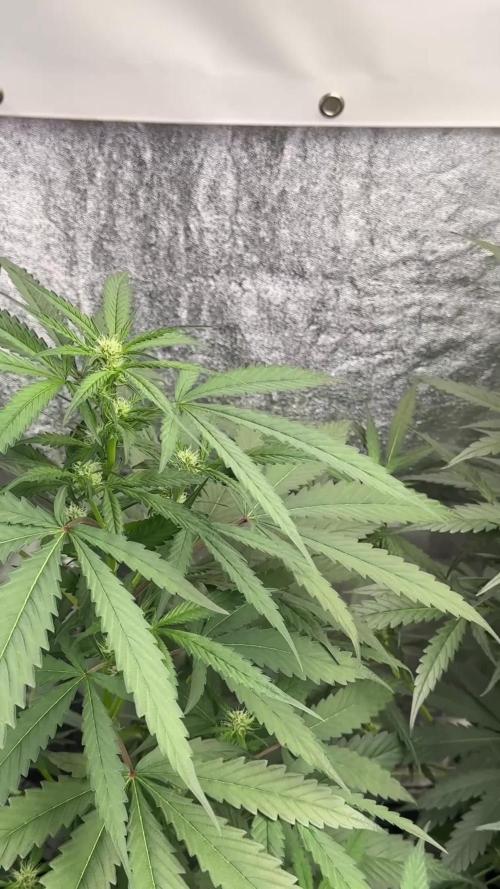

@DogDoctorOfficial
Follow
💚 Amnesia Haze Auto by Zamnesia – Pheno B
Week 6 | Quiet Confidence Begins to Bloom
Welcome back to another chapter of the 8×8 Adventure!
Growing multiple phenotypes side by side is one of my favourite parts of this project because every week nature reminds us that there is no such thing as a "correct" way for a plant to grow.
Pheno B has chosen a completely different rhythm from her sister.
While Pheno A stretches toward the ceiling with long internodes and a very expressive narrow-leaf structure, this lady prefers patience. She's shorter, more compact, and slightly behind in her overall flowering development, yet she's thriving under exactly the same conditions.
Same room.
Same lighting.
Same nutrients.
Same watering.
Same training.
The only thing that's different is the genetics expressing themselves in their own unique way.
And that's exactly why phenotype hunting is so fascinating.
🌱 The 12/12 From Seed Journey
For anyone joining this diary for the first time, welcome!
Every plant in this project has been grown under a 12 hours on / 12 hours off light schedule from the day the seeds germinated.
Rather than extending the vegetative stage, this method allows every phenotype to reveal its natural growth habits much earlier, making it easier to compare structure, stretch, flowering speed, and overall efficiency.
Watching sisters grow into completely different plants while sharing the exact same environment is one of the biggest rewards of this experiment.
Pheno B is proving that slower doesn't mean weaker—it simply means different.
🌿 A Compact Personality
Standing at around 69 cm, she's noticeably shorter than her sister, but she's beginning to develop a personality all her own.
Her internodes remain tighter.
Her branching is beautifully balanced.
The canopy is naturally organised, giving every future flower plenty of access to light without requiring much intervention.
The overall impression is of a plant that's taking her time, investing in structure before committing fully to flower production.
The first pistils are now multiplying across every growing tip, and although she's still stretching slightly, it's clear that flowering has become her main priority.
Sometimes genetics prefer to build slowly before rewarding us later.
This may very well be one of those plants.
🌸 Flower Production Is Taking Over
This week marks an important shift.
The explosive vegetative growth is beginning to slow, while clusters of fresh white pistils continue appearing across every branch.
Instead of producing dramatic vertical growth, she's now directing more of her energy toward building the framework that will eventually support her flowers.
Watching this transition happen is always exciting because it's the point where each phenotype begins revealing how it intends to build its harvest.
Every week, her own personality becomes a little clearer.
🍃 Gentle Training, Natural Development
Training continues to be intentionally minimal.
Low Stress Training performed earlier in the grow has already created a balanced structure, so this week only occasional leaf tucking was needed to keep developing flower sites exposed.
Rather than removing healthy leaves, I prefer allowing them to continue acting as efficient solar panels while simply repositioning them whenever necessary.
Healthy leaves mean more energy.
More energy means stronger flowers.
Sometimes the best decision is knowing when to leave the plant alone.
💧 Feeding the Transition Into Bloom
As with the rest of the room, Pheno B is now receiving a flowering-focused feeding program while still supporting the final stages of stretch.
This week's nutrient schedule includes:
• Plagron Terra Bloom
• Plagron Power Buds
• Plagron Sugar Royal
• Plagron Pure Zym
• Plagron Green Sensation
• pH adjustment using pH Plus and Lemon Kick
This week also introduces one of my favourite bloom additives: Green Sensation.
Rather than simply boosting phosphorus and potassium, Green Sensation is designed as a complete flowering enhancer, supporting flower development, nutrient efficiency, resin production, and overall plant vitality during the final weeks of bloom.
I like introducing it gradually as the plants begin committing fully to flowering, allowing them to transition naturally while preparing for the heavier bud-building phase that's still to come.
So far, she's responding beautifully.
🌡️ A Stable Environment
Every phenotype in this room continues sharing the exact same environmental conditions, allowing genetics—not environmental fluctuations—to tell the story.
Current conditions include:
• Day temperature: 29°C
• Night temperature: 25°C
• Relative humidity: 60%
• pH: 6.0
• EC: 1.78 mS/cm
• Root zone temperature: 21°C
• Nutrient solution temperature: 21°C
• CO₂ concentration: 639 ppm
Consistency remains one of the most valuable tools in any grow room.
When the environment stays stable, the plants can dedicate their energy to growing instead of constantly adapting.
📸 This Week's Gallery
This week's photographs perfectly capture the personality that's beginning to emerge.
The full-plant portraits showcase a compact, balanced structure with excellent branch spacing and a strong central leader that's quietly taking command of the canopy.
The close-ups reveal fresh clusters of white pistils forming at nearly every growing tip, signalling that flowering is now well underway.
One detail I particularly enjoy is how organised her architecture feels.
Nothing appears forced.
Every branch has found its place naturally, creating a canopy that's both easy to manage and full of future potential.
She's not trying to compete with her sister.
She's simply becoming herself.
And that's exactly what makes phenotype hunting so rewarding.
🔮 Looking Ahead
Over the coming weeks I expect Pheno B to continue slowing her vertical growth while shifting more and more energy into flower production.
If her current structure is any indication, she could develop into one of those wonderfully manageable plants that quietly surprises everyone at harvest with dense, beautifully stacked colas.
Every week her confidence grows a little more.
Now it's time to watch those flowers do the same.
💚 Thank You
Thank you so much for following another chapter of this 8×8 Adventure.
Watching two sisters grow side by side, sharing the exact same environment while expressing completely different personalities, continues to remind me why growing from seed never stops being exciting.
A huge thank you to:
💚 GrowDiaries for providing an incredible platform where growers from around the world can learn, inspire one another, and document every stage of their journeys.
🌱 Zamnesia for providing the outstanding genetics that make this phenotype hunt possible.
💜 Plagron for supplying the nutrition supporting these ladies from seed to harvest.
💡 Future of Grow LED for delivering the consistent light powering every day of this grow.
🌿 TrolMaster for helping maintain a stable environment where each phenotype can express its full genetic potential.
And finally, growers love to everyone following these diaries, leaving comments, sharing knowledge, and joining me on this adventure.
Every phenotype has its own story.
Pheno B may be telling hers a little more quietly...
...but she's making sure it's worth listening to. Growers Love 💚🌿

Likes
42
Share


@Ginger_gnome
Follow
So to start, I did a small leaf strip a few days ago. I like to do small leaf strips ones a week the last few weeks of flower. Now not big, Im Talking 15-20 leaves tops. Don't want to over stress the plant at this stage but also want to make sure the buds below are getting enough light.
The temperature has dropped a bit outside so the tent is running cooler then it was. Honest it got all week was 22.5c, but also only got up to 20c one night. Unfortunately this tent is right next to the door out of my grow space so all the cold air is coming through. Going to need to look at replacing the door with something that fits a bit better, or look at adding something to this door to help.
Next to that the plant is looking amazing so far. Looking forward to smoking this in the coming weeks.
Well happy growing everyone!!!!

Likes
12
Share


@DeepWaterCulture
Follow
Smell
Increased a lot this week and got that real sticky-icky-ickyness to the touch now it’s like glue :) and smells fire…
So fruity and sweet took a few more fans off possibly almost all apart from a few lol got a bit aggressive with her so she paid me back by giving me hives or whatever the bumps on my arms I always get are haha 😂 but yeah to allow the lighter green lower bits to get a little
More light for the last few weeks 💚🔥💪
Likes
21
Share


@MG2009
Follow
01/01/2022
Potting up and amending with
5-2-4 to give a little kick before mid flower
#6 is first girl to show herself, also got two different males and only difference is that one is lighter green and other darker green
(also dark green one seems to drink more than lighter green) 💚. Other than that structure is very similar I wonder which is a better breeding male? I guess I might pollinate and LABEL TWO BRANCHES ON each female one for each male. and find out.🙏🏻
01/06/2022
#3 showed today, reppoted and into flowering closet, along with#6,who showed earlier this week lights at 14-10 see how they respond to that schedule, which should help use up the 5-2-4 going into week 3 should help with her stretch. Which isn't really that much I believe maybe double her current height, which I will check at lights on.Week ,#3 if I think of it I'll give a good fungal dominant tea.


Likes
16
Share

@eldruida_lamota
Follow
Familia, estoy de vuelta y actualizo la cuarta semana de estas Blueberry Cheese de Zambezaseeds.
Tienen alguna carencia que próximamente a de ser solucionada 💪 espero la próxima semana se solvente.
Por lo demás fenómeno las flores ya están formando tricomas y me encanta.
Aparte de que siguen formándose progresivamente todas sus flores.
Agrobeta:
https://www.agrobeta.com/agrobetatiendaonline/36-abonos-canamo
Mars hydro:
Code discount: EL420
https://www.mars-hydro.com/
Las maximas de temperatura no superan los 26 grados y las mínimas no bajan 20, así que no me puedo quejar.
Los niveles de humedad también son los correctos van entre 50%/65% de humedad relativa.
Por supuesto el Ph lo estamos dejando alrededor de 6.
Hasta aquí es todo, buenos humos 💨💨💨.

Likes
6
Share


@Barcelona_Farmers710
Follow
Aquí empezó algunos problemas por olvidar usar el propolix🤦♂️...aparte de eso la maceta de 1 litros no calculamos bien la cantidad de nutrientes en el suelo, muchos errores pero mismo así una bomba de resina y colores Farmers!🌱

Processing
Likes
4
Share


Likes
16
Share


@Daddyhancocc74
Follow
Day 67 of flowering and any day it's getting cut down but truthfully thinking bout day 70 which will be on a Tuesday which I'm off I did turn the dim down a lil bit overall everything looks good smells good and soon hopefully taste good also my picture of my amber wouldn't load but on 5/11 I first saw them so Day 65
