Processing
Likes
Comments
Share
@JerMeds
Follow
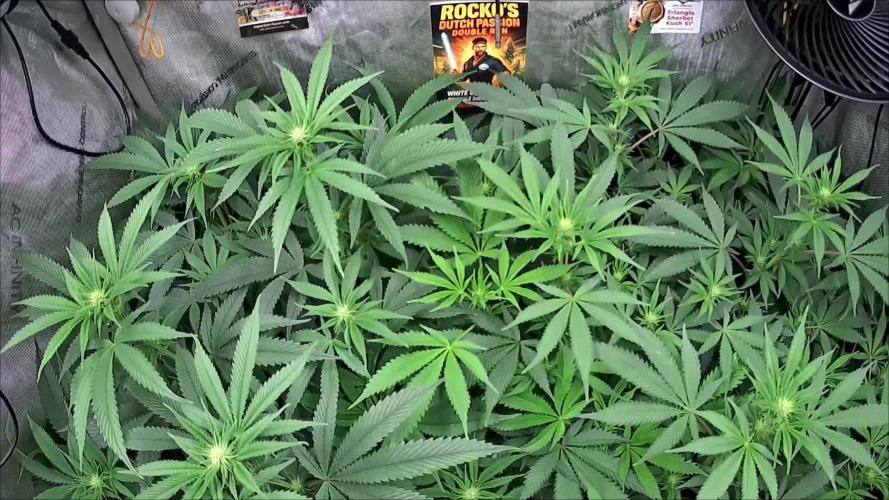
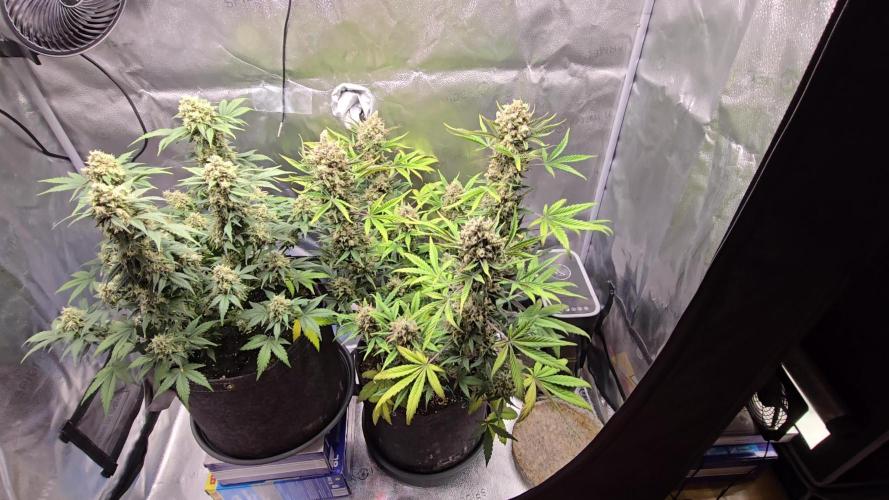
Well the buds are stacking up pretty well. They have been trying to stretch a little this week so I have been LST branches as they pop up and trying to keep them from getting too close to the lights. Its a really tight fit so going forward I gotta be careful what strains I grow in this cabinet. I will have to get some small/short strains to grow in here and recommendations?
Likes
25
Share
ANTHOCYANIN production is primarily controlled by the Cryptochrome (CR1) Photoreceptor ( !! UV and Blue Spectrums are primary drivers in the production of the pigment that replaces chlorophyll, isn't that awesome! 1. Diverse photoreceptors in plants Many civilizations, including the sun god of ancient Egypt, thought that the blessings of sunlight were the source of life. In fact, the survival of all life, including humans, is supported by the photosynthesis of plants that capture solar energy. Plants that perform photosynthesis have no means of transportation except for some algae. Therefore, it is necessary to monitor various changes in the external environment and respond appropriately to the place to survive. Among various environmental information, light is especially important information for plants that perform photosynthesis. In the process of evolution, plants acquired phytochrome, which mainly receives light in the red light region, and multiple blue light receptors, including his hytropin and phototropin, in order to sense the light environment. .. In addition to these, an ultraviolet light receptor named UVR8 was recently discovered. The latest image of the molecular structure and function of these various plant photoreceptors (Fig. 1), focusing on phytochrome and phototropin. Figure 1 Ultraviolet-visible absorption spectra of phytochrome, cryptochrome, phototropin, and UVR8. The dashed line represents each bioactive absorption spectrum. 2. Phytochrome; red-far red photoreversible molecular switch What is phytochrome? Phytochrome is a photochromic photoreceptor, and has two absorption types, a red light absorption type Pr (absorption maximum wavelength of about 665 nm) and a far-red light absorption type Pfr (730 nm). Reversible light conversion between the two by red light and far-red light, respectively(Fig. 1A, solid line and broken line). In general, Pfr is the active form that causes a physiological response. With some exceptions, phytochrome can be said to function as a photoreversible molecular switch. The background of the discovery is as follows. There are some types of plants that require light for germination (light seed germination). From that study, it was found that germination was induced by red light, the effect was inhibited by subsequent far-red light irradiation, and this could be repeated, and the existence of photoreceptors that reversibly photoconvert was predicted. In 1959, its existence was confirmed by the absorption spectrum measurement of the yellow sprout tissue, and it was named phytochrome. Why does the plant have a sensor to distinguish between such red light and far-red light? There is no big difference between the red and far-red light regions in the open-field spectrum of sunlight, but the proportion of red light is greatly reduced due to the absorption of chloroplasts in the shade of plants. Similar changes in light quality occur in the evening sunlight. Plants perceive this difference in light quality as the ratio of Pr and Pfr, recognize the light environment, and respond to it. Subsequent studies have revealed that it is responsible for various photomorphogenic reactions such as photoperiodic flowering induction, shade repellent, and deyellowing (greening). Furthermore, with the introduction of the model plant Arabidopsis thaliana (At) and the development of molecular biological analysis methods, research has progressed dramatically, and his five types of phytochromes (phyA-E) are present in Arabidopsis thaliana. all right. With the progress of the genome project, Fi’s tochrome-like photoreceptors were found in cyanobacteria, a photosynthetic prokaryotes other than plants. Furthermore, in non-photosynthetic bacteria, a homologue molecule called bacteriophytochrome photoreceptor (BphP) was found in Pseudomonas aeruginosa (Pa) and radiation-resistant bacteria (Deinococcus radiodurans, Dr). Domain structure of phytochrome molecule Phytochrome molecule can be roughly divided into N-terminal side and C-terminal side region. PAS (Per / Arndt / Sim: blue), GAF (cGMP phosphodiesterase / adenylyl cyclase / FhlA: green), PHY (phyto-chrome: purple) 3 in the N-terminal region of plant phytochrome (Fig. 2A) There are two domains and an N-terminal extension region (NTE: dark blue), and phytochromobilin (PΦB), which is one of the ring-opening tetrapyrroles, is thioether-bonded to the system stored in GAF as a chromophore. ing. PAS is a domain involved in the interaction between signal transduction-related proteins, and PHY is a phytochrome-specific domain. There are two PASs and her histidine kinase-related (HKR) domain (red) in the C-terminal region, but the histidine essential for kinase activity is not conserved. 3. Phototropin; photosynthetic efficiency optimized blue light receptor What is phototropin? Charles Darwin, who is famous for his theory of evolution, wrote in his book “The power of move-ment in plants” published in 1882 that plants bend toward blue light. Approximately 100 years later, the protein nph1 (nonphoto-tropic hypocotyl 1) encoded by one of the causative genes of Arabidopsis mutants causing phototropic abnormalities was identified as a blue photoreceptor. Later, another isotype npl1 was found and renamed phototropin 1 (phot1) and 2 (phot2), respectively. In addition to phototropism, phototropin is damaged by chloroplast photolocalization (chloroplasts move through the epidermal cells of the leaves and gather on the cell surface under appropriate light intensity for photosynthesis. As a photoreceptor for reactions such as escaping to the side of cells under dangerous strong light) and stomata (reactions that open stomata to optimize the uptake of carbon dioxide, which is the rate-determining process of photosynthetic reactions). It became clear that it worked. In this way, phototropin can be said to be a blue light receptor responsible for optimizing photosynthetic efficiency. Domain structure and LOV photoreaction of phototropin molecule Phototropin molecule has two photoreceptive domains (LOV1 and LOV2) called LOV (Light-Oxygen-Voltage sensing) on the N-terminal side, and serine / on the C-terminal side. It is a protein kinase that forms threonine kinase (STK) (Fig. 4Aa) and whose activity is regulated by light. LOV is one molecule as a chromophore, he binds FMN (flavin mononucleotide) non-covalently. The LOV forms an α/βfold, and the FMN is located on a β-sheet consisting of five antiparallel β-strands (Fig. 4B). The FMN in the ground state LOV shows the absorption spectrum of a typical oxidized flavin protein with a triplet oscillation structure and an absorption maximum wavelength of 450 nm, and is called D450 (Fig. 1C and Fig. 4E). After being excited to the singlet excited state by blue light, the FMN shifts to the triplet excited state (L660t *) due to intersystem crossing, and then the C4 (Fig. 4C) of the isoaroxazine ring of the FMN is conserved in the vicinity. It forms a transient accretionary prism with the tain (red part in Fig. 4B Eα) (S390I). When this cysteine is replaced with alanine (C / A substitution), the addition reaction does not occur. The effect of adduct formation propagates to the protein moiety, causing kinase activation (S390II). After that, the formed cysteine-flavin adduct spontaneously dissociates and returns to the original D450 (Fig. 4E, dark regression reaction). Phototropin kinase activity control mechanism by LOV2 Why does phototropin have two LOVs? Atphot1 was found as a protein that is rapidly autophosphorylated when irradiated with blue light. The effect of the above C / A substitution on this self-phosphorylation reaction and phototropism was investigated, and LOV2 is the main photomolecular switch in both self-phosphorylation and phototropism. It turns out that it functions as. After that, from experiments using artificial substrates, STK has a constitutive activity, LOV2 functions as an inhibitory domain of this activity, and the inhibition is eliminated by photoreaction, while LOV1 is kinase light. It was shown to modify the photosensitivity of the activation reaction. In addition to this, LOV1 was found to act as a dimerization site from the crystal structure and his SAXS. What kind of molecular mechanism does LOV2 use to photoregulate kinase activity? The following two modules play important roles in this intramolecular signal transduction. Figure 4 (A) Domain structure of LOV photoreceptors. a: Phototropin b: Neochrome c: FKF1 family protein d: Aureochrome (B) Crystal structure of auto barley phot1 LOV2. (C) Structure of FMN isoaroxazine ring. (D) Schematic diagram of the functional domain and module of Arabidopsis thaliana phot1. L, A’α, and Jα represent linker, A’α helix, and Jα helix, respectively. (E) LOV photoreaction. (F) Molecular structure model (mesh) of the LOV2-STK sample (black line) containing A’α of phot2 obtained based on SAXS under dark (top) and under bright (bottom). The yellow, red, and green space-filled models represent the crystal structures of LOV2-Jα, protein kinase A N-lobe, and C-robe, respectively, and black represents FMN. See the text for details. 1) Jα. LOV2 C of oat phot1-to α immediately after the terminus Rix (Jα) is present (Fig. 4D), which interacts with the β-sheet (Fig. 4B) that forms the FMN-bound scaffold of LOV2 in the dark, but unfolds and dissociates from the β-sheet with photoreaction. It was shown by NMR that it does. According to the crystal structure of LOV2-Jα, this Jα is located on the back surface of the β sheet and mainly has a hydrophobic interaction. The formation of S390II causes twisting of the isoaroxazine ring and protonation of N5 (Fig. 4C). As a result, the glutamine side chain present on his Iβ strand (Fig. 4B) in the β-sheet rotates to form a hydrogen bond with this protonated N5. Jα interacts with this his Iβ strand, and these changes are thought to cause the unfold-ing of Jα and dissociation from the β-sheet described above. Experiments such as amino acid substitution of Iβ strands revealed that kinases exhibit constitutive activity when this interaction is eliminated, and that Jα plays an important role in photoactivation of kinases. 2) A’α / Aβ gap. Recently, several results have been reported showing the involvement of amino acids near the A’α helix (Fig. 4D) located upstream of the N-terminal of LOV2 in kinase photoactivation. Therefore, he investigated the role of this A’α and its neighboring amino acids in kinase photoactivation, photoreaction, and Jα structural change for Atphot1. The LOV2-STK polypeptide (Fig. 4D, underlined in black) was used as a photocontrollable kinase for kinase activity analysis. As a result, it was found that the photoactivation of the kinase was abolished when amino acid substitution was introduced into the A’α / Aβ gap between A’α and Aβ of the LOV2 core. Interestingly, he had no effect on the structural changes in Jα examined on the peptide map due to the photoreaction of LOV2 or trypsin degradation. Therefore, the A’α / Aβ gap is considered to play an important role in intramolecular signal transduction after Jα. Structural changes detected by SAXS Structural changes of Jα have been detected by various biophysical methods other than NMR, but structural information on samples including up to STK is reported only by his results to his SAXS. Not. The SAXS measurement of the Atphot2 LOV2-STK polypeptide showed that the radius of inertia increased from 32.4 Å to 34.8 Å, and the molecular model (Fig. 4F) obtained by the ab initio modeling software GASBOR is that of LOV2 and STK. It was shown that the N lobes and C lobes lined up in tandem, and the relative position of LOV2 with respect to STK shifted by about 13 Å under light irradiation. The difference in the molecular model between the two is considered to reflect the structural changes that occur in the Jα and A’α / Aβ gaps mentioned above. Two phototropins with different photosensitivity In the phototropic reaction of Arabidopsis Arabidopsis, Arabidopsis responds to a very wide range of light intensities from 10–4 to 102 μmol photon / sec / m2. At that time, phot1 functions as an optical sensor in a wide range from low light to strong light, while phot2 reacts with light stronger than 1 μmol photon / sec / m2. What is the origin of these differences? As is well known, animal photoreceptors have a high photosensitivity due to the abundance of rhodopsin and the presence of biochemical amplification mechanisms. The exact abundance of phot1 and phot2 in vivo is unknown, but interesting results have been obtained in terms of amplification. The light intensity dependence of the photoactivation of the LOV2-STK polypeptide used in the above kinase analysis was investigated. It was found that phot1 was about 10 times more photosensitive than phot2. On the other hand, when the photochemical reactions of both were examined, it was found that the rate of the dark return reaction of phot1 was about 10 times slower than that of phot2. This result indicates that the longer the lifetime of S390II, which is in the kinase-activated state, the higher the photosensitivity of kinase activation. This correlation was further confirmed by extending the lifespan of her S390II with amino acid substitutions. This alone cannot explain the widespread differences in photosensitivity between phot1 and phot2, but it may explain some of them. Furthermore, it is necessary to investigate in detail protein modifications such as phosphorylation and the effects of phot interacting factors on photosensitivity. Other LOV photoreceptors Among fern plants and green algae, phytochrome ɾphotosensory module (PSM) on the N-terminal side and chimera photoreceptor with full-length phototropin on the C-terminal side, neochrome (Fig. There are types with 4Ab). It has been reported that some neochromes play a role in chloroplast photolocalization as a red light receiver. It is considered that fern plants have such a chimera photoreceptor in order to survive in a habitat such as undergrowth in a jungle where only red light reaches. In addition to this, plants have only one LOV domain, and three proteins involved in the degradation of photomorphogenesis-related proteins, FKF1 (Flavin-binding, Kelch repeat, F-box 1, ZTL (ZEITLUPE)), LKP2 ( There are LOV Kelch Protein2) (Fig. 4Ac) and aureochrome (Fig. 4Ad), which has a bZip domain on the N-terminal side of LOV and functions as a gene transcription factor. 4. Cryptochrome and UVR8 Cryptochrome is one of the blue photoreceptors and forms a superfamily with the DNA photoreceptor photolyase. It has FAD (flavin adenine dinucle-otide) as a chromophore and tetrahydrofolic acid, which is a condensing pigment. The ground state of FAD is considered to be the oxidized type, and the radical type (broken line in Fig. 1B) generated by blue light irradiation is considered to be the signaling state. The radical type also absorbs in the green to orange light region, and may widen the wavelength region of the plant morphogenesis reaction spectrum. Cryptochrome uses blue light to control physiological functions similar to phytochrome. It was identified as a photoreceptor from one of the causative genes of UVR8 Arabidopsis thaliana, and the chromophore is absorbed in the UVB region by a Trp triad consisting of three tryptophans (Fig. 1D). It is involved in the biosynthesis of flavonoids and anthocyanins that function as UV scavengers in plants. Conclusion It is thought that plants have acquired various photoreceptors necessary for their survival during a long evolutionary process. The photoreceptors that cover the existing far-red light to UVB mentioned here are considered to be some of them. More and more diverse photoreceptor genes are conserved in cyanobacteria and marine plankton. By examining these, it is thought that the understanding of plant photoreceptors will be further deepened.
Likes
Comments
Share
Flipped to 12/12. At start of flowering im using GHF Bio Bloom top dress 3g/l of substrate mixed with wormhumus by biobizz and watered by compost Tea with bioenhancer
Likes
3
Share
@Bdawg
Follow
Chopped day 60 Oreoz looking nice Grape cream cake to Probably wont do apples and bannana again
Likes
31
Share
Starting to put on some weight now. Everything is looking good at this point.
Likes
94
Share
Pretty much half of the flowering cycle has been completed! 28 days today. She's very vigorous, thickening up and frosting A LOT. I've also done some more gentle LST to spread a few branches further because new shoots are coming everywhere. Beautiful to look at. It's been quite moist at night, the sun sometines only starts at 10 am because of fog. When I decide to grow we have the rainiest year in the past 13 years and also the coldest May since 2006, fuck...at least the RH drops to 30% when the sun's at max, it's also been quite cold, that'll probably avoid mold problems. She started to smell very gently this week. Started as a ripe guava sort of smell that has now developed to VERY sweety and fruity profile. Strong skittles smell when I press the flowers, which is awesome! I'm a big sugar fan, I did not expect this smell but I just loved it! Thank you for visiting and see you next week! I'm so anxious I keep having dreams about her, mostly nightmares where someone chops her up or a bug kills everything...want to harvest soon 😂
Likes
Comments
Share
@BombBuds
Follow
Pflnazen wurden die Woche in 100% Coco umgetopft. 20l stofftöpfe Eine Pflanze wurde aussortiert. Mal schauen wie sie das umtopfen vertragen.
Likes
10
Share
Hey growmies! what a week for this plant, she responded wonderfully to the lollipopping and defoliation performed last week, in fact she started voraciously eating and i had to keep increasing dose and water every day. She did enter flower now, I have taken off a few more offshoots that wouldn't have yielded much bud and was crowding the canopy with tiny branches. Now was my last chance to take off said shoots, because this girl has started pumping energy into stretching, and now more of that precious energy will go into more dominant branches, that ultimately will yield higher quality flower. Could I technically have higher yield if I left the little branches? possibly. but that weight would come in fluffy bud that choke out airflow and nutrients away from the pretty flowers, which in turn suffer. the plant started stretching and she grew too close to her new lights, as a result all my tops have yellow tips, she should recover nicely however, I have raised the lights back to 45 cm above the canopy. Speaking of canopy, this autoflower is pretty big, atleast in DWC, so if you're growing her, deffo ScrOG her. Hydroguard keeps my roots pretty healthy, even during the heatwave without a chiller! next week i will put in a second trellis, help her while she stretches! hope to see you then
Processing
Likes
18
Share
@Manic
Follow
Easiest week so far, no problems just growing. I did spray some neem oil on my soil a few days a go to keep pests out of the fox farm soil. Week 4 will bring in topping after the next node grows in, should be 2 or 3 days. Also towards the end of the week after she recovers from topping I will begin LST. Will provide pics throughout the week Posted first vid in real light not my 600 watt LED. Mainly for health purposes. This will be so interesting to see how blueberry will develop after an accidental FIMing lol. Personal Note: Wait to top when there is a full mainstem and not barely new growth. Meaning wait til the new growth has 2 fan leafs spread out, and not when they are just leafs barley sprouted from the main stem. Rookie mistake number 1 so far at the end of week 3. Or maybe time will tell if blueberry will be gracious enough to be a beautiful big buded tree. I read where FIMing can develop up to 4 extra colas and still grow beautifully. Fingers crossed.
Likes
3
Share
🌱 MENTAL RAINBOW 🌈 Na, akkor induljon a történet. Sokan csak a kész növényt mutatják meg. A nagy bokrokat, a gyönyörű virágokat és a végeredményt. Engem viszont mindig sokkal jobban érdekelt az út, ami odáig vezet. Ezért most úgy döntöttem, hogy ezt a növényt az első pillanattól kezdve végig dokumentálom. Nem csak a sikereket, hanem a hibákat is. Nem csak azt, ami működik, hanem azt is, ami nem. A főszereplő egy Mental Rainbow a Sweet Seeds-től. Jelenleg még csak egy apró mag, amely a Root Riot kockában pihen. Kívülről nézve még semmi különös nem történik. Nincs gyökér, nincs levél, nincs növény. Csak egy mag és egy lehetőség. De minden nagy növény pontosan így kezdi. A következő hetekben és hónapokban végig követjük a fejlődést a csírázástól egészen a betakarításig. Valós körülmények között, valós döntésekkel, valós hibákkal és remélhetőleg valós sikerekkel. A cél egyszerű: Lásd, mit lehet megszívni. Hogy ne te szívj vele... 😄 Szívok helyetted én.
Likes
2
Share
@Swanbergs
Follow
This grow is looking phenomenal. Can’t wait to wash for rosin! Freezing as of now update: test run of bubble this shit is fucing crazy gas. So pungent and full of flavor. Tried some wet Melt in the Puffco it hits like crazy. Great effects and gas flavor. Will be pressing asap update did a 2nd wash tonight of all the trim from plant 3. I’d say 600 wet grams. Yielded great and awesome color
Likes
120
Share
@Hologram
Follow
OK, im doing an update now becouse my breakup cake is going tranny!!(hermie) I already have noiticed she was not growing as strong .. but u can blame that on anything , especially when growing outdoor.. but this morning i saw that she was g(r)oing 'bananas'!😢 I have put her aside from the rest (in the back of garden) but think gonna have to terminate her asap!..(and i will, right after this post👍) The weed she will give will be filled with seeds and those seeds will be hermies too, so wothless.. and if i dont throw her away quick she can infect the rest. So goodbye breakup cake..😢 who wants to eat a cake when they are breaking up anyway..😒 (just hiding my pain with lame humour 😳) happy growing for all ✊
Likes
4
Share
Hoy después de 10 días sin colgar nada las plantas presentan un ptipo de carencia debido al suelo debíl de inicio. Trasplantados a tiestos de tela reforzando el mantillo. En estos días he dejado un plazo más largo antes de volver a preparar el te de compost. Hoy recibirán su riego de té y esta mañana han sido rociadas.. La verdad que el efecto de positivo de rociar las plantas de buena mañana las deja bien tiesas y vigorosas. Antes de este riego recibió una tirada de agua sola y la siguiente fue de SST basado en brotes de soja germinados un técnica que aporta muchas vitaminas y enzimas a las plantas. El compost tea de esta semana le he agregado : Tierra de cultivo 100g Hummus de lombriz 200g Guano de murciélago 80g Cola de caballo 2.5g Spirulina 7g Hidrolizado de kelp 20g Ácidos fulvico 2ml Melaza 76ml Mezcla para 15 litros. A ver como le sienta.. Me siguen recomendando que le de algún aporte con productos pero sigo buscando el modo de hacerlo por mi mismo.. Si alguien cultiva así a base de tea estaría interesado en compartir conocimientos
Likes
7
Share
@Cthoff
Follow
Well am happy with the outcome and the way I grew it. I might do things slightly different next time. Be more proactive instead of reactive. 4.65 oz was the total weight (dried + trimmed) Smoked a little already before curing and was such a smooth and clean hit. No harshness in my throat and it was a clean high but more of a head high. That should change after a few weeks of curing in jars but nonetheless a comfortable high!
Likes
10
Share
@valiotoro
Follow
Hello everyone 😎 Week 2 for my girl it’s time for Topping & some LST She is doing very well,growing at fast pace and with a beautiful green colour on the leaves. Have a nice day 😎
Likes
19
Share
@DrLaggis
Follow
🌱 Day 43 - Beginning of the Third Flowering Week 🌱 Hello grow friends! 🌿 Today marks the start of the third week of the flowering phase. This week, I’m trying to adjust my nutrients a bit. I plan to slightly increase BioBizz Grow, as well as BioBizz Bloom, according to the feeding schedule. 🌱💧 I’m continuing to prune and thin out the plants a little each day, aiming to keep them stress-free. ✂️😊 The terpenes and buds are developing wonderfully so far, but I’m still struggling with very high humidity levels. 🌡️💦 Since my grow setup is on the second floor and we’re currently experiencing humid temperatures here in Germany, it’s been a challenge. I’m trying to reduce the humidity from 62% down to 50% during the day, but it’s proving difficult. 🌬️📉 I’ll keep you updated on how things progress! 🌿✨ 🌱 Day 47 - Everything is Going Well 🌱 Watering and Nutrients Today, I watered and fed the plant again. 🌿💧 Each plant received 1 liter, which is about 10% of the pot's volume. The plant is responding well to the nutrients, and growth is steady. Defoliation and Light Exposure I’ve done some light defoliation to ensure that every part of the plant gets proper light exposure. ✂️💡 My goal is to avoid any shadowed areas, allowing the buds to develop fully. Temperature Management The temperature is still quite high, reaching 27-28°C during the day. 🌡️🔥 I’m finding it difficult to bring it down, but the plant seems to be handling it well. To maintain a healthy environment, I keep both the fan and the exhaust system running on the highest setting, ensuring good air circulation. 🌬️🔄 Humidity Control Currently, the humidity is sitting at around 45-50%. 💧 It’s not perfect, but I’m monitoring the plant closely and making adjustments as needed. Careful Defoliation I continue to remove one or two leaves each day to minimize stress on the plant. 🍃🌿 This slow, careful defoliation ensures that the plant stays healthy while making sure all buds have access to light. Guard Dogs on Duty My dogs took a peek into the grow tent today and are now keeping a watchful eye over the plant. 🐕🌱 They’re doing a great job of “guarding” it! 🐾 I hope you enjoyed this update! I’ll continue to keep you all informed, and don’t forget—I post daily update pictures of the plant! 📸🌿 Stay tuned for more!
Processing
Likes
15
Share
Doing well with its 12-12 didnt really start the stretch yet still about the same size. My other 3 arent really my biggest concern I want this to do the best that's why I took them outside. Maybe next year If i time it right I'll start more in the ground at my cabin the few random clones i got out there in the ground are doing great but may not flower in time.
Likes
22
Share
@EelGrows
Follow
Week 10: This will be the final update before Harvest: I will update post harvest after the dry and weigh. Day 64-66: Decided I would continue feeding them until I harvest since they could go 7 days longer. Albeit with a half dose of Calmg and Boost(micro). All White Cracks seem to be doing good. I realized a few days ago the outer plants underneath the blurple LEDs seemed to be showing slight signs of light stress(the leaves were bending away from the light instead of toward it). I lowered the Blurples a few days earlier so I raised them back up. These are some FROSTY plants... Day 67-70: Going good, plants under the blurples responded postively to raising the lights. Seems I was wrong last week about these smelling stronger than the 4AM, it's actually the other way around lmao. But these are still some great smelling plants! Can't wait to dry and weigh that thicc double bud and main cola from WC#1! Hope it's not too airy, they look like pretty dense buds! Really bummed that I have to harvest this weekend, I would have liked to let #2 and #3 go for another week, but it's all good! Next time! Still this will probably the dankest shit I've smoked in a very long time 😂😎 #1 is probably the most mature at this point with about 90% cloudy and a 5-10% amber. #2 and #3 are the same with about 70-80% cloudy and a few amber. This has been an awesome learning experience and I'm already thinking about ways to improve my next grow! These White Cracks have been quite resistant to my newbiness! Awesome plants to grow! Much easier to hanlde than the 4AM!
Likes
16
Share
@TerpDaddy
Follow
Things are looking real good now. Blueberry is in full stretch and she’s gonna be a big girl. Grapefruit coming along real nice after early struggles. I am having some issues with light burn on my blueberry, but I think it’ll be alright. Absolute explosive growth from the blueberry monster this week. She’s up to 43 inch and I’m loving the spacing she has. As you can see, not very much lst going on here, but that’s how I like it. Grapefruit has been chugging along real nice. Just starting to flower now and she’s a bushy gal. I’m really looking forward to the flowering weeks ahead. I think these two are gonna be pretty.