Likes
Comments
Share
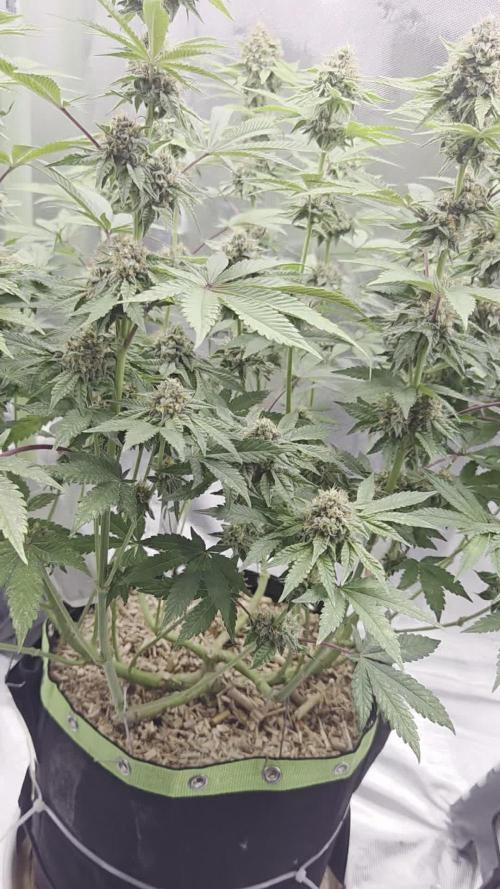
I had to add some support for the back left plant. I can technically Harvest and now but I'm waiting for a little more Amber on 3 plants. Its like 60/40 milky clear. Im thinking a week or so on 3 plants. But im horrible at guessing when they will be ready to harvest lol until I just scope and see lol.
Likes
5
Share
Bueno, cortada 😁. Sin duda esta era la mayor candidata a ser la primera en cortar, y además a ser de una gran cosecha. De momento está puesta a secar dentro del armario encima de las luces, a ver si llegamos a los 10/15 dias que me viene operación y así puedo disfrutarla en el periodo de recuperación ❤️‍
Likes
3
Share
Eccoci qui... Per problemi di lavoro ho tardato un pò la pubblicazione delle foto, la piccola è molto vigorosa ed emana un forte odore.. Già si può vedere la resina che si inizia a formare sulle cime in alto... Sono estremamente soddisfatto della sua crescita finora e sono sicuro che mi riserva sorprese, odore veramente intenso. Grande genetica, nonostante ha avuto una carenza siamo riusciti a recuperare ed ora produce tantissima resina, mi ha alzato le aspettative in lei ed ora si punta al raccolto. Grazie a tutti per il supporto, NON VEDO L'ORA DI RACCOGLIERLA 🔥🌲❤️
Likes
3
Share
Una in fioritura gia da un pò, l'altra continua a sviluppare diramazioni, molto belle, ma niente a che vedere con quelle dell'anno scorso... e vero che ancora in 2 mesi potrebbe succedere di tutti.. vedremo.
Likes
38
Share
So I'm very happy with this second run of Amnésia Auto! Harvested good quantity of very nice buds! And as always the GD community helped out nicely! Thanks to everybody!! Cya in the next round with some Royal Haze Auto!!0000
Likes
6
Share
🥒 Project Blue Tent – Week 5 Pickle Lemon Haze F1 – Pheno A (Folder 14A) Hello everyone, and welcome back to another update from Project Blue Tent! 💙🌱 If this is your first time stopping by, welcome! Project Blue Tent follows four individual plants, each documented in its own dedicated diary from seed all the way to harvest. Every plant receives the exact same environment, nutrients, lighting, irrigation and care, allowing us to observe how each phenotype expresses its own unique personality despite sharing identical conditions. This week marks another exciting milestone for Pickle Lemon Haze F1 – Plant A. After recovering beautifully from topping, it was finally time to install one of my favourite training techniques... The SCROG net. 🌿 Week Five – The Canopy Begins This week was less about vertical growth and more about shaping the future. With the plant fully recovered from topping and growing faster than any of the others inside the tent, I decided the timing was perfect to install the SCROG net and begin spreading the canopy. Plant A immediately confirmed my suspicion. She has become the most vigorous plant in the room.While the other ladies settled comfortably beneath the screen, this phenotype almost seemed eager to escape it. Every branch wanted to continue growing upward, so the goal this week became gently guiding that energy sideways instead. One branch at a time.One square at a time. Nothing forced. Nothing rushed. SCROG is very much a daily conversation with the plant rather than a one-time training session. Looking at her today, I already have the feeling she may end up occupying the largest portion of the canopy. Only time will tell, but she's certainly making a strong case for herself. 🕸️ What is a SCROG? SCROG stands for Screen of Green, and despite the name, the net itself doesn't actually support the buds. Its primary purpose is to control the plant's shape. Instead of allowing one dominant top to grow taller than everything else, the branches are gently guided horizontally beneath the screen. As each branch reaches a new opening, it's carefully tucked into the next square, encouraging the plant to spread across the available space rather than simply reaching toward the light. The result is a flatter, more even canopy where many growing tips receive similar light intensity. Instead of producing one large cola and many smaller ones hidden underneath, the plant is encouraged to create dozens of equally productive flowering sites. It's one of the most effective ways to maximize light efficiency inside smaller tents. 🤔 Is SCROG for everyone? Not necessarily. One important thing many new growers don't realize is that once the plant is woven into the screen, moving it becomes extremely difficult. Need to remove the pot? Almost impossible. Want to rotate the plant? Not anymore. Need to carry it somewhere else? Forget about it. The plant essentially becomes part of the tent. For growers who frequently move their plants for maintenance, watering or photography, SCROG can quickly become frustrating. Personally, I don't use it on every grow. But in compact setups like this Project Blue Tent, where every square centimetre matters, I absolutely love working with it. There's something incredibly satisfying about visiting the tent every day, gently guiding a few branches, watching empty spaces slowly disappear, and seeing the canopy become flatter and more uniform with each passing day. It isn't a technique everyone will fall in love with... But it's definitely one I encourage every grower to try at least once. Only by experiencing it can you decide whether it's the right style for your own garden. 🌡️ Environmental Conditions This week the environment remained stable, allowing the plants to focus entirely on recovering from training and continuing vigorous vegetative growth.Average conditions were: • 🌡️ Day temperature: 30°C• 🌙 Night temperature: 25°C • 💧 Relative humidity: 58% • 🥥 Root zone temperature: 24°C • 💦 Nutrient solution: 18°C • ⚗️ pH: 5.8 • ⚡ EC: 1.92 mS/cm • 💨 CO₂: approximately 450 ppm • 💡 Light schedule: 18/6 Even with slightly warmer daytime temperatures this week, the plants have continued to show excellent vigor thanks to stable root temperatures, consistent irrigation and healthy airflow throughout the tent. 🥥 Feeding Update One observation from the previous couple of weeks was the slightly lighter shade of green across all four plants. Although they remained healthy and continued growing without slowing down, I felt they were asking for just a little more food. Rather than waiting for deficiencies to develop, I made a small adjustment to the nutrient solution. Current feeding now consists of:• Plagron Hydro A — 1.9 ml/L • Plagron Hydro B — 1.9 ml/L • Plagron Hydro Roots — 1 ml/L This small increase has already made a noticeable difference. The fresh growth is returning to a richer shade of green while maintaining the vigorous posture I've been seeing throughout the project. One of the things I continue to appreciate about growing in coco is how quickly plants communicate with you. Small adjustments often produce visible improvements within just a few days, making it much easier to fine-tune nutrition before small issues become bigger ones. 🌿 Pickle Lemon Haze F1 – Plant A This phenotype keeps reinforcing the impression she's given me since the beginning. She's vigorous. Responsive. And full of energy. Even after being bent beneath the SCROG net, every branch seems determined to keep pushing upward, which is exactly the kind of behaviour I was hoping to see before entering the next stage of vegetative growth. The stems continue thickening beautifully, making the training process much easier than it would have been with weaker growth. The internodal spacing remains compact, the foliage is healthy, and the plant has handled every bit of stress I've introduced so far without missing a beat. At this stage she already feels like a plant that's going to demand plenty of room. Whether she ultimately becomes the dominant lady inside Project Blue Tent remains to be seen, but she's certainly making her intentions known. 🔍 Looking Ahead Over the coming week the focus will remain exactly where it should be. No rushing.No unnecessary stress. Simply continuing to tuck new growth beneath the SCROG screen while allowing the canopy to expand naturally across every available square. I'm excited to see how each phenotype responds to this new training style. Some plants naturally embrace SCROG. Others fight it every step of the way. That's one of the reasons I love documenting projects like this. Every week the plants teach us something new. And I have a feeling Pickle Lemon Haze F1 – Plant A still has plenty more to reveal. 💙 Thank You A huge thank you to Zamnesia for making Project Blue Tent possible, from these fantastic Pickle Lemon Haze F1 genetics to the complete ecosystem surrounding this grow. A heartfelt thank you to Plagron for providing the Premium Growbags together with the Hydro nutrient line, delivering consistent nutrition and allowing these plants to thrive week after week. A sincere thank you as well to Phytonaut for the outstanding LED lighting that continues producing compact growth, excellent structure and an incredibly even canopy across the tent. Thank you to GrowDiaries for giving growers around the world a place to document their journeys, exchange knowledge and inspire one another every single day. And finally... Thank you for following along. Whether you've been here since germination, recently joined the adventure, leave comments every week, or quietly follow these updates from the background, your support genuinely means the world to me. Project Blue Tent isn't just about growing great plants. It's about sharing the entire experience—the experiments, the lessons, the successes, the mistakes, and everything we learn together along the way. I hope you're all having an amazing week, and I can't wait to show you how this canopy develops over the next few days. Until next time... Growers Love, happy growing, and take care everyone! 🌱💙
Likes
1
Share
Remember that, however you are played, or by whom, your soul is in your keeping alone. Even though those who presume to play you be kings or men of power, when you stand before God, you cannot say, 'But I was told by others to do thus,' or that virtue was not convenient at the time. This will not suffice. Remember that. Day:18 84°F and 65% RH (VPD) for the vegetative stage. Approximately 1.15kPa(assuming leaf temperature is about 2°F cooler than the air), which falls right into the ideal vegetative sweet spot (0.8kPa to 1.2kPa). At 1.15kPa, plants can draw water and nutrients efficiently without risking stress or wilting. It keeps the leaf pores (stomata) open, allowing for ideal carbon dioxide intake and maximizing vegetative growth. VPD is determined by the leaf's temperature, not just the ambient air. Because leaves usually run 1° to 3°F cooler than room air under bright grow lights, my actual VPD will be slightly lower, closer to the 1.0kPa mark. As she transitions from vegetative growth to flowering, one can gradually lower the humidity (to around 45–60%) and drop temperatures slightly to prevent disease from settling inside dense buds when they appear. Night:6 At 70°F and 60% relative humidity, Vapor Pressure Deficit (VPD) is 0.86 kPa. This is right on the cusp of whats optimal for the vegetative stage. During the nighttime, plants generally close their stomata and undergo cellular respiration rather than photosynthesis. Transpiration slows to a near stop, making VPD less critical at night than during the day. However, maintaining a nighttime VPD between 0.8 and 1.0 kPa is highly beneficial in that it ensures the air is dry enough to prevent powdery mildew or bud rot, but moist enough to keep the plant from undergoing unnecessary stress. This range keeps the environment comfortable for cellular processes and prevents large atmospheric swings. Keeping it all flowing. (Not pushing them yet, these are photoperiods) The optimal soil (root zone) temperature for cellular root respiration and nutrient uptake in cannabis is between 68F & 72F This narrow range balances biological energy production (cellular respiration) with the dissolved oxygen levels in the soil, maximizing plant growth and health. Warmer soils hold significantly less dissolved oxygen. When soil temperature exceeds 74F oxygen depletion occurs, inhibiting cellular respiration almost entirely, At 68-72F root cells generate optimal adenosine triphosphate (ATP) via respiration to power root-tip elongation and the active transport of water and nutrients. Too Hot (Above 78F) Root respiration increases, demanding more oxygen, while the water's oxygen-carrying capacity drops. This creates a prime environment for anaerobic pathogens and Pythium (root rot). Too Cold (Below 60F) Root metabolism and cellular respiration slow to a crawl. This severely impairs nutrient and water absorption, leading to yellowing, wilting, and phosphorus deficiencies. A lot depends on whether it's automatic or photoperiod; with photoperiod, there is not as much of a need to push "hard" as the real countdown only begins once the flower is initiated. Automatics, on the other hand, the chronological "clock" begins ticking the moment the seed germinates. It is of critical importance that the seedling growth gets off to the races, understanding that early growth is like compound interest, which will pay off come harvest. This reality is why getting autoflowers "off to the races" early on yields such exponential benefits. The "compound interest" is directly related to the surface area of the leaves. Larger, faster-growing seedlings process more light and build bigger root networks early on, which translates into an explosion of vertical and lateral growth during their short vegetative window. The margins for error are so thin with autoflowers; this early-stage momentum depends on several critical practices. Seedlings exposed to increased atmospheric CO2 levels early in life will develop at an increased rate. To effectively "extend" or optimize the capacity of Photosystem II (PSII) for increased photosynthetic efficiency. In standard oxygenic photosynthesis, Photosystem II (PSII) is naturally limited to the red-light spectrum, peaking at 680nm. Extending its light-harvesting capacity past 700nm into the far-red region requires bypassing the natural limits of standard chlorophyll a. Adding 730 nm (far-red) LEDs alongside standard red/blue lights has been shown to increase canopy photosynthesis by 20–30% in several crops by acting synergistically with shorter wavelengths. However, the limitation is that excessive, pure IR/Far-red light (without accompanying red light) can trigger the "shade avoidance response," causing plants to grow tall, weak, and spindly rather than robust. Utilizing infrared light (specifically the 700-750 nm far-red range) is a viable method to boost photosynthetic efficiency. It acts as a bridge to allow PSII to utilize a broader spectrum of light, breaking the traditional 700 nm barrier. UVR8-mediated signaling (often in conjunction with CRY proteins) triggers protective mechanisms that maintain the stability of the photosynthetic apparatus (including LHCII and reaction center proteins), thus ensuring that the efficiency of Photosystem II remains higher in UV-B-exposed plants compared to plants lacking this receptor. ΦPSII indictates the rate of electron transfer from water to plastoquinone, which drives the production of ATP and NADPH. There is a close link between ΦPSII and the true rate of CO2 fixation (Φ*co2). ETR stands for Electron Transport Rate. It measures the speed at which electrons are moved through the thylakoid membranes in a plant's chloroplasts during the light-dependent reactions of photosynthesis. Infrared light (particularly Near-Infrared or NIR) improves cellular energy by interacting directly with the electron transport chain (ETC) in mitochondria. This process boosts adenosine triphosphate production, which acts as a metabolic coefficient multiplier by accelerating enzyme activity dramatically. Extend then multiply. Far-Red photons interact with plant photoreceptors to accelerate the plant’s biological "clock" or trigger a shade-avoidance response. Autoflowers don't use the plant's biological clock, although the IR will initiate a shade avoidance and make them stretchy. You can just add equal measures of 660nm-680nm to negate the shade avoidance effect. Replacing nights' "darkness" with a combination of IR+ and 660nm. Because autoflowers don't require a dark period to flower, many growers just blast them with light. 18/6 24/0. However, this ignores the plant's metabolic rhythms, where daytime photosynthesis (light reactions) must be perfectly balanced with nighttime carbon fixation and assimilation (Calvin cycle) to avoid bottlenecking plant development. Cellular respiration is a 24/7 process, but it can only function while the plant has the free oxidative capacity to do so. A 100% photosynthetically active leaf cannot perform cellular respiration. The viral trend of defoliation of every leaf that isn't "getting enough light" is of great detriment overall, putting 100% of the cellular respiratory "workload" and responsibility on the 0/4/6 hours of darkness in sub-optimal conditions for enzymatic activity. Photosynthesis captures nearly 100% of the initial energy as carbon, while cellular respiration is the process that unlocks 90% of that captured energy into usable ATP so the plant can use it. Respiration is considered roughly 30% to 40% efficient. It captures enough of the potential energy in glucose to synthesize around 30 to 38 ATP molecules per glucose molecule. The remaining 60% to 70% of the energy in the sugar is not captured in ATP; instead, it naturally escapes into the environment as heat, which helps regulate plant temperature. In plants, the primary enzymes of the Electron Transport Chain (ETC) and the ATP synthase complexes are typically adapted to function optimally in warmer temperatures (roughly 25°C to 35°C depending on the specific plant strain). As temperatures rise within this physiological range, molecular collisions increase, speeding up respiration and ATP production. The cannabis plant has a branched respiratory pathway. During heat or cold stress, plants activate Alternative Oxidase (AOX). AOX burns sugars to dissipate energy as heat rather than coupling it to ATP production. This pathway actually functions optimally at elevated temperatures to help protect the cell from the damaging build-up of Reactive Oxygen Species (ROS) during heat stress. Enzyme activity generally scales with heat; there is a strict biological limit. If canopy temperatures in a grow room exceed 40°C, the enzymes and their supporting lipid membranes lose stability. Not saying you need to go crazy, just optimize nights the same as we optimize days. Phosphorus is the driving force behind early seedling development. It acts as the "energy hub" of the plant, directly driving cell division, robust root growth, and the creation of DNA. Without an adequate, easily accessible supply early on, the plant's overall growth potential and final yield can suffer permanently. E=MC2 looks like a simple multiplication problem; it describes a fundamental physical truth: mass and energy are the same thing. The equation doesn't just calculate a value; it reveals that mass is effectively "congealed" energy. Energy is just numbers. Energy isn't a physical "substance" you can hold or touch. It is essentially an abstract, calculated number that we assign to a system to predict how it will change, interact, or move. A numerical label we attach to matter to track how it behaves. Because the universe runs on laws of symmetry (specifically, that the laws of physics don't change over time), a single global number must be conserved. We call that number "energy". We don't grow; we facilitate energy conversion. How well a seedling grows is essentially down to how much knowledge one can acquire to increase the level of conversion to occur. Applying knowledge effectively requires intuition, which comes from hands-on experience. A seasoned stoner learns to read subtle signs—like a slight change in leaf turgor (stiffness), subtle color shifts, or the specific texture of the soil—before a textbook diagnosis can be made. Ultimately, growing is the application of botanical science blended with active observation. Knowledge dictates your potential, but adaptability and attentiveness to the plant's immediate environment determine your results. 1.618 nature mathematically optimizes quantum energy transfer and light absorption efficiency within the photosynthetic machinery, as it naturally dictates energy scaling hierarchies and resonance dynamics. External vibration or electromagnetic wave that perfectly matches a plant's natural frequency directly influences plant growth. Low-frequency sound waves and targeted electromagnetic fields stimulate cellular processes and boost photosynthetic efficiency Does it produce better yields? How long is a piece of string? As long as you cut it. But isssss the juice worth the squeeze? The quantum framework of the IVM seems to think so. Good enough for the quantum firmware, good enough for the DNA software. Genetics are not dictated; they are expressed; the rate of that expression is dictated by the environment in which growth occurs. Quantum Coherence in Photosynthesis occurs When a photon of sunlight strikes a leaf, the energy it carries must travel to a reaction center to be converted into chemical energy. This process operates at nearly 100% efficiency. If the energy moved in a traditional "bunching" or random hopping manner, a large portion of it would be lost as heat. Instead, plants utilize quantum superposition. The energy particle (exciton) doesn't just take one path; it exists in a wave state and explores multiple pathways simultaneously. It essentially "chooses" the most efficient route to the reaction center simultaneously. Research shows that molecular vibrations and the specific network arrangements of chlorophyll molecules (like the naturally evolved Chlorophyll A & B ratios) actively protect against energy overflow, optimizing light capture across different light intensities. Enzymes are the biological catalysts that speed up chemical reactions within a plant's cells, allowing them to grow, metabolize, and repair. Rather than relying solely on the classical kinetic energy of molecules colliding, plants use quantum tunneling. Subatomic particles like electrons and protons (hydrogen ions) can literally "teleport" through energy barriers that they normally wouldn’t have the energy to climb over. This makes vital metabolic reactions happen far faster than classical physics could ever explain. Chloryphyll b has peak absorption at 460nm (Blue) and at 647nm(Red). If we take the blue peak wavelength 460nm and a UV-B, UVR8 peak absorption wavelength 285nm, Tryptophan-285 (W285) Sensing protein. 460/285=1.618 Φ If we take chlorypyhll b's Red absorption peak 647nm and a UV-A of 400nm, we get 647/400=1.618 Φ. "Structure of light". The cryptochrome photoreceptor (CRY) is a UV-A/blue light receptor that shares this dual sensitivity with several other biological structures and functions, including significant sequence similarity and a common evolutionary ancestor with DNA photolyase enzymes. These are light-activated enzymes that use blue/UV-A light to repair DNA damage caused by UV-B radiation in plants. Synergistic. But Shhh, it's a secret. Effective quantum efficiency of photosystem II, often denoted as ΦPSII, represents the proportion of light absorbed by Photosystem II (ΦPSII) that is actually used in photosynthetic electron transport. It is a key indicator of how efficiently a plant is using light for photosynthesis, as opposed to losing it as heat or fluorescence. ΦPSII (effective quantum yield of photosystem II) functions primarily as a "multiplier" (a coefficient of efficiency) rather than an additive factor when estimating the overall photosynthetic electron transport rate (ETR). Multipliers are considered far more beneficial than additions because they generate exponential growth, leverage existing resources to their full potential, and create sustainable, self-multiplying capacity, rather than just incremental, linear increases. This fascinating observation is rooted in the intersection of subatomic geometry, fractal scaling, and quantum dynamics. In specific molecular arrangements—such as in conjugated polymer networks or biomolecular architectures—the Golden Ratio (PHI) naturally dictates energy scaling hierarchies and resonance dynamics. Mathematically tied to the fine-structure constant, which defines the strength of the electromagnetic interaction. The Golden Ratio can be mapped geometrically as the Golden Angle (137.5 degrees) in atomic structures, linking the charge of the electron to fundamental quantum constants like Planck's constant. Electromagnetic. The Golden Angle (137.5): This angle is derived from the Golden Ratio (1.618). It is the smaller of two angles created when a circle is divided such that the ratio of the arcs equals the Golden Ratio.
Likes
21
Share
@Stash074
Follow
This week went well. Overall the ladies are healthy. They ended up stretching a lil more. I do know this will be the final week of stretch before focusing on producing buds. Which will be my goal over the next week,more defoliation. Also I've been using liquid kool bloom with feedings..we shall see if it makes a difference.. will keep yall updated in my next upload ..Happy growing 😎🍃
Processing
Likes
88
Share
@No_Clout
Follow
22/08/18 - everything’s looking great I’m sure they will be finished stretching sometime this week and also should be getting an additional LED to add to the tent by the end of the week. Also started to lolly pop each plant took about a 1/4 of the leaves etc so far will see how it reacts to this to see if I can continue to 1/3. 24/08/18 - lookin good 48hr after I trimmed the bottom branches/big ass fan leaves in the shade looking miserable so i had to chop em. Still waiting on my extra led in the post.
Likes
12
Share
Another few days, cut her half, ready end of the week ♥️👍 03/01 trichomes still blanc
Processing
Likes
1
Share
La 3 semana de crecimiento las niñas están en su máxima potencia comprobamos que no tienen falta fe ningún nutriente están super verdes con unas hojas muy grandes
Likes
4
Share
@GODAXE
Follow
2024.09.12 D64 Its been two busy week, as i trim the 1 pond mother, get aknowledge that my wife use my grow sniper two pruned is badly infested rose bush, since 2 week and never proper clean it whith alcool.😱😱😱😷 in result a massive PM & mithe contamination in my grow tent... 😱😭😷😭 all plant have been shoot with H2O2 at 0.5% and set ouside for 2 day, wich turn to be rainy as f***, until i clean and serilized everything, twice and run the hepa filter .😷😰 the plant look ok, lightly over wartered, but no more pest or PM sign as they return in the tent.. 3 days later PM hardly bonce back, no choice to use more agressive treatment so they all have been shoot with saffer's defender 3 in 1. after 3 shoot in 24h and another tent desinfection we should have get rid of it 🙏 8 day laters everything look fine👍, all damage leaf have been removed, i also prune some unrelevant lower and inner grow
Processing
Likes
13
Share
The new week has started. Right at the beginning I topped plants 1 and 2. Apparently 3 and 4 will follow on Friday. I have now also set the fertilizer to 0.6g per liter. The repotting unfortunately has to wait a day because my mycorrhiza order has not yet arrived. Day 30: The dynomyco mycorrhiza arrived today. So i decided to repot the plants. The picture of the roots confirms my decision. Day 32: I decided to tie down a few leafs. Day 35: After topping you can see in 2 of the 4 plants that new shoots form from the interface. I am happy to see that the small plants have such a growth tendency. The awnings have already overtaken the size of my palm. The plants became 3 times this week 300ml of water with 0,6g/l Hybrid Powderfeeding by Greenhousefeeding.
Likes
15
Share
Heureux merci Kannabia pour cette beauté. La nature fait de belle choses 🍁❤️ comment dire que j'ai hâte de la déguster ❤️
Likes
8
Share
@Webacca
Follow
Start in Woche 4. Hat sich einiges an Wuchs getan. Machen langsam den Eindruck wie richtige Pflanzen. Bisher scheint alles ok zu sein. Muss sich auch nicht ändern. Beleuchtung auf 30 DLI bei max 700 PPFD geändert. Schaunmermal, ob sie das aushalten, begrüßen oder neg. reagieren. Zeitraffer der vorhergehenden Woche am. Ende der Bilderreihe. Update 1: Die LCC hat jetzt ne LT Spange. Bei den anderen beiden gings nicht, weil der Wuchs zu kompakt ist. Internodienlänge ist echt kurz. Mal abwarten, wann es diese oder nächste Woche nochmal ne Chance gibt.
Likes
57
Share
Hey everyone 😃. Week after week, both phenotypes become more beautiful and beautiful 😍. Pheno 1 is clearly my favorite color klar. Let's start the week: Flowering day 49 Both plants were checked for health and the trichomes were checked with a microscope. (70% milky, 20% amber and 10% clear. Flowering day 50 Today both were poured with 1.2 l each, of course now without any sewing material so that she would use the rest until the harvest 👍. Flowering day 51 Today both were checked, the humidifier refilled and fresh osmosis water filled into the tank. Flowering day 52 Both were checked for their health and in the end time for mold, everything looks great 😍👍. Flowering day 53 Again 1.2 l per plant were poured and the trichomes checked, it will run out for about 10 days before it comes to harvest. Flowering day 54 The humidifier was refilled and the tent cleaned. Flowering day 55 Again both were carefully checked, osmosis water was filled in the tank, and everything was cleaned. That was the week before last 👍. Next week comes the last update before the harvest update 😎👍. Until then, I wish you all the best, stay healthy and let it grow 🍀👌 You can buy this Strain at : https://sweetseeds.es/de/red-mandarine-f1-fast-version/ Type: Red Mandarine F1 Fast Version ☝️🏼 Genetics: Red Poison Auto®️ (SWS39) X Tangie (California Orange x Hybrid Skunk) 👍 Vega lamp: 2 x Todogrow Led Quantum Board 100 W 💡 Bloom Lamp : 2 x Todogrow Led Cxb 3590 COB 3500 K 205W 💡💡☝️🏼 Soil : Canna Coco Professional + ☝️🏼 Fertilizer: Green House Powder Feeding ☝️🏼🌱 Water: Osmosis water mixed with normal water (24 hours stale that the chlorine evaporates) to 0.2 EC. Add Cal / Mag to 0.4 Ec Ph with Organic Ph - to 5.5 - 5.8 .
Likes
3
Share
Hope I can keep it short, will try to train it a bit so it fills the small space, Looking very beautiful and a very fast pace
Likes
3
Share
@WeedWagon
Follow
Day49: -cut away new lower nodes but keeper the fan leaves -watering 1l/every 2-3 days - LST correction every 1-2 days to keep an even canopy - one branch of top branches grows at a faster rate -looking healthy -Day56 switch to flower phase
Likes
3
Share
Jeah everything is going back to good with the plant. Its still very beautiful and I love it
Likes
4
Share
11/08/2025 - Tenho regado apenas com agua mineral com ph 6.2, para não saturar mais com nutrientes. Luz tá a 100%. Agora a ver a acontecer :D 14/08/2025 - Agua e só agua xD