


Likes
Comments
Share


@Blunt
Follow
20/06/22 - 26/06/22
Plants are growing well, very frosty. Turned light up to 85% and increased the flow of water.
Been lightly defoliating as necessary to expose those bud sites
Decreased Dual Fuel to 1.25ml/L, stopped root hormones as well.

Likes
3
Share


@FarithAriasFajardo
Follow
Bueno, así terminamos la fase de vegetación. Cometimos algunos errores, aunque se pudo solucionar. Cada día aprendiendo mucho y mejorando para que esta nueva etapa sea muy frutuosa. Muy feliz con lo logrado y cómo se ven las bebés hasta ahora. Próxima semana, floración. Vamos con toda en esta siguiente etapa con mucha emoción de ver cómo se estiran y salen sus pistilos, nos vemos la próxima semana con lo que será la primera semana de flora en estas bebés


Likes
3
Share

@SkullRipper
Follow
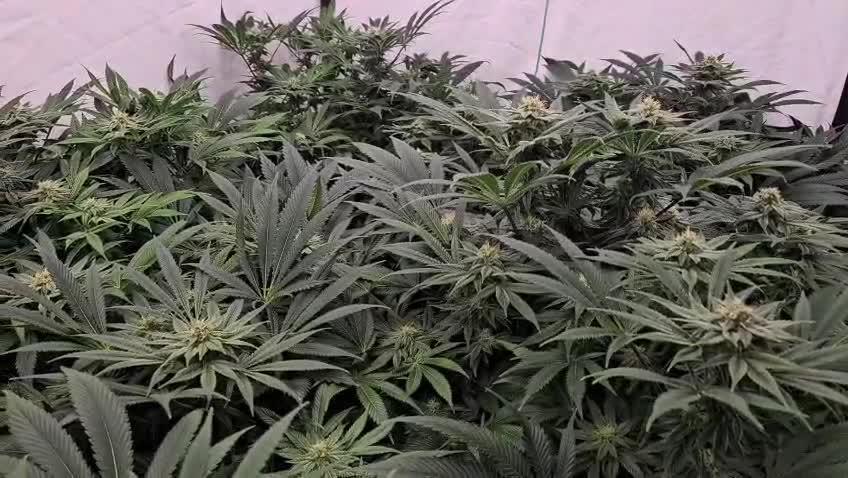
Day 32 of 5th week of Flowering,
This week I have not been able to run the C02 due to the low temps I am having ATM,(not even the 1.5 kw heater is up to the job!)
Normally at this point I would be swapping the L.E.D. lights out with a pair of 600w Hps, However been there b4 and did exactly that but the bud just is not as good and of less strength/dense.
First notice of some pistols turning brown.
All the plants have been removed and defoliation has been strong, They is also a notable difference in smell this week rising a bit over low but still easily managed.( If smells becomes a problem then I will be adding UNA gel to the air out ducting after the fans and filter! )
Ttfn Skully.


Likes
16
Share


@DevilishCherryBlossoms
Follow
I Make 2L Nutrients at a time
To always give fresh Nutrients
I only water with nutrients
Shake before watering.
Mix 30/08/21:
Kelpack 55ml
30/08 - New Nutrient mix
- watered @ 5PM today to further stress Relieve
- Excellent Health and Growth
- Smelling Amazing!
31/08
- New Mix for flowering Boost week 3 flower
Mix
Umya Nutrients :
Flora 2g; Carbon K 2g
Moblend1g (stand 1H for micro Organisms)
Calmag 1ml; Multi Amino 2ml
Molasses 5ml; Kelpack 25ml
- Watered @ 5pm
31/09 - Watered @ 5pm
01/09 - Watered @ 6:32pm
02/09 - got up this morning to some loud smelling MJ Lovin it
02/09 - Watered @ 5:45pm
- Pistils Changing color RED
03/09 - Early morning mini Feed 250ml
- Pistils Adding purple to color Changes
- So turns out on closer inspection that these pistils are orange and dark red not purple as i thought before pic is at the top ^ (* Closer look)
- Watered @ 8:45pm
04/09 - Watered @ 8am
- Watered again @ 6pm
05/09 - Watered @ 11:46am 1L
- added another 1L before she went to sleep today just to see how shed react
- Walked into grow area and she's about to disturb the neighbors cause she's loud tonight !
- End of week 11


Likes
9
Share


@datrobspeoria
Follow
I grew all of my plants the same and with 3 strains and only being allowed to have 5 plants total I have to pick the strongest growers and hope they stay strong and this time for me the gamble payed off nicely with a good harvest.
I would recommend this strain as it grows fast and did not seem to be a picky eater and took in a lot of heavy feedings...
Thanks for checking out my harvest and If you have any questions I will do my best to quickly answer them..


Likes
3
Share


Likes
19
Share


@adam_pawloski87
Follow
Let’s Go Day day 61 from seed !!! This week went real well! As you can see all these girls are starting to stack very well! Everything is pretty much the same, we have switched to fully bloom an these ladies are just Looking super healthy , we are getting a nice smell of grapes on these Ogreberrys ! Bruce Banner is packing crystals like a Mofo too an super stanky , all very happy about this run ! Still got a nice few more weeks of bloom to go let’s watch em stack ! Lets grow lil ladies let’s grow !! Hope you all enjoy an have an amazing productive day ! Peace love an positive vibes to all you Growmies out there Cheers 😶🌫️💨💨💨💨💨🤙🏻 If there’s any questions please just ask I’ll be glad to help !!


Likes
1
Share


@Ninjabuds
Follow
My Soaptini plant is still on the smaller side, but it's finally starting to take off. I think it's going to stay pretty short and stocky, which will be interesting to see.
It's been a challenging week with the constant rain and ridiculously high humidity. Keeping things dry indoors has been a real struggle. Despite the weather, I managed to flip all my feminized photoperiod plants to flower this week. I'm hoping the switch will go smoothly, but with this humidity, it's going to be tough.

Likes
9
Share


@SzkolaZiola
Follow
Day 8 of flower - first lollipopping - away with everything below 2/3 of plants height.
So much leaf matter taken away 😥
Tomorrow is watering and feeding day.

Likes
4
Share


@Kitties_and_Colas
Follow
We pulled her down with approx 90% cloudy trics..not a massive harvest and she could have gone an extra week but we're still playing catch up from our hermi ,we also desperately needed the space..I REALLY like this strain, it's easily becoming a favorite...it didn't last very long the firs time lol...the wife gives it a 7 and I'd say it's a firm 8.5 :)
Processing
Likes
6
Share


@GrowPassionItalyChris
Follow
I surprise anytime with dutchfem strains indoor, easy Girl Scout Kush they started a good flourish, fat buds, bottom buds also big, resin started, sweet smell of fruity mint chocolate kush when you push the nose in her flowers and medium big size of plant look very cute. Was a nice week. I know girl scout kush can purple buds and leaves in last period of flower, I wait this moment. I love this strain indoor.

Likes
65
Share


@Dendegrow
Follow
Week 4 of the flowering phase has arrived, and last week flew by 🌬️🌱. The ladies are thriving, and the buds are now clearly visible! ✨ The flowers are starting to turn darker, which is an exciting sign 🍒.
The first trichomes are already forming, hinting at a very potent strain 💎🔥. While the cherry aroma hasn’t come through yet, removing some leaves revealed an intense, waxy scent – very intriguing! 🌿👃
I’ll keep you updated with daily posts. Drop a like and stay tuned to see how the ladies develop 🌺📸. See you next week!
Woche 4 der Blütephase ist da, und die letzte Woche ist wirklich wie im Flug vergangen 🌬️🌱. Die Ladies haben sich prächtig entwickelt, und jetzt kann man die Buds schon richtig gut erkennen! ✨ Die Blüten beginnen langsam, sich dunkel zu verfärben – ein vielversprechendes Zeichen 🍒.
Auch die ersten Trichome sind schon sichtbar, was definitiv auf einen sehr potenten Strain hindeutet 💎🔥. Das Kirscharoma ist zwar noch nicht zu erkennen, aber beim Entfernen der Blätter wurde ein intensiver, wachsähnlicher Duft wahrgenommen – super spannend! 🌿👃
Ich halte euch weiterhin mit täglichen Updates auf dem Laufenden. Lasst ein Like da und bleibt dran, um zu sehen, wie sich die Mädels entwickeln 🌺📸. Bis nächste Woche!

Likes
2
Share

@ChubbyBudBros
Follow
-
Day 71
I increased the height from the lamp a bit further trying to get about 600-700 ppfd across the canopy, just to help her finish and prevent trichomes from degrading into CBD too fast. Hopefully She will be ready to cut down this week.
Day 72
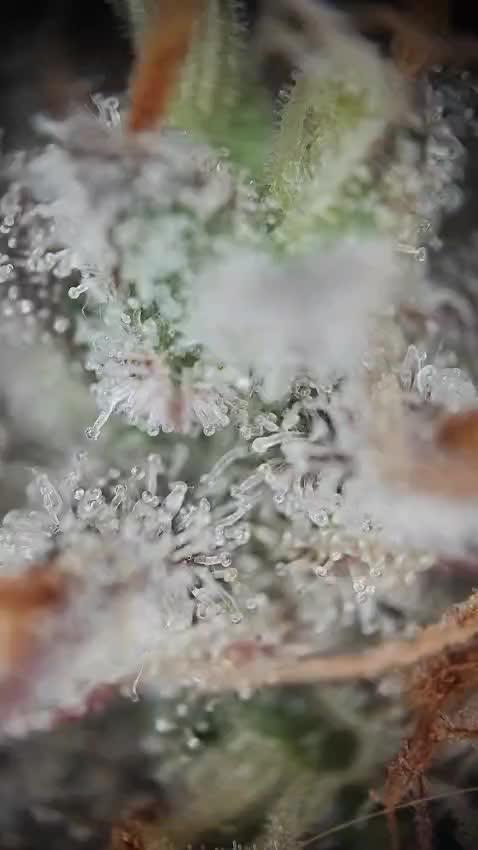
Still seeing a lot of clear trichomes, think we gonna be waiting for a while still. 😅 There's quite a few white pistils node still as well, which makes me believe she is still not done swelling.
Day 73
Still waiting on those trichomes to get cloudy...took some vids today, seems to be easier to get a better peak the the trichomes than just a still shot.
Also had to do another watering with 2L's of water.
Day 74
That darker purple color is getting stronger and stronger every day.
Day 75
Not sure if you can tell from the day 75 pics, but there's actually still so many white pistils. I'm gonna be waiting a while I think 😅
Day 76
Still a lot of clear trichomes for now, but these buds are definitely still fattening up.
Day 77
The pot is dry, but still a lot of clear trichomes, so I guess I will still give her water for now 😅, I prefer the pot to be pretty dry when I harvest, but seeing how she is still gonna be taking 1-2 weeks I'll keep giving her water as I was before. Gave 2liters, but this time only bio-bloom & top-max.


Likes
34
Share


@ILoVeThiSpLaNt
Follow
Cime dure come cemento ricoperte di zucchero. Profilo terpenico fruttato con tocchi zkittlez. Che dire?Non vedo l'ora di fumare anche questa 😊


Likes
4
Share

@DogDoctorOfficial
Follow
🌱 Skywalker OG — Week 6 From Seed
12/12 From Seed · Transition Into Flower
⸻
🔁 Quick Recap — From Seed to Now
Skywalker OG has been grown 12/12 from seed from day one.
No veg phase, no forced speed — just letting the plant express itself naturally while guiding structure gently.
From early life, our approach has been:
• Leaf bending instead of topping
• Minimal stress, frequent observation
• No rush — letting the plant tell us when it’s ready
Up until now, all work has focused on:
• Building a strong, open frame
• Keeping internodes exposed to light
• Preparing the plant for flower without shocking it
Week 6 from seed marks an important moment:
👉 The transition into flower structure, even if pistils are only just starting to show.
This week is less about growth speed — and more about setting the stage.
⸻
✂️ Canopy Work & Plant Training (This Week)
This week we went a little harder than usual, on purpose.
What We Did
• Continued leaf bending, but with more intention
• Light lollipopping of the lower, shaded growth
• Selective defoliation (not a strip-down, not a clean shave)
• Introduced plastic clamps to guide branches outward
Why We Did It
Leaf removal
• Improves airflow inside the plant
• Reduces humidity pockets
• Helps light reach meaningful flower sites
• Removes leaves that were blocking, not contributing
Lollipopping (light)
• Cleans up growth that would never reach the canopy
• Helps the plant redirect energy upward
• Makes future watering and airflow cleaner
Clamps & bending
• Opens the plant instead of stacking it
• Creates multiple dominant tops
• Avoids cutting or topping stress
• Allows gradual correction instead of forcing angles
We don’t see this as “defoliation” in the aggressive sense.
We see it as guidance and clarification.
Nothing here is done in one session or out of frustration.
Everything is done slowly, plant by plant, read by feel.
⸻
🌡️ Environment Update
• Day temperature: ~28°C (successfully raised)
• Humidity: ~65%
• PPFD: ~600–850 (based on plant height and position)
• CO₂: ~900 ppm
As outside temperatures remain cooler, the room itself has naturally become its own heat source:
• More plant mass
• Higher light intensity
• Under-canopy lighting added
This allowed us to stabilize the environment without forcing heaters or extremes, which is exactly how we like to work.
Airflow
• Vortex extraction
• Cross-winds with multiple fans
• Constant, gentle movement across the canopy
No leaf flutter chaos — just steady motion.
⸻
💧 Feeding & Nutrition Strategy
This week marks a clear nutritional transition.
• EC: 2.4
• pH: 6.5 (transitioning to 6.0+ from now on)
From this point forward:
👉 All feedings will be pH 6.0 and above
Why Higher pH Now?
As plants enter flowering, their nutrient priorities shift.
A slightly higher pH improves availability of key elements needed for:
• Flower initiation
• Structural development
• Energy transfer
Nutrient Changes
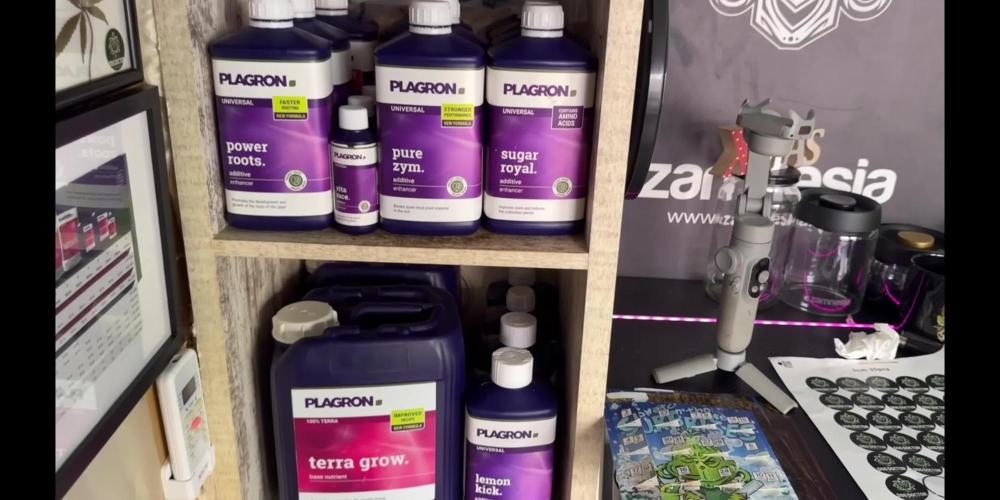
• ✅ Introduced: Terra Bloom — 5 ml/L
• ❌ Removed: Terra Grow
Simple, clean transition — no stacking, no panic feeding.
⸻
🔮 What to Expect Next Week
Expect:
• Stretch continuation
• Tops adjusting to new light exposure
• Faster response at exposed nodes
• More visible flower initiation
Do NOT expect:
• Immediate bud stacking
• Explosive flower size
• Perfect symmetry overnight
This week is about positioning, not payoff.
The work done now decides how easy (or hard) the next 4–6 weeks will be.
⸻
🧠 Final Notes
This is our way of reading the garden.
It’s our humble opinion, shaped by experience, observation, and patience.
Everyone is encouraged to:
• Try this technique
• Try other techniques
• Combine techniques
• Or do the exact opposite
Plants are teachers — not rules.
⸻
🙏 Thank You
Big thanks to:
• Grow Diaries for the platform
• Our sponsors and supporters
• The OGs who’ve been here since day one
• The new faces joining the journey
• The lovers
• The haters (they keep things interesting 😄)
And most of all — the community that keeps learning together.
See you next week 🌱
Let’s keep reading the plants.
Community Note
Due to YouTube community guidelines, our educational channel was taken down.
While we firmly believe the content was purely educational, we respect YouTube’s decision and are actively exploring alternative platforms to continue sharing this work.
📡 Please stay tuned.we never quit https://www.youtube.com/@DOGDOGTHEDOCTOR NEW STAY TUNED
🙏 Thank you for your patience and continued support.
FOR DISCOUNT CODES AND MORE JUST FOLLOW THE LINK https://website.beacons.ai/dogdoctorofficial
📲 Don’t forget to Subscribe and follow me on Instagram and YouTube @DogDoctorOfficial for exclusive content, real-time updates, and behind-the-scenes magic. We’ve got so much more coming, including transplanting and all the amazing techniques that go along with it. You won’t want to miss it.
GrowDiaries Journal: https://growdiaries.com/grower/dogdoctorofficial
Instagram: https://www.instagram.com/dogdoctorofficial/
YouTube: https://www.youtube.com/@dogdoctorofficial Deleted by Youtube
Vimeo : https://vimeo.com/dogdoctorofficial Under construction stay tuned ⸻
Explore the Gear that Powers My Grow
If you’re curious about the tech I’m using, check out these links:
🔆 Lighting & Environmental Control
• Future of Grow — Advanced LED lighting technology
https://www.futureofgrow.com/
DISCOUNT CODE: DOG20
• Lumiflora — Under-canopy LED lighting
https://lumiflorade.com/
• TrollMaster — Environmental controllers and automation gear (past collaboration)
⸻
Genetics
• Zamnesia Seeds — Genetics used in this project
https://www.zamnesia.com/
⸻
🌱 Soil, Substrates, Boosters & Root Support
• Plagron — Substrates, bio mixes, and supportive products
https://plagron.com/en/
⸻
🎒 Storage, Curing & Preservation
• Grove Bags — Curing and storage solutions
https://grovebags.com/
⸻
📸 Photography Equipment & Tools
(Not sponsors, but part of my creative toolkit)
• Sony A6700
• Sony full-frame macro lens + few more
• Stacking photography workflow - learning
• iPhone (for behind-the-scenes shots)
We’ve got much more coming as we move through the grow cycles. Trust me, you won’t want to miss the next steps, let’s push the boundaries of indoor horticulture together!
As always, this is shared for educational purposes, aiming to spread understanding and appreciation for this plant. Let’s celebrate it responsibly and continue to learn and grow together.
With true love comes happiness. Always believe in yourself, and always do things expecting nothing and with an open heart. Be a giver, and the universe will give back in ways you could never imagine.
💚 Growers love to all 💚
📸 P.S. – The Eye Behind the Lens
All photos in this diary (for now — except for the ones showing the camera, which I took with an iPhone) are taken with a Sony A6700 paired with a Sony full-frame macro lens and a few more.
Photography is part of the story — it’s how we share the fine textures, the glow, and the quiet details that words can’t always capture.
I’ve also started experimenting with photo stacking — a technique where multiple images, each taken at a slightly different focus point, are layered together to create one perfectly sharp image from front to back.
It’s not digital enhancement or AI; it’s pure photography — a way to reveal the plant’s beauty in microscopic depth, from trichome to petal.
You’ll even see a few shots of "ghost me" capturing the shots — camera, lens, setup — because every grow deserves not just to be cultivated, but documented like art.
FOR DISCOUNT CODES AND MORE JUST FOLLOW THE LINK https://website.beacons.ai/dogdoctorofficial
NEW DISCORD - Official Server Invite Link : https://discord.gg/ksjAkA5T74


