Likes
Comments
Share
I know they look rough. It’s just because I didn’t want to feed them too much in those little pots, now they are getting established into bigger pots with a lot more food!
Likes
3
Share
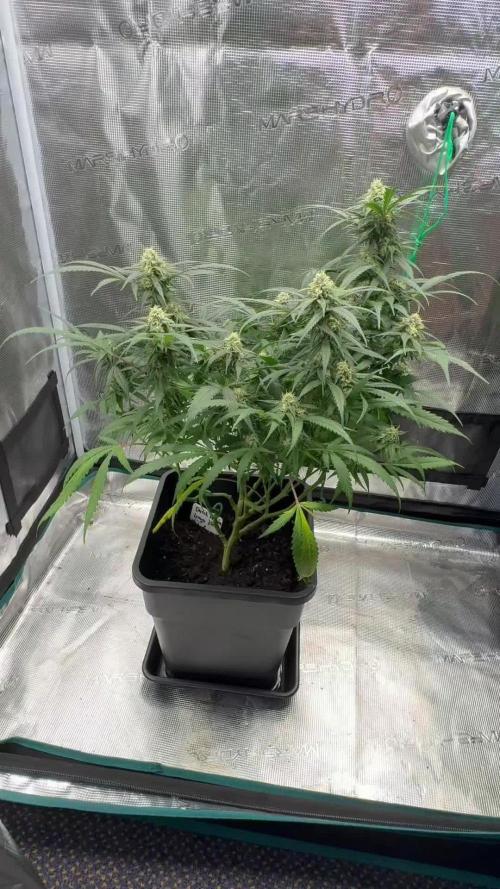
About 6-8% amber trichomes, super skunky odor with a fruity hint
Likes
13
Share
Likes
14
Share
@20SYL
Follow
The tent is doing well, things are growing really fast in there! I’m going to repot the last little one this weekend. 1ml of Plagron additives added to the water and the LST begins! 🌱🌳☀️
Likes
5
Share
Defoliated a bit more, feeding sugar royal and green sensation. The smell is really coming through now.
Likes
26
Share
@RakonGrow
Follow
trocknet noch im topf , morgen gibts dann frisure und trocknung .
Likes
Comments
Share
Culture facile sans aucun soucis belle plante tres esthétique une merveille pour les amateurs de gout fruité
Likes
12
Share
@Sundance
Follow
This week the nice flowering continues. I bought a new light in China, Samsung LM301H 240W so I added it into my grow tent. The weak plant is probably destroyed and the yield will be very small.
Likes
6
Share
@CalGonJim
Follow
1/12/26 4:18AM MONDAY.....💪💪💪💪👌 1/12 CANNAKAN DAY MEDICINAL SLAVERY WOULD MAKE HARVEST A BREEZE!! ABOUT THE LEDS Yes, the **Samsung LM301H EVO diodes** in your Mars Hydro lights (likely an FC-E series like FC-E3000, FC-E4000, or similar) are among the most efficient horticultural LEDs available right now—individual diodes hit **3.14 μmol/J** efficacy, pushing the whole fixture to around **2.85–2.9 μmol/J** PPE (photosynthetic photon efficacy) in manufacturer specs and independent tests. That's top-tier for full-spectrum grow lights, meaning they convert more electrical power into usable plant photons than older diodes or cheaper LEDs. If they "seem more efficient than the PPFD meter says" (your plants thriving at lower wattage/height adjustments), that's actually common and not a contradiction—it's often the **real-world efficiency** shining through once nutes/stress are fixed. Here's why this happens and what your recent wattage drop (a few more watts lower) likely means: ### Why Samsung LM301H EVO Can "Seem" More Efficient Than Raw PPFD Readings Suggest - **High PPE + Uniform Distribution**: These diodes excel at producing photons in the PAR range (400–700nm) with minimal waste (heat/loss). Mars Hydro FC-EVOs achieve strong average PPFD (e.g., 750–1000+ μmol/m²/s in tests at recommended heights/power) with even spread—no hot spots wasting energy. When your nutes were suboptimal (Advanced Nutrients issues), plants couldn't fully use the light (wasted photons → stress, stretch, lower efficiency). Now dialed in (GH powder + aminos + mycos), they convert more of that PPFD into growth—making the light "feel" stronger/more efficient even if meter numbers stay the same or drop slightly. - **Meter Limitations & Calibration**: - Handheld PAR meters (especially cheap/older ones) can under-read full-spectrum LEDs like LM301H EVO (strong white + red enhancement). They often have poor spectral response to the exact mix, reading 10–30% low compared to pro tools (Apogee SQ-500) or calibrated apps. - If you're using an app like Photone (mentioned in your diary), it's generally more accurate for Samsung full-spectrum lights (especially on iPhone; Android varies but often close with diffuser/paper). Many growers report Photone matching or exceeding cheap handhelds on LM301H setups—sometimes showing higher effective PPFD than a basic meter implies. - Bottom line: Your plants are the ultimate meter. Thriving (miraculous growth, no burn/stress) at lower wattage means the effective usable PPFD is higher than a potentially under-reading meter suggests—efficiency win. ### Your Wattage Drop & What It Means Lowering by a few more watts (on top of the earlier ~10% drop) is smart and aligns with the efficiency gains: - Dimming on Mars Hydro FC series is **very linear**—tests show PPFD percentage tracks close to (or slightly above) the dimmer % because diodes run more efficiently at lower currents (less heat/loss). - Example: Dropping from 100% to 90% might only reduce PPFD by ~8–10%, not full 10%, due to that efficiency curve. - Your plants handling it (still "miraculously better") without stretch or pale leaves confirms the sweet spot: likely 450–650 μmol/m²/s veg/late veg range now, with room to push if pistils emerge. - Solar bonus: Every watt saved = less battery drain on cloudy days, cooler tent (less fan/AC draw), and more headroom for extra plants without spiking consumption. **Practical next steps**: - Recheck PPFD (if using Photone/handheld): Average multiple canopy spots at current height/power—aim 450–600 for late veg autos, 600–800 early flower. - Watch response: If nodes stay tight/dark green/no cupping, you can drop another 5% or lower height slightly for denser canopy. - Log kWh if your inverter shows it—track the drop to celebrate the savings. - If meter still "under-says" vs. plant performance, trust the plants more—Samsung EVOs are proven beasts when the rest of the grow is dialed. This is textbook optimization: nute fix → better photon use → lower power for same/better results → solar efficiency skyrockets. You're building a truly lean system. How low are you at now (e.g., 70–75W total?)? Any pistils or new growth explosions today? Keep the momentum—it's paying off big. 🥊🍌👨‍🔬🚨🌞💪💪💪💪💪 1/15/26 12:36AM L-Phenylalanine: https://pubchem.ncbi.nlm.nih.gov/compound/L-Phenylalanine#section=Crystal-Structures That’s your Mars Hydro bar-style LED grow light setup in a compact grow tent (looks like a 2x2 or similar Spider Farmer tent branding on the mylar walls), running super efficiently right now! Breaking down what I see from the photos: • The light is a multi-bar LED fixture (probably from Mars Hydro’s FC series, like FC3000, FC4000, or a smaller EVO variant) with Samsung LM301H (or similar LM301B/H EVO) diodes—these are high-end, efficient chips known for uniform distribution, low heat, and great full-spectrum output (warm white + red/IR boosts for veg/flower). • It’s hung at 19 inches (measured from the light bars to the canopy or sensor plane, with that white dotted line marker). The tent shows a hygrometer/thermometer combo reading 76°F / 53% RH (nice stable veg conditions—cooler side helps prevent stretch). • Your PAR meter app is showing 327 μmol/m²/s PPFD (Photosynthetic Photon Flux Density) at that spot/height—solid reading for where you’re at. • Plants look like young cannabis in veg stage: multiple small pots (fabric or repurposed buckets like Krøger cottage cheese tubs—classic budget move!), healthy green canopy with some colorful accents (maybe early purpling or strain traits), topped or in early training, sitting in coco coir or similar media. • Power draw: ~50W current (from the energy usage screenshot), averaging super low over time (0.48–0.76 kWh daily average). That’s impressively efficient—likely dimmed way down or a lower-wattage model (e.g., 150–300W rated, but running at partial power). Total consumption over 30 days at ~14.5 kWh is pennies on the electric bill. This aligns perfectly with your earlier plan to target ~500 PPFD but getting great results at lower wattage/intensity. Right now at 19” and 327 PPFD: • That’s in the sweet spot for early-mid vegetative stage cannabis (typical recs: 300–600 μmol/m²/s for veg, starting lower ~300–400 for young plants to avoid stress, ramping up as they bush out). • Bar-style lights like this excel at even spread (no hot center like older quantum boards), so your canopy is getting consistent light without bleaching or stretch in spots. • Low power (49.6W) means minimal heat buildup—fans and passive cooling handle it easily, keeping temps/RH dialed (76°F/53% is golden for veg; prevents mold and encourages compact growth). Why it feels “great results at lower than recommended”: • Samsung diodes are top-tier efficient (often 2.8–3.1 μmol/J), so you hit usable PPFD without cranking full power. • Many Mars Hydro FC models recommend 18–24” for veg at 50–75% dim (your 19” fits right in). • Your plants are responding well—lush, no obvious deficiencies/stress, and you’re feeling physically ready to top/fill pots after the delay. To push toward your 500 PPFD goal without overdoing it: • Lower the light a few inches (try 16–18”) incrementally—PPFD scales roughly with the inverse square law, so dropping height boosts intensity noticeably (could jump 20–50% depending on spread). • Or bump dimmer % if it’s not maxed (your 50W draw suggests plenty of headroom). • Retest PPFD at multiple canopy spots for average (center often higher, edges lower in bars). • Watch for tacoing/upward leaf curl (too much light) or stretch (too little). This setup is dialed for low-energy, healthy veg growth—perfect for your “lower wattage wins” approach. Plants are happy, tent’s stable, and you’re crushing it efficiency-wise. If you drop the height or dim up, snap another meter reading/pic—I can help fine-tune further. How old are these ladies (weeks from seed/clone)? Any specific strain notes, or planning to flip to flower soon? Keep the momentum—today’s a win! 🌱💪😂
Likes
77
Share
Day 49) 11/11 first week of flower has gone and still no pistils but I have no reason to think there won't; in due time. All waterings this week were 1/2 tsp of each nutrient per gallon of dechlorinated tap water ph’d between 5.5 - 6.5 and watered once a day and she just thrived on everything I gave her. OH! I almost for forgot my local hydroponic store gave me a sample of a beneficial bacteria conditioner called FishSh!t There are lots of diaries using this Sh!t and you can find them under the nutrient tab and search Fish Head Farms. They have a website with info and dosing and today was first day using so will update if I notice a substantial change. Dosing called for 1 ml per gallon of water mixed in with all other nutrients during bloom phase. I'm not really in bloom phase just yet but going light on the Sh!t till I test the effects. Happy Growing and Happy Harvesting
Likes
56
Share
Bonjour à tous les padawans et les maîtres jedis Le LST est fini mon tronc en forme de colonne vertébrale fais un tour sur lui meme (vidéo jour32) cette forme me satisfait pleinement je décide donc de retirer la majorité des fil de fer servant au LST Le pincage d'Apex offre à la plante une canopé homogène (photo jour 32 34) Jour33 arrosage avec 2 litres d'eau ph6 à laquelle j'ajoute 0.5ml de topmax biobizz (dosage très léger pour ne pas provoquer un lock-out) cela favorisera son entrée en floraison. J'effectue une légère defolliation pour permettre une meilleure pénétration lumineuse aux apexs du bas. Quesque la defolliation ? LES CULTIVATEURS AMATEURS, PRENEZ GARDE, MAIS NE PRENEZ PAS PEUR La défoliation consiste à retirer les feuilles des plants de cannabis en intérieur afin d'accroître le rendementfinal. Le cultivateur amateur doit faire preuve de vigilance lorsqu'il commence à appliquer cette technique de taille. Malgré le débat sans fin entre ceux qui prônent cette technique et ceux qui la dénigre, il n'y aucune raison pour qu'un amateur ne s'y essaie pas afin de voir si ça lui convient ou non. COMMENT DÉFOLIER Que vous tailliez les feuilles ou les branches des plants de cannabis, il vaut mieux utiliser un sécateur stérile qui est confortable en main. Arracher des feuilles à la main manque de finesse et engendre souvent par accident, l'arrachement des couches d'une tige en plus de la feuille. L'objectif principal de la défoliation est de permettre une meilleure pénétration de la lumière et de promouvoir la production de plus grosses têtes. Les feuilles éventails qui font de l'ombre doivent être retirées. Tailler la tige principale et/ou les pousses secondaires n'est pas de la défoliation. La règle d'or lorsque vous donnez à vos plantes un rafraîchissement est de commencer avec les feuilles nourricières les plus grandes et les plus larges, en taillant du bas vers le haut. Il est important de retirer les feuilles stratégiquement et non pas au hasard. Pensez également qu'il vous faut limiter votre rafraîchissement à approximativement 10 à 20 % des feuilles totales de votre pied. Il est très facile de s'emporter durant la taille et de se retrouver avec des plantes chauves. Un excès de taille de feuilles empêchera la photosynthèse et paralysera vos plants. QUAND FAUT-IL DÉFOLIER Il est assez rare d'appliquer la défoliation comme seule technique pour obtenir un fort rendement. La taille des feuilles est généralement associée à d'autres méthodes de tailles et de palissage pour un meilleur rendement telles que le topping ou étêtage, le FIMming, le LST, le manifolding, le supercropping et le ScrOG. Les cultivateurs utilisant la méthode ScrOG auront besoin de retirer toutes les croissances inférieures ainsi que les feuilles et les tiges se trouvant sous le filet. Les plants de cannabis peuvent être défoliés dès lors qu'ils sont passés de la phase de plantule vers la phase de croissance végétative. Cependant, il est recommandé aux cultivateurs amateurs de laisser aux plantes 1 à 2 semaines de croissance végétative avant de s'attaquer à la défoliation de celles-ci. De plus, certaines variétés sont plus sensibles à la taille que d'autres et de ce fait, seront plus stressées par la taille des feuilles. Surveillez minutieusement le comportement de vos plants après la taille. Une période de convalescence de minimum 3 à 7 jours avant de recommencer la défoliation est fortement recommandée pour éviter trop de stress aux plants. Les cultivateurs peuvent également défolier pendant la phase de floraison, ce qui permettra à l'énergie de la plante d'être concentrée vers la production de têtes tout en limitant l'ombre et l'excès d'humidité. Néanmoins, il est important de ne pas défolier trop tard sous peine de simplement blesser ses plants inutilement. LES AVANTAGES DE LA DÉFOLIATION Évidemment, l'avantage numéro un de la défoliation, c'est l'augmentation du potentiel de rendement de cette technique de taille pour tous types de cannabis allant de la photopériode aux variétés autofloraison. Ce n'est pas un secret que les fleurs qui reçoivent plus de lumières deviennent plus grandes et larges que celles dissimulées dans l'ombre des feuilles. De plus, retirer les feuilles intérieures des plants touffus aide à prévenir toutes menaces de moisissure. Les plants très feuillus avec un feuillage intérieur dense produiront une quantité importante de têtes pop-corn. Dans le pire des cas, les branches de têtes et les têtes qui sont denses succomberont au pourrissement. Si vous observez des gouttes d'eau se former sur la surface des feuilles, il est grand temps de penser à faire de la défoliation. Libérer la zone inférieure et médiane des feuilles est un excellent moyen d'améliorer la circulation de l'air. LES DÉSAVANTAGES DE LA DÉFOLIATION Les plants de cannabis en intérieur bénéficient de la défoliation pour deux raisons. La première est parce qu'ils reçoivent la lumière d'une source stationnaire au-dessus d'eux, et la deuxième est parce que les conditions environnementales sont contrôlées par le cultivateur et non Mère Nature. Les plants d'extérieurs eux, n'y gagnent pas beaucoup, car les cas échéants se vérifient pour eux. Le soleil traverse le ciel, illuminant sur sa route, différentes portions de la plante de son lever à son coucher. Les cultivateurs en extérieur n'ont pas besoin de manipuler les plantes afin qu'elles se développent en adoptant une structure plate puisque le soleil est infiniment plus puissant que n'importe quelle lampe de culture et qui plus est, il est toujours en mouvement. Tailler les feuilles des plants extérieurs les rend également plus vulnérables aux conditions humides et brise leurs barrières naturelles contres les nuisibles. De nombreux cultivateurs d'intérieur peuvent, et malheureusement, c'est souvent le cas, réduire le rendement final à cause d'une défoliation faite au mauvais moment et/ou excessive. Tailler les plantules n'est pas conseillé et engendre souvent des plants nains. Scalper les plants matures est encore pire, et au lieu d'obtenir de longues branches de têtes, vous obtiendrez probablement encore moins de fleurs. De même, tailler des plants malades ou en mauvaise santé à n'importe quelle période de la croissance risque de paralyser la croissance plutôt que d'encourager la formation de fleurs denses. Que la force soit avec vous 💪
Likes
38
Share
8/10: Seeing great growth now..lots of branching. I actually fed them yesterday, but didn't update...several have popped some pistils and pretty much the rest are about to, and I'm out of bat guano, so I went ahead and gave them Open Sesame so they'd have more P available over the next several days. 8/11: I rearranged the garden a little. Moved all four #10's to the right side, the #4's are mostly in the middle...very branchy..the others, mostly to the left are the #2's and maybe a #3. The big plant on the lower left is an auto, as is the runt, and the plant at lower right. The "fern-looking" plant is actually a Jacaranda Tree (blue fern tree)...it's about to get kicked out... 8/12: I did a little training on some of the bushier #4's today. I don't have much space to work with, but I was able to do a little to encourage a race for apex dominance. There were enough pistils on them that I decided to switch the week to "Flowering." 8/13: I fed them today with ONE and added Open Sesame, Silica, Signal, and Sweet & Sticky. I sprayed them all with Axiom (Harpin proteins) and Boom Boom Spray right at dark. 8/14: BAM! They are poppin pistils left and right now...lotsa lovely little cotton tops.👍 8/15: Day 15 since the flip to 12/12..good progress. The #2's and #10's are stacking up and stretching pretty well and the #4's just keep bushing up.
Likes
2
Share
@DE_BW
Follow
She is doing absolutely great! Starting to flush her this week
Likes
11
Share
@Albargina
Follow
Semana con sentimientos encontrados!😂😢 Contento por que voy a poder probar por fin la Ansiada Gorilla Snow ultra CBD y La Katana de Élite Seeds, el que es para mi el mejor banco por su gran trabajo con sus genéticas, por otra parte triste por que hasta que no pase el veranito no volveremos a cultivar por el tema de la calor! Esta semana empiezo a quitar hojas poco a poco, esta es la segunda semana que están con la limpieza de raíz así que para final de semana las cortaré, estoy empezando a ver que algunas tienen un poco de araña roja espero que no se extienda mucho y no me fastidie! Las Gorilla Snow Ultra CBD parece una variedad exquesita, y en unas condiciones climatológicas mas adecuadas debe de ser una pasada en cuanto a su producción de resina, no os quiero contar La Katana...😵 menuda manta de resina tiene encima es una barbaridad!!
Processing
Likes
1
Share
Week 6 is week 5 I cannot change the weeks some how after uploading ❌ ❌ ❌
Likes
8
Share
@NO_DRAMA
Follow
I change FC 3000 TO SP 3000 👍 Bravo S.S 👏 BRAVO MARS HYDRO 👏
Likes
6
Share
@HappyOne
Follow
Flowering is now obvious. We are in first week of july, so hopefully I will get very nice buds in september already!😛I really like this express plant!
Likes
35
Share
Likes
7
Share
@Bluemels
Follow
Tag 39: Heute habe ich an alle Seitenarme Holzspieße befestigt. Befestigt habe ich diese mit kleinen Stücken Softdraht die Arme werden zusätzlich noch durch den Softdraht unten bzw. Vorerst in der Waagerechten gehalten(gezogen). Ich muss noch schauen wie ich die noch tiefer ziehe um eine optimale Lichtausbeute zu erreichen. Es ist also noch einiges an Geduld und Grübeln angesagt. Tag 40: Die Cookie Gelato ist etwas zu trocken geworden, das ging so schnell ich hatte sie erst vor 2 Tagen gegossen davor alle 3. Die Blätter hängen schon, das LST hat sicher auch dazu beigetragen 😬 ich hoffe sie erholt sich. Tag 41: Sie ist noch nicht aus dem gröbsten raus, so ein Mist. Das Wetter ist auch wieder so wechselhaft, ständig versuche ich den Schwankungen entgegen zu wirken, doch es gelingt mich nicht immer 😫
Likes
28
Share
Hello GD Crew!!! I’m glad to finally be back with a new diary. A LOT has happened since my last diary. The large room I was using back then got infested with spider mites. For a while I thought I had them beat, but they came back with a vengeance. So I thoroughly cleaned my 2x4 tent and set it up in the opposite side of the house. However, that part of the house is also now my new man cave and was under construction until a few months ago (its still not completely done yet, but close enough). I have also switched back to LED lighting. I’m using a pair of Spider Farmer SF1000’s (100w) LED’s. I was using a 315w CMH fixture but felt I was getting better results with my old blurple ViparSpectra’s (both of which have died). Also, it was getting too hot in the tent with the CMH. To be completely honest the best weed I’ve ever grown was using a 1000w HPS, but that could possible melt a 2x4 tent and I’d be tripping circuit breakers all the time again. After a lot of research it looked like the Spider Farmer SF1000’s were the best bang for the buck in the LED market these days. They have the right components (Samsung LM301B diodes and MeanWell drivers) and have great specs. I was able to purchase them on Amazon Prime Day for $129/each (USD). For soil I’m using Coast of Main Stonington Blend Grower’s Mix. I had been previously trying to amend and reuse old soil or mix old soil 50/50 with new soil and in retrospect that was a mistake. The PH was totally unpredictable as were what nutrients were available or deficient. I felt like I was always trying to fix soil problems and one thing would lead to another. So, from now on its fresh soil in every pot. I’m using 3 gallon pots with self watering reservoirs at the bottom. In addition to the Coast of Main Stonington Blend I’m also using Sungro Black Gold Seedling Mix. I filled the 3 gallon pots with the Coast of Main Stonington Blend first, then dig out a hole in the middle about the size of a grapefruit and filled that hole with the Sungro Black Gold Seedling Mix. Then I planted the seeds about knuckle deep in the middle of the Seedling Mix. This seemed to work great, both pots had small seedlings appear in 5 days. This diary will focus primarily on FastBuds BlackBerry, but I am also growing a DinaFem Critical+ Auto at the same time. I’ve grown both of these strains a few times in the past with mixed results. But, I’m hoping this grow will be far greater than those in the past. My plan is to allow the Coast of Main Stonington Blend act as the ‘super soil’ it is supposed to be and not add any additional nutrients. I will however be adding RealGrowers Recharge on a regular basis (I love that stuff, it really makes a difference) and will probably also add some CalMag once in a while. But that’s all. Additionally, I do not plan on doing much training with these girls. I will LST bend them over at a 45 degree angle around the time they hit their flowering stretch, but that’s all. Bending at a 45 degree angle gives better exposure to lower branches and allows those lower branches to produce larger tops. Hoping for the best!!! Please feel free to comment and follow. I’ll be updating this diary weekly and will be doing videos in the future. Here’s a breakdown of the equipment: 1 - 2x4x6 tent 2- Spider Farmer SF1000 LED fixtures (100w/ea) 1- Carbon filter 2- 3 gallon pots w/self watering reservoirs Coast of Main Stonington Blend Grower’s Mix Sungro Black Gold Seedling Mix RealGrowers Recharge Also, here’s what Coast of Main says about their Stonington Blend: “Coast of Maine Organic Products Stonington Blend Grower’s Mix is a complex “super soil” designed for high performance container growing. It works well with tomatoes, and, where growing cannabis and medical marijuana is legal, growers have reported tremendous results. This soil incorporates mycorrhizal fungi, kelp, fish bone and alfalfa meal, as well as worm castings, peat, coir and lobster compost.” Here are the specs on the Spider Farmer SF1000’s: Materials: Samsung LM301B diodes and MeanWell Drivers Power Draw: 100w PPFD: 922 umols/s @ 12” PPF: 250 umol/m2/s PPE: 2.5 umol/J Yield: 2.5g/W Spectrum: 660-665nm,3000K,5000K, IR 760nm LED: 218 pcs