




Likes
53
Share

@The_outdoor_guy
Follow
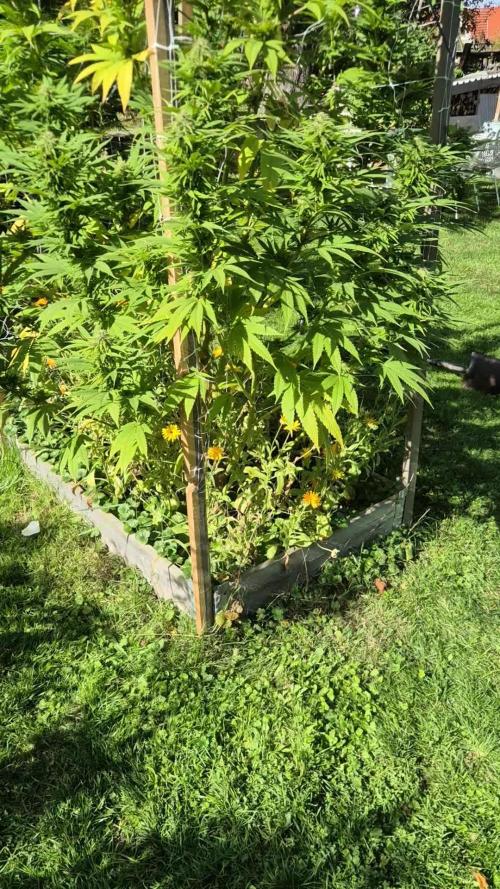
23 September, "good weather, bad news"
Now we r in week 6 of flowering and the things had a turn towards some shit.
I think the #1 took the rainy weather of last week not as good as I thought. In the last days i took 2-3 buds out because of Budrot. Not too bad I thought. And then td i had actually time to take a real close look and it was fucked, a total shit show. I had to take out at least 15, quite juicy thick as buds. Very early stage Budrot. Total of around 200-250 gramm wet weight, lost. I have the feeling I was not paying proper attention... my bet. I also dont know what the exact reason for this is, for sure some part the rain, but maybe also the genetics? My treatment? Should have watered much earlier with calcium? Bugs/dirt? Idk, it really took a toll on my motivation, cause so far it was looking really good :/
Also the question, is there more budrot comming?! Should i harvest some of the thickest headbuds already?! Or should I be pacient and trust in the resilience of #1?! Any advice guys?
The weather is gonna be so nice...soo idk
Beside from that:
#2 is doing fine, cause its 1-2 weeks behind #1. Its buds are not that dense yet, so that was maybe good.
The weather is gonna be really good in the next 10 days. Perfect conditions.
I watered both of them with a bit of CalMag and Molasse... hope they will like it.
One good news is #2 broke the 2 meter barriere, literally 200,5cm tall, real cool. This is the first plant i have that is this big.
What would you guys do (healthhunterfarms? haha) in my situation?! Wait? Get some Harvest in?
I would just love to see how thick they can get, but I also dont wanna harvest nothing :/



Likes
51
Share


@MadeInGermany
Follow
Flowering day 73
since time switch
to 12/12 h.
Hey guys :-)
Finally the time has come .
The lady was harvested and hung upside down in the dry tent 😍.
Before that, she stood in the drying tent in complete darkness for 2 days and the large leaves were removed.
The small leaves stay attached during the drying process so that they protect the buds and allow them to dry more slowly and evenly :-) .
In the dry tent, the temperature is 18-19.5 degrees and the humidity is 54-58% 👍.
In this environment they are now allowed to hang for 10-14 days before they are fine-tuned and trimmed clean by hand.
then after trimming they come to ferment for 6-12 weeks in dark jars with bobeda packs 62% to keep the perfect humidity.
After a few weeks, the Boveda packs 58% are used so that they can slowly dry out :-) .
Of course there is one last update after trimming.
Until then, I wish you a lot of fun with the update.
Stay healthy and let it grow 💚🙏🏻
👇🏼👇🏼👇🏼👇🏼👇🏼👇🏼👇🏼👇🏼👇🏼👇🏼👇🏼👇🏼
You can buy this Nutrients at :
https://greenbuzzliquids.com/en/shop/
With the discount code: Made_in_Germany you get a discount of 15% on all products from an order value of 100 euros.
👇🏼👇🏼👇🏼👇🏼👇🏼👇🏼👇🏼👇🏼👇🏼👇🏼👇🏼👇🏼
You can buy this strain at :
Clearwater Seeds
Water 💧 💧💧
Osmosis water mixed with normal water (24 hours stale that the chlorine evaporates) to 0.2 EC. Add Cal / Mag to 0.4 Ec Ph with Organic Ph - to 5.8 - 6.5
MadeInGermany

Likes
58
Share

@FatnastyzBudz
Follow
1-10 Day 78 Day 32
- First full dose of Green sensation today
- Per Gallon: 1.5ml Cal Mag, 4ml Green Sensation, 8ml Coco A+B - 714ppm @ 6.0ph
- 2500ml, runoff is 803 @ 6.6ph.
- Still giving an extra liter at midday
1-11 Day 79 Day 33
- Using the same mix I had left over from yesterday, but diluted with plain RO water to bring down all PPMs.
- 589ppm @ 6.2 ph
- 3500ml, runoff is 815@ 6.1ph
- Will start to lower the coco A+B tomorrow
1-12 Day 80 Day 34
- 1.5ml Cal Mag, 4ml Green Sensation, 7ml Coco A+B - 660ppm @ 5.9ph
- 3500ml, runoff is 716 @ 6.0ph
1-13 Day 81 Day 35
- 1.5ml Cal Mag, 4ml Green Sensation, 6ml Coco A+B - 660ppm @ 6.1ph
- 3000ml, runoff is 721 @ 6.1
1-14 Day 82 Day 36
- 1.5ml Cal Mag, 4ml Green Sensation, 5ml Coco A+B - 573ppm @ 6.0
- 3000ml, runoff is 690ppm @ 5.9ph
1-15 Day 83 Day 37
- 1.5ml Cal Mag, 4ml Green Sensation, 4ml Coco A+B - 543ppm @ 6.1 ph
- 3500ml, runoff is 650 @ 6.3
- Turns out that a liter of coco A+B is not enough for 4 plants LOL....so, I'm about out. I'm going to switch up I guess to Advanced Sensi Bloom A+B. So to get ready for this, me and chatgpt came up with a plan. Tomorrow I will flush out everyone with cal mag water, reset them, and then slowly start to introduce Advanced Nutrients.
1-16 Day 84 Day 38
- Resetting for Advanced Nutrients today!
- Per Gallon: 0.5ml Cal Mag, 2ml SLF - 33ppm @ 6.0ph
- 7000ml, runoff is 378 @ 6.3
- Will start low on the new Advance A+B tomorrow per ChatGPT
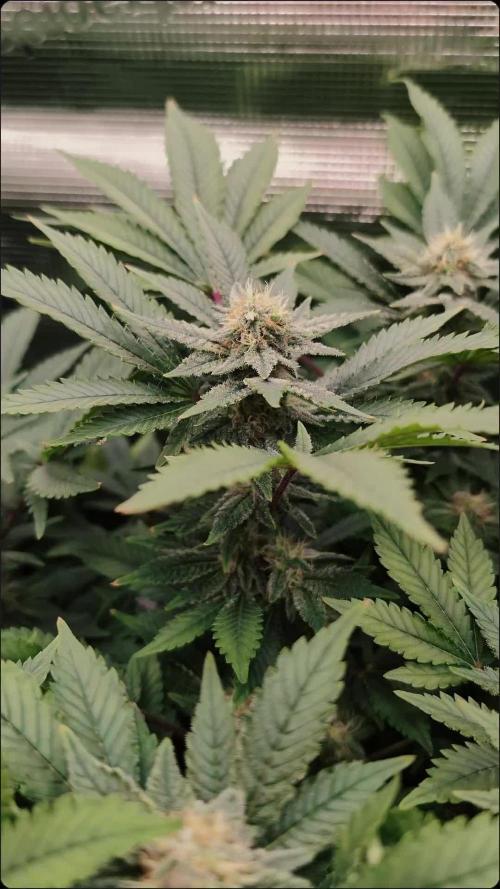
Fem 9 smells great, sweet like. Her buds are coming in big. I lover her size and she is perfect for a scrog.
Likes
24
Share


@CovikLaFlaire
Follow
I found out that my ph was off too, so the plants look ok if we take all my f ups in count.

Likes
26
Share


@KingSalomonsWeed
Follow
Joa, die Gelato ist super stable. Gebrochener Hauptstamm. Egal. 2 mal, auch egal. Sie ignoriert es einfach. 😍
Sensi Seeds
Good looking girl.
Duftet hervorragend.
Aus dem zelt kommt eun frischer Bananen angehauchter treibhausduft.
Sehr angenehm.


Processing
Likes
12
Share


@ThatoneAKguy
Follow
Now this side of the tent seems to be doing great. At first I thought it was the air circulation with the other side so I’m still digging into that. Either way this is about these two ladies and I see the forming of pistils and can’t wait to see what kind of stretch they get into in the upcoming weeks. As for the coco vs. the rockwool way I’ve done it in the past I’m leaning towards the rockwool way. It’s easier and thus far the plants I get from it are larger. It consumes about the same amount of water although less nutrients.


Likes
16
Share


@AestheticGenetics
Follow
4/1/25
She has super long, almost spider web type pistils that are super beautiful. I can see the calyxs packing on under neath the pistils and forming the buds.
She has a nice stacking to her. Maybe 6+ nodal cola.
Shining, fuzzy, glistening trichomes stretching out across the fan leaves.
Top Dressed with 2Tsp of Bloom, 1tsp of Microbe Charge, and 1Tsp Bloom Booster.
Ive also been trying a new method for the top dressing efficacy. I got the idea while watching build a soil using the earth box.
I have started covering the soil with some aluminum foil to kind of act as a cover so the feeder roots will come up to where the top dressing is. which seems to be working fairly well and simply.
4/6/25
She is producing super nicely so far. Seems to be thinner, longer buds. But i can visibly see the buds forming calyxes underneath the pistils. Very bulbous and full calyx stacking
4/7/25 the buds are starting to pack on some weight. everything looks happy and

Processing
Likes
11
Share


@Newbie5648
Follow
All looking great. Bud growing. 😃😃😃
Cant believe it. Going nicely. Just a very long patient wait.
Eager to finish so can start on RQS Green Gelato auto grow.
Hoping this will be complete in next 2 to 3 weeks. Than have to cure.
Lower leaves have issues. Top leaves look good.
Day 50 increased nutes to max 1.2ml each per 500ml water. Ph6.6. Watered 250ml to see any damage tomo. Run off from soil ph came to 6.4.
Day 51 watered 250ml from balance
Day 52 watered 100ml watered with nutes ph6.6
Day 53 watered 200ml from balance and lowered lights to 45cm from 80cm.
Hopefully more growth tomorrow 🙏
Likes
3
Share


@Happydays58
Follow
10/02 - DAY 69
- Staying on course. Aromas are getting strong even with the exhaust & filter running 24/7.
- Mo is still drinking 2 Gal every ~36hrs. All buds are getting their purple on without low night temps.

Likes
51
Share


@felixthegrower
Follow
Well, it was my first diary here, and I'm really happy to had found this amazing community that is so eager to help!
It gave me the opportunity to win the first giveaway in my life 😂 And it was from RQS! These seeds are in my new grow diary, and I really thankful for all the gift received! A special thank to Pol from the RQS staff!
A special thanks to everyone who watched me grow here, and I hope to contribute with the community more and more!

Likes
6
Share


@JackSkellington
Follow
19/05/2021
la mattina dopo aver lollipoppato ho trovato le teste delle apicali tutte a curvate verso giù credo sia dovuto allo stress.....
oggi andrò a visionare se si sono riprese dal stress dubito
proverò a risolvere l overfert alzando tutta la lampada in cima al box(poca luce=poco mangiare) per 4 giorni....
e cercherò di guardare un po le radici delle baby perchè ho il sospetto che l overfert si un conseguenza di troppa irrigazione d acqua....
se cosi non fosse credo che laverò il terreno tutte le mie bimbe sperando iniziano a schiarirsi un po dal quel verde scuro altrimenti niente fioritura....
restate connessi
21/05/2021
ho alzato la lampada a 90cm per farle riprendere dal forte stress lo tenuta cosi per 48 ore...
andrò il 24 a vedere cosa e successo...

Likes
96
Share


@morganfreeman420
Follow
Esta planta fue la que mas me gusto durante todo el proceso por su apariencia, aunque pense que iba a desatar un color rojizo solo lo hizo en tallos y en el enves de las hojas. Le di 72 horas de oscuridad y quedaron con una cantidad hermosa de resina


Likes
2
Share


@Luv2Grow
Follow
Day 71 - Starting week 11 and this is her final week. She will be getting chopped on Friday. She’s still has quite a bit of white pistils but just about 100% of the trichs are milky with about 30% amber so that’s telling me she’s ready. I’ve never tried the 72 hours of darkness before harvesting but because I need some room in the tent, I went ahead and took her out and placed her into a dark cabinet until Friday. She’ll have decent airflow in there so she should be ok until Friday.
Day 72 - Nothing new to update as of now. She’s just hitting her first 24 hours of complete darkness. I’ll give her a quick peak tomorrow and see how she looks and then will give her 24 more hours and chop her on Friday.
Day 73 - Just a few updated pictures before chopping tomorrow. It’s been almost 48 hours of darkness and I’m not seeing much of a difference in her but she is definitely smelling REALLY strong.
Likes
34
Share


@Dunk_Junk
Follow
I cannot believe how much growth this week!!! I think she has doubled in size!! For the first time I've had to higher the light fixture. It is now almost as high as I can put it. I'm kinda regretting not FIMing her now...... I hope she does not grow much more in height!


Likes
7
Share


@TripLife
Follow
Accidentally ripped off a branch during some stress training, totally my fault completely could have been avoided. Other than that she seems healthy what do you guys think? I have had a few gnats flying around it though and dried the soil out as much as I could before giving it another water. A lot more white hair progression this week.
Likes
13
Share


@Kenpowarrior
Follow
This week she got the works.😎👍 going for max buds.
Had to put sand in so i could kill of the little black fly's that lived in her soil...and the soil of the other plants.
Got rid of them for 80%!
I water her from the bottom now.
The sand gives it a nice looking pot😎👍.
This week will LST the tops too.
Going for big!😉😎
9/5/21 : new LST for the queen.😎👍