


Likes
Comments
Share


@CanarianGrow92
Follow
The last week for this fatty girls 😁 soon its harvest date, nice strain to grow, really easy, typical old school vigorous and stable! Nice kush smell, since the end of last week we only gave water

Likes
3
Share


@BR1CK_SANCHEZ
Follow
Starting off this new run strong!!! Loving how fast the sprouties are growing. They look pretty happy to me. Maybe bottled nutes are best for my indoor.

Likes
16
Share


@MadeInGermany
Follow
Info:
Unfortunately, I had to find out that my account is used for fake pages in social media.
I am only active here on growdiaries.
I am not on facebook instagram twitter etc All accounts except this one are fake.
Flowering day 61
since time change
to 12/12 h.
Hey everyone :-).
We arrive in the flowering week before the last :-).
She has developed perfectly up to now 👍.
It will be harvested in the next 10-14 days.
Until then, she still has enough time to use up all her nutrients.
The trichomes are already 60% milky, 30% clear and 10% amber.
This week it was poured 3 times with 1.2 l each.
As always, the tent was cleaned and everything checked.
Have fun with the update.
Stay healthy 🙏🏻
You can buy this Strain at
https://www.barneysfarm.com/blue-cheese-34
Type:
Blue Cheese
☝️🏼
Genetics:
Blueberry
X
Original Cheese
👍
Vega lamp:
2 x Todogrow Led
Quantum Board 100 W
💡
Bloom Lamp :
2 x Todogrow Led
Cxb 3590 COB 3500 K 205W
💡💡☝️🏼
Soil :
Canna Coco
☝️🏼
Fertilizer:
Green House Powder Feeding
☝️🏼🌱
Water:
Osmosis water mixed with normal water (24 hours stale that the chlorine evaporates) to 0.2 EC. Add Cal / Mag to 0.4 Ec Ph with Organic Ph - to 5.5 - 5.8

Likes
17
Share

@DogDoctorOfficial
Follow
White Widow – Week 6 | Second Big Flower, Buds Forming 🌸🌿
Light Schedule: 12/12 from seed
Room Temp: ~28°C (stabilized with AC)
Humidity: ~66%
VPD: ~1.33 kPa
CO₂: 450–800 ppm
Watering: Hand watering
Soil Content EC: ~2.96
⸻
From Hairs to Buds
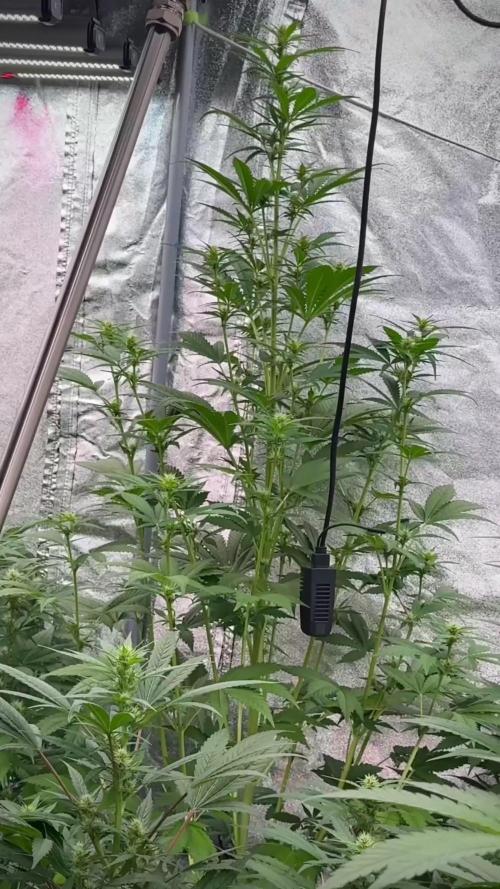
This week marks a real turning point. Our White Widow is moving past simple hairs, now we can clearly see the beginnings of tiny buds forming. It’s the second big flower stage in her journey, and the structure is starting to express the true White Widow personality: compact, resinous, and promising.
I took her out of the tent for another photoshoot, capturing her in detail with the Sony A6000. Close-ups show her leaves, structure, and those first clustered flowers. I also filmed short videos, including one where I share how I talk with my plants daily. For me, it’s not optional — it’s part of a symbiotic relationship. Plants respond to energy and care, and I believe everyone should try it. 🌱💭
⸻
Light Strategy – Emerson Effect Simulation
A special note this week: I recorded a screen video from the TrolMaster TM+ app to show how the lights are scheduled.
🌅 Wake-up: The reds switch on 15 minutes before the whites and blues.
🌇 Wind-down: At night, the reds also stay on 15 minutes longer than the other spectrums.
This is designed to simulate sunrise and sunset while taking advantage of the Emerson Effect, a synergistic boost in photosynthesis efficiency when far-red and red light are combined with other wavelengths.
The result? Plants wake up and settle down more naturally, with smoother light transitions, reduced stress, and potentially increased energy capture. It’s a small tweak, but it reflects how every detail of this environment is tuned with intention.
⸻
Environmental Changes
This week, a big addition: the AC unit. Before, the room was running hot at 31–32°C and more, but now it’s stable at 28°C (occasionally 29°C). Combined with ~66% RH, this gives a steady VPD of 1.33, right in a comfortable zone for flower.
CO₂ naturally fluctuates between 450–800 ppm, and the plants are thriving in these conditions. Even during the hotter weeks, they adapted beautifully, proof of the resilience of both the genetics and the environment we’ve been building.
⸻
Feeding & New Recipe
Until now, she’s been on the Aptus base recipe:
• Regulator – 0.15 ml/L
• CalMag Boost – 0.25 ml/L
This week, I introduced a Plagron trio to push flower development:
• Power Buds – 1 ml/L
• Sugar Royal – 1 ml/L
• Green Sensation – 1 ml/L
Why now? Because she’s transitioned from stretch to actual bud formation. Power Buds helps with compact flowering sites, Sugar Royal enhances metabolism and energy (especially under high light), and Green Sensation supports resin and bud swelling later on. Together with Aptus, it’s a blend of precision and experimentation, trusting experience, intuition, and past results.
⸻
12/12 From Seed – A Quick Recap
This run is about exploration:
• Started from seeds, with early germination struggles (mistakes included, lessons learned).
• This White Widow is the sole survivor of those early days.
• Straight into 12/12 from seed, she grew compact and resilient, surprising us by taking her time to flower despite the cycle.
• Now, at Week 6, we see her first true buds.
She’s not the tallest, but she’s beautiful, living proof of how genetics + environment + patience = results.
⸻
Looking Ahead
What to expect:
• Buds thickening and clustering.
• Stronger aroma starting to emerge.
• More demand on nutrition as flowering sites expand.
What not to expect:
• A tall, stretchy plant — she’s compact and will likely stay that way.
• Early harvest — White Widow still takes her time, even under 12/12.
⸻
Shoutouts & Gratitude 🙏
🌱 Zamnesia – for the legendary White Widow genetics
💧 Aptus Holland – for the precise, reliable base nutrients
🌸 Plagron – for the flower enhancers that now join the recipe
💡 ThinkGrow – for the bar LEDs keeping perfect spread
🚀 Future of Grow – for the Black Series 600W full-spectrum power
🧠 TrolMaster – for automating and stabilizing the grow environment (and letting us dial in the Emerson effect with custom light scheduling!)
And of course, thank you to everyone following this diary, reading, supporting, and sharing this journey. This project is about more than just one plant, it’s about experimenting, learning, and connecting with the grow along the way.
⸻
📸 Check the gallery for:
• Close-ups of bud formation
• Studio shots with the Sony A6000
• Behind-the-scenes of the grow room
• Video captures including the TrolMaster light scheduling demo
• Daily plant connection moments 🌱
📲 Don’t forget to Subscribe and follow me on Instagram and YouTube @DogDoctorOfficial for exclusive content, real-time updates, and behind-the-scenes magic. We’ve got so much more coming, including transplanting and all the amazing techniques that go along with it. You won’t want to miss it.
• GrowDiaries Journal: https://growdiaries.com/grower/dogdoctorofficial
• Instagram: https://www.instagram.com/dogdoctorofficial/
• YouTube: https://www.youtube.com/@dogdoctorofficial
⸻
Explore the Gear that Powers My Grow
If you’re curious about the tech I’m using, check out these links:
• Genetics, gear, nutrients, and more – Zamnesia: https://www.zamnesia.com/
• Environmental control & automation – TrolMaster: https://www.trolmaster.eu/
• Advanced LED lighting – Future of Grow: https://www.futureofgrow.com/
• Root and growth nutrition – Aptus Holland: https://aptus-holland.com/
• Nutrient systems & boosters – Plagron: https://plagron.com/en/
• Soil & substrate excellence – PRO-MIX BX: https://www.pthorticulture.com/en-us/products/pro-mix-bx-mycorrhizae
• Curing and storage – Grove Bags: https://grovebags.com/
⸻
We’ve got much more coming as we move through the grow cycles. Trust me, you won’t want to miss the next steps, let’s push the boundaries of indoor horticulture together!
As always, this is shared for educational purposes, aiming to spread understanding and appreciation for this plant. Let’s celebrate it responsibly and continue to learn and grow together.
Friendly reminder all you see here is pure research and for educational purposes only,
With true love comes happiness. Always believe in yourself, and always do things expecting nothing and with an open heart. Be a giver, and the universe will give back in ways you could never imagine.
💚 Growers love to all

Likes
20
Share


@LockDownGrow
Follow
So I managed too lst this little lady sideways very early on and she is now starting too form a little Bush,
The next week or two will surely provide something very special judging on who her sister lemon pie is now 2 weeks ahead of this one,
It seems this little lady is the purple
I really pumped the nutrients this week as you can see,
At the end of this week a stopped giving the plant these addavitves
More roots,
Humic acid,
Growzyime,
Fast bud folar spray,
And big buds,
And have now started too raise the house & Garden A&B soil feed and also there budXL
I also started off early but as a trace amount of there top shooter,
By the end of week I intend on giving them the full recommended of each and only be giving them the house and garden range at full streingh,
I will then wait for the first Amber tricomb then instant flush feeds,
Hopefully I get two weeks from that stage but it is often genetic so as long as I get at least one week and at least 3 feeds of water only then I'm happy
Likes
2
Share


@Greenbean420
Follow
Decent smoke, one of the plants tasted and smoked better than the other.
Likes
3
Share


@GreeneScene
Follow
Started a liquid supplement because my dry amendments aren’ didn’t activate my last grow.
Maybe I didn’t mix them deep enough or keep the top layer wet enough but i know its the end of my first run & my girls have been STARVING .
So even though I did top dress a few weeks ago I still started her on liquid amendments like my oldest girls & she’s handled all the feedings brilliantly.
She has pre flower pistals showing but only sparsely so we’re still vegging out.
She’s a beast & that’s an understatement. Definitely the biggest & most vigorous auto I’ve ever grown.
Liquid amendments I’ve been feeding are still indeed organic so no worries.
Likes
52
Share

@DogDoctorOfficial
Follow
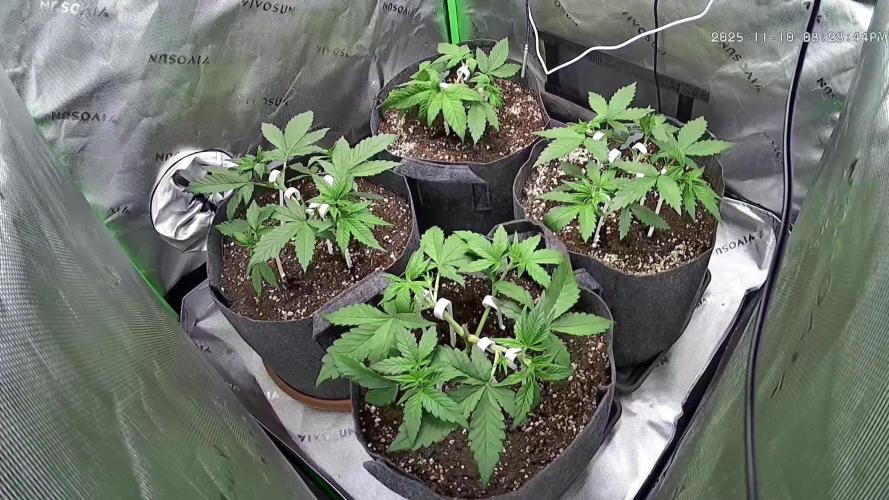
I am absolutely in love with my Cosmos Girl from Royal Queen Seeds! She's growing beautifully and it's amazing to see her develop day by day. I was surprised to see that she's developing 3 branches per node, but it's clear that she's adapting well to her surroundings and growing strong. Her inter node space is great, which tells me that she's receiving the right amount of light and nutrients to grow properly.
I'm a big believer in using quality organic nutrients, and that's why I trust no other brand in organics than Aptus Holland. Their products have never let me down, and I know that I can rely on them to provide my plant with the best possible nutrients for her growth and development.
I was thrilled to see that Cosmos started her pre-flower stage on day 28. This is a crucial time in her development, as it marks the transition from vegetative growth to the flowering stage. I can't wait to see her produce flowers and eventually develop into beautiful buds!
Overall, I'm so passionate about this plant and I'm putting all of my love and attention into her growth. It's an amazing experience to see her thrive under my care, and I'm excited to see what the future holds for my Cosmos plant!
As she is entering the flower stage i did apply for the last time , may be lets see, NutriSpary, a must for me in all my gardens . NutriSpray from Aptus is a fantastic product that provides a range of benefits for plants during their growth and development. This product is designed to be used as a foliar spray, meaning it is applied directly to the leaves of the plant.
One of the main benefits of NutriSpray is that it contains a range of essential micronutrients that are necessary for plant growth. These micronutrients include iron, manganese, zinc, and copper, which are all crucial for healthy plant development. By providing these nutrients directly to the leaves of the plant, NutriSpray helps to ensure that they are absorbed quickly and efficiently, which can lead to faster growth and better overall health.
Another benefit of NutriSpray is that it can help to increase the plant's resistance to stress. This is because it contains plant extracts that are known to have anti-stress properties. By applying NutriSpray regularly, you can help to protect your plants from a range of environmental stresses, such as temperature changes, drought, and pests.
NutriSpray is also easy to use and can be applied at any time during the plant's growth cycle. Simply mix the recommended amount of NutriSpray with water and spray it directly onto the leaves of the plant. This product is especially useful during periods of rapid growth, when plants may need an extra boost of nutrients to keep up with their development.
Overall, NutriSpray from Aptus is a fantastic product that provides a range of benefits for plants. From providing essential micronutrients to increasing stress resistance, this product is an excellent choice for any grower who wants to ensure that their plants are healthy and strong.
Man so exited hahaha lets stay tuned on this one, i know i will hihihi she promises great things
As always thank you all for stopping by and for supporting me on this journey, i am super passion about growing and fell blessed to have you all with me on this new journey <3 <3 <3
Genetics - RQS COSMOS F1
Ligth - LUMATEK ZEUS 465 COMPACT PRO
Food - APTUS HOLLAND
All info and full product details can be find in can find @
https://www.royalqueenseeds.com
https://aptus-holland.com/
https://autopot.co.uk/
https://lumatek-lighting.com/
With true love comes happiness <3<3<3 Always believe in your self and always do things expecting nothing and with an open heart , be a giver and the universe will give back to you in ways you could not even imagine so <3<3<3
<3 <3 <3 Growers love to you all <3 <3 <3
Cosmos F1: The World's First F1 CBD Cannabis Variety
Cosmos F1 is the largest autoflowering cultivar in RQS catalogue of F1 hybrids. With her tall, typical Christmas tree structure and bright green foliage, Cosmos F1 is a testament to the beauty and vigour of Cannabis sativa. Plus, thanks to her pure genetics, which descend from Oregon CBD, she boasts the highest CBD concentration in our entire F1 seed selection.
Aromas, Flavors, and Effects of Cosmos F1: A Vibrant CBD Super Variety
True to the pure lineage from which she descends, Cosmos F1 boasts a delicious aroma that combines the freshness of crisp pine with the full-bodied, almost creamy aroma of modern Cookies varieties, and an unmistakable peppery bite. Thanks to her high concentration of CBD and low levels of THC, Cosmos F1 offers a balanced effect without intoxication. Cosmos F1’s terpene profile is dominated by myrcene, farnesene, limonene, pinene, and caryophyllene. Combined with high concentrations of CBD, Cosmos F1 produces a clear, meditative effect that relaxes the body while leaving the mind functioning and focused. Her effects help unite the mind and body, creating a state of cosmic order.


Likes
9
Share


@Rangaku
Follow
Topped and transplanted into her final home , 27 L pot . She’s healthy strong and green .


Likes
62
Share


@Chucky324
Follow
Hello. This is the end of week 7 and the beginning of week 8 It's been a quite week.
There is a few more yellow leaves than I think there should be for the end of week 7 in flowering. It's been 25* c to 33* c day time temp in the greenhouse this week no wonder there is a few more yellow leaves. I start flush next week for 2 weeks. This strains description said 10 weeks to finish but I think some of these plants could be cut down soon. I don't mind overripe cannabis so I'll finish the 10 weeks for all the plants.
I made more Rick Simpson Oil this week. What a long process. It took most of the day. I got 140 g of oil from 1 lb. of cannabis. I tried to make a diary of it, but I know I could do better job. The camera I used ran out of juice and I grabbed another and forgot to turn on the sound. The wind got so strong at points it drowned out my voice. I'll put up what I made in a couple of weeks. after editing and subtitles : )
Till next week. Chuck.

Likes
117
Share


@StarLorr
Follow
Welcome to my autø Møøn Røck 1 Diary.
In this Diary:
Seeds: Sponsored by Ðivine Seeðs
Media: Pro~Mix HP *•ns
Nutrients: Remo Supercharged Kit *•ns
*•not sponsored
___________________________
Feeding:
Wed 13Nov: 2L Flawless Finish pH'd 6.2
___________________________
She barely can stand straight, buds are ready and took her out of the tent on Sunday 17-Nov-24 for the eventual el-choppo😁
___________________________
Thanks for stopping by, likes and comments are appreciated!👊🏻😎
Keep on growin!
Keep on tokin!!!
😙💨💨💨💨💨

Likes
3
Share


@710dreamin
Follow
She is doing well overall other than a little over watering upon transplanting into the living soil. I didnt plan for drainage like I should have but it is what it is I believe I'm getting her kinked out. Any tips are always appreciated... debating on topping her this coming week or just running lst on her. Maybe both who knows
Likes
13
Share


@tresplantes
Follow
They looking Fire all over smell is amazing
Bluezy has not the bud Strukture im looking for and does Not Look Like the biggest yielder but man the smell is Crazy like really Crazy chemical sour blueberry light bleaching on one bud
Dante’s Inferno buds are Rock Hard and slowly reaching the size of soft drink cans, and the node spacing is insane golfballs all the way down
The smell is like a tropical runtz super sweet fruitmix
Tomb raider has just amazing plant structure amazing bud Structure is a trych Monster and the smell goes towards sweet sour gelato Kinda direction


Likes
18
Share


@MinorMonster
Follow
Die dümmsten Bauern haben die dicksten Kartoffeln. Die dicksten Buds hab ich nicht, aber dafür viele 😄
129gr Buds und 22gr Popcorn. Bin auf das curing gespannt, der Geruch ist jetzt schon verlockend. Die Wirkung brauch nen Moment, ist dann erst kopflastig und kommt so nach 30 Minuten entspannt body-lastig.
Likes
57
Share


@Igrowneil
Follow
The overall cycle had to deal with alot of heat issues and lighting so what they did product is certainly top quality flowers just short on there stretch period so will run again to make a certain opinion but as of now no hermis and all seeds flowered apart from one tiny plant 10 girls all to harvest shows stable genicitic traits from these girls also , height , bud structure colour shape smell all seem to be closer to a match of each other
Processing
Likes
4
Share


@chiefredeyes
Follow
Week 12 - Venom OG and an unknown seed strain.
Tap water and Espoma Bloom full dose - 18hr light schedule
At this point I learned that I need to really make more use of my area for my plants by fiming, LST, SoG, etc.... I plan to try to monster crop the Venom OG and try to get some different results. It's not an auto-flower plant so I'll have some time to veg it to the way I want to see it before it gets too big.
Processing
Likes
39
Share


@DjDaveAtHome
Follow
Started LSTing. We'll see what a few weeks does to them! Growth is vigorous in DWC.
Noticed that the DinaMed's PH was dropping drastically over 24 hours. PPMs were way up at 1100. Diluted the solution by two thirds and re PHed her.


Likes
9
Share


@Plants_of_tayoat
Follow
This plant early entered to flowering stage in week 3. Other is nothing special. Thanks.
Likes
25
Share


@Fatnastyz
Follow
10-1
Day 2 of week 3 flower.
Ztrawberriez starting to dry after flush, looks ok.
Kosher started to show signs of burn, so I figured I over fed her too. Turns out ppm was 8900. Flushed to 1600 ppm. Shoulda did 2 more liters, but we'll see. Run off ph 7.1
Balance her out I hope. 😁🤘
Oh removed couple messed up leafs.
10-2
Ztrawberriez water 500 ml. ph 6.3
10-3
Water Z 500ml ish again. brought from 22% to 36% (ecowitt). made a gallon of water with recharge, kelp 10 ml, yucca. cal/mag 5ml ph 6.4.
also recalibrated my PH pen, never hurts!
Kosher should be water time tomorrow.
10-4
Watered K with the same goods Z got yesterday! Regular cal/mag water for Z
10-5
Watered both .2 mg epson per liter water.
Cal/mag, yucca 1k ml each approx. Maybe closer to 900.
Both growing great and smell great!
Z is a bit tall and head long. K is more compact but fatish? Anyways, doing great! Tea next day or 2 or 3. 🤣
10-6
1/4 cup poo, 3 tbs buildaflower, scoop of connect. Both!
.
.