The Grow Awards 2026 🏆 






Likes
Comments
Share
@MyCloset
Follow
Still week 12 changed to 12/12 on day 90, thought my system is working properly now and nutrient solution seems to be alright now.. maybe it can improve but its fine for now. They are growing ridiculous fast even when its not in perfect conditions, im definitely staying with rdwc the stem of this plant is about 3-4 cm big wich is insane before flower

Likes
31
Share
@Dunk_Junk
Follow
Growing well this week. Making more leaves to catch the light!!!
Timelapse is rubbish this week... Must do better.







Processing
Likes
2
Share
@ajglover217
Follow
my friend said the plants needed some stones for decoration

Processing
Likes
10
Share
@StarletBud21
Follow
Start of week 3 I believe the girls are doing good a few minor worries but that’s at ease for now I think , i have added nutes at a low level and will increase once I see how the plants react to the introduction of the nutes .. Looking into starting lsd on some plants but not too sure wether it’s to early or so . will continue to update the week but for now
Started lst on a few plants day 15 and seen good reactions by day 17 so quite happy with that and will continue this process I will also look into topping my plants as well but not just yet ... they seemed to like the nutes as well so all good week so far
Soo topping done on 4 plants wasn’t as scary as it sounded haha let’s see how they recover ! Going to combine lst as well now
Very good recovery it looks like and the end of week 3 looks promising with the plants
happy growing


Likes
9
Share
@Goldbud
Follow
6 cm in the first week flowering not bad it's getting bether. I Have defoliated in the basement giving her more Fresh air under the skirt! For the stretch phase added some molasses Orgatrex together with Bactrex.


Likes
23
Share
@BudxLess
Follow
First of all, a big thank you to @BeanswithPork. He gifted this cultivar to my dad, who has a special place in his heart for Blackjack the game.
Secondly, I am blessed to have such great results for my first grow ever. This plant was grown under the guide of my dad @Budxs and I learned a bunch from hi m this year. I have just smoked the first taste of this after a weks cure and I can rank it up there with some of the best weed I have ever smoked in my life. The taste is just perfect, citrusy and a bit fruity. The high is immediate and seems to be uplifting and makes me giggle. I live this stuff and I will grow more!!!
Thank you to all for following, it has been a blast.

Likes
15
Share
@Siriuz
Follow
I think she is all set now
But I could have waited one more week
But I ran out of soil foxfarm ocean forest
And some other stuff which makes me
Recycle this pot and transplant red poison auto who is right now flowering very fast and good so it is the end for sweet Gelato our first sweet Gelato from sweet seeds
Thanks a lot guys for helping me out. Thanks a lot grow diaries for all your support blessings and lets get this girl harvest alright my dudes will be uploading more content soon at the mean time we will be showing you the bud quality against Quantity and hopefully you will see how STRESS this girl was for an auto we know now that they are good for LST and HST better than any other techniques and just some auto like the ones you mix with thai Legendary genetics will grow very fast and recover very good reason why its better to apply fimming to autos that can run fast over recovery because without that gap you Cant use those techniques since the plant wont allow you its genetics are going to get STRESS and wont yield as much as it is supposed to
But other than that is the real fact that this lady was under phlizon lights 600W
And sadly we found out those are not
Full spectrum lights so we are
Very eager to join contest and try to win
With the support of the whole community
So we can continue to grow and show
The world ah educational and real
Pot smokers team all active in all social networking to point out this is love
For all the world back and forth
Thanks a lot please join me
Please like share Comment
Leave your thoughts
I do appreciate every single one
Hope you guys have a happy growing and happy harvest as well
Enjoy SuMMer will come soon
Are you ready?
Likes
2
Share
@MrLahey
Follow
Day 53 - ripening up! She’s reduced her water intake down to one or less than one liter per day. Smell is phenomenal and strong - like spicy bubblegum almost although I have a post covid sinus infection so my nose is pretty stuffy still.
I’m thinking 2-3 weeks MAX until I chop her. She seems ahead of or right on track for “estimated harvest time” from the breeder. Top colas are primarily cloudy trichomes and some clear and amber. Lower bud sites are cloudy/clear trichs. I think I’ve a tendency to harvest a little early so we will see how long I can push her before I feel it’s chop time. I suspect that will be dependent obviously on the trichomes, pistils and bract size but also overall health of fan and sugar leaves which seem to be fading due to senescence, improper ph maybe and cold night temps.
Ordered an apera gs1 ph pen as I’m pretty sure my current pen hasn’t been accurate the past month or so. Also ordered a blumat watering system for next grow (chicken n waffles from Humboldt seed company).
My vcure arrives this week so I’m really excited for when I chop this plant and dry/cure her in it.
Likes
17
Share
@Karl_Heinz420
Follow
Blütetag 9 🌺
500m l Osmosewasser bei PH 6,3 mit Calmag, Bio-Heaven, Fish-Mix, Bio-Grow, Top-Max und Bio-Bloom.
Blütetag 10 🌺
500m l Osmosewasser bei PH 6,3 mit Calmag, Bio-Heaven, Fish-Mix, Bio-Grow, Top-Max und Bio-Bloom.
Blütetag 11 🌺 - Nährstoffmangel
Bedingt durch das Gießen mit Osmosewasser zeigt sich ein möglicher Eisenmangel an den neuen Blättern. Daher 500m l Osmosewasser bei PH 6,3 mit 1ml ALG A MIC als auch die Blätter leicht besprüht. Die nächsten Tage wird sich zeigen, ob es den Bedarf des Mangels deckt.
Blütetag 12 🌺
500m l Osmosewasser bei PH 6,1 mit 0,4ml Calmag und 0,7ml F06 Eisen (mineralischer Dünger)
Blütetag 14 🌺
1,5 l Osmosewasser bei PH 6,1 mit 0,8ml Calmag und 0,7ml F06 Eisen (mineralischer Dünger)
Sunlight Evo 3-60 60% 60cm Abstand (ca. 600 PPFD)
23-25 Grad Celsius bei 50-55% Luftfeuchtigkeit. VPD 0,8 - 1,0 kPa
Processing
Likes
16
Share
@GreenCropsPT
Follow
Second week of vegetation they are going very well and lets see how it goes

Likes
35
Share
@SantaStone
Follow
Health to everyone! 👋
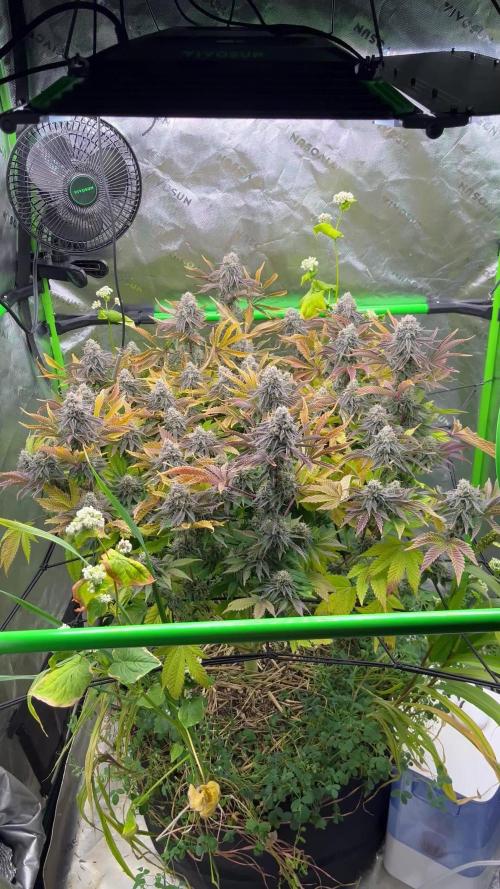
🌿1 week has passed since the big defoliation and switching the timer to 12/12 mode.
-Pre-flowering stage, stigmas have not yet appeared. We are waiting for the flowering to begin.
-Very thick stems.
-Appetite was restored by watering 5 liters per day (water 2 times a week).
-No problems or shortages were found.
-Every 3-4 days I remove several large burdocks (no more than 5), which greatly block the light.
-Added Bud Ignitor and Bud Factor X to the diet.
🤙In general, a strong and large plant with good resistance, which is pleasing to the eye.


Likes
12
Share


Processing
Likes
7
Share
@TegridyCal
Follow
Purole Lemonade is a particular strain, it has fewer leaves and is less bushy than the other plants but has a very nice color and seems to regulate quickly and very well to toppings. Really beautiful it looks good pomettebe. We spray neem solution + potassium soap every 3 days for protection and lord grow nourishing foliar every 15 days for leaf nutrition and co2 protection.


Likes
40
Share
@valiotoro
Follow
Easy trim✂️
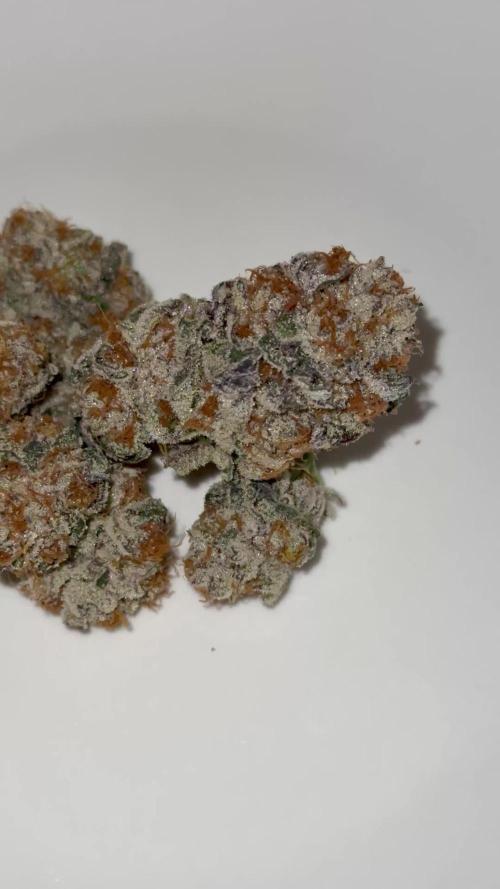
The buds are super sticky & dense⚡️
The smell is Absolutely DIVINE,flowery sweet & orange🤤🍊🌸


Likes
209
Share
@BioBuds
Follow
Great to see you and I missed you, I had some time so I created a video to thank our lovely foster company, who were so kind to let us try their light in return for a review. Now, most of you don't know I'm also into making music, mostly Techno but I also love HipHop and Gangster rap, mainly 90's Westcoast, although I'm fond of East Coast and a little dirty South, so this was an excellent time to showcase one of my tracks.
So please check my Autumn-themed, not commissioned, or approved by Mars Hydro, visualization video in thanks for @MarsHydroLED.
The grow has been going great! If you don't count the about a thousand fungus gnats I have been fighting. I'm manually manifolding and training the girls, into the desired shape, which is a bit hands-on but I see it as a collaboration more than a 50 shades approach to training. You can't just bust out a rope and domination on girls like that. We ease it in there, going to the limit every time, making them stretch and curl underneath the touch of our tender but firm hands. And when they are used to a little groping and fixation, we might bring out a few ropes here and there to spice it up a little. Anywaaaays.... I'm getting carried away here, back to the grow.
I had bought some coco-peat, after leaving none for the top layer as I suggested to all of you in the previous weeks of my grow (if you missed it, click one week back for a full recipe (the yellow image) for everyone in Europe) left me with enormous amounts of fungus gnats.
Its seems to alleviate the problem already. As it did with my previous grow the Gelato 33 Golden Canopy from Heaven.
In the meantime I notice my temperatures going down so Im trying to fix that too. All in all it had been a good week and this Orange Hill Special is promising to become something special!
Thanks for visiting again, see you soon!
