The Grow Awards 2026 🏆
Likes
Comments
Share
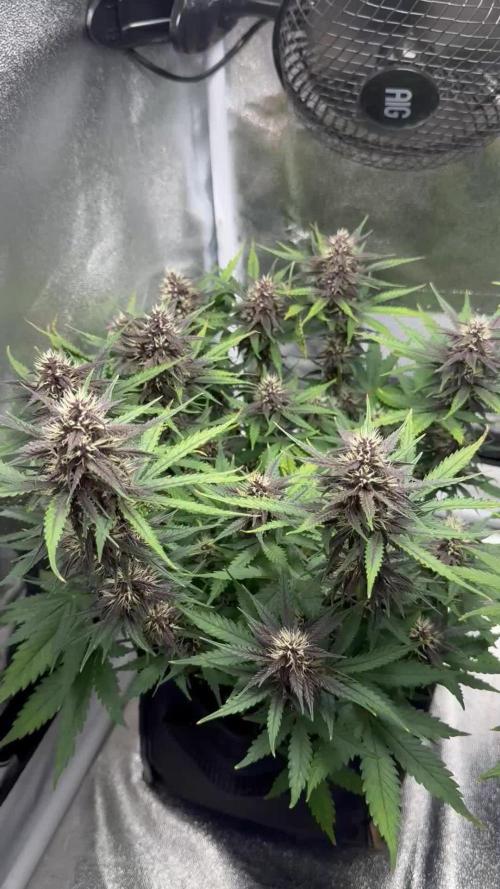
11/14/2022: things are still progressing nicely. The super cropping from last week doesn't seem to have had any negative effects. All three plants are looking extremely healthy. Can really see the effects of the sprouted seed tea I fed them yesterday. The girls are preying today. The smell is really starting to amp up now. Can smell them with the tent shut and with the carbon filter running. 11/15/2022: due to some minor tip yellowing, most likely from the heavy feeding last week, I only watered with 6.5 ph water with some ThermX 70 and Fish Shit. 11/17/2022: all three are putting on weight. Watered 1.6 liters each, using the Fish Shit, coconut powder, and ThermX-70 at a 6.7 ph. 11/19/2022: top dressed all three plants with 1/4 cup Clackmas Coot Gnarly Barley, 1/4 cup BuildASoil Craft Blend, then added about an inch of fresh Colorodo Worm Company worm castings, and sprinkled about 1/4 cup of Kashi Blend. Then watered each plant with 1.6 liters of 6.6 ph water, with Bio-Phos, powdered coconut, and 1/4 teaspoon of BuildASoil Big 6, for the extra micronutrients. This should hopefully be more than enough to get the plants through the final weeks of flower. Avg. VPD:1.5 PPFD: 700 DLI: 45
Processing
Likes
66
Share
Well its been a while. I'm social distancing from this site. 😂😂😂😂 Harvested the three Tangerine Hybrids Tangerine Slurpee Tangerine Fart Tahoe Sour Tangerine All smell incredible, these tester's will be a welcome addition to my flower stash. Sour Patch Kids x Sour Fire and Tahoe OGKB x Sour Fire Kush are out to flower now. I hope they don't reveg on me. And last but not least AJ's cut Sour Diesel is out to flower also. Fingers crossed they stay flowering. 🤗
Likes
10
Share
@Dreadnug
Follow
5/14- Buds are getting fat - some are starting to droop. The Calcium issue is resolved and feeding pH balanced water and not switching with well seems to have helped. Hopefully we can stay stead to harvest. Noticing some light burn so will have to potentially keep an eye on dialing back the lights a bit.
Likes
31
Share
All finished up this girl has impressed me for one gallon of dirt she has really been quite the plant and as far as appearance goes she is beautiful while and late flower she smells exactly like blueberry Pop-Tarts after the dry and the cure the blueberry remained strong but the Pop-Tart kind of faded but it's okay because blueberries are tasty lol seeing how it's across the somango and blueberry it makes sense.. the big question is what I grow her again and the answer to that is yes.. she has quite the frost and bag appeal
Likes
2
Share
@Finsfan
Follow
Gave them a dose of overdrive and molasses last weekend. This weekend I'm starting the 1-2 week flush. Lots of milky trichs, with just 1-2% amber. Think another week should be good. Based on hair ratios it's about 80% orange:20% white.
Likes
37
Share
@Whitey307
Follow
Hi all just finished another week having trouble with humidity since fan went marshydro said they out of stock but will send me a new one the minute they have it in which is a month haha 😄 all be harvest by then hopefully god help neighbours that's all I can say haha bought a new dehumidifier off amazon a shit cheap one not even making a difference at all haha so today splashed out a 100 euro for one so hopefully that'll do the job. other than all looking good I think. But actually if someone could tell me will I defoliate more leaves she very bush bit I'm afraid of disturbing flower so im leaf tucking but she is very bushy haha. also im looking at other diarys on this and my plants buds not as big or as far along as many im on 9 weeks on the dot at the moment if anyone with more knowledge please let me know. Anyway i lowered light again and up nuts a little bit and on we go one week closer to be stoned hopefully Enjoy all thanks for stopping to have a look and for comments +help. keep growing and blazing.
Processing
Likes
13
Share
@mr_smooke
Follow
we pass 5. week, in this week i been spred my girls and make some defoliation. she grow nicely week by week. in next week i will flip them on flower mode. tent is ollmost full
Likes
6
Share
Likes
2
Share
@Muuuy
Follow
Week 12 and we're still not there yet! However, the ladies are growing thicker every week. #2 & #3 are growing so thick, they can barely support the weight of their own buds. Really have to be careful when handling them, the risk of snapping a branch by accident is way too high right now. The reason for that is probably due to the crowded space in the growbox, in which there isn't much airflow despite having the little fan running nonstop when the light is on. Looking at the trichomes they can all take a few more weeks, just have to be patient now! This is plant #1/3. Still thickening slower than the other ones, but she's pretty fine otherwise!
Likes
126
Share
@nonick123
Follow
Día 83 (08/04) Riego 1,25 Litro H20 + Wholly Base 2,5 ml/l + Solid Green 1,5 ml/l + Big Bloom 1 ml/l de Gen1:11 TDS 1000 PPMs - pH 6,2 Día 84 (09/04) Velocidad de crucero ON... Las plantas se acercan a su fecha de cosecha teorica (49 días en floracion = 13/04/2024) Muestran ligeros signos de senescencia, pero siguen creciendo las flores, el consumo de agua no baja... 😍💥 Día 85 (10/04) Riego 0,5 Litro H20 sin nutrientes. TDS 225 PPMs - pH 6,6 Día 86 (11/04) Riego 1,25 Litro H20 + Wholly Base 2,5 ml/l + Solid Green 1,5 ml/l + Big Bloom 1 ml/l de Gen1:11 TDS 1000 PPMs - pH 6,2 Día 87 (12/04) Empezamos a revisar el color de los tricomas y se encuentran en su mayoría trasparentes con alguno turbio. Va a necesitar unos días más para madurar Día 88 (13/04) Riego 0,5 Litro H20 sin nutrientes. TDS 225 PPMs - pH 6,6 Se abre la ventana de la cosecha! 😍 Justo hoy cumplen 7 semanas (49 días) en floración Día 89 (14/04) Riego 1,25 Litro H20 + Wholly Base 2,5 ml/l + Solid Green 1,5 ml/l + Big Bloom 1 ml/l de Gen1:11 TDS 1000 PPMs - pH 6,2 💦Nutrients by Gen1:11 - www.genoneeleven.com 🌱Substrate PRO-MIX HP BACILLUS + MYCORRHIZAE - www.pthorticulture.com/en/products/pro-mix-hp-biostimulant-plus-mycorrhizae
Likes
18
Share
@Bncgrower
Follow
One more week passed, this girl have a very good structure and, i decide to make some clones because i was cutting the low brunches and it will go to trash, so i think is best i take some clones and stay with a plant principal and one or two with me and the others i will give to a friend who is having problems with ur first grow.. Happy growing 4 all 💪🌱🌱✌️
Likes
3
Share
Hola! Our senorita has stopped growing. Is it sad? definitely. Do the buds look good? oh yes. The fern in the pot is growing better than my tequilita and that's ok. I'll monitor her buds to determine the right time to chop. Out of my 3 Ganja Farmer autos, she seems to be on schedule (despite the growth stop). Another month? Maybe. We'll see.
Likes
45
Share
Next two weeks is when she packs a punch, terp profile of fuzzy peaches for days
Likes
3
Share
@Matagal
Follow
Fading Hard. LBCOG 1 is almost done, one more week. My plan is harvest all girls at november, 15. Oly water abaout one week now. - Love my garden!!!!
Likes
55
Share
What's in the soil? What's not in the soil would be an easier question to answer. 16-18 DLI @ the minute. +++ as she grows. Probably not recommended, but to get to where it needs to be, I need to start now. Vegetative @1400ppm 0.8–1.2 kPa 80–86°F (26.7–30°C) 65–75%, LST Day 10, Fim'd Day 11 CEC (Cation Exchange Capacity): This is a measure of a soil's ability to hold and exchange positively charged nutrients, like calcium, magnesium, and potassium. Soils with high CEC (more clay and organic matter) have more negative charges that attract and hold these essential nutrients, preventing them from leaching away. Biochar is highly efficient at increasing cation exchange capacity (CEC) compared to many other amendments. Biochar's high CEC potential stems from its negatively charged functional groups, and studies show it can increase CEC by over 90%. Amendments like compost also increase CEC but are often more prone to rapid biodegradation, which can make biochar's effect more long-lasting. biochar acts as a long-lasting Cation Exchange Capacity (CEC) enhancer because its porous, carbon-rich structure provides sites for nutrients to bind to, effectively improving nutrient retention in soil without relying on the short-term benefits of fresh organic matter like compost or manure. Biochar's stability means these benefits last much longer than those from traditional organic amendments, making it a sustainable way to improve soil fertility, water retention, and structure over time. Needs to be charged first, similar to Coco, or it will immobilize cations, but at a much higher ratio. a high cation exchange capacity (CEC) results in a high buffer protection, meaning the soil can better resist changes in pH and nutrient availability. This is because a high CEC soil has more negatively charged sites to hold onto essential positively charged nutrients, like calcium and magnesium, and to buffer against acid ions, such as hydrogen. EC (Electrical Conductivity): This measures the amount of soluble salts in the soil. High EC levels indicate a high concentration of dissolved salts and can be a sign of potential salinity issues that can harm plants. The stored cations associated with a medium's cation exchange capacity (CEC) do not directly contribute to a real-time electrical conductivity (EC) reading. A real-time EC measurement reflects only the concentration of free, dissolved salt ions in the water solution within the medium. 98% of a plants nutrients comes directly from the water solution. 2% come directly from soil particles. CEC is a mediums storage capacity for cations. These stored cations do not contribute to a mediums EC directly. Electrical Conductivity (EC) does not measure salt ions adsorbed (stored) onto a Cation Exchange Capacity (CEC) site, as EC measures the conductivity of ions in solution within a soil or water sample, not those held on soil particles. A medium releases stored cations to water by ion exchange, where a new, more desirable ion from the water solution temporarily displaces the stored cation from the medium's surface, a process also seen in plants absorbing nutrients via mass flow. For example, in water softeners, sodium ions are released from resin beads to bond with the medium's surface, displacing calcium and magnesium ions which then enter the water. This same principle applies when plants take up nutrients from the soil solution: the cations are released from the soil particles into the water in response to a concentration equilibrium, and then moved to the root surface via mass flow. An example of ion exchange within the context of Cation Exchange Capacity (CEC) is a soil particle with a negative charge attracting and holding positively charged nutrient ions, like potassium (K+) or calcium (Ca2+), and then exchanging them for other positive ions present in the soil solution. For instance, a negatively charged clay particle in soil can hold a K+ ion and later release it to a plant's roots when a different cation, such as calcium (Ca2+), is abundant and replaces the potassium. This process of holding and swapping positively charged ions is fundamental to soil fertility, as it provides plants with essential nutrients. Negative charges on soil particles: Soil particles, particularly clay and organic matter, have negatively charged surfaces due to their chemical structure. Attraction of cations: These negative charges attract and hold positively charged ions, or cations, such as: Potassium (K+) Calcium (Ca2+) Magnesium (Mg2+) Sodium (Na+) Ammonium (NH4+) Plant roots excrete hydrogen ions (H+) through the action of proton pumps embedded in the root cell membranes, which use ATP (energy) to actively transport H+ ions from inside the root cell into the surrounding soil. This process lowers the pH of the soil, which helps to make certain mineral nutrients, such as iron, more available for uptake by the plant. Mechanism of H+ Excretion Proton Pumps: Root cells contain specialized proteins called proton pumps (H+-ATPases) in their cell membranes. Active Transport: These proton pumps use energy from ATP to actively move H+ ions from the cytoplasm of the root cell into the soil, against their concentration gradient. Role in pH Regulation: This active excretion of H+ is a major way plants regulate their internal cytoplasmic pH. Nutrient Availability: The resulting decrease in soil pH makes certain essential mineral nutrients, like iron, more soluble and available for the root cells to absorb. Ion Exchange: The H+ ions also displace positively charged mineral cations from the soil particles, making them available for uptake. Iron Uptake: In response to iron deficiency stress, plants enhance H+ excretion and reductant release to lower the pH and convert Fe3+ to the more available form Fe2+. The altered pH can influence the activity and composition of beneficial microbes in the soil. The H+ gradient created by the proton pumps can also be used for other vital cell functions, such as ATP synthesis and the transport of other solutes. The hydrogen ions (H+) excreted during photosynthesis come from the splitting of water molecules. This splitting, called photolysis, occurs in Photosystem II to replace the electrons used in the light-dependent reactions. The released hydrogen ions are then pumped into the thylakoid lumen, creating a proton gradient that drives ATP synthesis. Plants release hydrogen ions (H+) from their roots into the soil, a process that occurs in conjunction with nutrient uptake and photosynthesis. These H+ ions compete with mineral cations for the negatively charged sites on soil particles, a phenomenon known as cation exchange. By displacing beneficial mineral cations, the excreted H+ ions make these nutrients available for the plant to absorb, which can also lower the soil pH and indirectly affect its Cation Exchange Capacity (CEC) by altering the pool of exchangeable cations in the soil solution. Plants use proton (H+) exudation, driven by the H+-ATPase enzyme, to release H+ ions into the soil, creating a more acidic rhizosphere, which enhances nutrient availability and influences nutrient cycling processes. This acidification mobilizes insoluble nutrients like iron (Fe) by breaking them down, while also facilitating the activity of beneficial microbes involved in the nutrient cycle. Therefore, H+ exudation is a critical plant strategy for nutrient acquisition and management, allowing plants to improve their access to essential elements from the soil. A lack of water splitting during photosynthesis can affect iron uptake because the resulting energy imbalance disrupts the plant's ability to produce ATP and NADPH, which are crucial for overall photosynthetic energy conversion and can trigger a deficiency in iron homeostasis pathways. While photosynthesis uses hydrogen ions produced from water splitting for the Calvin cycle, not to create a hydrogen gas deficiency, the overall process is sensitive to nutrient availability, and iron is essential for chloroplast function. In photosynthesis, water is split to provide electrons to replace those lost in Photosystem II, which is triggered by light absorption. These electrons then travel along a transport chain to generate ATP (energy currency) and NADPH (reducing power). Carbon Fixation: The generated ATP and NADPH are then used to convert carbon dioxide into carbohydrates in the Calvin cycle. Impaired water splitting (via water in or out) breaks the chain reaction of photosynthesis. This leads to an imbalance in ATP and NADPH levels, which disrupts the Calvin cycle and overall energy production in the plant. Plants require a sufficient supply of essential mineral elements like iron for photosynthesis. Iron is vital for chlorophyll formation and plays a crucial role in electron transport within the chloroplasts. The complex relationship between nutrient status and photosynthesis is evident when iron deficiency can be reverted by depleting other micronutrients like manganese. This highlights how nutrient homeostasis influences photosynthetic function. A lack of adequate energy and reducing power from photosynthesis, which is directly linked to water splitting, can trigger complex adaptive responses in the plant's iron uptake and distribution systems. Plants possess receptors called transceptors that can directly detect specific nutrient concentrations in the soil or within the plant's tissues. These receptors trigger signaling pathways, sometimes involving calcium influx or changes in protein complex activity, that then influence nutrient uptake by the roots. Plants use this information to make long-term adjustments, such as Increasing root biomass to explore more soil for nutrients. Modifying metabolic pathways to make better use of available resources. Adjusting the rate of nutrient transport into the roots. That's why I keep a high EC. Abundance resonates Abundance.
Likes
9
Share
@Headies
Follow
So I have spider mites. I screwed up so much i think this is going 15 weeks. Lost coast to the rescue! time to finish these buggers off
Likes
20
Share
@Jujuvass
Follow
Seems all good. Not using any growth technique, just letting the bushes to take form (yield not the biggest objective here). Also not adding nutrients as so far the growth is ok. Added a dehumidifier as the grow room was mad humid. Now stabilizing to 50% RH. Looking forward for the auto to starting flower so I can enjoy some nice high in a 4 weeks!
Likes
3
Share
@Comfrey
Follow
The soil is soaked with water after heavy rainfalls. Healthy plant.
Likes
11
Share