





Likes
4
Share


@Skinnytalls420
Follow
This is now in my top 10 autos very happy with the outcome!!! Smells amazing very nice I’m over the moon

Processing
Likes
41
Share


@Hawkbo
Follow
The big one and the second big one are interesting, the small one idk about. my ph meter broke and Hannah Instruments sent me a new probe. When I got it and checked run off everything was fucked up so I did a heavy flush on everything and a feed. Found some shit called Gnatrol on Ebay for the fungus gnats larvae added to the mix idk if it will work tho. Pictures were taken on Day 7 of Bloom


Likes
17
Share

@masterofsmeagol
Follow
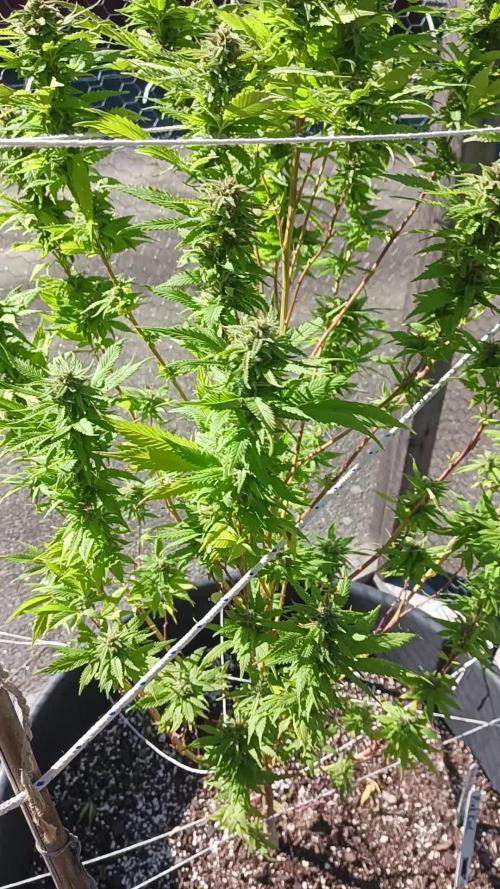
9/27 She made it through the rain! Looking great in the sunshine. I gotta bring the loupe over again. It's smelling really strong and it looks like most of the pistols have changed color. If I wasn't losing more to damage I'd leave it out longer. It will still be a couole days probably because I need to put away what's hanging and make room. This has been one crazy year. Forty degree temp swings. Crazy year and even crazier pot. Can't wait to try them all!
EDIT: I've been trying like hell to update this thing. I've been working my balls off. I ALMOST took the last pink kush. I have a video i'm trying to upload on my computer because I can't even update ANYTHING on my phone. Boy this years weed came out incredible! I've been working hard but as soon as I have a second to myself and get everything at least inside i'll finish the harvest and smoke reports and give some good pics/videos.
9/28 Finally got a video uploaded. It was yesterday. The Lome pink kush is looking real good. I'm losing more and more to these insects. I want to leave this plant a little longer and have the buds come together but the trichs are cloudy now. Almost every pistol has turned a red color. I'm going to bring my loupe and check it out today. Everything has turned out fantastic. I'm looking forward to taking pictures.


Likes
Comments
Share


@TaeTooTimes
Follow
First Day June 16 :
• 1 3/4 Inch Tall
• 30ml Of Water
Day 5 June 21 :
•Nearly 3 Inch Tall
•50ml of Nutrients Water
So far I have been feeding daily when the soil runs dry
Day 7 June 23 :
•3inch 1/4
•80ml of Nutrients Water

Likes
12
Share


@The_Good_Twin
Follow
The harvest of my dear Stella was supposed to happen on August 4th, but didn’t begin actually until August 9th. I decided to allow her to dry out a bit before beginning the harvest, but I had some other difficulties which made her dry out a whole lot before I ever even got started. You can tell how dry by looking at the pics and video. Luckily, the dryness was limited to her larger leaves.
She was already quite dry on the 9th when I started, and was more so by the 12th when I finished. Even after the advanced drying, her wet trimmed weight was still quite a bit. I’ll list the weights all together in a bit.
It took 4 days to get the whole plant trimmed, weighed, and hung up for final drying. She was hung up from August 12th till Friday, August 19th. I got busy harvesting another plant while she was hanging up, and just let her be.
On August 19th I took all of her branches down and removed the buds to get the true harvest weight of her buds alone.
Let’s get to the weight of the whole thing. The overall wet-trimmed weight of the plant was 18.329 ounces with the buds and branches combined.
I was a forgetful idiot and forgot to get the weight of the dry buds on the branches before removing the buds. So all we’re left with is the actual harvest weight of the dry buds alone.
The overall dry bud weight, or actual “true” harvest weight of the smokable bud is: 7.317 ounces. That’s a wonderful amount of freshly harvested bud to cure.
All of the buds were put into 8 quart sized jars filled roughly 3/4 full, and 1 pint sized jar, also 3/4 full.
Each jar has a hygrometer as well as 58% bóveda packs to help aid the curing process.
This is the 2nd DarkStar plant I’ve harvested, and both were very large plants. I used a scrog method the first time with a net that spread the whole plant out taking up the entire 4x4 area of the tent.
This time I wanted to let her grow more naturally. She got so large that I had to bend almost all of her taller branches over using HST methods. I had to bend 3-5 branches over more than once. By doing that, once her buds began to fatten up she got too heavy and needed to be supported just to stand upright. Toward the end she had to literally be tied up to the side of the tent.
Stella (DarkStar) was a wonder to grow, and she gave me a good amount of clones that will soon be harvested themselves.
It has been a journey with Stella, and I’m happy that the journey is now complete. Happy growing everyone!

Processing
Likes
17
Share

@Hawkbo
Follow
Pics taken on day 36. Some, if not most of these are lightly seeded, I've checked for herms but cant find no nuts. Sucks but from what I've read and people I've talked to seems like it wont be too big of a deal in the end, some old school growers even prefer lightly seeded nugget, I've never tried it intentionally. The green buzz nutes are working well. I'm almost out of the more PK so I had to add herculean harvest liquid bonemeal to get the ppm where i want it while trying to conserve the Gbl to last the rest of the run. Didnt have the lady to take my pics today so I was limited and had to take them lefty one handed and was shakey af.
#1 is definitely lightly seeded I noticed after last weeks update. It looks pretty cool if the buds connect they will be like 2 feet bud sticks. Starting to give off a dank aroma as well.
#2 is #2
Likes
41
Share


@BOMbolenath
Follow
Already showing some flower buds. It's developing well. Did some hard defoliation. smells good

Likes
7
Share


@Puff_TM_Dragon
Follow
Was seeing plenty of cloudy to amber trichromes. Sticky. It was time. I’m wondering if there is a chance I can reveg this plant.


Likes
2
Share

@eldruida_lamota
Follow
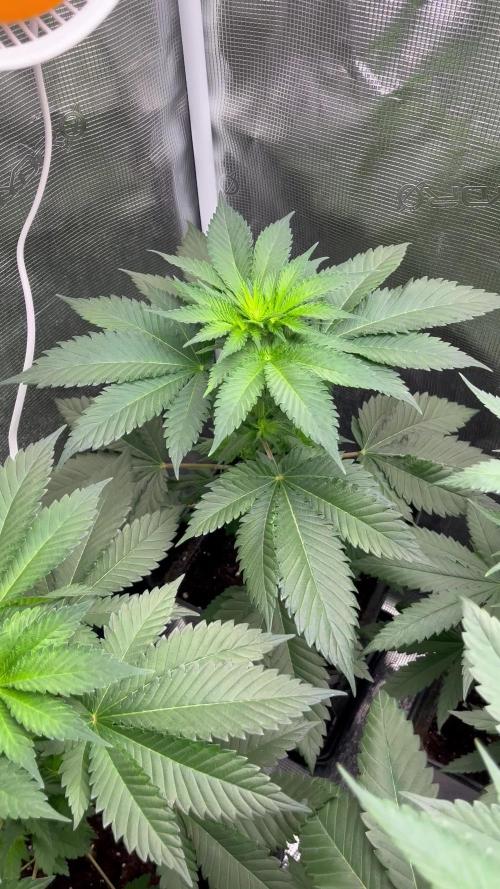
Vamos familia, actualizamos la primera semana de floración de estas NoName de Seedstockers.
La temperatura que estuvo entre los 24-26 grados y humedad dentro de los rangos correctos.
Esta semana cambiamos a 12 horas luz,12 horas de oscuridad, estiraron bien y ensancharon bastante también, el color es verde sano.
Se nota que los nutrientes de la marca Agrobeta hacen sus funciones.
- os dejo por aquí un CÓDIGO: Eldruida
Descuento para la tienda de MARS HYDRO.
https://www.mars-hydro.com
Hasta aquí todo, Buenos humos 💨💨💨
Likes
42
Share


@Ganjagrandaddy
Follow
DAY 21: With the settling in period well passed and the beginning of establishing their bases in the pots , it was time to get busy on the planned Methods to train them with. I enjoy trying different methods when growing multiple plants from a strain and comparing their finishes. It can be handy to watch which way pulls the best from them.
#1 Amnesia Haze has been f.i.m.m.e.d and seems to have caught her in a good spot. Hopefully a multi-crown will form as the lowers catch up now.
Amnesia #2 still has her rectangular look but I decided to top her as the node lengths could be a sign of a more sativa grow pattern possibly. This should keep her managed along with her potentially shorter sisters. The growth tips will be encouraged outwards now to give them their own space as they form.
Amnesia #3 has so far only been cleaned out of her 1 and 2 nodes. She will be bent over once she is tall enough to safely do it to her. All looking happy and a nice cour still so hopefully flowering will be close now to use the stretch to shape them.
Girl Scout Cookies # 1 has been bent over after working her stem a little between my thumb and finger to soften the stem again. She has stood back up once already so I have now had to use a tent peg to keep the 5th node down ....
#2 G.s.c also had the same treatment but her stem snapped so I had to quickly reset her to let her fix the break. She is repairing it and again starting to feed the leaves on her 5th node. If she doesnt repair enough , I can top her too. They both have a good amount of growth on them so should be nice producers.
All of the girls are due to go j derby the sp3000 directly in a day or so as I am harvesting a few others . They will be in then best spot to hit flowering stretch then. Onwards and upwards growmies. Be happy.
UPDATE #
I have been busy keeping g them trained over the past few days and wanted to show their progress before the next weekly update. It can help to show how the plants respond to the initial pinches /bends etc... They are bushing out where they need to now and the fimmed girl is bang on the money for the hotspot I think. Enjoy the new pics.
Likes
1
Share


@Pestitel
Follow
Amazing experience with the Mix Pack, I will try it again next summer for sure. Love the variety.

Likes
Comments
Share


@ORION1_1
Follow
Still lookin happy, water only around 6.5 ph. I will start some LST next week 👍🏼 I will also give a 1/4 dose of advanced nutrients sensi cal mag next week because that's one issue I've ran into, usually nearing flower and I feel weekly small doses helps negate any issues. LED lights seem to increase the need for cal mag at least in my environment. The auxiliary shoots off the main are interesting! It's definitely going to be more of a bushy structure and fun to LST! ✌️🏼 ♥️
Likes
8
Share


@MrAutoGrowerUK
Follow
packing on the Weight on the final few weeks. Added fox farm tiger bloom

Likes
1
Share


@LAShugars
Follow
Growing great! Trying to stop the stretching. Really thick stem at the base for this little 3 gallon grow bag.
Likes
48
Share


@TheCannaProphet
Follow
~ WEDDING CHEESECAKE FAST FLOWER by FastBuds ~
Well fam, here we go again with another epic strain from FastBuds Fast Flowering stable. After having such tremendous success growing their Gorilla Cookies Fast Flower outdoors last year, I've decided to run another of their fast flowering strains outdoors this year... Wedding Cheesecake Fast Flower!
The best description of this awesome cultivar comes directly from my friends at FastBuds which is as follows:
"A delight for the mind and body: Wedding Cheesecake FF (Fast-Flowering) is a delicious strain that offers XXL yields in a 7-8 weeks flowering cycle. This terpene powerhouse produces loads and loads of mouth-watering vanilla-creamy-cookie-scented terps with hints of citrus and cinnamon. In addition to its delicious aromas, this variety grows very well in both indoor and outdoor setups, yielding up to 650 g/m2 without extra maintenance, making it the ideal strain for beginners as it allows you to maximize yields while minimizing work. This super-fast feminized photoperiod version offers upbeat and energetic yet deeply relaxing effects that are perfect for consumers looking for a heavily focused, motivating, and creative high. It’s the ideal strain for those needing that extra energy boost to start a busy day on the right foot.
Wedding Cheesecake FF boasts chunky, large-sized buds with a thick layer of silvery-white resin and bright orange hairs scattered all over: that just screams ‘quality’. The lime-green flowers sparkle with an array of hues ranging from dark to light green, to magenta and purple, and reek of a delicious aroma that’ll remind you of fresh store-bought cheesecake.
This is an XXL hybrid that grows extremely tall in height, reaching up to 3m with one huge main cola and multiple long side branches that can withstand enormous yields of up to 650 g/m2 with ease. Wedding Cheesecake FF is extremely resilient to the elements and can be grown in almost every climate as long as you’ve got the space and basics covered, making her an excellent choice for those looking for large-scale harvests with a quick turnaround time without much effort."
________________________________________________________________________________________________________________________________________________________________________________________________________________________________________________________________________________________________________________________
The Setup:
This is going to be an outdoor grow, but I have started the Wedding Cheesecake FF indoors as our weather is still too cold to put her outside (nighttime temp's dipping regularly into the 30's℉).
The plan is simple... let her grow inside under a 19/5 light schedule until the nighttime temperatures stay above the mid 40's℉, at which point she'll be moved outside and transplanted into the soil which I have already setup and inoculated with beneficial microbes, and then let the fun begin!🤪💚
________________________________________________________________________________________________________________________________________________________________________________________________________________________________________________________________________________________________________________________
Weekly Updates:
6/9- Well, here we go into Week Eleven from seed for the FastBuds Wedding Cheesecake Fast Flower and she is looking MARVELOUS! 😍
Our weather is beautiful now with daytime high temp's in the 80's F without a lot of rain so I am watering her daily at sundown with approximately 5-7g of well water.
6/11- The FastBuds Wedding Cheesecake FF continues to explode with growth and I have been training her branches throughout the entire trellis net which she's now completely filled. I was going to install a second trellis net, but decided to just use the single net and do some HST on her to keep her canopy opened up.
6/13- I gave the Wedding Cheesecake FF a good watering today at sundown via the garden hose with straight well water.
I am planning on top dressing her in roughly 7-10 days from now with a blend of 4-4-4 and 2-8-4 along with some worm castings in anticipation of the start of flowering in the near future.
6/16- I watered today and also did a little canopy maintence, removing some leaves that were old and yellowing, along with some small shoots that would have only produced small larfy buds.
There's another week chalked up and it won't be long until this lady begins pre-flowering which will mark the start of the real excitement!
Thank you for checking out my diary, your positive comments and support make it all worthwhile! 💚Growers Love!💚😎🙏
Likes
96
Share


@Swollen
Follow
Week 8: the last week of veg for Gigi!
During these days I've started watering normally again with ph'd water and some additive.
This week was really flat: nothing bad or good happened, I think it's time to put her 12/12 and start the flowering session. I'll defoliate the next week, she need some chill before the light change. I'm troubleshooting with my reflex and pc right now, this old stuff doesn't work. 😑 However I've managed to do something. Making some beats and growing right now and I'm feeling good after work😁
Likes
56
Share


@MrGrow
Follow
14.10.2022
🌱 114 giorni dal seme
🌻 42 giorni fioritura
💧 2 l/48h
6.0 ph
2.2 ph
Finita la 6 settimana di fioritura. Alcune varietà mostrano segni di fioritura più avanzata, come la Kush Mintz di Barney's Farm, è la più gelata di tricomi tra tutte le varietà. Gelato#41 di green house Seeds sta mostrando cambiamenti di colore nelle cime, sembra che stiano diventando rossastre. La Jack's dream è forse quella più indietro di tt, e anche la più piccola della tenda. Una delle due Kush Mintz, profuma di ananas matura e dolciumi, un vero spettacolo😋


Likes
3
Share


@BigGGrows
Follow
Well, the Grandaddy black hermed on me in the beginning of week 7 flower. Separated her immediately and did a flush bringing the ppm down from over 2k to around 500. Two days later she was harvested. A little blown she didn't finish up how I wanted her to. 2 more weeks she would of been ready. Trichomes were 5% amber 70% cloudy 25% clear.
